Monthly Archives: March 2021

Book Review – ‘The Botany of Desire’ by Michael Pollan

Dear Readers, I’m a bit late to the party here: my friends have been raving about ‘The Omnivore’s Dilemma’ and this book for quite some time. Indeed, it took one of my friends buying ‘The Botany of Desire  – A Plant’s-Eye View of the World’ for me as a birthday present for me to actually read it. I’ve found it a fascinating read, one of those where you interrupt your partner’s book about the Vietnam War to regale him with facts about the arrival of the apple in the US or the way that prohibition and the war on drugs in the US led to the development of much stronger marijuana in Europe. But, first things first.

The book centres on four human desires, and the plants that encapsulate them. So, firstly we have the story of the apple, which fulfills our need for sweetness, something which seems almost primal. For most of the history of mankind, sweet food would have been a handful of berries in autumn, or a lick of honey when someone was brave enough to knock down a wild bee’s nest. I loved this description of Pollan’s son’s first encounter with sugar – the icing on his first birthday cake.

‘I have only the testimony of Isaac’s face to go by (that, and his fierceness to repeat the experience), but it was plain that his first encounter with sugar had intoxicated him – was in fact an ecstasy, in the literal sense of that word. That is, he was beside himself with the pleasure of it, no longer here with me in space and time in quite the same way he had been just a moment before. Between bites Isaac gazed up at me in amazement (he was on my lap, and I was delivering the ambrosial forkfuls to his gaping mouth) as if to exclaim, “Your world contains this? From this day forward I shall dedicate my life to it.” (Which he basically has done). And I remember thinking, this is no minor desire, and then wondered: Could it be that  sweetness is the prototype of all desire?’

What an interesting question! And from here we have the story of Johnny Appleseed, the Garden of Good and Evil, the way that apples only ‘come true’ from grafting, not from seed, and how varieties fall in and out of fashion.

The second is beauty, and for that we have the tulip. There is an exploration of tulipomania, of course, but also on the whole notion of the ‘broken’ tulip – a virus will cause a particular flower to be coloured in a different way from its neighbours, and in the Holland of the 1630’s, added to its value even though the offsets from the bulb were smaller and weaker than those from other plants. Pollan has some interesting thoughts about why, in the relentlessly mercantile environment of the 17th Century Low Countries, a lust for these extravagant blooms took hold. I found this part interesting, but not as compelling as the apple chapter, probably because I already knew a bit about tulipomania from Anna Pavord’s book ‘The Tulip’.

The next chapter is on the human desire for intoxication, and features marijuana. It starts with the story of Pollan growing some of the plant in his backyard, and suddenly realising that the person dropping off some wood that he’s ordered is actually the local policeman. We investigate the history of marijuana in the US and then in Europe, where selective breeding not just for strength, but also for a particular ‘kind’ of high really got going. And he has a description of that open-eyed wonder that often goes along with smoking pot that made me laugh out loud. Having eaten some vanilla icecream while high, he reports back:

For the first time in your journey on this planet you are fully appreciating Vanilla in all its italicized and capitalized significance. Until, that is, the next epiphany comes along (Chairs! People thinking in other languages! Carbonated water!) and the one about ice cream is blown away like a leaf on the breeze of free association.’

And yes, this just about sums it up.

It is by temporarily mislaying much of what we already know (or think we know) that cannabis restores a kind of innocence to our perceptions of the world, and innocence in adults will always flirt with embarrassment’.

Indeed.

But it’s in the final chapter, where Pollan looks at the human desire for control through the lens of the New Leaf potato, a genetically-modified organism which has a pesticide against Colorado beetle actually built in, that some of the most interesting facets of the relationship between humans and plants reveal themselves. So many gardens are a battle between what ‘nature’ wants and what human beings want. Genetically-modified crops seem to Pollan to represent the very pinnacle of this need for control, but he also sees it as an illusion: as one organic farmer says, the bugs will find a way to fight back. Isn’t it our desire to create monocultures that’s the problem, Pollan asks?

To shrink the sheer diversity of life, as the grafters and monoculturists and genetic engineers would so, is to shrink evolution’s possibilities, which is to say, the future open to all of us. “This is the assembly of life that it took a billion years to evolve,” the zoologist E.O.Wilson has written, speaking of biodiversity. “It has eaten the storms – folded them into its genes-and created the world that created us. It holds the world steady.” To risk this multiplicity is to risk unstringing the world.’

This is a fascinating and thought-provoking book, and makes me want to read some of Pollan’s other work, especially ‘The Omnivore’s Dilemma’. Let me know what you think if you’ve read it, I’d love to know your thoughts.

You can buy ‘The Botany of Desire’ in lots of places, but if you’re in the UK the NHBS bookshop is my go-to site, you can find it here.

New Scientist – Good News for Shadow Snakes, How Pufferfish Blink and How Lyrebirds Multiply Themselves

A Fugler’s Shadow Snake (Emmochliophis fugleri), rediscovered in Ecuador after 54 years (Photo by Scott J. Trageser, The Biodiversity Group)

Dear Readers, snakes are a notoriously difficult group of vertebrates to observe – they are secretive, well-camouflaged and often nocturnal, and so it can be hard to assess the status of different species. But in 2019, scientists Ross Maynard and Scott Trageser of The Biodiversity Group in Arizona found a small, dark snake wriggling across some boulders in Ecuador’s Andes mountains. Maynard was finding it tricky to identify the species, but after comparing photographs of the snake to records, it was found to be a Fugler’s Shadow Snake (Emmochliophis fugleri), only the second one ever found after a gap of 54 years. The clue to its low-profile can be found in its common name – it is dark coloured, very shy and only appears at night. No wonder they’re rarely found! However, this snake is positively social compared with the only other member of the genus Emmochliophis miops, who ‘went missing’ for 120 years before reappearing in 2017. Considering the state of the world’s biodiversity, it probably makes sense to keep a low profile.

You can read the whole article here.

Photo One by By Daiju Azuma - Own work, CC BY-SA 4.0, https://commons.wikimedia.org/w/index.php?curid=40496121

Fine-patterned pufferfish (Takifugu poecilonotus) (Photo One)

Now, it’s a well-known fact that bony fish don’t have eyelids, and yet pufferfish blink. How do they do that? Keisuke Ogimoto at the Shimonoseki Marine Science Museum in Japan was so taken by the way that pufferfish in the aquarium closed their eyes that he dedided to investigate how they did it, by using slow motion filming, ultrasound and examination of a fish that had died through natural causes.

It appears that although the fish doesn’t have eyelids, it can contract the skin around the eye, in much the same way as the iris in a mammal eye constricts over the pupil. But the pufferfish can also retract its eyeball into its head to a depth of 70% of the eye’s diameter, among the most extreme eye-sinkings of any animal.

The question that I’m left with is this: if other fish don’t need to blink, why does the pufferfish? Now that would be an interesting thing to find out.

You can read the whole article here.

Photo Two By Fir0002 - Own work, GFDL 1.2, https://commons.wikimedia.org/w/index.php?curid=7319898

Superb lyrebird (Menura novaehollandiae) (Photo Two)

And finally, the Superb Lyrebird (Menura novaehollandiae) of Australia is probably the most versatile of all bird vocalists. If you have never heard one before, watch the clip below.

https://www.youtube.com/watch?v=VjE0Kdfos4Y

Now, Anastasia Dalziell at Cornell University and her colleagues have found that male lyrebirds often copy the calls that other species of birds make when they are mobbing a predator, so that they sound like an entire flock of angry birds, complete with wingbeats. These calls are so accurate that, when played back, birds of other species come to participate in the mobbing.

However, the males tend to make these calls when displaying, and scientists were puzzled as to why this was an attractant. The complexity of the male’s call seems to increase his attractiveness to the opposite sex, but one alternative suggestion was that if it sounds as if a predator is close by, the female is less likely to leave. Could it be that the males are trying to scare the females into staying? Birds are more complex and have more complex social behaviour than we ever used to imagine.

You can read the whole article here.

Photo Credits

Photo One by By Daiju Azuma – Own work, CC BY-SA 4.0, https://commons.wikimedia.org/w/index.php?curid=40496121

Photo Two By Fir0002 – Own work, GFDL 1.2, https://commons.wikimedia.org/w/index.php?curid=7319898

Garden Plans for 2021

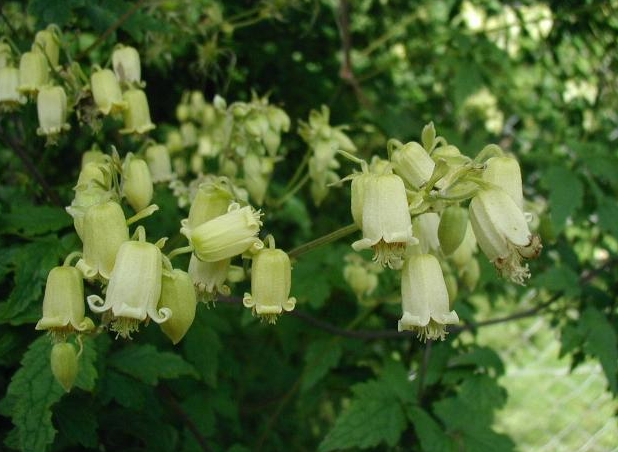
Photo One by https://upload.wikimedia.org/wikipedia/commons/f/ff/Clematis-rehderiana.JPG

Clematis rehderiana (Photo One)

Dear Readers, as I no longer spend money on eating out (except for the odd pizza delivery) or on holidays or on cinema or theatre, I have two main sources of outlay left, once food and domestic ‘stuff’ is covered – one is books, and the other is the garden. This year I am determined to have a rethink, and to try out some new plants – who knows how we’ll get on, but there’s only one way to find out!

My first purchase is a Clematis rehderiana (otherwise known as ‘Nodding Virgin’s Bower’, but we’ll skip over that thank you very much). It was quite a puzzle finding one, and I only persevered because my Gardening For Wildlife book by Adrian Thomas mentions it as being the very best clematis for wildlife. Unlike some of the other types, it has primrose yellow bells and smells of cowslips. The Guardian describes it as a ‘romper’, which is just what the garden needs. I’ve planted it next to my lilac, which is pretty early in the year and boring for the rest of it, so I’m hoping the clematis can be persuaded to scramble over it and then onto the fence behind. At the moment it is a twig with exactly one set of leaves, so let’s hope it perks up now it’s  in the ground.

Secondly, I was very aware that my north-facing garden is a bit of a desert for pollinators during the winter, and so I have chanced my arm on a Clematis cirrhosa var balearica – this one is ‘Wisley Cream’. It’s said to flower from November to March, and I am going to pop it in against my West-facing fence, and make sure that the roots are protected as I know it’s not necessarily fully frost hardy. The bittersweet and honeysuckle also grow on this fence, so I’ll have to make sure that they all share. And as it’s close to where we sit, it might even encourage us to brave the garden during the warmer days of winter.

Photo Two by sunoochi, CC BY 2.0 <https://creativecommons.org/licenses/by/2.0>, via Wikimedia Commons

Clematis cirrhosa var balearica ‘Wisley Cream’ (Photo Two)

In other news, I want to extend the range of geraniums in the garden, as they can be so good for pollinators – my Dusky Cranesbill (Geranium phaeum) are  covered in bees early in the year, but they die back way too soon, and I want something else that will take up the mantle. I’ve planted some Geranium macrorrhizum in a slightly sunnier (but not too sunny) position – these do amazingly well in some places around here. The plants are nicely well-grown, so I hope they’ll soon be flowering away. Any advice on geranium varieties for shady places would be gratefully received. Even the geranium ‘Rosanne’ that everybody swears by gave up the ghost when I planted it.

Photo Three by I, KENPEI, CC BY-SA 3.0 <http://creativecommons.org/licenses/by-sa/3.0/>, via Wikimedia Commons

Geranium macrorrhizum (Photo Three)

And I almost forgot that a lovely friend of mine gave me an envelope full of honesty seeds, so they’ll be going in pronto. I know they can be invasive but it’s such a struggle to get anything to thrive that invasive sounds like a feature rather than a bug, as us elderly IT folk sometimes say.

Photo Four from CC BY-SA 3.0, https://commons.wikimedia.org/w/index.php?curid=107188

Honesty (Lunaria annua) (Photo Four)

In other news, I’ve planted winter aconite, snowdrops and lily of the valley (another plant that can get out of control, yay!) in the green. I’m hoping that the lily of the valley will give some leafy cover to my poor frogs, although they’ve gone really quiet for the past week or so  – the temperature dropped to below freezing last night, so I’m sure that’s got something to do with it.

Photo Five by liz west from Boxborough, MA, CC BY 2.0 <https://creativecommons.org/licenses/by/2.0>, via Wikimedia Commons

Lily of the Valley (Convallaria majalis) (Photo Five)

So let’s see how this lot get on. In other projects, we have just got a new tiny table and chairs for the back of the garden – it’s something of a sun trap and will be a nice place to sit in the spring and autumn, and so I’ll need to tidy that area up a bit as well. And I really, really want to sort out some enormous planters/raised beds for the south-facing front garden, so that I can extend the season for pollinators – they are spoiled for choice when the buddleia and lavender are out, but it’s boring during the rest of the year (though I do have some Lambs Ears (Stachys byzantina) in my window boxes and I’m hoping that some wool carder bees might turn up).

Whoever said that a garden is always a work in progress had it absolutely right.

Photo Credits

Photo One by https://upload.wikimedia.org/wikipedia/commons/f/ff/Clematis-rehderiana.JPG

Photo Two by sunoochi, CC BY 2.0 <https://creativecommons.org/licenses/by/2.0>, via Wikimedia Commons

Photo Three by I, KENPEI, CC BY-SA 3.0 <http://creativecommons.org/licenses/by-sa/3.0/>, via Wikimedia Commons

Photo Four from CC BY-SA 3.0, https://commons.wikimedia.org/w/index.php?curid=107188

Photo Five by liz west from Boxborough, MA, CC BY 2.0 <https://creativecommons.org/licenses/by/2.0>, via Wikimedia Commons

LNHS Talks – Breeding Birds of Hampstead Heath by Jeff Waage

Dear Readers, the London Natural History talk this week was of particular interest to me. When we had a bird survey done in 2019, Coldfall Wood was found to be particularly rich in breeding birds for an urban woodland, but the increased footfall during lockdown, coupled with the threats to the environment itself, have made me worry about the additional pressure that is being put on the animals and plants that live there.

Jeff Waage was part of a team that undertook a survey of Hampstead Heath last year. Part of the reason was to determine which birds were displaying breeding activity, and where: disturbance from walkers and dogs is widespread even if there isn’t a pandemic, and there has been an increased demand for Forest Schools, ‘Forest Bathing’ and professional dogwalking. In the past year the Heath has had an estimated 50 million visitors, which is pretty much equivalent to most of the population of the country popping in. But data can help, and so Waage and his team walked transects of between 1 and 3 kilometres through the Heath on at least six occasions, looking for breeding behaviour.

Photo One by Dudley Miles, CC BY-SA 3.0 <https://creativecommons.org/licenses/by-sa/3.0>, via Wikimedia Commons

Kenwood, Hampstead Heath (Photo One)

Breeding behaviour was defined as territorial singing, birds carrying nesting material or food or fecal sacs, birds actually sitting on a nest, territorial disputes or sightings of fledglings. In my experience birds are very good at hiding nests, but you can fairly easily spot them ‘eating for two’ (or a dozen in the case of blue tits).

At the end of the survey, there had been 2169 sightings of 41 species of bird. Compared with the 26 species seen in Coldfall Wood this probably sounds pretty good, but the Heath has a much wider range of habitats. However, it’s clear that the Heath’s biodiversity has been under stress for some time: in 1992, a survey revealed 71 species. Many of those lost have been ground nesting birds, who are always the first victims of too much footfall and too many dogs, but even birds such as the mistle thrush and the common whitethroat appeared to be in decline.

Photo Two  By Andreas Trepte - Own work, CC BY-SA 2.5, https://commons.wikimedia.org/w/index.php?curid=32563057

Common Whitethroat (Curruca communis) (Photo Two)

Waage estimated that 40% of the Heath’s bird species were red or amber listed: he explained that this designation was arrived at by looking at both the vulnerability of the species (i.e. was it nesting in an area of high disturbance) combined with its ‘patchiness’ (i.e. were there just a few isolated populations within the Heath). For example, the whitethroats nested in scrubby areas where there was a lot of picnicking and dog walking, and there appeared to be only one pair of sparrowhawks.

Photo Three By Meneer Zjeroen - https://www.flickr.com/photos/nuskyn/4028311597/, CC BY 2.0, https://commons.wikimedia.org/w/index.php?curid=8528830

Female sparrowhawk (Accipiter nisus) (Photo Three)

The approach to maintaining and increasing the bird biodiversity of the Heath was multi-pronged.

Firstly, there was a need to identify areas of the Heath where there would be the least impact on breeding birds for commercial activities such as the forest schools, and this was possible following the survey.

Secondly, where birds were vulnerable there was to be a bid to raise public awareness, through new signage and articles in local newspapers.

A third area was to improve and even create habitat, such as reed beds for reed buntings.

Finally, resources such as food and nest boxes could be made available.

There was also a need to investigate what was happening on the fringes of the Heath – there were surprisingly few nesting finches, for example, and the group felt that this was probably because the finches were nesting in local parks and gardens instead, where there was a higher availability of food.

And lastly, and probably most importantly, the Heath needs continued monitoring to see what’s happening with the bird populations. Data can be our most powerful tool in gaining an understanding of what’s happening in an area, and over time. It will be interesting to see what future surveys reveal.

I’ve always been very happy to just enjoy nature, and to be thrilled at the arrival of a new bird or the sight of an unexpected insect. I’m still thrilled, but it seems to me that collecting data is a way of putting meat onto the bones of the anecdotal picture that you build up over the years. Citizen science is becoming increasingly popular, and I hope that, just as the Big Garden Birdwatch has become a major way of recording trends in garden birds, so other surveys will build up a picture of what’s going on with other plants and animals. In fact, there’s an online conference on this very subject being run by the Field Studies Council in May, with the added bonus that it’s concentrating on urban wildlife recording. I’ll be there, and will report back, but for £5 it seems like a bargain for anyone interested in getting involved with recording. With habitat destruction and climate change in full swing there has never been a better time to take notice of what’s going on around us.

Photo Credits

Photo One by Dudley Miles, CC BY-SA 3.0 <https://creativecommons.org/licenses/by-sa/3.0>, via Wikimedia Commons

Photo Two By Andreas Trepte – Own work, CC BY-SA 2.5, https://commons.wikimedia.org/w/index.php?curid=32563057

Photo Three By Meneer Zjeroen – https://www.flickr.com/photos/nuskyn/4028311597/, CC BY 2.0, https://commons.wikimedia.org/w/index.php?curid=8528830

An Early Spring Walk in St Pancras and Islington Cemetery

Dear Readers, it really feels as if spring is gathering apace this week. From a few tentative flowers opening gently on the crab apples and cherry trees, there is now an abundance of fluffy blossom.

The chapel looks spick and span after its long renovation, although these days it only houses the (much-appreciated) toilets rather than holding any services.

The tree on the corner of the woodland burial area is looking very fine as well.

The primroses are emerging under the cedars of Lebanon.

And the daffodils are everywhere. I feel a bit of a Scrooge for saying it, but I am generally not a great fan of those big butter-coloured daffodils, though they are cheerful enough, I suppose. I like the paler, creamier ones that look more like the vanishingly-rare wild daffodils of Wales, and I have a fondness for the little miniature ones as well. And I’m fond of what I think of as ‘proper’ narcissi, like the pheasant’s eye ones with a small, red-rimmed trumpet. Paperwhites have their place, though Mum used to find their scent overpowering in a small space, and I must admit that they can make me feel slightly nauseous too. I’m becoming so fussy! Or is it just that I’m noticing my preferences more?

Little daffodils (Tete-a-tete I think?)

On a few of the sunnier graves there is a cheery outburst of red deadnettle.

And of course there are always daisies. I think you could find some in flower in the cemetery on every single day of the year. They always seem so modest and so hard-working to me.

There are some unexpected visitors resting next to the stream. I love the way that ducks appear to be asleep but always have one eye open to make sure that you aren’t up to any mischief.

A lady stopped her car to say she’d been seeing the ‘birds’ for a few days, but wasn’t sure what they were. Unfortunately she asked my husband, who, momentarily flustered,  could only say that they were ‘ducks’. I have more work to do, clearly, though if she’d asked me she’d probably still be sitting in her car listening to me pronouncing forth on the wildfowl of London, so she had a lucky escape.

More spring flowers are emerging: there are the first grape hyacinths

and some Loddon lilies, which seem to be a cemetery speciality. I’m sure all of them are planted rather than wild, but they are naturalising in some areas. At first glance you might think that they are just giant snowdrops, but the shape of the flowers is quite distinct.

A rose-ringed parakeet posed very nicely for the camera, unlike the two that were briefly on the suet feeder in the garden this morning. Whenever I see them I think of the one that visited the garden the day after Dad died. It’s funny how superstitious death can make a person: I almost believed that Dad had popped back to cheer me up, and with the two this morning I automatically thought of Mum and Dad together again. Of course, I don’t really believe that they have somehow been reincarnated as parakeets, but part of me wishes it were true. What complicated beings we are as we wrestle with the big, unsolvable questions of life. Or maybe it’s just me.

And as we head into my very favourite part of the cemetery, the overgrown, unpeopled area around Kew Road and Withington Road, I am struck yet again by the beauty of a blossom tree.

The early crocuses are almost over now, how glad I am that I caught them in their full glory! They rather look as if an elephant has trodden on them now.

On the other hand, the Dutch crocuses are just coming out.

And while the snowdrops in the sunny areas emerged first and are now dying back…

…the ones in the shady areas are still in full flower.

And, let me share a little story with you that made me gasp. One of the Facebook groups that I belong to is about plant identification. A person posted that they had been reading about sorrel (the lemony-leaved member of the dock family), and so when they saw the plant below they decided to forage some and eat it.

And of course, it’s cuckoo-pint/lords and ladies, and is poisonous. How you could mistake one for the other astounds me, but then it’s often difficult to judge scale and size from a photo, and I suppose that the leaves are a similar shape if you squint. Fortunately, the poison in cuckoo-pint expresses itself by making the lips tingle and the tongue swell up, plus it tastes extremely unpleasant, so you aren’t likely to eat a lot of it. But even so, this was a close escape. I guess it’s exactly how our ancestors learned, and the ones who didn’t learn ended up deaded, as my Dad would have said.

Cuckoopint (Arum maculatum)

I heard the buzzard but didn’t see it. It’s very frustrating – I have a feeling that there’s a nest in the cemetery somewhere, and it must be pretty big, but I can’t find it. Anyhow, instead I saw a pair of crows harassing the kestrel, poor thing. It’s very difficult to make out from my most excellent photo (ahem) but it’s the bird in the middle. Kestrels don’t take nestlings or eggs, but I guess the crows aren’t taking any chances.

I saw one of the feral cats looking very sleek and well-fed – the lady who used to travel all the way from Camden to feed them and the foxes and the birds every day manages to get in at the weekend now when she can get a lift, but I suspect that other people are doing their bit to make sure that the animals don’t go hungry. I caught a quick glimpse of a fox too, but not for long enough to see if it was the poor vixen who’d had an accident that I saw last time.

And in other news,  I had my first Covid vaccination on Wednesday (the Astra Zeneca one), and although I felt pretty rubbish for about 24 hours it really does feel now as if there is a glimmer of  hope for some return to a new ‘normal’. I am so grateful to the NHS and all the people who are volunteering to help with the programme, and to the scientists who have managed to perform this miracle. I just hope now that we find a way to distribute the vaccine more equitably than we currently are, because in this situation it really is true that none of us are safe until we’re all safe. As I have done right through lockdown I am counting my blessings fervently and hoping for a decent pay rise for NHS staff (rather than the derisory 1% currently on offer), for more recognition for our care home staff, for a complete review of the care system, for support and recognition for our teachers and for all the workers who continued to staff our essential shops and transport systems, who collected our waste and delivered our post. If nothing else, this last year should have taught us who really is essential, and who really does deserve to be rewarded.


Saturday Quiz – Mountain ‘Weeds’

Dear Readers, many of the ‘weeds’ that have made their home in the UK came originally from mountainous areas. But which mountain range did these plants come from originally? One mark for the species, a second mark if you can name the mountain range that they came from.

Answers in the comments by 5 p.m. on Thursday 11th March please – I will unapprove your answers when I see them so that other people can’t see them, but I’m not always the speediest, so write your answers down old-school on a piece of paper first if you don’t want to be influenced.

Onwards!

1)

2)

3)

4)

5) This one has a wide distribution, so can you tell me where it was first found?

6)

7)

8)

9)

10)


Saturday Quiz – Wasp, Moth, Bee or Fly? The Answers!

Title Photo by Siga, CC BY-SA 4.0 <https://creativecommons.org/licenses/by-sa/4.0>, via Wikimedia Commons

Hornet Hoverfly (Volucella zonaria) (Title Photo)

Dear Readers, unusually we have a clear and run away winner this week, with Fran and Bobby Freelove not only getting all the insects in the right groups, but naming pretty much all of the species – they end up with 22.5 out of 24 (I was giving one mark for the correct species and one for the correct family). And in the following pack, we have Leo with 12 out of 12 for family ID, Claire with 11 and Mike with 10. It was a very tricky quiz so well done to everyone who took part!

Handy hints: Flies always have those big compound eyes which take up most of their faces (clearly seen in the title photo, and in the marmalade hoverfly). They also always have teeny tiny antennae. Flies also only have two wings, although this isn’t so easy to see in all of the photos.

Moths have thick, extravagant antennae, and no waist at all.

Bees often have antennae with a ‘kink’ or elbow in them, and have small oval-shaped eyes. They can be hairy, but then so can everyone else (have a look at the beefly). They have four wings, which, along with their eyes, is the easiest way of distinguishing them from flies.

Wasps tend to be slender, with a marked ‘waist’, but I think they are probably the hardest group to definitely identify. This is not helped by there being many families of ‘wasps’ – the ruby-tailed wasp in the first photo is in a different family from the other two examples. In this quiz, it was probably easiest to assume that if you didn’t know what it was, it was a wasp.

Photo One by gailhampshire from Cradley, Malvern, U.K, CC BY 2.0 <https://creativecommons.org/licenses/by/2.0>, via Wikimedia Commons

1) Ruby-tailed Wasp (Chrysis Ignita) – WASP

Photo Two by Hectonichus, CC BY-SA 3.0 <https://creativecommons.org/licenses/by-sa/3.0>, via Wikimedia Commons

2) Ivy Bee (Colletes hederae) – BEE

Photo Three by André Karwath aka Aka, CC BY-SA 2.5 <https://creativecommons.org/licenses/by-sa/2.5>, via Wikimedia Commons

3) Marmalade Hoverfly (Episyrphus balteatus) – FLY

Photo Four by jp hamon, CC BY-SA 3.0 <https://creativecommons.org/licenses/by-sa/3.0>, via Wikimedia Commons

4) Dark-Edged Beefly (Bombylius major) – FLY

Photo Five by gailhampshire from Cradley, Malvern, U.K, CC BY 2.0 <https://creativecommons.org/licenses/by/2.0>, via Wikimedia Commons

5) Hairy-Footed Flower Bee (Anthophora plumipes) – BEE

Photo Six by By Ian Kimber - Photo by Ian Kimber of ukmoths.org.uk who kindly granted permission by e-mail to use under a GFDL and/or CC-BY-SA license., CC BY-SA 3.0, https://commons.wikimedia.org/w/index.php?curid=1313245

6) Lunar Hornet Moth (Sesia bembeciformis) – MOTH

Photo Seven by Alvesgaspar, CC BY-SA 3.0 <https://creativecommons.org/licenses/by-sa/3.0>, via Wikimedia Commons

7) Heath Potter Wasp (Eumenes coarctatus) – WASP

Photo Eight By Bruce Marlin - Own work, CC BY-SA 2.5, https://commons.wikimedia.org/w/index.php?curid=662209

8) Wool Carder Bee (Anthidium manicatum) – BEE

Photo Nine by Lamiot, CC BY-SA 3.0 <https://creativecommons.org/licenses/by-sa/3.0>, via Wikimedia Commons

9) Six-Belted Clearwing (Bembecia ichneumoniformis) – MOTH

Photo Ten by By Algirdas - Own work, CC BY-SA 3.0, https://commons.wikimedia.org/w/index.php?curid=1803749

10) Tachina fera (Hoverfly) – FLY

Photo Eleven by Slimguy, CC BY 4.0 <https://creativecommons.org/licenses/by/4.0>, via Wikimedia Commons

11) Big-Headed Digger Wasp (Ectemnius cephalotes) – WASP

Photo Twelve by M kutera, CC BY-SA 4.0 <https://creativecommons.org/licenses/by-sa/4.0>, via Wikimedia Commons

12) Narrow-Bordered Bee Hawkmoth (Hemaris tityus) MOTH

Photo Credits

Title Photo by Siga, CC BY-SA 4.0 <https://creativecommons.org/licenses/by-sa/4.0>, via Wikimedia Commons

Photo One by gailhampshire from Cradley, Malvern, U.K, CC BY 2.0 <https://creativecommons.org/licenses/by/2.0>, via Wikimedia Commons

Photo Two by Hectonichus, CC BY-SA 3.0 <https://creativecommons.org/licenses/by-sa/3.0>, via Wikimedia Commons

Photo Three by André Karwath aka Aka, CC BY-SA 2.5 <https://creativecommons.org/licenses/by-sa/2.5>, via Wikimedia Commons

Photo Four by jp hamon, CC BY-SA 3.0 <https://creativecommons.org/licenses/by-sa/3.0>, via Wikimedia Commons

Photo Five by gailhampshire from Cradley, Malvern, U.K, CC BY 2.0 <https://creativecommons.org/licenses/by/2.0>, via Wikimedia Commons

Photo Six by By Ian Kimber – Photo by Ian Kimber of ukmoths.org.uk who kindly granted permission by e-mail to use under a GFDL and/or CC-BY-SA license., CC BY-SA 3.0, https://commons.wikimedia.org/w/index.php?curid=1313245

Photo Seven by Alvesgaspar, CC BY-SA 3.0 <https://creativecommons.org/licenses/by-sa/3.0>, via Wikimedia Commons

Photo Eight By Bruce Marlin – Own work, CC BY-SA 2.5, https://commons.wikimedia.org/w/index.php?curid=662209

Photo Nine by Lamiot, CC BY-SA 3.0 <https://creativecommons.org/licenses/by-sa/3.0>, via Wikimedia Commons

Photo Ten  By Algirdas – Own work, CC BY-SA 3.0, https://commons.wikimedia.org/w/index.php?curid=1803749

Photo Eleven by Slimguy, CC BY 4.0 <https://creativecommons.org/licenses/by/4.0>, via Wikimedia Commons

Photo Twelve by M kutera, CC BY-SA 4.0 <https://creativecommons.org/licenses/by-sa/4.0>, via Wikimedia Commons

Tense Times for Coldfall Wood

Sunrise in Coldfall Wood December 2020

Dear Readers, you might think that the trees that form part of an ancient woodland nature reserve would be safe from being cut down,  except when it’s essential for the management of the area. Sadly, as I have learned, you would be wrong. Trees are often felled in urban areas because they are blamed for damage to nearby housing, even when the houses are built  after the trees are fully grown, and even when such housing is extended right up to the treeline.

Those of you who have been following this blog for a while will know how passionately I care about the few small areas of ancient woodland that remain in North London, in particular Coldfall Wood. At only 14 hectares it provides a home for 26 species of breeding birds (including the lesser spotted woodpecker and song thrush, both Red List species),  2 species of bat, 106 species of beetle (including three Nationally Notable species), 56 species of spiders and 3 species of pseudoscorpion.

Song Thrush (Turdus philomelos) singing in Coldfall Wood

Black and Yellow Longhorn Beetle (Rutpela maculata) in Coldfall Wood

Two nuthatches – Coldfall Wood

Stock Dove (Coldfall Wood)

Treecreeper (Coldfall Wood)

One of the species recorded is the very rare Lesser Glow Worm (Phosphaenus hemipterus).

Photo One By Urs Rindlisbacher - Majka GC, MacIvor JS (2009) The European lesser glow worm, Phosphaenus hemipterus (Goeze), in North America (Coleoptera, Lampyridae). ZooKeys 29: 35–47. doi:10.3897/zookeys.29.279, CC BY 3.0, https://commons.wikimedia.org/w/index.php?curid=8770508

Lesser glow worm (Phosphaenus hemipterus) (Photo One)

However, being a rare ecosystem brings limited protection when insurance companies become involved. A local householder has been having subsidence problems with an extension that was built ten years ago. A number of two-hundred year-old oaks have already been destroyed without the knowledge of the local Friends group, whose role is to liaise with the council and to protect the wood. The plan was to fell a further seven trees on 1st March, even though the loss of the other trees hasn’t improved the situation. Fortunately we were able to get the felling postponed, but the trees still aren’t safe.

Coldfall Wood August 2020

Speckled Wood butterfly

Our local Council, Haringey, is under pressure from the insurance company (AXA) to fell the trees – the council can be found to be negligent if it doesn’t act, and can be forced to pay for any works deemed necessary. However, there are lots of reasons other than trees that can cause subsidence to occur, including the soil composition, the geography of the area and the adequacy of the foundations of the building,  and none of them have been explored. Our question is this: if cutting down a number of mature oak and hornbeam trees didn’t solve the subsidence problem, how will removing further trees help? Where does it end?

Water mint (Mentha aquatica) next to the seasonal pond, Coldfall Wood August 2020

There is a meeting on 5th March at the council to discuss a strategic approach to the problem, and we hope that this will at least allow for further research into the causes of the subsidence. However, we also have a petition asking for the felling to be stopped,  which has over 50,000 signatures already (link below). We are angry that trees and the habitat that they represent are considered so expendable at a time when councils, corporations and our national government all claim to be working to alleviate climate change. There is so much talk about protecting the environment, and yet greenspaces have never been under so much pressure. While we want to work constructively with the council and with the insurers, we have no intention of allowing the destruction of these trees.

The by-line for this blog has always been ‘ Because a community is more than just people’. That community includes the trees that provide much of the oxygen that we breathe, that shade us in the summer and that provide a home for hundreds of other species. If we don’t act now to give them the protection that they deserve, then when? 

The link to the petition is here. Please feel free to sign and share. I shall let you know how we get on.

Coldfall Wood 7.30 p.m. August 4th 2020

Photo Credits

Photo One By Urs Rindlisbacher – Majka GC, MacIvor JS (2009) The European lesser glow worm, Phosphaenus hemipterus (Goeze), in North America (Coleoptera, Lampyridae). ZooKeys 29: 35–47. doi:10.3897/zookeys.29.279, CC BY 3.0, https://commons.wikimedia.org/w/index.php?curid=8770508

All other photos by the author

Wednesday Weed – Brazil Nuts

Photo One by Taken by Deathworm at en.wikipedia - Transferred from en.wikipedia, Public Domain, https://commons.wikimedia.org/w/index.php?curid=3580398

Brazil nuts (Photo One)

Dear Readers, when I was growing up, a bowl of mixed nuts in their shells was a sure sign that Christmas was coming. There was a kind of hierarchy of difficulty when it came to using our manual nutcrackers. Hazelnuts were easy. Almonds were a bit trickier. Walnuts were pretty much spherical, and so they needed careful handling. But when it came to Brazil nuts we always handed the nutcrackers over to Dad so that he could apply the necessary pressure. Then, the white nut with its creamy flavour was separated from the papery dark brown inner skin and, if you were my grandmother, it was dipped into a puddle of table salt. She nibbled away at the nut with such obvious delight that it was clear that this was an exotic treat, not something to be taken for granted.

And if I’d known what went into the ‘making’ of a brazil nut, maybe I would have appreciated them more too.

Brazil nut trees grow in the forests of the Amazon, and the vast majority of the harvest comes from (unsurprisingly) Brazil, with Bolivia and Peru also major exporters. For some reason they are also grown in Cote d’Ivoire in Africa. However, this is one of the few major crops in the world that can only be wild harvested, and the reasons are complex.

Firstly, the Brazil nut flower can only be pollinated by a bee with enough heft to wriggle into the impressive flower. The female orchid bees meet the criteria, and so are essential to the continuation of the plant.

Photo Two by By M. C. Cavalcante, F. F. Oliveira, M. M. Maués, and B. M. Freitas - M. C. Cavalcante, F. F. Oliveira, M. M. Maués, and B. M. Freitas (2012) "Pollination Requirements and the Foraging Behavior of Potential Pollinators of Cultivated Brazil Nut (Bertholletia excelsa Bonpl.) Trees in Central Amazon Rainforest" Psyche vol. 2012 doi:10.1155/2012/978019 Figure 2, CC BY 3.0, https://commons.wikimedia.org/w/index.php?curid=22391398

The orchid bee Eulaema meriana on a Brazil nut flower (Photo Two)

However, what about the continuation of the orchid bee? The male of this species is much smaller than the female, and pollinates the orchid Coryanthes vasquezii – like all bees, he doesn’t do this out of the goodness of his heart, but because the orchid has something to offer. Unusually, what the orchid offers is not nectar, but a scent – the smell of the flower is a strong attractant for the female bee, and so the male ‘splashes it on all over’ in much the same way that adolescent males of my generation used to bathe themselves in Brut aftershave.

Photo by Edrei Quek at https://www.facebook.com/photo.php?fbid=10154959741085289&set=gm.1874856789457566&type=3&theater

Coryanthes vasquezii orchid (Photo Three)

Fortunately for the rainforest, the orchid is an epiphyte which grows only in the upper canopy of emergent trees. So, what this means is that the Brazil nut tree can’t be grown in a monoculture plantation like a peanut, but must be part of a diverse rainforest environment to survive.

Photo Four By Lior Golgher - Own work, CC BY-SA 4.0, https://commons.wikimedia.org/w/index.php?curid=3231673

A Brazil nut fruit (Photo Four)

Once the flower is pollinated, it takes up to 14 months for the fruit to mature. And what a whopper it is! A Brazil nut ‘fruit’ can weigh up to 2 kgs, and as they sometimes grow in parks and gardens, there is a risk of passers-by being brained. However, once safely on the ground, the fruit can be gnawed open by agouti, delicate forest rodents who tiptoe through the undergrowth. Like squirrels, the agouti bury what they can’t eat, but don’t always return to harvest the fruit, so this is one way that new Brazil nut trees emerge.

Photo Five by By brian.gratwicke - Agouti, CC BY 2.0, https://commons.wikimedia.org/w/index.php?curid=20397416

An agouti (Photo Five)

And I’m sure we’ve all seen those wildlife films featuring capuchin monkeys cracking open nuts by using a stone as a hammer, but if you haven’t, have a look here.

Brazil nuts, like all seeds, come with a hefty amount of fat and protein, which is intended to power the new tree when it germinates. Brazil nuts are also amongst the richest natural foods in selenium, which is an essential micronutrient. It seems that exposure to mercury or Vitamin E deficiency are the two commonest reasons for people suffering a deficiency, but grazing animals may need supplements if the soil is deficient. Although many people (like my grandmother) enjoy munching on an occasional Brazil nut, they are expensive enough not to be a regular ingredient in nut roasts and such. However, in Brazil itself, Brazil nuts are made into a cake Bolo de castanha-do-pará, and brownies and other sweetmeats may substitute Brazil nut flour for the normal wheat flour. The recipes I’ve found are mostly in Portuguese, as you might expect, but here is a link to one in English which looks pretty authentic, should you happen to have some Brazil nuts just laying about doing nothing.

Photo Six from https://receitas.globo.com/bolo-de-castanha-do-para-541ba02e4d38850a15000093.ghtml

Brazil nut cake (Photo Six)

The Brazil Nut tree itself is an extraordinary rainforest giant, reaching up to 40 metres high and living for up to a thousand years. It is forbidden to cut down a Brazil nut tree (known as a Castanheira) in Brazil without express permission, but I think it unlikely that this doesn’t happen. Let’s hope that the price of Brazil nuts stays high enough for a mature tree to retain its economic value, in a country with so much poverty. 

Photo Seven by By Nando cunha - Own work, CC BY 3.0, https://commons.wikimedia.org/w/index.php?curid=15650550

Brazil nut tree (Photo Seven)

And finally, in the absence of a poem, I would like to present to you this quote from Noël Coward, that delightful misanthrope. I have to say that I’ve found rather more brazil nuts than vanilla creams in my life. I will maintain to my last breath that there are more good people in the world than bad, and even if it’s not true it certainly makes the world a more hopeful place to live in.

It is my considered opinion that the human race (soi disant) is cruel, idiotic, sentimental, predatory, ungrateful, ugly, conceited and egocentric to the last ditch and that the occasional discovery of an isolated exception is as deliciously surprising as finding a sudden brazil nut in what you know to be five pounds of vanilla creams. These glorious moments, although not making life actually worth living, perhaps, at least make it pleasanter.”
― Noël Coward

Photo Credits

Photo One by Taken by Deathworm at en.wikipedia – Transferred from en.wikipedia, Public Domain, https://commons.wikimedia.org/w/index.php?curid=3580398

Photo Two By M. C. Cavalcante, F. F. Oliveira, M. M. Maués, and B. M. Freitas – M. C. Cavalcante, F. F. Oliveira, M. M. Maués, and B. M. Freitas (2012) “Pollination Requirements and the Foraging Behavior of Potential Pollinators of Cultivated Brazil Nut (Bertholletia excelsa Bonpl.) Trees in Central Amazon Rainforest” Psyche vol. 2012 doi:10.1155/2012/978019 Figure 2, CC BY 3.0, https://commons.wikimedia.org/w/index.php?curid=22391398

Photo Three by Edrei Quek at https://www.facebook.com/photo.php?fbid=10154959741085289&set=gm.1874856789457566&type=3&theater

Photo Four By Lior Golgher – Own work, CC BY-SA 4.0, https://commons.wikimedia.org/w/index.php?curid=3231673

Photo Five By brian.gratwicke – Agouti, CC BY 2.0, https://commons.wikimedia.org/w/index.php?curid=20397416

Photo Six from https://receitas.globo.com/bolo-de-castanha-do-para-541ba02e4d38850a15000093.ghtml

Photo Seven by By Nando cunha – Own work, CC BY 3.0, https://commons.wikimedia.org/w/index.php?curid=15650550

New Scientist – Flexible Spiders, Electric Fish and the Deepest Microbes Ever Found

A Water Web (Photo by Darko Cotoras)

Dear Readers, there are some amazing articles in New Scientist this week. First up, scientist Darko Cotoras of the California Institute of Sciences in San Francisco has found that a tiny spider found only on Cocos Island, off the coast of Central America, can make three different types of web according to the circumstances in which it finds itself.

Wendilgarda galapagagensis makes ‘aerial’ webs high above ground, attached to nearby stems and leaves. Near to the ground it makes ‘land’ webs, with long horizontal strands attached to branches, and with vertical strands anchored to the ground. Over pools it makes ‘water’ webs, like the ones in the photo, with the vertical strands attached to the water surface itself.

Cotoras wondered if this meant that the spider was actually turning into three separate species. However, when the spiders were relocated, they often started to build webs in the style that was most suited to their new home. In other words, these tiny invertebrates are not limited to just one web (which seems to be the case with many spiders) but can adapt according to circumstances. This seems to me to contradict one theory, which is that island animals adapt to occupy a very specific niche and are hence threatened if things change.

You can read the whole article here.

Juvenile Brown Ghost Knifefish (Apteronatus leptorhynchus) (Photo by Guy L’Hereux)

Brown Ghost Knifefish are found in the rivers of Colombia, and have a surprisingly complicated social structure. They use electric discharges to find food in the silty water, and to communicate with one another, and until 2016 little was known about them. Then scientist Till Raab and his colleagues at the University of Tübingen in Germany found a group of more than 30 fish in an area only 9 metres square. However, Raab noticed that there was little fighting between the fish, and wanted to examine what was going on.

In captivity, it was found that when a fish was denied access to a shelter by a competitor, the fish responded by targeting the other fish with electric pulses, which gradually increased in discharge before falling back to normal. The subordinate fish seemed to be deliberately provoking the fish who had control of the shelter into chasing and biting it. Although this didn’t result in a change of ownership, it did seem to improve the social standing of the subordinate fish, and over time seems to have ‘evened out’ the relationships between the fish. One fish that made repeated ‘attacks’ on the dominant fish eventually ended up with control of the shelter (one imagines a weary fish deciding that control of a piece of tubing wasn’t worth all this aggro).

Of course, the mere fact of being in captivity will have an influence on behaviour in any animal. However, what this does seem to illustrate is that fish are as capable of weighing up the delicate nuances of social relationships as any mammal.

You can read the whole article here.

The Chinese Continental Scientific Drilling Project (Image by Qin Wang et al)

And finally, here is something truly incredible. Scientists Hailiang Dong at the China University of Geosciences and Li Huang at the Chinese Academy of Sciences have discovered bacterial cells from a 5.1 kilometre-deep borehole in Eastern China (the Chinese Continental Scientific Drilling Project or CCSD). Previously, the deepest known microbes on land were nematodes found 3.6 kilometres deep in a South African gold mine.

At this depth, temperatures are a staggering 137 degrees Centigrade, far above the accepted threshold of 122 degrees Centigrade. Scientists now believe that temperature might not be the only factor involved – the pressure, the physical nature of the rocks and the availability of water might also play a role.

Proving that the cells are alive will be another problem – organisms living at this depth often have an extremely low rate of metabolism because of the poor availability of nutrients. However, experiments with deep sea organisms have revealed that, if fed, they often ‘wake up’ with surprising enthusiasm. It will be interesting to see what approach is taken with these new microbes.

One reason that finds like these are so exciting is that it greatly increases the range of habitats on other planets where life might be possible. But for me, a second reason is that it demonstrates the extraordinary versatility of life. It gives me hope that, even if we screw things up irredeemably on the surface, we might not wipe out life completely. Of course, we won’t be here to see it if things go that wrong but maybe, in millions of year time, the next inhabitants of earth won’t be quite so feckless with the planet that they inherit.

You can read the whole article here.