Monthly Archives: July 2021

A Scented Walk in St Pancras and Islington Cemetery

Garden privet (Ligustrum ovalifolium)

Dear Readers, the woodier parts of the cemetery are heavy with the scent of privet flowers today – the perfume has a heady, creamy quality that I associate with lilies. I look at the small trees that the privet has become, and wonder if, years ago, they formed nicely trimmed hedges. I do love a feral plant, though, and so do the hover flies and honey bees who are all over the blossom.

In fact, it’s been a good day for pollinators in many ways. The reflexed stonecrop is having a very good year.

And now that the dandelions have gone over, the other members of the ‘yellow compositae’ are making a break for it. I suspect that this is catsear (Hypochaeris radicata) but you need a PhD in plant identification to get these guys right.

And howsabout all this ribwort plantain? I have been practicing getting down to ground level to photograph some of these plants in what I like to think of as ‘fox-eye view’.

Ribwort plantain (Plantago lanceolata)

In the woodland grave area, the plants are busting out all over. There’s knapweed..

and St John’s Wort…

…and my very favourite umbelllifer, wild carrot. These plants all have that characteristic single red flower in the middle, but how I love the misty delicacy of them, and the way that they unfurl from their initial birdsnest buds.

Then it’s a quick visit to the horse chestnut tree to see how it’s doing. The leaf miners seem to be advancing and although the conkers are getting better, I don’t like the look of that canker on the stems. Maybe it’s nothing though. Everything is certainly getting bigger!

And now we have a puzzle – what on earth is this plant? The knowledgeable crew over at the Wildflowers of Britain and Ireland Facebook page have identified this as a pepperwort, but the jury is still out as to what species. At least it’s a complicated ID as opposed to something obvious.

A pepperwort, but which one?

The yarrow is also in full flower now, and this is another popular plant for hoverflies. What underrated pollinators these insects are! They transfer pollen in all innocence from one plant to another on their little sticky feet, and they especially like the open, easy flowers of daisies.

I also have a great fondness of spear thistle, which is a bumblebee favourite.

In the woodiest part of the cemetery I saw the buzzard fly across the path. I am convinced that they are nesting and roosting here, but they are very secretive, and who can blame them? These birds have been becoming commoner, with an increase in breeding birds of over 400% between 1970 and 2010 – when my book ‘The Birds of London’ by Andrew Self was published in 2014 there were thought to be between 66 and 93 pairs in the London area. I wish that the cemetery was more available to visitors during the week, so that I could do a bit more observing, but at the moment it’s just the weekend. Ah well.

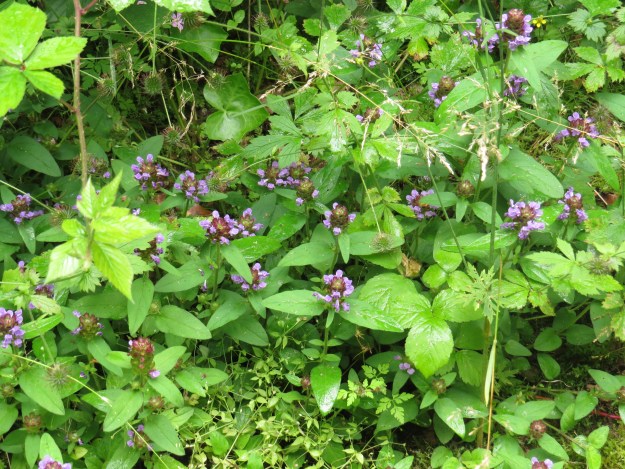
There has been a sudden outburst of self-heal (Prunella vulgaris) in the cemetery too.

And look at this lone daylily (Hemerocallis) flowering amongst a tangle of brambles and privet. I guess that there was a well-tended grave here that has disappeared under the wild flowers.

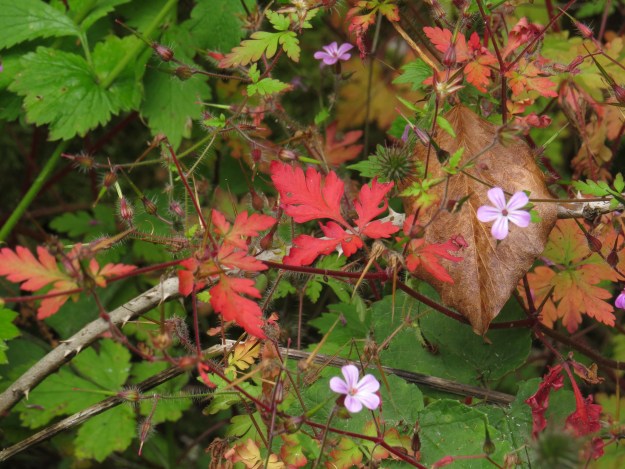
The leaves of the herb Robert are starting to turn red.

And the Scotsman seems to have had a rather large bird sitting just above him. Let’s hope that it was something splendid like the buzzard.

Five Minutes in the Garden

Dear Readers, it’s been one of those days when what I’ve mostly done is compare and contrast two spreadsheets and try to bring them together as one coherent whole, so what a pleasure it was to get up, stretch my legs and see what was going on in the garden. There are still a few damselflies about, I rather like that this one has a bar-code on her tail. This one is a Large Red Damselfly (Pyrrhosoma nymphula) and I know that it’s female because you can just about see a yellow band between some of the segments on the abdomen. She’s probably thinking about laying her eggs somewhere in the pond if she hasn’t done so already.

This plant has just popped up (as they do), and it’s a willowherb, probably Hoary Willowherb (Epibilium parviflorum),  a common willowherb of damp places. It’s so delicate that it’s hard to imagine how it held its own amidst the more vigorous plants, but here it is.

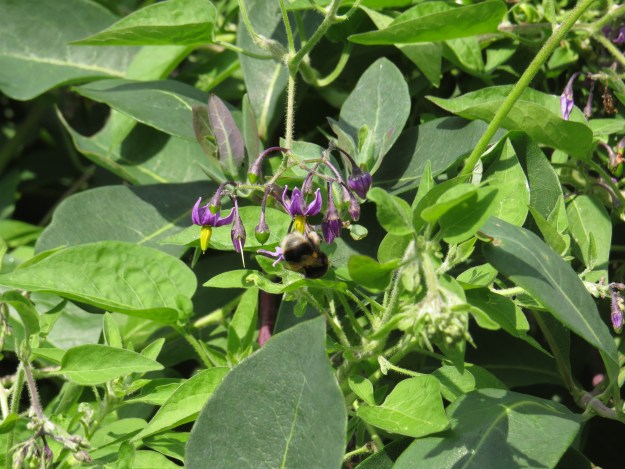
And over in the bittersweet there’s a bumblebee with bright orange pollen baskets on her legs. She looks as if she’s wearing a pair of tangerine-coloured bloomers.

This bee is carrying grey pollen, and interestingly you can tell what plant a bee has been foraging on by the pollen colour. Grey pollen can come from hazel or elder (probably elder at this time of year), and orange can come from lime – there are masses of lime trees in flower at the moment.

And having mentioned that I hadn’t seen any chaffinches for a while, a young one popped up on the seed feeder.

And finally, look who turned up on the guttering this morning while I was half-way through (yet another) Zoom call! The garden has been full of sparrows all week, and some were even belatedly examining my sparrow nesting boxes. Let’s hope they remember them next year.

LNHS Talks – ‘Are Gardens Good For Birds’ by Mike Toms

Dear Readers, this is a topic that will be close to all of our hearts, I’m sure. Are we actually helping birds when we feed them in our gardens? Should we be doing it all year round? What are the pitfalls of attracting large numbers of birds to a small space? I was eager to hear what Mike Toms had to say – he wrote the ‘Garden Birds’ volume of the New Naturalist series, one of my favourites, and currently works at the British Trust for Ornithology (BTO), so he’s a man who knows of which he speaks. I’ve given quite a lot of detail  here as I found it absolutely fascinating.

Toms started by explaining that the BTO is a research-based organisation that looks specifically at bird populations – changes in distribution and numbers, and the reasons for those changes. The bird that has been studied the longest is the grey heron – BTO have data going back to the 1930s and were able to map a correlation between cold, hard winters and declines in the heron population. Increasingly, though, the BTO studies birds in urban environments. In 2008 the world reached a point where half the population now lives in towns and cities, and this is expected to increase to two-thirds of us in 2050. Urbanisation has consequences not just because of the footprint of the areas themselves, but because of the resources that are needed to support them. Globally, some of the areas that are urbanising most rapidly are also those with the highest current levels of biodiversity, such as south-east Asia and the Horn of Africa.

In the UK, some species can adapt very nicely to the urban environment (Toms showed a photo of two herring gulls looking hopefully at somebody sitting on a bench with a sandwich). Such species have a broad diet, and are not too specific in their requirements, which is one reason why dove and corvid species do so well in our towns and cities. In the garden environment, you’re likely to see a lot of seed eaters, such as sparrows and finches, but far fewer insectivores.

London is particularly well-blessed with green space, however, and although we think about this in terms of parks and woodland, private domestic gardens are by far the biggest space. Taken together, the gardens of the UK cover a larger space than all of the land set aside for nature reserves. At this point, Toms did a survey on whether the live audience thought that gardens were good for birds, and over 90% thought that they were.

Toms then started to look at gardens in more detail. One trend, especially since lockdown, was that people wanted to make their little bit of greenspace more wildlife friendly – he showed a slide of a garden from the Chelsea Flower Show which was contemporary but had a bird feeder, lots of pollinator-friendly plants and some small trees and shrubs – it seemed like a nice combination of the aesthetic and the useful.

The big draw for birds in our gardens is clearly food – Toms had the staggering figure that across the UK we spend £200m per year on bird food (and about half of that is me 🙂 ). For birds to stay in our gardens, and not just use them for food, there need to be nesting opportunities too.

Toms showed an interesting graph which illustrated the reporting rates for robins – volunteers at the BTO record which birds they see in their gardens every week. It showed firstly that reporting rates for rural and suburban gardens are higher than those for urban gardens overall, but that all three types of garden showed a drop off during the breeding season – this seems to indicate that while robins will use gardens during the winter season as a food resource, they prefer not to nest in them.

Why is this? One reason is that most birds feed their nestlings on insects, and these are just not plentiful enough in gardens. Blue tits, for example, will nest in deciduous woodland where there are lots of caterpillars given the choice. This year was particularly devastating for birds as May was so cold, and June so wet, so there were lots of reports of nests failing and nestlings starving in the nest. However, a significant proportion of birds (over 50% of starlings and sparrows, a third of jackdaws and blackbirds and, surprisingly, 25% of song thrush) do breed in gardens, so the habitat is clearly important for these species.

Rural gardens in particular can also be important for birds such as the yellowhammer, tree sparrow and reed bunting, who are seedeaters  –  Toms showed a graph of farmland birds who visit gardens  with a seasonal peak in April, when all the natural food that the birds would normally eat has finished. In days gone by, there would be grain amongst the stubble, but with more efficient farming methods, the birds have taken to visiting feeders. This is especially important in the case of the cirl bunting, a very rare species in Devon, where garden feeding has really helped to reinforce the population.

Turning to blackbirds, Toms showed a graph of the reporting rate of the birds which showed a marked fall-off in the autumn every single year. He explained that this is partly due to the birds becoming more secretive during the moult, but also that they often move out of gardens during the glut of berries that are available in parks and the countryside.

With blue tits, Toms spoke about ringing exercises (where individual birds can be identified), which shows that it isn’t just the same old three or four birds visiting the feeders, but a succession of birds – you could have thirty different blue tits visiting the feeder in the course of a day.

Toms moved on to coal tits – these little birds largely feed on the seeds of coniferous trees, and so have done very well with the planting of sitka spruce plantations (one of the few creatures that have, I imagine). Again, the data from the recorders showed an annual peak and trough, but the peak was supressed in years when the spruces were ‘masting’ (producing their seed) – this only happens every few years, so that there is so much seed that the predators can’t eat it all, and the tree has the best chance of reproducing. In other words, if the spruce seed is available, the coal tits will eat it in preference to visiting the garden, but they will use the gardens if it isn’t so plentiful.

Then, Toms looked at longer term studies. One of them, on goldfinches, has showed a massive increase in the use of gardens by the species. Interestingly, there seem to be two ‘spikes’ in the data, which might indicate that firstly resident birds are using the gardens for food during the breeding season, and then a second wave of migrant birds comes in to take advantage of the resource.

Feeding is not an unalloyed good, however – Toms gave the example of trichomonosis and the greenfinch. This protozoal parasite is spread in saliva and faeces from infected birds, and is a very good reason for making sure that feeders are cleaned regularly. What I hadn’t realised was that the ‘spillover event’ probably came from woodpigeons, who have been carriers of this parasite for years, and one place where pigeons and greenfinches come into contact is at seed feeders in gardens. Greenfinch and chaffinch populations have been horribly affected, with Toms describing the chaffinch population as being ‘in freefall’. It made me think about the last time that I saw chaffinches in the garden, and it’s been quite a while ago.

The ‘pox’ that we sometimes see on blue and great tits seems, according to the BTO research, to have actually come from blackflies which have jumped across from the European mainland, thanks yet again to climate change.

Finally, Toms looked at blackcaps. These birds are increasingly using our gardens in the winter time (probably migrating in from Eastern Europe), and interestingly they prefer urban gardens, which are warmer because of the urban heat island effect (all that concrete stores heat during the day and releases it at night, increasing the ambient temperature). Blackcaps also prefer gardens where food is available every day.

So, it seems that the food that we provide is changing the behaviour of some birds, but by attracting them to our gardens we also increase their exposure to some diseases, and to different predators, such as cats and grey squirrels, which might not be so common in the countryside.

So, what were the conclusions? It’s very clear from the BTO’s studies that the birds who are visiting our gardens have become more diverse over time. We’re also putting out different foods – many of us are feeding not only seeds and peanuts, but suet products. Apparently, too much fat can affect a bird’s feather condition, but the addition of Vitamin E can counteract that. Where do I get suet products with Vitamin E, I wonder?

Living in an urban area brings a whole selection of risks and opportunities. There is pollution in cities that especially affects birds with their delicate lungs, glass windows claim billions of bird lives globally every year, and night time lighting can be confusing and destructive. Some studies have shown that blackbirds living in urban environments have shorter telomeres (the sections of their genetic code that protect the core genes), indicating that they have increased stress levels. Robins have to sing at night because they can’t make themselves heard over the traffic noise. Woodpigeon populations have gone through the roof, and may be contributing to disease in other species.

To sum up, Toms indicated that gardens are probably good for birds on balance, because they provide feeding opportunities and help to offset some of the damage that humans have done elsewhere. But it isn’t straightforward. Toms put in a plea for more research on what birds need, and especially pointed out the BTO’s Garden Bird Watch

To watch the whole talk, click here

How the Mighty Have Fallen….

Dear Readers, those who’ve been following this page for a few weeks might recognise this plant as the nine-foot tall angelica that popped up this spring. Well, the flowerheads have gone over and the plant has been looking a bit precipitous for a few days, but the rain and wind on Sunday night finally blew it over altogether. What a shame! But it’s clearly become handy for some of my local visitors, who find it very convenient.

The garden is still full of fledgling starlings – by this time in a normal year they’d be much more independent, and the garden would be falling silent. This year, the little devils are still everywhere. Each time I walk out to the shed they positively explode out of the surrounding trees and shrubs, followed by the woodpigeons, collared doves, goldfinches etc etc.

I’ve taken to saying “Calm down guys, it’s only me” every time I go out, but I’m not convinced it’s working.

And then, I had a very nice surprise this morning.

Fledgling sparrow marching along the hand rail.

Look at this fledgling house sparrow! I haven’t really seen sparrows in the garden for months, apart from the odd fleeting visit, but this morning the place was full of them. Here’s a Dad feeding his youngster…

For an enchanting ten minutes they seemed to be everywhere. Perching on the hemp agrimony….

..hanging out on the greater willow herb…

or just chilling on the hand rail waiting for some food….

…and every so often getting lucky…

Mum used to love sparrows.

“They’re so friendly!” she’d say. “You never see them fighting”.

Well, all I can say is she must have been watching a different species from the one that I observe, because I see sparrows squabbling all the time though, to give Mum her due, it does normally seem short-lived and non-serious. And today it was all about the difficult business of rearing these hard-earned balls of fluff to maturity. I always feel so privileged to host the local birds, especially when, like sparrows and starlings, they’ve become so much rarer than they were when I was a girl. The garden might look a bit wild and woolly, but goodness a lot of wildlife pops by, and that makes me much happier than a manicured plot would ever do.

Wednesday Weed – Creeping Jenny

Creeping Jenny (Lysmachia nummularia)

Dear Readers, I was rather taken with this pretty little plant when I spotted it at the cemetery last week. I have been thinking about getting some for the edges of the pond: it likes damp conditions and shade, which is just about perfect. It’s a member of the primrose family, though it superficially resembles a buttercup, and is a native plant, found mostly in the south of England. It’s also known as ‘moneywort’, probably because of its golden flowers and round leaves: its Latin name ‘nummularia’ also means ‘like a coin’.

Creeping Jenny (Lysimachia nummularia)

Creeping Jenny is also known as ‘herb twopence’, probably because of the leaves laying two by two along the stem. It was felt to be a most beneficial plant, one of the very best for treating wounds, and useful also for scurvy and haemorrhage. Boiled with wine and honey, it was believed to be a useful treatment for whooping cough. In Chinese traditional medicine it’s used to treat kidney and urinary stones, and it’s also said to be useful in the alleviation of gout.

Snakes were said to seek out the plant when they were in need of medicine, and yet another alternative name for it is ‘serpentaria’. I wonder if grass snakes, with their love of water and damp places, were often seen in association with the plant? This is often how these connections are made.

When burned, creeping Jenny was thought to deter insects and vermin in the house. Nobody will admit to actually eating the plant, but you can make a tea from its flowers and leaves.

A garland of creeping Jenny laid across the shoulders of yoked oxen is said to have made them work more peacefully together. As part of the loosestrife family (along with spotted loosestrife), it is said to generally increase serenity and lessen conflict, something that could come in very handy.

You may also have seen this golden version of creeping Jenny, which seems to be particularly popular for container displays.

Photo One by Photo by David J. Stang, CC BY-SA 4.0 <https://creativecommons.org/licenses/by-sa/4.0>, via Wikimedia Commons

Golden version of creeping Jenny (Photo One)

And finally, a poem. I rather liked this recent work by American poet Jack Ridl, published in Reformed Journal. I hope he has better luck with the sweet woodruff than I did, though.

Let Us Break Bread Together on Our Knees 

by Jack Ridl

And the angel said unto thee, Go thou
into your garden and plant Creeping Jenny,

alyssum, Sweet Woodruff to crawl across
the earth, and herbs to bring culinary alchemy

into each and every meal: oregano, rosemary,
lemon balm, chives, sage, and thyme. Then

set deep into the soil two wisteria vines, three
redbud trees, a butterfly bush, lupines, salvia,

zinnias, a hundred zinnias. Wait for the bees.
Wait for the 20,000 kinds of bees, from bumble

to honey to mason. Watch how they live in
harmony, all humming as if they can trust

one another and the petals, stamens, the ways
the flowers make their indifferent offerings

of pollen. Genuflect to the bees that ye may
eat of the fruit of the land. Be ever humble

in your unknowing. Learn the intelligence
of worm, vole, sparrow, spider, how none

needs even a holy word to linger and
work, becoming nothing more than what

they are under the benign disregard of sky,
the unpredictable nonchalance of weather.

Photo Credit

Photo One by David J. Stang, CC BY-SA 4.0 <https://creativecommons.org/licenses/by-sa/4.0>, via Wikimedia Commons

A July Visit to Barnwood

Nursery web spider (Pisaura mirabilis)

Dear Readers, Barnwood, a Community Forest in East Finchley, has become a real treasure-trove for biodiversity. I’d been sent a photo of a nursery web spider a few days ago, so I couldn’t wait to go and have a look for myself. In the photo above the proud Mum was looking after two balls of tiny spiderlings – a ladybird was roundly told off, though the spider clearly knew that the beetle wasn’t very tasty.

Nursery Web Spiderlings

The romantic life of a nursery web spider is fraught with danger for the male, who must woo the female with a wrapped gift of a fly or other tasty morsel. While she’s getting tucked in, he will hope to mate with her. If he’s lucky, he’ll make his getaway before she eats him. Then, the female lays a number of eggs which form a white ball – she will carry this around with her, and will also form the ‘nursery web’ that you can see in the photos. This is not used to catch prey – the spider hunts for these in the undergrowth – but for protection. The mother retreats into the sanctuary with her egg sac, which soon hatches to produce a mass of tiny spiderlings. At this point the mother stands guard outside until they disperse. 

I love the way that Barnwood has become not just a haven for wildlife, but a real community resource. Many of the fruit and nut trees are doing well, and the over-55s group has been making soup from foraged ingredients too. Here’s just a selection of the edible delights that are popping up…

Beech nut

Currants

Gooseberries

Apples

Medlars

One new development since my  last visit has been a lockable ‘shed’ – only someone who has had to lump garden tools backwards and forwards from their house without any way to store them on site will appreciate what a tremendous asset this is. And very fine it looks too.

The shed/lock-up

I tried to help ID some moths that had been caught in the trap overnight, but identifying these slightly worn noctuid moths is always a nightmare, at least for me. They will all be released into different places in the undergrowth so that the birds don’t learn where to find them. My friend L at Barnwood is going to ask a more experienced moth-er for some help with the ID. I am full of admiration for people who can understand the nuances of appearance between the different species.

We think that the tree growing by the entrance to Barnwood is an osier willow (Salix viminalis) – the plant’s flexible stems were historically used for basket weaving. It’s also a very useful plant for wildlife, and like all willow species can decontaminate heavy metals in soil.

Osier willow (Salix viminalis)

The prickly sowthistle and the common knapweed are in full flower – both are much favoured by bees and hoverflies. 

Prickly sowthistle (Sonchus asper\0

Common knapweed (Centaurea nigra)

And a speckled wood butterfly is basking in the sunshine. 

While we had a rest on the new benches in one of the clearings, a buzzard flew up from the locust tree opposite and soared off towards the cemetery. I wonder if it’s one of those that I regularly see over the cemetery? L remarked that he’d seen a red kite from Barnwood several times, and so we sat in companionable silence for a few minutes to see if one would cooperate and appear. We didn’t see one, but still, Barnwood feels like a place of great biodiversity, full of opportunities for all kinds of invertebrates and birds, and yet also a place that welcomes human diversity too. There is something for everyone at Barnwood.

For a great piece about Barnwood and its history, have a look here.

Book Review – Much Ado About Mothing by James Lowen

Dear Readers, anyone who has ever had access to a moth trap knows the mixture of apprehension and excitement that comes with peering into it early in the morning. Sometimes there are all sorts of jewelled wonders sitting in the egg-trays that you’ve put inside for their comfort. On other occasions, you have a variety of worn, brown creatures that are almost impossible for a novice to identify. But that’s all part of the fun. Will you spot some unusual migrant, or a stunning hawk moth, or a buff-tip that looks for all the world like a broken twig?

Photo One nick goodrum from Catfield in Norfolk, United Kingdom, CC BY 2.0 <https://creativecommons.org/licenses/by/2.0>, via Wikimedia Commons

Buff tip moth (Phalera bucephala) (Photo One)

My mothy adventures have been limited to my back garden (so far), but James Lowen is on a mission to convert those of us who still think of moths as being the drab relatives of those pretty day-flying butterflies. Personally, I love a quest – I’m thinking about Peter Marren’s wonderful book about finding the rare wildflowers of Britain. Lowen’s quest is a bit looser than Marrens’ but he still manages to travel the length and breadth of Britain in his search for rare and unusual moths -he encounters a man who breeds Death’s Head Hawkmoths at home, longhorn moths that ‘lek’ (perform a mating dance to attract females), moths that were thought to be extinct, moths that are just starting to appear in the UK from mainland Europe, and moths that look like other insects.

Currant Clearwing (Synanthedon tipuliformis) (Photo Two)

Not content with the bigger moths, Lowen takes a shine to micromoths as well. How I love an enthusiast! Even the moths that he admits aren’t particularly brightly coloured or ‘interesting’ are memorably described:

‘Granted, Marsh Moth is never destined to be a pin-up, its hues a greyer beige than a wainscot. Jagged lines across its wings track the share price of a particularly volatile stock. Subtle and understated, it is a moth-er’s moth.’

Photo Three Ilia Ustyantsev from Russia, CC BY-SA 2.0 <https://creativecommons.org/licenses/by-sa/2.0>, via Wikimedia Commons

Marsh moth (Athetis pallustris) (Photo Three)

Lowen describes the highs and lows of being a moth fanatic with great accuracy. The nights sitting in the cold and rain, the stomping up and down hill with heavy equipment, the ones that got away, the ones that turned up without any warning. A friend points him in the direction of a Clifden Nonpareil, the UK’s largest moth, under a strip light at Brockenhurst railway station.

Photo Four By Harald Süpfle - Own work, CC BY-SA 3.0, https://commons.wikimedia.org/w/index.php?curid=4663638

Clifden Nonpareil (Catocala fraxini) (Photo Four)

He describes the etiquette of moth-ing – can you count a moth that flew into someone else’s trap, for example, even if you saw it first? If a friend catches a rare moth and holds onto it until you can arrive to see it, does that count? Ethical dilemmas abound. All moths caught are released into a safe spot, and the scientific information collected by monitoring numbers is invaluable, but Lowen is clearly a man who wants to do no harm.

This book has really made me want to get the moth trap out to see what’s happening in my garden, and to do some recording – the picture is changing so rapidly with climate change, and moths are an interesting early indicator of what is happening already, and what might happen in the future. Lowen wears his extensive knowledge lightly, and I learnt so much about this fascinating group of insects. Highly recommended.

You can buy the book here.


A Mid-Year Walk in St Pancras and Islington Cemetery

Reflexed stonecrop (Sedum rupestre)

Dear Readers, I have some page-a-day calendars in my office – one with a daily photo of cats, one of dogs, and one of nature scenes. And so, I have to break it to you that today is the day when we reach the mid-point of the calendar year, and all the photos have to be turned around so that I can start looking at the images for the second half of the year. How did THAT happen? It feels like Christmas was about twenty minutes ago. Nonetheless, there are plenty of signs in the cemetery that the year is already starting to think about autumn, although there are still plenty of flowers about too, like these lovely yellow reflexed stonecrop, which are popping up on certain graves where the conditions are right.

On the horse chestnut, the conkers are getting bigger, but the leaves are showing the very first signs of the leaf miners that will have nibbled them to a frazzle by the end of August.

And please forgive me for a few more shots of the fox and cubs (Pilosella aurantiacia) – they are stunning.

Here’s a new plant in flower – generally known as Creeping Jenny, this is a member of the primrose family, and very pretty it is too. It was a very damp day today, which suits this little plant very much – it loves damp places, and in fact I was thinking about getting some for around the pond to soften the edges.

Creeping Jenny (Lysimachia nummularia)

I pause to examine the numerous trivial plant bugs (Closterotomus trivialis) on some hogweed – they are everywhere this year! The males are mostly black and red, the females are mostly green, and all of them feed on pollen and nothing else, but help to pollinate the plants as they do so.

There are great frothy masses of white stonecrop (Sedum album) around too.

The yarrow (Achillea millefolium) is coming into flower – quite a lot of it seems to be pinkish this year.

And the goat’s rue is putting in an appearance in both pale mauve and white. This is one of those plants that has gone from being a relative rarity in this part of the world to being pretty much ubiquitous in the cemetery.

Goat’s Rue (Galega officinalis)

I spot my first meadow brown of the year….

Meadow brown(Maniola jurtina)

And here is a very fine black-and-yellow longhorn beetle (Rutpela maculata) – the larvae live in the deadwood of deciduous trees, and the adults hang out on umbellifers, as in the photos below. I advise getting up close and personal to any stands of wild carrot or hogweed that you see – they are a great place to see interesting insects.

What really struck me today, though, was the way that the leaves on some perennial plants were already turning, and how beautiful they were. Look at these dock leaves! The colour may be due to a rust fungus or insect infestation, or it might just be part of the natural cycle of growth and decay (or indeed both of these things).

The leaves on the garlic mustard (Alliaria petiolata) are going through a similar process, but in shades of purple-red and yellow.

And the herb Robert is starting to display the clearest crimson of all…

And let’s not forget this splendid agent of decay who was obviously enjoying the rain. This is the brown-coloured form of Arion ater, the Great Black Slug. A very fine slug indeed!

And of course, I had to say hello to the Scotsman, who is standing pretty much in a grove of spent stalks and dry foliage at the moment. He doesn’t seem unhappy though, for all that.

A Coal Drops Yard Revisit

Entrance to Granary Square and Coal Drops Yard in orange and red….

Dear Readers, it’s been months since I’ve been to Coal Drops Yard in Kings Cross. Last time I was very impressed by the pollinator-friendly planting, but the entrance above was closed. Today it was open again, and so I took this photo for your delectation. The colours change as you walk along, but it’s very unusual to find it empty, so it was a mad scramble to unpack the phone and get this shot just before people came into the frame.

….and in green and blue.


Upstairs I was happy to see that a dogwood (possibly Cornus kousa) was in flower next to the new Camden Council offices. In fact I spotted several during this walk. The trees are obviously suddenly in fashion.

Kousa dogwood

The architectural panoramas in Kings Cross are always worth a look.

Some of the trees are underplanted with ornamental persicarias. The hoverflies were very fond of this one.

Then it was up to the planting around Coal Drops Yard itself. There were some foxtail lilies (Eremurus) in full flower, and they were attracting a lot of insect interest. I am still puzzling about what the flats in the gasholders behind are actually like to live in. I must hang around outside and accost someone 🙂

I like the way that this allium is just coming into flower, from the bottom up clearly if the bumblebee is anything to go by.

Elsewhere there are great drifts of Achillea in sherbet-yellow – they were disappointingly lacking in insect activity, except for this bumble. I think insects prefer straightforward yarrow, to be honest. They are creatures of simple tastes. It’s all about the pollen, the nectar and how easy it is to access – everything else about how a garden plant looks is strictly for our benefit.

Well, after all that excitement I head back to Coal Drops Yard, stopping to admire Thomas Heatherwick’s splendid roof…

….and the fine photography exhibition that’s just being installed….

…and the fountains that in warm weather are full of toddlers and small dogs….

But I was in need of light refreshment and since it had been a whole two hours since breakfast it was clearly time for some icecream. I really like Ruby Violet – Julie Fisher started off with a market stall in Tufnell Park, then got a shop, and now also has the parlour at Kings Cross. Today I had a scoop of Belgian Chocolate and a scoop of Salted Caramel and Almond Brittle. If you are ever in Kings Cross I can’t recommend them highly enough. Plus they have a teeny tiny garden outside.

Well after all that I needed to walk off a few calories (ahem) so I strolled about twenty yards to a much less visited part of the development. The first time I came here, I found a wasps’ nest, but this time I noted that there was a lot of lambs-ear (Stachys), and so I wondered if I’d see any wool carder bees, who use the soft fibres from the leaves to make their nests. They say ‘if you build it, they will come’ (or at least Kevin Costner did in ‘Field of Dreams’) so after a little bit of looking I spotted a female guarding a largish patch of the leaves against all comers. I love this species, they look like winged teddy bears but this one was very feisty, even seeing off a perfectly innocent red admiral butterfly who’d drifted overhead.

And here’s a large skipper butterfly (Ochlodes sylvanus) – I can tell that it’s a male by that black streak on the wing. These butterflies lay their eggs in long grass, and so it’s so pleasing that there are more and more patches left unmown even in display gardens like these.


I really liked this zippy little fly too, with its green metallic thorax and bronze abdomen, but what species it is remains to be seen.

Mystery Fly

A blackbird must have a nest nearby, judging by this adult with a beak full of worms…


And although it’s easy to forget that we’re right on the canal, here’s a damselfly to remind us…


And who is this, running around on the lawn like a little clockwork toy? It’s a juvenile pied wagtail, just trying to catch some pesky flying insects.


It’s a hard life being a young bird and trying to work out what’s what, but this one has picked a good spot, not just for flies but for crumbs as well.

It’s nice to see that nature is still taking advantage of the niches and opportunities that humans create, both deliberately and accidentally. I have a suspicion that if we all disappeared tomorrow, the peregrines would soon be nesting on the cranes and the swans would be playing in the fountains. For some bizarre reason, that makes me very happy.


A Legal London Tree Walk from London Tree Walks by Paul Wood – Part 2


Dear Readers, after saying goodbye to the falconer and his Harris hawks yesterday, I made my way across the Strand and into the Middle Temple via a twisty little lane called Devereux Court. Wood describes this as ‘entering another world’, and so it is – the sound of traffic falls away, to be replaced, in Fountain Court, by the splashing sound of the oldest fountain in London, dating from 1681.

The two twisted trees to either side of the fountain are black mulberries – although they look ancient, they were planted for Queen Victoria’s Golden Jubilee in 1887. I was just a little early to see them in fruit, so a return journey is definitely in order! Although James I is credited with trying to kickstart the British silk industry by importing mulberries back in the 1600s, Wood explains that archaeologists have found Roman-era mulberry seeds in remains in the city, so the berries have probably been on the menu since well before the silk link was established. Incidentally, black mulberries are the wrong species for silk worms, who prefer white mulberries, but black mulberries are apparently infinitely better eating.

Leaves of the black mulberry

One of the black mulberries being given a helping hand…

The gardeners in the various parts of the Temple are obviously extremely busy people, as we shall shortly see. I love that they have adopted that most insect-friendly of plants, the echium, as a statement in some of their beds – they crop up everywhere, and I am possessed with a need to try to grow one, after my success with my giant angelica this year. Echiums are in the borage family, and viper’s bugloss is an echium, though this plant is probably Echium pinana from the Canary Islands, otherwise known as Giant Echium, for obvious reasons.

On I go, past some more magnificent plane trees and the Middle Temple Hall, said to be central London’s finest Elizabethan building. This is probably where the first ever performance of Twelfth Night was held, and Shakespeare himself is thought to have been in attendance.

Middle Temple Hall

I have a quick look at Middle Temple Garden, which is a lovely spot, notable for its splendid acers and a particularly lovely peach-coloured climbing rose.

Middle Temple Gardens

A splendid rose…

Then it’s off into Pump Court. I am rather taken by the geometrical branches of the Tree Cotoneasters in this gloomy spot – they seem to be trying to sketch out a Mondrian painting.

A pump in Pump Court

Some very geometrical cotoneaster branches

I pause briefly at Temple Church (where a barrister friend got married), and am very taken by the pale blue clematis (possibly Blue Angel, but feel free to put me right) growing up the banisters to the Master’s House. This is my kind of garden, and I know how much effort it takes to make something look this informal. However, I haven’t seen anything yet.

Steps up to the Master’s House

Clematis (Blue Angel?)


Then it’s a quick turn into King’s Bench Walk, which is mostly a car park, though again the London planes are magnificent.

London Planes in King’s Bench Walk

There is a heap of building work going on, and I felt a little sorry for these poor echiums peering out over a hoarding…

But then I entered Inner Temple Garden. Oh my goodness! If you have never been here before, do make time when you come to London – it’s one of the most idyllic, beautifully designed gardens that I’ve ever come across. It has a breezy informality and romanticism that must take a shedload of work. It’s extremely pollinator-friendly which of course keeps me happy, and, as you would expect from a tree walk, it has some magnificent trees.

So, here we go. First up is a hybrid strawberry tree with rust-red bark, which was full of fledgling blue tits when I visited.

Hybrid Strawberry Tree

Mexican fleabane and ox-eye daisies have seeded themselves in the cracks on the steps.

The entrance/exit to the gardens

On one side of the path, euphorbia and verbena and a host of other flowering plants pour over the gravel….

Euphorbia

…while on the other side, there is a meadow of mixed grasses, poppies, ox-eye and other daisies.

There is a magnificent Atlas Cedar with blue-grey foliage, and the sound of goldcrests coming from the branches…

Atlas Cedar

…and the bed on the other side of the path as I turn towards the Thames is themed in dark red and white, with the largest scabious I’ve ever seen….

…some amazing white foxgloves with deep magenta centres and a kind of lacy frill around the edge (much appreciated by bumblebees as you can see)…

and some deep purple poppies…

There is a very unusual Manchurian Walnut…

Manchurian walnut

And although the alliums are going over, their seedheads are still very striking.

Allium seedheads

There is a magnificent dawn redwood….

Dawn Redwood

And then there’s an avenue of London planes. I defy anyone’s blood pressure not to drop as you walk along this green passage, regardless of the traffic belting past just over the wall.

There are 3 enormous plane trees planted in the lawn which are thought to date to the 1770s, but the avenue is younger – Wood thinks that the trees on the northern side (on the right-hand side of the first photo above) are probably nineteenth century, the ones on the southern side (closest to the river) are early twentieth century. When you look at the girth of the trunks you can see that those on the left are clearly still slim and youthful, while middle-aged spread has taken the ones on the right.

There is a lovely little fountain with the waterlilies just coming into flower.

And a splendid view back to the Manchurian Walnut.

The next border is a positive cornucopia of different varieties of hydrangea – it’s not my favourite plant, but some varieties are attracting bees who are after the pollen.

I have just missed the flowering of the tulip tree, but it does gift me with one blossom. This is a very fine tree. Its branches look like a cupped hand. I also appreciate the way that the gardeners have left a wide circle unmowed under pretty much all the trees in the lawn.

Tulip Tree

Tulip Tree flower

Tulip Tree

I walk past a young woman who has posed a china tea set with a shortbread biscuit on a tiny miniature table with a gingham table cloth against a backdrop of pink hydrangeas, and who is clearly taking a photo for her Instagram feed. I imagine it will be very pretty.

I am rather taken by this enormous plant. The chair underneath it is full-size. It looks a bit like Gunnera but not as spikey – some giant version of Rodgersia perhaps? I obviously have a thing for giant plants currently….

And then there’s this very unusual fuchsia.

A final turn, and I’m heading back towards the gate. It’s like being kicked out of Narnia…..

…because just a few hundred metres out of the garden I come to the Embankment, and this is the sight that awaits me.

Holy moly, what’s going on? Well, apparently it’s the Tideway Super Sewer, which aims to collect and transport more of London’s sewage (the current Bazalgette sewer was built when London’s population was only half the size). Every year, millions of tonnes of raw sewage end up in the Thames and its tributaries, so if this can be cleaned up it can only be a good thing. At the moment it looks a bit of a nightmare, but it will no doubt be great once the carpet’s down, as my Nan used to say. In the meantime, I would stick to the peace and tranquillity of the Inner Temple Garden if I was you. It’s open from 12.30 to 15.00 on weekdays (nb not weekends or public holidays), and I would check before making a special journey as I think it’s sometimes closed for special events. Well worth a look though, and another splendid walk from Paul Wood’s book.

London Tree Walks by Paul Wood is available here.

One of the older plane trees, probably dating back to about 1770.