Monthly Archives: July 2021

Negative, But….

Herb Robert seed pods

Dear Readers, I was very impressed by the speed with which my Covid -19 test results came back – the kit was sent off on Sunday and it was announced that I was negative on Monday. However, I have spent most of today in bed, shivering and with my teeth chattering, so clearly all is not well yet. I find it astonishing how even the roots of my hair feel sore, and how in the middle of a heatwave I wanted nothing so much as a hot water bottle. Still, with any luck I’ll be feeling a bit better tomorrow, especially as it’s my six-monthly performance review and I’ll need to be on the ball!

I just thought that you might want to see exactly why hardy geraniums are called cranesbills. Don’t these seedpods look just like the heads of an elegant bird?

Photo One by TJflex at https://www.flickr.com/photos/tjflex/49264893542

Sandhill Cranes (Photo One)

Photo Credits

Photo One by TJflex at https://www.flickr.com/photos/tjflex/49264893542

Self Isolation Day Three

Dear Readers, there are definitely worse fates than being stuck at home with a fridge full of food and a job that doesn’t involve any commuting. Today I am a bit brain-fogged and tired, but definitely improving.  I decided to spend half an hour in the garden to see what was going on before I headed back for a sleep (luxury!) and of course the bumblebees visiting the teasel caught my eye. I love the way that they dig right into the flowers to get at the nectar – I’m guessing that only the longer-tongued species can get at it, and certainly the hoverflies who land sometimes look a bit confused before flying off to something friendlier.

I was delighted to hear the children on their way to school this morning remarking on the bumblebees on the lavender and buddleia in the front garden. I must be doing something right. I sometimes think of bumblebees as a kind of gateway to the insect world for children – they’re big, furry, unlikely to sting unless really harassed, and have a kind of ramshackle charm that belies their superb adaptation to their environment and intelligence.

Honestly, who wouldn’t love them and want to look after them? On a sadder note, I found two bumblebees trussed up in a spider’s web on the fence. I might pop out later to see who the culprit is, but the web is very impressive. I did check to see if the bees were already dead, and they were, otherwise I might have had a tricky moral dilemma for all of ten seconds before I rescued them. I will spare you the photos, but here’s the web, and rather beautiful it is too.

Close to it a much smaller, less bee-murdering spider has slung a web. This is your typical diadem orb-web spider (Araneus diadematus), a very variable and common species but welcome for all that. Spiders eat so many garden ‘pests’ that I suspect we’d be chin deep in mosquitoes and greenfly if they didn’t exist.

For those of you on the edge of your seats about my small white butterfly egg, it’s turned yellow, which I think is a good sign…

And in other very exciting news, I noticed this while trying to follow a mystery moth. I discovered both that I suddenly have enchanter’s nightshade in the garden and leafcutter bees! Until I moved to East Finchley I had no idea that there were leafcutter bees in the UK, but then I saw that my rose leaves had these perfect half-circles taken out of them, and tied this in to the little bees that I saw feeding on what I thought was elecampane. How exciting! I shall keep an eye on it and see if I can catch them in the act, though I sense that it’s a little bit late in the year.

And now I’m off for a lie down. See you tomorrow, readers!

Oh The Irony….

Dear Readers, there is something a little ironic about having gotten through 18 months of a pandemic without even being pinged by the NHS app, only to catch something and end up self-isolating when ‘Freedom Day’ is today, 19th July. On the other hand, ‘Freedom Day’ won’t be freedom for vulnerable people, people who have compromised immune systems because of chemotherapy, elderly people or anyone else who has reason to fear the devastating potential effects of this virus. With only 50% of the country double-vaccinated, would it really have hurt to keep things on an even keel for another month or so? I don’t doubt that most people will continue to be sensible, but there has been a leadership vacuum of colossal proportions in this country. My heart goes out to people working in the NHS who are seeing the numbers of the hospitalized rising inexorably. We have been abandoned. No wonder so many people are filled not with joy at the unlocking, but with trepidation.

Anyhow, I have done my Covid test and posted it, and now I wait to see if what I have is something known or something unknown. I feel a bit tired, but basically much better, so I will just have to be a patient patient. Thank you for all the good wishes, and in particular to the person who reminded me that even if  it’s not Covid it doesn’t mean that  I should rush headlong back into my usual frantic round of activity – I think the phrase was ‘other viruses are available’, which made me hoot.  That is excellent advice. I feel tired to my bones somehow: it’s sometimes a struggle just putting one foot in front of another. But then, there’s always the garden, and it’s too blooming hot to do any actual work so I just sat in the shade and tried to pay attention, as that is the cure for most ills.

If you look very carefully at the picture below, you can just see a tiny plane about to enter the clouds. Who remembers that feeling when you’re on a flight and the plane starts to judder as you enter the clouds, as if it’s flying through something viscous? Or that extraordinary sensation when you get above the clouds and there’s the sun and that perfect blue? It always reminds me of that Buddhist sense that behind all our nonsense there is that clear, vast ‘mind’ that is available to all of us if only we could put other things aside.

I wouldn’t want you all to think that I was being too lazy, so I actually got up and wandered over to the pot of ‘wild flowers’ that we planted about a month ago. It’s fair to say that they haven’t been a stunning success, but what’s with the brassica? It looks like oilseed rape to me.

But all is not lost, because I did notice a small white butterfly hanging around earlier this morning, and when I bent down for a closer look, she has laid a single egg. Now, if you’re a gardener I can imagine you not being that impressed, but at least Small Whites only lay one egg, as opposed to 50 like a Large White. I shall have to see if this one survives, and shall have to remind my poor long-suffering husband not to water too enthusiastically this evening when he gets the hosepipe out.

In other news, the Great Willowherb is just opening. Every year the buds are parasitized by some little moth, and every year it seems to make not a jot of difference to the flowering.

And the collared doves are huddled in the whitebeam for shade. I think these birds are underestimated on the looks front, with their subtle shades of cinnamon and fawn and dusty grey.

And so, there you have it. I expect a few more garden posts in the next few days, but the weather looks gorgeous. Stay safe out there, UK people, and avoid any idiots….

A Mid July Walk in St Pancras and Islington Cemetery

Dear Readers, after a most peculiar day yesterday, when I seemed to run completely out of energy, I felt a bit better this morning, so decided to go for a somewhat truncated walk in the cemetery. I can avoid getting close to people, and felt quite a lot better, so it felt like a reasonable thing to do. Alas, halfway round it seemed like I am still not myself, so I went home to isolate and have ordered a test. I still think it will be negative, but you can’t be too sure.

Anyhow, the first thing I noticed was that the cherry plums, who seem to have been in bloom only about twenty minutes ago, are now dropping their fruit. How quickly the year goes!

And just look at the swamp cypress. After a slow start, it’s now truly magnificent.

The wild carrot is in flower. The young flowerheads are a dusty pink, the older ones bright white.

The white flowerhead has the characteristic single red flower in the middle, and botanists think that this has evolved to convince pollinators to come visit – it looks just like a small beetle already feeding. The pink flowers have one too, but they aren’t as obvious (yet).

it’s certainly persuaded this long-horned beetle to drop by.

The conkers are doing very nicely, though the leaves of the horse chestnut are looking worse every week.

The yellow and white stonecrops are being overtaken by this pretty pink-flowered plant, which I think is Caucasion stonecrop (Phedimus spurius). I am fascinated by the way that some graves form a good habitat for these plants, and others don’t – I’m guessing it’s all down to a mix of soil, sun and exposure.

It really does have a mid-summer feeling to it today – temperature in the ’80’s, sun beating down….

We stop for a most uncharacteristic rest, and a jumping spider pops onto my leg…

The evening primrose is coming into flower.

And what a pleasure it is, on these long, hot days, to walk along a shady lane.


Fostered Felines and an Unexpected Gift (Again)

Willow

Willow

Dear Readers, I am feeling a little under the weather this afternoon (I’m 99% sure it’s not the dreaded Covid-19, so please don’t worry). So, I decided to share this post from 2015 for those of you who haven’t seen it before, and, judging by the popularity of the Bailey post there are plenty of cat lovers out there. So I hope you enjoy it, and normal service will be resumed tomorrow. 

Dear Readers, although I usually write about the wildlife outside my house, today I would like to share some tales with you about the creatures that we actually select as our companions. My husband and I began to foster cats for Cats Protection back in 2008, because for me a house without a pet is not a home, but our garden-less flat wasn’t the best environment for housing a cat permanently. Fostering involves taking cats into your home and looking after them until they are ready to be re-homed. Sometimes the cats that we looked after were sick. Sometimes they were young or vulnerable, and needed some confidence-building. On one occasion we gave sanctuary to a creature who had no idea how to behave around human beings at all (see Snowball below). During our five years of fostering we looked after nearly 80 cats, and learned a lot about non-attachment, about how every cat is different, and how tolerant it was possible to be in the face of feline bodily fluids. We also developed a clear idea of the kind of cat that we’d want to adopt when we eventually had a house with some outside space (and at this point the Universe gave a little chortle). So, here, in no particular order, are some of the cats that were in our care, sometimes for weeks, sometimes for months.

Billy

Billy

Billy had suffered a horrible abscess on his head through fighting with another cat – he was a harem-scarum tomcat, a real bruiser. But after being neutered he settled down into home life and would head-butt you so hard when he wanted to be stroked that woe betide your best clothes if you happened to have a mug of tea in your hand. We developed a love for these big male ex-strays, who were so full of character and seemed to want to make the most of their new environment. We were sure that this was the kind of cat that we would eventually adopt.

Snowball

Snowball

Snowball was the most beautiful and most acrobatic cat that we ever fostered. He was pure white, deaf and lethal. If you ventured downstairs in your dressing gown he would pounce from behind cover and rip your bare legs with his needle-sharp claws. As he couldn’t hear your screams he presumably wondered why your mouth was opening and closing while you tried to prise him off. I still bear the scars from making the mistake of reaching out to pet him when he snuggled up next to me on the sofa. We worked with an animal behaviourist to try to reduce his ‘boredom aggression’, but no amount of tiring him out by playing with him would completely eliminate his bad behaviour. Eventually he was adopted, with full disclosure, by a man who didn’t mind wearing Wellington boots over his pyjamas in the morning, which just goes to show that there’s an owner out there for every cat if you wait long enough. When we waved Snowball goodbye it was with tears of relief rather than the usual sadness. I later heard that Snowball had taken to wandering, and was regularly retrieved from locations more than 2 postcodes away from where he lived. I doubt that he made old bones, but I don’t doubt that he lived his life as a semi-wild animal in just the way he chose.

Colette

Colette

Little Colette was rescued from a house fire – in fact the cat carrier in which she was saved was melted like a Salvador Dali painting. She smelled of smoke for days, and also had a brutal flea infection. She made a quick recovery, however, and was soon off to her new home, where hopefully they’d made sure the wiring wasn’t a death-trap.

Felix

Felix

Felix came to us with his little sister Irene, and he was an unmitigated show-stealer. Whenever there was something interesting going on, he was there, and poor Irene was relegated to the sidelines. If she was being stroked, he would barge his way in. If you put down 2 dishes of food, he wanted both of them. It was decided to re-home them separately, and you never saw a happier cat than Irene when her brother went off to his new home.

Galaxy

Galaxy

Galaxy came to us with a terrible throat lesions, an allergic reaction to his vaccinations and a general air of depression. Mother cats who are not vaccinated can pass calicivirus onto their kittens, which leaves them with a lifelong tendency to throat and mouth inflammation. Galaxy’s throat was so painful that there was some talk of putting him to sleep if the situation didn’t improve, and so we spoilt him horribly. He slept on the bed, in spite of his snoring. He got all the best food. We put up with his outrageous flatulence. And, lo and behold, he gradually improved, and was finally (after a year) re-homed with a wonderful lady who gave him venison and wild boar at Christmas, and didn’t mind him sleeping in her potted plants on the patio. He lived for another five years, and was so cherished that he frequently featured on his owner’s Christmas cards.

Honey

Honey

Honey was a most unfortunate-looking cat. She was as round as a beach ball and had a most disapproving expression (not helped by her moustache). However, she was an affectionate cat, and would sit beside you, purring like an idling engine. If you didn’t stroke her, she would reach out with one paw and place it on your arm until you produced the desired caresses. If they stopped, she would pause for a moment and then apologetically reach out again. Eventually she found a home with someone who could see past her unfortunate looks to the characterful creature beneath.

Mocha

Mocha (aka Fat Boy)

Latte

Latte

Mocha and Latte were described to us by the people at the cat shelter as ‘the Cappuccino Kits’ but they arrived as two lively adolescent lunks, with all the social graces of a troop of teddy boys. One afternoon, Latte decided to run up our full-length sitting room curtains, and, before I could stop him, Mocha tried to do the same. Unfortunately, Mocha was twice the weight of Latte and so the entire curtain rail, complete with an enormous chunk of plaster, came out of the wall, leaving a cloud of dust. Suffice to say that they were both in hiding for at least five minutes before they ventured out to inspect the damage.

Lee

Lee

Mork

Mork

And talking of adolescent lunks, Mork and Lee were our two first teenagers, and were a whole heap of trouble. Lee was forever jumping out of open windows, hiding on the top of bookcases and, on one occasion, getting into the washing machine.

Aaargh! Don't try this at home...Lee in the washing machine.

Aaargh! Don’t try this at home…Lee in the washing machine.

Mork was the most affectionate cat we ever had, and the first that would sit on your shoulder while you went about your housework (though he never did learn how to wash up or do anything useful). Mork and Lee were the first cats that we truly fell in love with, and we were heartbroken when they eventually found a wonderful new home. It’s safe to say that we were careful about not becoming too attached in future.

Tabby Kit

Tabby Kit

And this is Tabby, a lynx in miniature. Look at the size of those paws! He grew to be enormous, and was the gentlest kitten we ever looked after, happy to lie in your arms like a baby.

Rosa

Rosa

Rosa and the family

Rosa and the family

Mostly White

Mostly White

Stripey Tail

Stripey Tail

Rosa was the only cat who gave birth to her kittens in our house. And what an event it was! We had prepared several places for the big event, but of course she had her babies squeezed between the bookshelf and the radiator, on the 4th November. On the 5th November there was a Guy Fawkes party in the street, with deafening explosions and shouting and general carry-on, but she stayed firm despite it all. When the kittens first came out from their hiding place after a few weeks, she spent a lot of time trying to corrall them by tapping them with her front feet, like a footballer trying to dribble the ball, but eventually she gave up and let them start to explore. We felt like proud parents, and were most indignant when the shelter folk described them as ‘long-bodied and short-legged’. Harrumph!

Stripey Tail emerging for the first time

Stripey Tail emerging for the first time

Seymour

Seymour

Seymour was another big tom-cat, but he had a condition called Horner’s Syndrome, a condition which makes one eye droop, and is often related to lesions of the nervous system. Hence, he wasn’t expected to have a long life. He spent his first day with us hiding in his covered litter-tray, and it was only after I reached in to stroke him and he started to purr that I realised that he was just frightened and confused. He was always very careful with the many flights of stairs in the flat, and I’m sure that he couldn’t focus properly. As is often the case with the most damaged of cats he was very easy to love, and I was very happy when he was re-homed by someone who knew that his prognosis wasn’t good, but wanted to make his life as happy as it could be.

Which brings me on to Rosie.

Rosie

Rosie

We looked after Rosie when her owners went away on holiday. She was a cat with quite severe disabilities – she couldn’t stand up, and had to be helped to her litter tray a couple of times a day. She would always call and let you know when she wanted to go, which was generally at the human-friendly times of 8.00 am and 6.00 pm. She was a very perky cat, interested in everything that was going on, and loved to sit on the sofa next to you, or to be picked up for a cuddle. She also loved other cats, but they generally knew that there was something wrong with her, and so would avoid her. Until, that is, her owner adopted another little cat who had been through the most horrific abuse I’d ever heard of. He loved Rosie on sight, and would cuddle up with her in her basket – maybe she reminded him of his mother, or maybe he just recognised another cat that wasn’t able to deal with the world around her on her own. At any rate, the two of them were a comfort to one another throughout their lives.

So, dear readers, having read this far, what do you think happened when we finally decided to adopt? Was it a big tough tomcat, full of personality and affection?

Umm, no.

Our last two foster cats were a brother and sister: a big tough tom, and an extremely shy little female cat. The big tough tom was adopted out to Gerrard’s Cross (the richest area in the UK by the way), to a man who owned a stable full of show jumpers, a wood, a stream, and who didn’t mind if his cat wanted to sleep on the bed. This just left the female, who, up to then, had spent her whole time hiding behind the sofa.

John and I wondered who, on earth, would ever adopt a cat who never showed herself. The months went on. Nobody wanted a very ordinary little black and white scaredy cat. And yet, we’d started to notice that she wasn’t such a scaredy cat any more. She liked to be brushed, for just a minute or so at first. Eventually, she would demand to be brushed, and complain when you stopped.

Then, she started to jump on the bed when we were reading at night.The remarkable thing was that she would jump off as soon as we put the lights out, and would never come into the bedroom until she heard us talking.

And finally, she had no interest at all in going out into the garden. In the living room, she would hunt scraps of tissue paper, foil wrappers and invisible microbes, but she was quite content to watch the birds from a window-sill.

We stopped thinking about her in terms of ‘who else will adopt this cat if we don’t?’ and started to realise that, for us, she was ideal. She wouldn’t hunt and kill the creatures in my garden. She respected our sleep time. She didn’t have any strange problems with food. She did rip the sofa to shreds, but then it was old anyway.

So, Gentle Reader, we adopted her, and put away all notions of the cats that we thought we wanted, in favour of the one that we actually did. She is seven years old this year, and gets more outgoing and friendly every day.

Every animal has a personality. If we can understand this with our pets, I wonder why we find it so hard to acknowledge that wild animals might be the same?

Willow. The perfect cat.

Willow. The perfect cat.


In Tearing Haste (Again)

Goodness Readers, how this having a job business impacts on one’s social activities. I am not for one second complaining (and I am only part-time) but even so, some weeks it’s hard to stuff everything in. Nonetheless, I did find time for a quick ten minutes in the garden today, and as usual there was some interesting stuff going on. I love the way the teasel flower flowers, for one thing. Someone described it recently as ‘a sparkler that’s been lit in the middle’, and that’s not a bad description. What a stunning plant it is, even though it’s at the most peculiar angle. The flowerheads remind me a bit of cartoon snakes trying to look around a corner.

And the bees love them, clearly.

My ‘dwarf’ buddleia is now 8 feet tall, but the colour is spectacular. What would you call this colour? I’m dithering between magenta and cerise, but I’m open to suggestions.

There are cellar spiders in the shed again, and I can’t walk out there without demolishing a web that has been slung across my route. I managed to avoid this garden orb-web spider though – she’s made her web between the buddleia and the bay window in the front garden, and is getting stuck into all the aphids that fly into her trap. These spiders are around for most of the year, but they’ve just about gotten big enough for us to actually notice.

Although there have been a lot of aphids about this year, I’ve also noticed a huge increase in ladybirds and ladybird larvae. Today, there was this two-spot (though as you can’t see the spots I’ll need you to trust me on this one…)

And some harlequin ladybird larvae, who really do remind me of aphid-hoovers as they work their way through a herd of the poor things…

And here is a harlequin ladybird pupa just waiting for another ‘hoover’ to emerge…

Out in the back garden again, I notice that the slugs and snails have eaten all the sunflowers except two, one valiant entire specimen, and one where the stem has been eaten through so that the top leaves have fallen off. I wonder why they so prefer some plants over others? I need to grow most things until they’re the size of a tea pot before I can be sure that they’ll survive, and even so some still end up like lace. Where’s a hedgehog when I need one? And aren’t those frogs supposed to be earning their keep? Harrumph.

My last remaining sunflowers

And finally, it’s so nice to have the sparrow family still visiting the garden, along with the young starlings, the goldfinches and a couple more chaffinches yesterday. I might only have had ten minutes, but it definitely cheers me up.

After the Storm

Azure damselfly

What a strange summer it’s been so far! Yesterday, without any warning, a thunderstorm bubbled up, just as my husband was heading out for a haircut. It poured down for best part of an hour – the kitchen had rainwater coming in under the door, but further up the road basements were flooded, roads were impassable and torrents of water ran down the streets. And then, today, it’s hot, and in the garden there are dozens of damselflies, red and blue. Some are fighting, some are mating, some are just hanging out. A spider has built its web right across the pond and is dashing out every five minutes to truss up an aphid or some other tiny insect.

The meadowsweet and the hemp agrimony and the teasels had all been knocked horizontal when the angelica fell over a few days ago, and they were just starting to right themselves when yesterday’s storm hit. Ah well, they are still flowering even if some of the angles are a little strange. The teasel flower is a peculiar thing anyway – it flowers in the middle, and then the two bands of flowers move away from one another to opposite ends. It is beloved by all manner of little pollinating creature.

Teasel with tiny bees

I have never seen a bee so drenched in pollen. Unlike those sophisticates the bumblebees with their pollen baskets, a lot of little bees just basically roll about in it so that it adheres to their legs and tummies. This one has been identified as a base-banded furrow bee (Lasioglossum sp.). There are over 1700 species, with the ones in the UK being tricky to tell apart, though most of them are solitary bees building their nest tunnels in light soils. In the tropics some Lasioglossum species are sweat bees, which can be a bit irritating if you aren’t used to them, though as the poor things only want to feed it seems a bit harsh to hate them.

Apologies to anyone who gets seasick watching this, it’s the teasel moving, not me 🙂

And here is a bumblebee, doing that pollen-collection thang properly. This one is buzz-pollinating the bittersweet, vibrating at a high frequency so that the plant will release its pollen. Not that you can hear the sound above the wind…

And watching benignly from the pond is this frog. All the fuss and bother of the year is already over, and s/he can just sit and watch the world go by (though if s/he could see their way clear to munching on some of the slugs and snails that have appeared after the rain that would be very helpful). As I haven’t even seen them paying much attention to the water snails, though, I suspect this might not be on the cards.


Wednesday Weed – Pepperwort

A pepperwort, but which one?

Dear Readers, following my trip to the cemetery on Saturday I decided to find out a bit more about this rather strange plant. It looks rather like a giant shepherd’s purse although the seedheads are different. I was fairly sure that it was a member of the cabbage family, but one that I hadn’t seen before. Fortunately the knowledgeable people over at the Wildflowers of Britain and Ireland Facebook group were able to give a tentative identification – this is most probably Narrow-leaved Pepperwort (Lepidium ruderale). To identify it properly, I need to give the leaves a rub next time I’m in the cemetery – they are said to smell like a combination of horse dung and horseradish. I can’t wait!

The genus of the plant, Lepidium, means ‘small-scale’ in Latin – some authors think that this refers to the use of some species to treat leprosy, which causes scaly skin in its early stages. It might also refer to those tiny round seeds, which definitely have a resemblance to fish scales. However, the leprosy interpretation is supported by the fact that a close relative, dittander (Lepidium latifolium) was used as a treatment for leprous sores, and that stands of this unusual, normally coastal plant, have been found growing in the grounds of 3 hospitals in Kent and nowhere else in the county(Flora Britannica by Richard Mabey, page 153).

Photo One by Sten, CC BY-SA 3.0 <https://creativecommons.org/licenses/by-sa/3.0>, via Wikimedia Commons

Dittander (Lepidium latifolium) growing in its normal seaside habitat (Photo One)

The plant has also been used in a tincture to treat impetigo, another skin disease, and it’s said that it can also reduce blood pressure and decrease respiration (though why you’d want people to breathe less I am unsure). Furthermore a close relative of ‘our’ plant, field pepperwort (Lepidium campestre) was said to be an antidote to poison, and was sold under the name of ‘mithridate pepperwort’. And for those of us who are ladies of ‘a certain age’, yet another relative, maca (Lepidium meyenii) develops a huge, bulbous taproot which is said to taste like vegetable caramel, and which is said to be a great treatment for hot flushes. In its native Peru, maca is also used as an aphrodisiac, and there is some evidence that it has a direct influence on the action of hormones such as oestrogen, so maybe this isn’t so unlikely.

Photo Two By Vahe Martirosyan - https://www.flickr.com/photos/vahemart/29354035645/in/photolist-Lq4Xq7-KUBFMH-KUBDQM-KUqMKC-KUBBVV-LJv7uH-LyoM5o-KLS6Bs-LHV7yn-LHV77R-LAYZik-LHV6gc-LHV5tk, CC BY 2.0, https://commons.wikimedia.org/w/index.php?curid=54408048

Maca roots (Lepidium meyenii). Not to be confused with parsnips! (Photo Two)

As you might expect from the name, pepperworts of all kinds are said to have intensely mustardy, pepper-flavoured leaves, which can be used in salads when picked young. Having read the description of the smell, however, I might leave this one for the hardier folk among us. In fact, the plant is so strongly-flavoured that it can taint the milk of the animals that graze upon it, and furthermore it appears to be herbicide-resistant. Bees love it, however, and there was a tiny hoverfly feeding on this specimen, which you can probably see if you squint.

A pepperwort, probably narrow-leaved pepperwort

It seems to me that we owe so much to these nondescript little brassicas, not just because many of them are the ancestors of the cabbages, turnips and radishes that we enjoy today but in their own right. With their peppery flavour they added some much-needed flavour to our ancestor’s diet, and they can be surprisingly attractive to the human eye too: I rather liked the long spikes of flowers and seeds on the pepperwort. As already noted, they can be popular with pollinators, and caterpillars that can get past the mustardy flavour that is meant to deter them can find something tasty to eat.

And so to a poem all about cabbages. I love this! Words actually fail me. See what you think. My mother, too, used to overcook it, and put a spoonful of bicarb into the water, in theory to keep it green.

Brassicas by Eileen Sheehan

There was no sex in our village there was only
cabbage. Row upon row of it filling the haggards
on high, straight ridges. This is where babies came from
we were told, in all seriousness. My sister still remembers
being shown the exact head that she was discovered under.
We knew everything about growing the small, limp
plants that needed constant watering. Learned how to protect them
from root fly and caterpillar infestations. Recognized the different varieties,
from January King to Curly Kale, sewn in sequence for year-round cropping.
Instructed that it was never harvested until the hearts were firm and babies
were something only grown-up women found. Of sex
we knew nothing. We all hated it; the dank smell of it cooking
that permeated through the whole house for hours
after it was eaten, the sloppy look of it on the plates,
the run-off staining the spuds and bacon. But it was
good for us so we were made to finish it. Remember
how mother would add a teaspoon of soda to the water
to soften the fibers? Years later, I learnt that this destroys
the flavour, disarms the vitamins. The myth was easy
to believe in a farming community until our hormones and
neighbours’ sons, well educated in animal husbandry,
illuminated the shortcomings in our education.

Oh my sisters,
we are the daughters of cabbages and should celebrate our
cruciferae lineage; tough and sinewy of a strong variety,
adaptable to any climate, winter hardy;
never ones to take
ourselves too seriously: when I think on it,
my sisters, all that green we swallowed.

Photo Credits

Photo One by Sten, CC BY-SA 3.0 <https://creativecommons.org/licenses/by-sa/3.0>, via Wikimedia Commons

Photo Two By Vahe Martirosyan  https://www.flickr.com/photos/vahemart/29354035645/in/photolist-Lq4Xq7-KUBFMH-KUBDQM-KUqMKC-KUBBVV-LJv7uH-LyoM5o-KLS6Bs-LHV7yn-LHV77R-LAYZik-LHV6gc-LHV5tk, CC BY 2.0, https://commons.wikimedia.org/w/index.php?curid=54408048


LNHS Talks – London Hogwatch by Chris Carbone

Dear Readers, when I was in my twenties and thirties, our garden was positively awash with hedgehogs, from big lone males to whole families of hoglets. But the numbers declined, and I have never seen a hedgehog here in East Finchley. Recently, however, things have been looking up – I am hearing reports from the County Roads themselves of these spikey mammals being spotted, and only last week my friend A, who lives two roads away from me, rescued a poorly hedgehog in her garden and got him to a wildlife hospital. Could things be looking up for urban hedgehogs? I was looking forward to this talk to find out.

London Hogwatch is a case-study of urban mammals using camera traps run in collaboration with the Zoological Society of London (ZSL), and Chris Carbone has been involved with the project since 2016. The project overlaps with hedgehog studies in Regents Park, one of the last redoubts of the mammal in Central London. And, as the population of hedgehogs as fallen by over two-thirds in the past two decades, it’s a vital piece of research. The aim is to find out where the hedgehogs currently are, and to target these areas with campaigns and information to try to preserve them.

The project started in 2016 by concentrating on Camden, where the Zoo and Regent’s Park are situated. In 2017 it expanded to Haringey (not, I notice, to Coldfall Wood) and Richmond Park, and then on to Lambeth, Southwark and Sutton. Carbone explained that they are starting to do their first surveys in private gardens, and there’s a major programme of expansion planned for 2021, looking at Redbridge in East London for the first time (where I used to live and where hedgehogs used to be plentiful), and to other areas such as Hounslow and Enfield.

The projects have been run on something of a shoestring, relying on Masters and PhD students to do a lot of the analysis from the camera traps. I remember when I was running my camera trap that for every ‘valid’ photo of an actual fox there were dozens of cats, waving foliage and my legs going backwards and forwards to the shed, so I can only imagine the patience involved.

Carbone explained that camera-trap surveys had only really been possible during the past ten years – previous cameras were too big and expensive for widespread surveys. During the lockdown, cameras had been packaged up and shipped out for people to use in their own gardens, before collecting them back again, quarantining them and analysing the data.

There have also been a number of large-scale surveys. One, in Hampstead Heath in 2018, showed that there were at least 100 hedgehogs present. This was followed up in 2020 with some private garden surveys, which showed that gardens that were close to the area of the Heath where hedgehogs were present were also being visited by the animals, but that good habitat in places like Highgate Cemetery and Waterlow Park were completely devoid of hedgehogs, probably due to barriers such as the major roads that bisect the area, and walls and impenetrable fences between individual houses.

Studies also showed that there was a robust population of hedgehogs in the Barnes/Richmond/Roehampton area – an avid hedgehog fan in Barnes had been encouraging people to drill holes in their fences to enable the animals to travel between gardens. Camera trapping showed that there were lots of hedgehogs on Barnes Common and in the Wetland Centre, and that these were spreading out from this area, so this is an area of major importance for South London hedgehogs.

Interestingly though, to the south and west (i.e. in Richmond Park itself and the grounds of Roehampton University) there’s a population of badgers, who not only compete with the hedgehogs but will actually eat them. When Carbone showed his slide, there was a very clear demarcation between the areas where badgers were present, and those where hedgehogs were present. Although hedgehogs can co-exist quite happily with foxes and cats, it seems as it badgers are a step too far. However, badgers are much less likely to come into private gardens, and so Carbone feels that hedgehog highways and support from private garden owners can provide an important refuge for hedgehogs, where they are much less likely to come into contact with badgers.

Other surveys, such as one at Home Park which surrounds Hampton Court Palace, didn’t reveal any hedgehogs at all, but they did expose some interesting patterns of animal behaviour. Deer activity, for example, peaks very early in the morning before humans and dog walkers appear, and tails off to a much lower level when the park is being highly used. On Hampstead Heath, birds also try to avoid busy human times. With the usage of public greenspace having become so much more intense during the lockdown, it might be a while before some new balance between human and animal activity is achieved in our busiest parks and reserves.

So, what areas are good for hedgehogs, and what do they avoid? A predictive map of areas that should be good for the mammals has been built up from historic data gathered by other organisations and London Hogwatch, and the results show that:

  • Areas with badgers are really no-go areas for hedgehogs, as mentioned above
  • Allotments and gardens are good for hedgehogs, particularly if they have lots of invertebrates living in them
  • But! a lot more data analysis needs to take place to determine exactly what they need.

One big problem is genetic isolation between populations. There are a hundred hedgehogs in Hampstead Heath, and about thirty in Regent’s Park. There’s only about a mile and a half of distance between these two populations, but between the roads, the walls, the fences and the swathes of concrete it would be a very lucky hedgehog indeed who managed to make the trip unscathed.

Another is the dangers posed by our roads. Carbone shared a photo of a sadly-squashed hedgehog on a zebra-crossing in a 20 m.p.h. zone, taken during lockdown. If a hedgehog can’t avoid getting run down under these circumstances, what chance does it stand of crossing a busy road during normal times?

So, what’s the future for hedgehogs, and for London Hogwatch? Carbone outlined a few key points. Firstly, the organisation wants to identify current hedgehog ‘hotspots’ and concentrate efforts on those areas. Secondly, there is a whole debate to be had about use of public greenspace, and how to balance the needs of humans and of urban wildlife. Thirdly, we need a better understanding of the relationships between different urban species. Finally, Carbone thinks that there needs to be better partnerships between different sectors and stakeholders – there’s a tendency for people not to think ‘outside the box’ of their own particular interest area, and this can make things very challenging.

Carbone was asked about how people could help hedgehogs, and he had a number of ideas.

  • The hedgehog highway idea is very important – this works best where a small community agrees to, for example, make routes through their garden fences so that the hedgehogs can access food from a range of gardens.
  • Feeding can work, but it’s important to make sure that you do it in such a way that you aren’t also feeding all the other urban wildlife
  • You can buy hedgehog ‘houses’ and nests which can be useful in some circumstances
  • Carbone is not in favour of translocating hedgehogs, but thinks we should foster hedgehogs where they occur naturally – if hedgehogs are not already in an area there might be a good reason for why they aren’t there.

In short, this was an interesting talk that gave a good picture of what is currently going on in the field of London hedgehog research. Personally, I would have loved to know a bit more about possible reasons for the decline (I blame slug pellets and increased traffic, but who knows?) but I learned a lot, and I certainly wish London Hogwatch all the best as they expand into new areas of London. It will be good to hear about what they discover.

You can watch the whole talk here.

London Hogwatch doesn’t have a website yet (though they do have Twitter at https://twitter.com/londonhogwatch?lang=en, but I found this map from Hedgehog Street to be very useful.


R.I.P Bailey, King of the Cats

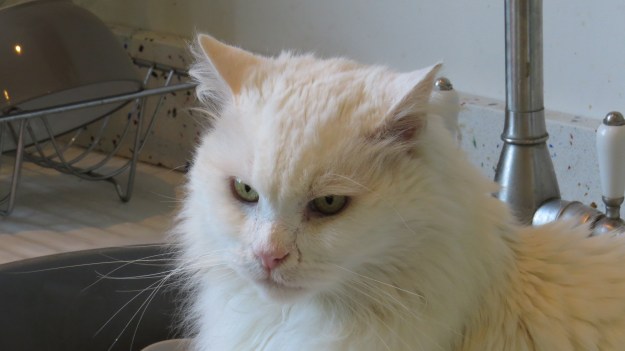
Bailey, the world’s most magnificent cat in 2017

Dear Readers, a few nights ago Bailey, the King of the Cats, went to sleep for the last time at the fine old age of nineteen years. He has been so much part of our life, and of the lives of many people who lived in the County Roads, that I wanted to pay tribute to him here.

I first met Bailey before we even moved to East Finchley. We were standing on the patio of what was to become our new home when we heard a loud and persistent miaowing issuing from the bushes. Up strode Bailey. He bobbed up for a head scritch, rolled on his back and then marched up to the back door, demanding to be let in. As it  wasn’t yet our house, we decided that this probably wasn’t the best idea, but once we were living there he became a regular visitor.

On one occasion I heard the voice of Bailey’s owner, followed by an all-too familiar wailing.

“Bailey! Come down from there. Don’t make a show of yourself”.

And there was Bailey standing on top of the ten-foot fence at the end of the side return. He had gotten up there, but seemed not to have worked out how he was going to get down. We humans stood and considered what to do. I tried standing on a chair but it wasn’t quite high enough. Fortunately at that point my six foot three inch tall husband arrived home from work, fetched a stepladder and rescued him. Carrying Bailey up the road to his actual house became part of our weekly routine. I think he regarded us as some kind of taxi service for when he was too tired to walk the last hundred yards home.

We soon made friends with Bailey’s actual family (or ‘subjects’ as I’m sure he thought of them). We were in regular contact, as Bailey developed a habit of wandering off. We never fed him, but other people did, and locating him became quite a problem. I am convinced that Bailey never thought of himself as a cat, but as a small furry human being. He would make himself at home on the armchair and watch benignly as I worked. He also loved sitting in the sink, normally (but not always) when there was nothing in it. We learned that what he loved was to drink from a running tap.

Bailey trying to get us to turn the tap on by telepathy.

Finally!

You would not believe that in these photos Bailey was already fifteen years old. He retained his elegant good looks for most of his life, and he was such a popular character on the street that everyone seemed to know his name. Well, you couldn’t really miss an extremely vocal pure-white cat who simply demanded to know who you were and what you could do for him. I had the sense that Bailey always knew what he wanted, and a bit more besides. We found we had a lot in common with Bailey’s owners, and we would probably never have found out how much if Bailey hadn’t ‘introduced’ us. He always seemed preternaturally wise to me.

As the years wore on, Bailey got a bit slower and a bit stiffer, like most of us, but he was still a regular visitor to the garden. The birds never bothered about him, and I never saw him try to catch anything. Other cats scattered at a glance. He would sometimes pay a visit to the garden ‘waterhole’ for all the world like a domestic lion.

Bailey drinking from the pond

He’d always march straight up to the back door and yowl to be let in. If he caught your eye from an upstairs window he would re-double his efforts.

Let me in!

In April this year he paid a visit to the garden. He was clearly a very elderly gentleman, and yet he still announced himself in the usual way,

He was very wobbly on his legs and so we called his ‘Dad’ who came to carry him home. It is so sad to see an animal towards the end of his days, and yet Bailey was a cat who defied pity; he was still the same regal cat that he’d been when we first met him eleven years ago. He loved people, was never happier than when he was plonked down in a patch of sunshine, and seemed to be of the opinion that everything had worked out for the best. He was, as Samuel Johnson said of his beloved cat Hodge, a very fine cat indeed.

R.I.P Bailey. The street is quieter, and much sadder, without you.