Monthly Archives: December 2021

Sunday Quiz – Musical Christmas Critters (and Plants)

The Schrankogel, a mountain in the Stubai Alps in Austria (Photo by Henk Monster)

Dear Readers, there are certain plants and animals that we seem to associate with winter in general, and Christmas in particular, so this week let’s see if you can identify what some song lyrics are going on about. All you need to do is to identify the animal(s) or plant(s) for one point each, and the song and artist for an additional two points. Please note that some of the songs feature more than one plant or animal, and I’ll give you a clue as to how many are in the song just to help out. Also, some plants and animals are featured more than once! Confusion reigns, I’m sure, but it’s Christmas, so don’t stress!

Answers in the comments by 5 p.m. UK time on Friday 17th December please, and I’ll post the answers on Saturday 18th December. I will disappear your answers as soon as I see them, so that they don’t influence the unwary :-).

I’ll post links to the songs in the answers so you can get your Christmas/winter celebration off to a musical start!

Onwards! Let’s see how we get on.

Song Lyrics

1.There’ll be no more sobbin’ when he starts a throbbin’ his old sweet song.

(Just one creature here)

2. Oh the rising of the sun
And the running of the deer

(Two plants here folks!) 

3. Tiny tots with their eyes all aglow
Will find it hard to sleep tonight

( I can count 2 plants and 2 animals in the lyrics to this song. Let’s see how you all get on)

4. The child is a king, the carolers sing
The old has passed, there’s a new beginning
Dreams of Santa, dreams of snow
Fingers numb, faces aglow

(Two plants – one specific and one generic)

5. You know Dasher and Dancer and Prancer and Vixen
Comet and Cupid and Donner and Blitzen
But do you recall
The most famous xxxxxx of all?

(One animal. But what an animal!)

6. Little xxxxx, little xxxxx
On the dusty road
Gotta keep on plodding onward
With your precious load

(One animal)

7. Have a happy holiday
Everyone dancin’ merrily
In the new old-fashioned way

(Hah! I can count 4 plants in the lyrics for this whole song. One of them is cooked, though :-))

8. Shadows painting our faces
Traces of romance in our heads
Heaven’s holding a half-moon
Shining just for us
Let’s slip off to a sand dune, real soon
And kick up a little dust.

(This one is a bit of a stretch but just think of the Three Kings! And there’s one Christmas animal here, and a plant that isn’t associated with the festive season, though I’ll give you an extra half-point if you can find it).

9. Fare you well my dear, I must be gone
And leave you for a while
If I roam away I’ll come back again
Though I roam ten thousand miles, my dear
Though I roam ten thousand miles.

(One Christmas bird and one generic plant)

10. You know I’m such a fool for you
You got me wrapped around your finger
Do you have to let it linger?
Do you have to, do you have to, do you have to let it linger?

(No plants or animals in the song, but what’s the name of the band? 🙂 )


Sunday Quiz – Evergreen – The Answers!

Conifers in Erlestoke Woods, Wiltshire (by Philip Reed)

Dear Readers, Mike from Alittlebitoutoffocus and Fran and Bobby Freelove both got a perfect 15 out of 15 this week, an evergreen collection of readers if ever I saw one. Thank you for playing, and I’m getting into a festive mood, so let’s see what we have for tomorrow…..

Photos

1) F) Scots Pine (Pinus sylvestris) Photo By Chris Eilbeck / Scots pine, Crow Wood.

2) B) Juniper (Juniperus communis) Photo by Dcrjsr, CC BY 3.0 <https://creativecommons.org/licenses/by/3.0>, via Wikimedia Commons

3) N) Heather (Calluna vulgaris) Photo by Mick Garratt

4) I) Strawberry Tree (Arbutus unedo)  Photo by Fabienkhan, CC BY-SA 2.0 <https://creativecommons.org/licenses/by-sa/2.0>, via Wikimedia Commons

5) C) Cedar of Lebanon (Cedrus libani)  Photo by Christine Matthews / Cedar of Lebanon, Forty Hall, Enfield

6) E) Norway Spruce (Picea abies) Photo by James St John at Picea abies (Norway spruce) 8 | Picea abies (Linnaeus, 1753)… | Flickr

7) M) Rhododendron (Rhododendron ponticum)  Photo by Colin Smith at Rhododendron Hedge © Colin Smith cc-by-sa/2.0 :: Geograph Britain and Ireland

8) H) Box (Buxux sempervirens) Photo by Derek Harper / Box hedges, Greenway

9) O) Cowberry (Vaccinium vitis-idaea)  Photo by By Jonas Bergsten – Photo taken by Jonas Bergsten using a Canon PowerShot G3., Public Domain, https://commons.wikimedia.org/w/index.php?curid=1233144

10) G) Holly (Ilex aquifolium)  Photo by Me haridas, CC BY-SA 4.0 <https://creativecommons.org/licenses/by-sa/4.0>, via Wikimedia Commons

11) A) Yew (Taxus baccata) Photo by David Skinner at Totteridge Yew | At around 2000 years, it’s said to be the o… | Flickr

12) D) Lawson Cypress (Chamaecyparis lawsoniana)  Photo by Rosser1954, CC BY-SA 4.0 <https://creativecommons.org/licenses/by-sa/4.0&gt;, via Wikimedia Commons

13) J) Ivy (Hedera helix) Photo by Evelyn Simak at Ivy (Hedera helix) © Evelyn Simak :: Geograph Britain and Ireland

14) L) Cherry Laurel (Prunus laurocerasus) Photo by Rosser1954 Roger Griffith, CC BY-SA 3.0 <https://creativecommons.org/licenses/by-sa/3.0>, via Wikimedia Commons

15) K) Gorse (Ulex europaeus)  Photo by Bernard DUPONT from FRANCE, CC BY-SA 2.0 <https://creativecommons.org/licenses/by-sa/2.0>, via Wikimedia Commons


Bah Humbug

Dear Readers, every year since 1947 the Norwegians have sent the people of London a Norway Spruce to put up in Trafalgar Square. It’s a way of saying ‘thank you’ for the support that we gave them during World War II. This year’s tree was felled by the Mayor of Oslo, Marianne Borgen and a bunch of (presumably well-muscled) school children, and was transported to England by the Norwegian authorities.

So, were we delighted that someone had gone to all that trouble to cheer us up? Well, some of us were, but others complained that the tree wasn’t symmetrical and had damaged branches. Words like ‘gift horse’ and ‘mouth’ come to mind. One person even asked what we’d done to upset the Norwegians?

Well, all I can say is ‘Bah Humbug’ to all the complainers. Someone goes to all the trouble to send you a tree and all you can do is moan? I imagine the tree will look lovely when it’s all spruced up (sorry).

Oh and look, here it is. The Norwegian government even thought (briefly) about sending us a new tree, but as the Mayor said, the important thing is the symbolism of the thing, which is about gratitude, and relationships between international neighbours. Isn’t Christmas meant to be about love, and generosity, and compassion, and all those other good things? Let’s hope that the Norwegians don’t take the opportunity to end this 63 year-old ritual. Then we’d have to find our own tree, and it would just about serve us right.

Plus, this living thing was hacked down from some peaceful spot in Norway by a gang of youngsters, bunged on the back of a lorry, thrown about as it crossed the North Sea and finally stood back up in Trafalgar Square as a centrepiece for people to get drunk around, and to scoff at. A little more respect, please!

And just look at that little star on the top, reminding us of what it’s all meant to be about. It’s enough to make you cry, if you’re that way inclined.


Parental Love?

Blue tit feeding great spotted woodpecker nestlings – photo by Phil Palmer, from British Birds Volume 114 issue 12

Dear Readers, you might remember how much I love British Birds magazine, and in this issue there were two tales of misplaced parental responsibility that I found absolutely fascinating. The first came from Pauline Hogg and Phil Palmer, who were at the Fairburn Ings RSPB reserve when they noticed a Great Spotted Woodpecker nest in a tree. To their astonishment, they noticed a rather nervous blue tit coming to the nest hole, and feeding the well-grown woodpecker chicks. Furthermore, it quickly became apparent that the lucky nestlings were being fed by two blue tits, a great tit and their actual parents.

It was noticed that, on the second day, the woodpecker parents seemed to want the youngsters to leave the nest – they brought food but then flew away with it to a nearby branch, seemingly in an attempt to persuade the chicks to fledge. However, the blue tits continued to bring green caterpillars to the nest, and the great tit appeared to bring moths. The woodpecker chicks showed no inclination to leave that day, and I can imagine the adult woodpeckers tapping their feet and getting very irritated. Both the blue and great tits seemed very nervous when feeding the woodpecker chicks, as well they might – woodpecker beaks are big, and sharp.

We don’t know the end of the story, but by the time that Mr Palmer and Ms Hogg visited again, the woodpeckers had fledged and the tits had gone. One possible explanation is that the blue/great tits had nested in the old woodpecker holes in the tree, but that the woodpeckers had then eaten their nestlings – certainly great spotted woodpeckers are notorious for drilling into nest boxes and taking the babies. Could it be that the instinct of the parents to provide food was so strong that they continued to feed? It seems not unlikely, but I guess we will never know.

Song Thrush feeding Pied Flycatcher chicks (Photo by Martin Garwood)

Another tale of misplaced parental enthusiasm was reported by Martin Garwood, who was actually looking for Purple Emperor butterflies in Dene Park, Kent, when he noticed a pair of pied flycatchers feeding well-grown youngsters in a nest. After a few minutes he went back to his butterfly-search, only to hear a kerfuffle by the nest. A song thrush with a beak full of invertebrates was attempting to feed the pied flycatcher chicks, with no success. Undaunted, the song thrush settled down to brood the nonplussed youngsters, while their parents tried everything they could think of to unsettle it. Eventually the thrush was disturbed by a passing cyclist but as it only moved a short distance away, I think we can guess that the same nonsense continued.

Pied flycatcher attempting to dislodge song thrush (Photo by Martin Garwood)

Was this a song thrush who had failed to breed, who had lost his/her own eggs, or who was just confused? Again, I suppose we will never know. What these two cases do point up, though, is the pressure that breeding birds are under, which can only be exacerbated by diminishing suitable habitat and continual disturbance. I sometimes think it’s a miracle that any birds actually manage to rear their young to adulthood. It also seems to me to be an indication of how complex the behaviour of birds is, and how little we understand it.

Wednesday Weed – Mistletoe

Mistletoe (Viscum album) in Somerset

Dear Readers, as Christmas is just around the corner I thought I’d share a few thoughts about mistletoe. What a strange plant this is! It’s associated with Christmas because it stays fresh and green even after the trees lose their leaves, but it has a longer association with fertility: the branches, foliage and seeds are said to resemble various sexual organs, though I must admit that I am having to squint to see much of a likeness, innocent soul that I am.

Photo One by By Agnieszka Kwiecień, Nova - Own work, CC BY 2.5, https://commons.wikimedia.org/w/index.php?curid=752332

Mistletoe fruit (Photo One)

Nonetheless, mistletoe has been used as a ‘cure’ for infertility (though as it’s toxic one would have to be very careful), as a charm for young women seeking to find husbands, and, of course, as an excuse for kissing. My latest issue of the Royal Horticultural Society (RHS) magazine has an article on mistletoe, which mentions that the kissing business probably started in the southwest Midlands, which is where mistletoe is commonest, and spread out from there, probably as a commercial enterprise, with the plant being taken to other parts of the country by the rapidly-growing railway network.

What intrigued me most in this article, however, was the story of how the mistletoe is spread. Mistletoe is a hemiparasite, which means that it derives its water and nutrients from its hosts, although it can photosynthesise itself. The plant seems to prefer hawthorn, apple, poplar and linden trees, though it has been found on hundreds of other species. The name ‘mistle’ comes from the plant’s association with thrushes, in particular the mistle thrush, which loves the fruit. It was long believed that mistletoe was spread by the birds wiping their beaks on twigs to get rid of the sticky substance that coats the seeds. However, it seems that mistle thrushes don’t do this, but simply excrete the seeds, only some of which will fall onto the correct type of branch and stick.

Photo Two by By Fir0002 (talk) (Uploads) - Fir0002 (talk) (Uploads), CC BY-SA 3.0, https://commons.wikimedia.org/w/index.php?curid=32885953

Sticky mistletoe seed (Photo Two)

Photo Three by By Yuriy75 - Own work, CC BY-SA 3.0, https://commons.wikimedia.org/w/index.php?curid=8897596

Mistle thrush (Turdus viscivorus) (Photo Three)

However, over the past few decades there has been a large increase in the range of mistletoe in the UK, and the reason cited in the RHS article (by Graham Rice) is the blackcap. These little warblers used to migrate in winter, but an increasing number are staying in the UK all year round. Not only do they love mistletoe, but they do wipe their beaks after eating the fruit.

Although mistletoe feeds from its host trees, it’s not generally seen as dangerous to them. Indeed, there is advice in the RHS article on how to persuade mistletoe to colonise your trees. So this seems like quite a happy partnership between the mistletoe and the blackcap.

Photo Four by By Charles J. Sharp - Own work, from Sharp Photography, sharpphotography.co.uk, CC BY-SA 4.0, https://commons.wikimedia.org/w/index.php?curid=104326583

Male blackcap (Sylvia atricapilla) (Photo Four)

Photo Five by By Vogelartinfo - Own work, GFDL 1.2, https://commons.wikimedia.org/w/index.php?curid=13276336

Female blackcap (Photo Five)

Mistletoes belong to the sandalwood family (Santalaceae), and I’d never really given any thought to whether there were other species. And of course, there are. In Southern Spain there’s the red-berried Viscum cruciatum or red-berried mistletoe.

Photo Six by By Nbauers - Own work, CC BY-SA 4.0, https://commons.wikimedia.org/w/index.php?curid=77809079

Red-berried mistletoe (Viscum cruciatum) (Photo Six)

In central and southern Europe there’s the yellow-berried mistletoe (Loranthus europaeus) which favours oak trees. The plants in the Loranthanceae family are known as ‘showy mistletoes’. I can see why.

Photo Seven by Stefan.lefnaer, CC BY-SA 3.0 <https://creativecommons.org/licenses/by-sa/3.0>, via Wikimedia Commons

Yellow-berried mistletoe (Loranthus europaeus) (Photo Seven)

Another ‘showy mistletoe’ is the Western Australian Christmas Tree (Nuytsia floribunda). This is a hemiparastic tree, of all things – it draws nutrients from the roots of any nearby plants that it can reach. Almost all species are susceptible to attack, but normally the tree only takes a small amount from each individual plant. It will even infiltrate underground cables. This is an extraordinary tree, revered by some of the Aboriginal peoples of the country, who used the bark for shields and harvested small amounts of the sticky gum that it exuded. The flowers, which can grow to up to a metre long, are favourites with pollinators

Photo Eight by By enjosmith - Flickr: WA Christmas Trees, CC BY-SA 2.0, https://commons.wikimedia.org/w/index.php?curid=30325757

Western Australian Christmas Trees (Nuytsia floribunda) (Photo Eight)

Photo Nine by By Photographs by JarrahTree...commons.wikimedia.org, CC BY 2.5 au, https://commons.wikimedia.org/w/index.php?curid=29752289

Nuytsia floribunda flowers abuzz with bees (Photo Nine)

And finally, there are the dwarf mistletoes, which are more closely related to ‘our’ mistletoe than the showy mistletoes above. These can be more serious pests of trees because they are considered to be disease-vectors. They don’t rely on birds to spread their seeds, but can shoot them at up to fifty miles an hour after building up thermostatic pressure within the plant. The species below, Arceuthobium oxycedri, grows on juniper, and can cause problems where the shrubs are being grown commercially (for example, for their berries to flavour gin).

Photo Ten by By Elie plus - Own work, CC BY-SA 3.0, https://commons.wikimedia.org/w/index.php?curid=27859735

Dwarf mistletoe (Arceuthobium oxycedri) growing on juniper in Lebanon (Photo Ten)

So there is a lot more to mistletoes than just our species, but of course, the plain old white-berried one is closest to my heart. And of course, it needs a poem. So how about this one, which is actually a song – the words are by Barry Cornwall, and the poem itself comes from a book called ‘Christmas with the Poets’ by Henry Vizetelly, published in 1851. It’s rather a rambunctious way to finish this post, but as winter comes we need to ‘banish melancholy’ in any way that we can, I find. I hope you enjoy it!

The Mistletoe

Words: Barry Cornwall

Source: Henry Vizetelly, Christmas With The Poets (London: David Bogue, 1851).

When winter nights grow long,
And winds without blow cold,
We sit in a ring round the warm wood fire,
And listen to stories old!
And we try to look grave (as maids should be),
When the men bring in boughs of the laurel tree.
O, the laurel, the evergreen tree!
The poets have laurels, and why not we!

How pleasant, when night falls down,
And hides the wintry sun,
To see them come in to the blazing fire,
And know that their work is done;
Whilst many bring in, with a laugh or rhyme,
Green branches of holly for Christmas time.
O, the holly, the bright green holly!
It tells (like a tongue) that the times are jolly!

Sometimes — (in our grave house
Observe, this happeneth not;)
But at times the evergreen laurel boughs,
And the holly are all forgot;
And then — what then? why, the men laugh low,
And hang up a branch of —— the mistletoe!
Oh, brave is the laurel! and brave is the holly,
But the mistletoe banisheth melancholy!
Ah, nobody knows, nor ever shall know,
What is done under the mistletoe.

Photo Credits

Photo One By Agnieszka Kwiecień, Nova – Own work, CC BY 2.5, https://commons.wikimedia.org/w/index.php?curid=752332

Photo Two by By Fir0002 (talk) (Uploads) – Fir0002 (talk) (Uploads), CC BY-SA 3.0, https://commons.wikimedia.org/w/index.php?curid=32885953

Photo Three By Yuriy75 – Own work, CC BY-SA 3.0, https://commons.wikimedia.org/w/index.php?curid=8897596

Photo Four By Charles J. Sharp – Own work, from Sharp Photography, sharpphotography.co.uk, CC BY-SA 4.0, https://commons.wikimedia.org/w/index.php?curid=104326583

Photo Five By Vogelartinfo – Own work, GFDL 1.2, https://commons.wikimedia.org/w/index.php?curid=13276336

Photo Six By Nbauers – Own work, CC BY-SA 4.0, https://commons.wikimedia.org/w/index.php?curid=77809079

Photo Seven by Stefan.lefnaer, CC BY-SA 3.0 <https://creativecommons.org/licenses/by-sa/3.0>, via Wikimedia Commons

Photo Eight  By enjosmith – Flickr: WA Christmas Trees, CC BY-SA 2.0, https://commons.wikimedia.org/w/index.php?curid=30325757

Photo Nine  By Photographs by JarrahTree…commons.wikimedia.org, CC BY 2.5 au, https://commons.wikimedia.org/w/index.php?curid=29752289

Photo Ten by By Elie plus – Own work, CC BY-SA 3.0, https://commons.wikimedia.org/w/index.php?curid=27859735

A Pet Story

Dear Readers, when I was growing up we had a variety of pets – a cat called Fuzzy, a dog called Spock, and a blue budgie called Fella. Fella lived in a cage on the sideboard for the whole of his life – we feared that if we let him out, either one of the other pets would get him or we’d never be able to get him back. My Mum remembered another caged bird that had escaped and had been chased around the room to try to recapture him until he’d died of fright. So Fella was permanently incarcerated in a cage about the size of a small suitcase.

As a child, I don’t remember him seeming to be unhappy. He loved his millet, and would chirp away to himself. But now and again he would go into a frenzy, squawking and flapping his wings, as if remembering what it was to fly. Feathers and dried droppings would go in all directions, and this was usually a cue to change the sandpaper on the bottom of the cage and generally tidy him up.

Fella must have died, but I don’t recall when – he didn’t come with us when we moved house when I was fifteen, so it must have been before then. I do remember that as I’d grown up, I started to have an aversion to keeping birds in cages – it seemed such a sad and limited life, such an imposition. We had the chance to enjoy the bird, but they got to do so little of what they had evolved to do. What depth of frustration was behind Fella’s ‘mad half hours’ as we used to call them?

And I was reminded of this again when I read this article about wild budgerigars in Australia. After the droughts and bushfires of the past few years, there has been a bumper wet season, and the birds are gathering in flocks up to 100,000 strong to drink, feed, pair up and make nests in the old red gum trees that they rely on (budgies are cavity-nesters, so need dead wood to nest in).

Steve Pearce, the photographer, describes how the sheer number of birds causes the air pressure to change, and the ‘whoosh’ as they fly past.

Budgerigars at a water hole – photo by Steve Pearce

What a rich and varied life these small parrots must lead! Of course, there are risks from hawks and other predators, from climate change and habitat destruction, and yet I have an inkling that any caged bird would prefer to take their chances living as evolution has designed them to do.

Hawk and budgerigars – Photo by Steve Pearce

We yearn for contact with nature, and yet so often we want it on our terms. When I was older and had money of my own, I kept reptiles and amphibians for a while. Sadly, you learn how to care for these creatures, with their complex needs, by trial and error, and it didn’t take me long to realise that my error could easily result in the death of a lizard or a frog, and so I stopped. Plus, where did these animals come from? Some may have come from breeders who were more experienced in the ways of animal husbandry than me, but how many were illegally harvested from the wild?

I think there has been something of a shift in the whole idea of pet keeping – more people take on rescue cats and dogs, and people who keep other animals get better advice about what their pets need. And it isn’t about loving them – I loved Fella, and my reptiles, and it didn’t give them a better life, because I didn’t know how to, and I didn’t take the time to find out.  Our sense of entitlement about the natural world, the idea that it is here to serve us and that that is its only value, is at the root of so much of what is wrong, from climate change to factory farming to the abandonment of ‘lockdown pets’ now that people are going back to work. I applaud that so many more people are thinking about these questions, and are considering other ways to be in relationship with the natural world. A change of attitude can’t come soon enough.

Photo by Steve Pearce

And if you would like to actually see the budgerigar murmuration, head over to this link to see it all happening….

A Bright Saturday in St Pancras and Islington Cemetery

Dear Readers, in winter you have to take your pleasures where you find them, and often nature has a way of hiding beautiful things in plain view, as if inviting us to take our time and pay attention. I was really struck by this skeletal leaf, eaten down to its skeleton by some little detritivore, possibly a slug. I love the way that you can see the intricacy of the structure of the leaf, and the way that it has folded over into itself like a little cage.

And there are still spiders’ webs everywhere, such as the one completely encasing some of the florets on this cypress.

In fact, once you get your eye in the webs are everywhere….

But not all the pleasures are small scale. Of course I had to wander past the swamp cypress to see how it was looking. The whole of the woodland burial site is carpeted in its russet leaves, but there are still plenty more to fall.

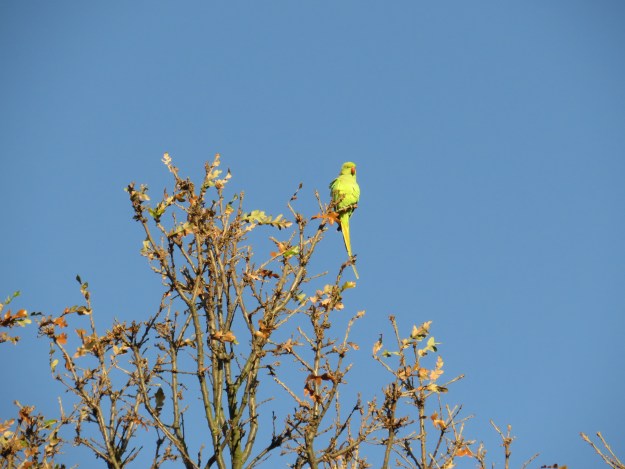
And then, how about this bird! He seemed a bit lost, as if he’d somehow been left behind when the rest of the flock headed off to mangle some Spanish chestnuts or cause havoc somewhere else.

I will never get over the sight of a bright green parrot at the top of an oak tree. I’m sure even a hundred years ago it would have seemed impossible. This parakeet seems very plump though so I imagine he’s doing ok. And after a few minutes he found his little friends and the whole lot of them flew off with all the kerfuffle that I associate with parrots. I have never yet met a shy, quiet, discreet member of the parrot family, though possibly they exist. Do let me know, Readers! I know that my Australian friends have parrots, cockatoos, budgerigars and all manner of Psittacines busting out all over. Are they all as gregarious and chatty as these ring-necked parakeets seem to be?


Sunday Quiz – Evergreen

Conifers in Erlestoke Woods, Wiltshire (by Philip Reed)

Dear Readers, at this time of year I am always grateful for trees that keep their leaves through the winter, providing shelter for birds and insects and a touch of green when everything else is so grey. But I am not always sure what I’m looking at, and so this week I thought I’d challenge us all to see how many evergreen plants we can identify. I’m making this multiple choice, as who has time in the run up to Christmas to mess about? Let’s see how we get on.

As normal (if I can get it right this week for a change), you will have until 5 p.m.UK time next Friday (10th December) to submit your answers in the comments, and as usual I shall make them disappear as soon as I see them. Answers will be posted on Saturday 11th December.

So, if you think that the plant in photo 1 is a yew, your answer is 1) A).

Onwards!

Plants

A) Yew

B) Juniper

C) Cedar of Lebanon

D) Lawson Cypress

E) Norway Spruce

F) Scots Pine

G) Holly

H) Box

I) Strawberry Tree

J) Ivy

K) Gorse

L) Cherry Laurel

M) Rhododendron

N) Heather

O) Cowberry

Photos

1)

2)

3)

4)

5)

6)

7)

8)

9)

10)

11)

12)

13)

14)

15)

Sunday Quiz – Monochrome…..The Answers

Title Photo by Miraceti, CC BY-SA 3.0 <https://creativecommons.org/licenses/by-sa/3.0>, via Wikimedia Commons

Black-headed gull (Title Photo)

Hi lovely people, well with typical brilliance I posted these answers (briefly) on the wrong day, but here they are for real. Who would guess that this simple little quiz would throw up so many varied answers? However, as usual everyone did extremely well. Claire got 21 1/2 out of 32, Sharon got 27 out of 32, but the joint winners this week are Anne and Fran and Bobby Freelove with 30 out of 32. I struggled a little to be fair with the answer to number 12, where both Anne and Fran and Bobby looked at the plant rather than the bee sitting on it :-). As I’d said that there were 8 ‘black’ answers and 8 ‘white’ answers (and for once I hadn’t messed up the count) I decided to disallow the answer of ‘black knapweed’ though I can see exactly why it was chosen. Anyhow, let’s see what’s coming tomorrow. I’m starting to feel in a Christmassy mood, so who knows 🙂

1) Black-footed ferret (Mustela nigripes)

2) Black Bryony (Dioscorea communis)

3) White Admiral (Limenitis arthemis)

4) Black Poplar(Populus nigra)

5) Whitethroat (Sylvia communis)

6) White-fronted goose (Anser albifrons)

7) Black horehound (Ballota nigra)

8) White dead-nettle (Lamium album)

9) Black tern (Chilidonias nigra)

10) Whitebeam (Sorbus subg. Aria)

11) Blackthorn (Prunus spinosa)

12) White-tailed bumblebee (Bombus lucorum)

13) Black widow (Latrodectus sp. )

14) White-tailed deer (Odocoileus virginianus)

15) White stork (Ciconia ciconia)

16) Greater Black-backed gull (Larus marinus)

Photo Credits

Title Photo by Miraceti, CC BY-SA 3.0 <https://creativecommons.org/licenses/by-sa/3.0>, via Wikimedia Commons

Photo One by USFWS Mountain-Prairie, CC BY 2.0 <https://creativecommons.org/licenses/by/2.0>, via Wikimedia Commons

Photo Two by Tony Atkin / Black Bryony Berries

Photo Three by D. Gordon E. Robertson, CC BY-SA 3.0 <https://creativecommons.org/licenses/by-sa/3.0>, via Wikimedia Commons

Photo Four from Meath Garden’s black poplar – ‘the most important veteran tree in Tower Hamlets’ — Roman Road LDN (romanroadlondon.com)

Photo Five by By Andreas Trepte – Own work, CC BY-SA 2.5, https://commons.wikimedia.org/w/index.php?curid=32563057

Photo Six by Ryanx7, CC BY-SA 4.0 <https://creativecommons.org/licenses/by-sa/4.0>, via Wikimedia Commons

Photo Seven by Evelyn Simak, CC BY-SA 2.0 <https://creativecommons.org/licenses/by-sa/2.0>, via Wikimedia Commons

Photo Eight by Franco Folini from San Francisco, USA, CC BY-SA 2.0 <https://creativecommons.org/licenses/by-sa/2.0>, via Wikimedia Commons

Photo Nine by Andy Reago & Chrissy McClarren, CC BY 2.0 <https://creativecommons.org/licenses/by/2.0>, via Wikimedia Commons

Photo Ten by Matt Brown at Whitebeam | Matt Brown | Flickr

Photo Eleven by Evelyn Simak / Blackthorn or sloe (Prunus spinosa)

Photo Twelve by Ivar Leidus, CC BY-SA 4.0 <https://creativecommons.org/licenses/by-sa/4.0>, via Wikimedia Commons

Photo Thirteen by Chuck Evans(mcevan)”., CC BY 2.5 <https://creativecommons.org/licenses/by/2.5>, via Wikimedia Commons

Photo Fourteen by Henry Mulligan, CC BY-SA 3.0 <https://creativecommons.org/licenses/by-sa/3.0>, via Wikimedia Commons

Photo Fifteen by Dick Daniels (http://carolinabirds.org/), CC BY-SA 3.0 <https://creativecommons.org/licenses/by-sa/3.0>, via Wikimedia Commons

Photo Sixteen by Des Colhoun at Great Black-backed Gull (Larus marinus) © Des Colhoun :: Geograph Britain and Ireland

Eleven New Bird Species on the UK Red List

Photo One by Ken Billington, CC BY-SA 3.0 <https://creativecommons.org/licenses/by-sa/3.0>, via Wikimedia Commons

Swift (Apus apus) (Photo One)

Dear Readers,  we had a bit of good news a few days ago, but we have to take the rough with the smooth, and the latest ‘Birds of Conservation Concern‘ publication from the British Trust for Conservation has some sorry news about the decline of some of our most familiar species. The last report was in 2015, and since then eleven species in total have been added to the Red List, making a total of 70 species considered to be at risk of extinction in the UK.  As usual, the reasons for the changing status of the birds are varied, but they’ve certainly given me pause and made me consider what, if anything, I can do personally to help.

Photo Two by By Andreas Trepte - Own work, CC BY-SA 2.5, https://commons.wikimedia.org/w/index.php?curid=40871366

House Martin (Delichon urbicum) (Photo Two)

Six species have been red listed for the first time because of worsening declines in their breeding populations. House Martins and Swifts are both listed, and the reasons for their declines include the fall in the insect populations across the whole of their migratory range and the worsening quality of their stopover sites and wintering grounds. This view is supported by the fall in numbers of those other migratory insectivores, nightingales and cuckoos (already on the Red List).

I am always personally horrified by the destruction of martin and swallow nests  by householders who can’t tolerate the mess at the nesting sites. As usual, the answer to the falling insect population is bigger than just us, but providing for not just pollinators but insects in general in whatever gardens we have is important, plus encouraging  councils to plant something other than generic geraniums and begonias. I may well pop up a swift nesting box as well, as I know some people have had success with them, especially when the swifts are encouraged to ‘pay attention’ by the playing of the calls of breeding pairs. I’d love to know if any of you have had any success!

Photo Three by Charles J. Sharp, CC BY-SA 3.0 <https://creativecommons.org/licenses/by-sa/3.0>, via Wikimedia Commons

Greenfinch (Carduelis chloris) (Photo Three)

Greenfinches have also suffered a catastrophic fall in numbers, moving straight from the Green list to the Red list in the space of 6 years. This is largely  due to the digestive diease trichomonosis. The report notes that this disease is also now prevalent in collared doves and  chaffinches, and in sparrowhawks which eat all these species. The best advice is to regularly clean all feeders, to take all feeders down for at least a week if you spot a sick bird. It has been several years since I’ve seen one in the garden.

Photo Four by Jan Frode Haugseth, CC BY-SA 3.0 <https://creativecommons.org/licenses/by-sa/3.0>, via Wikimedia Commons

Ptarmigan (Lagopus muta) (Photo Four)

Another new bird to the list is the ptarmigan – this is not unexpected as montane species are the most affected by climate change. As snow cover becomes less common in winter, the white colouration of these birds is less effective as camouflage, making them more vulnerable to predators, plus their food plants are also affected. There’s not much that I can do to protect the poor old ptarmigan, except to keep donating to the RSPB.

Photo Five by Maga-chan, CC BY-SA 2.5 <https://creativecommons.org/licenses/by-sa/2.5>, via Wikimedia Commons

Bewick’s swan (Cygnus columbarius bewickii) (Photo Five)

And, although  I have a large-ish pond, there’s not much I can do to help the declining Bewick’s swan either, nor the Dunlin or the Smew, all Red-List newcomers. All  three species are winter migrants to the Uk from Scandinavia and the Baltic regions in ‘normal’ times.  Some of these birds might not be showing up in the UK any more because climate change means that conditions are not so harsh,  and so they don’t have to travel so far to find food, showing that warming temperatures will produce winners and losers. However, there does seem to be a more general decline in these species, which is being investigated. As all of them are dependent to some degree or another on water quality and wetland habitat, I suspect that the dgradation of these habitats along their migration routes may have a part to play,

Photo Six by By Schlawe, C - This image originates from the National Digital Library of the United States Fish and Wildlife Serviceat this pageThis tag does not indicate the copyright status of the attached work. A normal copyright tag is still required. See Commons:Licensing.See Category:Images from the United States Fish and Wildlife Service.U.S. Fish and Wildlife Service, Public Domain, https://commons.wikimedia.org/w/index.php?curid=871413

Leach’s Storm Petrel (Hydrobates leucorhous) (Photo Six)

Other new bird species with the dubious ‘honour’ of joining the Red List include the Purple Sandpiper, the Goldeneye and Montagu’s Harrier. The final newcomer is Leach’s Storm Petrol, a tiny sea-faring bird with 90% of the UK population breeding on the remote island of St Kilda. I suspect that the decline in this bird, along with many of our oceanic species, is a result of the decline in the small fish and marine microorganisms that the birds eat.

Song thrush (Turdus philomelos)

Fortunately it isn’t all bad news: the Pied Flycatcher, Song Thrush, Grey Wagtail and Redwing all have breeding populations that have recovered enough to move them from the Red List to the Amber List, while the Kingfisher, Mute Swan and Red Grouse have moved from Amber to Green. I would love to know if the increase in the Red Grouse numbers has come at the cost of the breeding success of birds such as the Hen and Montagu’s Harrier, who often turn up dead in mysterious circumstances on grouse moors. Still, we should applaud successes when we see  them, because it’s clear that habitat conservation and restoration is one of the best ways to nurture the insects and detritivores who are so important in the food chain. I was also heartened by the news today that UK farmers are going to be paid to nurture their soils though I also note that environmentalists have condemned the measures as ‘puny’, and that they include a lot of measures that many farmers are already doing, such as growing cover crops over winter rather than leaving the soils bare.

It all seems overwhelming sometimes, doesn’t it? But I still maintain that nature is resilient and that we can all do our bit, even if it’s just a pot of lavender or leaving a corner of the lawn unmown. For any one in the UK wanting a bit of inspiration, can I suggest this lovely programme, which over two episodes tracks one man’s efforts to turn an acre of scrub into a wildlife haven in his native Ireland? We don’t all have an acre, but there are some great ideas that could easily be scaled down. And it has some wonderful photography, as you might expect from a wildlife cameraman.

https://www.bbc.co.uk/programmes/m0011pss

Photo Credits

Photo One by Ken Billington, CC BY-SA 3.0 <https://creativecommons.org/licenses/by-sa/3.0>, via Wikimedia Commons

Photo Two By Andreas Trepte – Own work, CC BY-SA 2.5, https://commons.wikimedia.org/w/index.php?curid=40871366

Photo Three by Charles J. Sharp, CC BY-SA 3.0 <https://creativecommons.org/licenses/by-sa/3.0>, via Wikimedia Commons

Photo Four by Jan Frode Haugseth, CC BY-SA 3.0 <https://creativecommons.org/licenses/by-sa/3.0>, via Wikimedia Commons

Photo Five by Maga-chan, CC BY-SA 2.5 <https://creativecommons.org/licenses/by-sa/2.5>, via Wikimedia Commons

Photo Six by By Schlawe, C – Images from the United States Fish and Wildlife Service.U.S. Fish and Wildlife Service, Public Domain, https://commons.wikimedia.org/w/index.php?curid=871413