Monthly Archives: March 2022

Frog News!

Dear Readers, it’s been really cold this week so the frogs  stopped their libidinous activities and spent most of their time torpid on the bottom of the pond. But today has dawned sunny and fairly mild, and the frogs have responded by coming to the surface and singing (you can just see this one’s white throat, which inflates when he sings and is a clear visual signal that he’s an available male).

The males are everywhere, but there’s no frogspawn yet – I’m guessing the water has to reach an optimum temperature before the females will release their eggs. There’s lots of time yet!

And in other news, the pond skaters are back too. No doubt they’ll be waiting for some frogspawn or tiny tadpoles for their lunch, but they’ll have to be patient.


Pond skaters

And in other news, the garden is absolutely full of small birds – chaffinches, goldfinches, blue tits, starlings, and four blackbirds who seem to have made an uneasy truce by dividing the garden down the middle.

Male chaffinch

Blue tit

Starling

I was going to record the song of the starling for you all, but every time I started a blooming plane went over. Who remembers those days at the start of the first lockdown when there was barely a contrail in the sky? In the time that I was trying to capture this bird ticking and whistling away, four planes went over my house with barely twenty seconds between. Meantime, my poor husband who has been so careful about getting Covid went to the pub for a leaving event last week, and has now tested positive for Covid. He’s ok – it seems to manifest as a bad cold and cough, and he’s triple vaccinated – but according to our rules in the UK it would be quite legal for him to go into work and give Covid to everybody else. Of course he won’t, because he has the option not to, but there’s now no legal protection for someone who works in a shop or as a cab driver or in any of the service industries to say that they aren’t working because they have Covid – their employer can simply order them into work regardless. Meantime, the cases for the over 55s are rocketing. Don’t let anyone tell you that it’s over and that we can all just get back to ‘normal’, because it’s clear that we can’t, and what is a minor inconvenience for my husband (and probably me when I get it, though I’m clear so far) can mean hospitalisation or worse for someone with a compromised immune system, or simply someone who is elderly or unwell.

Harrumph! Forgive the rant, please. I don’t know about anyone else, but the terrible things that are going on in Ukraine, climate change and the pandemic are enough to raise anyone’s anxiety levels through the roof. I donate to Ukraine charities, I work for a climate change organisation and yet it never feels like enough. But today I made myself sit in the garden and watch the birds and the frogs for half an hour, because I don’t think it serves anyone if I become mired in despair. Look after yourselves, readers. That hoary old cliche about putting your oxygen mask on first applies as much as it ever did.


Strident Delphiniums and Slightly Sinister Fritillarias

Still life by Jan van Huysum

Dear Readers, I was  crunching my way through the first volume of William Feaver’s biography of Lucian Freud (all 600-odd pages of it), when I read this quote by Cedric Morris, founder of an art school that Freud went to as a young man. Mainly a painter of flowers and landscapes, Morris had what Feaver describes as a ‘waspish glee’ in crushing any idea that he liked painting plants because they were ‘pretty’:

“The aspect of belles et jolie fleures, or charming, gay, lovely, etc., mean no more to me than such  qualities do in natural reaction to life in general: it is the attributes of grimness, ruthlessness, lust and arrogance that I find and, above all, the absence of fear in their kingdom”. 

He goes on to describe some what is involved in producing a floral portrait:

“Be he able to express the blowzey (sic) fugitiveness of the poppy as could Jan van Huysum, the slightly sinister quality of fritillarias as Breughel the Elder, or the downright evil of some arums, the elegance, pride and delicacy of irises, the strident quality of delphiniums, the vulgarity of some double peonies, chrysanthemums, roses and most dahlias…..all this and much more the flower painter has to do”.

Well, Readers, I found this all very interesting. Whenever we look at a plant we clearly see it through the filter of our times and experiences, and it takes a tremendous strength of will to just see a flower as it is. Everything in the natural world labours under the weight of our expectations and projections, from the sly fox to the innocent lamb, the peaceful dove to the noble lion. It takes a special kind of worldview to see a rose as ‘vulgar’, or a delphinium as ‘strident’.

Photo One by Opioła Jerzy, CC BY-SA 3.0 <http://creativecommons.org/licenses/by-sa/3.0/>, via Wikimedia CommonsOpioła Jerzy, CC BY-SA 3.0 <http://creativecommons.org/licenses/by-sa/3.0/>, via Wikimedia Commons

Some strident delphiniums (Photo One)

And, with our stop-motion cameras we can now observe the way that plants do battle in order to beat their competitors and access scarce resources such as light or nutrients, and also how they cooperate with one another – if you are able to access David Attenborough’s series ‘Green Planet’ I heartily recommend it. The denizens of the plant kingdom clearly have a much broader range of behaviours than we ever knew. However, to describe a plant as perfectly adapted to its environment as an arum as ‘evil’ seems to be taking anthropomorphism rather too far, even when it’s as midnight black as the one below.

Photo Two by By [https://www.flickr.com/people/15845498@N00 Se�n A. O'Hara] from Berkeley, CA, USA - ????? ?????????, ??? ?????????, Arum palaestinumUploaded by berichard, CC BY 2.0, https://commons.wikimedia.org/w/index.php?curid=10628149

Arum palaestinum (Photo Two)

And yet. There is clearly a relationship between human beings and plants that it’s difficult to deny, at least from the human side. I was deeply sad when this lime tree fell in the recent storms – it had been a source of solace to me during Mum and Dad’s last years, and it always cheered me up. When I stood under its branches and listened to the drowsy humming of the bees feeding on its flowers, I felt cocooned and protected. I strongly suspect that the fondness was all in one direction, but there was no doubting that this tree was an individual. There are increasing calls for animals such as dolphins and apes to be granted ‘personhood’. I wonder if there will ever be an equivalent ‘personhood’ for plants, especially trees? It would be one way to protect them as every council in the country seems hell bent on cutting them down.

Lime tree, Milborne St Andrew.

And is it impossible that plants have a relationship with us? On one level the answer is clearly yes, it’s impossible – plants don’t have brains, or nerves, or any of the other prerequisites for emotions. But as we learn more and more about the ‘wood-wide web’ (the way that trees can communicate with one another via the complex network of fungi that link them underground), I do wonder if plants have a much wider range of ‘feelings’ than we give them credit for. I also have friends who spend enough time with individual plants to start to ‘know’ them in a way that most of us don’t.

And in a way, whether a two-way relationship between us and plants exists is not really the question here. I believe that spending time with a particular landscape, or with particular plants, deepens our relationship with them. Drawing or painting a plant is another way to get to  know them. We start to notice, and to care, and it starts to feel personal. What we’re looking at is no longer ‘just’ a patch of brambles or a hornbeam tree, but something much more individual, with its own quirks and ways of growing and reacting to its environment. This noticing is the beginning of a deepening love and care for what’s right outside our door. And in spite of what Morris says at the beginning about how a plant painter needs to look at his or her subject, I can’t help thinking that what shines through in his iris paintings is nothing short of pure affection for his favourite plants.

Photo Three from https://gardenmuseum.org.uk/exhibitions/coming-soon-cedric-morris-artist-plantsman/

May Flowering Irises No 2 (1935) by Cedric Morris (Photo Three)

There is an interesting article about Cedric Morris as a plantsman and painter here.

Photo Credits

Photo One by Opioła Jerzy, CC BY-SA 3.0 <http://creativecommons.org/licenses/by-sa/3.0/>, via Wikimedia Commons

Photo Two by By [https://www.flickr.com/people/15845498@N00 Se�n A. O’Hara] from Berkeley, CA, USA  Arum palaestinum Uploaded by berichard, CC BY 2.0, https://commons.wikimedia.org/w/index.php?curid=10628149

Photo Three from https://gardenmuseum.org.uk/exhibitions/coming-soon-cedric-morris-artist-plantsman/

Wednesday Weed – Photinia

Photinia x fraseri ‘Red Robin’

Dear Readers, in the spring time it’s so easy to get carried away by the bulbs and the blossom that I fail to notice the new growth on some of the shrubs and trees around me. And so, on a bright but cold day, I was suddenly brought up short by the shiny, perfect crimson growth on this Photinia. The ‘Red Robin’ variant is the one most often seen, but my RHS magazine this week points out a couple of other varieties too.

This one is known as ‘Pink Marble’ or ‘Cassini’ – the bright red leaves are streaked with vivid pink, turning to white as the leaves mature.

And this one is known as ‘Crunchy’ – the leaves are serrated and emerge copper-brown, turning to chestnut and then green. This is derived from a different Photinia species from the usual Photinia x fraseri cross – Photinia serratifolia is otherwise known as the Chinese or Taiwanese Hawthorn, and has those very spiky, rather striking leaves.

Photinias are members of the rose family, and their name derives from the Greek for ‘shiny’. The wild plant comes from the warm, temperate parts of Asia, from the Himalayas east to Japan, and south to India and Thailand. There are about 60 species of Photinias, all of them shrubs or small trees. In addition to their very attractive spring foliage, a happy Photinia will reward the gardener with a mass of white flowers in the summer, followed by berries which are very popular with thrushes, starlings and waxwings, and which may stay on the plant right through the winter (hence the alternative name ‘Christmas Berry’).

A Photinia in full flower (Public Domain)

The leaves of some species contain cyanide, but this doesn’t stop them being munched upon by the caterpillars of the Common Emerald, Feathered Thorn and Setaceous Hebrew Character moths. This last moth is so named because it was thought that it had the Hebrew Character ‘Nun’ on its wings( נ). I note that some species of Photinia are mentioned as herbal remedies, for everything from worms to piles, but I must confess that I find the cyanide thing a bit disconcerting. I note that at least one website also mentions that the plant is considered to be ‘excessively aphrodisiac’, so don’t say I didn’t warn you.

Photo One by By Lamiot - Own work, CC BY 3.0, https://commons.wikimedia.org/w/index.php?curid=4352407

Common Emerald (Hemithea aestivaria) (Photo One)

Photo Two by By Hectonichus - Own work, CC BY-SA 3.0, https://commons.wikimedia.org/w/index.php?curid=17370251

Feathered Thorn (Colotois pennaria) (Photo Two)

Photo Three by By Please report references to olei@despammed.com. - Own work, CC BY-SA 2.5, https://commons.wikimedia.org/w/index.php?curid=1186278

Setaceous Hebrew Character (Photo Three)

In his book ‘London’s Street Trees’, Paul Wood mentions that Photinia, though normally seen as shrubs, are becoming more popular as small street trees, and indeed I found some when I was doing my Archway Street Tree Walk back in 2017. I think they make rather pleasant additions to the landscape, and no doubt the birds will be delighted.

Photinia x fraseri ‘Red Robin’

I imagine the autumn colour will be quite something as well.

And now readers, a poem. I thought that finding a poem that specifically mentioned Photinia would be something of a struggle, but I had reckoned without the Society of Classical Poets. They are on a mission to preserve the attributes of metre and rhyme in poetry and while I recognise that poets are a varied lot, and that finding a definition of poetry that works for everyone is almost impossible, I applaud their zest and enthusiasm. I rather like a poem that rhymes and has that satisfying sense of rhythm – such poems seem to stay in the head for longer, and are certainly easier to learn. And so here is my Photinia-related poem by David Watt, a poet from Canberra, Australia. I hope you enjoy it as much as I did.

Hedge Theory by David Watt

The hedge plants are trimmed by a gardener with shears
As they have been, like clockwork, for twenty-five years.
Yet they push out new shoots in continuing hope
Of extending their reach through the fence on the slope;

Protruding through uprights, with glossy new tips,
Their ruby leaves follow, like sensuous lips;
Curved in the middle and quivering so
From the gentlest of breeze, as it moves down the row.

When the gardener arrives, I expect the hedge moans:
“Can’t you see that we’re covering ironwork bones?
Softening edges gives purpose for hedges,
And Nature gives pleasure wherever her edge is.

“Borders are fitting for nations and states,
The banks of a river, or dinnerware plates;
But not for Photinia branches and stems,
Or sweet-smelling flowers in white diadems.

“The feature we share, let us not be mistaken,
Is to never give up though our dreams are forsaken—
When time and again every effort is met
By failure to further our reach past regret.
In fact, we have assets that few would suspect:
An underground network, and time to reflect

“On theory developed from close observation,
A lifetime of fieldwork, and growing frustration;
Which holds that our gardener grows brittle with age,
And little by little, he’s reaching the stage
Where lifting a cutter may shatter a limb—
Soon he will discover the joke is on him!”

Photo Credits

Photo One by By Lamiot – Own work, CC BY 3.0, https://commons.wikimedia.org/w/index.php?curid=4352407

Photo Two by By Hectonichus – Own work, CC BY-SA 3.0, https://commons.wikimedia.org/w/index.php?curid=17370251

Photo Three By Please report references to olei@despammed.com. – Own work, CC BY-SA 2.5, https://commons.wikimedia.org/w/index.php?curid=1186278

Slug News!

‘Slugs’ outside Tate Britain in 2018 – created by artist Monster Chetwynd, photo from The Guardian https://www.theguardian.com/artanddesign/2018/nov/30/the-most-wonderful-slime-of-the-year-tate-britains-giant-christmas-slugs

Dear Readers, it’s been a while since I wrote about slugs, our slimy molluscan ‘friends’, and so with perfect synchronicity I came across two articles with differing points of view this week. The first was in my New Scientist, where American slug expert Rory McDonnell was revealing some very interesting research on how to deter slugs in vegetable gardens and farms. While slugs that are native to a country have largely evolved to become part of the ecosystem and play an important role in breaking down decaying and dead vegetation, other species can become invasive and damaging, and climate change is also affecting the balance of invertebrates worldwide.

McDonnell points out that the number one go-to solution for slug and snail damage across the world is the use of slug pellets, which usually contain metaldehyde. This is poisonous to pets, but also to hedgehogs, song thrushes, frogs and the many other creatures that eat slugs, including some insect predators such as ground beetles. Metaldehyde pellets will be banned in the UK from early this year, though they are still legal in the US. Iron phosphate is approved as an organic solution, but there’s evidence that it could be toxic to earthworms.

Nematodes seem to be a better solution – the  species used are native to Europe and seem to target slugs and snails very specifically. McDonnell has found the same nematode species in California and Oregon,  but wants to be very sure that the nematodes only kill the pest species of slugs and snails, which has always been my worry about using them here in the UK – only 9 out of the 44 species of slug eat garden plants and some of them, such as the elegant leopard slug, actually eat other slugs. It would be a shame to blast all the molluscs in the garden when only a few are actually eating the lettuces.

Photo One by By Michal Maňas - Own work, CC BY 2.5, https://commons.wikimedia.org/w/index.php?curid=7984616

Leopard Slug (Limax maximus) (Photo One)

However, McDonnell does have a home-grown solution for attracting slugs and snails that he thinks will work world-wide – bread dough. McDonnell found that a mixture of yeast and flour, mixed with water and turned into dough balls, attracts more slugs and snails than anything else that they’ve tried, including slug pellets, beer, decomposing fruit and cat food. Once the hungry molluscs are gathered together, it’s relatively easy to dispose of them, if you are so inclined, or to re-home them if you have a handy bit of wasteland a good way away. Bear in mind that snails, in particular, can find their way home from up to half a mile away, so you might want to pop your molluscan migrants onto the panier of your bicycle and head off into the wilds. Also, as McDonnell notes that they collected 18,000 molluscs over 2 nights, you might need a big panier.

In other news, I note that the Royal Horticultural Society has decided to no longer designate any garden inhabitant as a ‘pest’. Hooray! Although more people complain about slugs and snails than any other animal, the RHS has (belatedly in my view) come to the conclusion that molluscs are an important part of the healthy garden ecosystem, and that, as with aphids and caterpillars, not only are they impossible to eliminate altogether but they attract lots of beneficial visitors such as ladybirds, birds and hedgehogs. The RHS’s advice to those who have slug and snail damage is:

  • Grow plants on so that they are older and less tender – slugs do love a delicate seedling. Cloches are also seen as a useful deterrent.
  • Slugs are excellent for compost heaps, so they could be collected at night and thrown into the compost. Whether they stay there is anybody’s guess. I suspect this could be combined very well with the bread dough technique.
  • ‘Strategic planting’ – put the plants that the slugs love best close to the plants that you’re trying to preserve, in the hope that the slugs will be distracted by their favourite food.
  • Dig a pond to encourage the frogs! I have never in my life actually seen one of my many, many frogs eat a slug but they are much more active at night, so maybe they mop them up when I’m in bed. Dig a pond anyway, they are such a source of delight.
  • Encourage the birds! Song thrushes do love a snail, but I’m not sure what other snail specialists there are out there. Let me know if any of your garden birds have been spotted with a slug.
  • And here’s one I hadn’t thought of – rake over the leaves in the autumn to expose any slug or snail eggs, so that the birds will eat them. In my experience most of the slug and snail eggs are laid on any open or torn bags of compost that I have, so it’s always worth looking at them too.

Garden snail (Cornus aspersa)

I know that for many of us trying to keep some kind of balance in the garden, so that it’s welcoming to all kinds of wild creatures without it being overwhelmed by any one kind, is a constant task. Any ecosystem is so finely tuned, and so susceptible to the vagaries of climate and the arrival of new species that it’s easy to just throw up our hands in despair. I do think, though, that given time things rebalance. I am reminded that two years ago my buddleia were so inundated with aphids that the honeydew rained down on the wheelies bins like glue. Last year, there were hundreds of ladybirds and hoverfly larvae – there were still too many aphids but there were less, and they lived for a shorter period of time before being eaten. Who knows what will happen this year? I have avoided the ‘scorched earth’ tactic of blasting everything with chemical sprays because I want that build-up of predators and that rebalancing, but I know that it comes at the expense of things looking as good as they should. But for me, the garden is home to a whole variety of animals, plants and fungi, and I want it to be a welcoming one. As spring gets going, let’s see what happens this year.

You can read the whole Rory McDonnell interview in New Scientist here – you might have to register, but it’s free.

The RHS article is here.

Photo Credits

Photo One By Michal Maňas – Own work, CC BY 2.5, https://commons.wikimedia.org/w/index.php?curid=7984616

An Exciting Walk in St Pancras and Islington Cemetery

Dear Readers, there was lots to see in the cemetery on Saturday, most of it centred around the bird life. We were barely through the gates when we noticed this crow, getting stuck into a mystery fruit. At first I thought  it might be a mango, but on balance I’ve decided it was an orange. Who knew that crows had a taste for citrus? I love the way that the crow is keeping the fruit under control with his or her foot.

Normally the crows are pretty shy, but this one was clearly too involved in eating to be put off by me and my camera.

Then, I was looking at the blossom (which is rather fine at the moment) when my husband said ‘what’s that bird with the red head?’

And yes it was a green woodpecker, usually a very elusive bird. This one was digging up ants as if they were going out of fashion – the wet weather has made the soil a bit easier to hammer into. The bird was completely engrossed in its task, but was moving so quickly that it was hard to get a decent shot. Some birds seem to live on a slightly faster timescale than us, and this one definitely did that. If  you look carefully in the video below you can see the bird’s long tongue flickering out to lick up the ants. It looks in some of the photos as if the beak is malformed but the bird looked healthy and was clearly feeding, so hopefully it can still look after itself. It’s a hard life bashing yourself against hard surfaces all day, and I’d be surprised if there wasn’t sometimes some collateral damage.

Then we spotted a small panther, clearly watching out for mice or other small rodents.

In the more open part of the cemetery there were several flocks of redwings, probably several hundred in total. They are starting to gather for the flight back north, but it was the first time I’d seen them in such numbers.

Round we go, and here’s another panther – this one is a bit chunkier than the earlier one.

And everywhere, the daffodils and various narcissi have taken over from the crocuses and the snowdrops.

The primroses are coming into their own as well.

And one of my favourite cherry-crabs is almost at the peak of flowering.

And finally, someone has given the lovely Scotsman on Kew Road some new flowers, and some twigs. I think this is probably the finest sculpture in the cemetery, and he never fails to move me, standing there so proud amongst the trees. When he was alive, someone clearly loved him very much.

Sunday Quiz – What’s That Feather?

Title Photo by Hariadhi, CC BY-SA 3.0 <https://creativecommons.org/licenses/by-sa/3.0>, via Wikimedia Commons

Dear Readers, I often find feathers in the cemetery or in the woods, and wonder what bird they came from. It can be very difficult to identify them, but some are easier than others (including, hopefully, the little selection below). So, can you simply match the feathers to the species of bird? All the feathers in the photos come from birds that have been found dead from natural causes, and when I publish the answers I will also publish a very useful link to the website that they came from (but not before because that would be too easy :-))

You have until 5 p.m. on Friday 11th March to submit your answers in the comments (I’ll ‘disappear’ them as soon as I see them), and the answers will be published on Saturday 12th March.

So, if you think that the feathers in Photo A belong to a ring-necked parakeet, your answer is 1) A)

Species

  1. Ring-necked parakeet (Psittacula kramerii)
  2. Magpie (Pica pica)
  3. Mallard (Anas platyrhynchos)
  4. Northern lapwing (Vanellus vanellus)
  5. Woodcock (Scolopax rusticola)
  6. Little egret (Egreta garzetta)
  7. Barn owl (Tyto alba)
  8. Sparrowhawk (Accipiter nisus)
  9. Eurasian jay (Garrulus glandiarus)
  10. Blue tit (Cyanistes caeruleus)
  11. Robin (Erithacus rubecula)
  12. Goldfinch (Carduelis carduelis)

A)

B)

C)

D)

E)

F)

G)

H)

I)

J)

K)

L)


Sunday Quiz – Spring Ephemerals – Trivia Quiz – The Answers

Dear Readers, we only had one ‘team’ playing this week, the magnificent Fran and Bobby Freelove, who got a splendid 12 out of 12 on this rather difficult quiz. Well done Fran and Bobby! And let’s see what I can come up with tomorrow. 

Photo One Franz Xaver, CC BY-SA 3.0 <https://creativecommons.org/licenses/by-sa/3.0>, via Wikimedia Commons

1)  Spring crocus (Crocus vernus) I. Which plant is supposed to have arisen from the body of a young man accidentally slain by a discus?

Photo Two by Evelyn Simak from https://www.geograph.org.uk/photo/6419558

2) Squill (Scilla siberica) J. The genus name for which plant means ‘to injure or to harm’, referring to the poisonous nature of some members of the genus?

Photo 3 By © Laila Remahl 2004. - Photographer, CC BY-SA 3.0, https://en.wikipedia.org/w/index.php?curid=736786

3)  Wood Sorrel (Oxalis acetosella) D. Which plant has leaves that fold up when it rains?

Photo 4 by Roger Jones from https://www.geograph.org.uk/photo/3945580

4)  Oxlip (Primula elatior) K. Which plant was long thought to be a hybrid of the primrose and the cowslip, until this was disproved by Henry Doubleday, one of the pioneers of the organic movement?

Photo Five by Tony Alter, CC BY 2.0 <https://creativecommons.org/licenses/by/2.0>, via Wikimedia Commons

5)  Spring snowflake (Leucojum vernum) H. Which plant is also known as the Loddon Lily?

Photo Six by Martin Olsson (mnemo on en/sv wikipedia and commons, martin@minimum.se)., CC BY-SA 3.0 <http://creativecommons.org/licenses/by-sa/3.0/>, via Wikimedia Commons

6)  Winter aconite (Eranthis hyemalis) L. Which plant, also known as ‘choirboys’, is said to only grow where the blood of the ancient Romans has been spilled?

Photo Seven by Penny Mayes 

7)  Lesser celandine (Ranunculus ficaria) A. Which of these spring ephemerals was Wordsworth’s favourite plant?

Photo 8 by MichaelMaggs, CC BY-SA 3.0 <https://creativecommons.org/licenses/by-sa/3.0>, via Wikimedia Commons

8)  English Bluebell (Hyacinthoides non-scripta) B. The species name of which plant means ‘unlettered’, to distinguish it from the hyacinth which is said to have the letters ‘AI’ inscribed on its petals?

Photo Nine by By Stu's Images, CC BY-SA 3.0, https://commons.wikimedia.org/w/index.php?curid=14948937

9)  Common Dog Violet (Viola riviniana) E. The name of which plant denotes an inferior species?

Photo Ten by Björn S..., CC BY-SA 2.0 <https://creativecommons.org/licenses/by-sa/2.0>, via Wikimedia Commons

10) Cowslip (Primula veris) C. Which plant is said to spring from cowpats and to smell slightly of apricots?

Photo 11 by Antje Shcultner at https://www.flickr.com/photos/momentsinthenature/

11)  Snowdrop (Galanthus nivalis) G. Avid collectors of which plant are known as galanthophiles?

Photo Twelve by Eirian Evans 

12)  Wood anemone (Anemone nemerosa) F. Which plant is called ‘The Flower of Death’ by the Chinese because of its pale, ghostly appearance?

Photo Credits

Photo One by Franz Xaver, CC BY-SA 3.0 <https://creativecommons.org/licenses/by-sa/3.0>, via Wikimedia Commons

Photo Two by Evelyn Simak from https://www.geograph.org.uk/photo/6419558

Photo Three By © Laila Remahl 2004. – Photographer, CC BY-SA 3.0, https://en.wikipedia.org/w/index.php?curid=736786

Photo Four by Roger Jones from https://www.geograph.org.uk/photo/3945580

Photo Five by Tony Alter, CC BY 2.0 <https://creativecommons.org/licenses/by/2.0>, via Wikimedia Commons

Photo Six by Martin Olsson (mnemo on en/sv wikipedia and commons, martin@minimum.se)., CC BY-SA 3.0 <http://creativecommons.org/licenses/by-sa/3.0/>, via Wikimedia Commons

Photo Seven by Penny Mayes

Photo Eight by MichaelMaggs, CC BY-SA 3.0 <https://creativecommons.org/licenses/by-sa/3.0>, via Wikimedia Commons

Photo Nine by By Stu’s Images, CC BY-SA 3.0, https://commons.wikimedia.org/w/index.php?curid=14948937

Photo Ten by Björn S…, CC BY-SA 2.0 <https://creativecommons.org/licenses/by-sa/2.0>, via Wikimedia Commons

Photo Eleven by Antje Schultner at https://www.flickr.com/photos/momentsinthenature/

Photo Twelve by Eirian Evans

Bigger Isn’t Necessarily Better

Dear Readers, I was reading a very interesting article in my Royal Horticultural Society magazine this week, about the different amounts of nectar sugar that gardens produce. In a study of 59 urban gardens in Bristol, PhD student and research assistant Nick Tew found that there was a massive difference between the amounts of nectar sugar produced by the different plots, varying from a measly 2 grams in the least productive garden to a whopping 1.7 kg in the most productive. What interests me, though, is that there wasn’t a correlation between the size of the garden and the amount of nectar produced – many of the bigger gardens had large amounts of lawn, which isn’t useful as a nectar source (though longer, more diverse patches of grasses do have other uses).

Stephanie Bird, the RHS Plant Health Scientist, points out that, in comparison with gardens with a large proportion of lawn

“Smaller gardens packed with plants are more beneficial, and if you don’t have a garden, then containers and windowboxes will still make a difference”.Gardens in affluent areas did tend to produce more nectar sugar, and I wondered if this was because people had more money available for plants, and maybe more time to tend them, or to pay other people to look after them. Interestingly, trees, shrubs and climbers provided two-thirds of the nectar sugar, because they tend to pack more flowers into a small patch of ground.

Lime blossom

Another thing to consider is the shape of the flowers in the garden. From July to October, apparently 80% of the flower nectar came from plants such as fuchsias and salvias, which are lovely for long-tongued pollinators, but which render the food unavailable to many other insects. The suggestion is to grow lots of single blooms or open flowers at this time of year – I’ve noticed how popular my asters and sedum are with a whole range of pollinators as we head into autumn, so this sounds sensible to me. Incidentally, sedum is no longer sedum, but is now hylotelephium. The new name apparently means ‘woodland distant lover’ – the plant was thought to be able to indicate when one’s affections were returned, though irritatingly I’m not sure how. On the other hand, I also read that ‘telephium’ referred to King Telephus, who suffered a spear wound that wouldn’t heal, and that was treated with this plant.

Red admiral on asters last September

Hoverfly on what was sedum and is now hylotelephium

So, in a way this report is nothing new – I think we’ve been aware for while that the more plants we had in our gardens/containers/ windowboxes the better, especially if coupled with a longer flowering period and a good array of flower types (not including double flowers which are too complicated for the pollinators to access, and which often don’t provide any food value). But what gives me a spur to action is the headline that you don’t need to have a massive garden to make a difference. It’s also a good illustration of the way that having lots of gardens all providing slightly different things at different times is ideal for flying insects, because it means that there’s always something to eat. Urban gardens in particular provide a patchwork of habitats, plants and flowering times in a very small space. This is all very encouraging, and inspires me to up my flowering game even more this year. Let’s see how we get on!

You can read about Nick Tew’s research here.

Bee on my angelica last year


Everything’s Kicking Off….

Dear Readers, I’m not quite sure why I love frogs so much, but there’s something about those little faces peering up from the water weed that always cheers me up, especially on a rainy day. Look at this one, as happy as a frog could possibly be in his personal water garden! And if you listen carefully, you can hear them singing – the male frogs have snow-white throats, as if to emphasise their vocal power.

They seem to be mostly males at the moment – there are a few smug couples who have already paired up, and there was a bit of a mating tussle going on yesterday with about five frogs all tangling with one another. I always feel a bit sorry for the first females who appear, as they are rather too popular for their own good. There is still not a jot of frogspawn, but I’m ever hopeful.

I love the way that sometimes the frogs just hang in the water like little astronauts. And look at those beautiful eyes! Could they be any more splendid?

And in other news, I saw a Great Tit emerging from the nest box that we put up at the end of last year. Fingers crossed for some babies! The pair of them have been hanging around in the garden a lot over the past few weeks. I think the site is pretty safe from cats, but not, sadly, from magpies or woodpeckers. I hope that nobody predatory notices what’s going on.

And finally, the blackbird wars in the garden seem to have eased, and one pair seems to have claimed the whole place as their territory. It’s so wonderful to hear the male singing in the morning.

Wednesday Weed – Silver Birch

Silver birch (Betula pendula)

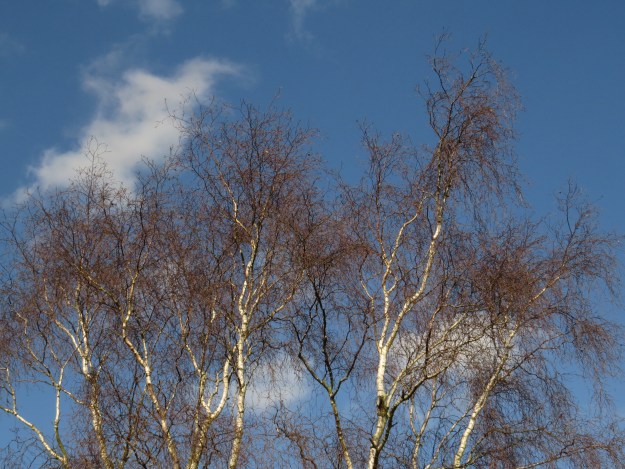
Dear Readers, this is a tree that can be found pretty much everywhere, and is often overlooked. How graceful it is, though, with its weeping twigs that, at this time of year, are a brownish-purple colour! And how ghostly that white bark can look, especially against a background of yews or other evergreens, though over time the bark develops deep, triangular black fissures. It was, in the 1920s and 1930s, a popular street tree, according to Paul Wood’s ‘Street Trees of London’ , but these days more exotic birch species such as the Chines red birch (Betula albosinensis) seem to be planted more frequently. As we shall see, silver birch supports a lot of biodiversity, so maybe it’s time for it to make a comeback, even though it’s a short-lived tree (it’s rare for a silver birch to live for more than 80 years.

Chinese Red Birch (Betula albosinensis)

The trees bear both male and female flowers in April and May. The male catkins are borne in groups of two or four, and look like dangling lambs’ tails. The female flowers are short, green and erect.

Illustration of silver birch features (Public Domain)

Although silver birch has a wide range, from Scandinavia through to Eastern Asia, I always associate it with the north. It seems to like heathland and moorland, and in the warmer parts of Europe it tends to grow at high altitudes. It is the national tree of Finland.

Photo One by By Percita at Flickr - Flickr, CC BY-SA 2.0, https://commons.wikimedia.org/w/index.php?curid=5986991

Birch forest in Finland (Photo One)

Birch forest is kind to other organisms – the canopy casts only light shade, and so an understorey can develop, as seen in the photo above. The ground beneath the trees can be full of primroses and wood sorrel, bluebells and wood anemone in spring, and in Scotland there may be blaeberry and cowberry growing underneath. The soft wood of the tree provides nest holes for woodpeckers, and the many insects that feed upon birch provide food for nightingales and warblers. This is a real contrast to the hardwood landscapes of hornbeam and oak woods, where the canopy is so shady that nothing apart from holly can survive outside of early spring, before the leaves form.

Photo Two by By Tony Holkham - Own work, CC BY-SA 3.0, https://commons.wikimedia.org/w/index.php?curid=33714192

Birch sawfly larvae (Photo Two)

More than 300 insect species are associated with the silver birch in the UK, including the larvae of the Kentish Glory moth.

Photo Three by Ilia Ustyantsev from Russia, CC BY-SA 2.0 <https://creativecommons.org/licenses/by-sa/2.0>, via Wikimedia Commons

Kentish Glory (Endromis versicolor) (Photo Three)

The tree is also associated with a whole raft of fungi, including fly agaric, birch knight and the birch polypore (or razor strop). The latter was actually used to sharpen razors, and is also used as a background for mounting dead insects in collections.

Photo Four by Jörg Hempel, CC BY-SA 3.0 DE <https://creativecommons.org/licenses/by-sa/3.0/de/deed.en>, via Wikimedia Commons

Birch Knight (Tricholoma fulvum) (Photo Four)

Photo Five by gailhampshire from Cradley, Malvern, U.K, CC BY 2.0 <https://creativecommons.org/licenses/by/2.0>, via Wikimedia Commons

Birch polypore (Piptoporus betulinus) (Photo Five)

So, it’s clear that birch trees, in life and death, support a whole range of species. As you might expect from a native tree, there is also a lot of folklore connected to silver birch. Bundles of birch twigs were used to drive out the spirits of the old year, and a besom, or broom, made of birch was used by gardeners to purify their gardens. In Finland,  birch twigs are used to beat the body when one comes out of a sauna. In the Scottish Highlands, a barren cow driven with a birch wand would become fertile, and a pregnant cow would have a fine and healthy calf.

Birch wood has been used for furniture, toys and for the bobbins used in Lancashire weaving factories, and birch bark is used for tanning leather. Traditionally, birch has been used as a treatment for rheumatism and arthritis, but recently there has been a resurgence in interest in birch syrup, which is made from the sweet and sticky sap of the tree in much the same way as maple syrup, although I note that this is usually made from the paperbark birches that are found in Alaska and Canada.

It comes as no surprise to me that these trees have been a subject for art – there is something about those shimmering white branches that begs to be painted. And artists as famous as Gustav Klimt couldn’t resist.

Photo Six by Ron Cogswell from https://www.flickr.com/photos/22711505@N05/26185760072

‘Birch Forest’ by Gustav Klimt (Photo Six)

And finally, a poem. Seamus Heaney, no less. How I love the way he manages to sum the man up in just a few tiny details. I laughed out loud. See what you think.

The Birch Grove by Seamus Heaney

At the back of a garden, in earshot of river water,
In a corner walled off like the baths or bake-house
Of an unroofed abbey or broken-floored Roman villa,
They have planted their birch grove. Planted it recently only,
But already each morning it puts forth in the sun
Like their own long grown-up selves, the white of the bark
As suffused and cool as the white of the satin nightdress
She bends and straightens up in, pouring tea,
Sitting across from where he dandles a sandal
On his big time-keeping foot, as bare as an abbot’s.
Red brick and slate, plum tree and apple retain
Their credibility, a CD of Bach is making the rounds
Of the common or garden air. Above them a jet trail
Tapers and waves like a willow wand or a taper.
“If art teaches us anything,” he says, trumping life
With a quote, “it’s that the human condition is private.”

Photo Credits

Photo One By Percita at Flickr – Flickr, CC BY-SA 2.0, https://commons.wikimedia.org/w/index.php?curid=5986991

Photo Two by By Tony Holkham – Own work, CC BY-SA 3.0, https://commons.wikimedia.org/w/index.php?curid=33714192

Photo Three by Ilia Ustyantsev from Russia, CC BY-SA 2.0 <https://creativecommons.org/licenses/by-sa/2.0>, via Wikimedia Commons

Photo Four by Jörg Hempel, CC BY-SA 3.0 DE <https://creativecommons.org/licenses/by-sa/3.0/de/deed.en>, via Wikimedia Commons

Photo Five by gailhampshire from Cradley, Malvern, U.K, CC BY 2.0 <https://creativecommons.org/licenses/by/2.0>, via Wikimedia Commons

Photo Six by Ron Cogswell from https://www.flickr.com/photos/22711505@N05/26185760072