Monthly Archives: July 2022

Monday Quiz – Full of Beans! – Week Two

Title Photo by Karyna Pachenko

Dear Readers, as mentioned yesterday, as no one has had a go at this yet, I’m going to leave it open for another week, just in case anybody wanted to give it a go but was unwell/on holiday/. No pressure if you just want to lay on the beach eating an icecream :-0

Dear Readers, the 3rd of July is International Eat Your Beans day, and who could argue with that? But the bean family (Fabaceae) is important in other ways too – beans convert nitrogen into a form that can be accessed by other plants (with the help of some very handy bacteria), and so are vitally important for ecosystems everywhere. So, as you might have guessed, our quiz this week is ‘bean-themed’, in the broadest sense of the word. See if you can identify these members of the bean family.

All you have to do is match the name to the plant, and away we go! Answers in the comments please (and you can also put them in Messenger on my Facebook page if you’re having problems here, though I have taken off every single restriction that I can think of). The quiz closes at 5 p.m. on Saturday 16th July at 5 p.m. UK time, and the answers will be posted on Sunday 17th July.

Onwards!

Species

A. Goat’s Rue (Galega officinalis)

B. Kidney Vetch (Anthyllis vulneraria)

C. Common Bird’s Foot Trefoil (Lotus corniculata)

D. Tufted Vetch (Vicia cracca)

E. Wood Bitter Vetch (Vicia orobus)

F. Meadow Vetchling (Lathyrus pratensis)

G. Wild Liquourice (Astragalus glycyphyllos)

H. Broad-leaved Everlasting Pea (Lathyrus latifolius)

I. Black Medick (Medicago lupulina)

J. White Clover (Trifolium repens)

Photos

Photo One by Anne Burgess

1)

Photo Two from https://flora-on.pt/?q=Vicia+orobus

2)

Photo Three by Ben Sale from UK, CC BY 2.0 <https://creativecommons.org/licenses/by/2.0>, via Wikimedia Commons

3)

Photo Four by AnemoneProjectors, CC BY-SA 2.0 <https://creativecommons.org/licenses/by-sa/2.0>, via Wikimedia Commons

4)

Photo Five by Lawn Weeds, CC BY 2.0 <https://creativecommons.org/licenses/by/2.0>, via Wikimedia Commons

5)

Photo Six by Lawn Weeds, CC BY 2.0 <https://creativecommons.org/licenses/by/2.0>, via Wikimedia Commons

6)

Photo Seven by paul dickson

7)

Photo Eight from https://www.flickr.com/photos/nedtrifle/4732026797

8)

Photo Nine by By Epibase - Own work, CC BY 3.0, https://commons.wikimedia.org/w/index.php?curid=5396096

9)

Photo Ten by By Epibase - Own work, CC BY 3.0, https://commons.wikimedia.org/w/index.php?curid=5396096

10)


A Warm Walk in St Pancras and Islington Cemetery

The leaves from the horse chestnuts have fallen already

Dear Readers, you might have been expecting the answers to last week’s quiz this morning, but actually nobody had a go this week – I suspect summer is here and people have lots of things to do, plus I know that some of our regular quiz-goers have some health challenges at the moment. So, I’ve decided to keep my quiz on beans open for another week – I’ll republish it tomorrow so that anyone who wants to have a go doesn’t have to go hunting for it. The answers will (finally) be published next Sunday, so you have until 5 p.m. UK time on Saturday 16th July to submit any answers. No pressure! It’s going to be too hot for anything involving the brain next week anyway.

In other news, I was in St Pancras and Islington Cemetery this afternoon, and it already feels like everything is sleepy. There’s the sound of tiny birds in the trees, but the great chorus of spring is silent, except for one familiar refrain – a song thrush, still hoping to find a mate even this late in the year. Song thrushes will sing until they find a mate, and will then fall silent except for during the morning dawn chorus, when everyone announces that they’re holding a territory and that they’ve made it through the night.  How well camouflaged these birds are! I imagine that this is a young male who has been heartily out sung this year. Maybe he’ll have better luck next spring.


In other news, as mentioned in the first photo, the leaf miner and the fungus have pretty much done for the leaves on this horse chestnut already, though other trees are looking a bit healthier. I find it hard to believe that the trees will survive this shortening of their season year on year, but fingers crossed. This one certainly looks pretty sad.

Branch of horse chestnut tree, showing the leaf damage.

It’s not all bad news, though – believe it or not, this is a buzzard, making slow, lazy circles on the thermals over the cemetery. I belong to a Facebook group called ‘Crap Bird Photos’ and I have a suspicion that this could be a candidate.

After a few minutes the buzzard drifted off towards the North Circular Road, and a kestrel zoomed past instead. All I needed was a sparrowhawk and all three of the Cemetery Raptors would have been visible at more or less the same time. Alas, the sparrowhawk didn’t show. It was lovely that the birds of prey were not harassed by the crows, who I presume have finished breeding for this year and are therefore not quite so touchy.

The Cedars of Lebanon all have some very fine cones, and if you look closely, you can see that they have clearly been slithered over by some snail or slug. These molluscs are clearly more acrobatic than you’d think. Unless it’s some other kind of resin? What do you think, Readers?

Cedar of Lebanon cone with added slug slime. You’re welcome .

And then there were the speckled wood butterflies. What vigorous critters these are. The males perch in a spot of sunlight and take on all comers – the one in the photograph not only saw off other males of his species and an unlucky large white butterfly, but also various hoverflies. Testosterone is clearly a force for action even in something as delicate as a butterfly. It was quite something to see the male spiralling up at speed and circling his opponent in a shaft of sunshine, before coming back down to rest. Females prefer males who defend a territory, because clearly they are fit and able to hold their own against other males. Interestingly, as the female comes to the end of her life she becomes less picky, and will mate with males who are not defending a territory but are instead just patrolling the countryside. Anyone who thought that butterflies were gentle, delicate creatures has clearly never watched the shenanigans of a bunch of speckled wood males. It’s like Poole Harbour on a Saturday night.


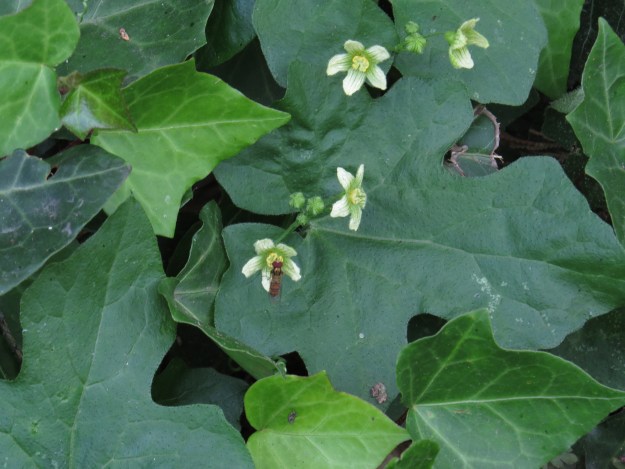
And finally, I was very happy to see that the white bryony is in flower. Our only native member of the cucumber family, this is a rather lovely vine with creamy-green flowers, and is clearly loved by hoverflies. I like the green tracery on the petals, and cupped shape of the flowers. It’s so nice when ‘weeds’ are left to do their own thing – there’s a lot of strimming going on at the moment in the cemetery, and while I appreciate that it’s necessary to keep some areas spick and span and tidy, I do love the wilder bits of the cemetery the most, where the ivy twines and there are unexpected rustles in the undergrowth. Let’s hope that at least some parts of the cemetery stay this way for years to come.

Phew….

Dear Readers, it’s edging up towards 80 degrees Fahrenheit today (a mere 26 degrees Celsius) but blimey it feels warm here in London. I am decidedly sleepy, and every time I try to do something intelligent my brain stops working, so here I am spending 15 minutes posting a few photos and trying to get my neurons to cooperate.

First up , a few shots of the pollinators visiting my buddleia. I can sit at my office desk and shoot these little sweethearts through the closed window, which is just about as much energy as I can muster today.

And then it’s out to the garden where it’s a bit cooler.

There was a family of wrens, the parents clicking and the babies squealing. I saw one adult feeding a fledgling with a nice fat insect, but they were most uncooperative on the photography front. Here is my one and only photo of a wren’s bum.

Then a comma butterfly happened along…

And then a very pretty brimstone moth appeared. I love these moths, they’re every bit as yellow as their butterfly namesakes. And look at those stripey yellow legs! It reminds me of Malvolio in Twelfth Night (English graduate here folks), when he was asked to appear with yellow-stockings and cross-gartered. ‘The Malvolio Moth’ – what a shame the creature is already named.

The caterpillar is fond of rowan (tick), hawthorn (double-tick) and Amelanchior (two street trees outside) so maybe we’re doing something right.

And finally, can anyone guess what on earth this is?

This strange little floating galaxy is a new spider’s web that has turned up in the shed, and just happened to be catching the light. Thirty seconds after I took this photo, the sun had moved, and the moment had passed.

So Readers, especially those of you in the south of England, batten down the hatches, make sure you drink lots of water, slap on the Factor 50 and make sure your fans are in working order. According to the weather forecast it’s not going to drop below 80 for about a fortnight. My dad would have loved it, but my mum hated the hot weather, and I seem to find myself somewhere in the middle. I have a shedload of work to do next week as well, but at least I’m not having to commute, so as always I’m grateful for both large and small mercies.


The Concise British Flora in Colour by W. Keble Martin

Dear Readers, I wonder how many of you lovely people who are ‘of a certain age’ remember this book, published in 1965? My lovely Aunt R. in Canada has given me her copy, and it certainly brought back some memories. It isn’t exactly a field guide, being a bit too large to lump around, but it has some of the loveliest illustrations of plants that I’ve ever seen. At some point I shall delve into it in more detail, but for now, I thought I’d share some of the illustrations with you, and see if any of you had it on your bookshelf.

But first, inside the book there were these! These stamps were issued before decimalisation came to the UK in February 1971, and hark back to the time of 12 pennies in a shilling, and twenty shillings in a pound. I somehow wonder how we coped with the maths. And gosh, the price of postage has gone up, though so has everything else. I do love getting a letter, even today. An email somehow isn’t quite the same. These were apparently issued in 1967 and you can buy them today for a whole 75p (or 15 shillings if you’re being old school).

And now for a look inside the book. Enjoy!

Superbloom, Tower of London

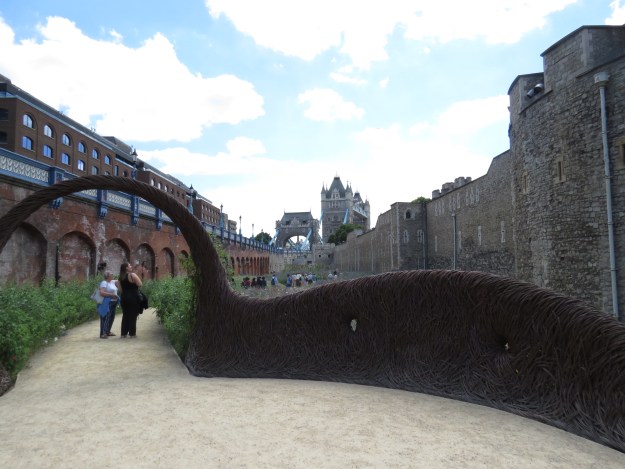
Dear Readers, for the Queen’s Platinum Jubilee this year, the moat at the Tower of London has been planted up with over 20 million seeds, designed to attract pollinators. And very pretty it is too! You can get a good view for free from the walkway around the outside….

..or you can pay £13.20 to wander amongst the flowers (there are special tickets for families), and in July and August it’s open until 21.00. Superbloom finishes on 18th September, for anyone who wants to come and see it, and the future after that is currently uncertain – while it’s likely that the moat will continue to be planted up, it might not be open to the public.

There’s also a slide which is advertised as depositing you in the middle of the flowers. Well, that’s true, but it’s a very small patch of flowers. The schoolchildren were thoroughly enjoying it anyway.

On the way to the entrance, there is a sculpture of a pride of lions made out of chicken wire by artist Kendra Haste – I’ve seen her work before, and have always been impressed by it. There have been wild animals at the Tower since Norman times – there used to be a ‘lion tower’ where the lions were housed. There was also an unfortunate polar bear who was shackled by one leg, but allowed to go swimming and fishing in the moat.

Kendra Haste’s lion sculptures.

And once in the moat, it reminds me, superficially at least, of the meadows at Waltham Abbey where I used to play as a child.

There are a wide variety of plants here. A lot of it is what I’d describe as ‘prairie planting’, and the word ‘Superbloom’ comes from what happens in the desert regions of the world after rain, when everything flowers at once. However the chief gardener, Nigel Dunnett, has designed the garden so that different plants emerge at different points. At the moment, there’s a lot of poppies, daisies and cornflowers. Later, there will be cosmos and  more rudbeckias. Dunnett has ‘form’ with this kind of planting, having done the display at the Olympic Park.

There are some bald patches which will presumably flower later in the year – it was apparently very difficult to get the display going, what with the cold spring. Some annuals were sown, some were brought in as planted turf. I do wonder how they managed to dissuade the pigeons from eating the lot.

Further round the moat, the cornflowers are exquisite – there are the usual blue ones, but also white, chocolate brown and magenta varieties. As usual, I like the wild-type ones best.

And then there are swathes that are less multicoloured, filled with yarrow and bladder campion.

At one point there is some ‘ambient  music’, which is meant to dull the sound of the traffic. I am a little allergic to the use of music in what is meant to be a ‘natural’ spot – I have a similar loathing for the sounds used in places like Sealife, where the poor old sharks have a constant soundscape that I imagine is meant to inspire awe. It would be interesting to know what the flowers thought. It is also entirely possible that I’m just being a curmudgeon.

As we wandered away from the soundscape, there was a sudden eruption of blue from the Viper’s Bugloss, so hardy that, as Dunnett says, ‘You could have a hurricane run through it and it would still stand up‘. This is one of my favourite plants.

Further along there’s a red patch, with lots of poppies and those magenta cornflowers that I mentioned.

And then there’s this extraordinary woven willow structure called ‘The Nest’ and sculpted by Spencer Jenkins. I particularly like the way that the live willows are woven into the structure.

Live willow woven into Spencer Jenkin’s ‘Nest’

But what made me sad, looking at all this floral abundance, was the lack of pollinators. There were plenty of honeybees (which made me think that there’s a hive nearby, maybe in the Tower itself). There were a few bumblebees, and a few white butterflies. It was a little breezy, so maybe the flying insects had stayed at home. But when I think of the meadows of Austria, or the meadows of my childhood, it’s clear that something is missing. Looking after our pollinators isn’t only about growing pretty flowers, it’s about keeping and creating habitat where they can breed and hibernate and where young insects can feed and pupate.

There is a rather lovely insect sculpture by Mehrdad Tafreshi. It feels to me like a eulogy.

Superbloom feels like a labour of love, and every volunteer that we spoke to was delighted to talk about the effort that had gone into creating the space. To see so much colour, especially on a lovely summer’s day, lifted the spirits. If you are interested in plants, it is well worth a look. And if, like us, you walked over Tower Bridge, you get some wonderful views of what is still, in spite of everything, the best city in the world (forgive my bias 🙂 but I am a Londoner).

“What you lookin’ at?”


Wednesday Weed – Catsear

Catsear (Hypochaeris radicata) (Hopefully)

Dear Readers, many moons ago I was doing a biology field course, and we were trying to identify the plants that grew along the coastline at Slapton Sands in Devon. It always amused me that we were not supposed to be looking at the ‘yellow Asteraceae’ because they are so difficult to identify. Well, here we are some twenty years later, and I still have trouble with the various yellow daisies that you can see growing everywhere at this time of year. I have gone out on a limb, though, and think that this one is catsear (Hypochaeris radicata), a very common ‘weed’ of disturbed ground that seems to take over from the dandelions about now. My Harraps Guide to Wildflowers suggests the following ways of identifying the yellow members of the daisy family that pop out at this time of year:

  • Are the flowers solitary (as here) or are there several flowers on the stem?
  • Are the flowering stems branched or unbranched (unbranched on my particular plants, but can be branched too, which isn’t helpful)
  • Are the flowering stems leafless or leafy? Catsear has no actual leaves on the stem, but it does have tiny triangular scales, which might be just about visible on the stems below (if you squint)
  • Then the next thing is the bracts (the green ‘bits’ that the flower emerges from). In catsear there’s a ‘cockscomb’ of short bristles near the tip.

So many members of this family are named for animals – in addition to catsear we have goats beard and hawkbit, hawkweeds and hawkbeards, oxtongue and sowthistle. Catsear is supposed to be so named because of the shape and fine hairs on the basal leaves. See what you think. I think if my cat’s ears looked like this I’d be off to the vet.

Photo One by Harry Rose from South West Rocks, Australia, CC BY 2.0 <https://creativecommons.org/licenses/by/2.0>, via Wikimedia Commons

Catsear rosette (Photo One)

The Belted Beauty moth caterpillar is said to have a taste for catsear. The males are rather splendid, but the females are small wingless furry creatures, who presumably hatch and then sit around emitting a pheromone and waiting for the males to find them. You can also see all manner of bees and hoverflies feasting on those yellow flowers.

Photo Two by By Harald Süpfle - Own work, CC BY-SA 3.0, https://commons.wikimedia.org/w/index.php?curid=11172412

Male Belted Beauty (Photo Two)

Photo Three by By Harald Süpfle - Own work, CC BY-SA 3.0, https://commons.wikimedia.org/w/index.php?curid=11172306

Belted Beauty (Lycia zonaria) (Female) (Photo Three)

Catsear is native to Europe but, like so many similar plants, it can now be found all over North America, Australia, Japan and New Zealand, and in some places it’s designated as a noxious weed. It’s been said to cause a disease called Australian stringhalt in antipodean horses, and very nasty it sounds too – it’s a sudden spasmodic contraction of the hind legs, and is most commonly seen in horses that have recently been turned out to pasture, especially in drought conditions. The damage might be caused not by the plant itself, but by a fungal mycotoxin that’s found in the soil, and then taken up by the plants, to be subsequently eaten by the horses.

Catsear has long been eaten by humans with no such ill effects – young leaves can be used much like those of dandelion, and are said to be much less bitter. In Crete, the leaves are steamed or boiled and used as a vegetable (Greece in general makes extensive use of the young leaves of all kinds of what we would consider ‘weeds’, and very sensible too). There is also a lovely recipe here for pasta with catsear leaves and asiago cheese. Yum!

Photo Four from http://www.veryeatalian.com/cats-ear-greens-asiago-cheese-orecchiette/

Orecchiette with catsear greens and asiago cheese (Photo Four)

The roots, much like those of chicory, can be roasted and used as a coffee substitute, and the scientific name ‘hypochaeris’ means ‘under/young pig’, which seems to suggest that the roots were also a favourite with pigs.

And finally, a poem. This reminds me of walking in Austria, and seeing the bees feeding from the flowers that emerged from the very edge of the melting snow. How I miss those meadows of spring flowers! Maybe next year….

The poem was found on New Zealand Poetry Shelf, curated by Paula Green. Well worth a look!

This for the end of a year

from a chorus of short-tongued alpine bees by Bernadette Hall


Let us give thanks for the flushes and zones of colour

in the herb-field, for the alpine genera,

the wire rush and the tangle fern, the sheep sorrel

and the cats-ear, the gentians and the astelias and everything

that grows under the edge of a melting snow-bank.


Let us give thanks for the cranesbill geranium and

the mouse ear myositis, for the ranunculus (little frog mouth,

little friend), for the feathered myrrh of the nival zone,

for the bog moss in the tarn,

for all that is and all that has been and all that is to come.


It is for us to keep our courage firm,

to nurse our appointed pain,

to await ‘that which springs ablaze of itself. ’

Photo Credits

Photo One by Harry Rose from South West Rocks, Australia, CC BY 2.0 <https://creativecommons.org/licenses/by/2.0>, via Wikimedia Commons

Photo Two By Harald Süpfle – Own work, CC BY-SA 3.0, https://commons.wikimedia.org/w/index.php?curid=11172412

Photo Three By Harald Süpfle – Own work, CC BY-SA 3.0, https://commons.wikimedia.org/w/index.php?curid=11172306

Photo Four from http://www.veryeatalian.com/cats-ear-greens-asiago-cheese-orecchiette/


In St Pancras and Islington Cemetery

The Swamp Cypress in all its glory

Dear Readers, what a few weeks it’s been! Between my exam, my visit to Barnwood, a trip to Somerset for my Aunt’s memorial service in the middle of a train strike and four days’ worth of Away Days at work, my size 8 feet have barely touched the ground. But now things are getting back to normal and  so I was able to have a sleepy meander around St Pancras and Islington Cemetery to see what was going on. First up was ‘my’ swamp cypress, all in green and looking very fine.

The woodland burial area is full of knapweed at the moment, and the bees and butterflies are loving it. There was a female Meadow Brown butterfly….

A leaf-cutter bee (Megachile spp) whose whole abdomen was coated in pollen (these bees don’t have the pollen baskets of some other species, and so may actually be better pollinators than their better-known relatives – the pollen is more easily transferred because it hasn’t been collected and stuffed into a ‘container’.

And here is a classic bumblebee, probably a buff-tailed (Bombus terrestris). Strange as it may seem, the summer is already coming to an end for many bumblebees, with queens emerging and looking for a chance to feed up and then hibernate. Summer is earlier for many creatures than it is for us.

There’s also lots of bindweed about. If it wasn’t such a thug, I reckon that everyone would be planting it for the beauty of those snow-white flowers. The bumbles love this one, too.

I love these tiny acorns forming on the oak trees….


The goat’s rue is really taking off all over the place. It’s one of those ‘weeds’ that I noticed first about five years ago, and now it seems to be everywhere. I wonder what has changed to make it so prevalent? It’s rather lovely regardless.

I am always surprised by the microhabitats in the cemetery, too. Some graves are completely covered in white stonecrop (Sedum album), but the plant can be found nowhere else.


The privet is in flower, and that creamy, slightly sickly smell is attracting insects from all over the place.

And there is creeping jenny at its feet, which I hadn’t noticed in this spot before.

And then finally, a speckled wood butterfly decides to sunbathe on the path, where it blends in perfectly.

It’s such a pleasure to take a slow amble, without thinking that I needed to be home to get stuck into studying or some other activity. Of course, in October it will be full-throttle again, but for the next few months I intend to recharge my batteries and remind myself of how much I love the nature that’s around me, low-key and subtle as it often is.

Monday Quiz – Pretty in Pink – The Answers

Delosperma (Or Mesembryanthum as we used to call it)

Dear Readers, you were all absolutely splendid this week, with Mal from FEARN (whose answers went into Spam for some reason known only to WordPress), Mike at Alittlebitoutoffocus, Christine and Fran and Bobby Freelove all getting 10 out of 10. Well done everybody! Let’s see what I can come up with for tomorrow. And Happy July to everyone!

Photo One by liz west, CC BY 2.0 <https://creativecommons.org/licenses/by/2.0>, via Wikimedia Commons

1) G. Purple Loosestrife (Lythrum salicaria)

Photo Two by Joli, CC BY-SA 4.0 <https://creativecommons.org/licenses/by-sa/4.0>, via Wikimedia Commons

2) F. Herb Robert (Geranium robertianum)

Photo Three by Phil Sellens from East Sussex, CC BY 2.0 <https://creativecommons.org/licenses/by/2.0>, via Wikimedia Commons

3) C. Grass Vetchling (Lathyrus nissolia)

Photo Four by Anne Burgess 

4) H. Great Willowherb (Epilobium hirsutum)

Photo Five by AnemoneProjectors, CC BY-SA 2.0 <https://creativecommons.org/licenses/by-sa/2.0CC BY-SA 2.0 Creative Commons Attribution-Share Alike 2.0>, via Wikimedia Commons

5) I. Musk Mallow (Malva moschata)

Photo Six by Björn S..., CC BY-SA 2.0 <https://creativecommons.org/licenses/by-sa/2.0>, via Wikimedia Commons

6) J. Common Centaury (Centaurium erythraea)

7) D. Pink Sorrel (Oxalis articulata)

Photo Eight by Trish Steel, CC BY-SA 2.0 <https://creativecommons.org/licenses/by-sa/2.0CC BY-SA 2.0 Creative Commons Attribution-Share Alike 2.0>, via Wikimedia Commons

8) E. Thrift (Armeria maritima)

Photo Nine by Anne5578, CC BY-SA 4.0 <https://creativecommons.org/licenses/by-sa/4.0>, via Wikimedia Commons

9) A. Common Ramping Fumitory (Fumaria officinalis)

Photo Ten by AnemoneProjectors, CC BY-SA 2.0 <https://creativecommons.org/licenses/by-sa/2.0>, via Wikimedia Commons

10) B. Ragged Robin (Silene flos-cuculi)

Photo Credits

Photo One by liz west, CC BY 2.0 <https://creativecommons.org/licenses/by/2.0>, via Wikimedia Commons

Photo Two by Joli, CC BY-SA 4.0 <https://creativecommons.org/licenses/by-sa/4.0>, via Wikimedia Commons

Photo Three by Phil Sellens from East Sussex, CC BY 2.0 <https://creativecommons.org/licenses/by/2.0>, via Wikimedia Commons

Photo Four by Anne Burgess

Photo Five by AnemoneProjectors, CC BY-SA 2.0 <https://creativecommons.org/licenses/by-sa/2.0CC BY-SA 2.0 Creative Commons Attribution-Share Alike 2.0>, via Wikimedia Commons

Photo Six by Björn S…, CC BY-SA 2.0 <https://creativecommons.org/licenses/by-sa/2.0>, via Wikimedia Commons

Photo Seven by Evelyn Simak (see photo for full attribution)

Photo Eight by Trish Steel, CC BY-SA 2.0 <https://creativecommons.org/licenses/by-sa/2.0CC BY-SA 2.0 Creative Commons Attribution-Share Alike 2.0>, via Wikimedia Commons

Photo Nine by Anne5578, CC BY-SA 4.0 <https://creativecommons.org/licenses/by-sa/4.0>, via Wikimedia Commons

Photo Ten by AnemoneProjectors, CC BY-SA 2.0 <https://creativecommons.org/licenses/by-sa/2.0>, via Wikimedia Commons

At St Leonard’s Churchyard in Shoreditch

Dear Readers, this magnificent church, built by George Dance the Elder in about 1740, is the one mentioned in the old song ‘Oranges and lemons’ about the bells of London ”When I grow rich, say the bells of Shoreditch’ is about this church. It’s known as ‘The Actor’s Church’ because so many Tudor actors are buried here, including James Burbage, who founded England’s first playhouse, and his actor son Richard Burbage, a leading man in many of Shakespeare’s plays. The actor Gabriel Spenser, who was killed by playwright Ben Jonson in a duel, is also buried here.

The church is right across the road from the venue for our away days, and so it was a great spot to take a walk at lunch. As an introvert I love to meet people, and to spend time with them, but hanging out with them socially en masse exhausts me, lovely as they are. So, it was good to pop over with the camera during the breaks to see what I could see.

The plane trees are truly magnificent, and it’s such a peaceful spot.

The gardens are absolutely full of pollinator-friendly plants, and there was an amazing variety of insects for such an urban spot, plus some lovely roses which filled the area with their scent.

A goldfinch was singing his head off from a nearby aerial…

And I found a shady spot where a family of wrens had just fledged.

One of the gardeners passed by with a wheelbarrow, and I told him how lovely it was.

“Thank you!” he said. “We’re all volunteers, you know”.

I said that I didn’t know, and he stopped briefly in his labours.

“I’m six years clean”, he said, “And this place has helped so much”.

“Well done!” I said. Getting off  booze or drugs is such a difficult thing, but the man looked fit and happy. Elsewhere, homeless people were sleeping on the grass, or bedding down on the church porch. Shoreditch and the area around here has always been poor, though the gentrification around here is something to see. Standing outside our Away Day venue I was regularly almost run down by young men on electric scooters, and I note that some of the two-up two-down houses round about are now over £500,000.

But still, enjoying the bees is free. Borage is always a good bet….

And look at the insects on this Achillea – on the left we have a very chunky hoverfly, but on the right it’s a tiny solitary bee. I am hoping to get an ID from my Facebook friends, so I will update here if I find out.

And hollyhocks are always such good value for pollinators. Bumblebees absolutely love them.

And this hot-lips salvia was a big favourite with the smaller common carder bumblebees

And then I spotted this solitary wasp. Note that very triangular abdomen, and the unusual pattern. I haven’t knowingly ever seen this creature before, and they are very difficult to ID to the species level, though it probably belongs to the genus Ancistrocerus, which means ‘hook-horn’ because the first joint of the antenna is bent back. Technically they are potter wasps, which means that they construct nests from mud, hidden away in cavities. It’s always great to find a new insect, and especially one as natty as this one. It just goes to show that it’s always worth stopping for a few minutes to see what’s about.

At Spitalfields City Farm

Holmes the Kuni Kuni pig

Dear Readers, on Wednesday I spent the day with my Finance Team colleagues in a yurt at Spitalfields City Farm. We were on an Away Day, and for many of us it was an opportunity to meet in person for the first time in several years. It was lovely to be in such a different environment, and I’m sure it made us more creative to be surrounded by sheep, pigs, chickens and sunflowers. If you are looking for a venue with a difference, I can’t recommend it highly enough.

I arrived early and managed to sneak in a quick visit with Holmes, the very chatty Kuni Kuni pig. Holmes is twelve years old now, and lost his brother Watson last year, but he seems very pragmatic, wandering over to say hello and enjoying a quick back rub. Pigs are amongst my favourite animals, and seeing him reminded me of my time working on a city farm in Dundee. The pigs there once made a break for it and headed to the bus station, where they wreaked havoc for half an hour until I could lure them home with some windfall apples. Holmes apparently loves crab apples, so it is clearly a piggy favourite.

Beatrix the Herdwick Sheep


Beatrix lost an ear in a dog attack when she was just a lamb, but seems very happy at Spitalfields. She seems to enjoy just watching the world go by.

Grace

Grace was ten years old this year, a good age for a sheep. She was adopted by the farm as a very scrawny, poorly orphan in May 2012 but has clearly been living her best life ever since. She is a Suffolk x Southdown sheep.

Spitalfields City Farm is part of the Rare Breeds Survival Trust, for its small herd of Castlemilk Moorit and Portland sheep. There are less than 1500 registered breeding ewes in the country, but the farm has a small herd. These are compact sheep with a fine creamy fleece, and the breed was developed by Sir Jock Buchanan-Jardine on his Scottish estate. The ancestry of the sheep includes both Manx and Shetland sheep and the wild Mouflon, so no wonder they look so rugged and self-assured. When Sir Jock died, the majority of his flock was culled, but a ram and six ewes were rescued by Joe Henson of the Cotswold Wildlife Park. All of the existing sheep are descended from these animals. It’s important to conserve breeds of domestic animal that might otherwise become extinct, not only for their own sake but because we never know what characteristics might be useful in the future as the climate changes.

Katriona the Castlemilk Ewe. Now 15 years old!

The farm also has donkeys….

….some very fine goats….

and this magnificent fluff ball of a cat, who came to check us out, demanded a chin rub and then sauntered past, as cats do.

And the farm has the most magnificent bee hotel that I have ever seen in my life. Five star accommodation if ever I saw any.

And so, instead of moving from room to room for our different Away Day sessions we could wander past the runner beans and the tomatoes, stopping en route to admire a goat or tickle a pig. I for one was certainly more relaxed than I would have been in a more conventional business environment, and surely that can only be a good thing. Plus, after two years of being confined to quarters, it was such a pleasure to hear the birds singing, and the bees humming. I’m sure such a place fosters out-of-the-box thinking.