Yearly Archives: 2022

They’re Back….

Dear Readers, these ring-necked parakeets really are most intriguing birds. They seem to be very set in their habits – during this past few weeks, we’ve been woken on several mornings by their squawking, and they often pop in on the way back to their roosting sites in the evening – yesterday they were most perturbed because Bear, the big black fluffy cat from across the road, had settled himself down on the patio and showed no inclination to move.

Normally, the pair of parrots seem to get on very well, but I am coming to the conclusion that either they aren’t the same two birds, or one of them is getting their breeding colours, and getting very tetchy to boot. Normally they feed very happily side by side on the peanuts, but today this male got very crotchety with the other bird who tried to feed. You can see how his ‘rose-ring’ is starting to appear, and very fine it is too, though it did cross my mind that it looks as if someone has tried to garrotte him. See what you think.

Anyhow, he was being very butch with the other poor parakeet, who had to sit at the top of the whitebeam until he’d eaten his fill.

Eventually the male flew off, and this one was allowed down to feed. All very intriguing. Parakeets are such characters, and this is building up to being a proper soap opera. I shall keep you posted.

A Spring Visitor

Dear Readers, it has been a really lovely couple of days here in East Finchley, and I was delighted to see this handsome boy sitting in the garden when I finished work yesterday. He’d had a little drink in the pond and was now sitting around waiting to see what would happen next.

He was a bit interested in the wood pigeons on the bird feeder, but they’re a bit high for him to reach. He hid behind the rose bush for a while just in case he could surprise one.

Then he had a little dig for fallen bird food and worms…

And then it was time for another look round…

And then the children next door came out to play ball, so he sauntered off, after first investigating one of my pots.

After all these years (nearly twelve years in this house), I still can’t get over spotting foxes in the garden. What a treat! It’s as if a little bit of the wild comes to call every time.

The Resurrection Men

Photo One by By Thomas Quine - https://www.flickr.com/photos/quinet/44598416660/, CC BY 2.0, https://commons.wikimedia.org/w/index.php?curid=80400437

Mastodon at the Royal Victoria Museum, Canada (Photo One)

Dear Readers, New Scientist this week has an article about ‘de-extinction’ – the process whereby scientists are attempting to bring back extinct species, using a combination of genetic editing, cloning and surrogacy. The most famous project is probably that of Colossal, a biosciences company that wants to recreate the woolly mammoth, and the TIGGR project at the University of Melbourne which wants to resurrect the thylacine or Tasmanian Tiger. Restore and Revive, a US NGO, is trying to de-extinct the passenger pigeon and the heath hen. But a study by the University of Copenhagen has shown up some of the difficulties in trying to bring back an extinct species from the dead (and that’s before we even get on to the ethical questions).

Thomas Gilbert at the University of Copenhagen has been working with a team who are looking at the Christmas Island Rat, also known as Maclear’s Rat (Rattus macleari). This rodent became extinct in the early 20th century, and a high-quality genome was extracted from preserved specimens. However, there were still many gaps in the genome, some of which could be filled by looking at the genes of the closely-related brown rat, but there was still a gap of some 5% of the genome, and the scientists have no idea what it did.

Crucially, it’s these genes that were the most recent, and which made the difference between the Christmas Island rat and the brown rat. It’s thought that in this case the missing genes relate to the rat’s immune system, and to its sense of smell – the latter, in particular, would influence the way that the Christmas Island rat found its food, interacted with other rats, and avoided predators. So, even if a ‘Christmas Island Rat Mark II’ could be created that looked like the original species, its behaviour is still likely to be very different.

Photo Two by By Joseph Smit - Proceedings of the Zoological Society of London 1887 web, Public Domain, https://commons.wikimedia.org/w/index.php?curid=15135055

The Christmas Island Rat (Photo Two)

Still, the companies that have set their hearts on recreating extinct animals soldier on in the face of ethical opposition. Just to set out my personal stall on the subject, it seems that the money being invested in de-extinction could be better spent on preserving habitats for the elephants, marsupials and birds that are in danger of extinction, rather than bringing back those who have already gone. Of course, that doesn’t mean that all this investment would go to these causes (just as the money spent on the space race wouldn’t have gone to ending world hunger if we’d never gone to the moon) but I smell a distinct whiff of the profit motive in many of these de-extinction projects. How much would people pay to see mammoths roaming in an American safari park, I wonder? And how much would these animals sell for?

Furthermore, many of these animals, especially the mammoths and passenger pigeons were intensely social creatures – how many are the companies actually planning to recreate, or is this a case of a few sad specimens in some kind of zoo? And what about the female elephants who would be the surrogates for the calves who are created, in the case of the mammoths?

All this for an animal that is probably just a poor facsimile of the original species, from a habitat that is now largely gone or degraded.

It is, of course, possible that interesting discoveries might be made in the search to revive these animals, discoveries that could be beneficial for living animals. But on balance, I think that just because we can do something, even imperfectly, it doesn’t mean that we should. Let’s try to preserve what we have, and what we are in danger of losing.

You can read the full article here.

Photo Credits

Photo One By Thomas Quine – https://www.flickr.com/photos/quinet/44598416660/, CC BY 2.0, https://commons.wikimedia.org/w/index.php?curid=80400437

Photo Two By Joseph Smit – Proceedings of the Zoological Society of London 1887 web, Public Domain, https://commons.wikimedia.org/w/index.php?curid=15135055

Back to Work….

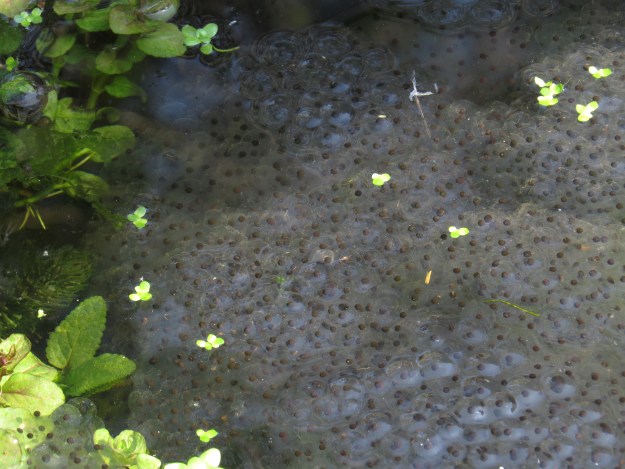
Dear Readers, I was back to work today, though clearly my brain is only operating at about 60% capacity – I look at my spreadsheets with considerable befuddlement, and don’t be asking me to calculate anything more complicated than the bill for my cappuccino. Still, I did at least find time to pop out to the garden to have a look at my tadpoles. I love the way that they turn from little full stops to little commas – you can see that some of them are already getting their tails.

There is so much frog spawn, though! All those little lives just waiting for the jelly around them to dissolve so they can venture forth and start munching the algae. And pretty much all the adult frogs have gone, as if they were never here. So that’s the amphibian excitement over for the year.

Or maybe not. I just rediscovered Seamus Heaney’s poem ‘Death of a Naturalist’. I hope you love it as much as I do. Just for a bit of background, flax-dams were used to rot down bundles of flax for making linen. I love that the frogs are ‘poised like mud grenades’.

Death of a Naturalist
BY SEAMUS HEANEY

All year the flax-dam festered in the heart
Of the townland; green and heavy headed
Flax had rotted there, weighted down by huge sods.
Daily it sweltered in the punishing sun.
Bubbles gargled delicately, bluebottles
Wove a strong gauze of sound around the smell.
There were dragonflies, spotted butterflies,
But best of all was the warm thick slobber
Of frogspawn that grew like clotted water
In the shade of the banks. Here, every spring
I would fill jampotfuls of the jellied
Specks to range on window sills at home,
On shelves at school, and wait and watch until
The fattening dots burst, into nimble
Swimming tadpoles. Miss Walls would tell us how
The daddy frog was called a bullfrog
And how he croaked and how the mammy frog
Laid hundreds of little eggs and this was
Frogspawn. You could tell the weather by frogs too
For they were yellow in the sun and brown
In rain.

Then one hot day when fields were rank
With cowdung in the grass the angry frogs
Invaded the flax-dam; I ducked through hedges
To a coarse croaking that I had not heard
Before. The air was thick with a bass chorus.
Right down the dam gross bellied frogs were cocked
On sods; their loose necks pulsed like sails. Some hopped:
The slap and plop were obscene threats. Some sat
Poised like mud grenades, their blunt heads farting.
I sickened, turned, and ran. The great slime kings
Were gathered there for vengeance and I knew
That if I dipped my hand the spawn would clutch it.

A Post Covid Walk in St Pancras and Islington Cemetery

Dear Readers, it felt very strange walking in the cemetery yesterday; although I am now past the worst of my covid infection I am still a little slow and breathless, and everything feels most peculiar. I first realised that brain fog was ‘a thing’ after my Dad died and I realised that I could no longer calculate percentages without having to think about it first. Fortunately my mental faculties gradually came back, but at the moment I’m still a bit hazy about many things. Still, it was good to get a bit of fresh air on the most beautiful spring day. I especially love the way that the Scotsman is standing in a pool of lesser celandine. I’ve remarked before that it seemed not to be having a very good year, but clearly I was just too early. It was everywhere on my walk, turning its shiny yellow face to the sun, and hoping for an early bumblebee to pop along, I’m sure.

The petals of many flowers in the buttercup family are shiny – there is a special layer of reflective cells which intensifies the yellow colour and makes the flowers even more attractive to pollinators. As the flowers grow older, this layer may rub off, leaving the petals white, as in the one on the far left hand side of the photo. There are some rather lovely buttercup photos (though not lesser celandine) on this microscopy-uk webpage, well worth a look.

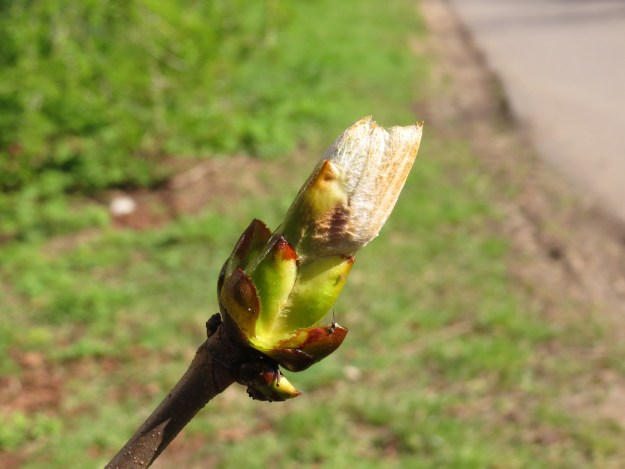
I was surprised to see how much of the cherry plum blossom was gone (after all I’ve only missed one week on my walks), but it has been very windy. On the other hand, the horse chestnut buds are pushing through already.

And although the bluebells look a  long way off, there’s one tiny patch of woodland where the Scilla have naturalised, and their blue is almost as intense. What a pretty and delicate flower this is, and it’s obviously happy even in deep shade.

And so it was with some relief that I got home and had a sit down, but it was great to see something outside my four walls for the first time in ten days. For anyone who is getting over covid, or indeed any infection, I’d say ‘be a little more gentle with yourself than you think you need to be’ – it’s good to give yourself time for your body to adjust to getting back to ‘normal’ rather than throwing yourself in with enthusiasm, especially as you’re getting older. When I was in my twenties and thirties I thought I was immortal and indestructible, but sadly now I know a bit better.

Sunday Quiz – Mellow Yellow

Dear Readers, it seems to me that if nature has a preferred colour in the South of England, it’s probably yellow – maybe this is because it’s a hue that can be seen by all kinds of pollinators, from bees and butterflies to the hard-working but underappreciated hoverflies. But how good are you at identifying yellow plants? Below are photos of twelve yellow flowers. All you have to do is to match the species to the photo.

You have until 5 p.m. UK time on Friday 25th March to put your answers into the comments, and the results will be published on Saturday 26th March. I will disappear your answers when I see them (if I manage to get myself organised – Covid has left me a bit brain-foggy this week, though I am generally very much on the mend).

So, if you think that the plant in Photo A is a Yellow Corydalis, your answer is 1) A)

Species

  1. Yellow Corydalis (Pseudofumaria lutea)
  2. Greater Celandine (Chelidonium majus)
  3. Goldilocks Buttercup (Ranunculus auricomus)
  4. Marsh Marigold (Caltha palustris)
  5. Common Toadflax (Linaria vulgaris)
  6. Great Mullein (Verbascum thapsis)
  7. Evening Primrose (Oenothera glazioviana)
  8. Turnip (Brassica rapa)
  9. Touch-me-not Balsam  (Impatiens noli-tangere)
  10. Lady’s Bedstraw (Galium verum)
  11. Yellow Archangel (Lamiastrum galeobdolon)
  12. Tansy (Tanacetum vulgare)

Photos

Photo A by Ivar Leidus, CC BY-SA 3.0 <https://creativecommons.org/licenses/by-sa/3.0>, via Wikimedia Commons

A)

Photo B by Tatters ❀ from Brisbane, Australia, CC BY-SA 2.0 <https://creativecommons.org/licenses/by-sa/2.0>, via Wikimedia Commons

B)

Photo C by Ian Cunliffe 

C)

Photo D by Randi Hausken from Bærum, Norway, CC BY-SA 2.0 <https://creativecommons.org/licenses/by-sa/2.0>, via Wikimedia Commons

D)

Photo E by MPF, CC BY-SA 3.0 <https://creativecommons.org/licenses/by-sa/3.0>, via Wikimedia Commons

E)

Photo F by By Stemonitis - Own work, CC BY-SA 3.0, https://commons.wikimedia.org/w/index.php?curid=15723196

F)

Photo G by gailhampshire from Cradley, Malvern, U.K, CC BY 2.0 <https://creativecommons.org/licenses/by/2.0>, via Wikimedia Commons

G)

Photo H by gailhampshire from Cradley, Malvern, U.K, CC BY 2.0 <https://creativecommons.org/licenses/by/2.0>, via Wikimedia Commons

H)

Photo I by Peter O'Connor aka anemoneprojectors from Stevenage, United Kingdom, CC BY-SA 2.0 <https://creativecommons.org/licenses/by-sa/2.0>, via Wikimedia Commons

I)

Photo J by Peter O'Connor aka anemoneprojectors from Stevenage, United Kingdom, CC BY-SA 2.0 <https://creativecommons.org/licenses/by-sa/2.0>, via Wikimedia Commons

J)

Photo K by CC BY-SA 3.0, https://commons.wikimedia.org/w/index.php?curid=129770

K)

Photo L by AnemoneProjectors, CC BY-SA 2.0 <https://creativecommons.org/licenses/by-sa/2.0>, via Wikimedia Commons

L)


Sunday Quiz – What’s In a Name? – The Answers!

Ivy (Hedera helix) – ‘helix’ means ‘twisted’ or ‘spiral’

Dear Readers, what a splendid crop of answers we had this week: Claire, Mal from FEARN, Rosalind Atkins, Anne and Fran and Bobby Freelove all proved their mettle with a score of 12 out of 12, well done to all of you – you were undefeated by Latin binomials, and there was a fine discussion about the merits of scientific names over on my Facebook page, for those of you who indulge. Suffice it to say that much as we love vernacular names, we can all see the value of having a name for each species that’s recognised across regions and countries. 

Let’s  see what I can come up with for tomorrow. 

Species Name and Meaning

  1. J) Officinalis means a traditional healing plant
  2. E) Verna means ‘of the spring’
  3. K) Rupestre means ‘wall or rock-loving’
  4. F) Sativa means ‘found on cultivated land’
  5. L) Pratense means ‘meadow-loving’.
  6. H) Sylvestris means ‘found in forests/woods’
  7. A) Repens means ‘creeping’
  8. B) Palustre/palustris means ‘found in marshes and bogs’
  9. C) Corniculata means ‘horned’ (the seed capsules of plants named ‘corniculata’ often have two tiny horns on them
  10. G) Lutea means ‘yellow’ as in Yellow Corydalis, Pseudofumaria lutea.
  11. I) Maculatum means ‘spotted’
  12. D) Hirsutum means ‘hairy’


Yet More Frogs

Dear Readers, I hope you’re not all bored to death by the frogs yet – I am still fascinated by the goings-on in the pond. This is clearly the biggest aggregation of frogs that I’ve seen in the pond in over ten years, and I am trying to work out why this year is so special. In the south-east it’s been a remarkably mild winter – I only remember the pond freezing on one day – and so I’m guessing that more of the amphibians have survived. Plus, the pond will have recovered since it was cleaned out a few years ago, so it’s probably at peak production. But even so, it’s like a froggy Serengeti out there. I just sat in the twilight and listened to them singing yesterday, which was a bit of a treat following a few foggy-minded days.

Every time I venture into the garden there’s a mass splashing as all the ‘double-frogs’ disappear under the water, though there’s so much frogspawn that it’s difficult for them to dive to the bottom. Then if I sit quietly they gradually resurface, and after a while some brave soul will start to sing, followed by another frog, and then another. It’s not a particularly musical sound to our ears but it clearly works with the ladies.

The white vocal sacs of the males must be quite an attraction too, especially in the half-light – I noticed how they shone out in the twilight yesterday. Apparently the females are attracted to the males with the longest and loudest calls. I remember one female sitting on a rock last year, surveying a choir of wildly croaking males, before entering the water and getting jumped on by the whole lot of them. Fortunately she was a big girl and managed to kick most of them off.

The males, once they’ve found a female, will hang on for grim death until she releases her eggs, which can take several days. Apparently the egg-laying nearly always happens at night, and that’s been my experience – I’ve never seen a female actually producing the eggs, but in the morning there are the big clumps of spawn. Once the female judges that the time is right to release her eggs, the male releases his sperm and voila, fertilisation. I suspect that the temperature of the water might have something to do with the actual release of the eggs – activity has certainly picked up now that the weather has warmed a little. The male may leave the female to try to find another mate once spawning is complete, but competition is intense in my little pond so I wouldn’t hold out a lot of hope.

And in a day or so it will all be over and done with, and in about three weeks the spawn will melt and tiny, comma-shaped tadpoles will emerge. I hope there’s enough food in the pond for them – they like algae but I know they’ll also eat lettuce, so if they seem to be struggling I’ll know what to do. Probably one in a thousand of the eggs will survive to be an adult frog, which looking at the volume of frogspawn is probably just as well. I don’t know if anyone else remembers the 1970s eco-horror film ‘Frogs’, but if all of these eggs turned into an adult frog I think I’d need a bigger house. I rather like the idea of ‘When Nature Strikes Back’ though. ‘A Croak! A Scream!’ indeed. Ray Milland was a good actor, but he was certainly in some stinkers.

Jealous Siblings and Domesticated Geese – Snippets from New Scientist

Photo One by By Emily Walker from Sydney, Australia - Goose FamilyUploaded by Snowmanradio, CC BY-SA 2.0, https://commons.wikimedia.org/w/index.php?curid=11981636

Chinese Geese (Photo One)

Dear Readers, it is my fifth day since I tested positive for Covid and I’m feeling a lot better physically, though my brain is all over the place. What a strange disease this is! I read an article stating that it seems to cause brain shrinkage, and as far as I’m concerned I wouldn’t be the slightest bit surprised. Hopefully it will spring back like a cushion at some point in the near future. It could also be because of cappuccino withdrawal, our local coffee shop will be missing us, especially as my husband is still testing positive and it’s now day 10. So I am finding myself entertained by little things in New Scientist.

First up, scientists who study the domestication of birds have been dealt a curveball by the discovery of some goose bones in the Chinese Stone Age village of Tianluoshan, which was inhabited between 5500 and 7000 years ago. 232 bones were found, and some belonged to geese who were less than 16 weeks old, so too young to have flown in from elsewhere. No wild geese breed in the area now, and the scientist interviewed, Masaki Eda from Hokkaido University Museum, thinks it very unlikely  that it was ever a suitable habitat for geese. Furthermore, analysis seems to show that the adult geese were bred locally (the chemical analysis  of the bones can show where the water they drank came from), and that they were all roughly the same size, indicating captive breeding. Carbon dating the bones puts them at about 7000 years old, making them the first birds to be domesticated.

I must admit that I thought that chickens were the most likely candidate for oldest domesticated bird – they are a bit more amenable for a start. A 2014 study reported finding domestic chicken bones from as early as 10,000 years ago. However, the bones weren’t directly dated, and many scientists believe that the bones come from pheasants that were hunted. So, for the minute, it looks like geese might have been our earliest avian companions.

And secondly, as an elder sibling myself I can vouch for the pain of suddenly no longer being the apple of my mother’s eye, so it’s no wonder that scientists studying wild bonobos in the Democratic Republic of Congo have found that their stress levels go through the roof when a new sibling is born, and stay high for up to seven months. Scientists observed the behaviour of the weaned infants when their new brother or sister was born, and also analysed urine samples for the stress hormone cortisol. Cortisol levels jumped to five times their normal level, and the youngsters were seen to be much clingier with their mothers than usual, though scientists weren’t sure whether this was because they wanted to see the infant or because they wanted their mother’s reassurance.

Because bonobos are so similar to us – the offspring stay with their mother for a very long period and are totally reliant on her, even after a new sibling is born – it’s somehow not surprising that the youngsters behave in much the same way that I did. My mother solved the problem of sibling jealousy by making me feel that my little brother was ‘ours’ rather than ‘hers’, and so from very early on I was involved in his care. It would be interesting to know what different strategies bonobo mothers have for keeping their offspring happy – I’m sure that they have such strategies. And also, is the effect less marked when yet another sibling comes along? After all, you can only cease to be an only child once.

Bonobo mother and baby – Photo by Kokolopori Bonobo Research Project https://www.bonobo.org/news-and-knowledge/baby-boom

And finally (and this is not from New Scientist, but from The Guardian)  a couple in New Zealand are heartbroken to discover that the world’s biggest potato, weighing in at 7.8 kilograms, is not, in fact, a potato. Nicknamed ‘Dug’, it was found by Colin Craig-Brown in their garden, but DNA analysis by the Guinness Book of Records has revealed that it is, in fact, the tuber of a gourd. Craig-Brown still has ‘Dug’ in the freezer:

“I say ‘gidday’ to him every time I pull out some sausages. He’s a cool character,” Craig-Brown said. “Whenever the grandchildren come round, they say, ‘Can we see Dug?’”

“He is the world’s biggest not-a-potato.”

And I don’t know if it’s just the Covid or the brain shrinkage, but I just love this story.

Dug, the world’s biggest not-potato

The Mosquitoes of the London Underground

Photo One by Walkabout12 - Own work, CC BY-SA 3.0, https://commons.wikimedia.org/w/index.php?curid=47027176By Walkabout12 - Own work, CC BY-SA 3.0, https://commons.wikimedia.org/w/index.php?curid=47027176

The London Underground Mosquito (Culex pipiens f. molestus)(Photo One)

Dear Readers, I was much taken by an article in New Scientist about the evolution of urban species by Rob Dunn this week, and in particular his thoughts about the infamous London Underground mosquito. During the Second World War, unfortunate civilians who spent nights on the platforms of Underground stations to avoid the Blitz complained about being bitten unmercifully, but it’s only recently that genetic technology has advanced to a point where we can really work out what’s going on.

Photo Two by By US Govt - This media is available in the holdings of the National Archives and Records Administration, cataloged under the National Archives Identifier (NAID) 195768., Public Domain, https://commons.wikimedia.org/w/index.php?curid=3458515

Sheltering in the Underground (Photo Two)

The original LU Mosquito came from the Fertile Crescent in the Middle East and lived above ground. These insects are active only during the warmer months, require a meal of blood before they can reproduce, and feed mainly on the blood of birds. However, as the mosquito spread north into colder climes, it survived by living in cities, particularly their underground regions such as sewers. The insect evolved new genetic characteristics, such as odour recognition, digestion and immunity, that would be useful in environments rich in organic waste.

However, it wasn’t just the genes that changed, behaviour did too. Both the underground and the above-ground mosquitoes are thought to be the same species, but the underground ones are active all year round, can reproduce without a blood meal, and prefer to feed on mammals: rats and mice in particular, but humans where they can find them. The underground mosquitoes are isolated from other mosquitoes, and their habitat can be compared to an island, as Dunn points out: the mosquitoes cannot disperse, and so they become more and more specialised. Cities such as Paris, Minsk, Tokyo and New York all have their own ‘Underground Mosquitoes’.

However, the isolation can have another, even more extreme, effect – it’s been shown that where LU Mosquito populations are isolated within the Underground network, they can start to become genetically distinct from one another. So, it was found that the mosquitoes found on the Victoria Line were different from those found on the Bakerloo Line. It’s quite possible that every underground line could have its own mosquito, though I suspect that lines with a larger proportion of stations which are above ground might be less distinct, because their mosquitoes can actually disperse and interbreed.

For us, though, as humans, it means that the old Petula Clark song ‘Don’t Sleep in the Subway’ has never been better advice.