Monthly Archives: March 2023

Wednesday Weed – Desert Willow (Chitalpa)

Desert Willow (Chitalpa tashkentensis)

Oops! This should, of course, have gone out on Wednesday. Apologies for the double post!

Dear Readers, yesterday I mentioned that some street trees had appeared in Church Lane, East Finchley, which had been given names. Apparently these trees (known as Desert Willows or Chitalpa tashkentsis) appeared more or less overnight, to the delight of the local residents, who then decided to name them after local people. So, we have Eve, named for Eve Bagley, whose family have lived in Church Lane for 90 years…

‘Angela’ for one of the original residents of Cricket Row on Church Lane…

‘Ted’ for Eve’s late husband, who was a veteran sailor on the Arctic convoys to Russia during World War II…

‘Pauline’ for the mother of Lisa, one of the residents of Church Lane…

and Dominic for the son of Church Lane residents Gail and Barry.

What a lovely idea this is! I’m sure that these will be the best nurtured, most loved trees in East Finchley. We humans do love to connect, and if we manage to do that by seeing plants or animals as individuals (which of course they are), all the better.

What on earth is a desert willow though? Well, the Chitalpas are hybrids between two closely related plants – the original desert willow (Chilopsis linearis) and the northern catalpa (Catalpa speciosa).

The ‘original’ desert willow isn’t a willow at all (though the leaves look rather similar), but one look at the flowers would tell you that this is a much more exotic plant – it comes originally from Mexico and the southern parts of the USA. The flowers are pollinated by large bees such as bumblebees.

Desert Willow (Chilopsis linearia) Photo By Stan Shebs, CC BY-SA 3.0, https://commons.wikimedia.org/w/index.php?curid=174367

The other half of the partnership is the northern catalpa, which lives in a very small area of the midwestern United States.

Northern Catalpa (Catalpa speciosa) Photo By Famartin – Own work, CC BY-SA 3.0, https://commons.wikimedia.org/w/index.php?curid=33470836

These two trees were hybridised by a botanist called A.Rusanov in the Botanic Gardens of Uzbekistan back in 1964. Although it looks very exotic, it’s not a bad choice as a street tree – it’s very drought-resistant and fast growing. I can’t wait for the flowers to appear. Let’s hope that they appeal to bumblebees in the same way that the parent plants do.

There are two forms of the plant – ‘Pink Dawn’ and ‘Morning Cloud’. It will be interesting to see which variety the Church Lane trees are.

Variety ‘Pink Dawn’ Photo By Frau Siebenschläfer – Own work, CC BY-SA 3.0, https://commons.wikimedia.org/w/index.php?curid=15726811

Variety ‘Morning Cloud’ By Benny White – Own work, CC BY-SA 3.0, https://commons.wikimedia.org/w/index.php?curid=6977091

In his book ‘London’s Street Trees’, Paul Wood calls Chitalpa ‘a street tree of the future’, so it’s interesting to see that it’s already turning up in East Finchley (and in some numbers too!). It’s always worth paying attention to the trees on our streets, they are often such an eclectic mix. To add a note of caution though, the International Dendrology Society suggests that Chitalpa is likely to be at the edge of its range in the UK, and that, without the long hot summers that its parent plants are used to, Chitalpa is always likely to be slightly unhappy. We shall have to see what happens, but fingers crossed! Although the one in the photo below is leaning out into the sunshine (as street trees so often have to to get enough light), it also looks very lush and green. The ones in Church Lane will not be overshadowed, so I have every hope that they will do better.

Photo by Owen Johnson of a leaning Chitalpa in London in August 2018 (see link above)


At Last

Dear Readers, I spotted my first frogs in the pond several weeks ago, but since then we’ve had a cold snap, and everything has gone very quiet. Today, however, was mild, and it’s fair to say that amphibian season has well and truly kicked off. Have a look at the little film below.

Every year this feels like a little miracle to me. Frogs arrived within a week of our putting in the pond, goodness only knows where they’d been until then because I don’t know of any other neighbourhood ponds. Frogs are such mysterious animals – what do they get up to once they leave the pond? Where do they hang out? A few adults seem to linger on every year, but the concentrations that I see in the spring are soon gone, replaced by tadpoles and then tiny frogs. I know that lots hibernate at the bottom of the pond, but how about for the rest of the year? Anyhow, I know that they eat lots of slugs (at least in theory) so I’m very pleased to welcome them every year. There’s something about those hopeful faces that I find very endearing.

And if you look closely at the photo below (just to the right of the frog), you’ll see the first blob of frogspawn.

In other news, there are still plenty of squirrels. Look at this one, pretending to be a lion at a waterhole in the Serengeti…

If s/he was holding a baby in her arms I could almost hear ‘The Circle of Life’ playing in the background…

And finally, further to my wish list of birds yesterday, I just want to point out how much I appreciate my regular visitors. The starlings really are at the peak of plumage perfection at the moment, and it’s easy to forget how handsome they are. Look at the extraordinary range of colours on the back of this male bird. And to continue the Serengeti theme, does anyone else think that the knot in the trunk to the left looks like an elephant’s eye?

And how do I know that this bird is a male? Because the base of his beak is pale blue (in the females it’s pink-ish). Very handy that they are colour-coded, eh.

Male to the left (blue tinge to base of bill)

There didn’t seem to be any females about – maybe they’re already nesting and incubating? How exciting this time of year is. I can’t wait to see what happens next.


A Bit of a Wish List

Nuthatch

Dear Readers, after the appearance of my 36th bird species last week, I am left wondering about which birds I would love to see in the garden, but never have. I am also pondering why this might be the case. For example, Coldfall Wood is just around the corner and is positively heaving with nuthatches, yet I have never seen them in the garden, although the great spotted woodpeckers regularly make the trip. Maybe the nuthatches have everything that they need, so why would they  move?

And here’s another bird that many people are blessed with, but that I have never been lucky enough to have as a visitor – the bullfinch.

Bullfinch (Pyrrhula pyrrhula) Photo By © Francis C. Franklin / CC-BY-SA-3.0, CC BY-SA 3.0, https://commons.wikimedia.org/w/index.php?curid=37675952

This lovely peachy-pink bird is not rare, and you’d think it would be pretty visible, but if it’s ever popped in I’ve never noticed it. My Crossley Guide mentions that it is now ‘a regular at garden feeders’. If you hear a distant wailing sound, that will be me.Then there’s this bird – it lives in ‘deciduous damp woodland’ (of which there is plenty again in Coldfall Wood) and you’d think that it might occasionally drop in, but not so far. This is the marsh tit, which as the Crossley Guide points out is one of the ‘worst-named British birds, not found in marshes at all’.

Marsh tit (Parus palustris) Photo By Sławek Staszczuk (photoss [AT] hotmail.co.uk), CC BY-SA 3.0, https://commons.wikimedia.org/w/index.php?curid=1550036

Moving on, this bird is definitely on my wish-list, but I am not holding out much hope, though a pair  were, again, heard in Coldfall Wood. If I saw a lesser spotted woodpecker in the garden I think you’d hear the cheers from space.

Lesser spotted woodpecker (Picoides minor) Photo By Thermos – Own work, CC BY-SA 2.5, https://commons.wikimedia.org/w/index.php?curid=1837011

And then there’s this one, the turtle dove. Some people do see them in their gardens, but this bird (like the lesser spotted woodpecker) is a Red List species. Would one pay a visit to a little suburban garden? Who knows. As I’ve said before, when you try to create a garden for wildlife, you never know who will turn up. After all, I didn’t expect the grey heron either.

Turtle Dove (Streptopelia turtur) Photo By Charles J. Sharp – Own work, CC BY-SA 4.0, https://commons.wikimedia.org/w/index.php?curid=122770143

And finally, this is my dream bird (well, in terms of what could possibly turn up). There are tawny owls in St Pancras and Islington cemetery and Coldfall Wood, I have a tall tree, and they would be extremely welcome (though the magpies might be less impressed). But hey, I can dream. And if all else fails, you can hear them tu-whit tu-whooing if you’re in Coldfall as night falls, and sometimes it’s enough to know that an animal is still around and living its life.

Tawny Owlets (Strix aluco) Photo By photo taken by Artur Mikołajewski – Own work, CC BY-SA 3.0, https://commons.wikimedia.org/w/index.php?curid=176924

So, this is the dream wish list, but in truth I am delighted with whoever shows up – even the commonest birds, the ones we take for granted, can amaze us if we pay attention. Is there a bird that you think should have shown up in your garden, one that you know is around, but which never puts in an appearance? Let us know, and we can commiserate together (and celebrate our good fortune in having a garden at all when so many people don’t).

Red List Eighteen – White-fronted Goose

White-fronted goose (Anser albifrons). Photo By Ryanx7 – Own work, CC BY-SA 4.0, https://commons.wikimedia.org/w/index.php?curid=72020641

Dear Readers, this bird doesn’t breed in the UK, but it is a winter visitor, and it’s Red listed because the numbers that visit are declining. So, what is going on? There are two distinct populations of white-fronted goose who visit us: in Ireland and western Scotland, the winter sees the arrival of ‘Greenland’ white-fronts, while in the east and south of England, we are visited by birds from the steppes of Russia. Both these populations have been affected by climate change, but in very different ways.

The Greenland birds visit us in the winter, spend time in Iceland in autumn and spring, and then head to Greenland to lay their eggs and raise their young, a window of only three months. However, the rising temperature of the North Atlantic means that these birds now sometimes arrive in Greenland to heavy snow – previously, the snow wouldn’t come until the birds had laid their eggs and were incubating them, before melting away when the goslings were old enough to start foraging. The earlier snow means that, just when the birds should start feeding up so that they had energy stores to take them through the exhausting business of egg-laying, their food was buried. Many birds are too skinny to reproduce, and the overall effect is that there aren’t enough young birds to replace the old ones. The Greenland population is therefore out of sync with the climate cycle of the region, which doesn’t bode well for the future of these birds.

Greenland race of the white-fronted goose (Photo By Rhododendrites – Own work, CC BY-SA 4.0, https://commons.wikimedia.org/w/index.php?curid=99843358)

For the Russian birds, the story is brighter. Again, there has been a decline in the number of birds reaching the UK but this is largely because the birds are ‘short-stopping’ – the winters are generally milder in Continental Europe now, so the birds stay there instead of using energy to push on to our shores. This is the case with a lot of bird species now, and just adds to our sorry state of ‘nature-depletion’.

White-fronted geese in flight (Photo by By Frank Schulenburg – Own work, CC BY-SA 4.0, https://commons.wikimedia.org/w/index.php?curid=95901578)

White-fronted geese can be found pretty much all over the northern hemisphere, so you can find these birds in North America too. There, they are known as ‘greater white-fronted geese’ to distinguish them from the ‘lesser white-fronted goose (Anser erythropus). I love that the greater white-fronted goose is also known as the ‘specklebelly’ in the USA. The white-fronted goose can be distinguished from the larger and commoner greylag goose because the white-front has that white band at the top of the bill, and also has orange legs, compared to the greylag’s pink ones.

My Crossley ID guide describes the call of the white-fronted goose as ‘disyllabic, with yelping, laughing quality. See what you think. This was recorded by Stanislas Wroza close to Strasbourg in France.

A famous flock of white-fronted geese were part of the inspiration for Sir Peter Scott to found the Wildlife and Wetlands Trust – they used to arrive at Slimbridge, now a reserve in Gloucestershire. Sometimes the white-fronts have one of the much rarer lesser white-fronted geese with them – these geese really are small, barely larger than a mallard. Slimbridge is still a wonderful place to watch waterfowl of all kinds. Lesser white-fronted geese are considered to be an endangered species across their range.

Lesser white-fronted goose (Anser erythropus)

By now, many white-fronted geese will already have departed, en route to their breeding grounds in the east or the west. Let’s hope that conditions in Greenland are good for the western birds, and that the eastern birds arrive without being shot out of the sky. They are relatively mannerly geese, compared to the assertiveness (ahem) of the greylag goose, who will snatch a croissant from your hand without so much as a by-your-leave. And we could all do with a bit more gallantry in our lives, I’m sure.

Crossley Guide illustration of white-fronted geese – European (Russian) subspecies are the two large birds on the left, the Greenland birds are the two large birds on the right)

And Dances With the Daffodils

Dear Readers, I photographed these daffodils in the East Finchley Station garden last year, and they cheered me up so much that I wanted to share them again on this (at the moment) rather damp and gloomy March day. Seeing daffodils always reminds me of my Mum, who had lots of poems off by heart, including this one by Wordsworth. It’s so popular that it’s almost a cliché, and yet there is something quite profound about it – nature can bring such solace and astonishment, and there’s nothing better, in my experience, for raising one’s mood.

I Wandered Lonely as a Cloud
BY WILLIAM WORDSWORTH

I wandered lonely as a cloud
That floats on high o’er vales and hills,
When all at once I saw a crowd,
A host, of golden daffodils;
Beside the lake, beneath the trees,
Fluttering and dancing in the breeze.

Continuous as the stars that shine
And twinkle on the milky way,
They stretched in never-ending line
Along the margin of a bay:
Ten thousand saw I at a glance,
Tossing their heads in sprightly dance.

The waves beside them danced; but they
Out-did the sparkling waves in glee:
A poet could not but be gay,
In such a jocund company:
I gazed—and gazed—but little thought
What wealth the show to me had brought:

For oft, when on my couch I lie
In vacant or in pensive mood,
They flash upon that inward eye
Which is the bliss of solitude;
And then my heart with pleasure fills,
And dances with the daffodils.

A New Bird for the Garden

Dear Readers, I was a bit taken aback when I looked out of the window this morning and saw this pigeon lookalike. At first (and without my glasses on) I thought that it was a young woodpigeon, but on closer inspection it was clearly a stock dove – the dark eyes, the very nice iridescent patterning on the neck and the broken bars on the wings mark it out. This is a bird that’s hiding ‘in plain sight’ – they can often be spotted in Coldfall Wood, but it’s the first time that one has visited the garden.

This brings my total number of species spotted in the garden to 36 – not too bad for a suburban garden!

  1. Grey Heron
  2. Sparrowhawk
  3. Rock Dove (feral pigeon)
  4. Woodpigeon
  5. Stock Dove
  6. Collared Dove
  7. Ring-necked parakeet
  8. Great spotted woodpecker
  9. Jay
  10. Magpie
  11. Carrion Crow
  12. Jackdaw
  13. Blackbird
  14. Song Thrush
  15. Redwing
  16. Fieldfare
  17. Long-tailed tit
  18. Great Tit
  19. Blue Tit
  20. Coal Tit
  21. Wren
  22. Dunnock
  23. Robin
  24. Blackcap
  25. Chiffchaff
  26. Goldcrest
  27. Pied Wagtail
  28. Grey Wagtail
  29. House Sparrow
  30. Brambling
  31. Chaffinch
  32. Common Redpoll
  33. Siskin
  34. Greenfinch
  35. Goldfinch
  36. Starling


Wednesday Weed – Rosemary Revisited

Rosemary (Rosmarinus officinalis)

Dear Readers, this week is our Away Day week at work, something that I approach with some trepidation, being allergic to ‘compulsory fun’ (though it has to be said that there are some interesting things going on too, so I shall try to rein in my inner curmudgeon). This means taht I will be pretty much full-time, and will not have my usual chance to cogitate over the blog, so some posts might be rather sketchier than usual. However, I was walking around the County Roads earlier this week, I noticed that the rosemary was in flower, even though the temperatures were only just above freezing. This might be a Mediterranean plant, but it seems to be very hardy. Plus, those little blue flowers are very attractive to bees, and are very pretty to boot. So it seemed like a good moment to revisit my 2018 post. Also, I can never see Rosemary without thinking of my beloved aunt Rosemary who passed away last year, and that’s just as it should be, because that’s one way that the people that we love live on. 

Dear Readers, here in East Finchley Rosemary is an extremely popular choice for the front garden. It is deliciously pungent if brushed against, and the tiny, complex flowers delight the bees. On a warm summer day the scent of the Mediterranean wafts up in a fragrant cloud. But on a cold December morning, it reminds me that the name ‘Rosemary’ comes from the Greek words for ‘dew of the sea’. It is also associated with Christianity: there is a legend that when the Virgin Mary threw her cloak over a white-flowered rosemary bush to dry, the flowers took on the blue colour from her garment. It was henceforth known as ‘the rose of Mary’.

In the Middle Ages it was said that a thriving bush of rosemary outside the front door indicated that the woman of the house wore the trousers, to which I reply ‘and your problem is?’. However, many men with such a botanical indication of their status right outside their living room window would sneak out at dead of night and cut the roots of the plant. A comb made from rosemary, however, was said to cure baldness, so maybe it was sometimes allowed to stay.

Sir Thomas More (1478-1535) had this to say about the plant:

“As for rosemary, I let it run all over my garden walls, not only because my bees love it but because it is the herb sacred to remembrance and to friendship, whence a sprig of it hath a dumb language.”

Rosemary is a member of the Lamiaceae or mint family, and numbers basil, sage, oregano and mint among its siblings. They all  share the intensely aromatic oils that are such a boon in cookery, and which were probably developed to deter pesky insects – rosemary has been used as a way to protect clothes against moths, and was one of the ingredients of ‘four thieves vinegar’  which was said to prevent a person from catching the plague. As the plague was spread by fleas, there might have been a germ of truth in the idea, as with many folk remedies.

Rosemary is well adapted for a hot climate, with its needle-like, waxy leaves, which protect against water loss. It is known for its tendency to bloom out of season, and one of the bushes that I spotted last week was bursting with flowers.

Any Shakespeare readers will recall that Ophelia strews rosemary ‘for remembrance’ shortly before her watery demise. There is a long history of associating rosemary not only with remembrance, but also with memory: rosemary oil is said to be good for those struggling to memorise facts and figures, or whose memory is failing. The Guardian reported that sales of rosemary oil were rocketing amongst revising students. A packet of Maryland Cookies used to do the trick for me along with vats of black coffee, but hey.

Ophelia and Laertes by William Gorman (circa 1880). Note the sprig of Rosemary drooping from Ophelia’s hand (Public Domain)

Rosemary was also much associated with marriage during the Middle Ages, and both bride and bridegroom would have worn it on their wedding day. The bride would carry a sprig of rosemary from a bush grown in her parents’ garden, to remind her of the love and protection that had been afforded her there. A bridesmaid would plant a sprig of the same bush in the bride’s garden as a symbol of protection and in due course, a sprig from this would be passed on to the bride’s daughters. I love the idea of handing plants down from one generation to another. I have a sudden  vision of a garden filled with plants given to me by my friends and family, and the possibility of passing the plants on in my turn. That would be a real garden of remembrance every time I stepped out into it.

Rosemary is a most popular culinary herb, especially with roast meat, but it has also been cropping up in desserts recently. If you scroll down through this article, you’ll find apple cake with rosemary crumble, for example, which sounds extremely acceptable, especially as I haven’t had my lunch yet. There is also a rosemary and chocolate brownie and, hallelujah, a cocktail made from lemonade, bourbon and rosemary. Just as well that there’s so much of it here in East Finchley.

Photo One (Brownie) by Yuki Sugiura for the Guardian

Rosemary and Chocolate Brownie (Photo One)

If you still have any rosemary left after all that cooking, you might consider knocking up some Hungary Water, which was a mixture of fresh rosemary tops and wine, and was used by Queen Elizabeth of Poland (1305-1380) to restore her youth and vitality when she was in her seventies (a ripe old age in those days). It is also said to cure gout and ‘paralysis of the limbs’. It had a brief spell of popularity as a perfume too, and no doubt all those courtly ladies (and possibly gentlemen) had great fun dousing themselves in the stuff.

Queen Elizabeth of Poland and her sons (1380). She looks very sprightly, I must say. (Public Domain)

And to finish, a poem. Elaine Feinstein (born 1930) is one of our greatest living Jewish poets, and this particular poem resonates deeply. It reminds me of the increasing frailty of my Dad, who was such a strong, vigorous man in his heyday. He still has his moments now, so it doesn’t do to underestimate him, but there is a poignant sadness in this work that moves me. I am breaking my usual habit of not pasting the poem because I want you to see it, but you can buy more of Feinstein’s work here.

Rosemary in Provence

We stopped the Citroen at the turn of the lane,

because you wanted a sprig of blue rosemary

to take home, and your coat opened awkwardly

as you bent over. Any stranger would have seen

your frail shoulders, the illness

in your skin – our holiday on the Luberon

ending with salmonella –

but what hurt me, as you chose slowly,

was the delicacy of your gesture:

the curious child, loving blossom

and mosses, still eager

in your disguise as an old man.

Elaine Feinstein

Photo Credits

Photo One (Brownie) by Yuki Sugiura for the Guardian 


The Blustery Day

Dear Readers, it has been a very blustery day here in East Finchley, as you can see from the squirrel above – he took some time out from eating to chase a female squirrel round and round the garden, but then went back to eating all the (very expensive) sunflower hearts.

The magpies were anxious about their nest too, as it swayed backwards and forwards at the top of the whitebeam. It must be quite deep now (it’s difficult to assess the real size from down here on the ground). Suffice to say it’s big enough for both the magpies to disappear into it. Apparently early April is the key month for egg laying, so by then we’ll know if these two are playing or serious. According to the RSPB website, Magpies start to breed at about two years old, and normally have a territory of about 12 acres, so these two are definitely ‘ruling the roost’ on our street.

Above the sound of the wind there’s the clear, thin song of the robin. He (or she) is looking very dapper at the moment.

And when the sun comes out, it lights up the colours on the goldfinches and the chaffinches. The weather might not know what it’s doing, but it’s good to see so much activity. There’s a real sense that the pace of life is speeding up.


A Brisk Walk Around the East Finchley

Dear Readers, after our walk around Coldfall Wood yesterday we took a stroll back, and spotted this amazing car – you certainly wouldn’t miss this one in an underground car park, it’s unique! I love the decoration, and I wonder if the Mongul Rally is actually the Mongol Rally, which finishes in Mongolia. It looks as if the owners might also raise money for the Macular Society, which is close to my heart as Mum had macular degeneration in the last years of her life. At any rate, there is no mistaking this vehicle, and it really cheered me up.

I paused next to All Saints Church on Durham Road to look at this house – if you look closely, you can see that it would have had black and white mock Tudor woodwork on the upper elevation, and it still has its original terracotta tiles right at the top. The glass in the small panels on the first and ground floors is coloured, something that you can see on several houses on this part of the road. I love how individual the houses are here, with the style varying from one small block to another, which reflects the tastes of the  different builders who were developing the area.

Elsewhere on Durham Road, this beautiful magnolia is just about to burst into flower…

And then it’s time for a look at the pavement plug-in points on Bedford Road. There are certainly a lot of them…

But they seem to come in two different types, or maybe the one above hasn’t been finished yet? Looking at them, I suspect the latter. They are mostly at either end of the road rather than in the middle. It will be interesting to see how they work out.

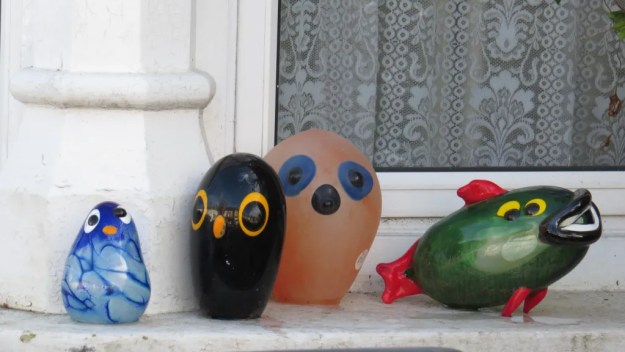
And another thing that always cheers me up are the lovely glass creatures outside this house, and the many containers and baskets full of flowers. A nice front garden is such a gift to everyone who walks past (says she, thinking of her very-much-inbetween-season containers in her front garden).

I love this moss ‘forest’ growing on one of the old brick walls…

And how come I’ve never noticed this plaque before? How things change in a century and a bit…

And finally, as I get back to my house I notice that the catkins on the Kilmarnock Willow are finally fully open – I love all the individual spots of pollen. If you look closely, you can see a tiny fly – not the pollinator that I had in mind when I bought the tree, but an underrated pollinator nonetheless, and I suspect it’s still too cold for many of the bees. Still, this catkin is a thing of beauty, and I’m so pleased that it’s providing sustenance to someone.

Exciting Times in Coldfall Wood

Dear Readers, after nearly three years and many, many delays, it looks as if Muswell Hill Playing Field, which is next to Coldfall Wood, is finally going to get its wildflower meadow. Two big patches have been staked out – one has been completely rotavated and the other, which already had a variety of grassland plants growing last year, has been rotavated in strips. Next week, children from Coldfall and Eden Primary Schools will come with their scarecrows and will help with the seeding. We are all very excited at the prospect of improving the biodiversity here, and I will keep you posted over the next few months as things develop.

At the moment, the main wildlife is a flock of crows, who are also very excited at all the juicy earthworms and beetle larvae that the rotavator has turned up. The main problem once seeded will be the pigeons, I suspect, who are very fond of grain. Let’s hope that the scarecrows will also be ‘scare-pigeons’. Certainly some of the scarecrows that I saw last week looked completely terrifying, so even if they don’t upset the birds they’ll certainly give the rest of us nightmares. I shall provide photos of the scary creations next week.

Crow making the most of the banquet

There will be a fine array of native plants, including wild angelica, red campion, white campion, ox-eye daisy, cowslip, meadow buttercup, hedge parsley, common knapweed, greater mullein, lady’s bedstraw, musk mallow, garlic mustard, selfheal, teasel and vetch, so there should be something here for any passing pollinator. The soil here is heavy clay but it didn’t look too claggy, so I am optimistic that we’ll get a good show. Haringey Council have also agreed to maintain the meadow, so hopefully it won’t revert quickly to perennial weeds like thistle as some meadows have. Watch this space.

In the meantime, there’s lots going on in the woods themselves. There are the very first flower on the blackthorn beside the Playing Fields – soon, these bushes will be a mass of white flowers.

There’s the last of the cherry plum…

Some not-altogether-natural crocuses and daffodils…

And this is a very fine fungus. I’m thinking beefsteak fungus, but I shall have to ask my resident expert.

There was a pair of very active nuthatches looking for insects in this dead branch, yet another reason for keeping deadwood wherever possible.

There has been a lot of very vigorous cutting back and treatment of the Japanese Knotweed. I will be fascinated to see how quickly it recovers (it’s usually quite a battle to get rid of a thicket as impressive as this one was in its heyday).

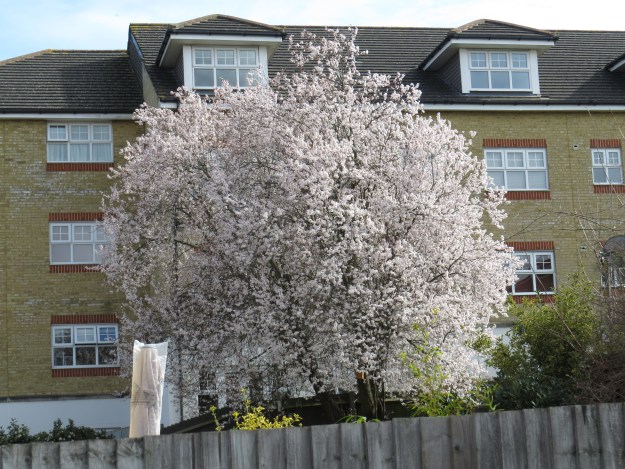
I caught a glimpse of a cherry tree in amongst the houses on Osier Crescent (just the other side of the field) and it was so magnificent that I had to go and have a closer look. I’m sure it gives a lot of pleasure to whoever looks at it.

And this cat looked pretty impressed too…

There’s water in the ‘wet woodland’ part of the woods…

The crows are hanging out in the trees overlooking the stream and the fields – there must have been thirty of them cawing and carrying on, and they all took off when an unfortunate buzzard flew past (probably one of the pair that live in the cemetery).

There are still catkins on the hazel…

The hornbeams are doing their frozen dance, the result of coppicing when they were very young which was never repeated, and has left them with multiple trunks…

and look, here’s a parakeet, just checking us out and making sure that we’re behaving ourselves.

We are so lucky to have ancient woodland so close by. It is such a wonderful space to explore, and already punches above its weight in terms of the variety and number of plants and animals who live here. It will be interesting to see what the meadow attracts over the next few months.