Dear Readers, I first wrote about the late summer disappearance of our feathered friends back in 2020, when we were mostly locked down and I had lots of time to cogitate on such things. But this weekend someone asked me, with some concern, about where the birds had gone – he had returned home from holiday to find his garden apparently deserted. Never fear! This happens every year. Read on to see my original post.
Dear Readers, the hubbub in the garden has stilled, the suet feeders swing empty, the mornings are bereft of birdsong and the most excitement that we have at the moment are a couple of woodpigeons beating one another up on the seed feeder. The change is so sudden, so extraordinary, that it’s easy to forget that this happens every single year, and in a way it’s good news – it’s proof that birds aren’t completely dependent on us, and that they can still find their own food when they want to.
But why does it happen?
Firstly, for most birds, the breeding season is pretty much over, the youngsters have literally ‘left the nest’ and the parents no longer have to worry about provisioning them. Even my live mealworms are left wriggling on the bird table, and I suspect that a fair few escape to freedom which is only fair. I think it’s no coincidence that the only birds who stick around in my garden are the ones who breed all year, such as the collared doves and the aforementioned woodpigeons. These birds can feed their offspring on ‘milk’ that they generate themselves in their crop, so are not so reliant on seasonal food and so can reproduce whenever the fancy takes them (which is frequently judging by ‘my’ birds, who spend most of their time chasing one another around with a lustful glint in their eyes).

Woodpigeons beating one another up.
Secondly, there is a lot of ‘natural’ food around for the next few months. Many insects are out and about, the hedges are already full of brambles, and there will be a positive feast available for younger birds to learn about. Fledglings need to learn where the other food sources are locally (and sometimes not so locally – blackbirds, for example, often have a place where they breed and a place where they overwinter). Plus, many young birds will be off finding territories of their own, which will push them further afield. All in all, it’s holiday-season for many creatures, and unlike us, they don’t have to worry about the impact of Covid-19 on their planned destinations.
But finally, many birds will be in moult at this time of year. Feathers don’t last forever, and they are of such vital importance to everything from insulation to flight that they have to be looked after and eventually replaced. For many birds this is a slow process, as the bird needs to retain enough feathers at any one time to make sure it can keep warm and make an escape if necessary. The birds tend to stick to a well-protected area with plenty of food available, and something like a bramble hedge is perfect. No bird wants to risk fluttering to a feeder if there is insufficient cover to pop back into. Plus, creating new feathers takes a lot of energy, so birds tend to do this after breeding and before the need to migrate or to put on fat for the winter.
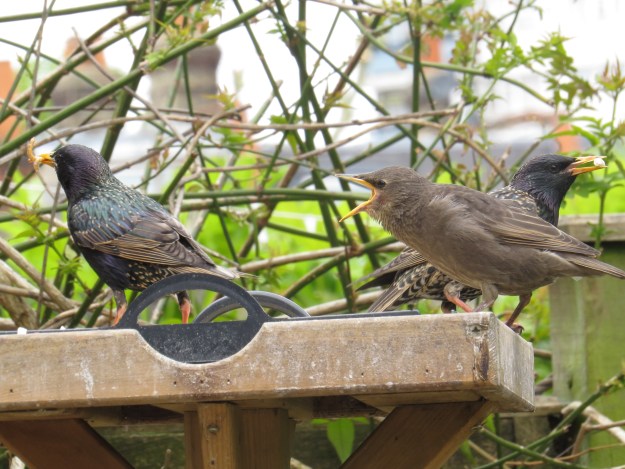
If you are lucky enough to see a baby starling at this time of the year, you might notice that it has some juvenile, dull-brown plumage, and some of the darker, more iridescent adult plumage.

Starling with full adult plumage
One type of bird that has a particularly tough time of it during the moult is the duck. Ducks, geese and swans lose all their feathers at the same time, which means that they can’t fly but have to stick to the safety of the water. To reduce the vulnerability of the more brightly-coloured drakes, they lose their brightest feathers first, which can lead to a variation on our main question: where have all the male ducks gone? The rather dowdier- looking drakes are said to be in their ‘eclipse plumage’ and this, my friends, is why identifying duck species at a wildfowl reserve is something of a challenge in the summer months. Female ducks, who may still have ducklings to care for, often lose their feathers later. One species, the shelduck, actually makes a ‘moult migration’, leaving their breeding grounds all over Europe to descend in vast numbers on the German Waddensea coast. Hundreds of thousands of shelduck arrive in July, and will leave to migrate to their wintering grounds once the process is complete. Although most European shelducks head to Germany, some spend the moulting period much closer to home, in Bridgewater Bay, Somerset.

Shelduck in January looking very pristine!
And so, although our gardens might be empty of birds, it’s a relief to know that they haven’t deserted us because they’re fed up with the quality of the food that we provide, or the way that we always seem to be at home these days. They are going through a perfectly natural process and, believe me, when the weather takes a turn for the worse they’ll be back, en masse, looking for mealworms. We just need to turn our attention to the other, smaller, less obvious critters in our gardens: keep an eye open now for queen bumblebees of many species, fattening themselves up prior to hibernation. And of course, the slow reddening of the berries, and the ripening of the blackberries. It looks as if it might be a bumper year!

Two siskins and a chaffinch in the garden in December 2017
Scene in May
By contrast, I was concerned it would take time to lure birds to my garden after my six week absence. Instead, I have been delighted by the presence of up to 23 different species of birds in a sitting. Even though we are still in the grip of winter temperature-wise, spring is in the air for the plants and the birds. Your post highlights the balance between the hemispheres 🙂
Indeed Anne, I’m glad your birds haven’t deserted you! They know where to find the good stuff!
Funnily enough, we’ve just noticed the return of some of ‘our’ birds. Firstly, 2 days ago, I noticed a few robins flitting back and forth, then a Mrs and Mr blackbird. The relatively few Canada geese have become 50 or more strong on the estuary and this morning I espied a curlew, which is the first time I’ve seen one since the beginning of Spring.
Curlew! How amazing…