Monthly Archives: September 2024

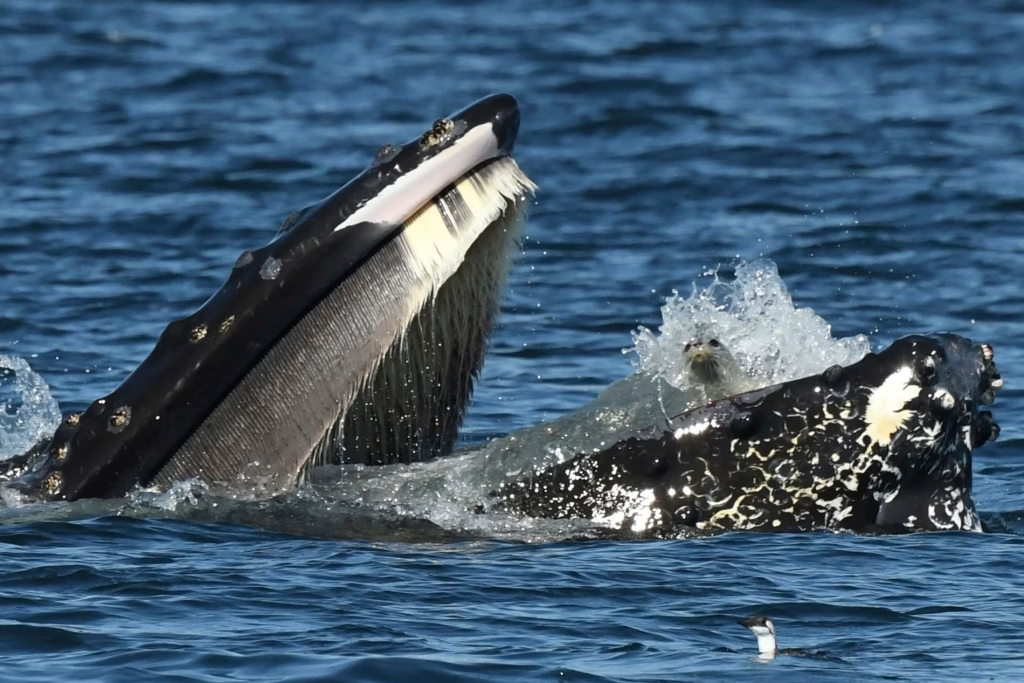
Gulp!

Humpback Whale and Surprised Seal (Photo by Brooke Casanova, taken off Anacortes, Washington USA)

Dear Readers, I’m sure many people were alarmed when they saw this photo today. Is that whale about to eat that poor seal? Well, no, and for a variety of reasons, though because of the way that they feed, humpbacks often end up with larger items on their menu than they anticipated.

When I was whalewatching in Monterey Bay back in 2018, I was lucky enough to witness the feeding tactics of humpbacks close up. You could often tell what was going on from miles away simply by watching the seabirds.

Photo by Peter Dunn

Humpbacks are baleen whales – they feed on tiny fish that they corral into a ball by blowing a ring of bubbles around them. As the fish start to mass together, they jump out of the water in their panic, and this attracts various kinds of gulls, shearwaters, and even pelicans.

The birds, in turn, attract sea lions.

Sealions massing above humpback whales (Photo by Peter Dunn)

And then this happens…

Humpbacks lunge-feeding (Photo by Peter Dunn)

As I mentioned in my blogpost about this trip, I’d seen scenes like this on ‘Blue Planet’ but never imagined that I’d see it for myself in a million years. Normally all the birds and the sealions manage to get out of the way of the whales in time, but I have seen a whale spit out a bedraggled pelican, and the whales sometimes ‘trumpet’ in irritation at the sealions. Something to bear in mind, though, is that the throat of a humpback whale is very, very small in diameter, and so the chance of anything as large as a bird, let alone a sealion, ending up in the stomach of a humpback is very unlikely.

A few words here about the photographer, Peter Dunn. He was our guide on this trip, and a more knowledgeable, well-organised and kinder human being you couldn’t hope to meet. Sadly, Peter was diagnosed with terminal cancer in March 2020, and contracted Covid-19 while he was in hospital. He died in May 2020, and what a loss that was, to his family and to the UK nature community. He was also a great photographer, and I think the photo below, of a mother whale breaching with her baby by her side, is one of his best photographs. What a wonderful man he was. You can read his full obituary here.

Double-breach – Photo by Peter Dunn

Peter Dunn in Antarctica


Normality!

Dear Readers, life is gradually ‘getting back to normal’ for Bug Woman here in East Finchley. Today, I met my dear friend P for lunch in Table du Marché, easily my favourite restaurant on the High Street. Admittedly I was leaning on a crutch and she had a walking stick so we made a pretty four-legged pair as we sidled crab-wise into the restaurant, but after three courses and a good old catch-up we both felt much better about the world. Plus, the wait for the 263 bus to take my friend home was only about five minutes, and the bus driver even stopped to make sure that she’d sat down before he took off towards Archway. Result! All too often the driver pulls away from the bus stop as if they’re driving a Formula One racing car, with the result that all the standing passengers head towards the back of the bus like pinballs.

Anyhow, my Open University course is open for those keen people who want to start early (official start date is 4th October), tomorrow I’m venturing into Islington on my own to get my hair cut, and on Friday I’m back to pilates for the first time in three months, which will necessitate a very slow and careful re-introduction to core strength and flexibility.

And in other news, I am giving a talk for  Finchley Women’s Institute on 9th October, which is coming up extremely fast. How to pack everything into 45 minutes is the question! I want to talk about making a garden wildlife friendly and what there is to see around North London in the way of urban creatures, plus I would really like to sing the praises of my beloved Coldfall Wood. Some judicious editing will be required for sure. And this is the first time that I’ve spoken in public since before lockdown, so I am sure to be a little anxious. Never mind! The past few months have shown me how easy it is for the world to get smaller, so now that I’m able to get out and about a bit I’m determined to push back the walls a bit and let the outside world back in. Let’s see how we get on.

The link to my talk in October is here. Wish me luck!

A Pregnant Mum…

Female Garden Spider (Araneus diadematus)

Dear Readers, whilst most animals in the garden breed in the spring, the garden spiders are different. This particular spider has spun her web in a perfect spot between the buddleia and the Kilmarnock willow, and I’ve been saying hello to her every morning. It’s amazing how quickly these spiders grow – I swear this one has doubled in size in the past week, and in fact that’s why we suddenly notice them – for most of the year (baby spiders hatch in April or May) they are too tiny for us to pay attention. But now the females are coming to the end of their life cycle. 

This spider’s huge abdomen suggests to me that she is will be laying her eggs soon – they are wrapped in a silken cocoon, and the female will stay with the eggs until she succumbs to the frost and dies. As winters grow milder, I imagine that there’s an outside chance that the spider will live through the winter, although as far as I know she only breeds once. Mating is, as with all spiders, a tricky affair for the male – the male taps the web rhythmically so that the female knows that he isn’t dinner. Apparently smaller males are eaten more often than larger ones, and males of all sizes spend a lot of time catapulting themselves off of the web if the female moves towards them suddenly. Who knows what happened to the father of this spider’s eggs? I dread to think.

Here she is in all her glory. I love the way that the patterns and colouration on the back of each spider is subtly different, but most Garden Spiders have that distinctive ‘cross’.

‘Our’ spider

Another Garden Spider – slightly darker in colour.

And here’s a little film of ‘our’ spider sorting out her web. I think she’s just tidying up a messy bit of silk here, to make sure that her web is as invisible as possible. Spiders often eat their webs – no point in wasting all that useful silk!

And here’s another favourite, often spotted on sunny walls – a Zebra Jumping Spider (Salticus scenicus). I love jumping spiders! And there have been Zebra Jumping Spiders patrolling the front of my house ever since I moved in. I always look out for them when it’s sunny, and they never disappoint. This species has been found capturing prey over three times its size, and it often keeps a close eye on the flies visiting the Mexican Fleabane in my window box. So many miniature dramas going on!

So there’s a lot going on in the garden as the year starts to segue into autumn, and there will be even more going on soon – the tree surgeon has been to visit, and I’m hoping for a massive pruning of my whitebeam and hawthorn by mid October. We were hoping to do this work in the spring, but it was so wet that by the time the tree surgeon could start, everything was in full leaf. Tree work is always a bit concerning, but it’s so important to make sure that trees are looked after and don’t outgrow their root system. Anyhow, fingers crossed, and I shall keep you posted!

Sciencing with Snails!

Samples of the Banded Snail (Cepaea nemoralis). Photo from Open University

Dear Readers, if you are a long-term follower of Bug Woman you’ll know that I love nothing better than a bit of sciencing, and so, a whole month before my next Open University module (S317 – Biological Science from Genes to Species since you ask) I am starting to prepare for my next ‘proper’ science experiment.

Banded snails, like the ones in the photograph, come in a variety of different colour forms, or ‘morphs’. They can be yellow, pink or brown, and they can have many bands, one band or no bands. Although they’ve been studied for decades, no one is quite sure why the variation occurs. One theory is that it’s linked to bird predation – snails in wooded areas tend to be brown and unbanded, so that the birds find it harder to see them, and in grassland areas they’re often yellow and banded for the same reason.

Another theory is that the further north you go, the more likely you are to see dark-coloured snails – the shell absorbs more heat, and, as frost is the main danger to our molluscan friends, dark-shelled snails are more likely to survive.

So, at some point I need to hobble out into the field and see if I can find 20 adult banded snails. Unfortunately, I have only ever seen one banded snail in my garden in nearly fifteen years of living here, so I am putting out the call far and wide to my neighbours and friends in case they have gardens full of the little devils. One suggestion from my lovely friend A is the cemetery, which has both woodland and grassland and so should provide a healthy selection of snails. I’m not sure if we’re meant to be doing field studies there though, so we’ll have to look as unobtrusive as possible.

Once we’ve found our snails, I need to categorise them and then release them to live the rest of their lives without further interference. What stories they’ll have to tell to their children, though.

Then, it’s a case of comparing my records not only to my fellow classmates, but also to historic records. It appears that someone was looking at banded snails in Colindale, which is close enough for my purposes. Now, if only I could get the website to open properly so I can actually look at the records!

Anyhow, I am very excited about getting back ‘into the field’, even though it will be a slow and careful experiment for sure, as the last thing I need is to topple into a mass of snails or trip over a gravestone. I shall keep you all posted, and in the meantime, if you live close to East Finchley and have a plethora of banded snails in your garden/allotment/local park, do give me a shout. I need all the help I can get!

The Littlest Corvid

Jackdaw (Coloeus monedula)

Dear Readers, the arrival of jackdaws in East Finchley is part of a continuing trend. Once upon a time, there were jackdaws in the City of London, right in the very heart of the Capital, and they even bred at the Tower of London, but 1905 was the last time that they were seen in the inner city. Why is something of a mystery. They certainly thrived on the insects and grain associated with horse-driven transport, and the fur from the horses and from other domesticated animals driven into markets such as Smithfield was commonly found in jackdaw nests, so maybe the change to petrol-driven transport played a part.

The other factor is probably nest sites. Unlike other crows, which nest in tall trees,  this smallest member of the corvid family is a cavity nester. I spotted one making his or her nest in the corner of an outbuilding when I was in Milborne St Andrew a few years ago.

Sadly, when I returned recently the hole had been filled in, and this is a persistent problem for jackdaws, even in the countryside. They have an unfortunate habit of nesting in chimneys, which is dangerous for them and for the home owner – nobody wants their chimney to catch on fire, and so many houses now have guards over the chimney stack to prevent the birds from nesting.

I used to associate the sound of jackdaws with visiting my parents, but it’s a real delight to hear them calling now in North London. I have no idea where ‘my’ jackdaws are nesting, but last year they brought their three fledglings along for some suet pellets and mealworms. Jackdaws mate for life (though in the winter you can see them in larger flocks, sometimes mixed in with rooks and crows). So, whenever I see one jackdaw I always instinctively look for the other one. They’re never far away.

Jackdaw with a beak full of mealworms

The eyes of a jackdaw are really something, and are one of the bird’s distinguishing features, along with that frosty ‘hoodie’ at the back of the head and neck. According to my British Trust for Ornithology newsletter this week, juvenile jackdaws have bright blue eyes, which turn brown during their first winter, and eventually become silver in the adult bird. The naturalist W.H.Hudson described them as ‘small malicious serpent-like grey eyes’ but I can only think that he looked with a jaundiced attitude. To me, the eyes of a jackdaw show a sharp intelligence, and a clarity of intention.

So, the sounds of a few jackdaws in flight can sound musical and somehow rather optimistic (at least to me). See what you think. This recording was by Bert de Bruin in Groningen in the Netherlands.

However, in the winter jackdaws and rooks may roost together in huge flocks, and the sound can  be properly awe-inspiring. This recording is of birds leaving a night roost in France, made by Stanislas Wroza.

For the best description of a jackdaw/rook roost, and what it feels like to witness this behaviour, I always turn to Crow Country by Mike Cocker. For a little taste, this is how he describes the call of the jackdaw:

“The jackdaws meanwhile produce sharp-chipped lapidary notes, like the sweet strike of flint on flint, and in this flinty landscape nothing could be more appropriate.”

What a perfect description! And so, when I hear the sound of the jackdaws outside, it always gives me a sense of hope, a sense of how nature is constantly changing and  adapting, and how what was lost from a city may one day return. Why life here suddenly seems more hospitable is anybody’s guess – more people feeding birds? The jackdaws changing their nesting habits, or finding nooks and crannies that other nesting birds don’t exploit? Who knows? I’m just glad to hear them.

First Visit to a Bookshop in Three Months!

Dear Readers, well I made it to Angel, traversed the Stairs of Doom without incident (you might remember that I fell down the stairs at East Finchley Station and broke my leg at the end of June) and as a reward, I had to visit a bookshop! I went to Waterstones on Islington Green – admittedly not a favourite like Daunt or the LRB bookshop, but the staff there are great, and there’s a good selection (such a good selection, in fact, that I had to tear myself away).

I managed to escape with just three paperbacks. First up is this year’s winner of the Wainwright Nature Writing Prize – Late Light, the Secret Wonders of a Disappearing World‘ by Michael Malay. I love hearing new voices who are writing about nature – I recently read ‘Uprooting’ by Marchelle Farrell, about a woman from Trinidad exploring her roots, and what ‘home’ means in a Somerset village during the Pandemic. It made me think about my own views of what life in a rural community is like, and how different it might be if you are visibly ‘different’ from those that you live amongst. in ‘Late Light’, Michael Malay, a recent immigrant from Indonesia,  explores similar themes as he finds himself learning to love the English countryside and the creatures that live there, just as human development is starting to encroach on the area where he lives. I am looking forward to getting stuck in, though my reading pile is positively frightening at the moment.

My second book was rather aptly called ‘Some of Us Just Fall – On Nature and Not Getting Better‘, by Polly Atkins. I read the first few pages, and was hooked. Atkins is a poet, and it shows. She is an advocate for the need for more disabled voices in the publishing industry, and for the inclusion of more marginalised authors in outdoor and nature writing. Again, this is a perspective that’s different from those who can get out and enjoy the ‘outdoors’ easily, without even thinking about it, as I was until my fall. There’s much to learn from other people, and from my own experiences, however painful.

And finally a bit of a wildcard: ‘A History of Pictures From the Cave to the Computer Screen’, co-authored by Martin Gayford and David Hockney. I find myself more and more interested in art and what it says about human beings in a particular time and place – I’m currently reading ‘The Upside Down World – Meetings With the Dutch Masters’ by Benjamin Moser, and finding it absolutely fascinating. I can imagine myself doing an Open University qualification in Art History or somesuch once I’ve finished my biology/environmental science degree. It’s never too late to learn!

So, what are you reading and enjoying at the moment? I hesitate to ask because of the size of my reading pile, but here we go…

And so, my leg is sore but I’ve made it all the way to Islington and back whilst staying vertical. This is the longest that I’ve stood up for since June, and the first time I’ve been on a tube train. I’m feeling so glad that I’m gradually getting better, even though I am still officially in the slowest 10% of walkers along Upper Street. It’s just nice to browse in a bookshop, sit in the sun with a coffee and look at the outrageous prices of the houses in the many, many Estate Agents’ windows as we pass. Onwards and upwards!

Echocardiogram

Echocardiogram image (not mine!)

Dear Readers, there is no diagnostic medical test more relaxing than an echocardiogram (unless you include any anxiety about the potential result). There is something strangely intimate about being in a darkened room while someone presses an ultrasound recorder against your breastbone. All is silent except for the occasional ‘whump, whump, whump’ of your own heart. Every so often you have to breathe in and hold your breath, and then let it out, and then repeat all over again. It’s slightly less relaxing if the technician forgets to tell you that you can breathe out. Not that that would ever happen.

I had an echocardiogram over a year ago, and at that point I was diagnosed with a bicuspid aortic valve (you can read all about it here and here, should you want to explore the history). Interestingly, this time the technician wasn’t so sure that it was bicuspid, but he did say that there was moderate calcification of the valve which also doesn’t sound like a barrel of laughs, so I guess we’ll just have to wait and see. In theory I should have an appointment with my cardiologist now that my 24-hour blood pressure test and the echocardiogram have been completed, but I have a gut feeling that I will have to chase it. Whilst the orthopaedic department at the Whittington has been completely on the ball (mainly because I was admitted as an emergency), cardiology has been slower, probably because resources are limited and there are people in a much worse state than me. Should we be waiting until I also get into a state, though? Not very economically sensible, and not very pleasant for the patient, for sure. I intend to be a moderately impatient patient, rather than an in-patient wherever possible.

And next week is the first week in forever when I don’t have any medical appointments. Hallelujah! Instead, I am hoping to take myself off to my pilates studio, which I’ve been attending for fifteen years, to gently start getting myself moving again. The teacher there knows me well, and I will take some photos of my fracture and my lovely new metal leg so he can see what’s been going on. Tomorrow I will be braving East Finchley Station with its terrifying Stairs of Doom for the first time since the accident for a ‘trial run’ to Angel Station, and if all goes well I may reward myself with my first trip to a bookshop for three months. Wish me luck!


An Ivy Bee Update

Photo by Philip Buckley

Dear Readers, you might remember that last year, reader Philip Buckley shared some photos and film of the ivy bees in his garden with us all, and if you haven’t seen it before, have a look here – https://bugwomanlondon.com/2023/09/29/amazing-ivy-bees/

What wonderful little bees they are! There are still a few on the ivy on the County roads here in East Finchley too. I’d love to know where they’re nesting, it can’t be far away.

One clear way to tell if what you’re looking at is a bee or a fly is ‘does it have pollen on its hind legs or underside?’. Some bees have very well-developed ‘pollen collection mechanisms’, known as corbicula, or ‘little baskets’ – you can see these on honeybees and bumblebees, and you can see blobs of pollen on the legs of the ivy bees in the photos above. You will never see pollen baskets on a fly. But flies can be surprisingly good bee-mimics. Have a look at the hoverfly in the film below. In particular, the way that it wobbles its abdomen up and down can look very convincing. This fly, though, is collecting nectar for its own pleasure/sustenance, rather than collecting pollen to feed its larvae.

I think this is one of the Eristalis hoverflies, probably Eristalis tenax, but I’d need to have taken a better photograph to be sure. Notice those big compound eyes, which again distinguish hoverflies from bees. It’s worth noting that hoverflies are often excellent bee/wasp/hornet mimics – anything to avoid getting eaten by those pesky predators, particularly the birds!

Hoverfly in the centre, ivy bee bottom right…

And I was somewhat relieved to spot a couple of ‘ordinary’ wasps. Any wasps nests will be breaking up about now, and the workers will finally have time to get some sugar for themselves before they die. It’s hard to begrudge them something sweet after all their hard work all summer.

I also saw 2 red admirals and a peacock butterfly this afternoon – they always pop out when I don’t have my camera, but it was lovely to see them, especially as they’ve been so scarce all summer. Sometimes there’s a ‘fall’ of butterflies migrating from southern Europe – the most spectacular one that I’ve ever seen was when painted lady butterflies descended on Culpeper Community Garden in Islington when I was working there. There must have been fifty butterflies! It was like being in a butterfly house. No such luck today, but after the damp spring and dodgy summer I’m grateful for whatever I see.

And let’s close with some more of Philip’s ivy bees. They always cheer me up.


The Cake Delivery Service

Dear Readers, ever since I’ve been able to get to the kitchen without crutches, I’ve been obsessed with cooking, and in particular, baking. However, there are only two of us at home, and neither of us really need to be piling on the calories, so I have been delivering cake to anyone who would like some. The plums are really delicious this year, and so I decided to make Nigel Slater’s Plum and Honey Cake (recipe at the Kitchen Lioness link below the photo above). I ran out of golden syrup so I substituted some maple syrup, and my cake was a bit thinner because it was in a larger tin but! I did love the slight acidity of the plums  against the sweetness of the cake. All I need now is some custard.

And  so, I took to the County Roads of East Finchley to deliver the cake to my friend A, who only lives around the corner. First up, I had time to admire the sedum  in my front garden, which is particularly fine this year.

And then, here is the sedum roof from the house a few doors along – what a great way to make a cover for one’s wheelie bins or bicycles?

Then the hibiscus is in flower – it does remarkably well considering that we can have chilly winters.  I am still waiting for the hibiscus street tree to flower – it has buds, but is taking its own  precious time.

I do love an acer against a clear blue sky…

And there are plenty of rowan berries for the birds. I especially like these orange berries against the terracotta-coloured brick wall.

The crab apples are looking rather fine at the end of the road. They almost look as if you could pluck them and  eat them, rather than having to turn them into jelly to offset their sourness.

Then it was off to deliver the cake. My friend has some very fine mature shrubs, including this one – my friends over at the Facebook group Plant Identification UK think it’s either Euonymous fortunei or japonicus, we’ll have to wait until the seeds ripen to find out which. Either way, it’s closely related to our native Spindle.

I went to physiotherapy yesterday, and as a result my leg is a bit sore today, so I had plenty of time as I hobbled back to admire this astonishing hydrangea. The leaves are going to be splendid soon, too.

I have some of this liriope in my garden, but it doesn’t flower as well as this one…

And as I get close to home, I find myself admiring the weeds, like this procumbent yellow sorrel, with its purple-brown leaves and happy open-faced flowers (no anthropomorphism there, clearly 🙂 ). Though now I’m looking at the photo, I’m thinking that what I could be looking at is in fact lesser celandine that’s tangled up with everything else.

And here is some sun spurge, one of the first Wednesday Weeds that I wrote about, back in 2014. And the yellow flower there is definitely procumbent yellow sorrel.

And finally, as I stagger womanfully to my front door, here is our recent friend, Canadian Fleabane, a little out of focus because it’s gotten a bit breezy. I am becoming rather fond of this weed, as indeed I am of a lot of the plants that are having a field day on the County Roads this year. There’s a quite surprising diversity of species, and always something new to notice. Who knew that ‘weeds’ could make me so happy? These days I’m greeting them as if they were old friends, much to the amusement of my neighbours. Well, a community really is more than just people.

Wednesday Weed – Canadian Fleabane Revisited Again!

Canadian Fleabane (Conyza canadensis)

Dear Readers, the fleabane by the side of my water butt is finally in flower, and I’m happy to report that it is, indeed, a Canadian Fleabane. But how can you tell, when  there are various other Fleabane species about? First up, each flower is topped with a little white ‘crown’, and the green ‘bit’ that the flower emerges from, the bract, is pretty much hairless.

Then we have Bilbao’s Fleabane (Conyza floribunda) which is a more recent introduction first seen in 1992 (Canadian Fleabane first put in an appearance in 1690), and can also be found in London and along the south coast of the UK. The flowers are very different, as you can see – the flowers look ‘pinched’ at the top, as opposed to cylindrical, and often have a red tinge.

Bilbao’s Fleabane (Conyza floribunda) (Photo By Meteorquake – Own work, CC BY 4.0, https://commons.wikimedia.org/w/index.php?curid=143713818)

And then  there’s another ‘recent’ introduction, Guernsey Fleabane (Conyza sumatrensis), which first appeared in 1974. This has flowers of a similar shape to Guernsey Fleabane, but the bracts are very hairy, and the flowers are often tipped with purple.

Guernsey Fleabane (Conyza sumatrensis) Photo By Meteorquake – Own work, CC BY 4.0, https://commons.wikimedia.org/w/index.php?curid=143648891

So, Canadian Fleabane  originally came from North America, while Bilbao’s and Guernsey Fleabane originated in South America. All three species have been extremely successful – they have tiny, light seeds that are easily distributed in a gust of wind and, as my garden suggests, this genus can establish itself wherever there’s a suitable crack in the pavement. In fact, in their book ‘Alien Plants’, Clive Stace and Michael Crawley have identified that there can be ‘waves’ of different Fleabanes, with Canadian Fleabane being replaced by Guernsey Fleabane  and then by Bilbao’s Fleabane. The authors point out that it’s not currently known exactly how this works, but for me it’s interesting – all of these species need open ground and sunlight in order to grow (so are all eventually outcompeted by slower growing, more heavily-leaved plants), but whilst Canadian Fleabane started off as a plant of wasteland, it’s now more often found on cultivated and fallow arable land. Guernsey Fleabane has taken a shine to railway ballast, and Bilbao’s Fleabane is found on brick paths. There is so much about ‘weeds’ that we don’t understand, and which can teach us all kinds of things about why some plants survive, some don’t, and how the relationships in a natural community change over time.

And now, let’s have a look at what we’ve found out about Canadian Fleabane and its relatives previously…

Fleabane (probably Canadian) with ragwort at Woolwich Dockyard

Dear Readers, Canadian Fleabane (and its close relatives Bilbao’s Fleabane and Guernsey Fleabane) are such weedy weeds that it’s easy to pass them by without so much as a second glance. Members of the Asteraceae (Daisy) family, they have tiny flowers and a whole lot of fluffy seeds and are annuals of such fecundity that once you have the plant on a patch of rough ground or, as here, along a riverside, you are probably going to have it forever. Experiments outlined in my book ‘Alien Plants’ by Clive Stace and Michael J. Crawley suggest that grazing with rabbits seems to be a way to keep the Fleabane (Conyza) genus in check, but there’s a grave lack of small furry grazing animals in Woolwich, clearly.

Fleabanes tend to grow alongside buddleia, as I noticed from the Woolwich walk.

Buddleia!

The name given to the community of plants established by buddleia and fleabane is the Buddleia-Conyza scrub community, and you can see it popping up in many urban sunny sites, frequently on builder’s rubble or tarmac – we have a great example of this just up the road from here in East Finchley on the site of an old petrol station which has been landbanked by developers for years, but you can also find great examples on railway embankments. Fleabanes tend to be the first colonisers, along with mugwort, American willowherb, bristly oxtongue and evening primrose, but soon the buddleia and the sycamore start to take over, with the fleabane tending to die out where it’s overshadowed by the buddleia. This feels like such a very urban habitat that I’m glad that it has its own name and now has people studying it. Colonisation can start within a year of a site being left derelict, and the habitat can persist for up to twenty years. It will be interesting to see how long the example of the Buddleia-Conyza complex in East Finchley lasts before someone decides to actually build there.

And when I looked back at the last time that I wrote about Canadian Fleabane, I mentioned that there was a patch at the side of my house. When I looked early this week, there was still some there, probably descended from the seeds that were dropped by the parent plant back in 2014. You have to admire the plant’s sheer persistence.

So, this is from my original post back in 2014.

A thicket of Canadian Fleabane has erupted in the alley at the side of our house, and I am delighted. I know this is not the reaction that most people would have, but then, this week is the thirteenth anniversary of my marriage to my Torontonian husband, so a little reminder of the country that he came from is very welcome. Plus, although this plant comes from so far away, it has put down firm roots in London, and is more commonly seen in the Capital than in any other city, so in that respect it is a little like me.

Canadian Fleabane 004 BPThere are lots of plants that resemble Canadian Fleabane, but none have such a mass of tiny flowers, which at this time of year are rapidly turning into fluffy seeds. The plant was apparently brought to the UK as seeds in the innards of a stuffed bird, back in the sixteenth century (unlike my husband who arrived into Heathrow in a big metal bird twenty-odd years ago).

Canadian Fleabane 003 BPIn many ways, Canadian Fleabane is a ‘proper’ weed – it’s an annual which produces thousands of seeds, and which can grow in the most unpromising of spots, as its appearance in my dark, soil-less side alley proves. But, as with so many plants, it has a myriad of helpful uses. A tea made from the plant is said to be helpful for arthritis and for diarrhoea, and it has also been used to combat hay-fever. Like so many fleabanes, it is also said to be good for deterring insect parasites.

Some wind-blown Canadian Fleabane

Some wind-blown Canadian Fleabane

I can’t help but admire a plant that can erupt from a crack a hairs-width wide and grow to four feet high in a single season.  This afternoon, the little seeds were flying away in the breezy weather, taking their chances on a new land far from where they started. And, thinking of my soulmate who flourished so far from his native soil, I find myself wishing them luck.