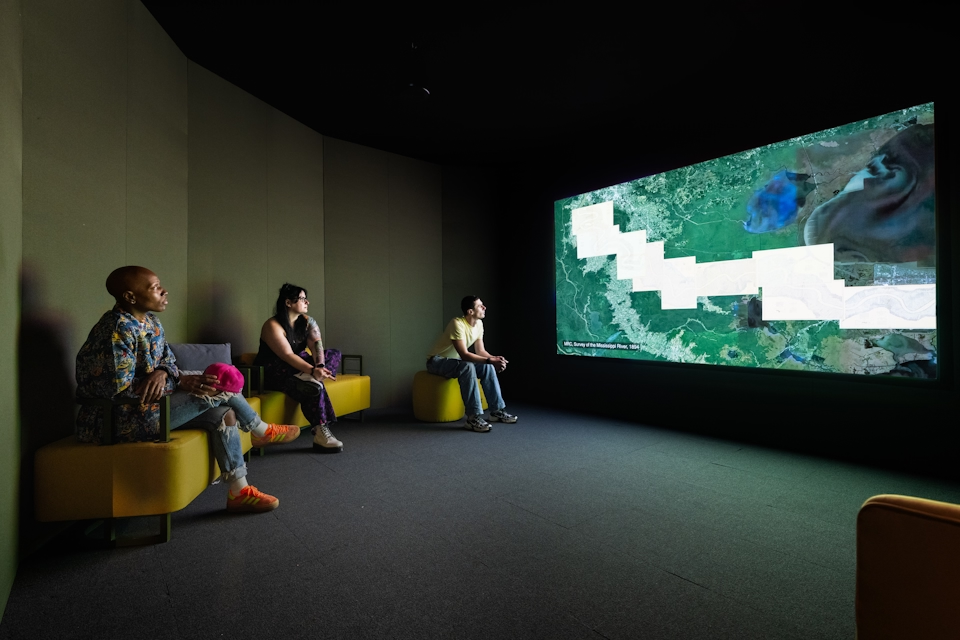
An Image from an exploration of ‘Death Alley’ along the Mississippi in Louisiana
Dear Readers, yesterday I made another foray into central London to see the current (free) exhibition at the Wellcome Collection, “Hard Graft“. It was a fascinating exploration of the ways in which work impacts the human body, and there was much to think about.
I didn’t have the stamina to spend as much time there as I would have liked, but I did sit for twenty minutes to watch the film in the photograph above. It explores an area along the Mississippi river in Louisiana which used to be known as ‘Cancer Alley’ (now ‘Death Alley’) and it describes how the land once used as sugar plantations is now a network of industrial sites, interspersed with small towns populated largely by black people, many of them the descendants of the slaves that used to live and die there. It shows how the plumes of toxic chemicals and particulates impact these small towns, and the images of the poisoned air that people are breathing in every day is horrifying. But people are fighting back on a number of fronts, and one of them is to identify the burial grounds of the slaves who died on the various plantations. When companies want to develop the land for industrial purposes, it’s surprising how often the archaeological companies that they employ ‘miss’ these graveyards, only for them to turn up when a less biased organisation is involved – even in Louisiana, it’s illegal to build over a graveyard. So a lot of work is going into identifying these burial sites, which were usually very close to the slave quarters, and where trees such as magnolias were often planted by those who were related to the deceased. If the sites can be found, at least any further industrial development can be halted, while efforts are being made to hold the existing facilities to account for their emissions.
The exhibition is split into three sections – ‘Plantation’, ‘Street’ (which features everything from sex workers to garbage disposal teams) and ‘Home’, about cleaners, piece work and other work done from the home. It has a strong emphasis on people coming together to fight injustice, and the importance of collective action. I highly recommend it, not least because it made me think about the impact of work on the body.
My mother was a ‘touch-typist’ who used to type up reports, manuscripts and other documents dictated by some boss-type chap (and it was always a chap) into a recording machine called a Dictaphone. Who remembers those? Back in the day, people didn’t do their own typing on their own laptop. No, they got someone else (usually a woman) to do it for them. One day Mum was musing about her life, and said something that’s stayed with me to this day.
“I just feel like part of a machine. I’ve got the ear phones in my ears (to listen to the recorded tape), my hands on the keyboard (Mum was once timed at 130 words per minute, and that was on a manual typewriter) and my feet on the pedals (that controlled how fast the tape went).
In fact, towards the end of her working life Mum developed carpal tunnel syndrome (CTS), but interestingly this only happened after the electric typewriter was introduced. On a manual typewriter, you used to have to stop to return the carriage at the end of every line, and so there were a variety of hand and arm movements. With an electric machine you could just keep going, and once the PC came in you didn’t even have to change the paper, so you were performing a small number of micromovements, just the sort of thing to irritate the median nerve, that runs through the tight corridors of the wrist joint.
Other people who suffer from carpal tunnel syndrome include people who work with machinery such as jack hammers or drills. It is extremely painful and debilitating, but when one of Mum’s colleagues asked for time off for her CTS she was accused of being neurotic, and was managed out of the organisation. This was back in the early 1990s. Would it still happen now? I’d like to think not, but I’m not so sure.
The exhibition also made me think about the implications of increasing the retirement age. If even sitting in an office can cause something as damaging as CTS (not to mention back pain and all the other joint problems that all that sitting can generate), how about people who are builders, or garbage collectors, gardeners or scaffolders? What happens if you work outside in all weathers or have to do a lot of heavy lifting or other physically demanding labour as you grow older? Some people will stay as fit as a fiddle, but how about if you have arthritis or one of the other ailments that happen as approach retirement age? Clearly we have a demographic problem in the UK, as in the rest of the Western World, but it does seem particularly harsh that those who are often paid the least, and have the least chance to retire early, are the ones who end up suffering the most.
Rant over! If you’re in London, the exhibition is well worth a look, and there’s a fine café and bookshop too.
The exhibition sounds very interesting.