
Superb Fairy Wren fledglings (Photo by Patrick Kavanagh at https://www.flickr.com/photos/patrick_k59/50754327287)
Dear Readers, it’s probably no surprise )to those of us who spend time watching our garden birds at least) that different species of birds react to one another’s alarm calls. I’ve watched birds scatter at the cacophony raised by a blackbird, or by the chinking call of a robin. However, scientist Will Feeny and his colleagues at the Doñana Biological Station in Spain have discovered that 21 different bird species react to a very specific vocalisation – it’s a kind of whining call which indicates the presence of a cuckoo or other brood-parasite.
The species who react one another’s calls include the Fairy Wrens of Australia, the Tawny-Flanked Prinia in Africa, Hume’s Leaf Warbler in Asia, and Greenish Warblers in Europe. All of these birds are targeted by different species of cuckoo, and the last common ancestor of these birds lived about 53 million years ago. And yet, they have all retained this particular vocalisation to warn of the danger.

Tawny-flanked Prinia (Prinia subflava) Photo By Bernard DUPONT from FRANCE – Tawny-flanked Prinia (Prinia subflava), CC BY-SA 2.0, https://commons.wikimedia.org/w/index.php?curid=39582043
As Feeny explains, brood parasites attack eggs and nestlings, but not adult birds. On hearing the ‘whining call’, adult birds flock together and start to mob the cuckoo, attempting to drive it away. Often, birds of several different host species will gather together to see the intruder off. Feeny found that when the alarm calls of species from other continents were played, the behaviour was the same – adult birds gathered together in ‘mobbing’ behaviour.

Greenish Warbler (Phylloscopus trochiloides) Photo by By Dibyendu Ash – CC BY-SA 3.0, https://commons.wikimedia.org/w/index.php?curid=33466390
Was it that the ancestor of all these different birds suffered from brood-paratism, or is there just something about this vocalisation’s pitch or quality that is is especially useful when combatting cuckoos? The jury is out, but this is an interesting example of how birds can communicate not just within their species, but with other species as well, even if separated by thousands of miles.
You can read the whole article here.


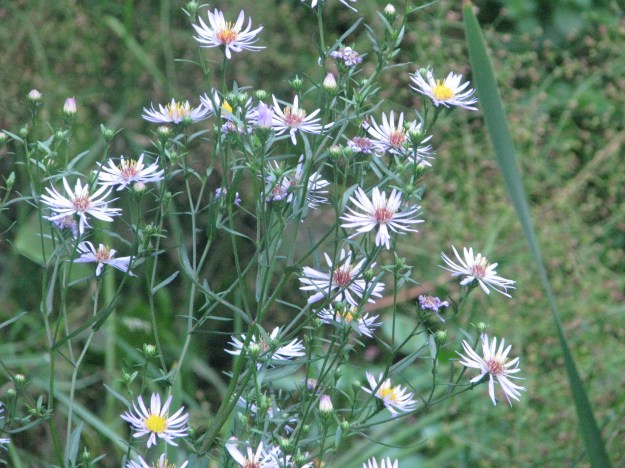 This small, lilac member of the daisy family seems to be popping up all over the place in my half-mile territory. These photos were taken in Coldfall Wood, where it makes the dried-up winter pond look like an Impressionist painting. But this delicate-looking plant has had a long journey. It comes originally from North America (it was introduced to England by John Tradescant in 1633), and it is a prairie plant rather than a woodland one. Nonetheless, it seems to made itself at home in all kinds of damp and neglected places, bringing a wash of pale lavender amongst the green


