Author Archives: Bug Woman

Monday Quiz – Summertime!

Swift Photo by pau.artigas, CC BY-SA 2.0 <https://creativecommons.org/licenses/by-sa/2.0>, via Wikimedia Commons

Swift (Apus apus)

Dear Readers, temperatures in London are expected to exceed 100 degrees Fahrenheit for the next two days, so I thought for this quiz we could have a look at some summer songs, and see if we could find the title and the artist. There have been some cracking songs about this time of year, and to be honest probably the best thing for most of us Londoners for the next few days would be to stay in, pull the curtains, drink lots of fluids and listen to them!

One mark for the song title, one mark for the artist (or an artist who has recorded the song). You have until 5 p.m. UK time next Saturday (23rd July) to pop your answers into the comments, and the answers will be published next Sunday (24th July). So, UK readers, have fun, stay cool and don’t do anything too intrepid. Depending on the humidity and a number of other factors, temperatures as low as 95 degrees can be deadly, as this article explains.

The Songs

A)Back of my neck getting dirty and gritty
Been down, isn’t it a pity?
Doesn’t seem to be a shadow in the city
All around, people looking half dead
Walking on the sidewalk, hotter than a match head

B) Fish are jumpin’
And the cotton is high
Your daddy’s rich
And your mum is good lookin’
So hush little baby
Don’t you cry

C) Ole ole – ole ole / Ole ole – ole ole

D) Whenever he calls my name
Soft, low, sweet, and plain
Right then, right there, I feel that burning flame
Has high blood pressure got a hold on me
Or is this the way love’s supposed to be?

E) Sittin’ here restin’ my bones
And this loneliness won’t leave me alone, listen
Two thousand miles, I roam
Just to make this dock my home

F) Hot summer streets and the pavements are burning
I sit around
Trying to smile but the air is so heavy and dry
Strange voices are sayin’ (what did they say?)
Things I can’t understand
It’s too close for comfort, this heat has got right out of hand

G)Out on the road today, I saw a DEADHEAD sticker on a Cadillac
A little voice inside my head said, “Don’t look back. You can never look back”
I thought I knew what love was
What did I know?
Those days are gone forever
I should just let them go but-

H)Sweet days of summer, the jasmine’s in bloom
July is dressed up and playing her tune
And I come home from a hard day’s work
And you’re waitin’ there
Not a care in the world

I)Well, we got no choice
All the girls and boys (girls and boys)
Making all that noise (ooh)
‘Cause they found new toys

J)I used to think maybe you loved me, now I know that it’s true
And I don’t want to spend my whole life, just waiting for you
Now I don’t want u back for the weekend
Not back for a day, no no no
I said baby I just want you back and I want you to stay


Monday Quiz – Full of Beans! – The Answers

Title Photo by Karyna Pachenko

Dear Readers, this week Fran and Bobby Freelove and new player Thirlsmith aka Wildflowerhunter both got a magnificent 10 out of 10 – congratulations Fran and Bobby and Thirlsmith! And on Monday, I suspect there will be something on the theme of summer songs….

Photo One by Anne Burgess

1) F. Meadow Vetchling (Lathyrus pratensis)

Photo Two from https://flora-on.pt/?q=Vicia+orobus

2) E. Wood Bitter Vetch (Vicia orobus)

Photo Three by Ben Sale from UK, CC BY 2.0 <https://creativecommons.org/licenses/by/2.0>, via Wikimedia Commons

3) G. Wild Liquorice (Astragalus glycyphyllos)

Photo Four by AnemoneProjectors, CC BY-SA 2.0 <https://creativecommons.org/licenses/by-sa/2.0>, via Wikimedia Commons

4) B. Kidney Vetch (Anthyllis vulneraria)

Photo Five by Lawn Weeds, CC BY 2.0 <https://creativecommons.org/licenses/by/2.0>, via Wikimedia Commons

5) I. Black Medick (Medicago lupulina)

Photo Six by Lawn Weeds, CC BY 2.0 <https://creativecommons.org/licenses/by/2.0>, via Wikimedia Commons

6) J. White Clover (Trifolium repens)

Photo Seven by paul dickson

7) H. Broad-leaved Everlasting Pea (Lathyrus latifolius)

Photo Eight from https://www.flickr.com/photos/nedtrifle/4732026797

8) C. Common Bird’s Foot Trefoil (Lotus corniculata)

Photo Nine by By Epibase - Own work, CC BY 3.0, https://commons.wikimedia.org/w/index.php?curid=5396096

9) A. Goat’s Rue (Galega officinalis)

Photo Ten by Andrew Curtis at https://www.geograph.org.uk/more.php?id=6505502

10) D. Tufted Vetch (Vicia cracca)

Photo Credits

Photo One by Anne Burgess

Photo Two from https://flora-on.pt/?q=Vicia+orobus

Photo Three by Ben Sale from UK, CC BY 2.0 <https://creativecommons.org/licenses/by/2.0>, via Wikimedia Commons

Photo Four by AnemoneProjectors, CC BY-SA 2.0 <https://creativecommons.org/licenses/by-sa/2.0>, via Wikimedia Commons

Photo Five by Lawn Weeds, CC BY 2.0 <https://creativecommons.org/licenses/by/2.0>, via Wikimedia Commons

Photo Six by Lawn Weeds, CC BY 2.0 <https://creativecommons.org/licenses/by/2.0>, via Wikimedia Commons

Photo Seven by paul dickson

Photo Eight from https://www.flickr.com/photos/nedtrifle/4732026797

Photo Nine by By Epibase – Own work, CC BY 3.0, https://commons.wikimedia.org/w/index.php?curid=5396096

Photo Ten by Andrew Curtis at https://www.geograph.org.uk/more.php?id=6505502

An Old Friend

Fencepost jumping spider (Marpissa muscosa)

Dear Readers, I was talking to my friend J about tattoos at lunch today. At the age of 60 she is planning on getting one in the shape of a swift, and so the conversation turned to what I would have, in the event that I decide to be artistically punctured with lots of small needles.

“A jumping spider”, I said, without any hesitation. And therein hangs a tale.

When I was six or seven, I was out in our tiny garden as usual. I had spotted a tiny creature on the concrete slab that housed the giant post for our washing line, and I had noticed that it was acting very strangely, so I lay on my stomach (in my best party dress as we were supposed to be going out) and realised that the animal was a spider about the size of my fingernail. A few inches away on the slab, a house fly was cleaning its eyes with its hairy front legs, rotating its whole head by about 240 degrees like they do. The spider was prowling ever closer, using the lumps and bumps in the surface of the concrete as cover. Then, it paddled its legs, tensed itself and leapt through the air onto the back of the fly.

And in that moment was Bugwoman born. Because I don’t think I had ever seen anything quite so thrilling or so unexpected, and it opened my eyes to a whole world of astonishment and good old-fashioned awe.

Back to the present day, and I was getting some cushions for the chairs in the garden out of the cupboard when I noticed this little chap. And I am quite sure he was a chap because those ‘boxing gloves’ are pedipalps, which he uses to insert his sperm into a female spider if she is willing to accept him, though my lovely friends at the British Spiders Facebook Page tell me that this is just a young male, as in adults those pedipalps would be more formed, and his stripes would be more defined.

Jumping spiders don’t use webs or any of that namby-pamby stuff – though they will anchor themselves to the ground with a silk line before they spring, just in case the jump fails. They are hunters through and through, and so they have those astonishingly large eyes at the front of their faces which help them to judge distance. The slightly smaller eyes which are further back are used to detect motion.

Most invertebrates, including most spiders, seem broadly oblivious to human presence, moving away when they sense a shadow or hear the vibration of footsteps, but jumping spiders actually look at you. They may even cock their heads like attentive dogs. To me, they are utterly adorable, and much easier to love than some of the bigger, hairier, danglier spiders that you might encounter in a shed. You are not supposed to have favourites, but I confess that these creatures fill me with a warm glow. Here’s a short film of this little chap.

Jumping spiders will also chase a laser pointer in much the same way as cats do. They probably have tetrachromic colour vision (which is better than our colour vision) and they also have high-sensitivity to ultraviolet light. They live in a colourful world, for sure, and in experiments they’ve been shown to be able to learn, remember and recognise particular colours.

Jumping spider chases laser pointer

Although this particular jumping spider is not very brightly coloured, the family to which he belongs (the Salticidae) are extremely varied, with over 6000 species, including the peacock spiders. You may well have come across them before, but if not, have a look at this extraordinary BBC film . Such tiny creatures, with such complex lives! It just reminds me of how little we actually know about the animals and plants that we share the planet with.

And so, I persuaded the jumping spider onto the fencepost for which he is named. Hopefully he’ll find a female jumping spider. At the very least, he’ll be able to find some insects to munch on. Good luck, little chap.

Cat Shenanigans

Willow in calmer times

Regular readers might remember my cat Willow, who loves to a) follow a patch of sunshine around the house, b) get a good grooming with her favourite brush, c) snuggle up on my lap when I’m reading in bed, and d) crunch through the most expensive kibble that money can buy. Things that she doesn’t much like include:

a) Being picked up

b) Being put into a cat carrier

c) Being put on the back seat of a taxi and

d) Sitting in the vet’s waiting room with all those horrible dogs

Well, as you might remember, she is 13 going on 14 years old, has high blood pressure and so needs regular monitoring. Over the past few months she has been steadily losing weight in spite of eating like the proverbial equine, so she has to go to the vet for blood pressure checks and a weigh-in, not to mention getting her claws clipped because there is no way I’m doing it and living to tell the tale.

Anyhow, today my husband was off on jury duty so I had to wrangle her into her cat carrier all by myself. It doesn’t matter how nonchalant I try to look, she always knows that something is up, so today I had to almost rugby tackle her to the ground. I landed a bit awkwardly on one foot, so now I’m limping, and the cat is giving me that ‘serves you right’ look.

The taxi driver was wearing a shirt covered in penguins. I liked him immediately, and he didn’t raise an eyebrow at the caterwauling (the cat, not me).

In the vet there was a bit of a crisis because some poor young girl had been looking after someone else’s French bulldog and the animal had collapsed. We’re having what passes for a heatwave here in the UK at the moment, and I am shocked by the number of people who are still walking their dogs in the heat of the day, especially the little short-faced breeds that already have trouble breathing. I suppose while people are unaware of the health problems that these dogs have and are seduced by how cute they look, they will keep buying them, and the animals will keep suffering. Certainly the lass who had been looking after the dog was mortified, all the more so because she’d been entrusted with someone else’s pet.

Anyhow, there’s a new vet ( a very nice chap) and the cat, as usual, loved him – she doesn’t actually hate all the fuss she gets when she’s in the clinic, just all the palaver of getting there. And sadly she’s lost another 100 grams, so she’ll have to go back in a month. The vet and I wrestled her to the ground to clip her claws (just as the toenails of humans get a bit gnarly and hard as we get older, a cat’s claws can actually grow into their pads if their owner doesn’t pay attention). It’s rather nice that she doesn’t clippety-clip around the house anymore, her claws tapping on the wooden floors like a very small circus pony.

And so that was the excitement for the day, and it was back to work. One of the great sadnesses of life is that our animals don’t live as long as we do – I’ve had to say goodbye to many companions, dogs and cats and any number of smaller animals. I hope that all this veterinary care will give Willow a happier, healthier life, and that it’s worth all the personal injury involved. Now I must go, it’s time for the cat’s  afternoon tea.

Willow exploring her domain.

First Images from the James Webb Space Telescope

The Carina Nebula

Dear Readers, I watched the launch of the James Webb telescope a few months ago with great trepidation. This is the most ambitious project for decades – the telescope is orbiting the sun at a point over a million miles away from the earth, and is equipped with 18 hexagonal gold mirrors and a sunshield to prevent it from being damaged by the sun. After launch, there was a six month wait while the mirrors were unfurled and the telescope was calibrated. Now, it is looking into a part of space never examined before, which is thought to be where the the very first stars and galaxies formed, over 13 billion years ago.

The James Webb looks for light in the infrared and near infrared spectrums – visible and ultraviolet light have been what’s known as ‘redshifted’ as the universe expanded.

So, if that’s not mindblowing enough, bearing in mind that the images that the telescope is capturing are historical – the stars and galaxies in the photos may have already ceased to exist, as it takes such a long time for the light to arrive at the telescope.

All images from Nasa here.

So, first up is a photo of the Carina Nebula (top) – it might look like a series of crags but  the clear, starry area in the middle is where the intense ultraviolet radiation and solar winds from the birth of new stars has carved out an area in the middle of the nebula.

Next is Stephan’s Quintet, which is apparently featured in ‘It’s a Wonderful Life’ – enlighten me, Readers, as I’ve missed this holiday classic. You can see the tails being pulled from some of the five galaxies due to the gravitational pull of the others, and there are also shock waves in the middle where the galaxies are crashing into one another.

The images are put together from many, many shots – this one was created from almost 1000 separate ‘photos’.

Stephan’s Quintet

Next, the Southern Ring Nebula. The star in the centre is expelling clouds of dust and gas and it dies.

This side-by-side comparison shows observations of the Southern Ring Nebula in near-infrared light, at left, and mid-infrared light, at right, from NASA’s Webb Telescope.

And finally, this is the image unveiled by President Joe Biden on Tuesday. This is the deepest and sharpest image of the known universe to date. This photo covers an area of the sky about the size of a grain of sand held at arm’s length by someone on the ground, and just look at the detail. It’s a composite made from photos taken by different cameras, and it took 12 hours to put the image together (as compared to several weeks for the poor old Hubble telescope). The image shows the galaxies as they looked 4.6 billion years ago. If you hear a strange sound, it’s just my brain melting…

Deep Field Image of galaxy cluster SMACS 0723

What a truly spectacular set of images these are. We will find out so much, not just about deep space but also about things like exoplanets (planets orbiting other stars) – the telescope can analyse the atmosphere of these planets, and so determine what kind of life could possibly exist on them. I look forward to the discoveries that this truly ground (space?) breaking innovation will provide.

Wednesday Weed – Clustered Dock

Clustered Dock (Rumex conglomeratus)

Dear Readers, this plant is apparently very common in the south of England but rare in the North, and it’s one of those ‘weeds’ that is everywhere, but unnoticed. Normally it grows alongside streams according to my Harraps Guide to Wildflowers, but this one was growing in St Pancras and Islington Cemetery in a shady spot. I did notice that they tend to grow in the lower-lying spots, so maybe it’s damp enough for them. It is native to Europe (including the UK), North Africa and Asia as far East as Pakistan, but has been introduced to the coastal areas North America and the west coast of South America, probably in grain and in seeds for cultivation.

The plant is very similar to wood dock (Rumex sanguineus), which is what I would expect to find under the horse chestnuts and ash trees in the cemetery, but in clustered dock the stems project out from the main stem at a wide angle to the stem, and that’s good enough for me, looking at this plant. The stems are also said to be very slightly zig-zag, which they were, though this isn’t captured in the photo. It’s a rule of nature that if there’s a distinguishing feature on a plant, I won’t have photographed it. Why I never take my ID guides into the field is another mystery (maybe because I usually walk with my husband who doesn’t have unlimited patience for my looking at sepals with a hand lens).

Photo One by Stefan.lefnaer, CC BY-SA 4.0 <https://creativecommons.org/licenses/by-sa/4.0>, via Wikimedia Commons

Clustered Dock showing the zig-zag stem (Photo One)

Like all docks, clustered dock is edible, but the leaves are said to taste very bitter, especially when the plant is older. However, docks contain a high level of oxalic acid which can cause the aggravation of kidney stones and gout. Even if we shouldn’t eat too much dock, the various species are foodplants for many, many insects, including these Ghost Moths (Hepialus humulii). The caterpillars feed on the roots of dock, and the emerging adults are different colours, as you can see below. The white males ‘lek’ above stands of plants to attract females, hovering in mid-air with their sparkling wings. However, these are a very ancient species, and are completely deaf and so, to avoid being eaten by bats, they display for just 20 minutes every day. I would give several eye-teeth to be around when these exquisite insects are displaying.

Photo Two by By Ben Sale from UK - Ghost Moth pair, CC BY 2.0, https://commons.wikimedia.org/w/index.php?curid=46076336

Brown female ghost moth and white male ghost moth (Photo Two)

Medicinally, an infusion of dock has been used as a blood cleanser and as a treatment for scurvy (the leaves contain Vitamin C). It has also been used to stem bleeding, and a poultice made from the leaves is said to be good for ‘cutaneous eruptions’. What a great description! I imagine that it means boils and warts.

And here is a poem by Rosni Gallagher, originally from Leeds, now living in Scotland, and of Indo-Guyanese and Irish heritage – you can hear her reading her poem here. I think it’s easy to take feeling comfortable in the countryside for granted, though even as a white woman I know that sudden feeling of unease when a man behaving strangely hoves unexpectedly into view. I love how she has noticed the dock leaves turning red, which indeed they already are.

Dock Leaves by Roshni Gallagher

Often, I want to flick shut
Stranger’s eyelids.

I’m sick of anticipating my own othering.
Thank god for places where people aren’t –

The green of the trees has always been a door
To walk through and become whole.
The green sinks into me and the woods beat

With spires of dock leaves,
Deep red, like a hundred bold hearts.

Who dared trick me
Into thinking I was a guest?
Up ahead, the wild silver lake exists

For a brown girl
To crouch beside it and try to catch the frogs.

Photo Credits

Photo One by Stefan.lefnaer, CC BY-SA 4.0 <https://creativecommons.org/licenses/by-sa/4.0>, via Wikimedia Commons

Photo Two by By Ben Sale from UK – Ghost Moth pair, CC BY 2.0, https://commons.wikimedia.org/w/index.php?curid=46076336

The Tale of the Large Tortoiseshell

Photo One by By Hectonichus - Own work, CC BY-SA 4.0, https://commons.wikimedia.org/w/index.php?curid=56042810

Large Tortoiseshell (Nymphalis polychloros) (Photo One)

Photo Two by By Jörg Hempel, CC BY-SA 3.0 de, https://commons.wikimedia.org/w/index.php?curid=27756983

Small Tortoiseshell (Photo Two)

Dear Readers, in the 1940s you would have seen large and small tortoiseshell butterflies on the scrubby edges of forests, but in 1980 the large tortoiseshell was declared extinct in the UK. The possible reasons were many. One was that the caterpillars of the large tortoiseshell feed on elm (unlike those of the small tortoiseshell, which feed on nettles0, and as we know, elm populations crashed following the introduction of Dutch elm disease. This on its own has reduced many species to a remnant of what they once were, but for the large tortoiseshell there was also the habitat of the adults to consider – they feed on the nectar of willows in the spring, and in the UK ‘scrub’ seems to have become a dirty word. Many scrubby areas have been rooted out and either planted with crops or with pine plantations. Large tortoiseshells seem to be particularly prone to parasites that destroy their caterpillars and eggs, and, as the caterpillars feed on the very top branches of trees, they are susceptible to predation by birds.

However, this year comes the news of yet another success at Knepp, famous for its rewilding project. Knepp has seen a burgeoning population of turtle doves, nightingales and many other creatures, and this year, large tortoiseshells have bred. This isn’t the first time that the butterflies have reproduced since their official ‘extinction’ – the butterfly migrates from mainland Europe, and there may have been some rump populations that have staggered on since the 1950s. The butterfly has been seen regularly on the south coast Some butterflies are bred and then released by mavericks trying to reintroduce species, which can make monitoring the actual status of a species very difficult. However, Knepp has a particular policy of restoring habitat rather than introducing species, and the conservationists worked very hard to restore the willow scrubland that the butterflies enjoy. The lepidopterists involved in the project  believe that while there might be some captive-bred butterflies about, too many are spotted crossing the Channel now for it to be all about releases – some butterflies are clearly making the crossing themselves and will breed if the habitat is suitable.

Photo Three by By Abrahami - Own work, CC BY-SA 3.0, https://commons.wikimedia.org/w/index.php?curid=19551010

Large tortoiseshell caterpillar (Photo Three)

So, it just goes to show that if the habitat is correct, and if a species still exists in mainland Europe, it is possible to encourage them to return naturally. I look forward to hearing further tales of how the rewilding at Knepp is doing, and what other animals might turn up. It’s good to have a positive story for once, when so much is being lost.

You can read the whole story here.

Monday Quiz – Full of Beans! – Week Two

Title Photo by Karyna Pachenko

Dear Readers, as mentioned yesterday, as no one has had a go at this yet, I’m going to leave it open for another week, just in case anybody wanted to give it a go but was unwell/on holiday/. No pressure if you just want to lay on the beach eating an icecream :-0

Dear Readers, the 3rd of July is International Eat Your Beans day, and who could argue with that? But the bean family (Fabaceae) is important in other ways too – beans convert nitrogen into a form that can be accessed by other plants (with the help of some very handy bacteria), and so are vitally important for ecosystems everywhere. So, as you might have guessed, our quiz this week is ‘bean-themed’, in the broadest sense of the word. See if you can identify these members of the bean family.

All you have to do is match the name to the plant, and away we go! Answers in the comments please (and you can also put them in Messenger on my Facebook page if you’re having problems here, though I have taken off every single restriction that I can think of). The quiz closes at 5 p.m. on Saturday 16th July at 5 p.m. UK time, and the answers will be posted on Sunday 17th July.

Onwards!

Species

A. Goat’s Rue (Galega officinalis)

B. Kidney Vetch (Anthyllis vulneraria)

C. Common Bird’s Foot Trefoil (Lotus corniculata)

D. Tufted Vetch (Vicia cracca)

E. Wood Bitter Vetch (Vicia orobus)

F. Meadow Vetchling (Lathyrus pratensis)

G. Wild Liquourice (Astragalus glycyphyllos)

H. Broad-leaved Everlasting Pea (Lathyrus latifolius)

I. Black Medick (Medicago lupulina)

J. White Clover (Trifolium repens)

Photos

Photo One by Anne Burgess

1)

Photo Two from https://flora-on.pt/?q=Vicia+orobus

2)

Photo Three by Ben Sale from UK, CC BY 2.0 <https://creativecommons.org/licenses/by/2.0>, via Wikimedia Commons

3)

Photo Four by AnemoneProjectors, CC BY-SA 2.0 <https://creativecommons.org/licenses/by-sa/2.0>, via Wikimedia Commons

4)

Photo Five by Lawn Weeds, CC BY 2.0 <https://creativecommons.org/licenses/by/2.0>, via Wikimedia Commons

5)

Photo Six by Lawn Weeds, CC BY 2.0 <https://creativecommons.org/licenses/by/2.0>, via Wikimedia Commons

6)

Photo Seven by paul dickson

7)

Photo Eight from https://www.flickr.com/photos/nedtrifle/4732026797

8)

Photo Nine by By Epibase - Own work, CC BY 3.0, https://commons.wikimedia.org/w/index.php?curid=5396096

9)

Photo Ten by By Epibase - Own work, CC BY 3.0, https://commons.wikimedia.org/w/index.php?curid=5396096

10)


A Warm Walk in St Pancras and Islington Cemetery

The leaves from the horse chestnuts have fallen already

Dear Readers, you might have been expecting the answers to last week’s quiz this morning, but actually nobody had a go this week – I suspect summer is here and people have lots of things to do, plus I know that some of our regular quiz-goers have some health challenges at the moment. So, I’ve decided to keep my quiz on beans open for another week – I’ll republish it tomorrow so that anyone who wants to have a go doesn’t have to go hunting for it. The answers will (finally) be published next Sunday, so you have until 5 p.m. UK time on Saturday 16th July to submit any answers. No pressure! It’s going to be too hot for anything involving the brain next week anyway.

In other news, I was in St Pancras and Islington Cemetery this afternoon, and it already feels like everything is sleepy. There’s the sound of tiny birds in the trees, but the great chorus of spring is silent, except for one familiar refrain – a song thrush, still hoping to find a mate even this late in the year. Song thrushes will sing until they find a mate, and will then fall silent except for during the morning dawn chorus, when everyone announces that they’re holding a territory and that they’ve made it through the night.  How well camouflaged these birds are! I imagine that this is a young male who has been heartily out sung this year. Maybe he’ll have better luck next spring.


In other news, as mentioned in the first photo, the leaf miner and the fungus have pretty much done for the leaves on this horse chestnut already, though other trees are looking a bit healthier. I find it hard to believe that the trees will survive this shortening of their season year on year, but fingers crossed. This one certainly looks pretty sad.

Branch of horse chestnut tree, showing the leaf damage.

It’s not all bad news, though – believe it or not, this is a buzzard, making slow, lazy circles on the thermals over the cemetery. I belong to a Facebook group called ‘Crap Bird Photos’ and I have a suspicion that this could be a candidate.

After a few minutes the buzzard drifted off towards the North Circular Road, and a kestrel zoomed past instead. All I needed was a sparrowhawk and all three of the Cemetery Raptors would have been visible at more or less the same time. Alas, the sparrowhawk didn’t show. It was lovely that the birds of prey were not harassed by the crows, who I presume have finished breeding for this year and are therefore not quite so touchy.

The Cedars of Lebanon all have some very fine cones, and if you look closely, you can see that they have clearly been slithered over by some snail or slug. These molluscs are clearly more acrobatic than you’d think. Unless it’s some other kind of resin? What do you think, Readers?

Cedar of Lebanon cone with added slug slime. You’re welcome .

And then there were the speckled wood butterflies. What vigorous critters these are. The males perch in a spot of sunlight and take on all comers – the one in the photograph not only saw off other males of his species and an unlucky large white butterfly, but also various hoverflies. Testosterone is clearly a force for action even in something as delicate as a butterfly. It was quite something to see the male spiralling up at speed and circling his opponent in a shaft of sunshine, before coming back down to rest. Females prefer males who defend a territory, because clearly they are fit and able to hold their own against other males. Interestingly, as the female comes to the end of her life she becomes less picky, and will mate with males who are not defending a territory but are instead just patrolling the countryside. Anyone who thought that butterflies were gentle, delicate creatures has clearly never watched the shenanigans of a bunch of speckled wood males. It’s like Poole Harbour on a Saturday night.


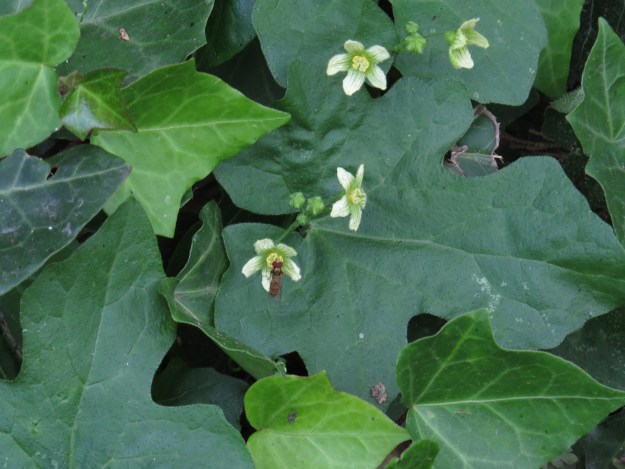
And finally, I was very happy to see that the white bryony is in flower. Our only native member of the cucumber family, this is a rather lovely vine with creamy-green flowers, and is clearly loved by hoverflies. I like the green tracery on the petals, and cupped shape of the flowers. It’s so nice when ‘weeds’ are left to do their own thing – there’s a lot of strimming going on at the moment in the cemetery, and while I appreciate that it’s necessary to keep some areas spick and span and tidy, I do love the wilder bits of the cemetery the most, where the ivy twines and there are unexpected rustles in the undergrowth. Let’s hope that at least some parts of the cemetery stay this way for years to come.

Phew….

Dear Readers, it’s edging up towards 80 degrees Fahrenheit today (a mere 26 degrees Celsius) but blimey it feels warm here in London. I am decidedly sleepy, and every time I try to do something intelligent my brain stops working, so here I am spending 15 minutes posting a few photos and trying to get my neurons to cooperate.

First up , a few shots of the pollinators visiting my buddleia. I can sit at my office desk and shoot these little sweethearts through the closed window, which is just about as much energy as I can muster today.

And then it’s out to the garden where it’s a bit cooler.

There was a family of wrens, the parents clicking and the babies squealing. I saw one adult feeding a fledgling with a nice fat insect, but they were most uncooperative on the photography front. Here is my one and only photo of a wren’s bum.

Then a comma butterfly happened along…

And then a very pretty brimstone moth appeared. I love these moths, they’re every bit as yellow as their butterfly namesakes. And look at those stripey yellow legs! It reminds me of Malvolio in Twelfth Night (English graduate here folks), when he was asked to appear with yellow-stockings and cross-gartered. ‘The Malvolio Moth’ – what a shame the creature is already named.

The caterpillar is fond of rowan (tick), hawthorn (double-tick) and Amelanchior (two street trees outside) so maybe we’re doing something right.

And finally, can anyone guess what on earth this is?

This strange little floating galaxy is a new spider’s web that has turned up in the shed, and just happened to be catching the light. Thirty seconds after I took this photo, the sun had moved, and the moment had passed.

So Readers, especially those of you in the south of England, batten down the hatches, make sure you drink lots of water, slap on the Factor 50 and make sure your fans are in working order. According to the weather forecast it’s not going to drop below 80 for about a fortnight. My dad would have loved it, but my mum hated the hot weather, and I seem to find myself somewhere in the middle. I have a shedload of work to do next week as well, but at least I’m not having to commute, so as always I’m grateful for both large and small mercies.