Author Archives: Bug Woman

Wednesday Weed – Goat’s Rue

Every Wednesday, I hope to find a new ‘weed’ to investigate. My only criterion will be that I will not have deliberately planted the subject of our inquiry. Who knows what we will find…..

Goat's Rue (Galega officinalis)

Goat’s Rue (Galega officinalis)

Dear Readers, while I was walking in the Playing Fields at the edge of Coldfall Wood a few weeks ago, I saw a plant that I didn’t recognise. This in itself is not so strange – of the plants that surround me, I know only a tiny fraction, though my knowledge is improving all the time. But this plant looked like a member of the pea family, but grew like a bush. It was all on its own, and had delicate mauve flowers. How had I missed it before?

IMG_3670I hurried home to my plant books, and discovered that I was looking at Goat’s Rue. It is a member of the pea family, and is a naturalised species – it was first introduced from the Middle East by 1568 and was found in the wild by 1640. In Flora Britannica, Richard Mabey describes how it is extremely common around Sheffield, and how it might have spread:

‘A Sheffield miner told me that he remembered his father recounting how in the early part of this century horticultural traders used to work the poorer parts of the city suburbs selling garden plants which only just merited that description. They were aggressive species like tansy, Michaelmas daisy, feverfew and goat’s rue, all of which have naturalised widely in the city. He recalled his father purchasing Japanese knotweed and how friends were invited round to marvel at the spotted stem and attactive foliage and how the plant was later divided up for exchange’.

However, as I have started to delve into the history of Goat’s Rue, I have come to realise that this is no ‘ordinary’ weed. In fact, I’m starting to think that there is no such thing as an ‘ordinary’ weed, but this one is extraordinary. It’s Latin name, Galega, means ‘to bring on milk’, and it was used to increase milk supply in a variety of domestic animals, hence its common name. Nursing human mothers have also used the herb for this purpose, and a quick look on the internet shows that supplements containing this plant are available, along with recommendations for dosage using the whole plant. Personally, I would be extremely careful about using any plant that is known to have toxic effects (see below).

IMG_3674What fascinates me most, however, is Goat’s-Rue’s long association with the treatment of diabetes. One of the chemicals in the plant was long known to reduce blood-sugar, but the compounds themselves were toxic – they are said to cause ‘tracheal frothing, pulmonary oedema, hydrothorax, hypotension, paralysis and death‘. However a chemist, George Tanret, identified a slightly less toxic compound from the plant called galegine, and this was used as the basis for treatments during the 1920’s and 1930’s. The drug that is currently used to treat Type 2 diabetes, Metformin, is a synthesised form of the chemical that was discovered in Goat’s Rue, with the toxicity taken out. With two parents and a brother who all have diabetes, it makes me humble to look at this plant and realise that without it, they might not have had access to the drug that helped, initially at least, to keep their conditions under control. In a short paper in ‘Practical Diabetes International’ by C.J. Bailey and C Day, the authors have this to say:

Postscript of ironies

There are several ironies about metformin. In our high-tech era of drug discovery and development this first-line treatment for type 2 diabetes is little removed from a herbal remedy of the middle ages. Despite its chemical simplicity and detailed investigation, metformin continues to evade a complete exposé of its cellularactivity. While endless pharmacovigilance has monitored the safety profile of metformin, its natural ancestor,G. officinalis (known as Professor Weed in the USA) is a Class A Federal Noxious Weed in 35 states of America, and appears on the database of poisonous plants.’

IMG_3672This is not the only way that Goat’s Rue has been used. It has been used as a worm treatment for domestic animals, and also to treat plague victims. In the first case, I can imagine that its toxicity was a way of killing the parasites, providing the dosage was managed properly and didn’t kill the animal as well. As to the poor plague victim, I suppose that death by poisoning was the least of their worries.

The name ‘Goat’s Rue’ has been explained as either the result of its use to encourage milk production, or because of the unpleasant smell of its bruised leaves. I don’t find either of these ideas particularly conducive – I’d have thought that  a goat would be happy to be producing more milk for its kids (though admittedly not if it was stolen to feed humans), and the leaves don’t smell particularly goaty to me. But there we go. The reasons are lost in the proverbial mists of time. The North American nickname for the plant, Professor Weed, is said to be because it was originally introduced as a forage weed by the professorial body at the Utah Agricultural Experiment Station. Not only was it found to be less toothsome to the grazing animals than alfalfa, but it also ‘went native’ with a vengeance, hopping over the fence and spreading all over those wide open spaces. When a report that it had killed some sheep in Europe came in, an eradication programme which removed over 90% of the plant took place. Since then, it has bounced back, and the battle goes on.

IMG_3671Goat’s Rue has also been used as a replacement for rennet during cheese-making (and in fact yet another alternative name for the plant in the north of England is ‘Cheese-Rennet’). It is said to be useful if you are bitten by a snake. And, in experiments that no doubt resulted in the deaths of hundreds of mice, it has been shown to reduce obesity. Was there ever a poisonous plant with so many uses? And, furthermore, so many names?

In German folklore, Goat’s Rue is known as one of the Holy Hay plants, along with Sanfoin and Alfalfa. This is because it was said to be one of the plants laid in the manger in Bethlehem. When Jesus was laid down amongst the hay, it is said to have spontaneously burst into flower. And, whatever your religion, what a lovely image this is to end with.


An Ordinary Butterfly

Dear Readers, one of the commonest and most familiar of the butterflies in our gardens at this time of year is the Red Admiral (Vanessa atalanta). While I was staying with my parents in Dorset this week I found a number of them visiting the buddleia bush, and was surprised both at how confiding they were, allowing me to get within a few inches of them, and how tattered and worn they looked. Some had so much wing damage that I was surprised that they could fly at all.

It isn’t surprising that these creatures look a little tired – most of them have made a migration all the way from central Europe to the UK to breed. Recently, however, some Red Admirals are hibernating in our garages and sheds, and the milder British winters mean that they can survive, making them a rare beneficiary of climate change. They are now officially a native species, after all their long history of presence in this country. In the autumn, some butterflies will make the journey in reverse, and have been spotted gathering over the White Cliffs of Dover just like migratory birds. In spite of their fragile appearance, these are tough, determined insects.

On arriving in the UK, a female Red Admiral will waste no time in finding a patch of nettles and depositing a single green egg at the growing tip of each one. They look a little like sea gooseberries to me, perfect and delicate, and will hatch after about a week.

Red Admiral Egg (Egg By Tristram [CC BY 3.0 (http://creativecommons.org/licenses/by/3.0)], via Wikimedia Commons)

As the caterpillar emerges, it wraps the leaf around itself as protection – you will often find whole patches of nettles with these little caterpillar cigarillos. They will enlarge the parcels each time they shed their skin, which is usually five times. The mouths of the newly-emerged young are so small that they can’t eat right through the leaf, just scraping away the outer layer. But as they grow, they become more voracious, cutting perfect half-circles through the edge of the leaf with each toss of their heads. Caterpillars are basically eating machines: while their preferred food plant is stinging nettle, they will sometimes munch through hops and pellitory of the wall. The caterpillars of the Red Admiral are spikey little black things, completely different to their elegant parents.

A fine Red Admiral caterpillar (note the silk at the top left hand corner) (By Lamiot, from Gilles San Martin [CC BY-SA 2.0 (http://creativecommons.org/licenses/by-sa/2.0), GFDL (http://www.gnu.org/copyleft/fdl.html) or CC BY-SA 4.0-3.0-2.5-2.0-1.0 (http://creativecommons.org/licenses/by-sa/4.0-3.0-2.5-2.0-1.0)], via Wikimedia Commons)

A fine Red Admiral caterpillar (note the silk at the top left hand corner) (By Lamiot, from Gilles San Martin [CC BY-SA 2.0 (http://creativecommons.org/licenses/by-sa/2.0), GFDL (http://www.gnu.org/copyleft/fdl.html) or CC BY-SA 4.0-3.0-2.5-2.0-1.0 (http://creativecommons.org/licenses/by-sa/4.0-3.0-2.5-2.0-1.0)], via Wikimedia Commons)

Once the caterpillar has reached the requisite size, after about four weeks, it will start to pupate. This is a process that has bewitched human beings ever since they realised that the lumpy, earthbound larva becomes a butterfly. It is extraordinary to me that all the material required for the transformation exists not only in the body of the caterpillar but in the egg itself. The germ of everything that is needed to make wings and antennae and compound eyes is already there. The one part of the caterpillar that remains relatively unaltered during the process are those six little legs at the front that turn into the long elegant legs of the butterfly. Everything else seems to be utterly changed.

When a caterpillar is ready to pupate, it stops eating. It draws together several leaves to make a silk tent, and then spins a silk holdfast for itself, called a cremaster. And then, the skin splits, and something new emerges, and dries. Where there was frantic movement, there is a pregnant stillness. The pupa is beautifully camouflaged, easy to overlook. But inside, something new is happening, and after two to three weeks, the adult emerges.

Red Admiral Chrysalis (Red Admiral pupa ("Chrysalis-butterfly-vulcan-chrysalide-papillon-vulcain-vanessa-atalanta-2" by Emmanuel Boutet - Own work. Licensed under CC BY-SA 3.0 via Wikimedia Commons - https://commons.wikimedia.org/wiki/File:Chrysalis-butterfly-vulcan-chrysalide-papillon-vulcain-vanessa-atalanta-2.jpg#/media/File:Chrysalis-butterfly-vulcan-chrysalide-papillon-vulcain-vanessa-atalanta-2.jpg)

Red Admiral Chrysalis (Red Admiral pupa (“Chrysalis-butterfly-vulcan-chrysalide-papillon-vulcain-vanessa-atalanta-2” by Emmanuel Boutet – Own work. Licensed under CC BY-SA 3.0 via Wikimedia Commons – https://commons.wikimedia.org/wiki/File:Chrysalis-butterfly-vulcan-chrysalide-papillon-vulcain-vanessa-atalanta-2.jpg#/media/File:Chrysalis-butterfly-vulcan-chrysalide-papillon-vulcain-vanessa-atalanta-2.jpg)

The Red Admiral is not a rare butterfly, but it is a very fine one, in its livery of chocolate brown and vermillion. There is much debate as to whether the ‘Admiral’ is a corruption of ‘admirable’, or a reference to the ensign flown on ships when the admiral was aboard. In France, however,  it is known as ‘le vulcain’, after the blacksmith of the gods. Its appearance in many European paintings may indicate temptation, with the crimson and smoky-grey wings being seen as reminiscent of the fires of hell. What a weight of symbolism for a butterfly to bear! And sometimes it might have led to the butterfly’s destruction, as there are old stories of a ‘red butterfly’ that was hunted in the north of England and the Borders as a witch.

Цифровая репродукция находится в интернет-музее Gallerix.ru

Portrait of Margharita Gonzaga (Antonio Pisanello 1440)

In truth, of course, the Red Admiral is a harmless creature and attractive creature, with no demonic intentions that I can detect. As an adult, the Red Admiral seems to have a liking for buddleia and thistles in particular, and is one of the last butterflies to still be on the wing in autumn – it is often seen feeding on windfall plums and apples. I have a great fondness for the damaged, faded creatures that are currently on the wing. They’ve probably crossed mountain meadows and fluttered across twenty-six miles of salt-water. They’ve maybe survived the attentions of birds and dragonflies, and have lost their bright-painted colours on the way. But by now, they have probably reproduced, and will soon be joined by their splendid, new-minted, perfect offspring. Who could begrudge these elderly insects their pleasure in nectar, or in basking in the sun?


Sources this week include Bugs Britannica by Peter Marren and Richard Mabey, and The Butterfly Isles by Patrick Barkham, both full of fascinating information.


Wednesday Weed Update – Rosebay Willowherb

Photo taken in 1948 by David Sweetland's father

Photo taken in 1948 by David Sweetland’s father

Dear Readers, my call for any information about Rosebay Willowherb during the Second World War has produced this wonderful  photo, taken in 1948, from my friend and fellow blogger David Sweetland. Here’s what he says about it:

‘Attached is a photo my father took in 1948 to the north east of St. Paul’s looking across the area that is now the Barbican. A good view of Rosebay Willowherb in the foreground. Did not know the name of the plant until I read your post today.

I remember him telling me that this (along with many other plants) very quickly spread over all the bombed land across the City. The bombed and burnt buildings were quickly cleared leaving large areas with low walls and open cellars and the plants quickly colonised these.’

David’s blog A London Inheritance is both a celebration of the London captured in his father’s photographs, and a fascinating exploration of how it is today. I heartily recommend it.


Wednesday Weed – Rosebay Willowherb

Rosebay Willowherb (Chamerion angustifolium)

Rosebay Willowherb (Chamerion angustifolium)

Dear Readers, back in 2002 Rosebay Willowherb was named as the County Plant of Greater London by the charity Plantlife, and, with its long association with the capital and its familiarity to Londoners, it seems an excellent choice. But it was not always so, for this was once a shy, little-seen plant, its spread a result of two World Wars, aided, as with so many ‘weeds’, by the development of the railways.

IMG_3677I have a copy of a book called ‘Flowers of the Field’ by the Reverend C. A. Johns, which was published in 1913. In it, the good Reverend describes the plant as ‘rare, except as a garden escape’. And yet, as the forests were felled and burned to provide wood for the First World War effort, it suddenly appeared in great swathes of cherry-pink, a development that was watched with some trepidation. In his book ‘Weeds’, Richard Mabey describes how it was seen by the botanist H.J. Riddelsdell:

‘Beautiful as the plant is in its flowering season, when it is in seed it creates desolation and ugliness over the whole area’.

The plant is native to the whole of the Northern Hemisphere, and in North America it is known as ‘Fireweed’: Rosebay Willowherb is either more tolerant of scorched earth than other plants, or positively prefers it. This was to stand it in good stead during the Second World War, when it colonised the bombsites so successfully that the Londoners christened it ‘Bombweed’.

As is often the way with the Blitz, we now look back on it as a time of good spirits and plucky bulldog tenacity. Londoners are said to have seen this new pink plant, which few of them would have seen previously, as a sign of London rising from the ashes like a phoenix. I wonder if some people were also a little perturbed by this new ‘invader’ however, especially as they were right in the middle of fighting a human one. If anyone remembers these times, or remembers their family talking about them, I would love to know!

While all this bombing and burning was going on, the plant was further distributed, just as Oxford Ragwort and Buddleia were, by the spread of the railways, the seeds being happily blown along and finding the clinker and scree slopes of the embankments most amenable to growth. In fact, when I head down to Dorset this week to visit my family I fully expect my route to be a veritable carnival of past Wednesday Weeds, with all the plants mentioned above in full flower.

IMG_3681There is no doubt that Rosebay Willowherb (named for its colour and for its bay-shaped leaves) is a most attractive plant, with its pink and carmine petals. Bees think so too, which is another reason to be glad of its profligacy. Its leaves are also unusual: the veins do not go to the edge of the leaf but curl back on themselves in loops, as you can just about see in the picture below. This makes it easy to identify even when not in flower.

Note the loopy veins on the leaves

Note the loopy veins on the leaves (By Magnus Manske (Own work) [CC BY-SA 3.0 (http://creativecommons.org/licenses/by-sa/3.0)], via Wikimedia Commons)

Rosebay Willowherb’s wide distribution means that has been used for a variety of purposes by many different communities. Here are just a few of them, from the Plantlives website:

  • The Cree people of North America used the fibre from the stems as sewing thread
  • The Kitasoo people used this same thread to make fishing nets
  • The Quinault and Skokomish tribes mixed the white fluffy seed fibre with duck feathers to make blankets, and the people of the Klallam mixed the seed fibre with dog hair to weave cloth.
  • The Blackfoot tribe rubbed the flowers on to their mittens and rawhide thongs to waterproof them
  • The Tanana tribe used the flowers as a mosquito repellent
  • The Thompson tribe regarded the flowering of Rosebay Willowherb as an indication that the deer were fat enough to be hunted, and for the Cree it was a sign that the moose would soon be entering the mating season.

IMG_3679Many peoples used Rosebay Willowherb as food – the shoots, leaves, flowers and roots have all been used, both as salad and as a potherb. In Alaska, it is used for everything from icecream to syrup, and you can find a recipe for Fireweed Jelly here. 

Monofloral (single plant) honey from ‘Fireweed’ is made in Alaska and areas of northwestern Canada, and is considered to be a premium product, slightly spicy and delicious.

In Russia, the flowers are used to make Koporye or Russian tea, which was exported to Western Europe as a competitor to Indian and Chinese tea during the 19th Century. It was fermented and dried in the same way as ‘real’ tea but had the advantage of being caffeine free. However, the East India Company was so threatened by the success of Koporye that they circulated a rumour about the way that the tea was produced, causing the trade to collapse. These days only a small amount of the tea is made, for local consumption.

Some Austrian Rosebay Willoowherb....

Some Austrian Rosebay Willowherb….

Like Broad-leaved Willowherb, Rosebay Willowherb is also used in traditional Austrian medicine for urinary complaints of all kinds. In North America, it has been used for everything from boils to cancer. Maybe its rarity in the UK until the last century has restricted its historical medicinal and culinary uses here, but who knows what we will come up with in the future?

IMG_3676One inspiring use for Rosebay Willowherb is as a way of recolonising areas which have been damaged by fire, or even by oil spills. As it grows, it also provides nectar for any intrepid insects which venture past. In short, it is the most extraordinarily generous plant, capable of all kinds of uses and beautiful to boot. Long may its flowers herald the high-days and holidays of summer.

IMG_3642

Bugwoman on Location – The Old and The New


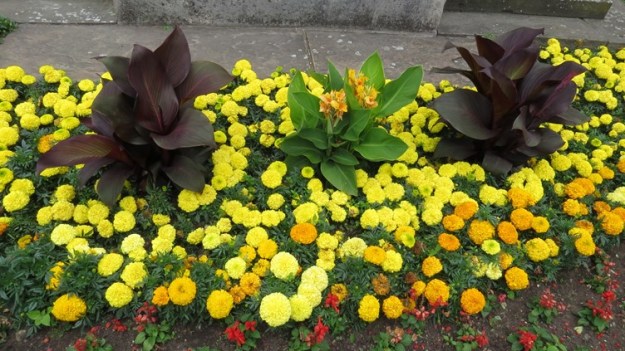
Conventional planting on Islington Green, North London. This replaced alliums, grasses and verbena. I’m not sure what caused the outbreak of conventionality, maybe budget cuts?

Dear Readers, municipal plantings in parks and public areas used to be the same wherever you were in the country. There would be regular ranks of blue lobelia and red geraniums, edged with white alyssum. Sometimes, the bolder councils would inject some double-flowered marigolds and petunias, and, if they were really going for broke, they might throw in a few bronze-leaved cannas, with big blousy golden flowers. Sadly, none of these plants have much to offer bees and other pollinators. And if you pop down to Islington Green in London today, you will see exactly the kind of planting that  I’m talking about.


This kind of planting stays in place for a few months, while bees and butterflies investigate and, disappointed, move on to something that will actually feed them. And then, one day, the plants will be pulled up and thrown in the compost, to be replaced with winter-flowering pansies and primroses. When summer returns, the whole ritual will happen all over again.

Now, there’s nothing wrong with this per se. Some containers of bedding plants add a certain joie de vivre to any garden, and these plants are hardy, long-flowering and low maintenance. The problem comes when city councils, in particular, miss the opportunity to do something a bit more pollinator-friendly. In London, where the gardens are small and the areas of concrete seem never-ending, bees regularly fall starving out of the sky. So on this bright July morning, I went to see what was being done to improve things.

My first stop was Whittington Park, on Holloway Road. My friend Penny tells me that Adolf Hitler is partly responsible for this park, because it is built on the remains of two whole streets that he bombed to bits during the Second World War. But it’s been Islington Council who have turned it into the rather remarkable spot that it is now.

On Holloway Road itself, there are two great swathes of perennial plants, most of them bee and butterfly-friendly.

IMG_3758

The blue spikes of eryngium mix with grasses and sunflowers and crocosmia and daylilies. The mauve of Verbena bonariensis stands out against the terracotta-coloured wall of the shop next door.

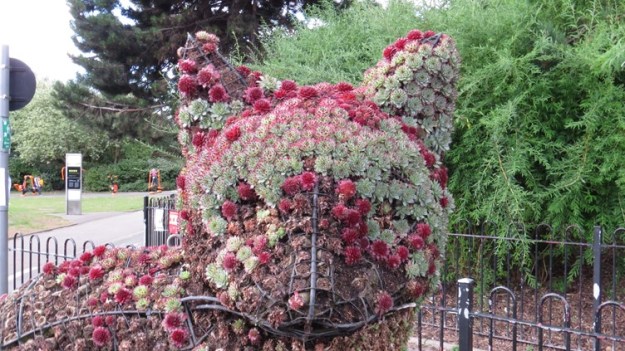
And in the middle of all this is a four-foot tall model cat, covered in sedum. This is in honour of Dick Whittington’s cat. Dick was a real person, but has become the stuff of legend. No one knows how ‘real’ the cat was, but I choose to believe in his existence, because it makes me happy to think of man and cat having adventures together.  It is said that Dick, as a very young man, fled his job as a scullion in the country and headed towards London , where the ‘streets were paved with gold’, along with his cat who was a renowned ratter.  It is from close to here that Dick, lonely, exhausted and broke,  is said to have been considering going back home  when he heard the bells of London saying ‘Turn again, Dick Whittington, Lord Mayor of London’. And so he turned and, together with his faithful cat, headed into the Capital and made his name and his fortune and did, indeed, become Lord Mayor.


What is lovely about Whittington Park is that it is a fully-functioning community resource. There’s an outdoor gym and a football pitch. There’s a nursery and a lovely playground for children. There’s a pond, where some pond-dipping was going on, and a skateboard park.

And there’s also a fenced-off area of wildflowers, which was originally an RSPB experiment to encourage house sparrows. Today it’s much used by bees and hoverflies, and also by a variety of birds who eat the seeds of the thistles and docks. In short, there is something here for everyone, human or animal, and in a very small space too. It just goes to show that wildlife-friendly planting doesn’t have to mean that the whole place turns into a jungle of nettles and bindweed.


Onwards! I jump onto a bus, and then another bus, and finally I arrive at the Barbican. This was previously another site full of red salvia and pots of agapanthus – pretty but sterile. But a few weeks ago, I noticed that it had had a makeover, so I wanted to revisit. And what a transformation it is. All of the beds at the entrance to the complex have been turned into a gravel garden. There are red-hot pokers and scabious and gaura and bee-friendly plants of many types. And it’s working! I saw honeybees and bumblebees, hoverflies and butterflies. At the moment some areas look a bit bare, as the plants are young, but I have no doubt that it will end up looking like an enormous prairie. It blends in well with the ageing Brutalist concrete towers around it, and people were sitting amongst the flowers, eating their sandwiches and relaxing. It’s a bold move to change the planting like this: some people hate the informal look of this kind of bed, and think that it seems ‘weedy’ and unkempt. So kudos to whoever did the Barbican design for sticking to their guns and not taking the easy route.


There is a place, of course, for any kind of plant design. Furthermore, it is much better to have a formal garden than no garden at all. Insects don’t much care whether your plants are native or non-native, and in a city there’s little chance that you’re destroying a pristine habitat by sticking in a couple of lantana. But looking at the drifts of flowers in Whittington Park and at the Barbican, it seems to me that with a bit of imagination we create wonderful spaces, which work for all members of the community, including the ones who aren’t human. My worry is that, with the budget cuts to local councils, the chance for innovation and creativity is restricted, even though a bee-friendly planting doesn’t have to cost more than a standard one. There is nothing like being ‘up against it’ to put a brake on new ideas, because there is no margin for error. Fortunately, these two parks already exist, and will hopefully be a beacon for other councils and other areas. What a boon it would be for all the creatures that pass through them.


Wednesday Weed – Buddleia

Every Wednesday, I hope to find a new ‘weed’ to investigate. My only criterion will be that I will not have deliberately planted the subject of our inquiry. Who knows what we will find…..

IMG_3716

Buddleia (Buddleia davidii)

Dear Readers, when two wild Buddleia plants started to grow in my front garden, I had no idea that they would be quite so enthusiastic. The one next to the front gate wallops everyone who tries to get to the front door with a whippy bloom-covered stem, which is particular fun when it’s been raining. The one by the wheelie bins is at least ten feet tall.

Apologies for the rain drops on the photo, it's been pouring down all morning...

Apologies for the rain drops on the photo, it’s been pouring down all morning…

But now that the lavender has finished flowering, it is the number one favourite of the pollinators around here. Have a look at this lot. The plant is also called Butterfly Bush, as I’m sure you know, and although I haven’t caught any photos of visiting Lepidoptera, it’s loved by every species from Cabbage White to Red Admiral.

IMG_3710 IMG_3708 IMG_3712 IMG_3711 IMG_3706Once the flowers have gone over, I will give both plants a healthy prune, and we’ll be able to access our house without having to go through a mini Tough Mudder assault course to get there.

IMG_3717Buddleia (Buddleia davidii) is originally from the mountainous areas of Hubei and Sichuan provinces in China, and was introduced to the UK when it was planted in Kew Gardens in 1896. It is named for the Basque missionary and explorer Father Armand David, who was the first European to see the Giant Panda, and who, in addition to his church duties, found time to identify no less than 63 species of mammal, 65 species of birds and and hundreds of species of plant which were previously unknown to Western science. In honour of his work, several species were named after him, including a very rare Chinese deer, which is known as Pere David’s Deer in the west. Several of the deer, which  were extinct in the wild,and survived only in the Emperor’s garden, were smuggled into Europe, including one animal which was ‘rescued’ by the good Father himself. As it turned out, it’s just as well that he did, because during the Boxer Rebellion in 1900 all the animals remaining in China were slaughtered and eaten. The European animals were brought together at Woburn Abbey, and bred so successfully that eventually some animals were able to be reintroduced back into China, a rare conservation success story.

Pere David's Deer (Elaphurus davidianus) ("Elaphurus davidianus 02" by DiverDave - Own work. Licensed under CC BY-SA 3.0 via Wikimedia Commons - https://commons.wikimedia.org/wiki/File:Elaphurus_davidianus_02.JPG#/media/File:Elaphurus_davidianus_02.JPG)

Pere David’s Deer (Elaphurus davidianus) (“Elaphurus davidianus 02” by DiverDave – Own work. Licensed under CC BY-SA 3.0 via Wikimedia Commons – https://commons.wikimedia.org/wiki/File:Elaphurus_davidianus_02.JPG#/media/File:Elaphurus_davidianus_02.JPG)

But, back to Buddleia. It’s a member of the Figwort family (Scrophulariaceae), a diverse group which includes such plants as Mullein and that little white-flowered plant you often see in garden centres, Bacopa. The grey-green leaves can look a little tatty late on in the season, but the glory of the plant are its flowers, long inflorescences of purple, lilac or white flowers which smell intensely of honey. I remember passing a boarded-up lot in Whitechapel, and being stopped mid-step by the sound of bees and the extraordinary perfume coming from behind the hoardings. When I peered through a gap, I could see a veritable Buddleia forest, the plants about twelve feet high, the blossoms bowed down under the weight of bees. No doubt this site is a block of luxury flats now, but then it was the equivalent of an East End watering hole for pollinators, and no doubt a refuge for other creatures too.

IMG_3707Each individual flower is ‘perfect’ – this means that it contains both male and female parts. The tiny seeds are very undemanding, requiring only the smallest patch of soil to germinate, and, like Oxford Ragwort Buddleia is likely to have spread along railway lines, its seeds caught up in the slipstream of trains. When I used to commute into Liverpool Street Station in London, the grim trackside was lit up with bush after bush of Buddleia, and as we pulled into the station, past the blackened Victorian walls which lined the route, an occasional shrub could be seen growing from a tiny crack in the brick work. I am sure that the poor soil and exposed location is similar to the scree slopes for which the plant was originally adapted. In its native environment, it has been christened ‘the Harbourage of Tigers’, but in my locality it is more likely to be cover for a neighbour’s cat.

Despite looking in all my usual books and perusing the internet, I could find no references to medicinal or culinary uses for Buddleia, and yet I have a feeling that in its native habitat those enormous sweet-smelling flowers must have been used for something – maybe to sweeten wine, or to make jam, or to adorn houses to keep evil spirits away. At the very least they are surely the favourite flower of some benevolent bee goddess, who will have her work cut out looking after her subjects at the moment, what with the sneaky reintroduction of neonicotinoids to the UK and the general decline in pollinator habitat. I imagine that she is polishing up her sting at this very moment.

IMG_3718I have several varieties of Buddleia in my garden – I am trying a few dwarf Buddleia in my containers, and also have a yellow-flowered variety where the blooms are spherical. But nothing attracts the interest of insects like these wild ones. They fill a gap at the end of the early summer-flowering plants, and before the late summer Sedum and Michaelmas Daisies really get going. I was interested to read that Butterfly Conservation recommends the planting of Buddleia in gardens as a nectar source, even though the plant has no value as a food plant for caterpillars, such is its value to adult insects. However, I would question the need to plant it, as if you live in an area where Buddleia grows wild, some will almost certainly turn up and save you the expense. If you are worried about your single plant turning into a Buddleia forest, note that the seed only ripens in the spring, so dead-heading and autumn pruning should keep it under some kind of control. If not, the seedlings are very easy to pull up. When I am Queen, I shall provide everyone with a Buddleia seedling to pop into their garden or grow in a pot, so that the bees and butterflies, for a few weeks at least, will have a honey-scented corridor of flowers to make their lives a little easier. In the meantime, if you don’t have one already, maybe you could consider finding one yourself? I guarantee you will have some very grateful six-legged visitors.


The Little Visitors

Dear Readers, early last Sunday morning I was shuffling about in my kitchen and sipping a cup of tea when I had the feeling that I was being watched. I peered out of the window. There were no birds, no cats. All was still, the sun just touching the top of the whitebeam tree. And then I chanced to look down, and, sure enough, a small face was peering at me over the edge of the patio.


How alive it seemed, this little creature, all twitching whiskers and bright eyes. It surveyed the scene, its small pink paws poised on the wooden beams beside the pond. It disappeared, and then popped back up again. And furthermore, it was not alone.


It seems, dear Readers, that while I have been away a mother Brown Rat has given birth to some babies in my garden. For a while I tried to convince myself that these little creatures were mice, but no, the small ears and blunt muzzles tell me that they are, in fact, Rattus norvegicus. And what a good time they were having, hoovering up the fallen mealworms from the bird table. It seemed to me that their mother had picked a perfect spot to raise her family – relatively safe from predators, warm, dry and right next to a food source.

The Brown Rat is the most successful mammal on earth (after humans), present on every continent except Antarctica. It shadows us wherever we live, though it is rarely seen. It could be argued that it has also sacrificed more for our well being than any other mammal, as the Brown Rat is the same species as the laboratory rat, and has hence been the victim of more varied torments than any other creature I can think of. If you have ever had a pet rat (and they can make delightful playmates, with a tremendous sense of fun) you have also been in contact with a Brown Rat. But there is no denying that these animals can be a vector for several diseases, including Weil’s Disease and Toxoplasmosis, and that they are associated in our minds with everything that is unclean and sordid.

At this point, I sense rising horror in some of my readers. After all, are rats not public enemy number one, a source of disease, thoroughly disgusting creatures who deserve to be eradicated on sight? Or have ‘seagulls’ taken their place this year?


Dear Friends, it seems to me that if we make a wildlife garden, we cannot be altogether sure what wildlife will turn up. And if we are a little too generous with the bird food, it is not surprising that all manner of opportunistic, intelligent creatures pop in to take advantage. I fear that the amount of food I’ve provided recently hasn’t taken into account the fact that many birds are now in moult and hence not visiting gardens very much. There is also a lot of natural food about, which most birds will take in preference to anything I can provide. And so, these little chaps are taking up the slack.

Now, I make it a rule not to kill anything that turns up in my garden, be it aphid or slug, snail or harlequin ladybird. Or, indeed, rat. But even if I did have a more ferocious turn of mind, can you imagine what would happen? Any animal control company would put down poison to kill these youngsters and their mother. And then, what happens if a fox, or a cat, or a dog eats the corpses? We don’t have many owls around here, but in the country, rat poison is the number one reason for the death of Barn Owls. We do have all manner of corvids and birds of prey, who are not averse to a spot of scavenging, who could also be killed. And anyhow, we are too quick to turn to death as a tool of species management. I am not an absolutist about these things, but in almost every case I’ve ever come across, there is a better solution to the problem of an animal in the wrong place than killing it.


Nearly all of our ‘pest’ animals increase their populations in response to our messiness. Pigeons, seagulls, rats, mice, will all become more noticeable in response to unemptied bins, food which is not kept securely and general litter-dropping. Plus, for some of these creatures we are taking their normal food – we have stripped the fish from the sea, for example, and seagulls are now stealing our ice cream and chips. So, I will cut back on the amount of food that I leave in the garden, not in order to starve my new rodent family, but to persuade them to disperse. There are always a few rats around, but they are normally invisible, unnoticed. It’s only when they binge-breed that they become a problem.

So, the baby rats ran around the patio for a while, and then suddenly noticed that they were being watched. One sat up on his back legs for a moment, eyes bulging as if he couldn’t believe what he was seeing. After all, for a fortnight there has been very little activity at my house, and maybe they were starting to think of the garden as their own. And then, both the rats bolted back under the path, and I haven’t seen them since. Have they already moved on? Has one of the many cats around here put an end to their short lives? Or are they keeping a low profile, emerging during the night to tidy up the garden? Whichever it is, I send them a salute,  from one opportunistic, adaptable, inventive species to another. All of our lives are so short, so fraught with troubles and worries that it’s hard to deny another creature a few moments in the sun.

Wednesday Weed – Creeping Thistle

Every Wednesday, I hope to find a new ‘weed’ to investigate. My only criterion will be that I will not have deliberately planted the subject of our inquiry. Who knows what we will find…..

Creeping Thistle (Cirsium arvense)

Creeping Thistle (Cirsium arvense)

Dear Readers, no sooner was I back in London following my holiday in Austria, than I galloped down to Coldfall Wood to see what had been going on. And it seemed as if everything had burst into flower while I was away, and was now finishing its reproductive cycle. For most animals and plants, it’s already autumn – summer might be just beginning for us, but the woods are silent, the queen bumblebees are already looking for hibernation spots, and these Creeping Thistles were already mostly transformed into puffy seedheads. But many insects are still appreciating their bounty – thistles seem to be amongst the most valuable plants for pollinators.

White-tailed bumblebee

White-tailed bumblebee

Small Skipper butterfly

Small Skipper butterfly

IMG_3691

Honeybee

I imagine that few people would choose to cultivate Creeping Thistle, in spite of its wildlife benefits – like Groundsel or Sow Thistle, it’s one of those plants that looks a bit ramshackle and unkempt on the best of days. Furthermore, it is considered an ‘injurious weed’ in the UK, where it is native, and a ‘noxious weed’ in most countries to which it has been introduced. In Canada, it is known as ‘Canada Weed’, which is surprising as it is an alien species. The name ‘Creeping Thistle’ might imply a shy, diffident plant, but actually refers to the way that the plant surreptitiously takes over a field.

IMG_3688The problem is that Creeping Thistle is just too successful. It forms what are known as ‘Clonal Colonies’, like the one in the picture, where the roots send up multiple shoots and stifle anything else growing in the area, extending its range by up to 6 metres per year. It also sends out cloud upon cloud of fluffy seeds, although only 3% of these are viable, so the main ‘problem’ is with the rhizomes rather than the flowers.It is safe to say that it is not popular with humans, though other creatures may beg to differ.

Goldfinch feeding on Creeping Thistle ("Carduelis carduelis2" by photo MPF - Own work. Licensed under CC BY-SA 3.0 via Wikimedia Commons - https://commons.wikimedia.org/wiki/File:Carduelis_carduelis2.jpg#/media/File:Carduelis_carduelis2.jpg)

Goldfinch feeding on Creeping Thistle (“Carduelis carduelis2” by photo MPF – Own work. Licensed under CC BY-SA 3.0 via Wikimedia Commons – https://commons.wikimedia.org/wiki/File:Carduelis_carduelis2.jpg#/media/File:Carduelis_carduelis2.jpg)

The leaves of Creeping Thistle have been used as animal fodder for centuries, usually after being crushed to remove the prickles. The young leaves and stems have also been eaten by humans. The seeds are up to 22% oil, which can be extracted and used as cooking oil or to fuel oil-lamps, though I would imagine that it would be hard work for a small return.

IMG_3690Medicinally, Creeping Thistle has been used by the Mohican and Abnaki tribes for worms, by people in Northern India for fluid retention, and in the north of England, the stems have been used to treat cramp.

IMG_3686So, here we have the Creeping Thistle, a plant that is too generous with its roots and seeds  for gardeners and farmers, but which is a boon for birds and insects. Here on the edge of Muswell Hill Playing Fields, just beside Coldfall Wood, it is a-buzz with all manner of creatures, and  doing no harm at all. And, as the word ‘Thistle’ goes right back to Old English, I imagine that it has been a cause of back-breaking work for hundreds, if not thousands of years. We might just as well rub along as best we can.

Bugwoman on Location – The Last Day in Obergurgl

IMG_3586There has been much talk this week about water and boulders, so it seems appropriate that on our last day we take a walk beside the river Gurgl, as it runs from Obergurgl down to Solden. When we start the day, at the little hamlet of Zwieselstein, it’s already running along at a fair clip, full of the sediment that turns it a milky grey.

IMG_3589Later in its journey, the Gurgl turns into a category 4 white-water rafting river, but no one tries to navigate these waters. For one thing, it’s full of enormous, house-sized boulders.

IMG_3592For me, rocks like this have a kind of personality, albeit one that’s developed slowly, over millennia. This path is full of them, each with their own community of plants.

IMG_3595IMG_3596And what a cool, green path this is on a hot, humid day. I don’t know of anything else like it around here.

IMG_3598There is one tiny spot of grey beach, and someone has built themselves a little tepee amongst the boulders.

IMG_3601From the cliffs on the opposite side of the river, I see a beetle-browed face looking out.

IMG_3614

Can you see the face?

We climb up over a promontory, into an area where the sun breaks through

IMG_3637IMG_3639And then,  it’s down a hill, and back into ‘civilisation’.

IMG_3641The Rosebay willow-herb is in full flower, as perhaps it might be along the edges of Coldfall Wood.

IMG_3646And as we cross a bridge, the waters from another stream join the Gurgl – the waters run alongside one another for a while, brown against grey.

IMG_3645Here in Solden, they have a penchant for covered bridges. Some are traditional…

IMG_3643..and some are modern.

IMG_3651And, as the Gurgl runs fiercely down the valley, to meet up with the river Inn (from which Innsbruck got its name) and than the Danube, and, finally, the Black Sea, so I must say goodbye to this place, for this year at least. Our two weeks has gone just as quickly as the river has, but I have loved sharing them with you. And now, I feel the itch to be back in my own bed, with my own things around me, and to see what’s been going on in my half-mile territory. So, after the fun of flying back into Gatwick tomorrow and lumping all our luggage home to East Finchley, I look forward to reporting back with the Wednesday Weed on 22nd July.

Until then, thanks for your support!

Bugwoman on Location – Something New

IMG_3531Dear Readers, yesterday we went for a walk in the Ferwalltaller, the last of the four valleys that lay directly above Obergurgl. Suffice to say that it was very, very hot, and very steep, and we both drank a pint of Applesaft gespritz (apple juice with soda water) when we finished. But look what has arrived, in the last few days – a brand new lamb, with umbilical cord still attached. She is much smaller than all the other young sheep, so I think she was born up here.

IMG_3535I love how her legs look too long for her body, and how her mother is keeping an eye on her. I also love how these sheep follow anyone with a walking pole, in the hope of a bite of sandwich.

Mr Bugwoman pursued by sheep

Mr Bugwoman pursued by sheep

One of the sheep has found the perfect answer to overheating – try laying down in a patch of snow.

IMG_3524But, that was yesterday. Today, we decided to take it a bit easier and get the bus up to the Tiefenbach glacier. The road climbs up to 2820 metres above sea level, and passes through a tunnel blasted out of the mountain which is nearly 2 miles long. When you get there, there is a very fine carpark, and restaurant, and cable car (as usual). At this time of year, the glacier itself looks a bit exhausted and grimy. It’s the only spot in the Oetzal valley where you could still do a spot of skiing if the urge came upon you.

A bit of glacier next to the car park

A bit of glacier next to the car park

IMG_3557

The entrance to the tunnel through the mountain

We board a cable car, and head up to the top. While all these ski slopes and restaurants and car parks feel like a desecration of the mountains, you don’t have to look far to see what a tiny proportion of the Austrian Alps are used for these purposes, and how much remains untouched.

IMG_3559IMG_3558The Austrians seem to love inducing vertigo in their tourists. Well it works for me. No way I’m walking out on that thing…

IMG_3565

Just call me Wusswoman….

And for any cable car enthusiasts, here is the Top Station

IMG_3568And some cable cars…

IMG_3570So, once we’d wandered round and admired the scenery, we headed back down for lunch. I ended up with Germknodel mit vanille sauce – in other words, an enormous dumpling filled with prune puree, with poppyseeds on the top and some custard. Well, as I’m vegetarian, it was that or chips. And look at these very fine curtains, showing Alpine scenes!

IMG_3573So, we headed back down into the village of Solden, or ‘Sin City’ as it’s known in these parts due to its Table Dancing establishments (two, open only in winter) and its bars. These are something of a shock after Obergurgl, which prides itself on its clean and healthy living. Having said which, this is still rural Austria. I imagine that the goings-on are relatively tame.

A table-dancing establishment

A table-dancing establishment

A table-dancer

A table-dancer

As we sit sipping a coffee, we notice a cortage of Porsches parked up opposite.

IMG_3578The drivers get out for a chat. From here, there are only two routes – into Obergurgl (and then out again because that’s where the road runs out) or over the Timmelsjoch pass, with its 28 hairpin bends, into Italy. I imagine that they’ll be off for a pasta lunch.

Off we go!

Off we go!

I wish them luck with trying to keep their yellow/black/white/black/yellow colour order when they have to get past buses/cyclists/motorbikes on those twisty roads. Oh, and yesterday a lorry got stuck going over the Timmelsjoch so no-one could get past in either direction for six hours. The idea of driving a convertible, with the wind in your hair, and the reality of being stuck behind an articulated lorry round 28 hairpins is something to consider.

So, we head for home, and pass this sculpture, made entirely out of bits of scrap metal, outside one of the hotels.

Scrap metal Ibex

Scrap metal Ibex

IMG_3585I love the ingenuity that takes things that would otherwise be thrown away, and makes something beautiful out of them. And, as I haven’t seen an ibex on this visit, it’s good to see an  image of one.

Tomorrow is our last day in Obergurgl. How can two weeks have past so quickly?