Category Archives: Bugwoman on Location

Bugwoman on Location – A Spring Walk in a Dorset Lane

IMG_5755

Blackbird nesting in an old farm building

Dear Readers, last week I was ‘on location’ in Milborne St Andrew in Dorset, spending a week with Mum and Dad. They are both doing very nicely at the moment, and Mum asked me to relay a message of thanks to you all, for your messages of goodwill when she was so ill at Christmas, and also for keeping my spirits up (which indeed you did). So, I add my thanks to hers. If any blog has a kinder or more generous readership than mine I would be amazed.

I decided to take an hour out from making pancakes and soup (not simultaneously, I hasten to add) and went for a walk along Cole’s Lane, which winds up through some new-build cottages and farm buildings and into the fields.  Last time I was here, the House Martins were massing on the roof prior to flying south, and as yet it’s too early for their return. But the bushes are alive with birdsong. Robins are singing  from the laburnums and elders, their little round bodies puffed up with passion. The woodpigeons are singing their soft, crooning verses, and some starlings are ticking and whistling in an old beech tree. The pulse of life has picked up, and the leaves are just coming through, as green and toothsome as baby salad.

The path passes by the cottage where my brother used to live, and then a modern single storey building that looks as if it might have occasional use as a conference centre or meeting place. As usual in the village, there are signs asking people to pick up their dog poo. I don’t know who the anti-social culprits are, but allowing your dog to do its business and not picking it up is number one concern around these parts. Another sign, by the hedgerow on the opposite side of the road, begs people not to pick the daffodils. And there are lots of daffodils, for sure.

IMG_5754Some are the plain golden trumpets that you can buy a bunch of in Sainsburys for a pound. Some are more like the wild flowers, the petals paler than the centre. Some are the colour of plaster and apricots. Pale cream primroses peek out every so often, and in the shadier places there is the liquid sun of lesser celadine, those little golden star-shaped flowers peeking out from amongst the dark-green heart-shaped leaves. In one spot, a little thicket of snowdrops is hanging on, each porcelain flower marked with a green kiss. In short, spring is pouring forth in abundance, and I half expect to see an Easter Bunny.

Then,  something moves by the stone steps leading up to a farm shed. My first thought is ‘rat’! And then I see a white bobbing tail as a tiny rabbit jumps back into the darkness of the open doorway. So, I did see an Easter Bunny!

Spot the ears!

Spot the ears!

I stride on womanfully uphill, and see a dunnock displaying in an hawthorn, raising his wings to display his armpits to a robin, who is unimpressed. I learned recently that the testicles of small birds, like sparrows and dunnocks, increase in size tenfold in the spring. Of course, the testicles are carried inside the birds so we can’t see them, but just imagine the impact of all of that testosterone on such a tiny bird! No wonder they are impetuous and bold. The dunnock, normally a mousey little bird, takes to singing its sweet, thin song from the top of any available bush, regardless of the danger. We have already mentioned the robin. And the wrens are exploding into song all along the hedgerow, so that as I leave each territory and enter the next it’s a constant corridor of sound.

A surprisingly bold dunnock

A surprisingly bold dunnock

The hedgerows themselves are worthy of mention. In some places, the road has been worn away so that it is a good two metres below where the hedge is. I bump into a well-equipped elderly man who is off for a hike – he has walking boots, two sticks,, a rucksack and a GPS. We talk about the hedges, and he agrees that some of them have probably been here since the Domesday Book, marking the edges of people’s land and stopping the wanderings of cattle and sheep. The individual plants might have withered and died, but each would have been replaced as it failed. And what a mixture of plants – hawthorn and yew, hazel and beech, blackthorn and plum, and some newcomers – berberis and mahonia and pyracantha. Each hedge is both a source of food and a shelter, for many little birds like to nest in the thick cover that a decent hedge provides.

Some lichen in one of the older hedgerows.

Some lichen in one of the older hedgerows.

I walk further up the path, passing an old barn (full of rolls of straw and bags of urea pellets),

IMG_5774and, as I come up to some puddles in the road where a tractor has created a convenient pool in the mud, I see a small bird with a blazing golden head. A yellowhammer, a typical bird of farmland and hedgerow. Once these were as common as sparrows, but I don’t remember the last time that I saw one. Their call, often rendered as ‘a little bit of bread and NO cheese’, was echoing around the copse. I looked up and down and roundabout to see if I could get a picture, but the yellowhammer is one of those birds that you see, briefly, flying away from you and into cover. As indeed I saw another twice before I gave up my photographic ambitions, and decided to just enjoy the walk.

By Tim Felce (Airwolfhound) (Yellowhammer - Rutland Water) [CC BY 2.0 (http://creativecommons.org/licenses/by/2.0)], via Wikimedia Commons

A yellowhammer. Not the one I saw, but a yellowhammer nonetheless (Photo One – credit below)

I followed a pair of birds along a little side-lane, as they bobbed about just in front of me, occasionally landing on the fence. They looked very finch-like, but I was sure they weren’t chaffinches. And, finally, when I got a good look I recognised them. They were linnets, the sweet singing birds of many a Victorian ditty, and I had never seen one before. They are the colour of dried thistles and stubble and autumn leaves.

Linnets! (Falls over in a swoon)

Linnets! (Falls over in a swoon)

IMG_5772Though by now, it was starting to cloud over, and I had more pancakes to make (yes, I know Shrove Tuesday was weeks ago but pancakes do contain eggs, which makes them Easter fodder as well).

IMG_5776

Aye, the weather’s on the turn….

And so, I retraced my steps, saying hello to the bold dunnock, the singing wrens and the feisty robins as I went. Spring is so full of new hope that it’s difficult not to get caught up in the spirit of the time.

Credits

Photo One – By Tim Felce (Airwolfhound) (Yellowhammer – Rutland Water) [CC BY 2.0 (http://creativecommons.org/licenses/by/2.0)], via Wikimedia Commons)

All other photos copyright Vivienne Palmer

Bugwoman on Location – Tate Modern revisit, and a walk along the Thames

Back at Tate Modern on Friday 19th February

Back at Tate Modern on Friday 19th February

Dear Readers, you may remember that last year I visited the latest Turbine Hall installation at Tate Modern in London. Called ‘Empty Lot’, it’s by Abraham Cruzvillegas, and comprises dozens of triangular planters, each filled with soil from different parts of London. Some contain material from allotments, some from parks, some from gardens, but none of the ‘plots’ are labelled, so it’s a little frustrating not to know which soil is from where. The containers are watered, and lighting is provided, but nothing is planted, so whatever grows will come from the seed bank that was there when the installation was created.

IMG_5397As you can see, some of the triangles have produced a reasonable crop of plants, but some are completely barren. Another frustration for me is that you can’t walk among the beds, but I managed to get an idea of what has grown up in some of them during the four months since I was here last.

Dandelions....

Dandelions

Stinging nettle...

Stinging nettle. Or maybe even small nettle?

A member of the carrot family....

A member of the carrot family and a discarded water bottle

Some sad nasturtiums reaching for the light....

Some sad nasturtiums reaching for the light….

So far, so much as expected. If I’d been a betting person, I’d certainly have put money on dandelions and nettles cropping up. But wait, what is this?

Black nightshade (Solanum nigrum)

Black nightshade (Solanum nigrum)

Springing forth from several of the beds was a fine crop of black nightshade (Solanum nigrum). Why on earth this should be so numerous is anybody’s guess. Unless, of course, I am looking at some potato plants. Maybe any gardeners could hazard a guess? These plants look a little more delicate than the potato seedlings that I remember from my youth, but then the light conditions may have rendered them a little etiolated. Maybe the only solution is to break into Tate Modern after dark with a spade and do a spot of digging.

Black nightshade or poorly reared potato?

Black nightshade or poorly reared potato?

The exhibition finishes on 3rd April, much to my frustration – a few more months would have seen any spring flowering plants coming into bloom, and would have made identification easier. But still, this is art, not science. Unfortunately. On the UK Wildflowers Facebook page, someone suggested repeating the experiment but with labels, and with soil taken from all over the UK, and with correct lighting levels. What a glorious sight that would be!

Anyhoo, I had forgotten that it was half-term, and by this time the place was mobbed with eager small culture-seekers. You couldn’t get into the cafe for the massed ranks of prams and little ‘uns. So, I decided to go for a walk along the Thames,  heading back towards Waterloo.

The magic of bubbles - outside Tate Modern

The magic of bubbles – outside Tate Modern

St Pauls

St Pauls

The Millennium Bridge, the Cheesegrater and the Walkie Talkie

The Millennium Bridge, the Cheesegrater and the Walkie Talkie

An elderly man sat on a bench just past the gallery, and produced a carrier-bag full of crusts for the pigeons, which they hoovered up in ten minutes. No wonder they look so sleek and well-fed around here.

Thameside Pigeons

Thameside Pigeons

There are so many small treasures along this one mile walk. Take the lanterns, which, although called ‘Dolphin lights’, are actually said to represent sturgeon, though they don’t much look like them, either. The lights on the north side of the river date from 1870 and were designed by George John Vulliamy, but the ones on the south bank are replicas, made to commemorate the Queen’s Silver Jubilee in 1977.

IMG_5473And on some parts of the embankment railings there are veritable miniature forests of moss.

IMG_5467It’s easy to forget that the Thames is a tidal river, and that sometimes little miniature beaches appear. The lettering on the embankment below, almost hidden in the algae, says ‘Welcome to Paradise’. I don’t know if there is ever dry land here, or if someone wrote the message from a boat. Very intriguing.

The lettering says 'Welcome to Paradise'.

The lettering says ‘Welcome to Paradise’.

And here is one of the little beaches, being pecked over by the usual suspects.

IMG_5497The Thames is a great location for gull-watching – you never know who is going to turn up. But the commonest birds at this time of the year are the black-headed gulls, who ride the waves breast down and tail up, like paper boats.

IMG_5471They are not averse to picking over what the tide brings in either. To my surprise, most of it seems to be organic matter – branches and weed – although of course there are also plastic bottles and other tat. The Thames is still full of surprises -everything from Roman coins to clay pipes to Delftware. A man wearing a woolly hat was standing on the beach, mobile phone clamped to his ear, spade upright beside him in the sand. I wonder what he found?

IMG_5492A family just along the path had brought out their lunches, and were immediately besieged with pigeons at their feet, and gulls perching on the railings, watching every mouthful with a beady eye. When people walked past they flew up in a flurry of paper-white wings, squealing and chuckling. It’s not wise to show these arch-scavengers a crust unless you’re serious, because they are not above distraction tactics, and will nick half a sandwich as soon as look at you. They, along with squirrels, are the animal equivalents of Dicken’s urchins, innocent looking but with petty crime on their minds. And yet, watching the gulls against a backdrop of olive-green water and the warm stone of St Pauls, they looked more like angels.

IMG_5527 IMG_5528Onwards! And just before the National Theatre there was a fine group of gulls perched on the railings – three black-headed gulls and a young lesser black-backed gull. You could argue that this was a combination of beauty and the beast, for the lesser black-backed gull is twice the size of his companions, and bears a beak meant for butchery rather than for picking things over. Still, this is a young gull, with speckled wings, not yet ready for the piracy of his adulthood. He stands quite companionably with his smaller companions as they preen their feathers and keep an eye open for biscuits. I get quite a few photos of the little group as they sit there peaceably while the endless stream of tourists walk past. The birds have the disinterested look of  market-stall holders who have already sold enough for the day, and are watching the world go by without comment.

IMG_5516IMG_5515And then, the lesser black-backed gull unfurls his wings and, unhurriedly, lifts his pink feet from the railing and leans into the wind, which carries him off across the river. He lands on the prow of an ancient barge, and settles himself. Maybe he is dreaming of hot-dogs. Or maybe his mind is as clear as water.

IMG_5524IMG_5525Credits

Information on Dolphin lights from the excellent ‘Memoirs of a Metro Girl‘ website.

All photos this week copyright Vivienne Palmer

Bugwoman on Location – ‘Empty Lot’ at Tate Modern

'Empty Lot' by Abraham Cruzvillega at Tate Modern

‘Empty Lot’ by Abraham Cruzvillega at Tate Modern

Dear Readers, earlier this week I took a day off from work and went to Tate Modern to see their latest Turbine Hall installation. This massive space has been home to Olafur Eliasson’s sunset light-show, Carsten Holler’s metal tubular slides, and an enormous red trumpet by Anish Kapoor, which took up the entire hall. This time, however, the art-work is inspired by nature. Called ‘Empty Lot’, it’s by Mexican artist Abraham Cruzvillegas and it consists of dozens of triangular wooden raised beds, each one filled with soil from a different part of London. There are lights positioned seeming randomly about the space, and each bed is watered regularly. However, the beds are not planted: whatever grows there will have been in the soil already. It seemed like an interesting idea, though I was concerned about the time-scale – the installation went in on 6th October, and will be removed on 6th April. As many of the plants won’t come into growth until March, it feels like a lost opportunity. How much better it would have been if it had run from February to September, for example. Nonetheless, I was intrigued.

IMG_4784When I entered the hall, I was disappointed. I had expected to be able to walk between the beds and see them up close. Instead, the beds are on scaffolding, so you can peer down on the ones that are nearest to the viewing platform, but can’t really see what’s happening in the ones that are furthest away. Furthermore, there is no way of telling which beds contain which soil. It would have been interesting to see if there was a difference between north and south London for example, or if the soil taken from industrial sites had different plants from those taken from parks and gardens. It would have been a chance for art and science to meet. Instead, some of the beds have things growing in them, and some do not, and why this might be is anybody’s guess. I harrumphed to myself in best Bugwoman fashion, and almost just walked away.

IMG_4770But then, I had a closer look. Already, some things are emerging. One bed is full of baby thistles.Several have stinging nettles. Some have grass. One bed is entirely full of what look like etiolated nasturtiums, their little round leaves balanced on stems as long as a giraffe’s neck. It’s clear that there isn’t enough light for some of the plants, and I imagine that these seedlings will collapse and die. There were delicious leaves that looked like maidenhair fern emerging from one or two of the beds. Another looked as if it would be populated with willowherb. There was a conker in one bed, and a couple of partially munched apples in another, though whether the fruit had been brought in with the soil or tossed there by a viewer was unclear.

Nettles

Nettles

IMG_4749

Little thistles?

Grass

Grass

Nasturtiums?

Nasturtiums?

Any ideas? Looks like maidenhair fern....

Any ideas? Looks like maidenhair fern….

The colour and texture of the soil was also interesting. Some looked like unimproved London clay, claggy and cold. Some was the colour of dark chocolate, and was obviously much improved with compost and mulch. Some had dried out, with a silvery salty sheen on the surface. As with so many things, the more I looked, the more I noticed.

IMG_4772So I suppose the question is, what does it all mean? Some might answer that art is in the eye of the beholder, who can attach whatever meaning they blooming (!) well want. The artist himself has said that we are all, as individuals, ‘empty lots’, where anything might grow or manifest itself. Someone else has mentioned that all the ‘exciting stuff’ in this installation is happening under the surface, as seeds sprout and mushrooms push their little heads up. But although I have frustrations with the work, for me it is a symbol of the sheer irrepressibility of life, which will appear regardless of location. I look forward to a return visit in the spring, to see what has popped up. For all that there may be human interventions – I’m sure people won’t be able to resist seed-bombing the beds closest to the walkways – the real fun will be in seeing what nature herself can do in this unnatural situation.

IMG_4789

Bugwoman on Location – Royal Botanical Gardens, Burlington, Ontario

IMG_4381Dear Readers, you might think that the Royal Botanical Gardens, situated an hour’s train ride out of Toronto, would be a manicured, formal place, full of flowerbeds and statues and fountains. It does have these things, but it is also the starting point for a variety of trails which pass through woodland and wetlands, and which support an extraordinary array of wildlife and plants. For the past two years I have met up with my American naturalist friend Michelle, who drives from Youngstown in the USA so that we can go and explore together. Although we meet so seldom, I feel that we are kindred spirits – both of us are obsessed with gardening for wildlife, and with learning as much as we can about our local ecosystems. However, Michelle has a much bigger job than me, as the biodiversity of the eastern side of North America is much more complicated than that of the UK. To take just one example, there are 59 species of butterfly in the UK, compared to 110 species in the Toronto area alone.

IMG_4390

As soon as we set off along the trail, we had the feeling that we were being watched. The eastern chipmunks appear within a few minutes of us starting our walk and look up at us with enormous eyes just in case we happen to have a sack of bird food with us. We don’t (at least until somebody takes pity on us later on and gives us some of theirs), but there was enough food already left on the fences along the trail to keep a whole army of chipmunks happy.

The name ‘chipmunk’ is thought to derive from an Ojibwe word meaning ‘he who descends the trees headlong’. These little rodents are fiercely competitive at this time of year – they need to gather as much food as they possibly can to enable them to survive the winter, and are not averse to stealing another chipmunk’s ‘stash’. Hence, when the chipmunks weren’t approaching us, they were chasing one another through the undergrowth.

And the chipmunks are not the only creatures who are stocking up on food. Other eyes are on us, too.

IMG_4428

The birds also appreciate the way that humans often have pockets full of provisions – here, a chickadee eats some sunflower seeds from Michelle’s hand, while another one waits in the branches. These birds remind me so much of the great tits in my own garden, with their varied calls and opportunistic ways. As small birds both species will have their work cut out to survive the winter, and so they will need as many of these fat-rich seeds as they can get their beaks on.

The flowers here are very different from those that would be found in a UK wood . Here, for example, are some arrow-leaved asters. At least, I hope they’re arrow-leaved asters (aster experts, feel free to put me straight!) Ontario has a fantastic range of asters, which interbreed quite happily and cause a real headache for anyone trying to work out what species they’re looking at.

IMG_4373

Arrow-leaved Aster (Symphyotrichum urophyllum)

Ontario is also blessed with a dozen or more species of goldenrod, which have a variety of flower types and preferred habitats. All of them seem to be beloved by pollinators.

IMG_4465

IMG_4389IMG_4399As we passed through the woodland, and onto the boardwalk that goes through the marshes, we are lucky enough to bump into a man with a camera and a woman carrying a half-kilo of peanuts and seeds. This couple walk the trail every day, and by coincidence we’d met them during our previous visit, and had followed them on their rounds.

IMG_4401We asked them what was new, and as we were discussing the possibilities, there was a splash, and a pointy-toothed face peered up from the water. A muskrat was undulating between the mallards.

Musk Rat (Ondatra zibethicus)

Muskrat (Ondatra zibethicus)

This was a new creature for me, a member of the sub-family that includes voles and lemmings, and hence not a true rat at all. Muskrats are thought to have a very important part to play in the preservation of wetlands – they eat some species, such as cattail and yellow water lily, in preference to others. Their populations are thought to cycle naturally – when very abundant, the muskrats will eat a lot of vegetation, which helps to keep the wetlands open. Their main natural predator is the alligator, but they are food to every kind of carnivorous animal, from pike to osprey to coyote. And humans have hunted them too, for their fur and as food. For several North American native peoples, however, muskrat played a vital part in the creation of the world, by bringing up the mud used to create the planet from the bottom of the primordial sea when all the other animals had failed.

After a few minutes, we realised that there were two muskrats, probably youngsters born this year. They are known to share the lodges of beavers, behaviour that was filmed during David Attenborough’s ‘The Life of Mammals’ series a few years ago. It’s not clear who benefits most from this arrangement, but maybe the shared body heat and the extra eyes to watch for trouble make it a most satisfactory cohabitation.

IMG_4410As we stood on the boardwalk, I saw a largish bird fly over. It seemed to have a white head.

‘Is that a gull?’ I asked Michelle.

‘It’s pretty big’, she said.

We watched for a few more minutes as it soared and banked.

‘It’s a Bald Eagle’, said Michelle. ‘Very rare around here’.

And so we stood as it banked in long slow arcs above the trees, and disappeared into the blue. What a surprise.

The birds below are rather commoner.

Turkey Vulture (Carthartes aura)

Turkey Vulture (Carthartes aura)

At one point, four turkey vultures were circling above us, riding the thermals on this unseasonably hot day. One way to tell them from other raptors is that they seem to tilt and correct themselves in flight, rather than holding their wings rigidly as the bald eagle had done. Turkey vultures are exclusively carrion eaters, and do not eat dogs, small children or prize chickens, in spite of their rather dark reputations. They are unusual among birds in having a well-developed sense of smell – they may quarter the ground searching for traces of the chemical ethyl mercaptan, which is produced by decaying bodies. This means that the birds can find food hidden under trees, where it is undetectable by sight. Unfortunately for the turkey vultures, other predatory birds watch what they are doing, and will follow them down when they find food, often displacing them from the corpse. However, if the dead animal is a large one, the turkey vulture (who has a surprisingly delicate bill for such a large creature) needs the larger birds to get through the hide. So, the turkey vultures wait around patiently, and mop up once the coast is clear. This is an example of mutual dependence, much like that between ravens and wolves in the northern forests – the ravens have been seen leading wolves to a corpse that is too difficult for them to open by themselves.

As we walk on along the boardwalk, the creek opens out, and we begin to see more water birds. At a distance, the one below looks very familiar, but as I get closer I realise that this is not the grey heron that I see at home, but an altogether more formidable bird, a great blue heron (Ardia herodias).

IMG_4426

Great Blue Heron (Ardea herodias)

This bird has a height of 54 inches, and a wingspan of over six feet. It is the largest North American heron, and even at this distance it was impressive, striding purposefully through the water. Great blue herons are migratory, leaving Ontario for Mexico and South America during the long cold winters, although the toughest birds may stay, provided the water doesn’t freeze over completely. This bird is easily big enough to feed on anything from ducklings to turtles, fish to frogs and even, dare I say it, the occasional juvenile muskrat.

We walk on along the path. The creek broadens out further, and then comes to a halt beside a road, with a lake opposite, and some lorries extracting gravel on the hillside beyond. On our side of the tarmac there are thick beds of reeds, and along the edge is an array of asters and goldenrod and evening primrose, as pretty as anything that could be dreamed up by a garden designer.

IMG_4431IMG_4435

IMG_4430

What is not so pretty is a small brown snake, dead in the middle of the road with its head crushed. Was it sunning itself when a car went hurtling past? There is something about the precision of the injury that perturbs me, as if someone deliberately killed this animal while it was doing nothing except minding its own business. But then I look up as something else flies low over the trees beside the path, arching away over the reed beds. A large brown and white bird that looks strangely familiar. It isn’t until it passes that I realise that we’ve seen an osprey, a much commoner bird in North America than it is in the UK, and surprisingly widespread – I saw one in San Diego a few years ago. On the way back we check out any dead trees to see if the bird is perching, but we are only lucky enough to get this one glimpse. Still, to see a bald eagle and an osprey in one day is extraordinary luck, and neither Michelle nor I are complaining.

I see an old friend, too.

Monarch Butterfly

Monarch Butterfly

After seeing monarchs in Collingwood last week, I’ve continued to see them. Once, I saw one flying anxiously over the Distillery District in downtown Toronto. What a difference it might have made if the half-barrel containers full of impatiens and geraniums had contained something with a bit more nectar. But here along the creek there are lots of wild plants to feed on, and the monarchs are taking full advantage.

And then, as we come to the end of the boardwalk I see a bird that even I can identify.

Red-winged Blackbird (Agelaius phoeniceus)

Red-winged Blackbird (Agelaius phoeniceus)

The red-winged blackbird is said to be the commonest bird in North America, with an estimated 250 million breeding pairs. This has sometimes led to a difficult relationship with human beings: in 2009, it was estimated that over 950,000 birds were poisoned as ‘agricultural pests’ in the south-eastern USA, even though these birds also eat a large number of insects which are injurious to crops. As usual, the poisoning did not just affect the target species: the rusty blackbird (Euphagus carolinus) has declined by almost 99% since the 1960’s, and it is thought that these birds may have been caught up in the biocide, although habitat destruction has undoubtedly also played a part.

"Euphagus-carolinus-001". Licensed under CC BY-SA 3.0 via Commons - https://commons.wikimedia.org/wiki/File:Euphagus-carolinus-001.jpg#/media/File:Euphagus-carolinus-001.jpg

Rusty Blackbird (Euphagus carolinus) – see below for photo credit

And so, it’s time for lunch, and we head back to the main cafe in the Royal Botanical Gardens. But as we go in, we pass these strange characters.

IMG_4440IMG_4441I’m not sure exactly what these plants are, but to me they are full of character, like shaggy green gods  waking up after a long sleep. Whether they have been designed to look like this, or have  grown this way I have no idea, but they seem the very embodiment of a kind of vegetable intelligence, a different way of being in the world that we, with our mammalian senses, can barely begin to comprehend. If walking in nature teaches me anything, it’s how little I know, and how abundantly much there still is to learn.

Photo credit for rusty blackbird pic: “Euphagus-carolinus-001”. Licensed under CC BY-SA 3.0 via Commons – https://commons.wikimedia.org/wiki/File:Euphagus-carolinus-001.jpg#/media/File:Euphagus-carolinus-001.jpg


Bugwoman on Location – Collingwood, Ontario, Canada

IMG_4313Dear Readers, for the next two weeks my Saturday posts will be from Canada, where I’m visiting the friends and family who live on this side of the pond. For part of this week I’ve been in Collingwood, a town of almost 20,000 souls on the coast of Lake Huron, where I’m staying with my husband’s aunts, Rosemary and Linda, both keen wildlife and plant enthusiasts. Visiting this part of the world always reminds me of the Chinese phrase ‘Same-same, but different’ – so many of the plants and animals are familiar, but then there are those which are not. On a walk down to the lake shore I found the plant below. I’m sure that my North American readers will recognise it immediately but it was a complete mystery to me.

Milkweed (Asclepias syriaca)

Milkweed (Asclepias syriaca)

Linda told me that this is Milkweed, is the food plant of the caterpillar of the Monarch butterfly. Its leaves contain toxins which make both the larvae and the adults poisonous to predators, which is probably some protection during the butterflies’ epic migration from Canada to Mexico, where they spend the winter.

"Monarch Butterfly Danaus plexippus Laying Eggs" by Photo by and (c)2009 Derek Ramsey (Ram-Man) - Self-photographed. Licensed under GFDL 1.2 via Commons - https://commons.wikimedia.org/wiki/File:Monarch_Butterfly_Danaus_plexippus_Laying_Eggs.jpg#/media/File:Monarch_Butterfly_Danaus_plexippus_Laying_Eggs.jpg

Monarch butterfly laying eggs on Milkweed.Photo credit (1) below.

At this time of year Milkweed is covered in seedpods, which will soon burst to reveal a mass of fluffy seeds. These are so light and buoyant that they were used as an alternative stuffing for lifejackets during World War Two – children were encouraged to collect the seedheads, and over two million pounds of milkweed floss were gathered in one year. The slogan was that ‘Two bags save one life’, as it took two bags of floss to fill one lifejacket.

The latex-like white sap was also harvested during the war as a rubber substitute by both Germany and the US, although it proved to have too little of the key ingredient to be feasible.

IMG_4299 (2)The flowers, which appear between June and August, are an invaluable source of nectar for all kinds of pollinators. The pollen is stored in special sacs, called Pollinia, which attach themselves to the insect and are pulled away when the insect leaves, provided that it is big enough – non-native bee species may become stuck to the plant, and die. Milkweed has been used both as a source of sweetness by Native Americans, and as a way of making arrows poisonous. Few plants can have such a variety of contradictory uses.

Onwards! We advance along the paths beside the lake.

Canada Goldenrod ( solidago canadensis)

Canada Goldenrod ( solidago canadensis)

The road from the bus station at Barrie to our destination at Collingwood was lined with stand after stand of Canada Goldenrod. It is the dominant plant of roadsides at this time of year, and will be familiar to my UK readers as well, appearing in many situations where the soil is disturbed. It is also said to have become a terribly invasive plant in China, and is flourishing in the abandoned rice-paddies around the abandoned nuclear plant at Fukushima. Clearly this is a plant of extraordinary resilience and opportunism. In Canada, it is browsed by deer and is eaten by at least twenty species of birds and mammals. In Ontario, the local Ojibway people called the plant ‘Geezisomuskiki’, which means ‘Sun medicine’, and it has been used by various North American First Nations people for both veterinary and human medicine. The Thompson tribe bathed their children in a decoction of Goldenrod for its sedative effect.

Sumac

Staghorn Sumac (Rhus typhina)

Staghorn Sumac is often seen growing along the railway lines in the UK, and is sometimes planted in gardens for its intensely red autumn foliage. It’s here in North America that it looks most at home, however, especially at this time of year, when the strange red fruits (called drupes) are beginning to ripen (the word ‘Sumac’ comes from an Arabic word meaning ‘red’). It is the source of the spice sumac, which has become very popular (especially with followers of chef Yotam Ottolenghi), but the seedheads are also used to make a pink soft drink called ‘Sumac-ade’ in North America. The leaves are added to tobacco and smoked by some Native Canadian peoples, and a dye can also be produced from the plant. Intriguingly, the wood of all Sumacs fluoresces under ultraviolet light, and I wonder if this is used to attract some nocturnal creature.

Sumac is a difficult plant to control, should one want to – cutting it down produces an array of sharp woody shoots. Apparently goats enjoy eating Sumac, but unfortunately they also enjoy eating pretty much everything else. As it is a plant that grows in poor, thin soil where other things are loathe to venture, it might be better, in general, to just enjoy it.

IMG_4331

Common Eastern Bumblebee (Bombus impatiens)

Being on a new continent can feel a little like being illiterate – I don’t immediately recognise even the commonest of birds and insects. In the photo above, I could tell that I was looking at a bumblebee, but I had no idea what species. A quick look at the trusty internets told me that this was a queen Common Eastern Bumblebee, but to me she was a wonderful creature – her ashy thorax made her look like no bee that I’d ever seen before. No doubt she is topping up her reserves with nectar in order to allow her to hibernate through the long, cold Ontario winter. Bumblebees are well-adapted for cold conditions, and it’s thought that their larger size and thick coating of ‘fur’ developed to protect them in the tundra areas in which they first evolved. If last winter in Collingwood was anything to go by, she’ll need every layer of insulation that she can get.

New England Aster (Symphyotrichum novae-anlgiae)

New England Aster (Symphyotrichum novae-anlgiae)

The New England Aster is a plant that is often grown in gardens in the UK, but here in Ontario it is a native plant that grows in abundance, making a colourful counterpoint to the Goldenrod. Its flowers are much more to the reddish-purple end of the spectrum than most asters (though the photograph doesn’t really bring this out), and the plant seeds and leaves are eaten by everything from grouse to moose. Again, it has an Ojibway name – Waunissikaehniswung, which means ‘that which would kill pain’ – native peoples in Canada and the US have used a poultive of the roots for pain, and an infusion of the plant for fever.

And then, this afternoon, we went to visit Juliet’s farm. Juliet is a close friend of Rosemary and Linda, and a sculptor who made the wonderful piece below.

IMG_4355Her house is surrounded by fields full of New England aster and Goldenrod, Milkweed and Red clover. And, floating above the flowers, their wings like tangerine-coloured stained glass, were  Monarch butterflies. As soon as one left, another arrived to take its place, like planes queuing up to land.  I managed to get just one shot of a butterfly feeding, so anxious were they to fuel up and be on their way south. At a time when these butterflies are becoming more and more scarce, this one field drew them in from the four points of the compass, as if they knew that, among all the fields of maize and canola they would get a welcome here.

IMG_4368Like wild creatures the world over, Monarchs are becoming scarce, due to the destruction of their over-wintering sites, the industrialisation of agriculture, the increased use of pesticides and a variety of other factors. But here, the butterflies found a brief sanctuary before their journey south. Let us never underestimate the value that the right resource, at the right time, can make to the lives of individual animals, whether it’s a pot of early-flowering crocuses for the bumblebees or a whole field full of wildflowers.

Photo Credit:

  1. “Monarch Butterfly Danaus plexippus Laying Eggs” by Photo by and (c)2009 Derek Ramsey (Ram-Man) – Self-photographed. Licensed under GFDL 1.2 via Commons – https://commons.wikimedia.org/wiki/File:Monarch_Butterfly_Danaus_plexippus_Laying_Eggs.jpg#/media/File:Monarch_Butterfly_Danaus_plexippus_Laying_Eggs.jpg

Bugwoman on Location – The Old and The New


Conventional planting on Islington Green, North London. This replaced alliums, grasses and verbena. I’m not sure what caused the outbreak of conventionality, maybe budget cuts?

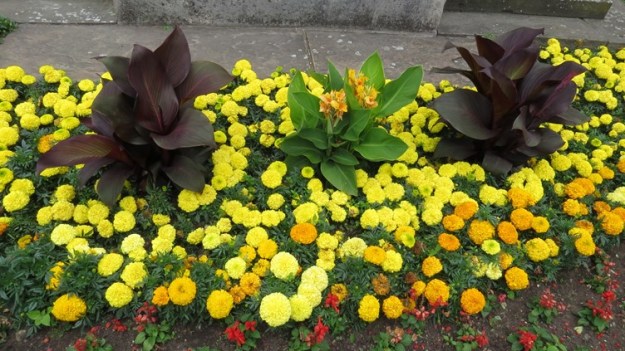
Dear Readers, municipal plantings in parks and public areas used to be the same wherever you were in the country. There would be regular ranks of blue lobelia and red geraniums, edged with white alyssum. Sometimes, the bolder councils would inject some double-flowered marigolds and petunias, and, if they were really going for broke, they might throw in a few bronze-leaved cannas, with big blousy golden flowers. Sadly, none of these plants have much to offer bees and other pollinators. And if you pop down to Islington Green in London today, you will see exactly the kind of planting that  I’m talking about.


This kind of planting stays in place for a few months, while bees and butterflies investigate and, disappointed, move on to something that will actually feed them. And then, one day, the plants will be pulled up and thrown in the compost, to be replaced with winter-flowering pansies and primroses. When summer returns, the whole ritual will happen all over again.

Now, there’s nothing wrong with this per se. Some containers of bedding plants add a certain joie de vivre to any garden, and these plants are hardy, long-flowering and low maintenance. The problem comes when city councils, in particular, miss the opportunity to do something a bit more pollinator-friendly. In London, where the gardens are small and the areas of concrete seem never-ending, bees regularly fall starving out of the sky. So on this bright July morning, I went to see what was being done to improve things.

My first stop was Whittington Park, on Holloway Road. My friend Penny tells me that Adolf Hitler is partly responsible for this park, because it is built on the remains of two whole streets that he bombed to bits during the Second World War. But it’s been Islington Council who have turned it into the rather remarkable spot that it is now.

On Holloway Road itself, there are two great swathes of perennial plants, most of them bee and butterfly-friendly.

IMG_3758

The blue spikes of eryngium mix with grasses and sunflowers and crocosmia and daylilies. The mauve of Verbena bonariensis stands out against the terracotta-coloured wall of the shop next door.

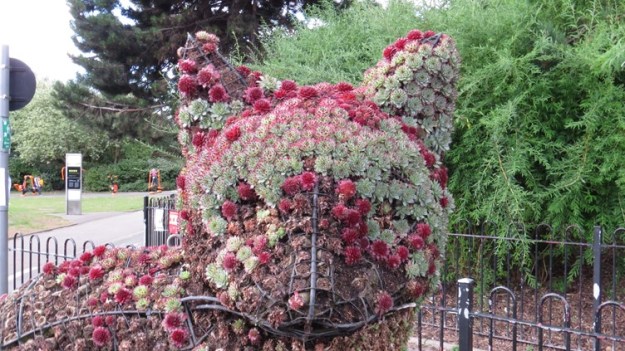
And in the middle of all this is a four-foot tall model cat, covered in sedum. This is in honour of Dick Whittington’s cat. Dick was a real person, but has become the stuff of legend. No one knows how ‘real’ the cat was, but I choose to believe in his existence, because it makes me happy to think of man and cat having adventures together.  It is said that Dick, as a very young man, fled his job as a scullion in the country and headed towards London , where the ‘streets were paved with gold’, along with his cat who was a renowned ratter.  It is from close to here that Dick, lonely, exhausted and broke,  is said to have been considering going back home  when he heard the bells of London saying ‘Turn again, Dick Whittington, Lord Mayor of London’. And so he turned and, together with his faithful cat, headed into the Capital and made his name and his fortune and did, indeed, become Lord Mayor.


What is lovely about Whittington Park is that it is a fully-functioning community resource. There’s an outdoor gym and a football pitch. There’s a nursery and a lovely playground for children. There’s a pond, where some pond-dipping was going on, and a skateboard park.

And there’s also a fenced-off area of wildflowers, which was originally an RSPB experiment to encourage house sparrows. Today it’s much used by bees and hoverflies, and also by a variety of birds who eat the seeds of the thistles and docks. In short, there is something here for everyone, human or animal, and in a very small space too. It just goes to show that wildlife-friendly planting doesn’t have to mean that the whole place turns into a jungle of nettles and bindweed.


Onwards! I jump onto a bus, and then another bus, and finally I arrive at the Barbican. This was previously another site full of red salvia and pots of agapanthus – pretty but sterile. But a few weeks ago, I noticed that it had had a makeover, so I wanted to revisit. And what a transformation it is. All of the beds at the entrance to the complex have been turned into a gravel garden. There are red-hot pokers and scabious and gaura and bee-friendly plants of many types. And it’s working! I saw honeybees and bumblebees, hoverflies and butterflies. At the moment some areas look a bit bare, as the plants are young, but I have no doubt that it will end up looking like an enormous prairie. It blends in well with the ageing Brutalist concrete towers around it, and people were sitting amongst the flowers, eating their sandwiches and relaxing. It’s a bold move to change the planting like this: some people hate the informal look of this kind of bed, and think that it seems ‘weedy’ and unkempt. So kudos to whoever did the Barbican design for sticking to their guns and not taking the easy route.


There is a place, of course, for any kind of plant design. Furthermore, it is much better to have a formal garden than no garden at all. Insects don’t much care whether your plants are native or non-native, and in a city there’s little chance that you’re destroying a pristine habitat by sticking in a couple of lantana. But looking at the drifts of flowers in Whittington Park and at the Barbican, it seems to me that with a bit of imagination we create wonderful spaces, which work for all members of the community, including the ones who aren’t human. My worry is that, with the budget cuts to local councils, the chance for innovation and creativity is restricted, even though a bee-friendly planting doesn’t have to cost more than a standard one. There is nothing like being ‘up against it’ to put a brake on new ideas, because there is no margin for error. Fortunately, these two parks already exist, and will hopefully be a beacon for other councils and other areas. What a boon it would be for all the creatures that pass through them.


Bugwoman on Location – The Last Day in Obergurgl

IMG_3586There has been much talk this week about water and boulders, so it seems appropriate that on our last day we take a walk beside the river Gurgl, as it runs from Obergurgl down to Solden. When we start the day, at the little hamlet of Zwieselstein, it’s already running along at a fair clip, full of the sediment that turns it a milky grey.

IMG_3589Later in its journey, the Gurgl turns into a category 4 white-water rafting river, but no one tries to navigate these waters. For one thing, it’s full of enormous, house-sized boulders.

IMG_3592For me, rocks like this have a kind of personality, albeit one that’s developed slowly, over millennia. This path is full of them, each with their own community of plants.

IMG_3595IMG_3596And what a cool, green path this is on a hot, humid day. I don’t know of anything else like it around here.

IMG_3598There is one tiny spot of grey beach, and someone has built themselves a little tepee amongst the boulders.

IMG_3601From the cliffs on the opposite side of the river, I see a beetle-browed face looking out.

IMG_3614

Can you see the face?

We climb up over a promontory, into an area where the sun breaks through

IMG_3637IMG_3639And then,  it’s down a hill, and back into ‘civilisation’.

IMG_3641The Rosebay willow-herb is in full flower, as perhaps it might be along the edges of Coldfall Wood.

IMG_3646And as we cross a bridge, the waters from another stream join the Gurgl – the waters run alongside one another for a while, brown against grey.

IMG_3645Here in Solden, they have a penchant for covered bridges. Some are traditional…

IMG_3643..and some are modern.

IMG_3651And, as the Gurgl runs fiercely down the valley, to meet up with the river Inn (from which Innsbruck got its name) and than the Danube, and, finally, the Black Sea, so I must say goodbye to this place, for this year at least. Our two weeks has gone just as quickly as the river has, but I have loved sharing them with you. And now, I feel the itch to be back in my own bed, with my own things around me, and to see what’s been going on in my half-mile territory. So, after the fun of flying back into Gatwick tomorrow and lumping all our luggage home to East Finchley, I look forward to reporting back with the Wednesday Weed on 22nd July.

Until then, thanks for your support!

Bugwoman on Location – Something New

IMG_3531Dear Readers, yesterday we went for a walk in the Ferwalltaller, the last of the four valleys that lay directly above Obergurgl. Suffice to say that it was very, very hot, and very steep, and we both drank a pint of Applesaft gespritz (apple juice with soda water) when we finished. But look what has arrived, in the last few days – a brand new lamb, with umbilical cord still attached. She is much smaller than all the other young sheep, so I think she was born up here.

IMG_3535I love how her legs look too long for her body, and how her mother is keeping an eye on her. I also love how these sheep follow anyone with a walking pole, in the hope of a bite of sandwich.

Mr Bugwoman pursued by sheep

Mr Bugwoman pursued by sheep

One of the sheep has found the perfect answer to overheating – try laying down in a patch of snow.

IMG_3524But, that was yesterday. Today, we decided to take it a bit easier and get the bus up to the Tiefenbach glacier. The road climbs up to 2820 metres above sea level, and passes through a tunnel blasted out of the mountain which is nearly 2 miles long. When you get there, there is a very fine carpark, and restaurant, and cable car (as usual). At this time of year, the glacier itself looks a bit exhausted and grimy. It’s the only spot in the Oetzal valley where you could still do a spot of skiing if the urge came upon you.

A bit of glacier next to the car park

A bit of glacier next to the car park

IMG_3557

The entrance to the tunnel through the mountain

We board a cable car, and head up to the top. While all these ski slopes and restaurants and car parks feel like a desecration of the mountains, you don’t have to look far to see what a tiny proportion of the Austrian Alps are used for these purposes, and how much remains untouched.

IMG_3559IMG_3558The Austrians seem to love inducing vertigo in their tourists. Well it works for me. No way I’m walking out on that thing…

IMG_3565

Just call me Wusswoman….

And for any cable car enthusiasts, here is the Top Station

IMG_3568And some cable cars…

IMG_3570So, once we’d wandered round and admired the scenery, we headed back down for lunch. I ended up with Germknodel mit vanille sauce – in other words, an enormous dumpling filled with prune puree, with poppyseeds on the top and some custard. Well, as I’m vegetarian, it was that or chips. And look at these very fine curtains, showing Alpine scenes!

IMG_3573So, we headed back down into the village of Solden, or ‘Sin City’ as it’s known in these parts due to its Table Dancing establishments (two, open only in winter) and its bars. These are something of a shock after Obergurgl, which prides itself on its clean and healthy living. Having said which, this is still rural Austria. I imagine that the goings-on are relatively tame.

A table-dancing establishment

A table-dancing establishment

A table-dancer

A table-dancer

As we sit sipping a coffee, we notice a cortage of Porsches parked up opposite.

IMG_3578The drivers get out for a chat. From here, there are only two routes – into Obergurgl (and then out again because that’s where the road runs out) or over the Timmelsjoch pass, with its 28 hairpin bends, into Italy. I imagine that they’ll be off for a pasta lunch.

Off we go!

Off we go!

I wish them luck with trying to keep their yellow/black/white/black/yellow colour order when they have to get past buses/cyclists/motorbikes on those twisty roads. Oh, and yesterday a lorry got stuck going over the Timmelsjoch so no-one could get past in either direction for six hours. The idea of driving a convertible, with the wind in your hair, and the reality of being stuck behind an articulated lorry round 28 hairpins is something to consider.

So, we head for home, and pass this sculpture, made entirely out of bits of scrap metal, outside one of the hotels.

Scrap metal Ibex

Scrap metal Ibex

IMG_3585I love the ingenuity that takes things that would otherwise be thrown away, and makes something beautiful out of them. And, as I haven’t seen an ibex on this visit, it’s good to see an  image of one.

Tomorrow is our last day in Obergurgl. How can two weeks have past so quickly?


Wednesday Weed from Obergurgl – Yellow Rattle. And a Mountain Tale.

Awned Yellow Rattle (Rhinanthus glacialis)

Awned Yellow Rattle (Rhinanthus glacialis)

Dear Readers, as I have been walking amongst the Alpine meadows here in Obergurgl, one plant has appeared over and over again – Yellow Rattle. In some places, it forms a lemon mosaic amongst the clover and the vetches and the many other flowers.

IMG_3386If it looks a little familiar, it’s maybe because the UK also has two species of Yellow Rattle, Rhimnanthus minor and Rhimnanthus angustifolius.

Yellow rattle (Rhimnanthus minor) ("Yellow-rattle close 700" by Sannse - en.wikipedia.org: 19:07, 5. Jun 2004 . . Sannse (Talk) . . 700x925 (197710 Byte) (Yellow-rattle ). Licensed under CC BY-SA 3.0 via Wikimedia Commons - https://commons.wikimedia.org/wiki/File:Yellow-rattle_close_700.jpg#/media/File:Yellow-rattle_close_700.jpg)

Yellow rattle (Rhimnanthus minor) (“Yellow-rattle close 700” by Sannse – en.wikipedia.org: 19:07, 5. Jun 2004 . . Sannse (Talk) . . 700×925 (197710 Byte) (Yellow-rattle ). Licensed under CC BY-SA 3.0 via Wikimedia Commons – https://commons.wikimedia.org/wiki/File:Yellow-rattle_close_700.jpg#/media/File:Yellow-rattle_close_700.jpg)

All of the plants look superficially like a yellow Deadnettle, but they perform a very different role in maintaining the biodiversity of grasslands, one that has made gardeners with dreams of a meadow in their front garden pay out for Yellow Rattle seeds and plug plants. For this inoffensive-looking plant is a hemi-parasite – it is able to photosynthesize, but obtains at least some of its nutrients and water from the roots of other plants.

IMG_3389Here in Obergurgl, it means that the Yellow Rattle ‘preys’ on coarse grasses, nettles and perennial weeds like dock, much reducing their vigour and giving the other plants a chance. UK gardeners are realising that it does much the same thing in their own gardens, hence the sudden market in plants. Sadly, in the wild in the UK Yellow Rattle is somewhat in decline, a victim of the prevailing attitude that the only good meadow is a monoculture.

The plant is a member of the Figwort family, which includes such diverse species as Speedwells, Foxglove and our old friend, Ivy-leaved Toadflax. Why only Yellow Rattle has taken up the parasitic lifestyle is a mystery, but it certainly increases the range of plant species here. I would be very interested to know if any of my gardening readers have tried planting it, and what the results were!

Incidentally, the plant is known as Yellow Rattle because the black seeds rattle away in the seed cases. The plant is an annual which sets seed early in the year, before the first mowing up here in the mountains, and is hence ready and waiting when spring comes round again.

Now, Readers, let me tell you a true mountain story. Yesterday, a group of walkers set out, with a long-established mountain guide, to walk the path from the Tieffenbach glacier down into the village of Vent, which is next door to the Obergurgl valley. Amongst them were the two other couples staying at our hotel. It’s a long downhill walk, across snow and sometimes ice, but this was a well-equipped group who were used to such things. To me, it sounds like several hours of hell, but each to our own. Anyhow. They started to inch along a precipitous, snow-covered pass. As one of the women walked under an eight foot tall boulder which was half blocking the pass, she slipped on some ice, slid down the hill and scraped her leg. As everyone was helping her, the next man in line passed under the boulder, touching it with his hand, and, as he too slipped and fell down the hill, the boulder, which may have been in place for thousands of years, uprooted itself and started to roll down the slope towards the man. Everyone screamed as the boulder bounced and careered towards the prone man. A guide ran down the hill, at considerable risk to himself, but with little hope of getting their before the boulder did. And then, the boulder struck a tiny rock, less than a foot high, rocked forward, rocked back, and settled in its new position, just a few metres from where the man still lay.

I heard all this from the couples at breakfast this morning. The man who fell has some cuts and bruises and a sprained shoulder, but is otherwise ok.  The woman who saw it all happen was still in shock.

“I have never been so close to a disaster before”, she said, her eyes brimming. “The stone that stopped the boulder was so tiny. We couldn’t believe it when the boulder stopped rolling. It could all have been so different. There was no way that the man would have survived if that thing had landed on him.”

And so, dear Readers, I leave you to draw whatever moral, or none, you’d like to from this tale. For me, there’s some satisfaction in the notion of a little stone stopping a great juggernaut of a boulder. But maybe that’s just me.

Bugwoman on Location – The Konigstal

The start of the path along the Konigstal

The start of the path along the Konigstal

Dear Readers, today we decided to tackle the Konigstal, the fourth of the local valleys that reach out like fingers from Obergurgl. Unlike the other valleys, which involve a climb and then a nice gentle stroll, the Konigstal involves climbing and climbing and climbing. It’s about 600 metres from where we start to where we finish, which doesn’t sound much, but doesn’t account for all the scree and snow and streams that are involved in getting to the little hut where we always collapse in a heap.

Snow lasts for a long time in the Konigstal

Snow lasts for a long time in the Konigstal

IMG_3477I haven’t seen many bumblebees since I arrived in the Alps, but today there was a little group of three  who seemed to prefer to crawl over the flowers rather than fly – at this altitude I imagine that they want to save as much energy as possible. This species is, I believe, Bombus mendax, a purely Alpine species which has a conservation status of  Near Threatened, what with climate change and the fragmentation of Alpine habitats.

IMG_3482Up and up we trudge. The mountains surround us as if we were specimen at the bottom of a bowl.

IMG_3489Can you see that tiny speck on the horizon? That’s where we’re going…

Funny how it never seems to get any nearer.

IMG_3495And the nearest place for a coffee is up there, at the Top Mountain Star cafe, a mere 3084 metres above sea level….

IMG_3494So we traverse some snow, scramble up some scree and all of a sudden it all seems doable.

IMG_3496And then, after a final push, we arrive.

IMG_3497This used to be the old customs hut, for people bringing goods from Italy into Austria. Whole herds of sheep, sometimes with whiskey bottles strapped to their tummies, apparently sneaked past this hut at dead of night without the customs officer waking up. I rather suspect that some of the whiskey found its way into the customs officer’s tummy.

And look at this view back down.

IMG_3501Glory hallelujah.

The flowers up here are the high altitude species that don’t thrive anywhere else.

Bavarian Gentian (Gentiana bavarica)

Bavarian Gentian (Gentiana bavarica)

And I was especially pleased to find these little beauties – they are Glacier Crowfoot, and can grow up to 4200 metres, so are some of the highest altitude plants in the Alps.

IMG_3509

Glacier Crowfoot (Ranunculus glacialis)

And so, it’s time to head back down. All those hard-earned metres melt away as we skip like mountain goats back down the path (or, to be more accurate, plod down with an occasional heart-felt groan). When we get down a little lower, armies of Spiniest Thistle appear, waving their ‘arms’ like miniature triffids.

Our old friends, Spiniest Thistle. En masse.

Our old friends, Spiniest Thistle. En masse.

And then, suddenly, we’re back on the main drag, walking back towards the Hochgurgl lift which will take us down for an Apfelsaft and a tea. We pass a small family group, who are conferring in German over a map. We manage to help them work out where all the paths go, but one woman holds back.

“Is it all like that?” she asks, gesturing at the path.

I realise that it probably does look rather daunting, as these things often do before you actually do them.

“About twenty-five percent of it is a little bit scary”, says my husband, “but the rest is fine”.

“It’s very beautiful”, I say.

“But I’m very scared”, she says.

And what can anyone say to that?

“I’m sorry,” I say. “I understand”.

And we turn away, to let them make their own decision. When we look back, it seems as if the father and one of the children has gone down, and the mother and another child, who is complaining bitterly, is heading back to the lift.

It’s so hard to beat our fears, sometimes. There are walks here that I certainly wouldn’t do – walks that are too exposed would not work for me. We all have our particular red lines, and this poor woman must have reached hers. Maybe she will gain in confidence over her holiday, but today this was just a step too far.

As we cross the last meadow, I notice a butterfly, and realise that it’s that great traveller, the Painted Lady. It’s already crossed the Atlas Mountains, and now it’s giving the Alps a go. How can such a fragile creature be so resilient, and so determined?

Painted Lady (Vanessa cardui)

Painted Lady (Vanessa cardui)

The underside of the wings is almost as beautiful as the top.

The underside of the wings is almost as beautiful as the top.

And as we reach the lift, we pass a very interesting character.

The scariest water trough in the valley

The scariest water trough in the valley

The Tyroleans have a very singular sense of humour that often falls over into kitsch. But there is often a dark side too – I have seen several water troughs carved into faces, and the people here seem to love witches on broomsticks, dwarves, gnomes, and other such folk. This chap looks rather menacing to me, with his staring eyes and gaping mouth.  I think I might wait till later to get some water, thank you.