Category Archives: Bugwoman on Location

Bugwoman on Location Day Seven – A Few Recommendations

Looking seawards along the Cannaregio canal

Dear Readers, just a few thoughts and recommendations from our trip to Venice. Firstly, stay in Cannaregio if you can! It’s close to the railway station and Piazzale Roma (which is where the buses from the airport arrive) but it’s still very much a neighbourhood, with easy access to all the usual tourist sites, on foot or by Vaporetto.

The Al Parlamento bar and restaurant has become a regular watering hole – tourists, locals, professors and students from the University and workmen moving stuff about on the boats all pop in. Plus the flatbreads and coffee are fab, and they will serve you an Aperol Spritz at 8 a.m. if that’s what you fancy. It’s right on the main Cannaregio canal, and it’s great for if it’s cold and raining and you need cheering up.

On the other side of the canal from Al Parlamento is MQ10, which I think of as more of a nice summer day breakfast place – you can watch all the life on the river, and the coffee is great. Pretty terrible reviews on Tripadvisor, but we didn’t have any problems. I think folk sometimes forget that these are largely neighbourhood bars, and the service isn’t always as snappy as it might be in some chain restaurants.

MQ10

If you fancy somewhere a bit fancier for a prosecco, the Radisson now has a converted palazzo very close to the Guglie bridge. The room rates at this time of year are eye-watering, but it’s fine for a mint tea or a cocktail if you’re feeling flush.

For our one special dinner (John’s 60th birthday for example) we like this place on the Fondamente della Sensa – Osteria Anice Stellato. Booking essential though…The menu is largely fish and vegetarian. The chocolate and pear cheesecake is a real winner!

For something a bit different from the usual Italian/Venetian food, I recommend Gam-Gam, a kosher restaurant right on the edge of the Ghetto. It serves great shawarma and hummous and falafel, and the apple cake is another highlight (can you sense a theme here?) It gets very busy, so again it’s worth booking.

And here is our favourite café on Campo Santa Margherita, over in Dursoduro. It looks out at the fish stall (and all the seagull-related excitement as they steal whole slices of pizza from unsuspecting tourists), it doesn’t serve food until midday, even though there is food at the bar, and it is one of the best places for people-watching in the sestiere.. In short, if you want to while away a few hours before your next museum. or the long trek home, this is a great place. Just keep an eye on your pizza.

Restaurant Margaret Duchamp at 3019 Dursoduro

Bugwoman on Location – The Scuola di San Giorgio degli Schivoni

San Giorgio degli Schiavoni (Photo by By Didier Descouens – Own work, CC BY-SA 4.0, https://commons.wikimedia.org/w/index.php?curid=19834519)

Dear Readers, Venice has a long history of immigration, particularly of skilled craftsmen from other parts of Europe. In the fifteenth century, sailors and workers from recently-conquered Dalmatia, known as Schiavoni, decided to form a fraternity or guild to support one another, and they bought an old hospital as the base for their school. They asked a young artist, Vittore Carpaccio, to produce some paintings based on the lives of their patron saints: St George, St Tryphon and St Jerome, and so he did. The result is probably my favourite place in the whole of Venice. There is something about these paintings that I find intriguing, and sometimes moving.

The Scuola is one of the few places in Venice that still doesn’t take credit cards, but fortunately we had some cash, enough not only to pay for the tickets but also to buy a guidebook, which I’ve been meaning to do every time I’ve visited for the past fifteen years. The woman behind the desk spoke Italian, English, German and French, and was obviously in love with Carpaccio – she whispered that her name was the same as that of Carpaccio’s mother. In between juggling languages and dishing out change, she ran around the building keeping an eye on a young family. The smallest child was cheerfully opening the drawers of a fifteenth century cabinet and nearly pulling it down on top of him while his mother wandered, oblivious.

Since I was last here in 2016, several of the paintings have been restored, and you can really see the details once again. First there are three paintings of the life of St George. First up, as you might expect, he’s killing the dragon. Note the many body parts laying about on the ground. If you look very closely, you can see various toads and frogs and other creeping creatures.

San Giorgio e il drago (1502)

In the next painting, we see St George bringing a much-diminished dragon into town for everyone to admire.

In the third St George painting, the people in the second painting are so impressed with St George and his taming of the dragon that they convert to Christianity. You can see a turban laying on the steps at the front of the picture.

The Baptism of the Selenites (Carpaccio, 1507)

Then there’s a painting of St Tryphon extracting a demon from the daughter of the emperor. The demon is known as a basilisk, and here looks rather like a cross between a donkey, a pigeon and a lizard. St Tryphon was the patron saint of the town of Cattaro on the Dalmatian coast.

St Tryphon and the Basilisk (Carpaccio, 1507)

My very favourite paintings, though, depict the life of St Jerome. One of them is away for restoration at the moment, but it shows St Jerome with a lion that arrived at the monastery. The other monks very sensibly ran away, but St Jerome greeted it as a guest and discovered that it had an injured foot, which he treated with ointments. The lion then lived amongst the brothers as a companion. In the painting, I love the way that the monks are fleeing with their habits flying, like so many birds.

St Jerome and the Lion (Carpaccio, 1502)

In the next painting, we see St Jerome’s funeral. Whereas the one above is all movement, this one is all stillness and contemplation.

The Funeral of St Jerome (Carpaccio 1502)

And then there is this. I wrote about it a few days ago: it shows St Augustine in his study at the moment when he is ‘visited’ by a vision of his dear friend St Jerome’s death. When I see the real painting, there are so many details that are astonishing, and unlike any of Carpaccio’s other paintings here – the realism of St Augustine’s half rising from the table, the way the little dog has sat back on his haunches as if stunned by the light. This is Carpaccio’s masterpiece, for me.

St Augustine in his study (Carpaccio, 1502)

And one last thing. At the bottom right of the painting there are two sets of musical notation. Following the restoration of the painting, there have been a number of attempt at actually bringing these to life. The one below is a choral version, but my new best friend, the curator, had a piano version which she played for me. It matches the mood of the painting perfectly, and I can’t help but wonder if viewers of the painting would have heard the music in their heads, or if there were ever musical performances around the work. This extract is from here.

And so, it was goodbye to the Carpaccios (though we’re hoping to get to the Accademia tomorrow to see some more). Incidentally, a ‘carpaccio’ of meat was named for the prevalence of red in many of Carpaccio’s paintings, which makes a bit of a nonsense of the idea of a ‘carpaccio’ of melon or kiwi fruit or any of the other versions that are around.

Heading home, it’s clear that the Aqua Alta is reaching its height – tomorrow we’re expecting 125 cm, which means that there will definitely be some flooding around here at about lunchtime. And there’s a vaporetto strike! And some thunderstorms! Looks like our trip will end with a bang. But in the meantime, here’s a little egret, making the most of whatever the tide brings in. Note those sweet little yellow feet. S/he could do ‘jazz feet’ in a Bob Fosse movie any day of the week.

Bugwoman on Location Day Four – Giudecca and the Redentore Church

View from Giudecca

Dear Readers, it’s fair to say that we’ve probably had the best of the weather for this week – today there’s a bit of mizzle, but we’re promised downpours tomorrow, and thunderstorms on Friday. In addition, there’s a transport strike on Friday which means some vaporetto lines will run and others will not, in a Byzantine combination of times and conditions that even I am having trouble intrepreting. Never mind! We shall make the best of it as always, and Venice is such a walkable city that a little bit of vaporetto/weather-based inconvenience will be as nothing.

Today, we crossed the lagoon on the number 2 vaporetto to have a wander around in Guidecca, a long, thin strip of land which is actually about a dozen tiny islands, each joined by bridges. First up was a coffee in the Hilton Hotel, which is based in the old Stucky flour mill which has dominated this part of the coast since it was built between 1884 and 1895. Stucky was a Swiss businessman who made his fortune in flour and pasta – the mill was steam powered and pumped out ridiculous quantities of both commodities. Stucky was rich enough to buy the Palazzo Grassi as his home in Venice, and was the richest man in the city. Alas, in 1910 he was murdered at Santa Lucia station in Venice by a former mill worker with mental health problems. Today the building is a very fancy hotel, with a shop that sells Rolexes and its own water taxi landing stage. It’s glitzy but strangely un-Venetian – you could be at any five-star hotel anywhere in the world, in spite of the extraordinary location. What happened to vernacular, and to quirky?

The new Hilton Hotel in the Stucky flour mill

By now the water is slopping over the dock, and I see that high tide will bring the water up to a maximum of a metre, which means some places will be underwater. But here on Giudecca we seem to be mostly ok, provided you walk away from the edge.

It seems that the weather is very tough on the street trees here though, what with all the inundation in salty water and the wind. The tamarisk below is definitely the worse for wear.

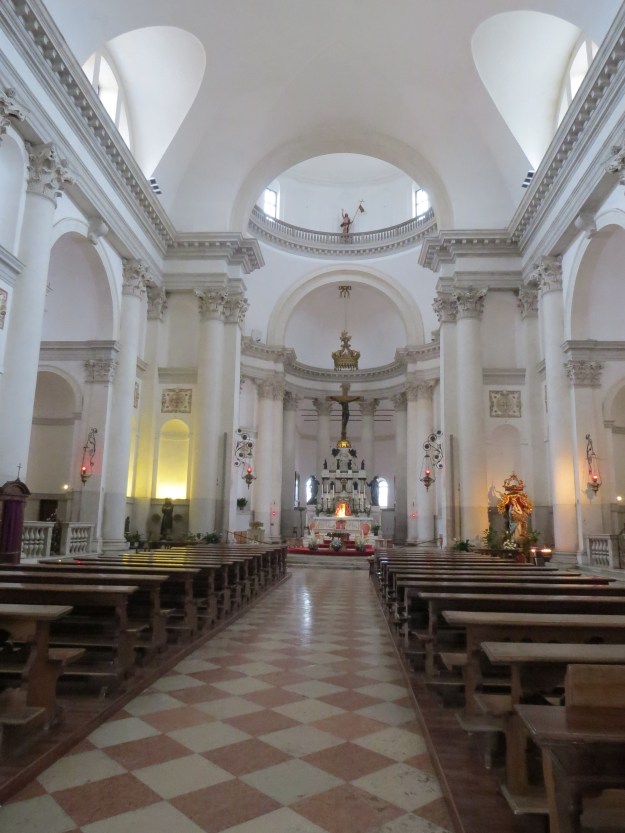
And then it’s off to the Il Redentore church, which was built to a design by Palladio and was consecrated in 1592. The church was built to give thanks for deliverance from the plague that raged through Venice in 1575/6, killing 46,000 people (about 20 % of the population). Whenever I think about how crowded some streets are it puts me in mind of what it must have been like to live here during this time.

The church was taken into the care of Capuchin monks after its consecration, and one of their conditions was that they could receive no profit from looking after the building. This meant that rich people could not pay to have elaborate tombs built here, and the monks could not spend their time praying for their souls. What this has meant in practice is that the church has been preserved pretty much as Palladio intended, without the Baroque flourishes that decorate so many other Venetian churches. There is a single nave with three chapels on either side depicting scenes from the life of Christ.

There is an ornate-ish altar, and a round dome.

During the third Sunday in July the Festival of the Redentore takes place, with a pontoon bridge constructed from Zattere on the other side of the Giudecca canal to the church. The Doge and the Senators used to walk across this bridge, which was originally constructed from boats, and would go to Mass in Il Redentore. The Festival is still a huge celebration, with a massive firework display, after which young Venetians head off to the beach at the Lido and wait for dawn. That must be something to see but strangely enough it doesn’t make me want to be in Venice at the time – too many people, too much noise and hubbub. The Venice that I love is a place of misty early mornings, quiet courtyards, narrow streets and people going about their day-to-day business. But then, the city has always been all things to all people, and I suspect that everybody has a ‘real’ Venice all of their own.

Side canal in Guidecca

Venetian Ducks!

More Oleander

Bugwoman on Location Day Three – Dursodoro

The old Stucky Flour Mill in Giudecca (now a Hilton Hotel)

Dear Readers, I love exploring the lesser known parts of Venice – they’re quieter than the main St Marks/Rialto route march, and they tend to be places where Venetians still live and work. Today, we had a wander around Dursoduro, which is home to the Gallerie d’Accademia, probably Venice’s most famous art gallery, though the weather was so glorious that we stayed outdoors for most of the time. This part of Venice was the first to be colonised (once the Venetians had moved on from the island of Torcello, which is truly the birthplace of Venice), and the name ‘Dursoduro’ means ‘hard back’ – the land was much less marshy than in other places.

I love just walking alongside the water here, gazing over at Giudecca and admiring the oleander. The super yacht in the first photo is the Lady Marina, owned by Sergio Mantegazza, owner of Globe Travel. He is worth $3 billion, and the yacht cost a mere $50 million. How the other 0.5% live, eh.

Canalside walk with superyacht (the Lady Marina in case you’re interested)

Oleander tree – my goodness, just look at the colour of that sky!

The ever-present herring gulls (of which more later) are using one of the super yacht moorings as a place to rest (and would probably nest there given half a chance).

We are on a mission, though, to find the Campo St Margherita. I’m not quite sure why we love this square so much, but one reason is definitely the people-watching. We settle down at a table outside our favourite sandwich bar, and the elderly man a few tables over starts singing in Italian with his friends. The song mentions ‘Venezia’ and ‘St Marco’ and so we assume it’s a local ditty. When he finishes we all clap, which encourages him to greater and greater efforts. More people sit down, most of them with very small fluffy dogs – pomeranians seem like particular favourites. We are close to the university, so students sit earnestly at another table, discussing ideas. Remember when we used to be earnest and discuss ideas? More of this, please. Several people are pushing wheelchairs, containing husbands or wives or friends – Venice is a difficult city for people with limited mobility and I can’t begin to imagine how they manage, although the chance to sit in the sun with an Aperol spritz and discuss the state of things with passing friends and neighbours must make up for a lot.

In front of us, on the left, is the fish stall, which has been here every time we’ve visited. Eager seagulls wait on the roofs of the adjoining buildings. The fishmongers stand behind the stall, gutting and chopping up fish, including a large swordfish, and the gulls wait their chance to steal some guts or a fish head, while their youngsters urge them on with those high-pitched musical cries that seem so out of place coming from such a large bird.

I am not sure what the small shaggy shrub in the photo below is, but every dog that passed decided it was an ideal place to lift a leg.

The building below is very handsome, but has been falling gently into disrepair over the past twenty years. When you see the prices of property you can see why Venice is in crisis – who can afford 380k euro for a one-bedroomed flat?

Across the Campo, there’s the deconsecrated church of St Margherita. The bell tower lost its top in 1808 when the structure was declared unstable, and the whole building is now an auditorium for the local university. I have a suspicion that while most of Venice is actually a very sleepy place (you could hear a pin drop around Cannaregio after 11 p.m.), this square is probably lively until the wee small hours.

Now, I assumed that the statue in the recess above the door would be St Margaret (the church is named for St Margaret of Cortona, whose lover was murdered and who subsequently became a nun, like you do) but as this is clearly a chap, and he’s standing on a crocodile, I suspect that he’s St Theodore, who is also represented on one of the plinths outside St Mark’s Square. The crocodile is meant to be a dragon, who was slain by the saint. St Theodore was patron saint of Venice until he was displaced by St Mark and his winged lion. No wonder he looks fed up.

St Theodore outside the church of St Margherita

St Theodore on the plinth at St Marks

But as we head back towards home, as usual it’s the quirky things that catch my eye. For instance, is this sign, seen in a shop selling Venetians prints from the 1930s, an instruction or a warning? Incidentally if you still fancy a cappuccino and it’s past twelve and you don’t want to look like a tourist (hah! As if we can avoid looking like tourists) you can order a latte macchiato instead.

And lots of the shops are closed because there’s going to be a power cut (especially pertinent as my husband is, he won’t mind me telling you, an energy-nerd, and it’s his sixtieth birthday today)

And how about this, in a used bookshop? I have certainly met plants who are more useful than some people, what with them sequestering carbon and producing oxygen and all, but this does seem a little harsh.

And then we get to a place where the canal does a sharp left turn, and I couldn’t resist recording a little piece of the goings on for you. I love the tourist gondola, the water taxi and the boat carrying a collection of chairs all trying to negotiate the corner.

And finally, we get to the bridge which crosses the Grand Canal close to the main train station, and I can’t resist taking a photo in each direction. We usually manage to avoid the number one vaporetto which plies its slow and crowded way up and down the Grand Canal, but only because we’ve already done it once. What an extraordinary water way this is! It makes me a little sad to consider how underused the Thames is now, although in its heyday it would have been extremely busy.

The Grand Canal looking towards St Marks

The Grand Canal looking towards Piazzale Roma, with the Ferrovia (the 1930s railway station) on the right.

A Visit to Mum and Dad, and the Dreaded Blandford Fly

Dear Readers, every time I come to visit Mum and Dad, I find myself in a flurry of activity – pulling up long grass, getting rid of plants that haven’t made it, trying to clean up the stone plaque (though I definitely need to speak to the stonemasons about the best way to clean it up – I don’t want to pollute the surrounding area with caustic chemicals, but I do want to be able to read their details). Then there’s the putting the old plants on the compost heap, getting rid of the dreaded plastic pots, positioning the new plants, and finally I slump under the cherry tree and feel a great sense of peace descend. This really is the most serene spot. All you can hear is the cooing of woodpigeons (plus the occasional ‘clap’ as one of the males demonstrates his strength by ‘clapping’ his wings at the top of a rollercoaster flightpath), the chinking of the many, many house martins, and the wind in the yew trees. I bring Mum and Dad up to date with my latest news – my retirement, all the medical tests that I’ve had since I ‘saw’ them last. I find myself telling them about my heart valve defect, and telling them not to worry. When I mention my retirement I can almost hear Dad saying ‘What took you so long?’. It might seem funny to talk to people who are dead, but I also know that I’m far from being the only person who does it.

I take a walk to see how my favourite lime tree is getting on (it was blown down in a storm last year), and it seems to be doing fine. It will take many years to reach its former splendour, but I love that it is hanging on.

The lime tree today

The Lime Tree in its full splendour

Now, when Mum and Dad first moved to Dorset I remember Dad telling me to be very careful that I didn’t get bitten by ‘the Blandford Fly’. How I laughed! However, following my walk down by the stream yesterday I have picked up about five nasty bites, and although I suspect that they’re merely mosquito bites, I have been casting my eye over information about the Blandford Fly, and I think that I owe Dad an apology.

The Blandford Fly (Simulium posticatum) is a species of blackfly which lives as a larva in the weeds alongside slow-running rivers. When the females emerge, they, much like midges, require a blood meal in order to for their 200-300 eggs to mature. Along comes a handy human walker or angler or someone wearing shorts and the fly is in heaven. The bites seem to be particularly irritating and painful, and because of this are prone to becoming infected. In the worst case people are hospitalised, and the name ‘Blandford Fly’ comes from an outbreak in the 1972 when over 600 people were so badly affected within a four week period that they needed treatment at the doctor or their local hospital.

At first (as was always the case), the treatment was to spray the riverbanks where the larvae lived with a chemical biocide. This resulted in the death of many other species of blackfly (important for fish and for other invertebrates such as dragonflies) and a disruption to the ecology of the river. However, in the 1980s another way of doing things became available. River ecology expert, Dr Mike Ladle, suggested that a newly-discovered bacterium called Bacillus thuringiensis israelensis (found in the Negev desert in Israel) could be used to target the Blandford Fly specifically without endangering any other species. The river was first sprayed with the bacterium in 1991, and Dr Ladle suggests that  ‘this is probably the best example of the use of a biological agent to control a pest, in an ecologically friendly fashion, anywhere in the world.’ It does seem to have been a remarkable success – in 1980 there were 1400 recorded cases of bites, but by 1999 it was down to 45 cases. 

All the more reason, then, for alarm in 2014 when disagreements about who should fund the spraying, and new EU legislation about licences for river treatment meant that the bacteria might not be used in time for the emergence of larvae in 2015. An 80 year-old Blandford resident, Pat Ashworth, went shop to shop, street corner to street corner, with an old-school petition, and managed to get nearly 2500 signatures to say that the treatment must go ahead. I suspect that many Dorset towns and villages are basically run by feisty retired ladies who won’t take no for an answer, and more power to them (and I also suspect that this phenomenon is not limited to Dorset).

Ashworth was obviously worried about people getting sick, but she also had other concerns. Hospitals and GP practices in the West Country are under a lot of pressure in the summer due to the influx of tourists, so bite treatment would be one more thing. She also cited the name of the Blandford Fly as being a deterrent to tourists, and suggested that it could just as easily be named ‘the Wimborne Fly’, passing the blame on to another Dorset village. She was absolutely right that the fly was present along most of the river Stour downstream of Blandford, so there are a number of other towns and villages that are affected.

Spraying with the bacterial agent recommenced in 2016, so at least in Dorset the risk of a nasty bite is much reduced. However, the fly is spreading, with cases in Herefordshire and Oxfordshire, and I note with some interest that ‘garden water features’ are thought to be a factor. Well, as the insects require slow-running rivers I suspect that the average garden pond can be exonerated. Always beware of articles on invertebrates in the local and national press, these guys frequently illustrate articles about bees with hoverflies so we can assume that the level of entomological knowledge is not what it might be.

I think we forget that although the UK isn’t tropical (yet) we do have all manner of biting insects, from your average mosquito to the terrifying midges of the west of Scotland, to cleggies in Devon and horseflies more or less anywhere. As I’m sure you know, it’s the anti-coagulant that the insects inject when they bite you that is the main irritant, and if you can avoid scratching you will greatly reduce the risk of infection. I generally use a hydrocortisone cream for a brief period until the itching subsides (calamine lotion can also work and is safer). If I fear that the irritation will keep me awake I might also take chlorphenamine maleate (the active ingredient in Piriton and many of those other antihistamines) but again just for a day or so. Comfrey ointment and comfrey tea have also been recommended to me, and the ointment certainly works. I’m always open to hearing about things that work for bites, as all manner of invertebrates seem to love me just as much as I love them, so fire away!

And just for the record, as Blandford flies normally bite the lower leg, and are most active from May to June, I am pretty confident that my bites are just from a mosquito, and that they’ll be sorted out within a few days. But apologies to Dad. The Blandford Fly does appear to have been a menace historically, even if it is now more of a minor nuisance.

Incidentally, Woodhouse and Hall, the local brewery, created an ale called Blandford Fly, flavoured with, among other things, ginger, which is said to be a helpful treatment for a bite. I do love how something so unpleasant can be turned into a marketing opportunity.

The story of the Blandford Fly (with a rather unnecessary dig at EU ‘bureaucracy’ ) is here. There are some photos of the redoubtable Pat Ashworth too.

Return to Dorset

The streamside pathway in Dorchester

Dear Readers, as you might remember my Mum and Dad’s ashes are buried in the churchyard of St Andrew’s church in Milborne St Andrew, a small village just outside Dorchester. So, three or four times a year I go to visit them, to tidy up the grave and to tell them what’s been going on. It might seem silly, but it gives me comfort to bring them up to speed with the news, and to let them know that they’re not forgotten.

First, though, I spend the afternoon and evening at Westwood House, a guest house in Dorchester. It was recently taken over by a new couple, Jocelyn and Karl, but the welcome, the breakfast, the rooms and the hospitality are just as good as ever. Plus, there was a new little visitor in the room.

This little cricket/grasshopper was a very determined critter. Before I went out for a walk, I managed to catch him/her, and put them outside on the balcony.

“There”, I thought, “That’s that”. But when I got back after a trot along by the stream (of which more later) there s/he was again. I caught them and put them out for a second time.

And then today, there they were again. Clearly I needed to translocate them to some better environment. But how? I used the wooden carved box that was in the toilet, but the cricket got out of the carved holes at the top and sat there grinning. Then it jumped onto the floor. Eventually I caught it in yet another box, and this time I managed to find a nice grassy area on a tiny alleyway where there was hopefully lots to eat and plenty of other little crickets to play with.

If it turns up again tonight I will be completely freaked out.

Anyhow, off I went for my usual walk, down to the stream and past the allotments and the little nature reserve. I spent a lot of time watching for fish: there were lots about (as two anglers would seem to indicate) but I couldn’t quite catch them in a photo. Here, to get you in the mood, is some water weed though. I always find it very relaxing to watch.

And just look at this. This is a male Banded Demoiselle, the only UK damselfly with a parti-coloured wing. They are found in lush vegetation alongside rivers and streams, and the females (who are metallic green or bronze, with a white spot on their wings) lay their eggs by injecting them into the stems of fleshy plants. What beautiful insects they are, especially earlier in the year where the males display by fluttering those black and blue wings.

The allotments are looking great too. Someone is obviously very keen on marigolds, which are excellent companion planting and good for pollinators too!

And someone has a fine crop of sunflowers too. If the heads are left, the goldfinches will have a feast later on.

And then it’s time for a little wander through the nature reserve. During the winter the boardwalk can be inundated with water from the local streams, but it’s much drier in the summer. You can almost guarantee that as you round the corner, someone will be sitting at the picnic table smoking ‘something or other’ but on one memorable occasion a few Christmases ago, it was two teenagers, one in a lion onesie and one dressed as a cow, both high as kites and giggling furiously. Well, I suppose it was the festive season.

The streamside pathway in Dorchester

This time it was just one guy with earphones looking pensively over the field, so I left him to it, and went on to admire the mass of Himalayan Balsam that has grown up in the past few months. What a pretty plant this is, and what a pain – it’s very clear that it’s taken over half the reserve, and will be taking over the whole thing if a way to contain it isn’t found.

Still, it was a fine walk, and it’s one of the reasons that I love Dorchester – unlike so many towns, it hasn’t been ruined by generic developments, and has managed to hold on to many of its historic buildings. It’s clear, however, that the pedestrianised High Street is travelling, with many shops shuttered. Marks and Spencer pulled out a few years ago, and with it went the underwear and socks of the people of Dorchester, not to mention the ready meals and the rhubarb yoghurts. Still, it looks as if the building might be turned into a spot for ‘mini shops’, for people who can’t afford the high local rents. What a great idea! I shall be interested to see how it plays out.

Obergurgl Day Six – The Rotmoos Valley

Dear Readers, after a week of not feeling very well and having weather that was thundery and grey, today dawned in perfect walking weather (sunny but not too hot) so we pounded up the steep service road towards the Rotmoos valley. This is one of my very favourite walks in Obergurgl – at the start of the walk there’s the Schonweissehutte,  which was renovated a few years ago but which still serves a decent goulasche soupe.

From here, you edge past the reservoir, with it’s rather confusing warning sign. I imagine it freezes in winter, so maybe it’s a warning to intrepid skaters that this might not be the best spot. If anyone reads German, feel free to correct me.

Then it’s off along the path towards what’s left of the Rotmoos glacier. In 1872 it came to the location of the boulder with the red and white stripes in the photo below. Today, as you can see, it’s barely there at all.

So this adds a sombre note to this bright and shiny day. I remember the glacier being much more developed when I first came here in 1994. It’s shocking to see how diminished it is. The University of Innsbruck has one of the world’s most important centres for the study of glaciation, and the weather station in the valley has been here since the 1930s, continually recording data.

The weather station

But still, the flowers and the insect life here are absolutely stunning. I saw my very first gentians of the holiday…

This orange plant looks rather like our Fox and Cubs, but is a closely-related species, known here as Golden Hawksbeard (Crepis aurea).

There is the delightfully-named Crimson-Tipped Lousewort, a member of the Figwort family…

…Kidney Vetch, which we have in the UK, though I’ve never seen it in such profusion…

There are no true ‘trees’ at this altitude, but there are these little prostrate willows (Salix retusa), who survive in the poor, thin soil.

Further along the path there’s Moss Campion (Silene acaulis), hunkering down close to the ground to survive the cold and the scouring wind (even today there was a chill breeze blowing from what’s left of the glacier). The Alps are a paradise for members of the Pink family, I must have seen at least eight species.

And there’s some Round-Headed Rampion (Phyteuma orbiculare), another plant that I associate very strongly with Alpine meadows.

We were surprised not to see any marmots, though there were a few whistles from the other side of the valley. But there was this female Northern Wheatear with a beak full of bugs – clearly she has a nest somewhere near, and kept a very close eye on us. The birds spend the winter in Africa, but in summer they spread out across the rocky places of Europe. Here in Austria they often make their nests in disused marmot burrows. I’d never been able to identify these birds before, so it was lovely to be able to do so with the assistance of the European Bird Identification Facebook page.

And of course, the paths are full of butterflies and moths. Have a look at these blue butterflies, feeding on a patch of earth that I suspect had been peed or pooed on by some passing creature, leaving behind minerals that the insects needed.

And then, there is a sight that has lifted my heart every time I’ve visited Obergurgl. The local Haflinger horses spend the summer in the meadows around the village, pleasing themselves about where they go and when, and only coming back to their stable if they sense an oncoming storm. They are all palominos, and are led by an experienced mare who knows the territory and calls the shots. I honestly believe that they are some of the most beautiful horses on earth. Once I’ve seen them, I know that I’m truly back in the Tyrol.

Obergurgl Day Two – Zwieselstein to Solden

Dear Readers, our go-to walk when we first get to Obergurgl is to get the bus to Zwieselstein, a little village located at the pinchpoint between the Obergurgl and Vent valleys, and to walk into Solden. It’s only a few miles, but it takes us alongside the Gurgl river and through the pine forest, so it’s cool and undulating without being too challenging. First up, though, we get off the bus a stop earlier than we should have (as usual) and so we walk past the eighteenth century church known as the Maria Hilf Kapelle. You can see the onion-shaped spire in the photo  below.

Then we come to a covered bridge dating from 2006. They definitely like a covered bridge around here.

I love all the wood piled up for the winter. The whole of Obergurgl is now powered by a district heating system using wood – previously many buildings were oil powered, which involved tankers travelling huge distances to get to the village. While I’m not overall keen on biofuels, they seem to make much more sense here, where there’s wood in abundance, than in many other places (like the UK for example, where the Drax power station uses wood imported from North American old-growth forests). Let me know how that’s sustainable.

But enough, I’m on holiday!

There is a very nice drinking fountain close to the main hotel, and I notice how the various ‘weeds’ prefer the splash zone. Very sensible.

Then it’s on, into the woods…

Alongside is the River Gurgl, milky with glacial run-off and looking quite the challenge for anyone into white-water canoeing or rafting. There are enormous boulders the size of houses, a testament to the power of wind and water over time – there are several huge areas of landslip too.

Some of the boulders are ecosystems in their own right, covered with moss and lichen and Alpine plants such as houseleeks.

There are a few patches of yellow foxgloves (Digitalis luteum) here too.

Then we suddenly come out of the wood and onto the long tarmac road into Solden itself. En route, we pass one of my favourite chalets – the front garden is always full of eclectic sculpture and it’s interesting to see how it’s changed since our last visit four years ago. I wonder if it’s a change of ownership, or just of taste?

Garden in 2023

Same garden in 2019!

Then it’s down into Solden while we consider whether to head up to the top of the Gaislachkoglbahn lift. Our Oetzal card (free to all visitors) gives us one up and down trip on each lift in the valley everyday, and as the weather was clearing we thought it was worth a shot.

Underneath the lift here’s a mountain-bike trail which is immensely popular with young cycling enthusiasts, though it looks pretty hair-raising to me. Cyclists load their bikes into the cable car and go to the first station (2176 metres) and then career all the way down again. I am always impressed at their daring, while being a little worried about what happens if you come off your bike midway down the trail.

The Gaislachkoglbahn heading up the mountain.

Anyhoo, we get to the first station without too much excitement. For the second leg (up to 3,040 metres) we share a gondola with a German family, where the Dad is clearly nervous and spends the entire 15 minutes joking about how much fun it will be if we plummet to the ground. I am glad that my German isn’t any better. I have noticed though that when people are afraid they often talk inanely about the very thing that they’re frightened of, so I have some compassion. It’s nice to get a gondola to ourselves when we go back down, nonetheless.

The view from the top is spectacular.

And for this trip at least, we resist the charms of the Ice Q Bar and Restaurant,  which featured in a James Bond movie ‘Spectre’ (and indeed there is a James Bond museum at the top). I’m sure we’ll be back for strudel and an eiscaffe later in the trip though. During the winter you can have dinner at the restaurant on a Wednesday evening, but they don’t do it in the summer. Harrumph.

The Ice Q Bar and Restaurant

And just to remind us that it’s not all fun and games in the mountains, there’s a rescue helicopter zooming about, and the lift complex is halted for a few minutes.

And then it’s time to head back down for lunch in the village. Of all the lifts that we use, this one has the most precipitous drop from the top station – it feels as if you’re thrown over the edge, which is quite unnerving. Just as well we can have a small scream in our empty gondola without disturbing any children or others of a nervous disposition.

Around the University of Toronto

Dear Readers, such was my yearning for green space today that my husband  suggested that we have a little walk around the campus of the University of Toronto. We got off at the Museum subway stop, where the boring old pillars have been replaced by Indigenous North West figures, like the one above, Doric columns (below)

…hieroglyphics…

.,…the Egyptian god Osiris…

and a Toltec warrior.

…all in honour of the Royal Ontario Museum upstairs. It makes a change from the boring tiled pillars in other stations for sure.

Upstairs we pass some of the University buildings, and I notice a preponderance of what I think are hostas. Holy Moly! Don’t Canadians have slugs and snails? Every time I’ve tried to grow these plants they’ve been reduced to a sad nibbled stem within a week, and yet here they look splendid. I do hope they aren’t using slug pellets.

This is the Law School, and very splendid it is too. I was discussing how I’d found the law module of my accountancy qualification the most boring part of the whole thing, and was wondering why, when generally I like subtle distinctions and problem-solving. Maybe it’s because it was accountancy law and not something juicier.

The Law School

There’s a striking new extension too.

The Jackman Law Building

Right opposite is a largish park, and the inhabitants clearly like to pop over to the University in search of easy pickings. My husband says that the squirrels on campus are notoriously friendly, and certainly we were approached several times by rodents with hopeful little faces.

Plus there are lots of North American robins, sparrows, starlings, cardinals and even the odd red-winged blackbird.

North American Robin

My husband’s aunt Rosemary was Head of Food Services at Hart House, which is part of the University campus, and which hosted a dinner for the G7 back in the day with Reagan, Thatcher and Helmut Kohl. John used to spend many hours in her office when things weren’t going well: Rosemary was one of those people who are a kind of compass point, someone that you turn to and know that they will be there. This ‘holiday’ has been particularly tough for John, what with his aunt now being dead, and his mother slipping ever deeper into dementia. But at least here it’s easy to remember Rosemary.

The window of Rosemary’s office at Hart House

The sports field has been astroturfed. You can imagine how delighted I am.

But there are still lots of pockets of green, and I can feel myself relaxing as we walk through them and past them. The bulbs are coming up, the trees are coming into leaf, and spring is definitely on the way.

Plus, look who’s arrived to take advantage of all that lush green grass! It’s unusual to see a goose all on their own – maybe this is a young-ish individual, as by the age of 3 they’ve usually paired up, and will stay with their mate for life (20-25 years). Or maybe the goose’s partner is nearby but hidden away. At any rate, in about a month there will be dozens of goslings about, and then we’ll know that summer isn’t far away.

Around St Lawrence, and a Patch of Green

St James's Church, Toronto

Well Readers, it’s another murky day here in Toronto but spirits are high because the local ice hockey team, the Toronto Maple Leafs (sorry about the incorrect plural but hey, I didn’t invent it) have won in the playoffs against Tampa Bay Lightning and are through to whatever happens next for the first time since 2004. There was so much blowing of car horns and cheering and general carry-on last night that I was delighted that we were on the 20th floor, but it’s nice for people to have something to celebrate, even though the sport is something of a mystery to me. All I know is that it seems to involve a lot of padded clothing and people whacking one another with sticks. In the next round the Maple Leafs appear to be playing against either the Bruins or the Panthers, so I expect a lot more excitement next week.

Today, one of the lifts at the hotel was out and the place seemed to be packed (mainly with people watching not only the ice hockey but the baseball (Toronto Blue Jays in case you don’t know, as I didn’t). When we got on, there was a chap wearing only  shorts and a towel who’d been to the sauna upstairs and was attempting to get to his room on the eighth floor. The lift stopped at every subsequent floor until we packed to overflowing with suitcases, children, sports gear, backpacks and various other paraphenalia. By the time we got to the eighth floor the poor semi-clad guy was looking more flushed  with embarrassment than I imagine he’d been in the sauna. We all tumbled out on the ground floor looking very dishevelled.

And then it was off into the rain. We were heading for the antiques market at St Lawrence, but first we passed the third of the great yellow stone churches of Toronto, the Cathedral of St James. I rather liked this photo of it caught in a web of streetcar lines. It’s in gothic revival style and is built with Ohio sandstone, which gives the churches around here their distinctive yellow colour.

On one side there is a children’s playground and some rather fine maple trees, much needed in this nature-deprived downtown. At the exhibition about neighbourhoods that we went to earlier this week, many people had commented that the centre of town needed some more greenspace, although I did find a rather lovely spot later on this walk.

The cathedral as seen through the park

Some maple leafs!

We walked on towards St Lawrence Hall, which has been the home of the food market for years. Just around the corner there used to be the antiques market, but alas this has now moved to Missisauga.

There is some building work going on just across the street, but the trees seem to be being well protected, something our councils at home should definitely look at. Notice how all the trees are wrapped in two layers of plywood.

There are very strict signs about what should and shouldn’t happen in the vicinity of the trees.

And here is the road in all its glory. I imagine it is a very shady spot when all the trees have leafed up, something that will be very welcome during the baking, humid Toronto summer.

Today, though, the rain is pretty persistent…

…and fairly gloomy….

And then, in the rain, we find this little park, right in front of where the court house used to be. How welcome these spots of greenery are amongst all this concrete! It reminds me of how delighted I used to be when I found some green in the City of London when I was working there. Even on a damp and dreary day it lifted my spirits, especially as it was filled with the chirping of yet more sparrows.

And finally, how about this, an actual gas lamp! It’s all that’s left of the 1841 gas-lighting system that used to brighten up Toronto. I’m not quite sure why it’s on during the day, but then we need all the light we can get when it’s as dank as today. It certainly cheered me up.