Category Archives: Bugwoman on Location

Around St Lawrence, and a Patch of Green

St James's Church, Toronto

Well Readers, it’s another murky day here in Toronto but spirits are high because the local ice hockey team, the Toronto Maple Leafs (sorry about the incorrect plural but hey, I didn’t invent it) have won in the playoffs against Tampa Bay Lightning and are through to whatever happens next for the first time since 2004. There was so much blowing of car horns and cheering and general carry-on last night that I was delighted that we were on the 20th floor, but it’s nice for people to have something to celebrate, even though the sport is something of a mystery to me. All I know is that it seems to involve a lot of padded clothing and people whacking one another with sticks. In the next round the Maple Leafs appear to be playing against either the Bruins or the Panthers, so I expect a lot more excitement next week.

Today, one of the lifts at the hotel was out and the place seemed to be packed (mainly with people watching not only the ice hockey but the baseball (Toronto Blue Jays in case you don’t know, as I didn’t). When we got on, there was a chap wearing only  shorts and a towel who’d been to the sauna upstairs and was attempting to get to his room on the eighth floor. The lift stopped at every subsequent floor until we packed to overflowing with suitcases, children, sports gear, backpacks and various other paraphenalia. By the time we got to the eighth floor the poor semi-clad guy was looking more flushed  with embarrassment than I imagine he’d been in the sauna. We all tumbled out on the ground floor looking very dishevelled.

And then it was off into the rain. We were heading for the antiques market at St Lawrence, but first we passed the third of the great yellow stone churches of Toronto, the Cathedral of St James. I rather liked this photo of it caught in a web of streetcar lines. It’s in gothic revival style and is built with Ohio sandstone, which gives the churches around here their distinctive yellow colour.

On one side there is a children’s playground and some rather fine maple trees, much needed in this nature-deprived downtown. At the exhibition about neighbourhoods that we went to earlier this week, many people had commented that the centre of town needed some more greenspace, although I did find a rather lovely spot later on this walk.

The cathedral as seen through the park

Some maple leafs!

We walked on towards St Lawrence Hall, which has been the home of the food market for years. Just around the corner there used to be the antiques market, but alas this has now moved to Missisauga.

There is some building work going on just across the street, but the trees seem to be being well protected, something our councils at home should definitely look at. Notice how all the trees are wrapped in two layers of plywood.

There are very strict signs about what should and shouldn’t happen in the vicinity of the trees.

And here is the road in all its glory. I imagine it is a very shady spot when all the trees have leafed up, something that will be very welcome during the baking, humid Toronto summer.

Today, though, the rain is pretty persistent…

…and fairly gloomy….

And then, in the rain, we find this little park, right in front of where the court house used to be. How welcome these spots of greenery are amongst all this concrete! It reminds me of how delighted I used to be when I found some green in the City of London when I was working there. Even on a damp and dreary day it lifted my spirits, especially as it was filled with the chirping of yet more sparrows.

And finally, how about this, an actual gas lamp! It’s all that’s left of the 1841 gas-lighting system that used to brighten up Toronto. I’m not quite sure why it’s on during the day, but then we need all the light we can get when it’s as dank as today. It certainly cheered me up.

At The Beach(es)

Dear Readers, if you were to get on a 501 streetcar on and head east, you would, after about 30 minutes on a good day, end up on the shores of Lake Ontario in a district called The Beach (or The Beaches depending on how old you are and what social pretensions you have). You might almost think you were at the seaside, except that there isn’t that briney twang in the air. There are certainly lots of gulls and a few terns, and many, many dogs, including this enormous harlequin Great Dane.

The air is full of the cries of red-winged blackbirds, which always makes me sad these days, because it reminds me of time spent with my beloved departed aunties.

But there is something about a brisk walk that always lifts the spirits, and of course there’s always something to see, like this Olympic swimming pool which is being renovated, and which has sparrows nesting in the defunct lights.

The side of the swimming pool, in new brutalist concrete

The sparrows’ nest in the light fixture

There are some small species tulips in one of the dune areas, which are currently being protected to enable milkweed and other plants for butterflies to grow. The tulips aren’t native but they are rather pretty.

I always forget that Lake Ontario is still a transport hub, so I was surprised at the size of this ship on the horizon. And how delighted I was to find this website, which shows which ships are currently on the Lake and where they’re going. I believe that the ship below could be the Robert S.Pierson, which is a self-discharging bulk carrier. So now you know.

And I think that this has to be the most enigmatic lifeguard station I’ve ever seen. It looks like a short story just waiting to happen.

And finally we’re back on the long and varied main drag of The Beach(es) and it’s time for a coffee. We get into The Remarkable Bean just before the cycling club, whose members are mainly older than I am and definitely put me to shame. I can recommend the lemon and blueberry scone if you’re passing.

And finally, as we head back to the street car, we pass a small park with a magnolia tree that is whiter than the whitest snow, a real showstopper. The photos don’t do it justice, but you get the idea.

And finally, here are some Crown Imperials. In the UK, it’s a plant that is sometimes now pollinated by blue tits, who have taken to drinking the nectar. I wonder if the chickadees in Canada will get the same idea?

A Change in the Light

Dear Readers, yesterday was mostly a drab, dank day in Toronto, with everything in shades of grey. The buildings are often painted in a colour that I can only describe as ‘bottom of a stagnant pond’, and the chill winds whistle between the skyscrapers so that you feel like an ant in a ravine. We went for dinner at the Queen Mother Café, which is a big hit with local students, and even as we sat eating our chocolate pecan pie, the sky lightened and everywhere lit up with spectacular evening light.

We went for a quick walk to Grange Park, which is where you get a view of the Ontario College of Art and Design, with its Will Alsop-designed extension, the Rosalie Sharp Centre for Design. This ‘box’ is cantilevered above the existing college building, and has won numerous awards, but also seems to be popular with students and Torontonians alike – a serious effort was made to include all the major stakeholders in the design, and the playfulness of the structure seems to have won everybody over.

At the other side of the park is the Art Gallery of Ontario. In the photo below you can see the original buildings, from the 1840s and 1885, and above it the South Gallery, designed by Frank Gehry,  with its protruding spiral staircase and blue glass and titanium panels. The gallery is surprisingly integrated inside, but looks almost shocking from the outside – the blue panels remind me of tarpaulins and seems to give the whole thing a rather unfinished look.

At the corner of the Art Gallery of Ontario, I found this chap.

He is constructed entirely from old leather sofas.

The artist, Brian Jungen, was inspired by the story of a circus elephant called, inevitably, Jumbo, who was killed by a train in Ontario in 1885. The work is called Couch Monster: Sadzěʔ yaaghęhch’ill. ‘Couch monster’ refers to the breaking of the animal’s spirit that is required to make it work in a circus – it becomes a ‘monster’ created by human beings for their own entertainment. Sadzěʔ yaaghęhch’ill comes from the Dane-zaa language of the Athebascan Native Canadians, and means ‘my heart is ripping’, speaking to the sadness and cruelty of keeping  living beings in captivity. I was very moved by this diminished creature, balancing on its little legs on a ball, wrinkled and powerless.


It just goes to show that you never know what’s around the corner in Toronto!

Back In Toronto, Vertical City….

Dear Readers, so here we are, back in Toronto for a visit to catch up with my husband’s Mum, who is 95 next week and has severe memory problems. Normally we would have caught up with my favourite aunties who lived out in Collingwood, but they both passed away last autumn, so this time it’s a very city-centric visit. Still, I like Toronto, though they can’t seem to leave anything alone – every year there are more skyscrapers, more building sites and more cranes.

It has always been a bit of a vertical city – there are spires aplenty.

This is the Metropolitan United Church, one of the largest churches belonging to the United Church of Canada. It was built in 1872 in a neo-gothic style, and houses a carillon of no less than 54 bellths, which probably explains why I can hear it from my hotel room. It also has Canada’s largest pipe organ. It’s been cleaned up recently, and the yellow stone is really rather fetching.

In the grounds I noticed this tree – its bark is so pale that at first I thought it was a eucalyptus, but no, it’s a London plane, and clearly Toronto must have had extremely high temperatures and /or drought over the past few years for it to lose so much bark.

And here are some angels, just for luck.

Just down the road is St Michael’s Catholic Church, another fine building. Construction started in 1845, in gothic revival style. The building contains fragments of a pillar and some pieces of the roof from York Minster in the UK, sealed into the cornerstone – Toronto was known as York when it was first founded in 1793.

All in all though, the speed of building work is really something. There is plenty of what London’s  Gentle Author and Toronto’s Shawn Micallef would call ‘Facadism‘, where just the front wall of a building is retained and all of its substance is demolished.

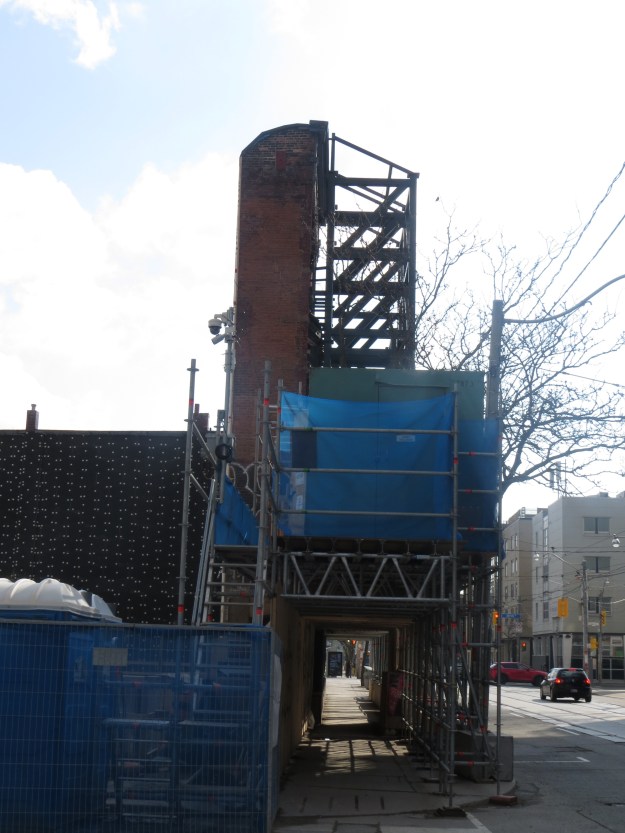
Some interesting buildings have survived, though I wonder for how much longer – this wooden-clad yellow building has always  fascinated me. It seems to have been everything from a music venue to a shawarma house, and I note that in 2021 there was a campaign on Facebook to save it. Now, it seems to be closed so things don’t look good.

Our favourite bookshop in Toronto, Ben McNally, has found yet another new home, so I’m expecting to make a visit early next week.

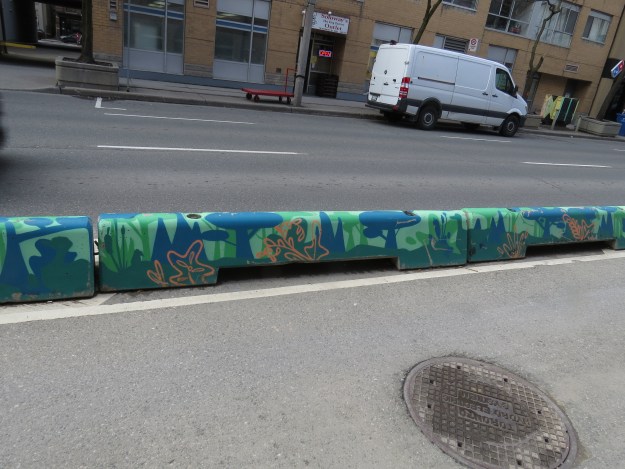
And finally, how about these? They’re used to designate the bike lanes in the city, and are hated every bit as much by drivers as the various bollards that are used in London. These have been painted by various artists, and I particularly like the centipede one (surprise surprise). See what you think.

A Beautiful Day in Milborne St Andrew

Dear Readers, today I went to Milborne St Andrew to tidy up Mum and Dad’s grave, and the weather was way more beautiful than I had any right to expect at the beginning of December. The mist was just clearing, and the view over the fields behind the graveyard was serene.

There’s a little crab apple tree behind the gravestone, and a cherry tree overhead, so there’s always something lovely to keep them company.

I’d brought a couple of winter hellebores and some cyclamen, but the rosemary and Achillea that I brought last time were still doing well, in spite of the flowering being finished. As usual, I tidied up a bit and then sat next to the grave for a while with my back against the tree. Fortunately I’d brought a ‘bag-for-life’ with me to sit on, as it was a bit on the damp side.

It is so peaceful. I am always sad when I’m here, but it’s tinged with gratitude that Mum and Dad are no longer in pain, and that they are in such a lovely spot. The church dates back to Norman times, so probably people have been being buried here for a thousand years or more, and there’s something about that long history that keeps me company and makes me aware of how universal my experience is.

As I sit, I hear the heavy drone of a bumblebee, who makes a ‘bee-line’ for the hellebore. Something else to be grateful for.

The blue tits and great tits are busy working the shrubs and trees for food, and the jackdaws clack away as they fly over.

The trees here have become as familiar as old friends. The Scots Pine looks particularly magnificent.

The avenue of yew trees frames the view of the fields.


And the beech trees are magnificent this year. I have never seen such colour.

But I can’t leave without saying hello to my favourite Cedar of Lebanon. It towers over the Rectory, which is a very impressive building, though no longer inhabited by the Rector who lives in a much more modest home.

And finally, here’s the stump of the lime tree that came down in the storms earlier this year, but which is clearly determined to survive and even thrive.

As I turn for home, I pass a blackbird looking for worms. Usually they fly off when I get too close, but this one just carried on regardless. I love the way that they just throw the leaves around.

I love Milborne St Andrew. It’s a working village rather than one that would feature on a calendar, or the top of a biscuit box, and it’s all the better for it. Mum and Dad had excellent medical care here, and good friends who would run out in the middle of the night if Mum fell out of bed, and who helped me sort out Mum and Dad’s bungalow when I needed to sell it to pay for Dad’s care. There are painful memories here, but they are outweighed by the happy ones. Coming here keeps me in touch with Mum and Dad and the place they loved. I always feel calmer when I leave, more integrated somehow. Mum and Dad were never ones for grave visiting, but it works for me.

A Trip to Tate Modern

Dear Readers, it will come as no surprise to regular followers that I love London – I was born and bred in this city, and yet even after 62 years my heart still races when I walk its streets. It’s the sudden and unexpected views that always get me, such as spotting the new Tate Modern extension appearing alongside the old power station tower as I turn a corner. Today I was even helped by one of the top-hatted concierges outside the Bankside Hilton, who pointed me in the direction of this unexpected view of the Shard. The Shard seems to have replaced the Post Office Tower as the building that pops up everywhere, though it looks rather like some evil triangular god peering over his realm and deciding what to blast with a thunderbolt next.

I am going to Tate Modern to see their ‘Surrealism Beyond Borders’ exhibition, which closes at the end of the week. Time was I tried to see everything at both Tate galleries, but now that I’m working it’s a bit trickier. I will write more about the exhibition tomorrow, as I think it deserves a post of its own, but to be honest it was a treat just to catch a tube ‘south of the river’, wander around with the camera and then catch the 17 bus back to Archway.

I have gotten a bit ahead of myself, though, because I arrived at Southwark station on the Jubilee line, which is up there with my favourite stations. It always reminds me of a cruise ship, for some reason (though I have never been on a cruise ship so who knows?)

It’s certainly got that brutal concrete thing going on, but I love it nonetheless. The blue glass wall shown below was apparently influenced by the work of 19th century Prussian architect Karl Friedrich Schinkel, and I can certainly see where the idea might have come from. When you take the escalator up from the platforms you are suddenly surrounded by this amazing blue dome, as if you have ascended into some kind of transport heaven.

Ascending to the blue wall (Photo by Di Chap at https://www.flickr.com/photos/chap_d/17173382167/

The blue wall at Southwark Station (Photo by Diamond Geezer at https://www.flickr.com/photos/dgeezer/66002534)

Schinkel’s stage set for Mozart’s The Magic Flute (1815) (Public Domain)

Anyhow, back to Tate Modern. I was a bit alarmed to see that there’s some renovation going on at the top of the power station tower.

Apart from the fact that the structure looks a bit on the flimsy side, my additional worry was for the peregrine falcons who have nested here for many years. The Royal Society for the Protection of Birds used to have telescopes outside so that you could watch the birds, and they were famous for hunting at night because of the floodlights on the building. Many a local pigeon met a spectacular end at the talons of the birds, but sadly this renovation, which has taken more time than expected and more money than budgeted, has rendered the birds homeless. There are at least twenty pairs of peregrines in London, and apparently the Tate Modern birds had a quick look at St Pauls as an alternative home, but decided it didn’t quite meet their demanding criteria. I hope they found somewhere else to raise their young.

After the exhibition I took a leisurely walk back over the Millenium Bridge, which always provides plenty of photo opportunities…

St Pauls….

A whole range of skyscrapers….

View towards the Globe Theatre with pigeons who are delighted that the peregrines have moved on….

The Shard glowering under a storm cloud….

A contented gull….

Canary Wharf and Tower Bridge

And then I catch a number 17 bus almost immediately, which is a minor miracle as I usually have to wait for at least twenty minutes. Clearly, the Bus Fairy must be keeping an eye on me.

On arrival in Archway, I saw this.

It’s an old-fashioned phone box, and someone has planted it with a jasmine which is doing very nicely, thank you! It did cheer me up. Someone is obviously taking the time to water it and look after it.

And finally, here’s a random cat, sitting in a sunny spot on the High Road and refusing to respond to my entreaties. Oh well, you can’t win them all.

The Capital Ring – East Finchley to Finsbury Park – Part One


Queen’s Wood

Dear Readers, the Capital Ring is a circular walking route 78 miles long that meanders around London, mostly in Transport for London zones 3 to 4. I have actually done it before (and have the certificate to prove it 🙂 ), but after nearly two years of stop-start lockdowns and general confusion, it felt like a good time to do it again. Plus I have been growing increasingly sedentary, so it seemed like a good time to gently get active again.

The Capital Ring actually runs right through Cherry Tree Wood, which is a mere quarter of a mile from our front door so on Saturday, after a long-postponed visit to the dental hygienist (clearly I know how to enjoy myself at the weekend) we set off. Everywhere on the walk is looking extremely parched, but in the early morning it was pleasantly cool. The new café was doing a roaring trade, and rightly so – the food is delicious. I stopped briefly to see if I could get a copy of a new history of the park by our very own Roger Chapman, but it had been so popular that it was briefly out of stock. Clearly there is a renewed interest in our local green spaces, which is very encouraging.

Cherry Tree Wood in the Sunshine

View back to the new cafe

The fenced off area was being used to grow a meadow. Interestingly, it seemed to have the finest crop of greater plantain (Plantago major) that I think I’ve ever seen – meadows often throw up surprises in their first few years, depending on what has been hiding in the seed bank and what the conditions are. The young fruit trees look to be doing very well, though, and the wild service tree has lots of berries this year.

A fine crop of greater plantain

Berries on the wild service tree

I also really liked these mosaics on the side of the Ladies Toilet – very pretty, and very unexpected. I’m wondering if some more are planned, to fill the gaps.

Then it’s out of the gate, along Fordington Road, and off to Highgate Wood. We look back to see the tiny ‘village green’ with its mature trees.

And we pause briefly to consider these bollard-y things, which look as if they’ve been freshly-painted, probably to make them more obvious to drivers. I always thought that they marked the boundary of a parish or somesuch, but the company that makes them, Furnitubes, describes them as a Bell Bollard. Their role seems to be to “deflect the wheels of heavy vehicles protecting pedestrians, people and buildings in busy public realm environments.” These were on the corner of a mini roundabout, so maybe some vehicles take the corner too quickly.

Maybe we should have them on the corner of Leicester Road in East Finchley rather than the concrete bollard which is almost always in a horizontal position.

Horizontal bollard on Leicester Road

Then it’s up a steep hill and into Highgate Wood. This is part of the same great wood as Cherry Tree Wood and my beloved Coldfall Wood, the whole lot originally being owned by the Bishop of London and used as his hunting ground. Highgate Wood used to be known as Gravel Pit Wood, and is the same mix of oak and hornbeam as the other woods.

Highgate Woods.

I note a lot of use of dead hedges to try to protect the understorey areas, and there are some places with actual fences. It’s very hard to try to persuade people not to let their children and dogs trample through places where the young plants are struggling to survive, and most folk don’t seem to even notice them unless they’re higher than usual. Still, they do provide habitat for all manner of small animals and for fungi.

A dead hedge

It is so deliciously cool under the trees at this time of year, but the spider webs give an indication that the year is moving on. How can it be August already?

Then it’s out of Highgate Wood, across the busy road to Muswell Hill, and into Queen’s Wood. There is a delightful cafe here in what looks almost like a hobbit house, with much of the produce grown in the kitchen garden at the back. It used to be known as Churchyard Bottom Wood until it was acquired by Hornsey Borough Council in the 19th century, and named for Queen Victoria. I love the old-fashioned signposts.

This is a much shadier and hillier wood than Highgate Wood, with the amenities all clustered close to the entrance, and the rest of the wood feeling wild and rather mysterious. It’s usually much quieter than Highgate Wood, and none the worse for it. During lockdown both woods were used to within an inch of their lives, with some areas a sea of mud. Now, they have a chance to recover, though the current drought is leaving things dangerously dry. The photo below, for example, shows what is usually a pool full of frogs and dragonflies.

I do wonder what the water companies think they’re doing. Our local company, Affinity Water, actually sent us an email telling us that they have no plans to impose a hosepipe ban, even after the driest few months in living memory. They are, however, dependent on rainfall this autumn and winter to help them to maintain supplies. Surely it would be prudent to conserve water now in case this doesn’t happen? The reasons for not imposing a ban are apparently

But other companies, even in drier areas, have held firm. Those involved in drought discussions say companies would rather wait until the last minute, when rivers are running dry, rather than irritate customers by putting bans in place early” (The Guardian, 3rd August 2022)

In the meantime, river levels are dropping, with the subsequent danger to wildlife. Honestly, ‘irritate customers?’ There’s a lot to how a message is put across, and I’m sure most reasonable people would understand the need to be sensible after the weather this year. In the meantime, fish are gasping in the rivers and the invertebrate life is being wiped out.

Anyhow, at this point we leave Queen’s Wood and walk up Priory Road, passing the most beautiful dark maroon-coloured rose in the front garden of a house which is undergoing a thorough refurbishment. I’m so glad that it was left.

And on the other side of the road there’s a very fine Victorian terrace. These look like very upscale houses for the time, with decorative green tiles outside and all sorts of little plaster details. On the other hand, this is a very hilly spot, and we passed the poor postman who has to tackle some of the steepest external staircases I’ve ever seen.

“It keeps me fit”, he said as he rocketed past us as we huffed and puffed up the hill. Clearly we need to do more of this walking stuff.

Victorian houses on Priory Road – note the ground level green tiles, the double bay windows and the decorative plaster on the top floor.

Then we pass through a very steep path between number 63 and number 65 Priory Gardens and head up to the Archway Road. We pause at the traffic lights to gaze at Jackson’s Lane Community Centre. This used to be a Methodist church, but these days showcases all kinds of innovative performance art of all kinds, with a particular emphasis on shows for young people.

Jackson’s Lane Community Centre

And now, we’re about to walk the second part of the route, along the Parkland Walk. But to hear about that, lovelies, you’ll have to wait until tomorrow…..

A Visit to Lilactree Farm

Dear Readers, you might remember that in April last year I reviewed ‘Minding the Garden – Lilactree Farm’ by Brian Bixley, a fascinating book about a year in the life of a garden in Ontario, and lots of other things besides. This year, the stars aligned so that, on an exceptionally sunny day, we were able to visit Brian and his wife Maureen at Lilactree Farm, to see the garden in its spring glory. I should say that my photos don’t do the garden justice, but hopefully you’ll get an idea of what a delight it is.

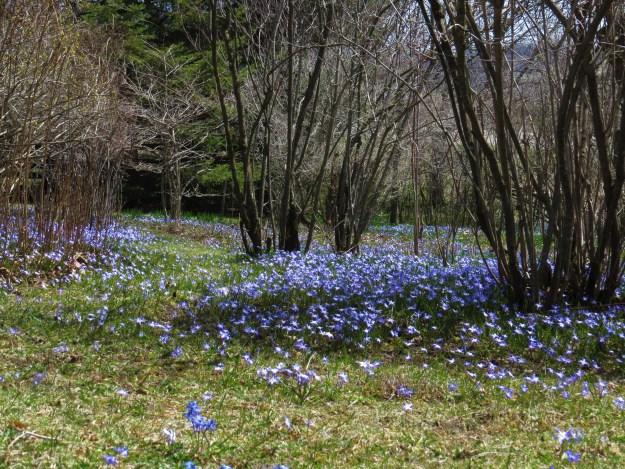
I have noted how splendid the scilla was in Collingwood, but it really comes into its own here, along with the chionodoxa: the shrubs stand ankle-deep in different shades of blue and pale pink, with hellebores, winter aconite and summer snowflake marking the changes.

On a sunny bank outside the house there was a fine selection of fumitory – I’m familiar with yellow corydalis, which grows like a weed in London, but these were a rainbow of lilac and pink. Known as ‘bird-in-a-bush’, the wild type of the plant (Corydalis solida) is a pale lavender, but there are several varieties in pink and coral. They looked spectacular growing amongst the chionodoxa, and were very popular with the bees – the bumblebee in the second photo is, I think, a Common Eastern Bumblebee (Bombus impatiens), but as it was the first one I’d ever seen I was enchanted by its completely black, furry abdomen. Bumblebees are important pollinators of long-throated flowers such as fumitories, and the bees certainly need the early nectar and pollen, so everyone is happy. In fact, I have never seen a bank of flowers so abuzz with bees and hoverflies – I even asked Brian if he was keeping bees but no, these are travelling to enjoy his largesse.

There was a row of daphne just coming into flower, and a tricolour bumblebee(Bombus ternarius) was foraging – again, a new species for me, and surely one of the most handsome bumblebees anywhere.

The garden has what I always think of as ‘good bones’ – the structural elements, such as the sculpture and the blue posts below, will look different throughout the year, as they are enhanced and supported by what is happening botanically. The sculpture below twinkles in the sun, reflecting aspects of the landscape.

And when you reach the top of the path, you have a wonderful view over the hills and woods beyond.

The blue posts below provide a strong linear element in a garden of many curves. In the spring they pick up the colour of the scylla. I would love to see them later in the year as other plants come into flower.

Blue posts with scilla

It was wonderful to see Lilactree Farm after falling in love with it through Brian’s book. It seems to me that it’s a prime example of gardening with passion – Brian grows what he loves, and is constantly experimenting to see what will work in the temperamental Canadian climate. He is not a ‘wildlife gardener’, and yet his garden is absolutely full of life. By growing a variety of plants with a long flowering season, Brian has created a place which is welcoming to pollinators as it is to people. It was an Open Day for the garden, and there was a constant stream of people coming to see it, many of them repeat visitors who obviously love it. It made me yearn to see what it’s like in the summer, or in autumn. But in spring, when we have been so deprived of colour and scent, it is a real treasure. I could imagine myself sitting under a tree with a book in a pool of scilla and feeling very content with life.

You can buy Brian’s book ‘Minding the Garden – Lilactree Farm’ here.

Chionodoxa luciliae

Blue posts with scilla


The Mourning Dove – Canada’s Own Pigeon

Mourning Dove (Zenaida macroura)

Dear Readers, Canada is blessed with the usual feral pigeons and (increasingly) the Eurasian Collared Dove (which looks set to be as successful in North America as it has been in the UK). However, the Mourning Dove is the bird that always typifies Canada to me. It’s a small, bright-eyed bird with a distinctively doleful call.

Interestingly, the wings also make a strange whistling sound, which you can hear at the end of the clip below – it sounds almost like the call of a different bird, or maybe a very tiny horse whinnying. Like most pigeons, the Mourning Dove is an excellent flyer, being able to reach speeds of over 55 mph.

The bird is a popular game bird in the USA, with up to 20 million of these small birds shot every year, but it maintains its population by being able to have up to six broods every year, each with two chicks. Both parents feed the squabs with crop milk, a secretion unique to the pigeon family which enables the birds to breed more or less all year round, especially as the adults eat seeds and so are not dependent on the insect population.

Photo One by By Andrew Atzert from Mesa, AZ, USA - Family of DovesUploaded by Snowmanradio, CC BY 2.0, https://commons.wikimedia.org/w/index.php?curid=11044215

Mourning Dove parent with two chicks (Photo One)

Mourning Doves are not showy birds, but their feathers have a delicate, misty beauty. A legend of the Huron/Wyandot people of North America tells how a Mourning Dove was the favourite bird of a maiden, Ay’ura, who died. Her spirit travelled towards the entrance of the underworld but all the Mourning Doves followed, and wanted to go with her. The Sky Deity, who guards the gate to the underworld, lit torches so that the smoke would obscure the entrance, and so Ay’ura went on to the spirit world, but the feathers of the Mourning Doves were smudged with the smoke. Their cry is said to resemble the chant that used to be said over the dead.

Photo Two from By http://www.naturespicsonline.com/ - http://www.naturespicsonline.com/galleries/Nature15/_mg_8449a.htm, CC BY-SA 2.5, https://commons.wikimedia.org/w/index.php?curid=1083262

Mourning Dove (Photo Two)

The birds that I saw in Canada are probably recent arrivals – Ontario is towards the northern range of the Mourning Dove, which can be found throughout the US and down into Mexico. The Canadian birds tend to migrate south every year, returning into Canada between March and May. On arrival, the males court the females with graceful, circular glides, followed by the usual pigeon-y bobbing dance. The male then leads the female to some potential nest sites, and she chooses one. The male then finds the nesting material while the female builds the nest, no doubt being extremely picky about the male’s offerings. Both parents incubate the eggs, and both feed the young. They seem to be devoted parents, which is probably another reason for their success – they are considered of ‘Least Concern’ as far as conservation goes.

And while this is not directly related to the Mourning Dove, I am in the mood to share this poem with you. It has been such a hard two years, and yet the birds are still singing, and the sun is shining outside my hotel window. If nothing else, so many of us have learned to look at familiar things in a new way. The Mourning Dove is one of Canada’s commonest birds, and yet I’d never really considered it before. There is always something new to learn, and to admire.

“Hope is the thing with feathers”  by Emily Dickinson

Hope is the thing with feathers
That perches in the soul,
And sings the tune without the words,
And never stops at all,

And sweetest in the gale is heard;
And sore must be the storm
That could abash the little bird
That kept so many warm.

I’ve heard it in the chillest land,
And on the strangest sea;
Yet, never, in extremity,
It asked a crumb of me.

Sound Credits

First file by Manuel Grosselet from XC381111 Mourning Dove (Zenaida macroura) :: xeno-canto

Second file by Paul Marvin from https://xeno-canto.org/153648

Photo Credits

Photo One By Andrew Atzert from Mesa, AZ, USA – Family of DovesUploaded by Snowmanradio, CC BY 2.0, https://commons.wikimedia.org/w/index.php?curid=11044215

Photo Two from By http://www.naturespicsonline.com/http://www.naturespicsonline.com/galleries/Nature15/_mg_8449a.htm, CC BY-SA 2.5, https://commons.wikimedia.org/w/index.php?curid=1083262

Toronto after Covid – First Impressions

Pusateri’s Food Hall in Saks Fifth Avenue, Toronto, in pre-Covid times (Photo by Alexander Vu from https://urbantoronto.ca/news/2016/11/eaton-centre-new-pusateris-comes-saks-fifth-avenue)

Dear Readers, one of my first treats when I arrive in Toronto is to follow the underground PATH system from our hotel to Pusateri’s at Saks Fifth Avenue, which used to be the food hall to end all food halls. Fancy a salad, made up before your very eyes? Or Icelandic Skyr yoghurt with raspberries and melted chocolate? Or fresh bread, straight from the oven? Admittedly, you needed deep pockets to shop regularly at Pusateri’s, but as an occasional treat, you couldn’t beat it.

Today, the only outlets open in the whole food hall were one selling pizza (admittedly delicious), and one selling the most ornate eclairs you’ve ever seen. Everything else was silent and fenced off. Black boxes with the word ‘Pusateri’s’ were on all the shelves instead of artisanal pasta and fancy chocolate. An occasional member of staff drifted past to clear up the detritus from someone’s pizza meal. Before the pandemic, you could queue for twenty minutes for your salad. Today, there is no salad at all.

Pusateri’s didn’t cover itself in glory early in the pandemic, when it was charging $30 for a tin of hand wipes, and was called out for price-gouging by the Ontario premier Doug Ford. But I suspect that the problem with Pusateri’s is much more to do with the way that many workers have voted to stay at home rather than coming back into the office. And of course, this is what’s happened all over the world. People are working from home (me included) because it feels safer, less stressful and more efficient, but the sandwich shops, the shoe repairers, the greeting card shops and the purveyors of office clothing are all going to the dogs. It’s been a massive shake up of our urban ecology, and I suspect that, much as Jacob Rees-Mogg might leave little passive-aggressive notes on the desks of civil servants who aren’t in the office, working from home, at least for some of the time, is here to stay.

Of course, this is a massive opportunity for local shops and businesses. People who work from home still need a break, and maybe they will pop out to a local newsagent for a magazine, go to the neighbourhood coffee shop and get their groceries from the place around the corner. What a good thing that could be! In many communities there was a coming-together during the pandemic, and there’s plenty of scope for that to continue. Many of us fail to see the appeal of getting up at 5.30 in the morning to be in the office for 7.30 so that they can leave by 4.30 and miss the worst of the rush hour, especially when compared with the 30 second commute from the bedroom to the office that many of us currently have.

I wonder what happened to all the staff who used to work here, chopping and packaging, taking cash, adding toppings to yoghurt and dressings to salad? There are other Pusateri’s outlets in the city, so I’d like to think that some people have moved to them, but nonetheless I wonder about the bulk of the employees. Canada had a pretty generous furlough scheme, but even so, jobs must have been lost here. It might be that the food hall will be reopened gradually, but I wonder if it will ever have as much custom as it did before the pandemic.

I have only been in Toronto for a couple of hours, so no doubt there are lots of other changes, some for the good, some not. But my initial feeling is that the centre of the city has been somehow hollowed out by the pandemic and its aftermath. I wonder if I will still feel the same at the end of the holiday? Let’s see.

Pusateri’s eclairs