Category Archives: London Birds

The Little Orcas

Dear Readers, while I was in Milborne St Andrew in Dorset with my parents this week, I went out in search of autumn. It is my favourite season, with its lengthening shadows, golden light and occasional sun-blessed days. And being in the autumn of my own life I sometimes feel a certain restlessness, a kind of scratchy irritability and dissatisfaction. At times like these, I need to get out and walk, and tune in to something that’s outside my own head. Sometimes, it takes me a while to find what I’m looking for, to slow down enough to ‘see’ properly. But this time, I was pummeled into paying attention by creatures that were even more restless than I am.

House Martins (Delichon urbica)

House Martins (Delichon urbica)

House Martins are among the first birds to arrive in the UK from sub-Saharan Africa, and the last to leave. On this late August day, they seem deeply conflicted. One minute they land on the red-tiled roofs at the end of the village, and preen energetically. The next they fly up in a great flurry, circle the roof and land again. They resemble nothing so much as a shoal of little fishes, darting this way and that, directed by some imperative that is invisible to mere humans. The distinctive blue-black and white plumage of the adult birds reminds some people of orcas.

IMG_4217 (2)

All the time, the House Martins call, a sound like a bagful of pebbles being shaken vigorously. This is an anxious time for them. For the newly fledged youngsters, it will be the first time that they’ve made their epic migratory journey. In a good year, House Martins will have two or three broods, and all those fledglings will accompany their parents on the trip south. What triggers this journey is probably a combination of the shortening day-length, falling temperatures and the decline in insect numbers. This last is vital: House Martins feed only on insects, catching them in mid-air. Without these birds, and others like them, our mosquito and midge problem would be much worse than it is.

Not everyone is delighted to have House Martins or Swallows or Swifts nesting under their eaves. The birds can be messy and noisy for the few months that they are rearing their young. Most people tolerate the inconvenience for the delight of seeing the birds soaring and barrel-rolling over their houses, and for the joy of their return every spring, for these birds are intensely faithful to their nest sites, and will re-use a nest if they can, patching it up with mud  if it’s been damaged by the winter weather. But for some people it’s a nuisance too far, and the nests are destroyed, or wire is used to deter the birds on their return. I can only imagine the confusion when, having braved desert, mountain, ocean and conurbation, the birds arrive at their destination only to find that their nest, lovingly built with over 1000 beakfuls of mud,  no longer exists. House Martins have declined significantly in the UK in the past few years, enough for the RSPB to put them on their Amber list of conservation concern. This may be down, in part, to the lack of suitable nest sites, as new houses and farm buildings often lack the overhanging eaves that are essential to create the nest. I’m sure that our addiction to pesticides will also not be helping with the food supply.

We know very little of what happens to House Martins once they reach their wintering grounds – of the 290,000 birds ringed in Britain and Ireland, only one has been recovered south of the Sahara. In fact, there is a theory that the birds spend the winter in the air, eating insects, and only come to earth in uninhabited forest regions to roost. This is not as unlikely as it sounds: while the breeding population of House Martins spends the hours of darkness on the nest, unmated birds are thought to roost on the wing at elevations of over 3300 feet. But wherever they go, there is a certain sadness in their leaving. By the time I left my parents to come back to London, most of the House Martins had gone. This is all to the good, of course – any bird that stayed in the UK would undoubtedly die of starvation.  We must make peace with their going, because we know that it is what they need to do. And, as in so much of life, the letting go is all.

090415_1720_TheLittleOr1.jpg

Resources this week included Mark Cocker’s Birds Britannica, a wonderful guide to both the  facts and folklore of British birds.

A Dapper Bird

European Coot (Fulica atra)

European Coot (Fulica atra)

Dear Readers, one of the sad things about my half mile territory is that it doesn’t contain any lakes, or indeed any ponds except for the one in my garden. So when the urge to seek out waterfowl takes over, I have to head for Hampstead Heath, which has a fine selection of water bodies (though whether they will be quite as grand when they’ve finished their controversial dam project is anybody’s guess). One of the most dapper and austere of the birds to be found here is the European Coot, a member of the rail family. It is an easy bird to identify, all sooty-black except for that white beak and frontal shield, and is probably most well known for being ‘as bald as a coot’. However, when you actually look at the creature, this doesn’t really make sense. It’s the front of their faces which are white, not the tops of their heads. I am indebted to the Hedgeland Tales website for pointing out that one of the Old English meanings of ‘bald’ was ‘streaked or marked with white’, and this makes much more sense. It may also be that the name of the Bald Eagle was referring to its whiteness, not its lack of hair. Or indeed feathers.

Most other rails, such as the Moorhen and Water Rail, are shy, retiring, good-mannered birds, tip-toeing around as if anxious not to offend. But one look at the glaring red eyes of the coot should tell you that this is a bird of passion. While all is mostly peaceful at this time of year, the Coot is not a bird to be messed with.

IMG_4181It doesn’t take much to upset a coot.You will often notice them laid out flat in the water, heading towards something on the other side of the pond like a small feathery torpedo. They are extremely territorial birds during the breeding season, and a pair will defend their little patch of water against all comers – dogs, humans, swans, ducks, but most especially other coots. An outbreak of explosive clucks and squawks heralds the onset of hostilities. They fight with wings, beaks, and with their enormous, fascinating feet.

By Tony Hisgett from Birmingham, UK (Coots 1c Uploaded by Magnus Manske) [CC BY 2.0 (http://creativecommons.org/licenses/by/2.0)], via Wikimedia Commons

By Tony Hisgett from Birmingham, UK (Coots 1c Uploaded by Magnus Manske) [CC BY 2.0 (http://creativecommons.org/licenses/by/2.0)], via Wikimedia Commons

Let’s take another look at those feet.

By Emőke Dénes (WWT London Wetland Centre) [CC BY-SA 2.5 (http://creativecommons.org/licenses/by-sa/2.5)], via Wikimedia Commons

By Emőke Dénes (WWT London Wetland Centre) [CC BY-SA 2.5 (http://creativecommons.org/licenses/by-sa/2.5)], via Wikimedia Commons

Whereas birds like ducks have full webbing between their toes, birds like coots have ‘partial webbing’, so there is an extended flap of skin surrounding each joint. This enables them to spread their body weight over floating vegetation and mud, and to improve their swimming speed. These are birds which are absolutely at home in the water, but much less so in the air – although the coot is better able to fly than, say, a moorhen, it still takes to the skies reluctantly, with much splashing and flapping. Many members of the family are totally flightless, which led to the extinction of some species once they encountered man and his long-time companions – rats, cats, dogs and pigs. One such is the Chatham Rail, wiped out in New Zealand by the end of the 19th Century.

Chatham Rail (Cabalus modestus)

Chatham Rail (Cabalus modestus)

The Eurasian Coot, however, is doing very well. It has a range which includes the whole of the Old World and Australasia. In the UK, the RSPB estimates that there are approximately 190,000 birds, with 31,000 breeding pairs. And, with a clutch size of up to ten eggs, and a propensity to produce 2 or 3 broods a year, you might think we would soon be wading through an ill-tempered sea of coots, pecking at our ankles and spoiling our shoe polish with their big flappy feet.

Coot feeding chicks ("Sothöns-6". Licensed under Public Domain via Commons - https://commons.wikimedia.org/wiki/File:Soth%C3%B6ns-6.JPG#/media/File:Soth%C3%B6ns-6.JPG)

Coot feeding chicks (“Sothöns-6”. Licensed under Public Domain via Commons – https://commons.wikimedia.org/wiki/File:Soth%C3%B6ns-6.JPG#/media/File:Soth%C3%B6ns-6.JPG)

However, in the breeding season it seems that everything likes a mouthful of fluffy baby coot. Black-backed and Lesser Black-backed gulls are particularly partial. Pike and heron take a few. The babies drown themselves, get tangled up in angler’s paraphenalia and get themselves lost. But by far the biggest danger to little coots, I regret to say, is other coots. Adult birds will destroy eggs and kill chicks that get too close to their own brood. But unfortunately the sheer pressure of so many babies can also turn their own parents into furies. A chick which begs too much may be pecked on the head by its mother so often that it gives up and dies of starvation. Some may even be killed. Gradually, the brood reduces to a size that the parents can handle, and where there were ten baby coots, there may eventually be only one or two. And in the great scheme of things, this is probably just as well, though you would need a heart much harder than mine not to be upset at the sight of chicks being gradually reduced to hopelessness and eventual death.

The lucky survivors ("Eurasian coots - juveniles with adult" by Taken byfir0002 | flagstaffotos.com.auCanon 20D + Canon 400mm f/5.6 L - Own work. Licensed under GFDL 1.2 via Commons - https://commons.wikimedia.org/wiki/File:Eurasian_coots_-_juveniles_with_adult.jpg#/media/File:Eurasian_coots_-_juveniles_with_adult.jpg)

The lucky survivors (“Eurasian coots – juveniles with adult” by Taken byfir0002 | flagstaffotos.com.auCanon 20D + Canon 400mm f/5.6 L – Own work. Licensed under GFDL 1.2 via Commons – https://commons.wikimedia.org/wiki/File:Eurasian_coots_-_juveniles_with_adult.jpg#/media/File:Eurasian_coots_-_juveniles_with_adult.jpg)

In spite of all of this, however, I find coots fascinating birds. They are much more outgoing and confident than your average rail (when did you last see a Moorhen fighting a Black-headed Gull for a crust)? Their social dynamics are fascinating, and they have a kind of urban, bustling attitude which means that they punch well above their weight on the average boating lake. Our parks would not be the same without the clinks and plinks of coots arguing amongst themselves. Quieter, yes. But definitely not the same.

IMG_4153

The Pigeons of Bunhill Fields

Dear Readers, it is of course a law of nature that if I am going to accidentally publish a post before it is ready, many of the photographs will be ‘wrong’. If you received an earlier version of this post, apologies. Hopefully this one will be a little easier on the eye.

There are places in London where the past butts so hard against the present that it’s difficult to keep a grip on both. One of these places is Bunhill Fields, a burial ground tucked away between City Road and Old Street. People have been interred here since the Fourteenth Century, but it is most famous for its Eighteenth and Nineteenth burials of dissenters. John Bunyan is buried here, and so, it is thought, is William Blake. Whilst Bunyan has a fine white tomb with his effigy peacefully resting on top, for Blake there is just a stone, stating that he is thought to be buried somewhere in the graveyard, along with his wife. Some red and white gladioli in a vase stand beside the memorial, in modern-day remembrance of this most eccentric and visionary man, who conversed with angels in his garden, and who saw more clearly than most the connections between the different parts of creation.


The graves here are so old that they have been fenced off to prevent visitors from damaging them. But the main route through the graveyard, on an August weekday lunchtime, is full of office workers going to and fro, clutching their takeaway salads from Pret a Manger and chatting on their mobile phones. Some take a detour to the green behind the Fields, and find themselves a bench beneath the London Plane trees. Others are cutting through at speed. No one is looking at the graves. Perhaps they’ve seen them all before and know how historic this site is. Perhaps they’ve a deadline waiting for them back at their desks, and this is the only leafy-green spot that they’ll see until they pack up this evening.


As usually happens, I am putting down my rucksack and pulling out my camera when a woman with a clipboard approaches. Do I have a kind face, or is there something in my expression that tells her that I am a loiterer rather than a dasher? At any rate, she is from the City of London Authority, and wants to know what I am doing in Bunhill Fields so that she can classify my visit. No doubt all this data is used to consider the worthiness of an open space. Maybe it opens up the world of grants and other funding. The woman shows me a list of reasons for visiting the Fields. Sadly, none of them exactly match what I’m doing here.

‘I am here’, I announce, ‘to photograph the pigeons’.

She is flummoxed. After a moment she makes a decision.

‘I’ll put that down as ‘Other”, she says.

What I am actually doing is taking some photographs of the individual pigeons in the flock that lives here. While it’s tempting to think that all pigeons are the same, they are in fact extraordinarily varied in plumage. I wanted to capture some of that variation, and to have a think about why it might be.

There are two kinds of pigeon colouration which are so common as to be considered ‘normal’. One of these is the ‘Blue Bar’. These birds have two distinct bands on their wings, though the colour of these bands can vary. These are the closest to the wild pigeon, the Rock Dove (Columba livia) from which all pigeons are descended. These often seem to me to be the healthiest looking pigeons as well, though I’m unsure how these facts are related.

Two Blue Band pigeons

Two Blue Bar pigeons

The other very common pigeon pattern is the Chequered. Instead of bands on the wing, this type is mottled, usually in shades of dark grey.

Chequered pigeon

Chequered pigeon

I walk on to the green and sit down on a bench. There are about twenty pigeons walking optimistically about, giving the sandwich-munching office-workers a sneaky look as they gallop past, then circling back at the slightest sign of messiness or engagement.

I notice that the birds seem to form sub-flocks, hanging about with other birds that look like them. There are some birds, for example, which show variations on the theme of rust and grey. Technically, these are called ‘Red’ birds and they are very attractive to look at – the rusty colour can infuse their whole breast, or be a kind of patina on top of a basic dove-grey. Three of them follow one another about, and hang hopefully around a man who is eating a cheese baguette whilst talking on his mobile phone. I notice that they approach from behind the bench and snatch the crumbs from behind. Clever birds!

Red pigeon in stealth mode

Red pigeon in stealth mode

I wonder about this colour segregation as well. I read that pigeons prefer to mate with birds who resemble their parents, so maybe this helps to ‘set’ particular patterns. And if the birds are related, that explains why they seek out one another’s company.

Another frequent colourway is the Black bird. There were several of these in the flock, but, surprisingly, I spotted two birds who were all black except for their white wing feathers. One of these birds had a white blaze on the  head as well. He or she looked very exotic, a most unlikely feral pigeon. Maybe these two were siblings.

Black pigeon

Black pigeon

Two almost-Black pigeons, with interesting white wing feathers.

Two almost-Black pigeons, with interesting white wing feathers.

As I sat and watched, I noticed that the pigeons would often fly off as one, heading for another likely source of food on the other side of the green. As they rose, some of them would slap their wings audibly. I’d always thought that this was a warning, or a display. Here, though, I came to the conclusion that it was a way of telling the other birds that a food source had been discovered – on hearing the ‘slap’ other birds would fly up and join the flock which flew directly to the food source.I have noticed before, in Waterloo Station for example, that the birds are acutely conscious of one another’s behaviour, and if one bird flies down to a source of food, the others will follow suit, even if they can’t see food from their perch. But something different seemed to be going on in Bunhill Fields. Alerting other pigeons, even unrelated ones, to food seems almost altruistic, but then if every bird does it, everyone benefits. There is so much about these ubiquitous creatures that we don’t yet understand. I can almost feel a PhD subject coming on.

I had lots of photographs by now, and so I decided to head back, against the tide. But as I drew level with a tomb, I noticed two pigeons courting on top of it. A Red male and a Blue Bar female were ‘kissing’, fencing with their beaks. Then, the male started to groom the female’s head and neck, while she closed her eyes. Finally, he stepped on top of her and, wings flapping, got down to business. I realised that taking photographs of pigeons mating was probably not very seemly, although the participants didn’t seem to care. And as the stream of humanity passed by, oblivious, the next generation of pigeons was conceived. I’m sure that William Blake would have been delighted.

IMG_4046IMG_4050


Bugwoman on Location – The Old and The New


Conventional planting on Islington Green, North London. This replaced alliums, grasses and verbena. I’m not sure what caused the outbreak of conventionality, maybe budget cuts?

Dear Readers, municipal plantings in parks and public areas used to be the same wherever you were in the country. There would be regular ranks of blue lobelia and red geraniums, edged with white alyssum. Sometimes, the bolder councils would inject some double-flowered marigolds and petunias, and, if they were really going for broke, they might throw in a few bronze-leaved cannas, with big blousy golden flowers. Sadly, none of these plants have much to offer bees and other pollinators. And if you pop down to Islington Green in London today, you will see exactly the kind of planting that  I’m talking about.


This kind of planting stays in place for a few months, while bees and butterflies investigate and, disappointed, move on to something that will actually feed them. And then, one day, the plants will be pulled up and thrown in the compost, to be replaced with winter-flowering pansies and primroses. When summer returns, the whole ritual will happen all over again.

Now, there’s nothing wrong with this per se. Some containers of bedding plants add a certain joie de vivre to any garden, and these plants are hardy, long-flowering and low maintenance. The problem comes when city councils, in particular, miss the opportunity to do something a bit more pollinator-friendly. In London, where the gardens are small and the areas of concrete seem never-ending, bees regularly fall starving out of the sky. So on this bright July morning, I went to see what was being done to improve things.

My first stop was Whittington Park, on Holloway Road. My friend Penny tells me that Adolf Hitler is partly responsible for this park, because it is built on the remains of two whole streets that he bombed to bits during the Second World War. But it’s been Islington Council who have turned it into the rather remarkable spot that it is now.

On Holloway Road itself, there are two great swathes of perennial plants, most of them bee and butterfly-friendly.

IMG_3758

The blue spikes of eryngium mix with grasses and sunflowers and crocosmia and daylilies. The mauve of Verbena bonariensis stands out against the terracotta-coloured wall of the shop next door.

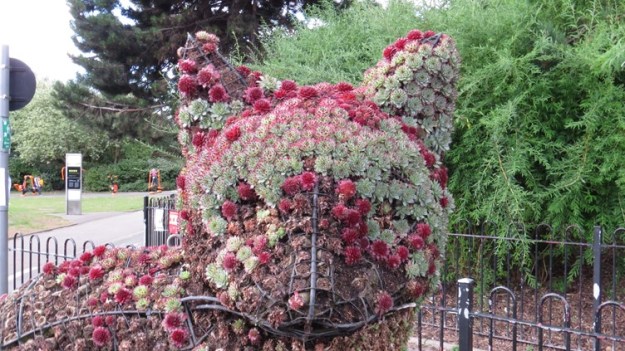
And in the middle of all this is a four-foot tall model cat, covered in sedum. This is in honour of Dick Whittington’s cat. Dick was a real person, but has become the stuff of legend. No one knows how ‘real’ the cat was, but I choose to believe in his existence, because it makes me happy to think of man and cat having adventures together.  It is said that Dick, as a very young man, fled his job as a scullion in the country and headed towards London , where the ‘streets were paved with gold’, along with his cat who was a renowned ratter.  It is from close to here that Dick, lonely, exhausted and broke,  is said to have been considering going back home  when he heard the bells of London saying ‘Turn again, Dick Whittington, Lord Mayor of London’. And so he turned and, together with his faithful cat, headed into the Capital and made his name and his fortune and did, indeed, become Lord Mayor.


What is lovely about Whittington Park is that it is a fully-functioning community resource. There’s an outdoor gym and a football pitch. There’s a nursery and a lovely playground for children. There’s a pond, where some pond-dipping was going on, and a skateboard park.

And there’s also a fenced-off area of wildflowers, which was originally an RSPB experiment to encourage house sparrows. Today it’s much used by bees and hoverflies, and also by a variety of birds who eat the seeds of the thistles and docks. In short, there is something here for everyone, human or animal, and in a very small space too. It just goes to show that wildlife-friendly planting doesn’t have to mean that the whole place turns into a jungle of nettles and bindweed.


Onwards! I jump onto a bus, and then another bus, and finally I arrive at the Barbican. This was previously another site full of red salvia and pots of agapanthus – pretty but sterile. But a few weeks ago, I noticed that it had had a makeover, so I wanted to revisit. And what a transformation it is. All of the beds at the entrance to the complex have been turned into a gravel garden. There are red-hot pokers and scabious and gaura and bee-friendly plants of many types. And it’s working! I saw honeybees and bumblebees, hoverflies and butterflies. At the moment some areas look a bit bare, as the plants are young, but I have no doubt that it will end up looking like an enormous prairie. It blends in well with the ageing Brutalist concrete towers around it, and people were sitting amongst the flowers, eating their sandwiches and relaxing. It’s a bold move to change the planting like this: some people hate the informal look of this kind of bed, and think that it seems ‘weedy’ and unkempt. So kudos to whoever did the Barbican design for sticking to their guns and not taking the easy route.


There is a place, of course, for any kind of plant design. Furthermore, it is much better to have a formal garden than no garden at all. Insects don’t much care whether your plants are native or non-native, and in a city there’s little chance that you’re destroying a pristine habitat by sticking in a couple of lantana. But looking at the drifts of flowers in Whittington Park and at the Barbican, it seems to me that with a bit of imagination we create wonderful spaces, which work for all members of the community, including the ones who aren’t human. My worry is that, with the budget cuts to local councils, the chance for innovation and creativity is restricted, even though a bee-friendly planting doesn’t have to cost more than a standard one. There is nothing like being ‘up against it’ to put a brake on new ideas, because there is no margin for error. Fortunately, these two parks already exist, and will hopefully be a beacon for other councils and other areas. What a boon it would be for all the creatures that pass through them.


A Summer Walk in Coldfall Wood

054Dear Readers, it has been a difficult couple of weeks. A fortnight ago, my Dad was rushed into hospital with a suspected heart attack and chest infection, which turned into blood poisoning. For a few days he was delirious and didn’t even know who my Mum was, after 58 years of marriage. It is so hard to watch the people that you love suffer, and to feel so helpless, and my heart went out to my Mum, who is not well herself. But praise be for antibiotics, because after ten days in hospital my Dad was well enough to come home, and is now gradually getting back to his usual wry, patient self.

And so it was a rather wrung-out, raw Bugwoman who took herself off to Coldfall Wood to see what had been going on in her absence. And after about fifteen minutes, I started to notice the extraordinary mix of flora that is coming into bloom along by the stream. First of all, there was this plant.

Himalayan Honeysuckle (Leycesteri formosa)

Himalayan Honeysuckle (Leycesteria formosa)

016This is Himalayan Honeysuckle which, as the name suggests, is native to the Himalayas and south west China. I’ve noticed it a few times, not just in Coldfall but in Highgate Wood as well. It is also known as Flowering Nutmeg, and is considered invasive in Australia. Here, it doesn’t seem to be a particular problem, though it does grow to about 8 feet tall, and has bamboo-like stems that could, at a pinch, be mistaken for old friend Japanese Knotweed. Further along by the stream, the whole plant had collapsed, and I wondered if it had been unmercifully attacked. In fact, my plant books tell me that when the plant reaches a certain height, it faints away like a Victorian Lady who has glimpsed some naked male pectorals,  and then regrows from the roots.

Raspberry (Rubus idaeus)

Raspberry (Rubus idaeus)

Right opposite the Himalayan Honeysuckle there was an unexpected snack, in the form of a little stand of Raspberries. It’s easy to forget that these plants are natives, and indeed the only time that I ever contracted a tick was when I was standing up to my armpits in a patch of wild yellow raspberries in Scotland. I assume that the plants here have been transported from the gardens on the road above by the stream. At any rate, I have to say that the one in the middle of the photo was absolutely delicious, and that there is something about sun-warmed fruit that does wonders for the spirit.

Onwards!

019It surprises me how quiet it can be in the wood during the day, when most people are at work, the dog walkers have largely been and gone, and the children are all in school. The only bird song came from the Song Thrush, which is sad, because it means that he hasn’t been successful in finding a mate this year – Song Thrushes stop singing when they are paired up, unlike most birds who will continue to defend their territory with sound.

A Capsid Bug

A Capsid Bug

There were lots of insects about: a tiny capsid bug stayed long enough to get a photograph before flying away. Capsid bugs are ‘true’ bugs, insects that use tubular mouthparts to bore into a plant and suck its sap. Aphids are the best known ‘real’ bugs, but most go about their business unremarked, doing little damage and living out their life cycles without us even knowing what they are. If I looked hard enough, I would be willing to bet that there are insect species here that are unknown to science, as there are in most suburban gardens. For a great insight into the sheer biodiversity that is all around us, I recommend ‘Wildlife of a Garden – A Thirty Year Study’ by Jennifer Owen.

065

Woody Nightshade (Solanum dulcamara)

Entangled with the other plants was that distinctive scrambler, Woody Nightshade, or Bittersweet. Later in the year, it will have bright-red berries that are extremely poisonous, but also very bitter – the author of the Poison Garden website, John Robertson, has bravely tasted a couple, just so that we don’t have to . One look at the flowers will tell a gardener that this is a member of the same family that gives us tomatoes, potatoes and peppers, the Solanaceae. This family also provides us with Deadly Nightshade, but that is a small price to pay for chips and pasta al arrabiata.

063Now, what would you think if you saw the plant below?

Garden Escape, or Native Plant?

Garden Escape, or Native Plant?

There are several bushes with bright yellow flowers and rather attractive blushing berries along by the stream. I took one look, and thought ‘these have escaped from nearby gardens’. And indeed, maybe they have, but the story is a little more complicated than this.

051

Tutsan, or Sweet Amber (Hypericum androsaenum)

Tutsan is actually a native plant, a member of the St John’s Wort family. Its name is said to come from toute saine meaning ‘all-healthy’, and it is mentioned in Culpeper’s 1653 Herbal as being useful for gout and sciatica, and for healing burns. So, while these individual plants might have escaped, this is a plant with a long and venerable wild history. Which just goes to show how much there is to learn every time I step outside, and how things are never exactly as they seem.

I turn for home.

024But what’s this?

Hedge Woundwort (Stachys sylvatica)

Hedge Woundwort (Stachys sylvatica)

What a delicate and yet upright little plant this is, another favourite of herbalists, particularly John Gerard, the seventeenth-century plant healer. This is a common plant but I had never noticed it before, so I was delighted to add another species to my list of Deadnettles. A large bumblebee was obviously enjoying it as I arrived, and it reminded me that plants don’t have to have large, showy flowers to be full of nectar.

I was nearly out of the wood when it gave me another gift.

Black and Yellow Longhorn Beetle (Rutpela maculata)

Black and Yellow Longhorn Beetle (Rutpela maculata)

When this insect first landed, I thought that it was an ichneumon wasp or somesuch, but in fact it is a very handsome beetle. The larvae spend up to three years maturing in rotting wood, and then emerge, fresh-minted like this one. The beetle visits the flowers of cow parsley and Queen Anne’s lace (and helps to pollinate these plants in the process), finds a mate and the cycle begins all over again. And indeed, I managed to get just this single shot before the beetle lurched into the air again and headed off on his reproductive quest.

So, I headed back home, renewed by more than just my filched raspberry. There is something about walking in familiar places and deepening our knowledge of them that reminds me of the process of building a friendship, or even a marriage. We see the loved one in all moods and all weathers. Sometimes, as today, the whole wood feels open and generous. Other days, the wood seems closed and morose, and I need to be patient until I see what it is she needs me to see. I have never had such a relationship with a place before, and yet it feels as true as many human partnerships that I’ve had, and truer than some. I would recommend the slow burn of getting to know somewhere profoundly, over years or decades, especially in our fast-paced, easily-distracted, superficial society. We should all have a place that has become part of our heart.


Something of a Kerfuffle

IMG_2565

A fine collection of Starling (Sturnus vulgaris) fledglings

Dear Readers, have a look at the photograph above and see how many fledgling starlings you can count. This is one branch of my Hawthorn tree, and on Thursday this week it was a heaving, wheezing mass of babies. Every year, the youngsters emerge en masse and I am always touched that the parents bring them to my garden, though I suspect the neighbours are not so impressed with the noise and mess and general kerfuffle from dawn till dusk.

IMG_2573When they first leave the hollow tree that has been their home for the first few weeks of their lives, the fledglings seem wide-eyed with wonder. They follow their parents to the hawthorn tree, and sit there waiting for something to eat. While they wait, they investigate. The urge to peck anything that looks remotely edible reminds me of the way that human babies investigate everything mouth-first.

IMG_2511IMG_2514 The fledglings spend a lot of time looking up hopefully, and wheezing every time an adult hoves into view. How the adults identify which baby is theirs is one of those mysteries of nature, but each youngster is as distinctive to his or her parents as our babies are to us.

IMG_2516The adults, strangely enough, seem rather relaxed. Do they know that the most frantic part of their job is over, and that soon their offspring will be independent? Or are they just exhausted and having a breather?

IMG_2466I have been in this house since the autumn of 2010, and every spring brings this flush of new life. I like to think that some of these birds are the youngsters of previous years, who are bringing their own fledglings to a reliable source of food. Feeding wild creatures is a big responsibility – although animals will find alternative sources of food if we suddenly stop providing for them, they are very vulnerable at times when they need extra supplies, such as now, or during a cold winter.  I always have some food on offer, but try to adjust the quantities according to need. An added incentive for year-round feeding is that starlings are a Red List species – according to the British Trust for Ornithology, their numbers have dropped by 80% nationally since the 1970’s. One reason for this is that fewer fledglings survive, possibly due to the difficulty in finding food during our drier summers, so I like to make sure that there is always some food available.

IMG_2520 (2)In a week or so, the fledglings will have learned to feed themselves, and will start to disperse. The frenetic pace in the garden will die down, and things will go back to normal. But for now, the hawthorn tree reverberates to the sound of hungry youngsters, and the starlings have left their ‘mark’ all over the garden furniture. My bird food budget is well and truly blown, and the man who delivers the suet pellets has probably developed a hernia from lifting all the heavy boxes. But there is something about this great burst of animal fertility that fills me with hope. In spite of everything that we are doing to mess things up, some things are still working.

IMG_2563

A Work in Progress

Me aged about four with my nan.

Me aged about four with my nan.

Dear Readers, I grew up in Stratford, in East London. Five of us crammed into a two-bedroom house with an outside toilet, no bathroom, and a pocket handkerchief-sized garden. And yet, it was that little garden which first triggered my interest in insects. I spent hours digging in the dirt with spoons that I’d smuggled from the cutlery drawer. I reared woolly bear caterpillars in a plastic box, tried to create woodlouse habitats under concrete slabs and marked the backs of passing ants with watercolours from my paintbox. I was a permanently messy child, with scuffed knees and dirty fingernails, in spite of the attempts by my mum and nan to keep me more or less lady-like. In a way, I was a pioneer of wildlife gardening before the term had even been invented, because the more invertebrates there were in the garden, the better I liked it. Once, I rescued some milky, sticky eggs that I found and put them into the damp course under the living room window. When we were suddenly inundated by enormous yellow slugs a few weeks later, I kept very quiet.

As I grew up, I didn’t have much access to a garden. I was in student digs, and then in a variety of rented accommodation. Some people seemed able to create a floral paradise wherever they were, but not me. I was always on the move, always too easily distracted. A bout of serious depression in my thirties didn’t help. For a while, I had a few pots on a first floor balcony and got most of my access to nature from the community garden down the road.  And then, in my fifties, we moved into our house in East Finchley, and things started to change. For the first time, I could settle down, with a garden of my own. It felt safe, finally, to become a gardener.

My garden in May

My garden in May

When we moved in, our house had a very typical family garden – rectangular lawn, patio, shed. But I wanted so much to turn it into something that was friendlier for wildlife. We don’t have children, and so there was no need for somewhere to play football or badminton. We decided that, as this is the kind of thing that we would only do once, we would get someone to help us with the design of the garden, and with the heavy work of digging out a pond to replace all the grass. I figured that if the garden had ‘good bones’ it would be more difficult for me to mess it up. I am still a novice, trying things out, messing things up, forgetting to do things and doing them at the wrong time. But, thankfully, nature is very forgiving.

View of the left-hand side of the garden, with white lilac, hawthorn and whitebeam

View of the left-hand side of the garden, with white lilac, hawthorn and whitebeam

The plants on the left hand side of the photo above were already there when I moved in –  white-flowering lilac, hawthorn and  whitebeam. How lucky I am to have some mature trees! However, the garden is north-facing, and as the trees grow, the area underneath becomes increasingly shady. In particular, the lilac has turned into a monster, almost a small glade of trees in its own right. It has an evergreen, white clematis scrambling through it, which provides some sustenance for early Bumblebee queens, but I’m sure I could do more. Does anyone have any experience of renovating such an august shrub? I know that if I’m going to try to help it renew itself, it needs to be right after flowering, so I’d better get a move on.

The hawthorn is in full flower at the moment

The hawthorn is in full flower at the moment

The hawthorn is attracting a mass of insects and small birds, who spend best part of the day pecking through the flowers for caterpillars.

Bowles Mauve - perennial wallflower

Bowles Mauve – perennial wallflower

One of the plants that works hardest in the garden is the Bowles Mauve perennial wallflower. I put it in over three years ago. In all that time, there hasn’t been a day when there hasn’t been at least a few flowers on it. Bees of all kinds seem to love it, it needs no care, and my only fear is that at some point it will run out of steam. In the meantime, I appreciate its generosity every day when I look out of my kitchen window.

The pond.

The pond, complete with self-sown Greater Willow Herb

The pond is the single most interesting thing in the garden. Frogs lay their eggs in it, dragonflies and damselflies hover over it, water boatmen swim in it and everything drinks from it, from foxes to blackbirds to dunnocks to a wide range of neighbourhood cats. There is always something going on. It has reached a stage now where, provided we remove most of the leaves and excess water plants in the autumn, it is self-maintaining. If you have any space at all, even a balcony with room for a bucket, I would recommend putting in some water. You will be amazed what turns up.

Another picture of the pond. Can you tell I'm in love?

Another picture of the pond. Can you tell I’m in love?

I also have a lot of bird feeders – 2 for seed, 2 for suet, 2 for nyger, and a bird table that looks as if it was cobbled together by Heath Robinson. They’ve been very useful for attracting the birds into the garden, but I’m pleased to see that they spend a lot of time foraging for natural food in the trees and shrubs at this time of year.

IMG_2442

My Heath Robinson bird table.

My Heath Robinson bird table in front of the rampant lilac bush and the Bowles Mauve.

I’ve also managed to squeeze in a mixed hedge – yew, beech, hazel, hawthorn and spindle.I’ve been cutting this back in the autumn to encourage it to get thicker, but I think it will be a while before it gets thick enough for anybody to nest in it. Again, it does much better in the part of the garden where it is not under the whitebeam. The poor spindle is nearly always eaten half to death by aphids, particularly (you guessed it) in the darker part of the garden.

The hedge, looking back to the house.

The hedge, looking back to the house.

As you might expect, I am unfazed by weeds. I have a wide variety, from the usual nettles and dandelions to comfrey, Mexican fleabane, pendulous sedge, herb bennet, yellow corydalis, green alkanet, forget-me-knot, and elecampane. I have a huge stand of Greater Willowherb which is so good for the bees that I can’t help letting it get bigger every year. I have bramble and bindweed trying to find their way in from the back of the garden, and I do confess to encouraging these to curb their ambitions with a pair of secateurs. What intrigues me is that many of these plants can be found locally, in the wood or the cemetery, and I wonder how unique the mixture of ‘weeds’ is to any particular locality. Certainly, if something grows wild nearby, it is more likely to turn up. I have a view that, if not too ‘over-managed’, our gardens can become extensions of nearby habitat, rather than completely different ones. It makes sense to support the wildlife that is already living in an area, rather than asking it to adapt to a completely new set of plants.

I also have an eight-foot tall volunteer cherry tree, courtesy of the one next door. My garden is becoming a forest.

The 'volunteer' cherry tree.

The ‘volunteer’ cherry tree.

Of course, not everything in the garden is rosy. Especially the poor Rosa rugosa which I planted underneath the whitebeam in a moment of madness. It reaches out with its poor attenuated stems for the sunlight and produces, oh, maybe three flowers a year. If I was a bit more confident about it surviving, I would move it, but now is obviously not the time.

One of the few flowers on my poor rose bush

One of the few flowers on my poor rose bush

I am so lucky to have a garden again, and believe me, I am grateful every day that I have a chance to enjoy it. . There is always something going on, some new creature appearing or an unidentified plant popping up. But every garden is a work in progress. If you are also lucky enough to have a garden, what things have you tried that have helped your local wildlife? Do you have any advice on north-facing gardens, or working with heavy clay soil? If you don’t have a garden, have you tried containers, or guerilla gardening? Or what have you observed in your local park? I would love to know what your number one plant for pollinators is, for example, or if you’ve had any success with bug-hotels or nestboxes. I truly believe that observant gardeners and dog-walkers and runners and allotment-holders have a deep pool of knowledge that should be tapped for the benefit of our wildlife, and that we have so much to learn from one another.

Blackbird in the rain ...

Blackbird in the rain …


Green and Gold

Dear Readers, I am off to Somerset today and may not have internet access, so I am publishing my Saturday blog on Friday. Have a good weekend!

St Pancras and Islington Cemetery

St Pancras and Islington Cemetery

On Tuesday, I went for a walk with a good friend. She is reeling from a series of unexpected bereavements and yet, like me, she derives comfort from walking in the semi-wilderness of St Pancras and Islington Cemetery’s Victorian greenery. There, amongst the bluebells and the blackbirds there is a sense of perspective. For all the grief that death causes, it is, in the end, just a way of recycling the elements that came originally from the hearts of stars. Nothing is ever truly created or destroyed, just transmuted into another form. The materials that made us become speckled wood butterflies and cowslips, thrushes and hoverflies.

IMG_2016As we walked along one of the paths, a marble tomb set with vases of bright red fabric roses glowed out. There was certainly no missing them – they were beacons amongst the softer creams and golds and blues of the real flowers. I am not personally a great fan of artificial blooms, but I am not standing in judgement. They speak to those of us who are still alive. They say ‘the people beneath these tombstone have not been forgotten’. They say ‘someone cares about this tomb’.

Of course, the people in the other tombs may not have been forgotten either. It might just be that their relatives and friends prefer other forms of remembrance – that moment when a certain song plays on the radio, or a photo on a mantelpiece, or a hushed conversation when someone remembers something the departed did. Some grave-visiting is a form of public celebration. Some of it is a ritual. Some of it, for some people, is a way of communing with the person who’s gone.

We came across one grave which was almost invisible under plants, photos, ornaments, ribbons. I remembered that this was the grave of a woman who died in her thirties, back in the 1980’s. Every week, her widower comes to tend the grave, to have a conversation with her, and to feed the foxes with the remains of his sandwiches. How extraordinary, this love that has lasted for thirty years since the last ‘real’ words between these two.

On another grave, a red rose in a pot, fallen on its side and dry as a bone. Sometimes, people don’t even take the plants out of their cellophane wrapping. My friend picked it up, looked at it. We spotted one of the many downpipes at the end of the path.

“I’m going to sort this out”, she said. She ripped the cellophane from around the pot, and threw it in the bin. Then she put the plant under the water and waited until it was well soaked.

“I reckon that’ll do alright”, I said. The plant was on the edge of giving up, but not quite.

My friend put it back at the side of the grave, wedging it upright with a stone.

“I hope so”, she said.

We both straightened up and looked around.

IMG_2024It had brightened up. And along the edge of the main path through the cemetery was a sea of yellow flowers: it was the largest gathering of dandelions in bloom that I had ever seen in my life, each one a little sun. Bees buzzed lazily over them, collecting the pollen they needed to raise their babies. How extraordinary nature is when left to herself! I rejoiced that the people who managed the cemetery weren’t intent on blasting every ‘weed’ into submission.

IMG_2025On we went, passing the fresh green leaves and four-petalled flowers of Garlic Mustard, the shy purple faces of Dog Violet.

IMG_2040I saw something fly out from the woods and land on a tombstone.

IMG_2031“Green woodpecker!” I said, digging out my camera. The bird was a long way away, and it was going to be hard to get a shot. As you can see.

“Where?” said Jo.

“On that last tombstone”, I said.

“Blimey missus, you’ve got good eyes”, she said. But really, it’s just that when you have a passion for something, you are alert for the slightest glimpse of the beloved.

The bird looked around and then jumped down onto the ground.

IMG_2034I could see it hammering away at something in the grass. We crept closer. A car went past. Green Woodpeckers are shy, and I was sure that we wouldn’t be able to get too close, but the bird ignored the vehicle. We advanced a little further. The bird still seemed perfectly relaxed.  And then, finally, it startled and flew up, into the trees.

When we got to where the bird had been, I saw what he had been hammering at.

IMG_2038There was the raised dome of an ants’ nest, and in it were three or four deep holes. I remembered that Green Woodpeckers love ants, but didn’t realise that they would try to dismantle a nest to get at them.

The holes, in the hard ground, were a good inch deep. I was impressed. Just as a Great Spotted Woodpecker hammers into wood, so a Green Woodpecker turns the same instinct groundwards.

We turned to head for home. We walked along a mossy path, past ground covered with the last of the Lesser Celandine. Every so often, we turned up the face of a bluebell to check the colour of the pollen – white for the English Bluebell, bright turquoise for the Spanish one. They were mostly English. And, as we did this, I heard a bird alarm call that I didn’t recognise. It was a deep, loud tick, almost like the sonar used by dolphins to detect their prey. And then, a small grey bird wearing what looked like a jet-black fur hat flew out of a sycamore sapling and into an ivy-covered tree.

“Blackcap”, I said, and what followed were a few bursts of liquid, melodious song, all the more beautiful for being so brief, and for being followed so suddenly by silence.

What better resting place than here amongst the bluebells, serenaded by blackcaps? And what better way of restoring ones spirits than a walk around this peaceful resting place?

Cemetary and Parakeets 007


The Bird That Runs Down Tree Trunks

Nuthatch (Sitta europaea)

Nuthatch (Sitta europaea)

Dear Readers, I like to think of myself as someone who is hopeful, but realistic. So, when I see those boards at the entrance to a nature reserve, describing all the wildlife that is lurking beyond the gate, I prepare myself for disappointment. Animals have a habit of moving around and not being where you expect to see them. Plants may not be in bloom, or may disappear completely. So whenever I’m told that there are nuthatches about, I breathe a long sigh. They are my nemesis. I have heard them many times. What I’ve never managed to do is to actually see them. So, when I was in Coldfall Wood last week and saw a small bird flash past and land in a tree down by the Everglades, I was not expecting him to stick around for some photographs. But, I was wrong!

IMG_1937 (2)Nuthatches are not uncommon birds – there are approximately 220,000 breeding couples in the UK, and they have a range from Portugal all the way to Japan. However, they are difficult to spot. You are much more likely to hear one – have a listen to the audio section on the RSPB page here. And one facet of their behaviour is unmistakable. Nuthatches are the only British birds that can run both up and down tree trunks – if you see a small bird hopping downwards, it’s a nuthatch.

Nuthatch heading down a tree trunk (By Jyrki Salmi from Finland (Eurasian Nuthatch) [CC BY-SA 2.0 (http://creativecommons.org/licenses/by-sa/2.0)], via Wikimedia Commons)

Nuthatch heading down a tree trunk (By Jyrki Salmi from Finland (Eurasian Nuthatch) [CC BY-SA 2.0 (http://creativecommons.org/licenses/by-sa/2.0)], via Wikimedia Commons)

Notice how nuthatches have a very wide stance - they don't hop up the tree with their feet together like woodpeckers. It's all part of the 'jizz' of the bird, the combination of factors that make identification possible (By Smudge 9000 (Flickr: Nuthatch (Sitta europaea)) [CC BY-SA 2.0 (http://creativecommons.org/licenses/by-sa/2.0)], via Wikimedia Commons)

Notice how nuthatches have a very wide stance – they don’t hop up the tree with their feet together like woodpeckers. It’s all part of the ‘jizz’ of the bird, the combination of factors that make identification possible (By Smudge 9000 (Flickr: Nuthatch (Sitta europaea)) [CC BY-SA 2.0 (http://creativecommons.org/licenses/by-sa/2.0)], via Wikimedia Commons)

Like Treecreepers and Woodpeckers , nuthatches forage beneath the bark of trees for their food, although they also eat seeds and, as you might expect, nuts. The bird jams an acorn or a hazelnut into a crevice in bark and bashes away at it with his ‘hatchet’-shaped bill. During the winter, the birds will cache nuts for use later on, and will hide them in plant-pots and window boxes, under stones, beneath bark and anywhere else that seems appropriate. Tests have shown that they can remember where they’ve left their caches for thirty days, which is impressive when I consider that some days I can barely remember where I’ve left my tube pass.

In the winter, nuthatches are another bird that might join a ‘feeding flock’ of finches or tits, but in the spring, the birds pair up for breeding.

Two nuthatches!

Two nuthatches!

Nuthatches are said to be monogamous, but, as in most things to do with the natural world, it ain’t that simple. A German study showed that ten percent of the chicks in the study area were fathered by a male who was not part of the ‘couple’, usually from an adjacent territory. Nuthatches are quite sedentary birds who need good quality woodland (which is increasingly short supply), and maybe the odd ‘illicit’ liaison helps to keep the gene-pool mixed up.

IMG_1942 (2)

Nuthatches are yet another cavity nesting bird that lives in the wood – last week we talked about the Stock Doves that need hollow trees to nest, and when you add in the woodpeckers and the parakeets, it’s clear that the housing problem is about as acute as it is in the rest of London. However, having found a hole, nuthatches will make the entrance smaller if it’s too big, creating mortar from mud until way into the nest is a tight squeeze. The mud sets hard enough to deter even a woodpecker. Away from the nest, the nuthatch’s major predator is the sparrowhawk, that silent, round-winged killer of woodland birds. As usual, though, the major problem for nuthatches is the destruction of their habitat, another reason to be glad for the preservation of ancient woodland remnants like Coldfall.

IMG_1941 (2)Exploring Coldfall Wood reminds me of being in love. To start with, it was all about the obvious things – the scent of woodsmoke, the marsh marigolds, the parakeets squawking. But with every walk, I am noticing something different – the moods of the wood in rain and mist, the way the sounds change with the season, the arrival of some creatures and the departure of others.  Sometimes, the wood seems closed and unyielding, unwilling to share anything, and then I know that I have to be patient, and put in the time to really pay attention. At other times, the place seems abundant, full of wonders, with a new song bursting forth from every shrub, a new plant blooming under every tree. I never know what’s going to be happening when I set out, and I am starting to relax into the mystery of it all. Just as you never truly know another person, however long you live with them, so I will never know this few hectares of woodland. And that is the wonder of it .


The Unnoticed Pigeon

Stock Dove (Columba oenas)

Stock Dove (Columba oenas)

Dear Readers, it is always worth checking out what at first glance may appear to be a Woodpigeon or a Feral Pigeon, because it may in fact be a Stock Dove, to my mind one of the prettiest of Britain’s native doves. There are a pair of them in Coldfall Wood at the moment, and I was delighted when I spotted them.

How can you tell that they are, in fact, Stock Doves? For a start, they do not have the characteristic white neck marks, or underwing flashes, of the Woodpigeon. Close to, you can also see that they have dark eyes which give them a gentle expression – Woodpigeons have a somewhat icy glare, and feral pigeons have red eyes. Furthermore, Stock Doves have a broken black line on their wings, and don’t have a white rump. What they do have is an iridescent patch of blue green on their necks.  Below is one of the illustrations from the Crossley ID Guide, which has been made freely available for us bird-loving bloggers ( a very generous gesture I feel).

Stock Doves (notice also the woodpigeon centre left for comparison) (By Richard Crossley (The Crossley ID Guide Britain and Ireland) [CC BY-SA 3.0 (http://creativecommons.org/licenses/by-sa/3.0)], via Wikimedia Commons)

Stock Doves (notice also the woodpigeon centre left for comparison) (By Richard Crossley (The Crossley ID Guide Britain and Ireland) [CC BY-SA 3.0 (http://creativecommons.org/licenses/by-sa/3.0)], via Wikimedia Commons)

IMG_1904 (2)Stock Doves are not rare (there are approximately 270,000 breeding pairs in the UK), but the UK has over 50% of the total European population, and so they are accorded Amber conservation status by the RSPB. This compares with over 5 million pairs of woodpigeons, and a million pairs of collared doves. They are undoubtedly under-recorded, and are generally rather shy, not allowing themselves to be approached as closely as the other members of the family.

The name ‘Stock Dove’ does not refer to their status as food birds (though they have been used as such), but from the old English name for a tree trunk, post or stump – Stocc. This is because they nest preferentially in hollow trees, although they have had to diversify since Dutch Elm Disease caused the demise of their favourite tree, and have been found nesting in everything from rabbit warrens to ivy-covered walls to church spires. All hollow trees are fiercely contested these days, with woodpeckers, parakeets and owls all fighting for the same nest holes. In ‘Birds Britannica’ Mark Cocker and Richard Mabey recount how this self-effacing bird has been known to

“…attack jackdaws, break the leg of or even kill a little owl, and scrap violently with neighbours”.

The Stock Dove may look cuddly but you wouldn’t want to get on the wrong side of one. However, dead trees are generally allowed to stand in Coldfall Wood, and it may be that this pair have managed to stake out a suitable tree. I shall watch with interest to see if there are any juvenile birds later in the year.

IMG_1907 (2)The song of the Stock Dove is also rather more subtle than that of other pigeons: it reminds me a little of a long-jumper’s run up, or maybe a frog calling from the bottom of a well. It’s certainly a tentative sound, easily lost against the squawking of parakeets, the shouting of wrens and the calls of great tits.

IMG_1903 (2)Although the Stock Dove has historically been considered a country bird, in recent years it has been making increasing excursions into the suburbs and even central London. In the early spring, the birds gather in flocks to find food, and a group of over 1200 was counted in the Maple Cross area in 2009, followed by 912 birds in 2010. In ‘Birds of London’, Andrew Self remarks that these are ‘possibly the highest gatherings of these birds ever seen in the UK’. As agricultural land becomes an increasingly hostile environment for many creatures, maybe the ‘encapsulated countryside’ in our cities is becoming a safer, more welcoming option. I know that I never cease to be astonished by the sheer variety of the plants and animals that I find in my half mile territory.