Category Archives: London Birds

2015 – A Work in Progress

Me aged about four with my nan.

Me aged about four with my nan.

Dear Readers, this is my ‘Year Two’ post, from 2015. I think this is the first time that I wrote in any detail about my garden, and it’s interesting to me to see how it’s changed – the evergreen clematis has gone, and it occurs to me that I could plant something similar to gussy-up my lilac when it’s gone over. And I think I need some more Bowle’s Mauve, I’d forgotten how useful it is. Everyone was so helpful with their comments and suggestions following this post, and it gave me more confidence to write about the personal. 

Dear Readers, I grew up in Stratford, in East London. Five of us crammed into a two-bedroom house with an outside toilet, no bathroom, and a pocket handkerchief-sized garden. And yet, it was that little garden which first triggered my interest in insects. I spent hours digging in the dirt with spoons that I’d smuggled from the cutlery drawer. I reared woolly bear caterpillars in a plastic box, tried to create woodlouse habitats under concrete slabs and marked the backs of passing ants with watercolours from my paintbox. I was a permanently messy child, with scuffed knees and dirty fingernails, in spite of the attempts by my mum and nan to keep me more or less lady-like. In a way, I was a pioneer of wildlife gardening before the term had even been invented, because the more invertebrates there were in the garden, the better I liked it. Once, I rescued some milky, sticky eggs that I found and put them into the damp course under the living room window. When we were suddenly inundated by enormous yellow slugs a few weeks later, I kept very quiet.

As I grew up, I didn’t have much access to a garden. I was in student digs, and then in a variety of rented accommodation. Some people seemed able to create a floral paradise wherever they were, but not me. I was always on the move, always too easily distracted. A bout of serious depression in my thirties didn’t help. For a while, I had a few pots on a first floor balcony and got most of my access to nature from the community garden down the road.  And then, in my fifties, we moved into our house in East Finchley, and things started to change. For the first time, I could settle down, with a garden of my own. It felt safe, finally, to become a gardener.

My garden in May

My garden in May

When we moved in, our house had a very typical family garden – rectangular lawn, patio, shed. But I wanted so much to turn it into something that was friendlier for wildlife. We don’t have children, and so there was no need for somewhere to play football or badminton. We decided that, as this is the kind of thing that we would only do once, we would get someone to help us with the design of the garden, and with the heavy work of digging out a pond to replace all the grass. I figured that if the garden had ‘good bones’ it would be more difficult for me to mess it up. I am still a novice, trying things out, messing things up, forgetting to do things and doing them at the wrong time. But, thankfully, nature is very forgiving.

View of the left-hand side of the garden, with white lilac, hawthorn and whitebeam

View of the left-hand side of the garden, with white lilac, hawthorn and whitebeam

The plants on the left hand side of the photo above were already there when I moved in –  white-flowering lilac, hawthorn and  whitebeam. How lucky I am to have some mature trees! However, the garden is north-facing, and as the trees grow, the area underneath becomes increasingly shady. In particular, the lilac has turned into a monster, almost a small glade of trees in its own right. It has an evergreen, white clematis scrambling through it, which provides some sustenance for early Bumblebee queens, but I’m sure I could do more. Does anyone have any experience of renovating such an august shrub? I know that if I’m going to try to help it renew itself, it needs to be right after flowering, so I’d better get a move on.

The hawthorn is in full flower at the moment

The hawthorn is in full flower at the moment

The hawthorn is attracting a mass of insects and small birds, who spend best part of the day pecking through the flowers for caterpillars.

Bowles Mauve - perennial wallflower

Bowles Mauve – perennial wallflower

One of the plants that works hardest in the garden is the Bowles Mauve perennial wallflower. I put it in over three years ago. In all that time, there hasn’t been a day when there hasn’t been at least a few flowers on it. Bees of all kinds seem to love it, it needs no care, and my only fear is that at some point it will run out of steam. In the meantime, I appreciate its generosity every day when I look out of my kitchen window.

The pond.

The pond, complete with self-sown Greater Willow Herb

The pond is the single most interesting thing in the garden. Frogs lay their eggs in it, dragonflies and damselflies hover over it, water boatmen swim in it and everything drinks from it, from foxes to blackbirds to dunnocks to a wide range of neighbourhood cats. There is always something going on. It has reached a stage now where, provided we remove most of the leaves and excess water plants in the autumn, it is self-maintaining. If you have any space at all, even a balcony with room for a bucket, I would recommend putting in some water. You will be amazed what turns up.

Another picture of the pond. Can you tell I'm in love?

Another picture of the pond. Can you tell I’m in love?

I also have a lot of bird feeders – 2 for seed, 2 for suet, 2 for nyger, and a bird table that looks as if it was cobbled together by Heath Robinson. They’ve been very useful for attracting the birds into the garden, but I’m pleased to see that they spend a lot of time foraging for natural food in the trees and shrubs at this time of year.

IMG_2442

My Heath Robinson bird table.

My Heath Robinson bird table in front of the rampant lilac bush and the Bowles Mauve.

I’ve also managed to squeeze in a mixed hedge – yew, beech, hazel, hawthorn and spindle.I’ve been cutting this back in the autumn to encourage it to get thicker, but I think it will be a while before it gets thick enough for anybody to nest in it. Again, it does much better in the part of the garden where it is not under the whitebeam. The poor spindle is nearly always eaten half to death by aphids, particularly (you guessed it) in the darker part of the garden.

The hedge, looking back to the house.

The hedge, looking back to the house.

As you might expect, I am unfazed by weeds. I have a wide variety, from the usual nettles and dandelions to comfrey, Mexican fleabane, pendulous sedge, herb bennet, yellow corydalis, green alkanet, forget-me-knot, and elecampane. I have a huge stand of Greater Willowherb which is so good for the bees that I can’t help letting it get bigger every year. I have bramble and bindweed trying to find their way in from the back of the garden, and I do confess to encouraging these to curb their ambitions with a pair of secateurs. What intrigues me is that many of these plants can be found locally, in the wood or the cemetery, and I wonder how unique the mixture of ‘weeds’ is to any particular locality. Certainly, if something grows wild nearby, it is more likely to turn up. I have a view that, if not too ‘over-managed’, our gardens can become extensions of nearby habitat, rather than completely different ones. It makes sense to support the wildlife that is already living in an area, rather than asking it to adapt to a completely new set of plants.

I also have an eight-foot tall volunteer cherry tree, courtesy of the one next door. My garden is becoming a forest.

The 'volunteer' cherry tree.

The ‘volunteer’ cherry tree.

Of course, not everything in the garden is rosy. Especially the poor Rosa rugosa which I planted underneath the whitebeam in a moment of madness. It reaches out with its poor attenuated stems for the sunlight and produces, oh, maybe three flowers a year. If I was a bit more confident about it surviving, I would move it, but now is obviously not the time.

One of the few flowers on my poor rose bush

One of the few flowers on my poor rose bush

I am so lucky to have a garden again, and believe me, I am grateful every day that I have a chance to enjoy it. . There is always something going on, some new creature appearing or an unidentified plant popping up. But every garden is a work in progress. If you are also lucky enough to have a garden, what things have you tried that have helped your local wildlife? Do you have any advice on north-facing gardens, or working with heavy clay soil? If you don’t have a garden, have you tried containers, or guerilla gardening? Or what have you observed in your local park? I would love to know what your number one plant for pollinators is, for example, or if you’ve had any success with bug-hotels or nestboxes. I truly believe that observant gardeners and dog-walkers and runners and allotment-holders have a deep pool of knowledge that should be tapped for the benefit of our wildlife, and that we have so much to learn from one another.

Blackbird in the rain ...

Blackbird in the rain …


Wild Swans – Poetry in Motion

Wild Swans flying over Loch Insh (Photo by Charlie Marshall https://www.flickr.com/photos/100915417@N07/47883972061)

Dear Readers, I have been so busy writing about wild geese that I forgot to include a poem about wild swans by one of my favourite poets, W.B Yeats. I love this poem, with its close observation and air of melancholy – note ‘the bell-beat of their wings’.

The Wild Swans at Coole
BY WILLIAM BUTLER YEATS

The trees are in their autumn beauty,
The woodland paths are dry,
Under the October twilight the water
Mirrors a still sky;
Upon the brimming water among the stones
Are nine-and-fifty swans.

The nineteenth autumn has come upon me
Since I first made my count;
I saw, before I had well finished,
All suddenly mount
And scatter wheeling in great broken rings
Upon their clamorous wings.

I have looked upon those brilliant creatures,
And now my heart is sore.
All’s changed since I, hearing at twilight,
The first time on this shore,
The bell-beat of their wings above my head,
Trod with a lighter tread.

Unwearied still, lover by lover,
They paddle in the cold
Companionable streams or climb the air;
Their hearts have not grown old;
Passion or conquest, wander where they will,
Attend upon them still.

But now they drift on the still water,
Mysterious, beautiful;
Among what rushes will they build,
By what lake’s edge or pool
Delight men’s eyes when I awake some day
To find they have flown away?

Mute swan in flight (Photo by Alexis Lours, CC BY 4.0 <https://creativecommons.org/licenses/by/4.0>, via Wikimedia Commons

And another poet who is up there in my list of favourites is Edna St Vincent Millay, largely for her near-constant air of exasperation, with which I often sympathise.

Wild Swans
Edna St. Vincent Millay
1892 – 1950

I looked in my heart while the wild swans went over.
And what did I see I had not seen before?
Only a question less or a question more;
Nothing to match the flight of wild birds flying.
Tiresome heart, forever living and dying,
House without air, I leave you and lock your door.
Wild swans, come over the town, come over
The town again, trailing your legs and crying!

Mute swan (Photo by By Diego Delso, CC BY-SA 3.0, https://commons.wikimedia.org/w/index.php?curid=18759800)

And how about this, by Sara Teasdale, an American poet who died in 1933? You can almost feel the hush in the darkened park…

Swans
Sara Teasdale
1884 – 1933

Night is over the park, and a few brave stars
Look on the lights that link it with chains of gold,
The lake bears up their reflection in broken bars
That seem to heavy for tremulous water to hold.

We watch the swans that sleep in a shadowy place,
And now and again one wakes and uplifts its head;
How still you are—your gaze is on my face—
We watch the swans and never a word is said.

And finally, here’s a poem by Stevie Smith. It’s an early work, but I think it still has that kick that was most well-developed in poems such as ‘Not Waving But Drowning’. It starts off almost like some childish doggerel, but suddenly deepens. See what you think.

The Bereaved Swan

Stevie Smith

Wan
Swan
On the lake
Like a cake
Of soap
Why is the swan
Wan
On the lake?
He has abandoned hope.

Wan
Swan
On the lake afloat
Bows his head:
O would that I were dead
For her sake that lies
Wrapped from my eyes
In a mantle of death,
The swan saith.

Photo by
L.C. Nøttaasen at https://www.flickr.com/photos/magnera/

Coal Drops Yard – An Update

The roof at Coal Drops Yard, designed by Thomas Heatherwick

Dear Readers, you might remember that I’ve been keeping an eye on the Piet Oudolf-inspired planting around Coal Drops Yard at Kings Cross, to see how it’s maturing and whether it has as much pollinator-attractiveness as it promised. Well, clearly there are no longer any gaps: have a look at this positive bank of Rudbeckia, which was attracting many hoverflies (none of which I managed to photograph, but they were there! I promise).What strikes me most, though, are the textures: this style of prairie-planting features many grasses and seedheads, and I think it works very well in this urban context. And if anyone can identify any of these plants, I would be most appreciative!

What struck me most, though was the sun shining low through these grasses. They really are stunning.

I only wish that when I planted things in the garden I was so conscious of how they would look at different times of the year. Or is this a happy accident? The sun was also lighting up these deep magenta asters, which were attracting a few of the last queen bumblebees before they settle down for the winter.

But what struck me  most was not the planting here, but a much more modest planting just around the corner, close to the Waitrose supermarket and the Ruby Violet ice cream shop (highly recommended). There was a little family of young sparrows in the hedge – sparrows always love a hedge, for shelter and  food and everything else that they need, and these birds were taking full advantage. It was lovely to hear them chirruping away, especially as they are now so much rarer in London than they used to be.

And a few metres away there was some lovely soft soil, just perfect for a dust bath.

Meanwhile, a robin sang from a low branch and occasionally cocked its head to listen to another robin before responding.

With a little thought, it’s very possible to create habitats and niches for all kinds of wildlife in the city, and they aren’t always where you might think. More power to the designers here for making space for the birds and the bees.

You can read more about Coal Drops Yard below, and see how the wildlife changes through the year.

First visit in February 2020

Revisit in October 2020

Revisit in July 2021

Little Things….

Dear Readers, following the news about my heart earlier this week I have decided to make a point of popping out into the garden to see what’s going on every day, instead of sitting hunched over my laptop like a vulture. And today, I was amazed by the number of house sparrows who seem to be visiting the garden. Earlier this year I would have said that I got maybe 3 or 4 occasionally, but today there must have been a flock of twenty, including a couple of fledglings. I am so glad to be able to make them welcome.

Blurry baby on the yew shrub to the left!

Furthermore, I love the subtle colours on the back of the male sparrows, in their shades of chestnut and charcoal and fawn.

And look at those little grey caps! If you ever see a sparrow with a brown cap you’re looking at a tree sparrow, which is even more exciting if you’re interested in relative rarities, though house sparrows are on the Red List as we know.

The teasel is coming on a treat, and the very first flowers are starting to appear. Soon a whole ring of pale lilac flowers will decorate each ‘bloom’.

First flowers!

How architectural they are, these flowerheads! They are masterpieces of geometry.

Elsewhere in the (admittedly extremely overgrown) garden, the first of the greater willowherb flowers has appeared…

My ‘dwarf’ buddleia (now nine feet tall) is coming into bloom…

And the hebe next door is putting out its lilac firecracker flowers, much loved by the bees.

And so, it was well-worth popping outside to see what was going on, as it always is. I heartily recommend it!

Making the Most of It…

Dear Readers, my buddleia really is in a shocking state this year – there is so much honeydew coming from the greenfly that it managed to stick my green wheelie bin shut. However, it isn’t all bad news because a little flock of sparrows visit more or less every day, to give the insect life the once over and to pick off all sorts of invertebrates.

It’s difficult to see properly, but this bird might even have found a caterpillar, which is clearly what he’s really after – you have to work much harder to get calories from a bunch of aphids than you do from a nice juicy larvae. There are lots of baby sparrows about, so I imagine that the parent birds are having to work very hard, especially with the rain being intermittent and the ground as hard as iron. Goodness knows what the blackbirds are doing, they’ll be needing a pneumatic drill to get into the ground around here.

It is lovely to sit at my desk on a call, and to glance up to see a sparrow or a goldfinch feeding, though. And I’m watching as the flowers on the buddleia start to expand. They look most unpromising now, but will soon be splendid purple pollinator-attracting blooms, and no doubt all manner of insects will take advantage. But for now, back to the day job!

After the Rain

Dear Readers, it’s been a hot, humid day, followed by a thunderstorm, followed by some more of the hot, humid stuff. I’m back at work after my exams and my inbox is hilarious. I used to start reading my emails from the oldest ones, but after many years I’ve learned that the best way to do it is actually to start with the most recent, because it’s surprising how many of them have been sorted out by the time you get to the end of the thread. Still, it’s strange to be back, and I still feel a bit disoriented.

I popped outside after the storm just to see which plants were still vertical, and spotted the loveliest little common carder bee. I have a great fondness for these little ginger chappies – they seem even more busy than your average bumble. Their nests, which are ‘carded’ together with grass and moss, are usually on the surface of, or just below, the ground, and there are rarely more than 100 workers. They have a great fondness for deadnettle flowers, or foxgloves, and they are able to ‘buzz pollinate’, so you might see them making one hell of a buzzy noise around your tomatoes (or in my case, the bittersweet that’s been growing wild). They need to vibrate the flowers at just the right frequency to get them to relinquish their pollen. In countries where there are no bumblebees (such as Australia), the tomatoes are instead pollinated by humans (usually migrant workers ) with the equivalent of a plant vibrator. So if ever I’m feeling hard done by, I always consider someone tickling tomatoes in the blistering heat and count my many, many blessings.

In the south of England there are normally two generations of common carders, which explains why you might see them on the wing right into late October in a mild year. In the north their flight season is a lot shorter, but one was recently spotted on Orkney, but as climate change edges many creatures further and further north, who knows where it will turn up?

And in other news, my teasel is coming along very nicely, and looks more and more like a skinny, spiky green person every day.

And my bottlebrush plant is about to burst – my lovely Aunties, Rosemary and Linda, who died last year, bought it for me when they came to visit, so it’s very special, and I’m pleased to see it doing well. It’s another one that the bees normally love, so I’m hopeful, but I have to say it’s been very, very quiet on the bee front so far this year. Let’s hope that things improve.

Incidentally, I noticed how the swifts seem to follow the insects – after the rain they came screaming down the street, but as it warms up and gets less humid they get higher and higher. It reminds me of when I laid on my back as a teenager and watched hundreds of them swirling about until I had to hold onto the grass because I felt as if I was going to fall into the sky. I hope that somewhere they are still being found in such huge numbers,  because around here you’re lucky if you see half a dozen at any one time. I’m sure that the loss of insects means less insect-eating birds, but I’d love to know how it’s going where you live. How are the bees, and the birds?

Herring Gulls Are Even Brainier Than I Thought….

Adult Herring Gull (By Scottmliddell (Own work) [CC BY 3.0 (http://creativecommons.org/licenses/by/3.0)], via Wikimedia Commons)

Dear Readers, I have written before about how intelligent I think herring gulls are, and how we underrate their brains at our peril. But a study of the birds by Franziska Feist at the University of Sussex has shown that they are even more attuned to human behaviour than we knew.

The experiment was all about crisps. Feist and her colleagues presented crisps in either blue or green packets to groups of herring gulls, and then sat down about 5 metres away. The observer then either just sat and watched, or pulled a packet of crisps out of their bag and started to eat them.

When the experimenter was eating crisps, the gulls approached the packets 49 percent of the time, compared to 19% when the observer was just sitting around. But when the observer was eating crisps(and this is the clincher for me), the birds pecked the packet which was the same colour as the one that the observer was eating from 95 percent of the time.

Herring Gull in flight (By JalilArfaoui (Own work) [CC BY-SA 3.0 (http://creativecommons.org/licenses/by-sa/3.0) or GFDL (http://www.gnu.org/copyleft/fdl.html)], via Wikimedia Commons)

So, this appears to indicate that a) the food choices of this group of herring gulls can be influenced by what humans are eating and b) that it isn’t in this case just about the type of food, but that they even take the colour of the packaging into account, to make sure that they are eating ‘our’ food. I find this astonishing, and you can read the whole article here.

This increasing attunement to the way humans behave is probably coupled with the way that herring gulls have changed their habits, from being largely coastal to coming inland and feeding from landfill sites. They nest on flat roofs everywhere, and are often seen to be a menace, in spite of the fact that they are declining and are on the IUCNs Red List of endangered birds in the UK. We are fast becoming their main source of food, so no wonder they are paying more attention to the finest nuances of our behaviour. The effect of all that junk food on the gulls themselves would be interesting to monitor.

Incidentally, a 2019 study showed that gulls are much less likely to steal your chips if they think you are watching them – only 26 percent of a sample of gulls touched the food if they were being stared at, and they took 20 percent longer to approach than if the experimenter was busy doing something else. So if you don’t want to be ambushed and chipless, it pays to be diligent, as it does in most situations. I wonder if the rise of the smartphone could be correlated with the increased success of herring gulls stealing food? Now that would be an interesting study.

And here is one of my favourite short films, of a herring gull ‘puddling’ for worms and then announcing  their presence with a most gratifying ‘long call’. Just look at that intelligent expression! These are extraordinary birds, well worth our attention.

At Last

Dear Readers, I spotted my first frogs in the pond several weeks ago, but since then we’ve had a cold snap, and everything has gone very quiet. Today, however, was mild, and it’s fair to say that amphibian season has well and truly kicked off. Have a look at the little film below.

Every year this feels like a little miracle to me. Frogs arrived within a week of our putting in the pond, goodness only knows where they’d been until then because I don’t know of any other neighbourhood ponds. Frogs are such mysterious animals – what do they get up to once they leave the pond? Where do they hang out? A few adults seem to linger on every year, but the concentrations that I see in the spring are soon gone, replaced by tadpoles and then tiny frogs. I know that lots hibernate at the bottom of the pond, but how about for the rest of the year? Anyhow, I know that they eat lots of slugs (at least in theory) so I’m very pleased to welcome them every year. There’s something about those hopeful faces that I find very endearing.

And if you look closely at the photo below (just to the right of the frog), you’ll see the first blob of frogspawn.

In other news, there are still plenty of squirrels. Look at this one, pretending to be a lion at a waterhole in the Serengeti…

If s/he was holding a baby in her arms I could almost hear ‘The Circle of Life’ playing in the background…

And finally, further to my wish list of birds yesterday, I just want to point out how much I appreciate my regular visitors. The starlings really are at the peak of plumage perfection at the moment, and it’s easy to forget how handsome they are. Look at the extraordinary range of colours on the back of this male bird. And to continue the Serengeti theme, does anyone else think that the knot in the trunk to the left looks like an elephant’s eye?

And how do I know that this bird is a male? Because the base of his beak is pale blue (in the females it’s pink-ish). Very handy that they are colour-coded, eh.

Male to the left (blue tinge to base of bill)

There didn’t seem to be any females about – maybe they’re already nesting and incubating? How exciting this time of year is. I can’t wait to see what happens next.


Big Garden Birdwatch 2023

Dear Readers, putting peanuts on the bird table was clearly not the best idea for the Big Garden Birdwatch this year: I have numerous very cute photos of grey squirrels (and one of a feral pigeon, a most unusual visitor) but none of the other birds could get a look in, though a very bold robin did have a go. Still, fortunately other feeders are available and so it wasn’t a complete washout. Clearly I’ll have to limit the seed and peanuts to the hanging feeders, which are a bit more of a challenge for the mammals.

So, we had a blackbird…

2 blue tits…

3 chaffinches (and at this point I feel like saying ‘and a partridge in a pear tree’, but I shall resist)…

1 collared dove (and no woodpigeons during the hour, probably too many squirrels…)

A dunnock, photographed through the back of a garden chair because s/he was very flighty and uncooperative…

Two very busy great tits, who I suspect are nesting nearby…

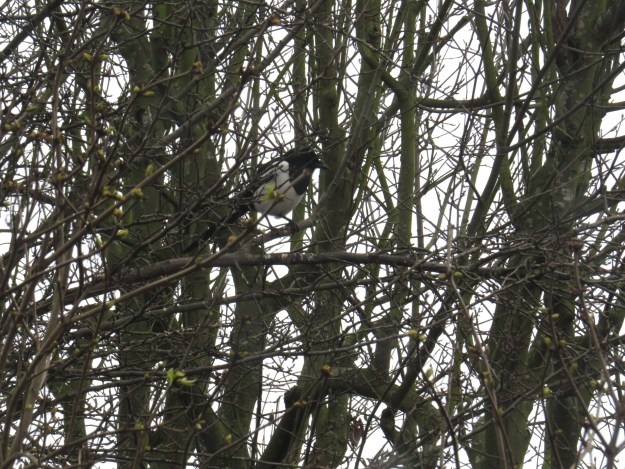
2 house sparrows, 2 magpies…

The magpies were in an altercation with the squirrels at one point – the birds seemed to be set on dismantling the remains of a drey in the whitebeam, probably for nesting material (it’s too early for baby squirrels), and the largest of the squirrels managed to drive them off.

Oh, and a robin…

and no less than fifteen starlings. At one point I thought that they might divebomb the squirrel, but those little dudes have very sharp teeth, so they thought better of it. There were so many of them that I thought I’d taken a photo, but this is the only one. Still, you get the general idea.

So, apart from the woodpigeon other no-shows were the goldfinches (where have they gone?), the ring-necked parakeets who’d popped in earlier, the blackcaps who are usually around, and the coal tit. But an hour isn’t very long in bird-time, and so I’m not unhappy – at least there’s something for the team at RSPB to punch into their computers. I shall be interested to see what effect, if any, the summer drought and the recent cold snaps have had on numbers. First winter survival is a key factor for the success of many garden birds.

Did you do the Big Garden Birdwatch? How did it turn out for you?

Red List 2022 – Number Two – The Herring Gull

Things that I have seen herring gulls do:

  • Dance on a patch of muddy ground to ‘bring up the worms’
  • Slide down a pitched roof, then flutter up to the top and slide down again, like a child in a playground.
  • Swoop over the shoulder of a two year-old and take the ball of ice cream out of the cone without a sound.
  • Feed their fluffy youngsters on the flat roof of Dorset County Hospital, where they nested as if it was a shingle beach.
  • Fight off all comers on a landfill site as they dive for the tastiest morsels
  • Sit on top of a pole at a popular beach in Jersey, waiting for the café owner with the water pistol to disappear before descending onto some abandoned chips

The sound of their wailing is really the sound of the seaside to me, although they are just as often found inland now – when I wake up in Dorchester, the first thing I hear are the gulls on the roofs behind, and they were a familiar reveille in Islington too.

Young herring gull (Larus argentatus)

From the amount of opprobrium that these birds get, you would think that they were a rapidly increasing pest, but in fact they are on the Red List for British Birds, as both their breeding and non-breeding populations are decreasing and have done so since the early 1970s when the first census was taken. Since then, numbers across the whole of the UK and Ireland have fallen by a half to two thirds.

The reasons for this are complex and varied. Herring gulls have, as noted above, often scavenged at landfill sites, but increasingly the organic material is used for biofuels, or buried immediately, reducing the availability of food. On the other hand, these sites are seen as harbourers of Clostridium botulinum, botulism to you and me – this can be fatal to anyone who ingests enough of it, including gulls. I remember that when I lived on the River Tay in Dundee, some tins of preserved meat were washed overboard from a ship, and they became contaminated with the botulinum bacteria – herring gulls were literally falling dead from the sky. Reductions in by-catch from fishing boats has also had an effect, and our old friend the mink can be a significant predator of chicks in some areas. No wonder the gulls are moving into urban areas, where there are plenty of messy people throwing their Kentucky Fried Chicken remains on the ground (although it’s fair to say that it’s a rare rubbish bin that is gull-proof, these being adaptable and intelligent birds). In spite of their Red List status, 16,000 gulls were culled as a ‘nuisance’ between 2013 and 2018. We clearly need to find a better way to live alongside these birds.

Herring gulls are not endangered in Europe as a whole, where they have a population of over 1 million and an extremely large range. Still, something is going on here in the UK which is not favourable to these big, beefy gulls, and what affects them is likely to affect other coastal birds who are less adaptable. And so, it’s something to be lamented. It would be yet another loss if their calls were not heard above our rooftops. They are the quintessential ‘seagull’, the backdrop to any number of radio programmes about the seaside, including Desert Island discs.

Am I the only one who finds that the hairs stand up on the back of their necks when they hear the herring gull’s ‘long call’ (recording by Irish Wildlife Sounds, made in Barleycove, County Cork, Ireland).

And this is the begging call of a juvenile – it is surprisingly high-pitched, and I’ve found myself turning round to identify the caller on more than one occasion, only to realise that it’s coming from a big bruiser of a young gull (recording also from Irish Wildlife Sounds)

And finally, here’s a story by Liz Humphreys, Principle Ecologist at the British Trust for Ornithology (BTO). She is monitoring kittiwakes, but her task involved tiptoeing her way through a gull colony that included herring gulls. Here’s what she says in ‘Into the Red’ by Kit Jewitt and Mike Toms.

I’d give myself a second to brace myself for the welcoming committee and then step into the fury. 

I would see the gull chicks fleeing in panic, diving into the vegetation and takin gcover behind rocks. Carefully picking my way through, I then noticed the speckled fluffy behinds of small gull chicks poling out from the plentiful rabbit – and sometimes puffin – burrows. I would pause, even in the mayhem, to marvel at this comical sight of leopard-skinned balls tucked away in the undergrowth. Clearly they were working on the principle that if they couldn’t see me, then I couldn’t see them. Meanwhile the adults were alarming from the skies, getting increasingly agitated at my presence.

Herring gulls clearly just want to live their lives, which are so intertwined with ours. I remember staying at a chalet in Lochinver in Scotland. Clearly, one of the local gulls had been fed by previous visitors, because s/he would stand on the hand rail overlooking the kitchen and glare in, occasionally shuffling from foot to foot. We tried to ignore that pale-eyed stare, but in the morning, just at first light (which comes very early in Northern Scotland in June) there was a sharp rat-tat-tatting at the glass door. We woke with a start, and there was the gull, ready for breakfast. Eventually we came to an agreement – we would leave out something when we went to bed, and the gull would feed and then go off to pursue more appropriate avian pursuits. These birds should not be underestimated, and we will need to learn to live with them.

Herring gull chick in nest with egg, photo by John Haslam.