Category Archives: London Birds

A July Visit to Barnwood

Nursery web spider (Pisaura mirabilis)

Dear Readers, Barnwood, a Community Forest in East Finchley, has become a real treasure-trove for biodiversity. I’d been sent a photo of a nursery web spider a few days ago, so I couldn’t wait to go and have a look for myself. In the photo above the proud Mum was looking after two balls of tiny spiderlings – a ladybird was roundly told off, though the spider clearly knew that the beetle wasn’t very tasty.

Nursery Web Spiderlings

The romantic life of a nursery web spider is fraught with danger for the male, who must woo the female with a wrapped gift of a fly or other tasty morsel. While she’s getting tucked in, he will hope to mate with her. If he’s lucky, he’ll make his getaway before she eats him. Then, the female lays a number of eggs which form a white ball – she will carry this around with her, and will also form the ‘nursery web’ that you can see in the photos. This is not used to catch prey – the spider hunts for these in the undergrowth – but for protection. The mother retreats into the sanctuary with her egg sac, which soon hatches to produce a mass of tiny spiderlings. At this point the mother stands guard outside until they disperse. 

I love the way that Barnwood has become not just a haven for wildlife, but a real community resource. Many of the fruit and nut trees are doing well, and the over-55s group has been making soup from foraged ingredients too. Here’s just a selection of the edible delights that are popping up…

Beech nut

Currants

Gooseberries

Apples

Medlars

One new development since my  last visit has been a lockable ‘shed’ – only someone who has had to lump garden tools backwards and forwards from their house without any way to store them on site will appreciate what a tremendous asset this is. And very fine it looks too.

The shed/lock-up

I tried to help ID some moths that had been caught in the trap overnight, but identifying these slightly worn noctuid moths is always a nightmare, at least for me. They will all be released into different places in the undergrowth so that the birds don’t learn where to find them. My friend L at Barnwood is going to ask a more experienced moth-er for some help with the ID. I am full of admiration for people who can understand the nuances of appearance between the different species.

We think that the tree growing by the entrance to Barnwood is an osier willow (Salix viminalis) – the plant’s flexible stems were historically used for basket weaving. It’s also a very useful plant for wildlife, and like all willow species can decontaminate heavy metals in soil.

Osier willow (Salix viminalis)

The prickly sowthistle and the common knapweed are in full flower – both are much favoured by bees and hoverflies. 

Prickly sowthistle (Sonchus asper\0

Common knapweed (Centaurea nigra)

And a speckled wood butterfly is basking in the sunshine. 

While we had a rest on the new benches in one of the clearings, a buzzard flew up from the locust tree opposite and soared off towards the cemetery. I wonder if it’s one of those that I regularly see over the cemetery? L remarked that he’d seen a red kite from Barnwood several times, and so we sat in companionable silence for a few minutes to see if one would cooperate and appear. We didn’t see one, but still, Barnwood feels like a place of great biodiversity, full of opportunities for all kinds of invertebrates and birds, and yet also a place that welcomes human diversity too. There is something for everyone at Barnwood.

For a great piece about Barnwood and its history, have a look here.

A Legal London Tree Walk from London Tree Walks by Paul Wood – Part 2


Dear Readers, after saying goodbye to the falconer and his Harris hawks yesterday, I made my way across the Strand and into the Middle Temple via a twisty little lane called Devereux Court. Wood describes this as ‘entering another world’, and so it is – the sound of traffic falls away, to be replaced, in Fountain Court, by the splashing sound of the oldest fountain in London, dating from 1681.

The two twisted trees to either side of the fountain are black mulberries – although they look ancient, they were planted for Queen Victoria’s Golden Jubilee in 1887. I was just a little early to see them in fruit, so a return journey is definitely in order! Although James I is credited with trying to kickstart the British silk industry by importing mulberries back in the 1600s, Wood explains that archaeologists have found Roman-era mulberry seeds in remains in the city, so the berries have probably been on the menu since well before the silk link was established. Incidentally, black mulberries are the wrong species for silk worms, who prefer white mulberries, but black mulberries are apparently infinitely better eating.

Leaves of the black mulberry

One of the black mulberries being given a helping hand…

The gardeners in the various parts of the Temple are obviously extremely busy people, as we shall shortly see. I love that they have adopted that most insect-friendly of plants, the echium, as a statement in some of their beds – they crop up everywhere, and I am possessed with a need to try to grow one, after my success with my giant angelica this year. Echiums are in the borage family, and viper’s bugloss is an echium, though this plant is probably Echium pinana from the Canary Islands, otherwise known as Giant Echium, for obvious reasons.

On I go, past some more magnificent plane trees and the Middle Temple Hall, said to be central London’s finest Elizabethan building. This is probably where the first ever performance of Twelfth Night was held, and Shakespeare himself is thought to have been in attendance.

Middle Temple Hall

I have a quick look at Middle Temple Garden, which is a lovely spot, notable for its splendid acers and a particularly lovely peach-coloured climbing rose.

Middle Temple Gardens

A splendid rose…

Then it’s off into Pump Court. I am rather taken by the geometrical branches of the Tree Cotoneasters in this gloomy spot – they seem to be trying to sketch out a Mondrian painting.

A pump in Pump Court

Some very geometrical cotoneaster branches

I pause briefly at Temple Church (where a barrister friend got married), and am very taken by the pale blue clematis (possibly Blue Angel, but feel free to put me right) growing up the banisters to the Master’s House. This is my kind of garden, and I know how much effort it takes to make something look this informal. However, I haven’t seen anything yet.

Steps up to the Master’s House

Clematis (Blue Angel?)


Then it’s a quick turn into King’s Bench Walk, which is mostly a car park, though again the London planes are magnificent.

London Planes in King’s Bench Walk

There is a heap of building work going on, and I felt a little sorry for these poor echiums peering out over a hoarding…

But then I entered Inner Temple Garden. Oh my goodness! If you have never been here before, do make time when you come to London – it’s one of the most idyllic, beautifully designed gardens that I’ve ever come across. It has a breezy informality and romanticism that must take a shedload of work. It’s extremely pollinator-friendly which of course keeps me happy, and, as you would expect from a tree walk, it has some magnificent trees.

So, here we go. First up is a hybrid strawberry tree with rust-red bark, which was full of fledgling blue tits when I visited.

Hybrid Strawberry Tree

Mexican fleabane and ox-eye daisies have seeded themselves in the cracks on the steps.

The entrance/exit to the gardens

On one side of the path, euphorbia and verbena and a host of other flowering plants pour over the gravel….

Euphorbia

…while on the other side, there is a meadow of mixed grasses, poppies, ox-eye and other daisies.

There is a magnificent Atlas Cedar with blue-grey foliage, and the sound of goldcrests coming from the branches…

Atlas Cedar

…and the bed on the other side of the path as I turn towards the Thames is themed in dark red and white, with the largest scabious I’ve ever seen….

…some amazing white foxgloves with deep magenta centres and a kind of lacy frill around the edge (much appreciated by bumblebees as you can see)…

and some deep purple poppies…

There is a very unusual Manchurian Walnut…

Manchurian walnut

And although the alliums are going over, their seedheads are still very striking.

Allium seedheads

There is a magnificent dawn redwood….

Dawn Redwood

And then there’s an avenue of London planes. I defy anyone’s blood pressure not to drop as you walk along this green passage, regardless of the traffic belting past just over the wall.

There are 3 enormous plane trees planted in the lawn which are thought to date to the 1770s, but the avenue is younger – Wood thinks that the trees on the northern side (on the right-hand side of the first photo above) are probably nineteenth century, the ones on the southern side (closest to the river) are early twentieth century. When you look at the girth of the trunks you can see that those on the left are clearly still slim and youthful, while middle-aged spread has taken the ones on the right.

There is a lovely little fountain with the waterlilies just coming into flower.

And a splendid view back to the Manchurian Walnut.

The next border is a positive cornucopia of different varieties of hydrangea – it’s not my favourite plant, but some varieties are attracting bees who are after the pollen.

I have just missed the flowering of the tulip tree, but it does gift me with one blossom. This is a very fine tree. Its branches look like a cupped hand. I also appreciate the way that the gardeners have left a wide circle unmowed under pretty much all the trees in the lawn.

Tulip Tree

Tulip Tree flower

Tulip Tree

I walk past a young woman who has posed a china tea set with a shortbread biscuit on a tiny miniature table with a gingham table cloth against a backdrop of pink hydrangeas, and who is clearly taking a photo for her Instagram feed. I imagine it will be very pretty.

I am rather taken by this enormous plant. The chair underneath it is full-size. It looks a bit like Gunnera but not as spikey – some giant version of Rodgersia perhaps? I obviously have a thing for giant plants currently….

And then there’s this very unusual fuchsia.

A final turn, and I’m heading back towards the gate. It’s like being kicked out of Narnia…..

…because just a few hundred metres out of the garden I come to the Embankment, and this is the sight that awaits me.

Holy moly, what’s going on? Well, apparently it’s the Tideway Super Sewer, which aims to collect and transport more of London’s sewage (the current Bazalgette sewer was built when London’s population was only half the size). Every year, millions of tonnes of raw sewage end up in the Thames and its tributaries, so if this can be cleaned up it can only be a good thing. At the moment it looks a bit of a nightmare, but it will no doubt be great once the carpet’s down, as my Nan used to say. In the meantime, I would stick to the peace and tranquillity of the Inner Temple Garden if I was you. It’s open from 12.30 to 15.00 on weekdays (nb not weekends or public holidays), and I would check before making a special journey as I think it’s sometimes closed for special events. Well worth a look though, and another splendid walk from Paul Wood’s book.

London Tree Walks by Paul Wood is available here.

One of the older plane trees, probably dating back to about 1770.

A Legal London Tree Walk from London Tree Walks by Paul Wood – Part 1

A Venerable London Plane on Kingsway

Dear Readers, doing Paul Wood’s ‘arboreal ambles’ has been a lovely way of reacquainting myself with London, after an absence of nearly eighteen months. I had forgotten how much I loved the city, and how a leisurely walk can bring so much more than you expect. So it was today, when I had a splendid and totally unexpected encounter with two species of birds of prey, discovered a ‘secret’ garden in the heart of the legal district, and met some of the most extraordinary London plane trees that I’ve ever come across. I’ve lived in the capital for my entire life, and yet there’s still so much to discover.

Anyhow, we commence on Kingsway, which runs past Holborn station. The road is lined by London plane trees and a few Trees of Heaven, all of which seem to lean out away from the buildings, presumably to catch more sunlight. These are not old by plane tree standards – these were planted after the Second World War, in 1947.

Next, I duck through a narrow lane towards the entrance to Lincoln’s Inn Fields. The square is lined by some fine early nineteenth-century buildings, including the Sir John Soane’s Museum, which I haven’t yet visited (some Londoner I am, but isn’t it always the way?)

The Sir John Soane’s Museum – a treasure chest of collected antiquities

I have to stop to admire a crow who is trying to work out how to get into the litter bin, and is trying to pretend that he isn’t.

‘Nothing to see here!’

Then it’s into Lincoln’s Inn Fields. For a while there was an encampment of homeless people here, in the middle of the biggest square in London, and one of the richest areas. In 1993 the fences were raised, and the people were booted out. Since then, the gates have been locked at dusk, but I noticed some people sleeping on the benches, and one soul curled up in a sleeping bag behind one of the shrubs. During the Covid lockdown we managed to provide a place to sleep for all the homeless people in London, which proves that it can be done, but as everyone seems to think we’re getting back to normal, it’s business as usual for the destitute.

There is a fine Canadian Sugar Maple enclosed in it’s own little paddock, as if the park keepers are afraid that it will uproot itself and catch the first plane back to British Columbia (though with temperatures in the 40s at the moment I would advise it to stay put). It was planted by Jean Chrétien, and as it’s a source of maple syrup it occurs to me that maybe the fencing is to keep sugar addicts out. It’s true that I would certainly do a lot for maple syrup, food of the gods.

The plane trees in the square are some of the oldest in London , and are certainly some of the stoutest. Many of them look as if all the weight has settled on their bottom halves. I can relate.

This one, to the left of the path, is particularly splendid. I had no idea that plane trees could grow into such robustness.

At the bottom of the path there’s an area planted with some very unusual tropical plants. As I nearly needed a machete to get through it’s safe to say that it isn’t much populated. My eye was much taken by this furry plant, hiding in the grove like a skinnier version of Chewbacca. If you know what it is, please tell!

And then, I leave the Fields and head towards Lincoln’s Inn itself.

The gates to Lincoln’s Inn

And I couldn’t have been more astonished to see this handsome chap.

This is a Harris hawk, one of two that are regularly flown in the area to try to deter the seagulls who have been digging up the lawns for worms and dive-bombing the lawyers on their way to and from their chambers. I had a great conversation with  the falconer who flies the birds, and found out a good deal about them. For one thing, they are weighed before being flown, because this gives an indication of how hungry they are, and how ready they will be to fly – a heavy hawk is more likely to disappear into a tree or not fly at all. The male hawk is very fond of the leather falconer’s glove (the falconer thinks that the bird likes the glove more than him), and comes readily to the hand of anyone who wears it, while the female bird is much more nervous around strangers, gloved or not.

The female is in moult at the moment, hence her slightly shabby look. Female hawks are always a good bit bigger than the males.

The female Harris hawk

These birds really are built to take small mammals rather than birds – the male hawk was recovering from a bite on the leg from a rat which he had taken before the falconer was able to separate them. Look at those talons! The beak is built for tearing, the eyes are protected by a ridge of bone which both keeps the sun out of their eyes and gives some protection from thrashing prey.

And then I got a chance to actually fly the bird! Glove on the left hand and arm outstretched (away from the face, just in case), I watched as the bird swept in and landed on the glove to tear into a morsel of food. The falconer said that there always has to be food, otherwise the bird (particularly the female) feels as if a deal has been broken. It’s not unheard of for her to head off into a tree and sit there for hours until she feels that her point has been made. It’s all about trust: these are never really tamed, these birds. After all, they could just fly off if the urge took them. They come back because their primary motivation is food, and the falconer is the main supplier.

For wild birds, though, it’s more complicated. The falconer mentioned that peregrine falcons were nesting on the spire of the building behind Lincoln’s Inn, and that the Harris Hawks were very interested when they heard them. As I headed off on the rest of my walk, I heard the familiar mewing sound of peregrines, and took two photos on the off chance that they would at least show something. I got more than I expected.

In the picture below, you can see that there are three birds, one at the top, one to the right, and one perched at the bottom. I’m assuming that this is either a pair of peregrines and a fledgling, or an adult and a couple of fledglings.

And then there was another bout of mewing and I got a second shot. I showed it to the falconer and we both think this is a food drop, where a parent is teaching a youngster to hunt by dropping food for it, or where the male is dropping food for the female. Peregrines are the fastest animals in the world (achieving up to 200 mph in a full stoop) and have been known to attack eagles to force them away from a nest site. I was so lucky to see them, and so lucky to catch even these images.

So, what a spectacular day! And it’s not over yet. Tomorrow we’ll discover one of the loveliest London gardens that I’ve ever seen, and meet some more very venerable trees…

A Late-June Walk in St Pancras and Islington Cemetery

Well, Dear Readers, there were no mammalian foxes in the cemetery today, but there was certainly lots of botanical fox and cubs (Pilosella aurantiaca), which is fast becoming my favourite June flower. Just look at it! Absolutely beautiful….


But there are lots of new things happening as well. The horse chestnuts have gone from upright to hanging down, in preparation for ripening and dropping to the ground.

And I noticed this rather fine lichen growing on an angel’s arm. Funny how it’s just in the one spot!

But this week really is insect week. The hogweed is attracting all sorts. Firstly, there are the trivial plant bugs that I wrote about last week. Apparently if they have white spots on the carapace and are largely green, they’re female (which I think these two are).

Some Trivial Plant Bugs (Closterotomus trivialis)

And then how about this handsome fellow? This is a male swollen-thighed beetle (Oedemera nobilis) – the female has much less impressive legs. The beetles feed on the pollen of the hogweed, and the young live in hollow plant stems.

Then they were joined by a long-horn beetle who was twice their size, but is equally harmless, feeding on pollen. I think this is a four-banded longhorn beetle (Leptura quadrifasciata).

We got great views of the buzzard riding the thermals today. For a good five minutes the bird circled in splendid isolation…

Until the crows started to appear to chase it out of town…

The salsify has gone over, leaving these fluffy seedheads…

But when we pop round to the toilets, there is fluff absolutely everywhere. There’s a hybrid black poplar, and the female catkins produce prodigious volumes of cotton wool.

Hybrid black poplar is (not surprisingly) black poplar crossed with American cottonwood. It makes for a rather lovely tree.

And here, for your delectation, is a film of the seeds falling, with an accompaniment of North Circular Road traffic. If you listen carefully, you can hear a wren bellowing above the din.

So, what else? There was this male Adonis blue butterfly (Polyammatus bellargus), which you can tell from the common blue by the chequerboard effect on the edges of the wings.

And there was this rather worn small copper butterfly (Lycaena phlaeas) – this species packs three generations into every year, so I’m thinking that this was a first generation insect who had already bred, and is now enjoying the sunshine.

On the plant front, there is the first of the meadow cranesbill (Geranium pratense) joining the many other cranesbills that are in flower at the moment.

And some of the graves are covered in sedums: there’s the white stonecrop (Sedum album) that looks like seaspray…

and reflexed stonecrop (Sedum rupestre). These two plants are confined to graves that have been covered with decorative stone chippings or gravel, which must make the perfect substitute for the scree slopes and shingle banks where you would normally find the plant.

And finally, another favourite member of the clover family, common birdsfoot trefoil (Lotus corniculatus), adding its yellow and orange flowers to the riot of colour in the grassy areas. I feel as if this week really has hit the peak for flowering in the cemetery. Let’s see if next week can outdo it!

A St Pauls Perambulation from London Tree Walks by Paul Wood – Part Two

London plane tree in Bow Churchyard

Dear Readers, the second part of my tree walk features lots of plane trees. This is hardly a surprise in the middle of London, but what was startling was the size of some of them. Look at this one for example, in the courtyard of St Mary Le Bow, thought to be the ‘Bow Bells’ that Cockneys need to be born within the sound of (rather than the church at Bow in East London). However, spectacular as this is, there is another a few hundred metres away on the corner of Cheapside and Wood Street. This is the Cheapside Plane, a landmark for several hundred years, and a truly venerable tree.

The Cheapside Plane

In London Street Walks, Wood is of the view that the tree is likely to have been planted in the eighteenth century (there are older planes in the capital), and not only is it protected by local bye-laws, but the shops underneath it are too. The square that the tree stands in was the site of one of the 37 churches that was destroyed during the Great Fire of London: the tree also survived a direct hit during the Second World War. It stands with its roots in a very tiny, dark, damp square, surrounded on three sides by the fire escapes and air conditioning units of the adjacent buildings, but it looks healthy and strong. According to ‘The Great Trees of London’ it used to hold a rookery, but rooks are a very rare sight in even Greater London these days: it’s thought that the rooks left when the horses did, and when people no longer raised sheep locally. The rooks used the fur from these animals to line their nests, and the fact that the last major stronghold of rooks in the capital is close to Richmond Park, with its large herds of deer, supports this theory.

The shadows of the branches of the Cheapside Plane on nearby buildings.

At the end of Wood Street lies a most peculiar tower: this is St Alban Wood Street, all that remains of a Wren church destroyed in the Blitz. The tree at the bottom is a nettle tree (Celtis australis) which can live for 1000 years in its native Southern Europe, but is often seen off by the frosts in the UK. I imagine that living in the middle of an urban heat island must be helping this one to survive, The building is now a private residence, and I would give several eye teeth to have a look inside and see how they’ve managed to make it  habitable.


I love how the new and old buildings in London suddenly come into stark juxtaposition. Sadly I haven’t noted down which church this is, but I’m sure you get the general idea.

On I go to St Mary Aldermanbury, close to the Guildhall and site of a rather splendid copper beech.

But I managed to miss the Judas Tree, which I’d written about in an earlier post. Still, it’s looking very healthy, and there’s always next year. I’ve always wanted to see the magenta flowers bursting out from the branches and even the trunk. My tree book describes them as ‘budding endearingly’, and who could resist such a description? I must make a date in my diary.

Judas Tree (Cercis siliquastrum)

And now, here’s a thing, and many thanks to Wood for pointing it out. As you walk around the corner onto Aldermanbury Square, there are some plane trees which are being trained into a kind of pergola, akin to a wisteria or a vine. I imagine that this is a phenomenal amount of work – as we know, plane trees seem to want to grow up, rather than out. The shadows are very fine, however, and several people were enjoying a sandwich and a coffee under their shade. I was a little flabbergasted that plane trees could be ‘persuaded’ to grow in such a way, and I did wonder why the planners hadn’t chosen something more amenable to this kind of treatment, but I guess that only time will tell.

There are some Himalayan birch on the other side of the square, bang smack up against the hoardings for a major refurbishment of the Brewer’s Hall, rebuilt after the Great Fire of London so probably in need of some tender loving care. I have a strong suspicion that a couple of the birches have been removed to make room for the skips, though.

Himalayan birch plus skip.

On the other side of the passageway that skirts the Brewer’s Hall I stopped to listen to a blackbird singing from somewhere very high up. I thought that it might be in the Honey Locusts that shaded the spot, but I couldn’t see it. Maybe it was on top of one of the many, many cranes. I paused to look at this statue of ‘The Gardener’, by Swedish sculptor Karin Jonzen. It looked very familiar to me, and when I did some research I discovered why – he used to be in the gardens at Moorgate where I would often meet Mum before we travelled home together. Now he’s in this shady spot next to a building site, serenaded by blackbirds.

On I go, under the Terry Farrell-built Alban Gate and past Richard Rogers’s ’88 Wood Street’ with its brightly coloured steam-ship inspired heating outlets.

Air conditioning by Sir Richard Rogers

I pause to have a quick look at the Roman Wall on Noble Street, uncovered by war damage in the Second World War and now surrounded by a rather nice mixture of wildflowers of various kinds and ferns.

The Roman Walls

Trailing bellflower on part of the Roman Wall

On the roundabout there are some Chinese Red Birches, which Wood explains can be distinguished by the reddish-brown bark on the younger branches. They are a welcome sight in this traffic-heavy, intensely urban area.

Chinese Red Birch (Betula albosinensis)

But, Dear Readers, there is one more thing that I want to share with you, but to do it justice, I’m going to leave it until tomorrow. Not far to go now, I promise!

Well, It’s Not All Bad….

Teasel

Dear Readers, I have never grown teasel before and so I was delighted to see that it looks for all the world like a group of happily cheering people, rather like the ones below. The meme is 100% me 🙂

But what I wanted to say was that although a stem of my angelica plant has tumbled over, it has been instantly colonised. First of all the aphids came – I think this really backs up the argument of many organic gardeners, who say that plants that are weakened are much more likely to support masses of pests. The main, living part of my plant appears to be completely aphid-free.

And then these spiny predators turned up.

This is a harlequin ladybird larva. It’s true that harlequins are rather less picky about what they eat than other ladybirds, and that they are outcompeting our native species, but it’s much too late to worry about that now. This one was positively shovelling his way through the greenfly, leaving nothing behind but their poor, parched corpses. See, I told you this was a cheerful post.

And the head of the plant was alive with bugs – I am hoping that this chap was, joy of joys, a Trivial Plant Bug (Closterotomus trivialis), just for the sheer happiness of having a trivial insect in the garden. However, bugs are extraordinarily difficult to identify, so I’m prepared a) to be wrong and b) to be told that these two insects were different species. Hopefully one of them also likes aphids.

And then I spotted this fly. It seems to be a tachinid fly – this is a group of parasitic flies who lay their eggs on the larvae of other insects. My insect book mentions that some species can be ‘abundant on hogweed and angelica’. Who knew? I just thought that they were houseflies, and had no idea that they had such interesting lives. Apparently they find their host caterpillars, lay their eggs in the vicinity or actually on the larvae, and when the eggs hatch the flylets (a new word that I just made up) burrow their way in and eat away. One species, Phasia hemiptera, eats shieldbugs, so I am just wondering if this is what was going on.

In other news, the magpie fledglings have hatched, and very demanding they are too. My neighbours are a bit unhappy about the noise, and it’s true that these birds don’t have the sweetest of singing voices, and also that they get up very very early (the birds, not the neighbours). Here is one of the adults and a youngster on the television aerial opposite. I rather like that late evening light.

And finally, here is a rare find. My lavender is just coming into flower, and I noticed a most unusual bee feeding from it. Look how furry it is!

This is a wool carder bee (Anthidium manicatum) – if you have lambs-ears (Stachys) in your garden, you might see these bees gathering the hairs in order to form a nest ball – only the females do this, while the males (unusually for insects these are larger than the females) may establish a territory above a patch of flowers, and will do battle with any other bees, hoverflies or other flying invertebrates that appear. Fighting might involve head-butting, wrestling or using their abdominal spines to crush an intruder into submission. This individual hasn’t reappeared (yet) – they have a great liking for woundworts of various kinds and black horehound, along with other dead nettles, so maybe they are hanging out somewhere else. I actually gave away several lots of stachys earlier in the year, so maybe my neighbours will be reaping the benefits. Do watch out for these bees, they are a real treat, and with those hairy legs they’re (relatively) easy to tell from your average bumblebee.

Babies and Some Cheekiness

Dear Readers, blue tits always sound a bit flustered to me, but for maximum anxiety you need to be present on fledging day. Goodness, the poor parents! I couldn’t work out exactly how many babies there were, but I’d estimate at least six, and they were all over the place. For the adults it must have felt like herding cats, plus they were intent on feeding all the little ones.


Fortunately the fledglings soon get fed up with waiting around and start pecking at things at random, until eventually they learn what’s edible and what’s not. And as at today, none of the babies had managed to drown themselves in the pond, which is always a result.

I decided to put out some suet and live mealworms just in case the blue tits would find them. Sadly, everyone else found them first. Firstly the starlings, with their latest broods of youngsters….

And then an occasional visitor, who always scatters everyone else. The jackdaw spent a good five minutes meticulously searching out the mealworms before flying off. S/he must have a nest somewhere, I’m sure. Look at that face! No wonder no one messes with the jackdaw (except for the magpie).

And finally, I have planted some packets of seeds in some of my pots, and every day someone digs them up. I had my suspicions, but today they were confirmed.

And then another squirrel ran into the garden. Would there be war?

Well, these two obviously knew one another because they touched noses and then sat happily together, squashing my wildflower mix under their furry bottoms. If there was ever evidence that once you have a wildlife garden you have no control whatsoever about who turns up, this is it. And honestly? I don’t begrudge them. There’s plenty in my garden for everyone.

A Walk with a Good Friend at Walthamstow Wetlands

Dear Readers, as a society I think we often undervalue friendship in favour of familial or romantic partnerships, and yet the people who are often there for us through all of life’s uncertainties are our friends. On Thursday I visited Walthamstow Wetlands with my friend S. This year we will be celebrating our fortieth ‘friendiversary’ – we met in Scotland when we were 21 and both working as Community Service Volunteers. We haven’t seen one another since before this latest lockdown, and yet one sign of friendship for me is that we instantly drop into conversation as if we’ve never been apart. With so much shared history, there is much that we don’t have to explain to one another, and sometimes a whole incident can be retrieved from memory with a few words or a gesture that would be inexplicable to anyone else. True friendship is a very particular kind of love: my friends are often very different from me and from one another, and yet what we share is a deep concern for nature, a desire for justice and a need for real connection.

So, we grabbed a coffee at Walthamstow Wetlands café and sat down to catch up. There was much to distract us: there was a spotted flycatcher hawking from a nearby tree, and the cries of swifts from the nest boxes in the chimney of the old engine room.

However, all was not as it seemed – I got talking to a chap from the London Wildlife Trust who told me that, ahem, there weren’t yet any swifts in the nest boxes – the cheery sound of swifts nesting was a recording meant to encourage any passing swifts to take up residence. I shall have to see if it’s worked when I visit next – there were plenty of swifts over the garden in East Finchley this morning, so let’s see if it works.

S and I were just settling down with the flat whites when I noticed a Canada goose leaving the reservoir behind us and heading up the bank with a few goslings. Adorable! And then there was another gosling. And another one. And another one.

In the end we counted 17 goslings. Good grief! I wondered if they all belonged to this set of parents, or if they’d just picked up a few along the way – geese often adopt stray goslings, so strong are their parental instincts. What was lovely about these was that they paid us no attention at all, but simply grazed away naturally.

It wasn’t just the Canada geese either. We’d already seen several Greylag goose families by the entrance to the other part of the Wetlands.

At first I took this plant for viper’s bugloss, but it could also be phacelia. It was absolutely covered in bees. What do you think?

There’s a family of shelducks with tiny spotted ducklings too, but way off in the distance.

And, as we loop around and head back to the entrance, we spot this heron, no doubt keeping an eye open for tasty frogs and sticklebacks.

What is great about Walthamstow Wetlands is that although it’s still a working reservoir, it has, in the past three years, become one of London’s most important sites for biodiversity. Last year it even attracted a pair of passing spoonbills, a most unlikely visitor to East London! But even with the Canada geese, a common bird by anyone’s standards, there can be moments of magic, which are all the lovelier for being shared with a good friend. It’s so easy to take established relationships for granted, but if this last eighteen months has taught us anything, it’s that we should treasure those that we share our history with.

Magpie Wars

Dear Readers, ever since I’ve been putting live mealworms in the garden I’ve been ‘adopted’ by a pair of magpies. Goodness, what pirates they are! They terrorise the collared doves by swooping into the tree in a most menacing way, though I’ve never seen them actually attack one. I do suspect that they sometimes take an unsuspecting tadpole, and so far the starling fledglings have gone unmolested.

Then yesterday there was a ridiculous amount of noise coming from the front of the house. I strolled out to the front door (almost locking myself out in the process) and saw two pairs of magpies facing off on the roof opposite. I remembered that when magpies are in a tree, the most dominant one (often the one with the longest tail) sits at the top, and I wondered if this was the case here too, with one pair claiming the ‘roof line’.

However, as I watched I came to the conclusion that the roof line was maybe the boundary between the territories – ‘my’ magpies seemed much happier once the other pair had departed back the way they’d come. After all the cackling and chuckling there was a return to calm, with ‘my’ magpies popping back into the garden to check out the mealworms again.

I’ve been reading a bit about magpie territorial behaviour, and it seems that a pair in residence will be ‘tested’ by non-breeding males on a regular basis. Often, as soon as battle is commenced a great flock of other magpies will turn up to watch the fun; it’s thought that this gives them an opportunity to review the strength of the combatants without putting themselves at risk, though by the level of excitement on such occasions I suspect the non-participants are having as much fun as primary school children when a ‘rammy’ breaks out. If a male fancies his chances, he’ll be back later to ‘have a go’. This makes me wonder if what I was seeing was not a fight between two pairs, but between a pair and two males, one fighting, one watching.

There’s a very interesting article about all this stuff online, by David Holyoak. Most of his observations were of rural birds (the data relates to the 1960s) but clearly, magpies were ever bit as rambunctious and noisy then as they are now. Holyoak wonders if the wide range of vocalisations (compared with crows) might indicate that, like jays, magpies were once birds of dense woodland, who needed auditory rather than visual signals to communicate. Certainly if there’s a magpie about, you know it.

Another study looked at the quality of territories. Generally, in towns territories tend to be smaller, because there’s more availability of food, especially for an omnivore like a magpie who eats everything from tadpoles and mealworms to chips and Kentucky Fried Chicken. I suspect that my garden has the advantage of availability of food, and the disadvantage of lots of cats and people, though as you’ll remember, one of the magpies thought nothing of challenging a sparrowhawk so I suspect a mere cat would be as nothing. What it doesn’t have is any very large trees (though the whitebeam is starting to get a bit unruly), but then there’s Coldfall Wood across the way for nesting purposes. A study of territories by Anders Pape Møller graded territories as High Quality to Low Quality, and found that birds in a High Quality territory could be there for 8-10 years. Looks like the magpies and I will have lots of time to find out about one another.

A Mid May Walk in St Pancras and Islington Cemetery


Dear Readers, this tumbled headstone, complete with its own pond and fine growth of algae, just about sums up this week. It is heading towards being the wettest May on record. What people generally don’t appreciate is that climate change creates weather chaos, not just a gradual rise in temperatures. For the birds who have started breeding the lack of insects will probably increase the rate of nest failure, and for insects trying to complete their reproductive cycles it will lessen the amount of time that they have available. At least we haven’t had snow in London, though it has fallen further north this month.

It’s also been very windy, so the dandelion clocks, so abundant last week, have more or less disappeared, to be replaced by a carpet of daisies and buttercups.

Creeping Buttercup (Ranunculus repens)

There are several species of buttercup in the cemetery: there’s the typical creeping buttercup (Ranunculus repens), with its three-lobed leaves, the poor old Goldilocks buttercup, (Ranunculus auricomus) where the flowers are always missing their petals and it looks as if it’s been nibbled even when it’s pristine, and the delicate meadow buttercup (Ranunculus acris), with its finely-cut leaves. Once you’ve got your eye in for identifying these plants, you notice that the flowers on the meadow buttercup seem to have more separated petals, and the whole plant is a bit taller than the creeping buttercup. My Dad taught me that where there are buttercups of any kind it’s an indicator that the soil is wet, so it’s best to avoid standing near them if you don’t have your Wellington boots on.

Meadow buttercup (Ranunculus acris)

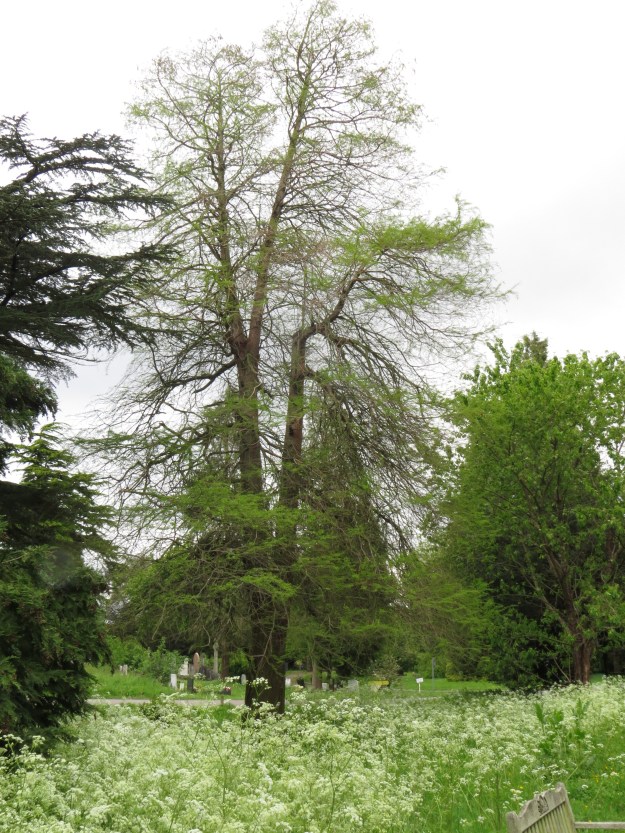
I am pleased to report that ‘my’ swamp cypress is finally getting a coat of green, rather later than I expected. Look at it standing ankle-deep in cow parsley!

I noticed how the flowers on the horse chestnut turn pink when they’re pollinated – you can see the mixture of yellow and pink blossom on this flowerhead. I have seen bumblebees about in the midst of the storms this week, determinedly heading for the dusky cranesbill which is in full flower in the garden. I am a recent convert to species geraniums – some varieties are shade-tolerant, and the bees love them. I imagine that a tree like a horse chestnut must be a powerful bee magnet. So many flowers! So much nectar and pollen!

There is some sorrel just starting to appear too – I horrified my husband by eating a leaf just to make sure. It looks rather like a grass, but it’s actually a member of the knotweed family. The leaves have a delicious lemony tang to them, and if you look at the stem you can see how similar it is to plants like bistort and redshank.

Common sorrel (Rumex acetosa)

When we reach the main path that leads to the North Circular Road entrance, what should we see but a blooming little egret flying past! I apologise for not getting a better photo for you, readers. I promise that the white blob just right of centre towards the top of the photo is actually an egret, not a stray handkerchief whooshing past in the high wind. I wonder where s/he was going?

On we go. I am delighted with the way that the sycamore flowers are already turning into the little ‘helicopters’ as we used to call them.

A rather magnificent crow surveyed the scene from the top of a tree. We’d just watched a crow pick up half a sandwich that someone had dropped, dunk it in a puddle to moisten it and then fly off, presumably back to a nestful of little dinosaurs waiting for their lunch.

And there’s an area completely covered in shining cranesbill (Geranium lucidum). Even allowing for the damp weather, just look how shiny the foliage is! And look at all those fallen horse-chestnut flowers, probably ripped untimely from the tree in this week’s wind, rain and hail.

Shining cranesbill (Geranium lucidum)

Storm damage


More branches down

My friend A told me that there were some whole trees down in other parts of the cemetery. It’s such a large area that they can lay around for quite some time if they haven’t fallen onto a recent grave, and if they aren’t blocking a well-used road.

And, as usual in the cemetery, I notice something that I’ve walked past a hundred times without really seeing it.

The broken column symbolises a life cut short, and was often used to signify the death of a child, as indeed is the case with this memorial. Little John Arthur Winter died at the age of 18 months, and is buried here with who I imagine are his grandparents, judging by the ages.

John Arthur was born in Shoreditch,  to Charles Richard and Amy Jane Winter, and was baptised in St John the Baptist church in Shoreditch. In 1881, 5 years after John Arthur had died, Charles Richard and Amy were living at 164 Southgate Road in Hackney. They had two children, Charles aged 12 and George aged 4, and their 4 year-old niece Alice was visiting them on the day of the census. Charles Richard lists his occupation as ‘clerk/surveyor’, but the section for Amy’s employment is blank. By 1891 the family have moved to Hever in Kent, and it seems as if Charles Richard has gone up in the world, with his occupation now listed as ‘Architect/Surveyor’. The older boy, Charles, is now 22 years old and a stonemason, and the younger, George, is a draughtsman and architect, so it looks as if both children followed in their father’s footsteps. Their niece, Alice, seems to be living with them, and they now have a general servant. In the 1901 census Charles Richard and Amy are still living in Hever, but all the young people have left and they no longer have a servant. The couple are only 55 years old  but by 11th November 1901, Charles Richard is dead, and is buried in St Pancras and Islington Cemetery, though not in the same grave as his infant son. Amy Jane follows him in 1920, and it seems from the burial records that she might have spent her last days in Brighton. Maybe one of her sons lived there?

It is extraordinary what you can find out on the internet these days, but the bare bones of a life give no idea of the really important things – was a person kind? Did they have a sense of humour? What infuriated them, and what got their pulses racing? Did they love their job, or hate it? Did the sons get on with their father? How come the niece was living with them? All these things vanish when the last person who remembers someone, or has heard about them, dies themselves. Nonetheless, I think we often don’t realise what a huge difference we can make to the people around us, for good and for ill, and how those things ripple out into the wider world. My grandmother remembered her two dead sons until her own dying day: one died at eighteen months of scarlet fever, and the other at two years old from diptheria. But the stories that she told me about them live on in me, and so in a way they still live on, though their lives were so short, and so long ago. Let’s never forget to pass on those stories.