Category Archives: London Birds

Goldfinches and Squirrels…

Dear Readers, there really seems to be no limit to the acrobatics that our local squirrels will perform to get at the sunflower seeds. Look at those toes, just about hanging on! I’m guessing that it’s all worth it. When the leaves fall off of the whitebeam I’m fully expecting there to be at least one drey, and possibly two. I think that the mother squirrel has had a pair of babies for the last two years. After all, with food and water available on your doorstep, why would you move?

But prior to the arrival of the squirrel, there was a largish party of goldfinches, including two fledglings.

One of the fledglings

Now, people sometimes ask how to tell the difference between a male and female goldfinch. In species such as chaffinches it’s very straightforward – males are pink and females are beige. But in goldfinches, it’s a bit more subtle. If you look at the photo below, however, it’s fairly clear (even though the photo is a bit on the murky side). The bird on the left of the photo is a male – the red colour on his face clearly extends above and beyond the eye. If the photo was clearer, you could also see that the feathers just above the beak are black (they are usually grey in the female. The bird on the right is a female – the red coloration doesn’t extend back beyond the eye. However, be warned – it’s practically impossible to sex juvenile birds, like the one on the top perch, and there can be lots of variation between individual birds due to their condition, whether they’re moulting or not and their age.

Male to the left, female to the right, juvenile at the top.

What I am really hoping, though, is that at some point the goldfinches take advantage of the teasels that I’m growing. I do like the idea of having wild food in the garden, but maybe the sunflower seeds are just too easy. Let’s see what happens as the year progresses.

And it’s still raining.

A Wet Saturday in East Finchley

Rain dripping from the awning outside Coffee Bank

Dear Readers, our usual Saturday walk in St Pancras and Islington Cemetery was terminated abruptly today in favour of a flat white in Coffee Bank on East Finchley High Road. What a morning! It poured down relentlessly, and I look forward to the statistics which are going to announce that this was the wettest August ever. Even in the rain there are still things to see, but I wanted to start by showing you who popped into the garden yesterday.

This little one is very skinny but otherwise healthy – her tail looks mangey in the photo but it’s actually just a lighter silvery colour. She is all legs, and ears,  and is clearly one of this year’s cubs. Normally they haven’t been visiting until it’s properly dark,  but I imagine this one was very hungry. After about five minutes she loped off into the undergrowth and disappeared. It always feels like such a privilege to be visited by these animals.

Back to the High Road!

Coffee Bank stands right next to what is known as Carol’s Crossing. A wonderful local woman, Carol Jackson, was killed in a car accident at this spot in 2019. There had been many complaints about the difficulties for pedestrians who wanted to cross the road at this point, and it was very sad that the refuge in the middle of the road which makes things so much easier was constructed literally weeks after her death. Flowers are often left here in memory of Carol.

The ‘Carol’s Crossing’ embroidered sign

The crossing that makes life so much easier for East Finchley pedestrians

While I was watching the rain, I suddenly noticed the terracotta panels on the houses opposite. It’s these little details that make the mixed architecture around here so interesting. Clearly Tudor roses were very much in vogue.

And there are some fine floral swags too.

At least the plane trees are enjoying the rain, after the long dry periods of the last few summers.

And above the shop there’s a ‘ghost sign’ for an off licence – it’s interesting that there is still an off licence on this spot.

Then it’s off for a brisk trot along Leicester Road. Someone has planted borage and corn cockle in their front garden, and once it gets a bit drier I’m sure the bees will be delighted. I see some enchanter’s nightshade in there too – for the longest time I never saw this in East Finchley but suddenly it’s appeared.

All Saints Church looks rather forbidding against the grey sky….

But as we turn into my road, there’s a patch of blue sky.

And there is also something of an Alfred Hitchcock moment. Look at all these starlings! What are they waiting for?

They are all clicking and preening and whistling and generally discussing something I’m sure.

Maybe one of these days East Finchley will have enough starlings to have its own murmuration. Wouldn’t that be exciting? As it is, my conscience is unwrung because I topped up the bird feeders before I went out. In the film ‘The Birds’, I don’t think it was ever clear why the birds started to attack humans, but goodness knows they have enough cause. Let’s hope they don’t ever get it into their heads to take revenge.


A Bit of a Racket

Dear Readers, over the years I have learned to tune in to what’s going on in the garden by the sounds that the birds make, and today there was a positive cacophony of clicking and wheezing and squeaking. I followed the sound around the garden, and eventually came across this handsome chap sitting on the fence. His name is Bear (very appropriate I think), and while I have occasionally seen him patting a frog on the head, he is generally much more interested in just hanging out.

However, this didn’t put off the little family of wrens. Have a listen here! I managed to get a fleeting glimpse of one on camera, but there were probably four or five of them, making a combination of loud clicks and much softer contact calls.

Seeing a wren in the garden used to be a cause for some celebration, as it was such an unusual sight. Since lockdown, however, I’ve realised that the garden is positively inundated with the little darlings, creeping through the hedge and the bittersweet like so many adorable flying mice. Such feisty characters, and such big voices! I have rarely managed to get a decent photo, as they are so hyperactive, but here are a couple of photos by John Humble, a long-term Facebook friend and wonderful photographer.

And here is an excerpt from Carol Ann Duffy’s Christmas poem, The Wren Boys, from 2015. It makes me think about all the things that we project onto animals, all the stories that we tell ourselves about them, and how they matter not a jot to the creature involved. It also makes me think about the Helen Macdonald book that I’ve just finished, ‘Vesper Flights’. A review will be making an appearance soon!

Hedge-bandit, song-bomb, dart-beak, the wren
hops in the thicket, flirt-eye; shy, brave,
grubbing, winter’s scamp, but more than itself –
ten requisite grams of the world’s weight.

And here’s the craic: that the little bird
had betrayed a saint with its song,
or stolen a ride on an eagle’s back
to fly highest; traitor and cheat.

But poets named it Dryw, druid and wren,
sought its hermit tune for a muse;
sweethearts thought it a foolproof blessing for love.
Which was true for the wren? None of the above.


Small Pleasures in St Pancras and Islington Cemetery

A hoverfly’s bum. You’re welcome!

Dear Readers, after missing last week’s walk in the cemetery because I was still feeling poorly, it was a great pleasure to have a stroll around today, enjoying the little things that have changed since I was here last. In truth, the end of July/beginning of August is a quiet time for nature, with the babies fledged, the caterpillars growing and all manner of creatures fattening up for the autumn, but there are still lots of interesting things going on if you look closely. The woodland graveyard site is full of blowsy thistles, wild carrot, ragwort and knapweed, and the hoverflies are taking full advantage.

Drone fly (Eristalis pertinax), a honeybee mimic

Hornet Mimic Hoverfly (Volucella zonaria)

Marmalade hoverfly (hopefully) (Episyrphus balteatus)

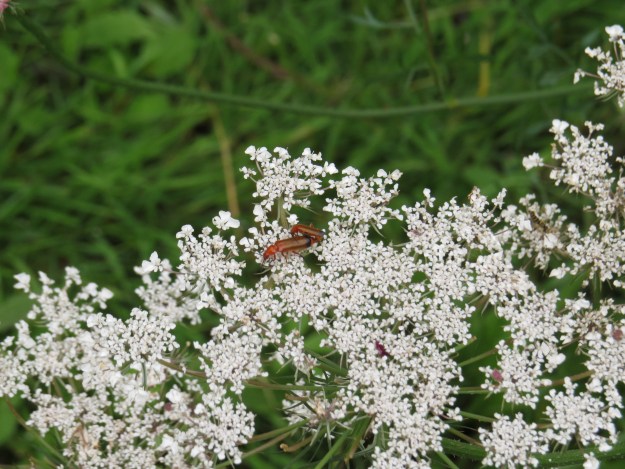
Hoverfly larvae are some of our most voracious aphid-eaters – we might be more familiar with ladybirds and their youngsters as they plough through a ‘herd’ of greenfly, but hoverfly maggots, though not the most appealing of creatures to look at, are basically aphid hoovers. The mimicry which means that these insects resemble bees or wasps is possibly also their downfall where humans are concerned – some people only have to see a flash of yellow and black stripes before they reach for a rolled-up newspaper. However, I’m sure that lots of predators leave them alone because of their colouration, so hopefully it all evens out. And look, here are some Common Red Soldier Beetles (Rhagonycha fulva), living up to their popular name of ‘bonking beetles’.

The conkers are continuing to fatten up.

Now, there’s a rose bush growing out of this conifer. So far, so unusual.

But here is something even more interesting…

This shaggy mass is the gall of a wasp, Diplolepsis rosae, which laid its eggs in the buds of the rose in the spring. Otherwise known as robin’s pincushions, each of these structures is woody inside and covered in long red or green hairs. The gall will contain many chambers, each of which contains a well-protected wasp larva. Male wasps are very rare, but the females can reproduce without needing sperm, so this is no problem. The new wasps appear in the spring, just in time to find new buds to parasitize. In Germany, these galls are known as ‘sleep apples’, and putting one under your pillow is supposed to be a cure for insomnia.

Photo One by By Frank Vincentz - Own work, CC BY-SA 3.0, https://commons.wikimedia.org/w/index.php?curid=2623501

The inside of a robin’s pincushion, showing the chambers and larvae (Photo One)

I was having something of a gall-ing day though because I also found these galls on some crack willow. Someone has clearly been having a very good time! These are caused by a sawfly rather than a wasp: the female injects a chemical into the leaf that causes the plant to make the gall. She usually also lays an egg, which eats its way out of the gall over a few weeks, but occasionally a gall won’t have an egg, because for some reason the female didn’t lay one. This tree was positively peppered with galls but looked very healthy nonetheless. Healthy plants can put up with a great deal of nonsense from insect ‘pests’ without any detriment.

I spotted this lovely fresh female Gatekeeper butterfly (the males have a brown stripe across the forewings).

Rather less welcome is the positive plantation of Himalayan Balsam that I’m seeing next to the cemetery stream. This is such an attractive plant – it bears more than a passing resemblance to a huge moth orchid, and it comes in a whole range of pink, white and coral. However, it is going to be taking over this stream if folk don’t watch out, and as the cemetery already has a massive problem with Japanese Knotweed I hope that it will be kept under better control.

As we were walking through the trees, I heard the sound of young birds, probably raptors of some kind, hidden in the branches overhead. It was so frustrating not to be able to see them! But then I remembered a tip from Mike over at Alittlebitoutoffocus – he’d recently uploaded an app where you can ‘listen’ to birdsong with your phone, and it will then tell you, to a reasonable degree of accuracy, what you’re listening to. So, in the middle of the cemetery I downloaded the app, recorded the birds and lo and behold, it returned a result of ‘sparrowhawk’ with 95% certainty. Two minutes later, a sparrowhawk flew overhead. Result! I spent the rest of the walk recording various birds to see how good I was personally – I identified a song thrush, a green woodpecker and a blackcap, but would have missed a greenfinch (even though I know that they’re present in the cemetery because I’ve seen them). So, I can recommend this app if you want to improve your id skills, or even just want to find out what birds are about – there are definitely lots more than you ever see.

And finally, I had to stop to smell the lime blossom. I think it’s one of my favourite perfumes – not as heady as jasmine, not as floral as rose. What a delight it is to feel almost normal again.

Photo Credit

Photo One By Frank Vincentz – Own work, CC BY-SA 3.0, https://commons.wikimedia.org/w/index.php?curid=2623501

A Late July Walk on Hampstead Heath

Dear Readers, there has been all sorts of shenanigans at the Bathing Ponds on Hampstead Heath during the past few years. Charges were introduced for swimmers at the Women’s Pond for in 2004 (though I note that over sixties can still swim for free before 9.30 a.m.), and were increased recently. Works have taken place to dam some areas around the men’s pond due to flood risk – there are a lot of flood mitigation works in the pipeline in several of the green spaces in North London, and with the recent flooding following storms during the past month it looks as if something will need to be done. Balancing the future needs of the area against present amenities is always tricky, especially as, with climate change, things look so uncertain. One thing is certain – Hampstead Heath will always provoke strong, passionate feelings from those who use the area regularly, and who want to protect it. Long may this continue.

It was very quiet in the woods today: on a summer weekend during lockdown the crowds were everywhere, but today seemed like a welcome return to some kind of normal. The ivy roots dangling from this horse chestnut put me in mind of those great trees of the Southern USA with the Spanish Moss dangling from their branches.

There are little patches of Small Balsam (Impatiens parviflora) – I haven’t noticed this elsewhere in North London. At least it isn’t as bold and invasive as the Himalayan Balsam (Impatiens glandulifera) that’s popped up in other places, such as the Cemetery.

This very fine hoverfly was on the creeping thistle – I can’t pass a patch of thistle without stopping for a look, there’s always someone interesting popping in for a feed. This very handsome chap is the Great Pied Hoverfly (Volucella pellucens), a close relative of the Hornet Hoverfly(Volucella zonaria) that I mentioned in my post about Cherry Tree Wood earlier this week. The Great Pied Hoverfly has a most interesting lifecycle. The adult female walks into the nest of a common wasp, and somehow gets away without being stung to death. She lays her eggs, and when they develop into larvae they feed on detritus in the nest, and dead and dying wasps and their larvae. When they are ready to pupate, they leave the nest and burrow underground, reappearing the following spring in time for the whole cycle to begin again. Never underestimate a fly, that’s all I can say.

And here is some Great Mullein (Verbascum thapsus),  a plant that I hadn’t noticed on the Heath before. I feel a Wednesday Weed coming on.

Great Mullein (Verbascum thapsus)

And here is some Musk Mallow (Malva moschata), a much more delicate plant than the Common Mallow that I’m usually finding all over the cemetery. Another Wednesday Weed, maybe?

Musk Mallow (Malva moschata)

I always love my first glimpse of Kenwood House through the trees. That way lies coffee and a brownie!

Now, have a look at this absolutely magnificent sweet chestnut (Castanea sativa). I am clearly getting better at identifying things, because one factor in identification of mature sweet chestnuts (over 60 years old) is that the bark starts to spiral around the tree, usually in a clockwise direction, though I’m not convinced that this isn’t anti-clockwise (says she, scratching her head). I do love being able to put a name to things, it seems more respectful somehow. Also, I must remember to take a big sniff towards high summer, as the male catkins are said to smell of frying mushrooms.

When we finally get our coffee and brownie, we’re joined by this very fine pigeon. He is not at all deterred by the fact that my husband’s flapjack is vegan, and I swear he’d be sitting on our knees waiting for crumbs if he was allowed. He breaks off only briefly to huff and dance around a female he lands nearby before he’s back on flapjack watch.

A crow flies up onto the roof of the building opposite with what appears to be an entire scone – possibly someone wasn’t paying full attention in the tearoom gardens next door. The crow is soon joined by a fledgling. I can’t see for certain, but I suspect that the adult is dunking the cake into some water in the gutter to soften it up a bit for the youngster – I’ve seen them do this before. You are always being watched by some sort of avian beady eye when you sit here with a sandwich. Be warned.

The flowers outside the gift shop are all supersized, be they the white hydrangeas, the dahlias or the ten-foot-tall sunflowers.

And there was a brief moment on the path back to the ponds when there was no one around at all – not a jogger, not someone having a conversation on their mobile, not a gaggle of small children or a dog walker with various hounds. There was just us, and the sunshine, and the trees for about 90 seconds.

Long enough to notice how the Enchanter’s Nightshade, normally such a weedy little plant, can actually also be magical in the right light.

Back to the boating pond. Oh dear.

And just in case it isn’t clear….

No one told the ducks and the black-headed gulls though, and the swifts were skimming the surface for insects. I haven’t seen a single swallow or house martin yet this year though, I hope things are better where you are.

Tufted duck and black-headed gull having a rest

And how about this female/juvenile Mandarin duck (Aix galericulata)? I’ve never seen a male here, but I know that many of them have escaped from wildfowl collections. There are a lot more protected, reedy areas around the boating pond now, and the duck nests in tree holes, so it would be nice to think that they might have made a home here.

We head back, stepping carefully around a painted lady butterfly that’s picking up salts from the path.

I’m delighted to see the ragwort doing so well – this must be one of the UK’s most maligned plants, but it’s the foodplant of the cinnabar moth, and is much beloved by all sorts of pollinators.

We stop for a few minutes to watch the dogs swimming in the doggy part of the pond. Some dogs are clearly into it, and others can’t understand what all the fuss is about. Guess which heading this hound falls under.

And then it’s back to the 214 bus stop, with a brief pause to admire this sign on the side of what is now an Italian restaurant. How I’d love to stop for a Bean Feast!

A Summer Walk in East Finchley Cemetery

Bhutan Pine (Pinus wallichiana)

Dear Readers, today I pulled out all the stops and headed to East Finchley Cemetery for a quick look at what was going on. I feel a bit as if I’m in Wonderland at the moment – all the colours seem brighter and the sounds of the birds are enchanting.

There are some spectacular specimen trees in the cemetery, such as this Bhutan pine (Pinus wallichiana). Its original home is the foothills of the Himalayas, Karakorum and Hindu Kush, but it seems strangely at home here in North London, amidst the monkey puzzle trees and the cedars of Lebanon.

On a smaller scale, I love the community of tiny plants living on this wooden roof. What look like bird droppings are, in fact, lichens.

And then a streak of greenish-yellow catches my eye, and a young green woodpecker poses very nicely for a few minutes.

We hear a young bird of prey calling from one of the big cedars, but no amount of patience will persuade it to emerge from the foliage, and its parents are clearly not in the mood to indulge it, so I might never know what it was. Very frustrating, but then that seems to be how nature works – some days everything falls into your lap, and some days you have to sigh and walk on.

There are some lovely unused buildings in the grounds of the Cemetery, which seems to mostly use the Italianate crematorium or the big Anglican chapel at the main entrance. The Glenesk Mausoleum is a lovely building, now completely fenced off and in danger of being engulfed by the nearby trees.

The Glenesk Mausoleum

There is a hopeful kneeling saint on the right hand pediment, but the one on the left has disappeared under a tangle of ivy.

The non-conformist chapel is in better shape, though the two small heads on the doorway have seen better days.

I’m not sure how much this chapel is used, but according to the cemetery’s management plan to 2012 it was thought to be a feeding roost for brown long-eared bats, so maybe a little seclusion is not a bad thing. There are lots of bat boxes mounted in the trees around the cemetery, but as it closes at 4 p.m. I guess I will never take a twilight walk to see what’s going on. Let’s keep our fingers crossed that the summer air is criss-crossed with bat flight.

And, as I am midway through my Leith’s Online Cookery Course (it’s pasta week!) my eye was drawn to this grave. Jean Baptiste Virlogeux was chef at the Savoy during the 1930s, and was then Head Chef at the Dorchester for ten years, where he catered for the Queen and Prince Phillip. Whilst at the Savoy he invented the ‘Omelette Arnold Bennett’, a mixture of smoked haddock, eggs and gruyere in honour of the famous author. At the Dorchester, Virlogeux came up with the idea of the ‘Chef’s Table’, a private table for very special guests who could watch the chef work and no doubt ply him with confusing and impertinent questions while he wrestled with their dinner.

On our way back to the entrance we encounter this cheeky squirrel, who is clearly of the view that if he stays still enough we won’t notice him.

But then, how about this? Most of the beds in the cemetery are rather formal, but this is so bright that it seers the eyeballs, and none the worse for that. There is a sweet smell, I think from the salvia. How it cheers me up, especially on a dull day like today.

And just when you think the colours couldn’t get any brighter, look who drops in.

Peacock butterfly (Aglais io)

And now it’s time to head home for a cuppa and a few hours with my feet up (once I’ve done my blog of course). As usual the cemetery has provided all sorts of delights. What fine spots they are for reflection and for nature!

Oh The Irony….

Dear Readers, there is something a little ironic about having gotten through 18 months of a pandemic without even being pinged by the NHS app, only to catch something and end up self-isolating when ‘Freedom Day’ is today, 19th July. On the other hand, ‘Freedom Day’ won’t be freedom for vulnerable people, people who have compromised immune systems because of chemotherapy, elderly people or anyone else who has reason to fear the devastating potential effects of this virus. With only 50% of the country double-vaccinated, would it really have hurt to keep things on an even keel for another month or so? I don’t doubt that most people will continue to be sensible, but there has been a leadership vacuum of colossal proportions in this country. My heart goes out to people working in the NHS who are seeing the numbers of the hospitalized rising inexorably. We have been abandoned. No wonder so many people are filled not with joy at the unlocking, but with trepidation.

Anyhow, I have done my Covid test and posted it, and now I wait to see if what I have is something known or something unknown. I feel a bit tired, but basically much better, so I will just have to be a patient patient. Thank you for all the good wishes, and in particular to the person who reminded me that even if  it’s not Covid it doesn’t mean that  I should rush headlong back into my usual frantic round of activity – I think the phrase was ‘other viruses are available’, which made me hoot.  That is excellent advice. I feel tired to my bones somehow: it’s sometimes a struggle just putting one foot in front of another. But then, there’s always the garden, and it’s too blooming hot to do any actual work so I just sat in the shade and tried to pay attention, as that is the cure for most ills.

If you look very carefully at the picture below, you can just see a tiny plane about to enter the clouds. Who remembers that feeling when you’re on a flight and the plane starts to judder as you enter the clouds, as if it’s flying through something viscous? Or that extraordinary sensation when you get above the clouds and there’s the sun and that perfect blue? It always reminds me of that Buddhist sense that behind all our nonsense there is that clear, vast ‘mind’ that is available to all of us if only we could put other things aside.

I wouldn’t want you all to think that I was being too lazy, so I actually got up and wandered over to the pot of ‘wild flowers’ that we planted about a month ago. It’s fair to say that they haven’t been a stunning success, but what’s with the brassica? It looks like oilseed rape to me.

But all is not lost, because I did notice a small white butterfly hanging around earlier this morning, and when I bent down for a closer look, she has laid a single egg. Now, if you’re a gardener I can imagine you not being that impressed, but at least Small Whites only lay one egg, as opposed to 50 like a Large White. I shall have to see if this one survives, and shall have to remind my poor long-suffering husband not to water too enthusiastically this evening when he gets the hosepipe out.

In other news, the Great Willowherb is just opening. Every year the buds are parasitized by some little moth, and every year it seems to make not a jot of difference to the flowering.

And the collared doves are huddled in the whitebeam for shade. I think these birds are underestimated on the looks front, with their subtle shades of cinnamon and fawn and dusty grey.

And so, there you have it. I expect a few more garden posts in the next few days, but the weather looks gorgeous. Stay safe out there, UK people, and avoid any idiots….

Five Minutes in the Garden

Dear Readers, it’s been one of those days when what I’ve mostly done is compare and contrast two spreadsheets and try to bring them together as one coherent whole, so what a pleasure it was to get up, stretch my legs and see what was going on in the garden. There are still a few damselflies about, I rather like that this one has a bar-code on her tail. This one is a Large Red Damselfly (Pyrrhosoma nymphula) and I know that it’s female because you can just about see a yellow band between some of the segments on the abdomen. She’s probably thinking about laying her eggs somewhere in the pond if she hasn’t done so already.

This plant has just popped up (as they do), and it’s a willowherb, probably Hoary Willowherb (Epibilium parviflorum),  a common willowherb of damp places. It’s so delicate that it’s hard to imagine how it held its own amidst the more vigorous plants, but here it is.

And over in the bittersweet there’s a bumblebee with bright orange pollen baskets on her legs. She looks as if she’s wearing a pair of tangerine-coloured bloomers.

This bee is carrying grey pollen, and interestingly you can tell what plant a bee has been foraging on by the pollen colour. Grey pollen can come from hazel or elder (probably elder at this time of year), and orange can come from lime – there are masses of lime trees in flower at the moment.

And having mentioned that I hadn’t seen any chaffinches for a while, a young one popped up on the seed feeder.

And finally, look who turned up on the guttering this morning while I was half-way through (yet another) Zoom call! The garden has been full of sparrows all week, and some were even belatedly examining my sparrow nesting boxes. Let’s hope they remember them next year.

LNHS Talks – ‘Are Gardens Good For Birds’ by Mike Toms

Dear Readers, this is a topic that will be close to all of our hearts, I’m sure. Are we actually helping birds when we feed them in our gardens? Should we be doing it all year round? What are the pitfalls of attracting large numbers of birds to a small space? I was eager to hear what Mike Toms had to say – he wrote the ‘Garden Birds’ volume of the New Naturalist series, one of my favourites, and currently works at the British Trust for Ornithology (BTO), so he’s a man who knows of which he speaks. I’ve given quite a lot of detail  here as I found it absolutely fascinating.

Toms started by explaining that the BTO is a research-based organisation that looks specifically at bird populations – changes in distribution and numbers, and the reasons for those changes. The bird that has been studied the longest is the grey heron – BTO have data going back to the 1930s and were able to map a correlation between cold, hard winters and declines in the heron population. Increasingly, though, the BTO studies birds in urban environments. In 2008 the world reached a point where half the population now lives in towns and cities, and this is expected to increase to two-thirds of us in 2050. Urbanisation has consequences not just because of the footprint of the areas themselves, but because of the resources that are needed to support them. Globally, some of the areas that are urbanising most rapidly are also those with the highest current levels of biodiversity, such as south-east Asia and the Horn of Africa.

In the UK, some species can adapt very nicely to the urban environment (Toms showed a photo of two herring gulls looking hopefully at somebody sitting on a bench with a sandwich). Such species have a broad diet, and are not too specific in their requirements, which is one reason why dove and corvid species do so well in our towns and cities. In the garden environment, you’re likely to see a lot of seed eaters, such as sparrows and finches, but far fewer insectivores.

London is particularly well-blessed with green space, however, and although we think about this in terms of parks and woodland, private domestic gardens are by far the biggest space. Taken together, the gardens of the UK cover a larger space than all of the land set aside for nature reserves. At this point, Toms did a survey on whether the live audience thought that gardens were good for birds, and over 90% thought that they were.

Toms then started to look at gardens in more detail. One trend, especially since lockdown, was that people wanted to make their little bit of greenspace more wildlife friendly – he showed a slide of a garden from the Chelsea Flower Show which was contemporary but had a bird feeder, lots of pollinator-friendly plants and some small trees and shrubs – it seemed like a nice combination of the aesthetic and the useful.

The big draw for birds in our gardens is clearly food – Toms had the staggering figure that across the UK we spend £200m per year on bird food (and about half of that is me 🙂 ). For birds to stay in our gardens, and not just use them for food, there need to be nesting opportunities too.

Toms showed an interesting graph which illustrated the reporting rates for robins – volunteers at the BTO record which birds they see in their gardens every week. It showed firstly that reporting rates for rural and suburban gardens are higher than those for urban gardens overall, but that all three types of garden showed a drop off during the breeding season – this seems to indicate that while robins will use gardens during the winter season as a food resource, they prefer not to nest in them.

Why is this? One reason is that most birds feed their nestlings on insects, and these are just not plentiful enough in gardens. Blue tits, for example, will nest in deciduous woodland where there are lots of caterpillars given the choice. This year was particularly devastating for birds as May was so cold, and June so wet, so there were lots of reports of nests failing and nestlings starving in the nest. However, a significant proportion of birds (over 50% of starlings and sparrows, a third of jackdaws and blackbirds and, surprisingly, 25% of song thrush) do breed in gardens, so the habitat is clearly important for these species.

Rural gardens in particular can also be important for birds such as the yellowhammer, tree sparrow and reed bunting, who are seedeaters  –  Toms showed a graph of farmland birds who visit gardens  with a seasonal peak in April, when all the natural food that the birds would normally eat has finished. In days gone by, there would be grain amongst the stubble, but with more efficient farming methods, the birds have taken to visiting feeders. This is especially important in the case of the cirl bunting, a very rare species in Devon, where garden feeding has really helped to reinforce the population.

Turning to blackbirds, Toms showed a graph of the reporting rate of the birds which showed a marked fall-off in the autumn every single year. He explained that this is partly due to the birds becoming more secretive during the moult, but also that they often move out of gardens during the glut of berries that are available in parks and the countryside.

With blue tits, Toms spoke about ringing exercises (where individual birds can be identified), which shows that it isn’t just the same old three or four birds visiting the feeders, but a succession of birds – you could have thirty different blue tits visiting the feeder in the course of a day.

Toms moved on to coal tits – these little birds largely feed on the seeds of coniferous trees, and so have done very well with the planting of sitka spruce plantations (one of the few creatures that have, I imagine). Again, the data from the recorders showed an annual peak and trough, but the peak was supressed in years when the spruces were ‘masting’ (producing their seed) – this only happens every few years, so that there is so much seed that the predators can’t eat it all, and the tree has the best chance of reproducing. In other words, if the spruce seed is available, the coal tits will eat it in preference to visiting the garden, but they will use the gardens if it isn’t so plentiful.

Then, Toms looked at longer term studies. One of them, on goldfinches, has showed a massive increase in the use of gardens by the species. Interestingly, there seem to be two ‘spikes’ in the data, which might indicate that firstly resident birds are using the gardens for food during the breeding season, and then a second wave of migrant birds comes in to take advantage of the resource.

Feeding is not an unalloyed good, however – Toms gave the example of trichomonosis and the greenfinch. This protozoal parasite is spread in saliva and faeces from infected birds, and is a very good reason for making sure that feeders are cleaned regularly. What I hadn’t realised was that the ‘spillover event’ probably came from woodpigeons, who have been carriers of this parasite for years, and one place where pigeons and greenfinches come into contact is at seed feeders in gardens. Greenfinch and chaffinch populations have been horribly affected, with Toms describing the chaffinch population as being ‘in freefall’. It made me think about the last time that I saw chaffinches in the garden, and it’s been quite a while ago.

The ‘pox’ that we sometimes see on blue and great tits seems, according to the BTO research, to have actually come from blackflies which have jumped across from the European mainland, thanks yet again to climate change.

Finally, Toms looked at blackcaps. These birds are increasingly using our gardens in the winter time (probably migrating in from Eastern Europe), and interestingly they prefer urban gardens, which are warmer because of the urban heat island effect (all that concrete stores heat during the day and releases it at night, increasing the ambient temperature). Blackcaps also prefer gardens where food is available every day.

So, it seems that the food that we provide is changing the behaviour of some birds, but by attracting them to our gardens we also increase their exposure to some diseases, and to different predators, such as cats and grey squirrels, which might not be so common in the countryside.

So, what were the conclusions? It’s very clear from the BTO’s studies that the birds who are visiting our gardens have become more diverse over time. We’re also putting out different foods – many of us are feeding not only seeds and peanuts, but suet products. Apparently, too much fat can affect a bird’s feather condition, but the addition of Vitamin E can counteract that. Where do I get suet products with Vitamin E, I wonder?

Living in an urban area brings a whole selection of risks and opportunities. There is pollution in cities that especially affects birds with their delicate lungs, glass windows claim billions of bird lives globally every year, and night time lighting can be confusing and destructive. Some studies have shown that blackbirds living in urban environments have shorter telomeres (the sections of their genetic code that protect the core genes), indicating that they have increased stress levels. Robins have to sing at night because they can’t make themselves heard over the traffic noise. Woodpigeon populations have gone through the roof, and may be contributing to disease in other species.

To sum up, Toms indicated that gardens are probably good for birds on balance, because they provide feeding opportunities and help to offset some of the damage that humans have done elsewhere. But it isn’t straightforward. Toms put in a plea for more research on what birds need, and especially pointed out the BTO’s Garden Bird Watch

To watch the whole talk, click here

How the Mighty Have Fallen….

Dear Readers, those who’ve been following this page for a few weeks might recognise this plant as the nine-foot tall angelica that popped up this spring. Well, the flowerheads have gone over and the plant has been looking a bit precipitous for a few days, but the rain and wind on Sunday night finally blew it over altogether. What a shame! But it’s clearly become handy for some of my local visitors, who find it very convenient.

The garden is still full of fledgling starlings – by this time in a normal year they’d be much more independent, and the garden would be falling silent. This year, the little devils are still everywhere. Each time I walk out to the shed they positively explode out of the surrounding trees and shrubs, followed by the woodpigeons, collared doves, goldfinches etc etc.

I’ve taken to saying “Calm down guys, it’s only me” every time I go out, but I’m not convinced it’s working.

And then, I had a very nice surprise this morning.

Fledgling sparrow marching along the hand rail.

Look at this fledgling house sparrow! I haven’t really seen sparrows in the garden for months, apart from the odd fleeting visit, but this morning the place was full of them. Here’s a Dad feeding his youngster…

For an enchanting ten minutes they seemed to be everywhere. Perching on the hemp agrimony….

..hanging out on the greater willow herb…

or just chilling on the hand rail waiting for some food….

…and every so often getting lucky…

Mum used to love sparrows.

“They’re so friendly!” she’d say. “You never see them fighting”.

Well, all I can say is she must have been watching a different species from the one that I observe, because I see sparrows squabbling all the time though, to give Mum her due, it does normally seem short-lived and non-serious. And today it was all about the difficult business of rearing these hard-earned balls of fluff to maturity. I always feel so privileged to host the local birds, especially when, like sparrows and starlings, they’ve become so much rarer than they were when I was a girl. The garden might look a bit wild and woolly, but goodness a lot of wildlife pops by, and that makes me much happier than a manicured plot would ever do.