Category Archives: London Mammals

Coming Home at Last Revisited

Dear Readers, in October 2018 Mum and Dad both went into a nursing home in Dorchester. It was one hell of a change for all of us, and reading this I think I was walking around in a daze. 

Dear Readers, it’s some indication of how the summer has passed that I have not created a post about East Finchley since June. But this morning was so beautiful that I had to go out with the camera for a stroll around the County Roads. I have been so stressed that I have become completely unmoored, and the cure is to walk, slowly, to pay attention, to breathe and to notice. What better place to start than with the plane trees on the High Street, that seem to be holding the sun in their branches? They are the last species around here to come into leaf, and the last to lose those leaves.

The Bald-Faced Stag gazes towards Cherry Tree Wood, as usual.

There are a lot of tropical Fatsia plants in some of the south-facing front gardens on Lincoln Road. The buds look like little green artichokes, bursting into waxy white flowers.

There are lots of members of the daisy family still coming into flower, loosening those tight-fisted buds one petal at a time.

Michaelmas daisies are everywhere, I love the way that the stamens go from yellow to purple as the flower ages.

Michaelmas daisies

A pumpkin left over from Wednesday’s Trick or Treating gives me the side-eye…

And the autumn berries and hips and fruit are set off by the blue sky.

Each burst of colour feels like a small electric shock. I ask myself where the summer went? Since July every waking moment has been spent organising, planning and worrying about my parents. Now that they are in the nursing home I feel redundant, without purpose. This will pass, I know, but at the moment I feel as if all the grief that has been stored up over the warmer months is exposed by the extravagance of autumn. It all feels just a little too much, beautiful as it is.

I spent a few days with Mum and Dad in the nursing home last week. I had a chance to have a good talk with Mum and to take her through what had happened, step by step. She seemed to understand, finally, that we were unable to look after her at home anymore, and that we wanted to carry out her wishes to be with Dad, and to be close to the friends and neighbours  that she loves. She hasn’t mentioned going home since, though I am not optimistic enough to assume that this will be the end of the conversation. But things look better than they did last week, and that is a bonus.

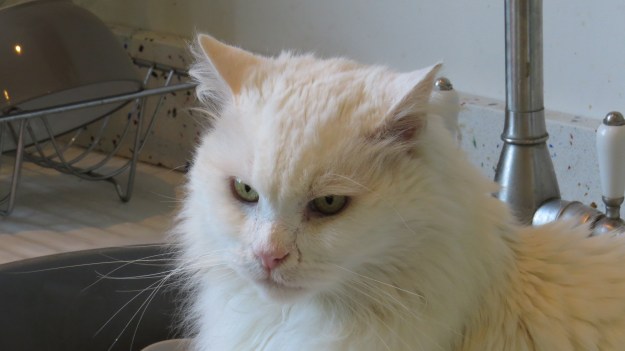
And now, I have to work out what I want to do when I grow up. As I am nearly sixty, I’d better get a move on. And in the meantime, I am walking the streets with my camera, making friends with the local cats.

There is one garden that I really love. It is a tiny space but absolutely full of nicotiana, borage, and other pollinator-friendly plants. There are a few honeybees even on this chilly day – one of the benefits of a south-facing plot is that it warms up the insects and helps the nectar flow. As I watch, I hear a low-pitched humming, and a queen bumblebee as big as the first joint on my thumb appears. Maybe the warmth of the day has roused her from her hibernation, and she needs a snack. The borage shudders and bows under her weight.

I float along to the High Street again. For a whole hour I haven’t been worrying about whether the nursing home are taking dad’s slight chest infection seriously, or what they will do about the fact that he’s now more or less nocturnal and keeps waking mum up. I realise that though I still have a role to play, the day to day care is not something that I need to meddle in. The home is happy for me to phone whenever I want, but I do think that after being so involved for such a long time, I need to step back from the small stuff. The trouble is, it’s a reflex, and it gave my life purpose.

What do I do now, with my one wild and precious life?

Well, one thing seems to be that I take photos of bollards that have been knocked over. The one on Leicester Road is no sooner concreted into verticality than it’s prone again. This cycle must have been repeated a dozen times since we moved to East Finchley in 2010. And there’s a bollard on the High Street that is similarly afflicted. I could extract some cheesy metaphor about persistence and resilience, but actually it seems a bit Sisyphean, a never-ending task that seems to have no more meaning than a grudge match between bad drivers and some long-suffering council workers.

On Bedford Road there is a rather beautiful tree. It is poised like a heron about to take off, one branch flung back and arching over a garage, the other leaning over the pavement and almost kissing the tops of the cars. What a deeply inconvenient being it is, no doubt blocking out the sun from the front windows and depositing leaves in great russet piles. And yet, it is obviously loved, and encouraged, and valued. There is room on these streets for the strange, the unusual, the awkward. I feel at home here. One day it will be my turn, too, to leave. I hope that I will have planned ahead so that the transition will feel like one that was a choice, rather than imposed on me. And in the meantime I hope to make the most of the harvest, and of the glory that it brings.


The Cup of Gold – Revisit

The Cup of Gold 002

Bug Woman is away, but I love this celebration of Coldfall Wood, and the unlikely people that you meet there…..

During the past week, my husband John and I have been going for a walk around Coldfall Wood after dinner every night. We can both sense that the darkness comes a little earlier with every passing day, and soon, it will be night time before he gets home.

When I open the gate to the wood, it’s as if I’ve entered another world. The branches of the oak and hornbeam meet overhead, so the area underneath is still and dark, the only sounds the chippy calls of robins sorting out their territories. These are ancient, twisted trees that look as if they’ve been caught out in the middle of a dance, and will start to gyrate again once we’ve moved on.

The wood is only a few hundred metres deep at this point. As we follow the path, we can see the sun setting, the space between the trees glowing copper-red, an abstract painting of molten light and matt black. As the path turns right, we are right up against the fence that separates the wood from the allotments. And there, in the fork of a small tree, I see something that makes me catch my breath.

The Cup of Gold 005

It looks as if someone has woven a delicate cup out of strands of caramel. In fact, it’s a spider’s web, layer on layer of threads twisted around and around the twigs. Beautiful in itself, it’s now backlit by the sunset. And to complete the illusion of something supernatural, every individual silken hair is moving gently in the whispering breeze.

Such moments, when we see something as if we’ve never seen it before, feel sacred to me, as if for a few moments we’ve been granted a view of the innate beauty and perfection of everything on this earth. It makes me wonder what I miss every day as I go about my business, oblivious.

In a few minutes, the sun has disappeared and the web returns to invisibility. We walk on, loop up onto the playing fields. There are dozens of crows here, digging at the turf, chatting away, walking around with their feet turned inwards and what looks like their hands behind their backs. They always remind me a little of Prince Charles – it must be that slightly self-conscious gait. Crows have such a variety of cackles and coughs and giggles and caws, and as they fly backwards and forwards from the trees to the football field, they use them all. This is a big crow community, and I wonder what they talk about.

Hitchcockian Crow

We turn back into the darkness of the wood, turn right over a tiny muddy brook, one of several that criss-cross between the trees. Towards the road, a big bed of reeds is growing, planted deliberately to try to reduce the polluted water that comes from the road above. There is a small scuffling noise in the brambles, and a rat appears. I’ve seen one here everytime I’ve taken this walk, but I have no way of knowing if it’s the same one, or if there’s a family. They seem to be especially common this year – maybe the warm weather has meant more picnics, and hence more food-waste, although the wood is normally very unlittered. The rat sits up on his haunches, gnawing at something that he holds between his little pink hands. He is surprisingly tame, and lets us approach to within ten feet before he scuttles off into the undergrowth.

The Cup of Gold 012We turn the final corner to head home. A young man wearing a beret and glasses is there with a small hairy dog. We say good evening, pass him by, go on a little further, and stop. There, amongst the dead leaves, is one of the biggest cats I’ve ever seen.

‘Hello!’ I say.  The cat looks a little unnerved, but comes forward all the same. It has a mass of long hair, in cream and tabby and swirls of grey. Its ears have little tufts on them, as if were a lynx.

‘He looks like a Norwegian Forest Cat’, I say to John. ‘What a beautiful cat’.

The young man turns.

‘Yes’, he says, “He is a Norwegian Forest Cat. He sometimes comes for a walk with us when I bring the dog out’.

The little dog rushes up to us, jumps up for a sniff and a lick and a scratch on the head

‘Careful’, says the young man, ‘He’ll cover you in mud’.

But it’s a dry evening, and so the damage is minimal.

‘It’s a bit of a pain when the cat comes out, actually’, says the young man. ‘I have to watch out for all the other dogs in case they chase him. He might be big, but he’s really soft’.

The dog runs up to the cat, who head butts him. They are obviously good friends.

And so, that finishes off a fairy-tale evening. We’ve had cups of gold, talking crows, tame rats and cats that go out for a walk with their dog and human friends. Coldfall Wood really is a magical place.

Well, That’ll Teach Me

Dear Readers, when I went off to Canada a few weeks ago, my window box was looking pristine – some lovely cyclamen, and a rather attractive fern. On my return, I thought it looked a bit ropey but put it down to lack of water (though goodness only knows it appears that the UK has had lots of rain). However, on closer inspection there was something rather unusual poking up like a little bald chap through the soil.

Before I left, I put out some eggs for the fox – they were just past their sell-by date, but would have been defunct by the time I got back. And it looks as if the little devil has jumped onto the garden table, then onto the windowsill, and has cached two of the eggs in the window box. I just wonder if she’ll be back for them later? I shall keep you posted.

And in other news, the squirrels have taken the top off of the squirrel-proof feeder again, and goodness only knows where it’s gone. I have combed the area but no sign so far. And I’m pretty sure that I screwed it back on tight, so they must be more dextrose than I gave them credit for.

Squirrel-proof feeder no longer!

But it’s not all bad news. My whitebeam and hawthorn trees (which I decided to postpone pruning until the autumn because it was getting a bit late in the spring) are looking magnificent. The white lilac is quietly turning into a tree as well.

My marsh marigold is in full flower (though I note that the duckweed is coming back and is going to need a bit of skimming).

The geranium is doing well as cover for frogs, and the green alkanet has rather taken over. That’s a fine digging-out job for someone at some point, but at the moment I’m just pleased to see something thriving. And I just spotted some bindweed poking out of the geraniums, so there’s yet another job. Every year we go away to Canada in the spring and then I spend the rest of the year playing catch-up. Hey ho!

And finally, my winter-flowering honeysuckle, which was basically a twig, has really taken off this year, two years after it was planted. It’s a funny thing, that – some plants really do take a while to get established and happy. I’m hoping for great things later in the year.

My winter-flowering honeysuckle.

So, it’s all go in the garden. How is yours doing, if you’re lucky enough to have one? The weather has been most peculiar here this year – Toronto actually felt warmer than London, whereas usually it’s balmy in comparison. And I can tell that it’s been raining buckets, but then a lot of the plants seem to have thoroughly enjoyed the conditions. Let’s see what the rest of the year has to offer.

2021 – R.I.P Bailey, King of the Cats

Bailey, the world’s most magnificent cat in 2017

Dear Readers, when I say that a community is about more than just people, I often think of Bailey, who visited our garden regularly from when we moved in in 2010 to when he passed away in 2021. What a magnificent creature he was! And he seemed to bring the community together in a whole range of creative ways. We miss him still….

Dear Readers, a few nights ago Bailey, the King of the Cats, went to sleep for the last time at the fine old age of nineteen years. He has been so much part of our life, and of the lives of many people who lived in the County Roads, that I wanted to pay tribute to him here.

I first met Bailey before we even moved to East Finchley. We were standing on the patio of what was to become our new home when we heard a loud and persistent miaowing issuing from the bushes. Up strode Bailey. He bobbed up for a head scritch, rolled on his back and then marched up to the back door, demanding to be let in. As it  wasn’t yet our house, we decided that this probably wasn’t the best idea, but once we were living there he became a regular visitor.

On one occasion I heard the voice of Bailey’s owner, followed by an all-too familiar wailing.

“Bailey! Come down from there. Don’t make a show of yourself”.

And there was Bailey standing on top of the ten-foot fence at the end of the side return. He had gotten up there, but seemed not to have worked out how he was going to get down. We humans stood and considered what to do. I tried standing on a chair but it wasn’t quite high enough. Fortunately at that point my six foot three inch tall husband arrived home from work, fetched a stepladder and rescued him. Carrying Bailey up the road to his actual house became part of our weekly routine. I think he regarded us as some kind of taxi service for when he was too tired to walk the last hundred yards home.

We soon made friends with Bailey’s actual family (or ‘subjects’ as I’m sure he thought of them). We were in regular contact, as Bailey developed a habit of wandering off. We never fed him, but other people did, and locating him became quite a problem. I am convinced that Bailey never thought of himself as a cat, but as a small furry human being. He would make himself at home on the armchair and watch benignly as I worked. He also loved sitting in the sink, normally (but not always) when there was nothing in it. We learned that what he loved was to drink from a running tap.

Bailey trying to get us to turn the tap on by telepathy.

Finally!

You would not believe that in these photos Bailey was already fifteen years old. He retained his elegant good looks for most of his life, and he was such a popular character on the street that everyone seemed to know his name. Well, you couldn’t really miss an extremely vocal pure-white cat who simply demanded to know who you were and what you could do for him. I had the sense that Bailey always knew what he wanted, and a bit more besides. We found we had a lot in common with Bailey’s owners, and we would probably never have found out how much if Bailey hadn’t ‘introduced’ us. He always seemed preternaturally wise to me.

As the years wore on, Bailey got a bit slower and a bit stiffer, like most of us, but he was still a regular visitor to the garden. The birds never bothered about him, and I never saw him try to catch anything. Other cats scattered at a glance. He would sometimes pay a visit to the garden ‘waterhole’ for all the world like a domestic lion.

Bailey drinking from the pond

He’d always march straight up to the back door and yowl to be let in. If he caught your eye from an upstairs window he would re-double his efforts.

Let me in!

In April this year he paid a visit to the garden. He was clearly a very elderly gentleman, and yet he still announced himself in the usual way,

He was very wobbly on his legs and so we called his ‘Dad’ who came to carry him home. It is so sad to see an animal towards the end of his days, and yet Bailey was a cat who defied pity; he was still the same regal cat that he’d been when we first met him eleven years ago. He loved people, was never happier than when he was plonked down in a patch of sunshine, and seemed to be of the opinion that everything had worked out for the best. He was, as Samuel Johnson said of his beloved cat Hodge, a very fine cat indeed.

R.I.P Bailey. The street is quieter, and much sadder, without you.


The Sad Story of Community Vole

Dear Readers, I was rushing off to a meeting on Tuesday (yes, even us retired folk still have meetings) when I was stopped in my tracks by this little rodent, all alone in the middle of the pavement. What on earth was s/he? With those tiny ears it wasn’t a mouse, and I wondered for a second if s/he was an escaped gerbil, but then it clicked. I was looking at an East Finchley bank vole.

Two young women popped out from the house and we all looked at the vole. I was worried because you would never normally get this close to a wild rodent – bank voles are very skittish and can climb trees and shrubs. My Guide to British Mammals says that they ‘walk and run, often  in quick stop-start dashes’, but not this one.

“Do either of you girls have a box?” I asked. I knew that the vole would get eaten by a cat or pecked to death by a magpie if s/he was left where she was.

Neither girl had a box, so I dashed back home to get one. I thought that we needed to check a) if it was actually some kind of rodent pet and b) if it was a wild animal, I’d keep it safe until after dark and then release it if it was well enough.

When I came back, the mother of the girl was also there, and all four of us stood and gazed at the oblivious rodent.

“He’s rather sweet”, said one of the girls. I always find it heartening when people aren’t scared of small furry things.

And so I scooped the vole up and popped them into a box. I got the slightest of nibbles (which didn’t break the skin) so I felt as if there was still some feistiness left, a good sign. I told my poor long-suffering husband what was going on, and left him to find food/shelter/water etc for our guest.

When a message went out on the Whatsapp for the road, the little rodent was quickly christened ‘the Community Vole’.

When I got back, the Community Vole was having a little nibble at some muesli, but clearly they weren’t well – there was a slight tremor that I’ve seen before in mice that have eaten something poisoned, either by rat/mouse poison, or from their foodplants being sprayed with pesticide or herbicide. But bank voles only have a lifespan of a year, so s/he could simply be getting to the end of their natural life. I realised that s/he was much too weak and wobbly to be released into a night-time garden full of cats and foxes. Plus, if s/he was poisoned, anything that ate them would also pick up some of the toxin.

Meantime, the street was full of suggestions for Community Vole’s name.

“Vole-taire”.

“Vole-demort”

“Vole-erie”

But in between the jollity there was genuine concern for the well-being of this small animal.

I put some bedding into the box, made sure there were various kinds of food (grass, grapes, cashew nuts, sunflower seeds), covered the box and found a quiet spot for it. If the vole rallied by the next morning, I could release them. If they were still unwell, I would see if I could find a vet. But in my heart I knew that this little one was on its way out.

Next morning, they were tucked up in their bed, dead.

People were genuinely sad that s/he’d died. There are an estimated 23 million bank voles in the UK (their numbers actually go up and down according to whether it’s a beech mast year – see yesterday’s post), but there’s something about seeing an individual animal, or person, that activates our empathy. It’s easy to dismiss whole rafts of animals as ‘vermin’, and frighteningly easy to do that to people as well, but when we hear the story of one creature or person we can somehow understand and start to build connections. Maybe that’s how we save ourselves, one story at a time.

At Last

Dear Readers, I spotted my first frogs in the pond several weeks ago, but since then we’ve had a cold snap, and everything has gone very quiet. Today, however, was mild, and it’s fair to say that amphibian season has well and truly kicked off. Have a look at the little film below.

Every year this feels like a little miracle to me. Frogs arrived within a week of our putting in the pond, goodness only knows where they’d been until then because I don’t know of any other neighbourhood ponds. Frogs are such mysterious animals – what do they get up to once they leave the pond? Where do they hang out? A few adults seem to linger on every year, but the concentrations that I see in the spring are soon gone, replaced by tadpoles and then tiny frogs. I know that lots hibernate at the bottom of the pond, but how about for the rest of the year? Anyhow, I know that they eat lots of slugs (at least in theory) so I’m very pleased to welcome them every year. There’s something about those hopeful faces that I find very endearing.

And if you look closely at the photo below (just to the right of the frog), you’ll see the first blob of frogspawn.

In other news, there are still plenty of squirrels. Look at this one, pretending to be a lion at a waterhole in the Serengeti…

If s/he was holding a baby in her arms I could almost hear ‘The Circle of Life’ playing in the background…

And finally, further to my wish list of birds yesterday, I just want to point out how much I appreciate my regular visitors. The starlings really are at the peak of plumage perfection at the moment, and it’s easy to forget how handsome they are. Look at the extraordinary range of colours on the back of this male bird. And to continue the Serengeti theme, does anyone else think that the knot in the trunk to the left looks like an elephant’s eye?

And how do I know that this bird is a male? Because the base of his beak is pale blue (in the females it’s pink-ish). Very handy that they are colour-coded, eh.

Male to the left (blue tinge to base of bill)

There didn’t seem to be any females about – maybe they’re already nesting and incubating? How exciting this time of year is. I can’t wait to see what happens next.


Well, That’ll Teach Me….

Holy Moly readers, I should remember that when I go away in spring I come back to a garden that needs a machete to hack my way to the shed, but as it’s been three years since I’ve been anywhere I hope I can be forgiven. The whitebeam has sprung into leaf, the hawthorn is laden down with flowers…

The Geranium phaeum (or Dusky Cranesbill) is in full flower…

The Geranium macrorhizum has been flowering for weeks and is now in its full glory…

The Geranium nodosum (are you sensing a theme here?) is so delicate that I currently have it in a pot, but it too is flowering (along with the white Herb Robert that has seeded itself)

And finally, I planted an ornamental dead nettle, Lamium orvala (otherwise known as balm-leaved red dead-nettle) and it promptly looked very unhappy before it disappeared. This year, it’s about eighteen inches tall, covered in flowers and abuzz with bees. Very satisfying.

And here is a new visitor to the garden – I believe that she’s from the next road to us and that her name is Sadie. She was a tiny bit too interested in the frogs, but as the whole pond is currently covered in duckweed (at least until we start removing it tomorrow) they at least have plenty of cover.

A Spring Visitor

Dear Readers, it has been a really lovely couple of days here in East Finchley, and I was delighted to see this handsome boy sitting in the garden when I finished work yesterday. He’d had a little drink in the pond and was now sitting around waiting to see what would happen next.

He was a bit interested in the wood pigeons on the bird feeder, but they’re a bit high for him to reach. He hid behind the rose bush for a while just in case he could surprise one.

Then he had a little dig for fallen bird food and worms…

And then it was time for another look round…

And then the children next door came out to play ball, so he sauntered off, after first investigating one of my pots.

After all these years (nearly twelve years in this house), I still can’t get over spotting foxes in the garden. What a treat! It’s as if a little bit of the wild comes to call every time.

An Exciting Walk in St Pancras and Islington Cemetery

Dear Readers, there was lots to see in the cemetery on Saturday, most of it centred around the bird life. We were barely through the gates when we noticed this crow, getting stuck into a mystery fruit. At first I thought  it might be a mango, but on balance I’ve decided it was an orange. Who knew that crows had a taste for citrus? I love the way that the crow is keeping the fruit under control with his or her foot.

Normally the crows are pretty shy, but this one was clearly too involved in eating to be put off by me and my camera.

Then, I was looking at the blossom (which is rather fine at the moment) when my husband said ‘what’s that bird with the red head?’

And yes it was a green woodpecker, usually a very elusive bird. This one was digging up ants as if they were going out of fashion – the wet weather has made the soil a bit easier to hammer into. The bird was completely engrossed in its task, but was moving so quickly that it was hard to get a decent shot. Some birds seem to live on a slightly faster timescale than us, and this one definitely did that. If  you look carefully in the video below you can see the bird’s long tongue flickering out to lick up the ants. It looks in some of the photos as if the beak is malformed but the bird looked healthy and was clearly feeding, so hopefully it can still look after itself. It’s a hard life bashing yourself against hard surfaces all day, and I’d be surprised if there wasn’t sometimes some collateral damage.

Then we spotted a small panther, clearly watching out for mice or other small rodents.

In the more open part of the cemetery there were several flocks of redwings, probably several hundred in total. They are starting to gather for the flight back north, but it was the first time I’d seen them in such numbers.

Round we go, and here’s another panther – this one is a bit chunkier than the earlier one.

And everywhere, the daffodils and various narcissi have taken over from the crocuses and the snowdrops.

The primroses are coming into their own as well.

And one of my favourite cherry-crabs is almost at the peak of flowering.

And finally, someone has given the lovely Scotsman on Kew Road some new flowers, and some twigs. I think this is probably the finest sculpture in the cemetery, and he never fails to move me, standing there so proud amongst the trees. When he was alive, someone clearly loved him very much.

Spring Is In the Air!

Dear Readers, you might recognise this fox from a few days ago, when I was waxing lyrical about how pretty she was. Sadly, all the local foxes also seem to think that she’s pretty, as the amount of fox-action in my street last night was really something to hear. It started before dark, and at 10 a.m.  this morning I saw three very fine foxes chasing one another up the road. I went to the shed to put out some bird food and yet another fox brushed against my legs as it bolted past. Don’t these critters ever sleep?

My go-to book for information on foxes is ‘Fox-Watching’ by Martin Hemmington, and he has a very useful month-by-month guide to the behaviour of foxes. As I suspected, January is the peak month not only for mating, but also for dispersal of last year’s youngsters from the territory of their parents. All this makes for an extremely noisy and messy month. Both females and males will double-down on marking their territories – the urine of the females will attract the dog foxes, and the males will want to make sure that their boundaries are secure.

Hemmington points out that as most foxes are solo at this point, they use vocal means to communicate. And don’t they just! The ‘scream’ that was once thought to only be made by vixens is actually made by both sexes in order to attract a mate, and all the youngsters will also be trying to find someone to partner up with for the first time. There’s also that ‘contact call’ – around here, it’s usually three barks, but there’s one individual fox that makes four short ‘arf-arf-arf-arf’ calls.

If you aren’t familiar with the sounds made by red foxes (though I suspect most of you already are), you can hear a fine variety of screams and barks in the video below, along with some howling and an occasional owl. I’ve never heard a fox howling around here, but I guess they live so close together that it’s not worth the effort.

https://www.youtube.com/watch?v=iPFTEuT3d4I

You don’t get a whole lot of ‘gekkering’ at this time of year – I associate this much more with foxes playing, and January is a serious month. Here’s what it sounds like, though, courtesy of Paul Cecil. There’s also a very interesting article about fox communication in general here.

So, I suspect that I and my neighbours are in for a few more weeks of disturbed sleep, but Hemmington assures us that by later in February the vixens will be pregnant and the males will be taking it easy prior to the birth of the cubs. The gestation period for foxes is 53 days, so if you happen upon any foxes ‘in the act’ you can probably date when the cubs will be born with some accuracy.

I’ve never actually seen any tiny cubs, but I do remember some very lovely gawky youngsters…here’s a selection from St Pancras and Islington Cemetery. And roll on spring!