Category Archives: London Plants

Wednesday Weed on Friday- Mexican Fleabane Revisited

Dear Readers, so many people commented on yesterday’s post about the Mexican Fleabane that I found during my lunchtime wander that I felt it was due for a revisit. This piece dates back to 2014, when I was just starting out on my blogging adventures, and I regret to say that I no longer have the plant in its original position, though as I mentioned yesterday it is now in my windowboxes, so will hopefully spread from there.

I have had a quick look in my Alien Plants book by Clive Stace and Michael Crawley, and the authors mention that Mexican Fleabane is one of the plants with the highest tolerance for dry soil, which makes it perfect for those little pockets of stony-dry soil at the bottom of walls, or in the cracks between paving stones. The authors also mention it as being a plant of villages, especially those where ‘cottage garden’ style front gardens are cultivated:

These plants are often found as fly-tipped garden waste on roadsides at the edge of the village, and as self-seeded individuals on paths, banks and walls.“(Page 475).

And it’s not just villages, clearly – we often find garden rubbish dumped in our local ancient woodland, and this might be one reason why we have hybrid bluebells rather than the original native species.

Stace and Crawley note that the plant is often found in urban areas as well, as we’ve seen. They associate Mexican Fleabane as a plant that appears where people actually have gardens for it to escape from – it’s interesting how the flora of an area can change according to whether people have access to their own greenspace or not.

And now onto my original post on Mexican Fleabane, from what now feels like a lighter, more innocent time. Over the past eight years I have written about hundreds of ‘weeds’ and garden plants and foodstuffs of various kinds, but if there’s something you’d like to know more about that I haven’t covered, do drop me a note in the comments – I am always open to inspiration!

Mexican Fleabane (Erigeron karvinskianus)

Mexican Fleabane (Erigeron karvinskianus)

On Sunday, I decided that things in the garden had gone too far. My deciduous hedge was slapping me in the face with a wet branch every time I went to the shed to get the  bird food. I’d been allowing the stinging nettles to do their thing in a quiet corner, but they had busted out and were popping up all along the path, patinating my ankles with blisters. The branch on the whitebeam was so low that my husband nearly brained himself everytime he went to collect the washing. A little judicious, gentle pruning and a modicum of cutting down and pulling up was required, just to make the garden habitable for people, plants and animals.

I went to collect the green wheelie bin for the bits that we couldn’t compost or put in the log-pile. It lives in the dark alley at the side of the house, which attracts a wide variety of volunteer plants: Yellow Corydalis and Greater Celandine, Buddleia and even an intrepid Foxglove. But as I got to the darkest, dreariest part of the path, a little plant glowed up at me as if lit by moonlight: a Mexican Fleabane.

Mexican Fleabane by the wheelie bin

Mexican Fleabane by the wheelie bin

The flowers of this little plant are very similar to those of our native daisy, but it has very different habits. While our daisy is low-growing and short-stemmed, keeping its head down to avoid the blades of the mower, the Mexican Fleabane is straggly and dangly, and is most at home in tiny pockets of soil. In some parts of the country, it can be seen clinging to the gaps between the bricks in a wall, tumbling down like a floral waterfall.

Like so many of the plants I’ve discovered, it has come a long way. It was named after a Hungarian botanist and explorer with the magnificent name of  Baron Wilhelm Friedrich Karwinski von Karvin (von Karvin Karvinski). He found his sample plant in Oaxaca, Mexico. It arrived in the UK some time during the nineteenth century, and promptly ‘escaped’. Today, it is found on the west coast of North America, all over Europe and even in Japan, where it is categorized as an undesirable alien. One person’s dangerous weed is, as always, someone else’s desirable garden plant, and indeed, if you fancy a Mexican Fleabane for your garden, the online garden centre Crocus will provide you with one for 7.99 GBP.

Mexican Fleabane 3 BlogWhen I look at this plant, it makes me ponder on why we call somebody ‘weedy’. Are we complimenting them on their adaptability, toughness, resilience and savage beauty? Sadly, we are usually talking about a young man who has grown a little too tall for his girth, someone who is always picked last for the soccer team. I suppose that the Mexican Fleabane is a typical ‘weed’ in this regard – it is a droopy, unassertive little plant, a literal ‘wallflower’. Like many a human ‘weed’, however, it has the last laugh, having quietly succeeded in populating most of the planet where more aggressive, obvious plants have failed.

Mexican Fleabane 2 BlogFurthermore, it appears that it is not called ‘Fleabane’ for nothing. In less hygienic times, dried fleabane would be put into mattresses to deter biting insects, and it has been suggested that the same can be done today in the beds of dogs and cats to keep the fleas away. Certainly it’s worth a try – I know that Roundup and such chemicals work, but I always worry about how they work, and whether they have any deleterious effect on the creatures that they are used on. If any one has a go, do let me know!

So, in my brief stint of tidying up, I managed to discover a new plant. I will be delighted if it spreads – a bee was investigating the flower as I left to write this piece. I might even give it a little encouragement.


Wednesday Weed – Angel’s Trumpet

Angel’s Trumpet (Brugmansia sp.)

Dear Readers, I spotted this plant in Regent’s Park at the weekend, and was amazed at its beauty, but there’s more to this shrub than meets the eye. Angel’s Trumpet (and the closely related Datura) are some of the most poisonous ornamental plants in the world, containing the same poisons as those found in Deadly Nightshade (not surprisingly as they’re in the same family, the Solanaceae). Like many poisonous plants, however, their toxins have proved to have many uses. Medicinally, the alkaloid chemicals that they contain have been used for everything from anaesthesia and sedation to treating asthma. However, the plant was originally found in Central and South America, and here the local people used the plant mainly for external complaints such as rashes and arthritis. They were much more circumspect about using the plant internally, although it was sometimes used to induce vomiting and to kill parasites such as tapeworms.

However, Angel’s Trumpet is probably most famous for its hallucingenic properties. The effects of the plant have been described as ‘terrifying rather than pleasurable’, and I read with a certain amount of horror that children in some South American tribes would be given a drink containing Brugmansia so that they could be admonished directly by their ancestors in the spirit world. It was also used to drug slaves and the wives of important people so that they could be buried alive with their dead lords. And if that doesn’t make you shudder, I don’t know what will.

Angel’s Trumpet was also used by South American shaman for a variety of initiation and magical ceremonies. Apparently ‘bad shamans’ will add the plant to the brew served to gullible Westerners who want to take part in Ayahuasca ceremonies, seen as a way of raising consciousness, altering perception and as a cure for depression. As vomiting is seen as part of the ceremony, I guess that the Angel’s Trumpet is likely to make you vomit a whole lot (if it doesn’t kill you).

For a plant that can be seen in cultivation on a regular basis, Angel’s Trumpet is listed by the IUCN as extinct in the wild. How so? It appears that the plant had a long-standing relationship with some large species of megafauna which probably ate the seeds and dispersed them. The animal has since become extinct itself, and so it’s the shamans (and latterly the gardening industry) that have kept the seven species in the Brugmansia family alive.

Incidentally, the way that you tell a Brugmansia from the closely-related Datura is that in Angel’s Trumpets, the flowers hang down, whereas with the Daturas (such as the American Jimsonweed) the flowers stick out or up. They are just as poisonous as their dangly relatives.

Sacred Datura (Datura wrightii) from Joshua Tree National Park

Another reason to grow Angel’s Trumpets has been their sweet scent, which is especially pronounced at night. As you might surmise, this indicates that the plant is moth-pollinated (and by moths with very long tongues, presumably). One red species (Brugmansia sanguinea) has no scent, and is pollinated instead by hummingbirds. Some butterfly larvae also feed on the leaves and are able to utilise the poison in the plant to make themselves distasteful to predators. The poison lingers on not just in the caterpillars, but through the pupal stage and into the adult butterfly.

Brugmansia sanguinea (Photo by By Derek Harper, CC BY-SA 2.0, https://commons.wikimedia.org/w/index.php?curid=18092796)

So, Angel’s Trumpet is a plant of contradictions – exquisitely beautiful and sweet-smelling, but also so poisonous that a woman who pruned her plant and then rubbed her eye with her hand was blinded in that eye for 24 hours. It’s not surprising that Jimson Weed, with all of its strange, exotic beauty, was painted numerous times by Georgia O’Keefe. She frequently painted flowers which were common, but she had this to say, and I couldn’t agree more.

“When you take a flower in your hand and really look at it, it’s your world for the moment, I want to give that world to someone else.”

Jimson Weed by Georgia O’Keefe (1936)

One in a Million….

The Marylebone High Street Elm

Dear Readers, whenever I go to Marylebone High Street (almost always to visit Daunt Books, easily my favourite bookshop in the world), I always pause to check up on the Marylebone High Street Elm. This tree is designated as a ‘Great Tree of London’, and so it should be – the Dutch elm outbreak in the 1970s put paid to most of the elms not only in London, but in the UK, so this tree is a real survivor. It is a Huntingdon Elm (Ulmus x hollandica ‘Vegeta’), a natural hybrid between the wych elm and the field elm that was once common across the east of England, but is now extremely rare as a mature tree, especially in London and environs. ‘Nine Elms’ (now home of the US Embassy) was named for its trees, and Seven Sisters was also named after 9 elm trees that used to grow there, plus there are hundreds of street names with ‘Elm’ in them. That a plant that is so much part of our history could be wiped out in less than a decade is a stern warning to us about lapses in biosecurity, especially with the shadow of ash dieback about to destroy another iconic tree. The bonfire of regulations that is currently promised will no doubt make things even worse.

But still, the Marylebone Elm is doing extremely well, providing passersby with some much-needed shade, and growing a little every year. Long may it thrive, in spite of the cars and taxis swooshing past, climate change, drought and flood.

Sunjlight through the leaves of the Marylebone Elm

To see elms in all their glory it’s well worth a visit to Brighton, which has managed not only to hold onto many of its street elms, but also has the National Elm collection. Brighton’s location, between the South Downs and the sea, and the rigorous attention of its arborists, has managed to protect the trees when so many others were lost.

This was the tree often seen in Constable’s paintings. The loss of mature elms must have been heartbreaking for those who knew the countryside well. Carol Ann Duffy sums it up beautifully in her poem ‘The English Elms’.

Seven Sisters in Tottenham,
long gone, except for their names,
were English elms.

Others stood at the edge of farms,
twinned with the shapes of clouds
like green rhymes;
or cupped the beads of the rain
in their leaf palms;
or glowered, grim giants, warning of storms.

In the hedgerows in old films,
elegiacally, they loom,
the English elms;
or find posthumous fame
in the lines of poems-
the music making elm-
for ours is a world without them…

to whom the artists came,
time after time, scumbling, paint on their fingers and thumbs;
and the woodcutters, who knew the elm was a coffin’s deadly aim;
and the mavis, her new nest unharmed in the crook of a living, wooden arm;
and boys, with ball and stumps and bat for a game;
and nursing ewes and lambs, calm under the English elms…

great, masterpiece trees,
who were overwhelmed.

‘The Cornfield’ 1826 (John Constable)


Wednesday Weed on Friday – Yarrow Revisited

Yarrow (Achillea millefolium)

Dear Readers, I am seeing a lot of yarrow about at the moment, and I thought that this underappreciated little ‘weed’ deserved a moment in the spotlight. So, I have chosen it as ‘my’ plant in a team Bioblitz that we’re doing for my OU course at the moment. A Bioblitz is where a specific area is investigated in depth, to determine which plants and animals live there – I did a quick survey of Oxleas meadow (which we visited during our Capital Ring walk on Monday). It’s interesting to see the different plants that this grassland throws up, and I suspect that most areas of dry sward in England would quickly be populated by this plant if left to their own devices. Anyhow, yarrow was one of the very first plants that I treated as a Wednesday Weed, way back in 2014. See what you think!

Yarrow (Achillea millefolium)

Yarrow (Achillea millefolium)

As I squelched womanfully around the edge of the playing fields at Coldfall Wood on Monday, I was forcefully reminded that most of the soil of London is clay. The whole area was a slippery, claggy mass. I could have picked up a handful and thrown myself a pot. A Golden Retriever hurled himself into a large puddle, and a crow hopped down to check out the new water features that had appeared after the previous night’s heavy rainfall.

IMG_0718I was looking for something interesting to share with you all. Something with berries, or interesting foliage. Something that hadn’t either disappeared or turned into a twig. And then I spotted these, flowering amongst the brambles on the sunlit side of the fields.

IMG_0731Yarrow is a plant of the northern hemisphere, which grows in Europe, Asia and North America. It gets its Latin name, Achillea,  from the Iliad – Achilles was said to have been taught the use of yarrow by his centaur teacher, Chiron, and to have always carried some with him into battle to staunch bleeding. Everywhere that it grows it has a long history of use as a medicinal herb. Some of its other names, such as Woundwort and Sanguinary, reflect its traditional use as a bloodclotting agent, but the flowers and leaves have also been used for everything from phlegmatic conditions to menstrual cramps. Humble the plant may be, but it seems to be a veritable medicine chest, and is even said to increase the efficacy of other herbs when it is used in combination with them.

In Asia, the dried stalks of Yarrow are used as part of the I Ching divination process, and in North America the Navajo use it for toothache and earache.

IMG_0730 I associate Yarrow with areas of old grassland, where its delicate leaves form an important part of the sward, but quickly learned that it had an important role in the health of our agricultural land. Before we contracted our current mania for monoculture, Yarrow always formed part of the meadow’s plant community – it has extremely deep roots, which make it resistant to drought and helpful in cases of soil erosion, plus the leaves (which can also be eaten by humans) are rich in minerals and good for grazing animals. These days, it seems to be something of an outlier, growing at the edges of fields where the turf is allowed to grow a little longer.

IMG_0726The list of beneficial qualities goes on. Yarrow is excellent for companion planting because it attracts pollinators such as hoverflies who will eat many plant pests. Starlings use it to line their nests, and it has been shown to reduce the parasite load that the nestlings have to bear.

IMG_0728In the wild, Yarrow grows in three colour variations – white (as below), pale pink and dark pink. Many cultivated varieties exist, and are indeed ‘bee-friendly’, though not, I suspect, as ‘friendly’ as the original plant.

IMG_0724

Pale Pink Yarrow ( © Copyright Evelyn Simak and licensed for reuse under this Creative Commons Licence)

Pale Pink Wild Yarrow ( © Copyright Evelyn Simak and licensed for reuse under this Creative Commons Licence)

The name ‘Yarrow’ is said to come from the Anglo-Saxon word gearwe, which means ‘to prepare’ or ‘to be ready’. Many practices concerned its ability to ward off evil – it was burned on St John’s Eve (23rd June). This coincides with the Summer Solstice, so may be another case of a Christian holiday overlaying a much older tradition. Also at the Solstice, a bundle of Yarrow would be tied over a child’s cradle, or over the entrance to the house, to ensure good luck in the coming year.

As usual, I am gobsmacked. This unobtrusive little plant has had a millenium-long relationship with human beings all over the world. These days, most of us (including me) scarcely give it a second glance. Pushed to the edge of the field like so many plant species, it flowers on , even on an iron-hard December day. It makes me sad that so much of the plant lore that our grandparents would have known is being lost. It is so important that we recognise our place in a community that is made up of land, plants and animals, not just humans. In the meantime, the Yarrow waits on.

 © Copyright Ian Cunliffe and licensed for reuse under this Creative Commons Licence.

© Copyright Ian Cunliffe and licensed for reuse under this Creative Commons Licence.


Wednesday Weed – Canadian Fleabane Revisited

Fleabane (probably Canadian) with ragwort at Woolwich Dockyard

Dear Readers, Canadian Fleabane (and its close relatives Bilbao’s Fleabane and Guernsey Fleabane) are such weedy weeds that it’s easy to pass them by without so much as a second glance. Members of the Asteraceae (Daisy) family, they have tiny flowers and a whole lot of fluffy seeds and are annuals of such fecundity that once you have the plant on a patch of rough ground or, as here, along a riverside, you are probably going to have it forever. Experiments outlined in my book ‘Alien Plants’ by Clive Stace and Michael J. Crawley suggest that grazing with rabbits seems to be a way to keep the Fleabane (Conyza) genus in check, but there’s a grave lack of small furry grazing animals in Woolwich, clearly.

Fleabanes tend to grow alongside buddleia, as I noticed from the Woolwich walk.

Buddleia!

The name given to the community of plants established by buddleia and fleabane is the Buddleia-Conyza scrub community, and you can see it popping up in many urban sunny sites, frequently on builder’s rubble or tarmac – we have a great example of this just up the road from here in East Finchley on the site of an old petrol station which has been landbanked by developers for years, but you can also find great examples on railway embankments. Fleabanes tend to be the first colonisers, along with mugwort, American willowherb, bristly oxtongue and evening primrose, but soon the buddleia and the sycamore start to take over, with the fleabane tending to die out where it’s overshadowed by the buddleia. This feels like such a very urban habitat that I’m glad that it has its own name and now has people studying it. Colonisation can start within a year of a site being left derelict, and the habitat can persist for up to twenty years. It will be interesting to see how long the example of the Buddleia-Conyza complex in East Finchley lasts before someone decides to actually build there.

And when I looked back at the last time that I wrote about Canadian Fleabane, I mentioned that there was a patch at the side of my house. When I looked early this week, there was still some there, probably descended from the seeds that were dropped by the parent plant back in 2014. You have to admire the plant’s sheer persistence.

So, this is from my original post back in 2014.

A thicket of Canadian Fleabane has erupted in the alley at the side of our house, and I am delighted. I know this is not the reaction that most people would have, but then, this week is the thirteenth anniversary of my marriage to my Torontonian husband, so a little reminder of the country that he came from is very welcome. Plus, although this plant comes from so far away, it has put down firm roots in London, and is more commonly seen in the Capital than in any other city, so in that respect it is a little like me.

Canadian Fleabane 004 BPThere are lots of plants that resemble Canadian Fleabane, but none have such a mass of tiny flowers, which at this time of year are rapidly turning into fluffy seeds. The plant was apparently brought to the UK as seeds in the innards of a stuffed bird, back in the sixteenth century (unlike my husband who arrived into Heathrow in a big metal bird twenty-odd years ago).

Canadian Fleabane 003 BPIn many ways, Canadian Fleabane is a ‘proper’ weed – it’s an annual which produces thousands of seeds, and which can grow in the most unpromising of spots, as its appearance in my dark, soil-less side alley proves. But, as with so many plants, it has a myriad of helpful uses. A tea made from the plant is said to be helpful for arthritis and for diarrhoea, and it has also been used to combat hay-fever. Like so many fleabanes, it is also said to be good for deterring insect parasites.

Some wind-blown Canadian Fleabane

Some wind-blown Canadian Fleabane

I can’t help but admire a plant that can erupt from a crack a hairs-width wide and grow to four feet high in a single season.  This afternoon, the little seeds were flying away in the breezy weather, taking their chances on a new land far from where they started. And, thinking of my soulmate who flourished so far from his native soil, I find myself wishing them luck.

More on Bracken

Dear Readers, you might remember that, in our discussion on bracken, it was stated that it was known as ‘eagle fern’ because of the pattern in a transverse section of the root. Some people also thought that it looked like the oak tree that Charles II was said to have hidden in after the Battle of Worcester in 1651 (thanks to Sara for pointing out that I’d put down the wrong monarch (again)). Once I’d sorted out my Charles I’s and Charles II’s , I was delighted to be sent the botanical print above by long-time reader Anne Guy. It shows a cross-section of the root of the plant, and indeed it does look rather like a flying bird. However, as with all things it does rather depend on how you look at it. The root cross-section below (from a paper on hemorrhagic disease in Belgian cattle) is thought by the authors to resemble a double-headed eagle, but if you tilt your head and look at it upside down, it also looks very like a tree.

Cross-section of bracken root

And how about this one, from the book ‘Scandinavian Ferns’ by Benjamin Øllgaard and Kirsten Tind, Rhodos, 1993 (the root is in the bottom right-hand corner). Double-headed eagle or tree?

Root cross section in bottom right-hand corner

So, it seems as if the ‘eagle fern’ moniker for this plant is perfectly understandable. I wonder if it should also be known as ‘oak  fern’ as well, though? As with so many things, I suspect that it just depends on how you look at it.


The Capital Ring – Stoke Newington to Hackney Wick

The view along Casenove Road

Dear Readers, our 3.7 mile long walk today started at Stoke Newington Station. Typically we had decided to get there with a combination of bus (102), tube (Piccadilly Line to Wood Green) and bus (67 to Stoke Newington), which was a bit long-winded but gave us a chance to sit on the top deck and admire the splendid houses along the route. When we eventually arrived, our first stop was Cazenove Road, with its magnificent avenue of London plane trees, planted shortly after 1900. These giants make such a difference to the temperature – this was to be quite a hot, exposed walk, and in retrospect I should have bathed in this cool, shady spot for a bit longer. Alas, not all the plane trees have made it to 2022, and I did wonder how much they shaded the front gardens of the houses. A small price to pay for all this lush greenery I’d imagine.

This one didn’t make it, clearly….

This borderland between Stoke Newington and Stamford Hill is home to many different communities – members of the Orthodox Jewish community were walking home after prayers, there are lots of Turkish and Caribbean cafes and shops, and we passed a mosque which had been cleverly created from three of the terraced houses. It reminds me of how many people have made their homes in the capital, and how much they have enriched all of our lives.

We pass Jubilee Primary school, and I fell in love with the pavement art outside. The children’s drawings have been turned into plaques, along with their descriptions of what living in Hackney was like. This one says “When I’m in Hackney I hear birds tweeting like happy families”.


This one says (rather less optimistically’ “When I’m in Hackney I smell fumes flowing like fire in the air”.

And it looks as if the words of this youngster have been cut off, because all that remains is “When I’m in Hackney”, but I think I can identify a space theme going on, and it is 100% adorable as far as I’m concerned.

Further down Filey Avenue there is the most splendid lilac-blue hibiscus.

And then we turn left into Springfield Park, but before we do I am much taken by these flats. The towers (which I assume house a fire escape or other staircase) are most striking. I haven’t been able to find out anything about the estate, but with a pleasant view over Springfield Park I imagine that it’s a nice place to live.

By now we’ve been walking for oh, about twenty minutes and so our thoughts are turning to lunch. And what better place than Springfield Park? The park was originally the grounds of Springfield House (built in the 19th century) but it was taken over by London City Council in 1909. And if it’s a nice day, and you fancy sitting peacefully, watching the crows imitate that bit in ‘The Birds’ where they congregate before tearing chunks out of Tippi Hedren you could do much worse. I had the most splendid avocado, hummus and halloumi on ciabatta bread and considered myself very lucky.

View from the Springfield Park Cafe

Crows menacing the invertebrates in the grass.

Some very handsome Egyptian geese

Springfield Park also apparently has a community orchard, but I missed it – what a shame. It would have been interesting to compare it to Barnwood in East Finchley.

We walk down through the park, and discover that the geology of the area is actually rather special – it has been designated as one of Greater London’s Regionally Important Geological Sites (which makes me curious as to where the others are – I feel yet another blogpost coming on!) Apparently the park contains not only ‘Hackney Gravel’ deposited by the River Lea a quarter of a million years ago, but on top of this it has fine ‘brick earth’, a wind-blown loess known as rock flour. The two components together make the site perfect for making bricks, and these two components are laid on top of the more typical London clay that forms the basis of the geology of most of London. Roman sarcophagi and a Saxon boat were found during excavations in the park, and it’s thought that the lake is probably the result of gravel extraction over the years.

The view from the hill in Springfield Park

And then it’s downhill to the Lea/Lee Valley Navigation. This waterway used to mark the boundary between Essex and Middlesex, and now delineates the line between the London Boroughs of Waltham Forest and Hackney. The spelling of the name of the area has more or less settled down now, with ‘Lea’ referring to the river Lea and its natural manifestations, and ‘Lee’ referring to anything man-made. The river Lea itself runs for about 50 miles, from Luton to Bow Creek, and the Capital Ring follows it east for about three miles.

First up is the Springfield Marina. There are river boats moored along the whole length of the walk, some of them in fine fettle and some of them on what looks like the verge of disintegration. It’s also a walk that lacks shade, and I was very glad that I’d brought my Factor 50 suncream.

To start with, the path is broad, and we walk along the edge of Walthamstow Marshes, just slightly south of the Walthamstow Wetlands reserve that I visit on a regular basis. The ditch by the side of the path is full of bulrushes, purple loosestrife and other water plants, and I get a brief view of a reed bunting before it disappears back into cover.

Common Reed Bunting (Photo One)

Bulrushes

I love that the skies are so big here. Also, the path is relatively wide, which means that the cyclists who zoom past have plenty of room. In the later part of the walk, the path is much narrower and encounters can be a bit more fraught.

There is a delightful pub on the other side of the river, but as my Capital Ring book points out, the little ferry that used to take you across ceased in the 1950s. Alas, for we have been walking now for forty minutes and surely we’re due another sit down?

The Anchor and Hope – so near, and yet so far.

There is, however, a railway viaduct which goes to Clapton and takes people off to Stansted Airport. Apparently an aviator, A.V.Roe, used to create his early airplane prototypes in the arches of the viaduct, and the marshes used to cushion his inevitable crash landings.

Looking along the river, we catch a glimpse of a family of swans and a lone oarsman. The swan on the right looks a wee bit defensive to me. In situations like this, my money is always on the swan, but we didn’t hear any splashing or screaming so presumably all was well.

Looking into the distance I noticed some cows. They were most uncooperative as far as getting a nice photo goes, but they have been reintroduced to the marshes to help with the habitat. We underestimate the role that grazing animals play in biodiversity, I think.

Cows’ backs.

Cows’ backsides

And at this point, the River Lea and the Lee Navigation separate for a while, and our way ahead is blocked by some building work on the new Ice Skating Centre, which will enable people to do their double axels and pirouettes all year round. We are leaving the wide open spaces next to Walthamstow Marshes, and are heading into something altogether more urban. But for that, we’ll have to wait until tomorrow….


After the Rain at Barnwood

Dear Readers, it’s always interesting to see what has and hasn’t thrived during the drought of the past few months. At the Barnwood Community Orchard, some of the trees and fruiting shrubs are still doing very nicely, even the recently planted ones (largely due, I suspect, to the care and attention given to them by the volunteers at the site. On the other hand some plants, such as the hazel to the left of the photo, are covered in crisp brown leaves and look very sorry for themselves. I wouldn’t give up hope just yet, though – native shrubs such as this can be very resilient, and it’s more  than possible that it will resurrect itself after the recent rains.

Many of the other plants are looking very healthy. This guelder rose (Viburnum opulus) is full of berries. What good value this plant is, with its white flowers in spring, its red fruit in late summer and its fine golden colour in the autumn. It’s also one of the national symbols of Ukraine, and so it couldn’t be more appropriate.

I love the way that small fruit trees look when they have a few pears or apples on them – they often look almost overwhelmed by what they’ve produced. This little apple is called ‘Ellison’s Orange’, and is apparently a cross between Cox’s Orange Pippin and a variety called Cellini. It’s said to develop an aniseed flavour in storage (unlikely to be a problem this year as I imagine these apples will get munched up very quickly), and to be more disease-resistant, and juicier, than Cox’s. However, it is said to be prone to apple canker (a fungal disease of apple trees that attacks the bark) and therefore requires good drainage. The variety was first seen in 1905, and is believed to have been developed by C.C. Ellison, a Lincolnshire priest who clearly had a fondness for apples.

Ellison’s Orange

Now, as usual I was keeping my eyes open for invertebrates, and I found a very fine spider on some dried-up teasel. It seemed to be feeding on a shieldbug nymph, and at first I thought it was something exotic – look at that lovely lacy pattern on the abdomen.

But no, this our old friend the Noble Spider (Steatoda nobilis) – I normally have a couple of these living in my sash windows in the kitchen. The good folk at the UK Spider Identification Group on Facebook, along with many other people, have been trying to rehabilitate this rather fine spider by changing its common name from ‘Noble False Widow Spider’, which was rather playing into the sensationalist headlines of the tabloid press. Schools have been shut down because of this spider, people have accidentally burnt down their houses by trying to get rid of them with flame throwers and they have been blamed for people losing their limbs.

It’s true that they can bite, but only if provoked or trapped next to skin, and in most cases the result is no worse than a wasp sting. There have been cases of infections after ‘spider bites’, but this would be the case with any puncture wound, and in none of the cases has the initial cause been proven. In short, if you leave these guys alone (the male is more prone to bite, but only because he wanders further in search of a mate, and is therefore more likely to come into contact with people), and just admire them from a safe distance everybody will be ok. And just think of all the midges and mosquitoes and houseflies that they consume! Spiders are some of my favourite house guests, and I don’t even need to change the bed.


And finally, here is a Barnwood-related puzzle. A moth trap has been run in Barnwood for several months, but when Leo, custodian of all things Barnwood-related, opened the trap to inspect it a few days ago, he found that all  the Jersey Tiger moths had been beheaded and partially eaten. What could be causing this crime? We did wonder if the culprit was the mosquito who was found alongside the ‘body’, but only briefly.

Jersey Tiger with completely innocent mosquito

The murderer is likely to be a wasp – they are voracious hunters, and I believe that they can learn about food sources, and how to exploit them. They may even communicate with one another to reveal where food is. Leo is currently considering how to manage this new problem – he notes down the moths that he finds and releases them safely, but has never had dead moths before. It will be interesting to see what happens next.


Wednesday Weed – Marsh Woundwort

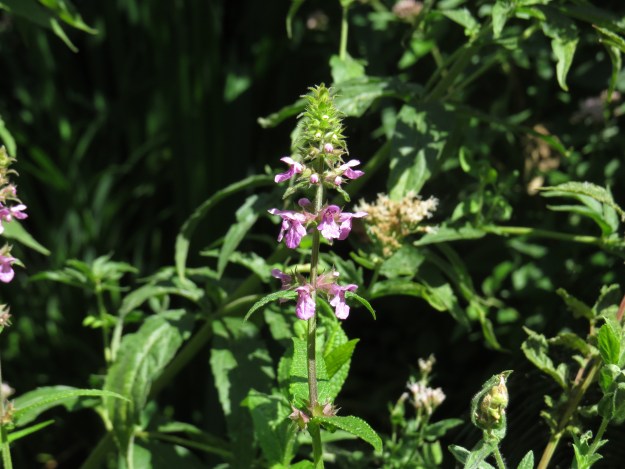
Marsh woundwort (Stachy palustris)

Dear Readers, it is always such a delight when a new plant pops up alongside the pond. I have been watching this one for some weeks, so when it came  into flower I was, for a moment, a little confused. Clearly it’s a deadnettle, but I thought it might be hedge woundwort (Stachys sylvatica). The pale pink flowers are a giveaway though, plus the leaves on the upper stem are stalkless. In addition, the leaves of hedge woundwort give off a rather unpleasant smell when crushed, whereas those of marsh woundwort are much less scented. Finally, as the name suggests, marsh woundwort likes damp places, and so here it is, nestled amongst the meadowsweet and the hemp agrimony.

Marsh woundwort is native to the UK and to most of Europe and Asia, and has been introduced to North America. Like all of the woundworts, it has a long history of use medicinally – in her ‘Modern Herbal‘, Mrs Grieve tells the following story:

This plant had formerly a great reputation as a vulnerary, being strongly recommended by Gerard in his Herbal. He tells us that once being in Kent, visiting a patient, he accidentally heard of a countryman who had cut himself severely with a scythe, and had bound a quantity of this herb, bruised with grease and ‘laid upon in manner of a poultice’ over the wound, which healed in a week, though it would ‘have required forty daies with balsam itself.’ Gerard continues:’I saw the wound and offered to heal the same for charietie, which he refused, saying I could not heal it so well as himself – a clownish answer, I confesse, without any thanks for my good-will: whereupon I have named it “Clown’s Woundwort.” ‘

Afterwards, however, Gerard himself used the plant to cure many ‘grievous wounds’, including some that were considered life-threatening. Mrs Grieve says that the plant, when harvested in July, just as it comes into flower, can be used to relieve gout, cramps, pains in the joints and vertigo. The fresh juice can be made into a syrup and used to alleviate haemorrhage and dysentery. In a more recent record, Monica Wilde, a forager and herbalist, records how marsh woundwort tea, and a poultice soaked in the liquid, helped to alleviate the symptoms from a very nasty insect bite. Very interesting stuff.

Marsh woundwort is also said to be edible – the roots, according to Mrs Grieve ‘are tuberous and can attain a considerable size’. When boiled, they are said to form ‘a wholesome and nutritious food, rather agreeable in flavour’. The roots were also dried, powdered, and added to bread and soup in the winter months when there was not much in the way of greens to eat. The shoots can also be eaten and are said to taste pleasant in spite of their disagreeable smell.

In Shetland, marsh woundwort, along with several other plants, was known as grice mooriks, with ‘grice’ meaning ‘pig’ and ‘moorik’ meaning ‘edible root’. So clearly it wasn’t just humans who found the roots palatable.

Like all deadnettle species, the flowers of marsh woundwort are popular with bumblebees. The caterpillars of the rather spectacular speckled yellow moth (Pseudopanthera macularia) can also be found feeding on woundworts of all kinds, and what a fine moth it is!

Photo One by Ben Sale from UK, CC BY 2.0 <https://creativecommons.org/licenses/by/2.0>, via Wikimedia Commons

Speckled Yellow moth (Pseudopanthera macularia) (Photo One)

And finally, a poem. This is so atmospheric – set during the English Civil War, you can almost hear the hammering as the church is stripped of its angels and decoration, smell the smoke. See what you think.

Commission by Damian Walford Davies

Suffolk, 1650 
I was in the graveyard, islanded
by creeks, parsing deep botched
cuts that pass for epitaphs.
Horses drummed their piss
on clumps of woundwort –
so loud, the troopers laying
statues on the fire turned to look.
Stare long enough, the tower’s
flintwork will bewilder you. Gilt
paint burns especially. He called me
from the porch, framed by gargoyles
and the Lamb, bitter ramsons
mixed with sweetish smoke.
My sergeant rose among the reeds,
a tan bird mewing in his gloves.
The church was cool; their eyes
were hammering at three angels
on the roof. I wrapped the balls
inside a paper patch and shot,
walked out decked in golden dust.


Photo Credits

Photo One by Ben Sale from UK, CC BY 2.0 <https://creativecommons.org/licenses/by/2.0>, via Wikimedia Commons

Wednesday Weed – Delosperma (Ice Plant)

Delosperma sp.

Dear Readers, the local garden centre is absolutely full of these cheery little plants at the moment, and the ones in my window boxes are positively busting out all over. These are succulents, and so are (helpfully) drought-resistant, a theme that feels more and more important as hosepipe bans loom, and heatwaves and dry spells are likely to become more common.

The common name for Delosperma is ‘ice plant’, but this is also used for a whole variety of what I used to call sedums. Older readers might also remember the name ‘Mesembryanthemum’. There are about 170 plants in the genus, and all of them live in Southern Africa. They are beautifully adapted to dry conditions: their leaves are fleshy and store water for arid times, and the seed capsule opens in response to rain to free the seeds at the most auspicious time. These plants have been flowering consistently since I planted them over a month ago, with no sign of stopping yet! They seem to be attractive to hoverflies, though the marjoram that they’re planted with is a much bigger draw for bees.

Another adaptation to arid living is the bladder cell: this is what gives the plant the name ‘ice plant’, as sometimes the cells shimmer with liquid. They are modified hair cells, and during times of high stress will manage the salt intake of the plant – as less water is available, the salts in the plant can reach toxic levels. There is some thought of using members of the Delosperma genus for bioremediation of salt-logged soils.

Leaves of the Delosperma, showing the bladder cells.

So, Delosperma is clearly a great plant for a sun-drenched south-facing window box, and it comes in a whole array of colours too, from red, orange and yellow through cool blues and icy whites. I imagine it must look strikingly beautiful when it blooms in its natural surroundings. In California it seems to be a favourite in some ocean-front properties, maybe due to its ability to cope with the salty breezes.

Photo One by By Peter D. Tillman - Own work, CC BY-SA 2.0, https://commons.wikimedia.org/w/index.php?curid=89361118

Delosperma cooperi planting on ‘Millionaire’s Row’, Cambria, California (Photo One)

Remarkably, though, the plant is also very hardy – one gardener that I follow has found that his Delosperma specimens will survive a Newfoundland winter, and I may well leave mine out just to see if they can make it through the colder months.

Although the plant doesn’t look as if it might be particularly edible, it was apparently taken onboard ship and the leaves eaten to prevent scurvy – again, maybe its drought and salt tolerance would have made it appealing. I imagine that the leaves taste a little like samphire. Medicinally, the leaves have been used to make a soothing cream, and have also been used to treat bloating, dysentery, liver and kidney disease and pneumonia. Interestingly, the leaves are also said to contain hallucinogenic chemicals, and a deep dive into the internet realm of people rearing plants for their psychedelic properties reveals lots of folk growing pretty pink succulents and having no success with getting high whatsoever. Personally, I think that the flowers are quite ‘trippy’ enough without eating the poor thing.

However, the Batu people of South Africa use the leaves of Delosperma to make khadi, an alcoholic wine which induces hallucinations. The roots are used to grow yeasts which are then used for beer.

And now, how about a poem, lovely people? I am reminded of the photo of the California coast (above) as I read this. It takes a couple of readings, I think, to absorb all the nuance. W.S di Piero was born in Philadelphia in 1945, and his poems are said to be full of ‘gritty realism’: he also takes inspiration from painters such as Caravaggio and (my favourite!) Carpaccio. I think there’s something epic about this work, as it reaches back in time and then focuses in on the flowers around a child’s feet. See what you think.

Ice Plant in Bloom

BY W. S. DI PIERO

From where I stood at the field’s immaculate edge,
walking past the open patch of land that’s money bounded,
in California’s flat sunlight, by suburban shadows of houses
occupied by professors, lawyers, radically affluent do-gooders,
simple casual types, plus a few plumbers, children of lettuce-pickers
and microchip princes, grandchildren of goatherds and orchard keepers
who pruned and picked apricot trees that covered what wasn’t yet
block after block. Vaporized by money, by the lords and ladies of money,
in one month, on one block, three bungalows bulldozed, and the tanky smells
of goatherds and, before them, dirt farmers who never got enough water,
held momentary in the air like an album snapshot’s aura,
souls of roller-rink sweethearts and sausage-makers fleeing
heaps of crusty lath, lead pipe, tiny window casements,
then new foundations poured for cozy twelve-room houses.
So what was she doing in that field among weeds and ice plant?
The yellow and pink blooms spiking around her feet like glory?
Cranking her elbow as surveyors do, to a bored watcher in the distance,
she fanned the air, clouds running low and fast behind her.

A voice seeped through the moodless sunlight
as she seemed to talk to the flowers and high weeds.
She noticed me, pointed in my direction. Accusation, election,
I could not tell, nor if it was at me myself
or the green undeveloped space she occupied,
welded into her grid by traffic noise. Okay!
A word for me? A go-ahead? Okay! Smeared by the wind
and maybe not her own voice after all. I held my place.
She would be one of the clenched ministers adrift
in bus terminals and K-Marts, carrying guns
in other parts of America, except she dressed like a casual lady of money,
running shoes, snowbird sunglasses, wristwatch like a black birthday cake.
The voice, thin and pipey, came from the boy or girl,
blond like her, who edged into view as I tracked the shot. The child,
staring down while he cried his song, slowly tread the labyrinth
of ice plant’s juicy starburst flesh of leaves.
Okay! He follows the nested space between flowers that bristle at his feet,
his or hers, while the desiccated California sky so far from heaven and hell
beams down on us beings of flower, water, and flesh before we turn to money.
The sky kept sliding through the tips of weeds. The sky left us behind.

Photo Credits

Photo One By Peter D. Tillman – Own work, CC BY-SA 2.0, https://commons.wikimedia.org/w/index.php?curid=89361118