Category Archives: London Plants

Wednesday Weed – Hemp Agrimony Revisited

Honeybee on Hemp Agrimony (Eupatorium cannabinum)

Dear Readers, I haven’t written about hemp agrimony since 2016, and so I thought that it needed a few more minutes in the limelight. These are the same plants that I planted in 2010, and they are still going strong twelve years later. Every year I cut them back in the autumn, and every spring they burst forth again without any bother or nonsense. This year I’ve put in a circular plant support so they’re not quite as flopsy-bunny as they’ve been in previous years, but they are still a little shaggy and unkempt, rather like me. No wonder I love them, and I’m not the only one. The honeybees pop over from the nearby allotments for a feed, especially as the lavender has gone over now, but it is also popular with all manner of little hoverflies, bees and wasps, including this rather intriguing visitor from Sunday afternoon.

Nomada sp. bee

You might think that the little critter in the photo above was a tiny wasp, but in fact it’s a bee, and a rather sneaky one at that. Nomad bees don’t build nests of their own, but are cleptoparasites – the females creep into the nest of another species of bee and lays her egg on the wall. When the larva hatches out, it kills the host’s larva and feasts on it and the provisions of pollen and other materials that the mother bee has so lovingly gathered. Normally the host species is some kind of mining bee, and the range of the nomad bee is very closely attuned to that of the intended target, so I shall have to keep my eyes open and see what mining bees are about. One other delightful thing about hemp agrimony is that the flowers are at eye level so I don’t even have to bend over to see all the drama. You might remember me spotting the spider below last year – she was hanging around trying to catch a bee or moth, or even a butterfly – today I spotted a comma, a blue butterfly and a large white all popping in to feed.

Candy-striped spider ((Enoplognatha ovata)

So, hemp agrimony definitely punches above its weight when it comes to invertebrate interest, and, as I have one plant in the sun, one in the shade and one in semi-shade it extends the flowering season to about six weeks.

I included some of the plant’s medicinal and folkloric uses in the original post below, but having a quick look at the Plantlore website, it seems that even as recently as the 1920s/30s, a poultice of the leaves was used to cure a fisherman whose arm was otherwise likely to be amputated. The person who had heard the story of the fisherman was, in his teens, much afflicted by boils on his neck and arms, and his parents remembered that the plant concerned was hemp agrimony. The youngster jumped on his bike and found a stand of the plants, and took some of them – sure enough, a poultice made from the leaves drew out the pus from his infection, and he was cured. He writes about how, whenever he sees hemp agrimony he regards it with ‘admiration and gratitude’, which is exactly how I feel about it, and about so many of the plants that I’ve grown to love through writing the Wednesday Weed.

And, as I didn’t include a poem in my original post, here’s a new one, by Matt Howard. He was born in Norfolk, and works as a nature conservationist and organiser of environmental and arts events. I think I would have known that Howard was a close observer of the world around him just from reading this poem, with its understanding of the interwoven lives of humans, plants and animals. See what you think. Howard’s website about his latest project, described as ‘ an innovative international poetry translation project that will map the poetry of nature and place across borders’ is here.

Reed sweet-grass by Matt Howard


A quarter acre of it, mowed
down the low meadow for the clearing.
Frost and stubble among the rides.
Dominant and too coarse to bale,
a day’s work, with rake and fork.


An aesthetic of summer justified
by muscle memory in February,
slung from hip, back, shoulder and wrist –
the idea of the nectar-rich; marsh orchid,
ragged robin, hemp agrimony


and what it all might mean. High talk,
but none of it bluff or bluster;
hard-pronged, our true vernacular sworn
and sweated by the good tonnage we heap,
taller than a big man. Purposeful.


The stack will grow warm as a body inside;
a hibernacula of predator and prey:
grass snake and her leathery eggs,
tunnelings for vole and shrew,
all bedfellows of the rat, three feet down.


Hemp Agrimony (Eupatorium cannabinum)

Hemp Agrimony (Eupatorium cannabinum)

Dear Readers, I wonder if there was ever a plant quite as ramshackle-looking as Hemp Agrimony when it’s past its prime. The flower heads looks as if they are in need of a good comb, and when the seeds come the overall effect is of a gigantic thistle with bedhead. But if we look at the photograph above, we can see a hoverfly who is in no way put off by the general air of untidiness. For, of all the flowers that has self-seeded around my pond, Hemp Agrimony is among the most popular.

IMG_4270Like many plants whose blossom is made up of numerous small flowers, Hemp Agrimony’s nectar can be easily accessed by the more non-specialised pollinators, such as flies and hoverflies. And the multiplicity of blooms means that there is a lot of food in one place. Honeybees also have a great fondness for the plant, and when it’s sunny the bees drift drowsily over the dirty-pink flowers, which Richard Mabey  compared to ‘whipped strawberry mousse’ in his book Flora Britannica.

IMG_4291Hemp Agrimony is a member of the Asteraceae, or Daisy family. You might expect that it has some psychotropic properties, what with it having the species name cannabinum, but this simply refers to the shape of the leaves. This doesn’t stop the occasional perfectly innocent Hemp Agrimony seedling being impounded of course, because botanical knowledge is not necessarily the first thing that they teach at Police Academy. Richard Mabey  mentions that young Horse Chestnut trees have been taken into custody because their leaves also have a strange resemblance to the true Cannabis plant, at least if you’ve never seen one of the latter.

IMG_4278Hemp Agrimony is a native plant in the UK, and like so many plants that have been here for a while, it has some interesting folklore. One alternative name for the plant is ‘Holy Rope’ – the leaves of Hemp, which this plant resembles, were used to make rope, and it was believed that such a rope was used to bind Christ before his crucifixion. A more day-to-day belief was that if bread was placed on a bed of Hemp Agrimony leaves, it wouldn’t go mouldy. The plant has also been used medicinally, especially in the Netherlands where it was for jaundice, as a blood-purifier and as a cure for scurvy. It is said to be toxic, however, and it has been noticed that the iron-stomached goat is the only creature that will eat it.

IMG_4271Hemp Agrimony likes damp, shady places, and so is very at home beside the pond in my north-facing garden. It’s a perennial too, so all it needs is some cutting back to stop it becoming too much of an eyesore. I put the hollow stems beside the shed, where they will hopefully be used by hibernating insects. And next year, without any bother at all, it will be back as a late summer feast for pollinators. I am very happy to live with its wayward habit and general shagginess when the reward is such an abundance of insects and other invertebrates.

Resources this week include: Flora Britannica by Richard Mabey

The Plant Lives website

The A Modern Herbal website


Wednesday Weed – Candytuft

Candytuft (Iberis umbellata)

Dear Readers, candytuft has been a popular garden plant for as long as I can remember – it has a lot of garden variants, many of them pure white, but the ones I have in my windowboxes are palest pink when young. Candytuft is actually a member of the Brassicaceae, or cabbage family, and as with most of these plants there are four petals arranged in a cross-shape (hence the alternative name for the family of ‘crucifers’). The name ‘candytuft’ doesn’t relate to the plant’s sweetness, but to the old name for Heraklion the main city of Crete, Candia. The genus name ‘Iberis’ also emphasizes the Mediterranean connection, with Iberis coming from Iberia, the classicaal name for Spain.

Wild candytuft (Iberis amara) grows all over Europe but its heartland is around the Mediterranean. The wild plant can be found in the UK but is extremely rare, as it lives on the south-facing slopes of chalk downs, a habitat that is becoming increasingly rate. You can tell the plant from its garden cousin because the flowers grow up into little cones and the petals are asymmetric.

Photo One by By H. Zell - Own work, CC BY-SA 3.0, https://commons.wikimedia.org/w/index.php?curid=10426344

Wild Candytuft (Iberis amara) (Photo One)

All members of the cabbage family have chemicals called glucosinolates, which produce the pungent garlic/radish/mustard smell of many brassicas, and which defend against many insects. However, members of the candytuft family have an additional chemical defence, cucurbitacin, which is more commonly found in cucumbers. Interestingly, this defends against cabbage white butterflies, who are not deterred by the strong flavours of other kinds of brassicas.

Although a member of the cabbage family, Candytuft doesn’t seem to be particularly edible, what with its teeny tiny mustard-flavoured leaves which are hardly worth the gathering. Some people do admire the flowers though, and I’m sure that a few thrown into a salad would brighten things up no end.

Medicinally, the flowers have been used for gastro-intestinal complaints, such as bloating or acid reflux. I note that chemical company Bayer are growing their own candytuft flowers to produce ‘Iberogast’, a herbal treatment for these problems. In Mrs Grieve’s Modern Herbal (from the 1930s), the plant is said to have been used to treat gout, rheumatism and atrial fibrillation. Presumably the wild plant was much more  common then than now.

In the Victorian language of flowers, Candytuft is said to signify ‘indifference’, perhaps because it’s tolerant of a variety of growing conditions. I do wonder how the Victorian lady managed to decipher any bouquet sent to her, and whether spats developed with different posies winging their way backwards and forwards, becoming ever more insulting. For example, a bunch of flowers containing amaranth (pretension and foppery), aspen (lamentation), basil (hatred) and bilberry (treachery) would be a most irritating thing to receive. Maybe the only response would be to buy some very woody plants and throw the whole lot at the sender.

Photo Two by By Stefan Laarmann - Own work, CC BY 2.5, https://commons.wikimedia.org/w/index.php?curid=947261

Candytuft (Photo Two)

And finally, a poem. Christopher Morley’s ‘Our House’ features lots of things that I would like – the old-fashioned garden, the window seat, the summer house, the banister – but I think a moat is a step too far. See what you think. Morley was a journalist, poet and great fan of Sherlock Holmes, and I find this poem as cozy as an old armchair, and none the worse for it. We don’t need to be challenged all the time, eh.

Our House
by Christopher Morley (1890-1957)

IT should be yours, if I could build
The quaint old dwelling I desire,
With books and pictures bravely filled
And chairs beside an open fire,
White-panelled rooms with candles lit-
I lie awake to think of it!

A dial for the sunny hours,
A garden of old-fashioned flowers-
Say marigolds and lavender
And mignonette and fever-few,
And Judas-tree and maidenhair
And candytuft and thyme and rue-
All these for you to wander in.

A Chinese carp (called Mandarin)
Waving a sluggish silver fin
Deep in the moat: so tame he comes
To lip your fingers offering crumbs.
Tall chimneys, like long listening ears,
White shutters, ivy green and thick,
And walls of ruddy Tudor brick
Grown mellow with the passing years.

And windows with small leaded panes,
Broad window-seats for when it rains;
A big blue bowl of pot pourri
And-yes, a Spanish chestnut tree
To coin the autumn’s minted gold.
A summer house for drinking tea-
All these (just think!) for you and me.

A staircase of the old black wood
Cut in the days of Robin Hood,
And banisters worn smooth as glass
Down which your hand will lightly pass;
A piano with pale yellow keys
For wistful twilight melodies,
And dusty bottles in a bin-
All these for you to revel in!

But when? Ah well, until that time
We’ll habit in this house of rhyme.

Photo Credits

Photo One by By H. Zell – Own work, CC BY-SA 3.0, https://commons.wikimedia.org/w/index.php?curid=10426344

Photo Two by By Stefan Laarmann – Own work, CC BY 2.5, https://commons.wikimedia.org/w/index.php?curid=947261


Primroses and Red Kites and Babies!

Candelabra primula (Primula bulleyana)

Dear Readers, as you might imagine I have been pretty swamped with work since getting back from Canada, but it was such a beautiful day today that I actually managed to pop out to see what was happening in the garden. First up, I noticed that some of the candelabra primulas that we planted last year have actually survived, and are coming into flower – these are orange and yellow, but we have some purple ones for later in the year. The patch at the top end of the pond is often a bit bleak at this time of year, before everything else gets going, so it was lovely to see them. We have put in supports for the hemp agrimony this year, so hopefully they won’t be overwhelmed before they’ve finished for the year.And then, I was having a cup of tea when I thought I heard the sound of baby birds. The blue tits have been all over the hawthorn this year gathering caterpillars, and then one of them shot past me and headed for the nest box that we put up on the balustrade of our loft.

And here’s a shot of his or her tail disappearing into the nest. I am so excited! We will keep the curtains on the room drawn so that we don’t disturb them. I feel like a proud surrogate parent.

I am hoping that at some point the climbing hydrangea will reach the balustrade, it would provide some extra cover and hiding places. I reckon about another two years at the rate it’s growing. Believe it or not, we cut it back level with the ground floor window (above the green door) in January 2020.

And then, finally, after looking for them for the past year, I saw a red kite in the sky over East Finchley.

At one time, these birds were so valued as scavengers that to kill one was a capital crime. But over time, with habitat destruction, cleaner streets, less carrion about and the rise of egg-collecting as a hobby, the bird became extremely rare, retreating from its range across the whole of the UK to a few sites in Wales, where it was never able to raise enough chicks to expand.

By the 1930s there were only 30 birds in the whole of the UK, all derived from one female bird. It was decided to bring in birds from Sweden and Germany to improve genetic diversity, and the birds were released in various sites around the UK. This was so successful that there are now an estimated 10,000 birds, and their range is increasing every year. They are the most elegant of birds, with their forked tails and narrow wings, and it was a real joy to see one so close to home. The main risks now to the birds are poisoning from rodenticides used to kill rats (this also kills many other birds of prey and mammals, including domestic dogs and cats). They also have a habit of colliding with power cables. Still, this is a real success story, and we could all do with one of them!

Well, That’ll Teach Me….

Holy Moly readers, I should remember that when I go away in spring I come back to a garden that needs a machete to hack my way to the shed, but as it’s been three years since I’ve been anywhere I hope I can be forgiven. The whitebeam has sprung into leaf, the hawthorn is laden down with flowers…

The Geranium phaeum (or Dusky Cranesbill) is in full flower…

The Geranium macrorhizum has been flowering for weeks and is now in its full glory…

The Geranium nodosum (are you sensing a theme here?) is so delicate that I currently have it in a pot, but it too is flowering (along with the white Herb Robert that has seeded itself)

And finally, I planted an ornamental dead nettle, Lamium orvala (otherwise known as balm-leaved red dead-nettle) and it promptly looked very unhappy before it disappeared. This year, it’s about eighteen inches tall, covered in flowers and abuzz with bees. Very satisfying.

And here is a new visitor to the garden – I believe that she’s from the next road to us and that her name is Sadie. She was a tiny bit too interested in the frogs, but as the whole pond is currently covered in duckweed (at least until we start removing it tomorrow) they at least have plenty of cover.

An Easter Walk in St Pancras and Islington Cemetery

Garlic Mustard (Alliaria petiolaria)

Dear Readers, after a few weeks of having a break from the cemetery, it was such a pleasure to be back on a sunny spring day with not a cloud overhead. I was pleased to see the garlic mustard coming into flower, and was keeping a keen eye open for orange-tip butterflies, who lay their eggs on the plant. Well, I didn’t see any, but I did see several citrus-coloured brimstone butterflies, whose caterpillars  feed on buckthorn. There is a view that the name ‘butterfly’ came from these  bright yellow beauties.

Photo One by Charles J. Sharp, CC BY-SA 4.0 <https://creativecommons.org/licenses/by-sa/4.0>, via Wikimedia Commons

Male brimstone butterfly in flight (Photo One)

I seemed to be scaring up butterflies at every step, like this peacock: red admirals, peacocks and the odd speckled wood were all warming themselves up on the paths. It wasn’t quite the swarms of lepidoptera that I remember from our walks in the Austrian Alps, but it wasn’t bad for East Finchley.

The Tibetan cherry tree is coming into flower, and very fine it is too.

This jay was a little less shy than usual…

But this green woodpecker was rather more reticent than of late…

And we saw the Official Cemetery Cat, who is very splendid…

And an unofficial cemetery visitor, who we’ve seen before, and who looks like a little panther.

But loveliest of all, against that clear blue sky, was the buzzard, peacefully riding the thermals and unharried by the crows for once. Maybe they’re all off on holiday.

Mustn’t it be lovely to fly like that! The closest thing that I can think of is swimming, which is something I haven’t done for way too long. Maybe I’ll find somewhere over the summer.

Oh, and the lesser celandine is still in flower….


….and there was this patch of pink sorrel close to the North Circular Road boundary. I hadn’t noticed it before, but no doubt it will soon be everywhere. All sorts of mysterious things grow in this rather ‘weedy’ area, including the mysterious salsify that I was so astonished by a few years ago. Although you can hardly hear yourself think for traffic noise, it is always full of surprises.

A Spring Walk in St Pancras and Islington Cemetery

Dear Readers, three weeks after the onset of my Covid I’m finally feeling like myself again, and so it was such a joy to head out to St Pancras and Islington Cemetery to take in the glory of the Lesser Celandine. Just look at them! Could they be any more joyful, I ask myself.

And if you watch closely, you can see them being appreciated by a whole mass of bees and tiny pollinators.

The primroses are out in force too.

I heard the buzzards mewing, and saw one being hotly pursued by the usual gang of crows. And, for your delectation, here is a sparrowhawk’s backside, shortly before she exited stage left, also pursued by crows. Note those distinctive bars on the stomach.

Blackcaps were singing their heads off, as was this chaffinch, who was making a most uncharacteristic volume of sound.

And the blackthorn is in flower.

I have mentioned before that the lesser celandine was Wordsworth’s favourite flower, but I’d never read the poem that he composed to it. I had expected some cheery paean to the first flower of spring but, as so often with Wordsworth it’s rather more thoughtful than that. So here, for your delectation, is Wordworth’s Lesser Celandine. See what you think.

The Lesser Celandine

There is a Flower, the Lesser Celandine,
That shrinks, like many more, from cold and rain;
And, the first moment that the sun may shine,
Bright as the sun himself, ’tis out again!

When hailstones have been falling, swarm on swarm,
Or blasts the green field and the trees distressed,
Oft have I seen it muffled up from harm,
In close self-shelter, like a Thing at rest.

But lately, one rough day, this Flower I passed,
And recognized it, though an altered form,
Now standing forth an offering to the blast,
And buffeted at will by rain and storm.

I stopped, and said, with inly-muttered voice,
“It doth not love the shower, nor seek the cold:
This neither is its courage nor its choice,
But its necessity in being old.

“The sunshine may not cheer it, nor the dew;
It cannot help itself in its decay;
Stiff in its members, withered, changed of hue.”
And, in my spleen, I smiled that it was grey.

To be a Prodigal’s Favourite -then, worse truth,
A Miser’s Pensioner -behold our lot!
O Man, that from thy fair and shining youth
Age might but take the things Youth needed not!

William Wordsworth (1770-1850)

A Post Covid Walk in St Pancras and Islington Cemetery

Dear Readers, it felt very strange walking in the cemetery yesterday; although I am now past the worst of my covid infection I am still a little slow and breathless, and everything feels most peculiar. I first realised that brain fog was ‘a thing’ after my Dad died and I realised that I could no longer calculate percentages without having to think about it first. Fortunately my mental faculties gradually came back, but at the moment I’m still a bit hazy about many things. Still, it was good to get a bit of fresh air on the most beautiful spring day. I especially love the way that the Scotsman is standing in a pool of lesser celandine. I’ve remarked before that it seemed not to be having a very good year, but clearly I was just too early. It was everywhere on my walk, turning its shiny yellow face to the sun, and hoping for an early bumblebee to pop along, I’m sure.

The petals of many flowers in the buttercup family are shiny – there is a special layer of reflective cells which intensifies the yellow colour and makes the flowers even more attractive to pollinators. As the flowers grow older, this layer may rub off, leaving the petals white, as in the one on the far left hand side of the photo. There are some rather lovely buttercup photos (though not lesser celandine) on this microscopy-uk webpage, well worth a look.

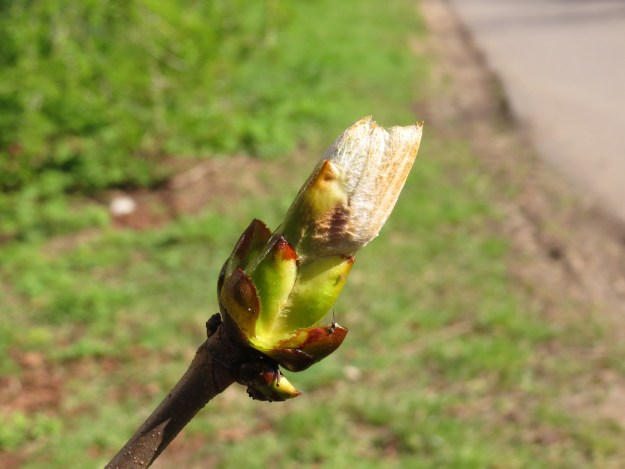
I was surprised to see how much of the cherry plum blossom was gone (after all I’ve only missed one week on my walks), but it has been very windy. On the other hand, the horse chestnut buds are pushing through already.

And although the bluebells look a  long way off, there’s one tiny patch of woodland where the Scilla have naturalised, and their blue is almost as intense. What a pretty and delicate flower this is, and it’s obviously happy even in deep shade.

And so it was with some relief that I got home and had a sit down, but it was great to see something outside my four walls for the first time in ten days. For anyone who is getting over covid, or indeed any infection, I’d say ‘be a little more gentle with yourself than you think you need to be’ – it’s good to give yourself time for your body to adjust to getting back to ‘normal’ rather than throwing yourself in with enthusiasm, especially as you’re getting older. When I was in my twenties and thirties I thought I was immortal and indestructible, but sadly now I know a bit better.

An Exciting Walk in St Pancras and Islington Cemetery

Dear Readers, there was lots to see in the cemetery on Saturday, most of it centred around the bird life. We were barely through the gates when we noticed this crow, getting stuck into a mystery fruit. At first I thought  it might be a mango, but on balance I’ve decided it was an orange. Who knew that crows had a taste for citrus? I love the way that the crow is keeping the fruit under control with his or her foot.

Normally the crows are pretty shy, but this one was clearly too involved in eating to be put off by me and my camera.

Then, I was looking at the blossom (which is rather fine at the moment) when my husband said ‘what’s that bird with the red head?’

And yes it was a green woodpecker, usually a very elusive bird. This one was digging up ants as if they were going out of fashion – the wet weather has made the soil a bit easier to hammer into. The bird was completely engrossed in its task, but was moving so quickly that it was hard to get a decent shot. Some birds seem to live on a slightly faster timescale than us, and this one definitely did that. If  you look carefully in the video below you can see the bird’s long tongue flickering out to lick up the ants. It looks in some of the photos as if the beak is malformed but the bird looked healthy and was clearly feeding, so hopefully it can still look after itself. It’s a hard life bashing yourself against hard surfaces all day, and I’d be surprised if there wasn’t sometimes some collateral damage.

Then we spotted a small panther, clearly watching out for mice or other small rodents.

In the more open part of the cemetery there were several flocks of redwings, probably several hundred in total. They are starting to gather for the flight back north, but it was the first time I’d seen them in such numbers.

Round we go, and here’s another panther – this one is a bit chunkier than the earlier one.

And everywhere, the daffodils and various narcissi have taken over from the crocuses and the snowdrops.

The primroses are coming into their own as well.

And one of my favourite cherry-crabs is almost at the peak of flowering.

And finally, someone has given the lovely Scotsman on Kew Road some new flowers, and some twigs. I think this is probably the finest sculpture in the cemetery, and he never fails to move me, standing there so proud amongst the trees. When he was alive, someone clearly loved him very much.

Wednesday Weed – Silver Birch

Silver birch (Betula pendula)

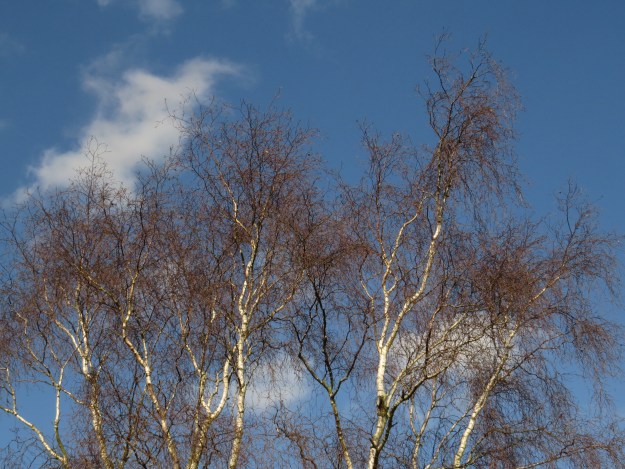
Dear Readers, this is a tree that can be found pretty much everywhere, and is often overlooked. How graceful it is, though, with its weeping twigs that, at this time of year, are a brownish-purple colour! And how ghostly that white bark can look, especially against a background of yews or other evergreens, though over time the bark develops deep, triangular black fissures. It was, in the 1920s and 1930s, a popular street tree, according to Paul Wood’s ‘Street Trees of London’ , but these days more exotic birch species such as the Chines red birch (Betula albosinensis) seem to be planted more frequently. As we shall see, silver birch supports a lot of biodiversity, so maybe it’s time for it to make a comeback, even though it’s a short-lived tree (it’s rare for a silver birch to live for more than 80 years.

Chinese Red Birch (Betula albosinensis)

The trees bear both male and female flowers in April and May. The male catkins are borne in groups of two or four, and look like dangling lambs’ tails. The female flowers are short, green and erect.

Illustration of silver birch features (Public Domain)

Although silver birch has a wide range, from Scandinavia through to Eastern Asia, I always associate it with the north. It seems to like heathland and moorland, and in the warmer parts of Europe it tends to grow at high altitudes. It is the national tree of Finland.

Photo One by By Percita at Flickr - Flickr, CC BY-SA 2.0, https://commons.wikimedia.org/w/index.php?curid=5986991

Birch forest in Finland (Photo One)

Birch forest is kind to other organisms – the canopy casts only light shade, and so an understorey can develop, as seen in the photo above. The ground beneath the trees can be full of primroses and wood sorrel, bluebells and wood anemone in spring, and in Scotland there may be blaeberry and cowberry growing underneath. The soft wood of the tree provides nest holes for woodpeckers, and the many insects that feed upon birch provide food for nightingales and warblers. This is a real contrast to the hardwood landscapes of hornbeam and oak woods, where the canopy is so shady that nothing apart from holly can survive outside of early spring, before the leaves form.

Photo Two by By Tony Holkham - Own work, CC BY-SA 3.0, https://commons.wikimedia.org/w/index.php?curid=33714192

Birch sawfly larvae (Photo Two)

More than 300 insect species are associated with the silver birch in the UK, including the larvae of the Kentish Glory moth.

Photo Three by Ilia Ustyantsev from Russia, CC BY-SA 2.0 <https://creativecommons.org/licenses/by-sa/2.0>, via Wikimedia Commons

Kentish Glory (Endromis versicolor) (Photo Three)

The tree is also associated with a whole raft of fungi, including fly agaric, birch knight and the birch polypore (or razor strop). The latter was actually used to sharpen razors, and is also used as a background for mounting dead insects in collections.

Photo Four by Jörg Hempel, CC BY-SA 3.0 DE <https://creativecommons.org/licenses/by-sa/3.0/de/deed.en>, via Wikimedia Commons

Birch Knight (Tricholoma fulvum) (Photo Four)

Photo Five by gailhampshire from Cradley, Malvern, U.K, CC BY 2.0 <https://creativecommons.org/licenses/by/2.0>, via Wikimedia Commons

Birch polypore (Piptoporus betulinus) (Photo Five)

So, it’s clear that birch trees, in life and death, support a whole range of species. As you might expect from a native tree, there is also a lot of folklore connected to silver birch. Bundles of birch twigs were used to drive out the spirits of the old year, and a besom, or broom, made of birch was used by gardeners to purify their gardens. In Finland,  birch twigs are used to beat the body when one comes out of a sauna. In the Scottish Highlands, a barren cow driven with a birch wand would become fertile, and a pregnant cow would have a fine and healthy calf.

Birch wood has been used for furniture, toys and for the bobbins used in Lancashire weaving factories, and birch bark is used for tanning leather. Traditionally, birch has been used as a treatment for rheumatism and arthritis, but recently there has been a resurgence in interest in birch syrup, which is made from the sweet and sticky sap of the tree in much the same way as maple syrup, although I note that this is usually made from the paperbark birches that are found in Alaska and Canada.

It comes as no surprise to me that these trees have been a subject for art – there is something about those shimmering white branches that begs to be painted. And artists as famous as Gustav Klimt couldn’t resist.

Photo Six by Ron Cogswell from https://www.flickr.com/photos/22711505@N05/26185760072

‘Birch Forest’ by Gustav Klimt (Photo Six)

And finally, a poem. Seamus Heaney, no less. How I love the way he manages to sum the man up in just a few tiny details. I laughed out loud. See what you think.

The Birch Grove by Seamus Heaney

At the back of a garden, in earshot of river water,
In a corner walled off like the baths or bake-house
Of an unroofed abbey or broken-floored Roman villa,
They have planted their birch grove. Planted it recently only,
But already each morning it puts forth in the sun
Like their own long grown-up selves, the white of the bark
As suffused and cool as the white of the satin nightdress
She bends and straightens up in, pouring tea,
Sitting across from where he dandles a sandal
On his big time-keeping foot, as bare as an abbot’s.
Red brick and slate, plum tree and apple retain
Their credibility, a CD of Bach is making the rounds
Of the common or garden air. Above them a jet trail
Tapers and waves like a willow wand or a taper.
“If art teaches us anything,” he says, trumping life
With a quote, “it’s that the human condition is private.”

Photo Credits

Photo One By Percita at Flickr – Flickr, CC BY-SA 2.0, https://commons.wikimedia.org/w/index.php?curid=5986991

Photo Two by By Tony Holkham – Own work, CC BY-SA 3.0, https://commons.wikimedia.org/w/index.php?curid=33714192

Photo Three by Ilia Ustyantsev from Russia, CC BY-SA 2.0 <https://creativecommons.org/licenses/by-sa/2.0>, via Wikimedia Commons

Photo Four by Jörg Hempel, CC BY-SA 3.0 DE <https://creativecommons.org/licenses/by-sa/3.0/de/deed.en>, via Wikimedia Commons

Photo Five by gailhampshire from Cradley, Malvern, U.K, CC BY 2.0 <https://creativecommons.org/licenses/by/2.0>, via Wikimedia Commons

Photo Six by Ron Cogswell from https://www.flickr.com/photos/22711505@N05/26185760072

Wednesday Weed (on Thursday) – Chickpeas

Photo One by Serife Gerenschier (bluecherry.at), CC BY 3.0 <https://creativecommons.org/licenses/by/3.0>, via Wikimedia Commons

Chickpeas (Cicer arietinum) (Photo One)

Dear Readers, is there any food more versatile than the chickpea? This little legume has, along with the lentil, been the mainstay of civilisations all around the Mediterranean and beyond since at least Neolithic times, and if you want to get into a delicious culinary argument, just ask someone who makes the best falafel, or where to buy the best hummus. For Greece, Turkey, Egypt, and all the countries of the Middle East right through to the Indian subcontinent,  the chickpea is one of the most important staple foods, turned into purees, fritters, pancakes and dumplings, flavoured with everything from garlic and lemon to tamarind and turmeric. In Italy the chickpea turns up as farinata, a delicious egg-free pancake, and in Mexico and the islands of the Caribbean it can be found as a spicy street food. If you go to the grocery shop you can have enough protein for several hearty main meals for less than a pound and chickpeas also freeze well once cooked.

I must confess to a special love for the chickpea, because my husband has probably eaten several tubs of hummus every week for the past twenty years. I have even caught him eating it surreptitiously by the spoonful straight from the fridge. Luckily, I would agree with Nicolas Culpeper the herbalist, who says that chickpeas are less ‘windy’ than dried peas, and more nourishing.

It occurred to me, though, that I had no idea what a chickpea plant looked like – as with so many foods, the actual production takes place somewhere else. It cheers me greatly that the English company, Hodmedods, is looking at restoring the reputation of some of the UK’s native beans, such as field beans, which are well-suited to our climate, but they have also recently started to grow their own chickpeas. Hooray! So maybe we’ll soon see these little chaps growing in our fields (although there are also some wild ones who have presumably popped up from spilled bird seed or human food).

Has anyone out there tried growing some of these beans? I somehow forget that what we’re eating are seeds, and that if plonked in a pot they might turn into something interesting.

Photo Two by H. Zell, CC BY-SA 3.0 <https://creativecommons.org/licenses/by-sa/3.0>, via Wikimedia Commons

Chickpea plant (Photo Two)

As you can see, the chickpea plant looks very much a typical ‘bean’, with those pinnate leaves. The flowers are even more of a giveaway. Incidentally, the plant’s scientific name, Cicer arietinum, is thought to have given rise to the Classical name Cicero.

Photo Three by Forest & Kim Starr, CC BY 3.0 US <https://creativecommons.org/licenses/by/3.0/us/deed.en>, via Wikimedia Commons

Chickpea flowers (Photo Three)

Chickpeas are a nutrient-dense food, with a 100 gram serving providing over 20% of an adult’s daily requirement for protein, fibre, iron and phosphorous. However, they have also been used medicinally: Pliny the Elder suggests that the way to treat warts is to touch each one with a chickpea during the new moon and to then throw the chickpea over the shoulder. One way to cure gout was to soak the feet in the water that the chickpeas had been cooked in. These days we know that this water can be used to make an egg-free meringue, which makes sense if you think about how full of protein this substance is. For the sceptics among you, there’s a recipe for vegan meringues here, and very pretty they look too.

Photo Four from https://www.bbcgoodfood.com/recipes/vegan-meringues

Vegan meringues (Photo Four)

Although chickpeas are very widely grown in cultivation, they come originally from a tiny area of Anatolia in what is now Turkey. They are thought to be descended from the wild chickpea, Cicer reticulatum, and there were several varieties even before the plant was domesticated. These days you can buy black chickpeas, green chickpeas and the more usual golden chickpeas. I’m fairly sure that if blindfolded I wouldn’t be able to tell the difference.

Photo Five by By Sanjay Acharya - Own work, CC BY-SA 3.0, https://commons.wikimedia.org/w/index.php?curid=3131388

Different varieties of chickpeas (Photo Five)

And finally, a poem. There is a poem by Rumi in which he envisions a conversation between a poor chickpea being boiled and the cook who has put it there, but it seems to have a view akin to ‘that which doesn’t kill us makes us stronger’, a sentiment that I loathe with every fibre of my being, along with ‘everything happens for a reason’. No, sometimes terrible things happen, and people are shaped in ways that hinder the rest of their lives by those things. But I do rather like this poem by Lauren Whitehead, which feels appropriate to the season, and mentions a tin of garbanzos, which is the US term for chickpeas, so I think I can get away with it. Let me know what you think, readers.

Not Everything Is Sex
BY LAUREN WHITEHEAD

Okay
Tell that to the palm

of this Black man’s hand
ever so slightly cupped

and carrying in its bend
the finger tips of another

Black man, both of them
arms stretching upward

toward the sky, measuring
their reach against one another

on a basketball court
in Brooklyn, in spring

Okay
Spring

And when I say spring
I mean bee-buzzing-near-a-pink-bud-

almost-bursting spring
tantric spring

everyone-outside-in-three-
quarter-sleeves-despite-the-virus-

buzzing-near-our-tongues
spring So you can’t tell me

it’s not sex Cause it’s not not sex
The risk of all this tenderness

all this giving of ourselves
all this inside on the outside

open, vulnerable I know sex
when I see it and I see it

everywhere: lips on the nipple
of a soft serve, an arm fist deep in

a grocery store shelf, digging
for the last can of garbanzo beans

It’s not not a ménage à trois
these three men snuggled

in the front seat of a moving
van, singing bachata

dancing from the hips up
in the window, open

throats open, their whole necks
to the wind, reckless

reckless, I tell you, full on
abandon So say what you will

about transmission
about fluid, skin to skin

about the necessary things
that make the deed the deed

I don’t care cause it’s spring
and I’ve never seen anything so intimate

as this touch still taken
in the face of an apocalypse

Photo Credits

Photo One by Serife Gerenschier (bluecherry.at), CC BY 3.0 <https://creativecommons.org/licenses/by/3.0>, via Wikimedia Commons

Photo Two by H. Zell, CC BY-SA 3.0 <https://creativecommons.org/licenses/by-sa/3.0>, via Wikimedia Commons

Photo Three by Forest & Kim Starr, CC BY 3.0 US <https://creativecommons.org/licenses/by/3.0/us/deed.en>, via Wikimedia Commons

Photo Four from https://www.bbcgoodfood.com/recipes/vegan-meringues

Photo Five by By Sanjay Acharya – Own work, CC BY-SA 3.0, https://commons.wikimedia.org/w/index.php?curid=3131388