Category Archives: London Plants

A Post Covid Walk in St Pancras and Islington Cemetery

Dear Readers, it felt very strange walking in the cemetery yesterday; although I am now past the worst of my covid infection I am still a little slow and breathless, and everything feels most peculiar. I first realised that brain fog was ‘a thing’ after my Dad died and I realised that I could no longer calculate percentages without having to think about it first. Fortunately my mental faculties gradually came back, but at the moment I’m still a bit hazy about many things. Still, it was good to get a bit of fresh air on the most beautiful spring day. I especially love the way that the Scotsman is standing in a pool of lesser celandine. I’ve remarked before that it seemed not to be having a very good year, but clearly I was just too early. It was everywhere on my walk, turning its shiny yellow face to the sun, and hoping for an early bumblebee to pop along, I’m sure.

The petals of many flowers in the buttercup family are shiny – there is a special layer of reflective cells which intensifies the yellow colour and makes the flowers even more attractive to pollinators. As the flowers grow older, this layer may rub off, leaving the petals white, as in the one on the far left hand side of the photo. There are some rather lovely buttercup photos (though not lesser celandine) on this microscopy-uk webpage, well worth a look.

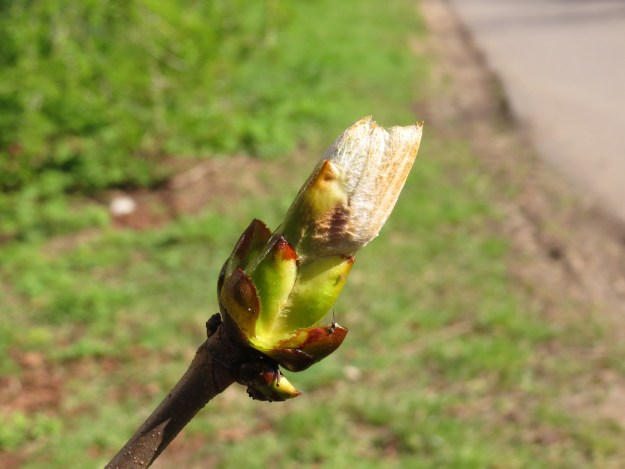
I was surprised to see how much of the cherry plum blossom was gone (after all I’ve only missed one week on my walks), but it has been very windy. On the other hand, the horse chestnut buds are pushing through already.

And although the bluebells look a  long way off, there’s one tiny patch of woodland where the Scilla have naturalised, and their blue is almost as intense. What a pretty and delicate flower this is, and it’s obviously happy even in deep shade.

And so it was with some relief that I got home and had a sit down, but it was great to see something outside my four walls for the first time in ten days. For anyone who is getting over covid, or indeed any infection, I’d say ‘be a little more gentle with yourself than you think you need to be’ – it’s good to give yourself time for your body to adjust to getting back to ‘normal’ rather than throwing yourself in with enthusiasm, especially as you’re getting older. When I was in my twenties and thirties I thought I was immortal and indestructible, but sadly now I know a bit better.

An Exciting Walk in St Pancras and Islington Cemetery

Dear Readers, there was lots to see in the cemetery on Saturday, most of it centred around the bird life. We were barely through the gates when we noticed this crow, getting stuck into a mystery fruit. At first I thought  it might be a mango, but on balance I’ve decided it was an orange. Who knew that crows had a taste for citrus? I love the way that the crow is keeping the fruit under control with his or her foot.

Normally the crows are pretty shy, but this one was clearly too involved in eating to be put off by me and my camera.

Then, I was looking at the blossom (which is rather fine at the moment) when my husband said ‘what’s that bird with the red head?’

And yes it was a green woodpecker, usually a very elusive bird. This one was digging up ants as if they were going out of fashion – the wet weather has made the soil a bit easier to hammer into. The bird was completely engrossed in its task, but was moving so quickly that it was hard to get a decent shot. Some birds seem to live on a slightly faster timescale than us, and this one definitely did that. If  you look carefully in the video below you can see the bird’s long tongue flickering out to lick up the ants. It looks in some of the photos as if the beak is malformed but the bird looked healthy and was clearly feeding, so hopefully it can still look after itself. It’s a hard life bashing yourself against hard surfaces all day, and I’d be surprised if there wasn’t sometimes some collateral damage.

Then we spotted a small panther, clearly watching out for mice or other small rodents.

In the more open part of the cemetery there were several flocks of redwings, probably several hundred in total. They are starting to gather for the flight back north, but it was the first time I’d seen them in such numbers.

Round we go, and here’s another panther – this one is a bit chunkier than the earlier one.

And everywhere, the daffodils and various narcissi have taken over from the crocuses and the snowdrops.

The primroses are coming into their own as well.

And one of my favourite cherry-crabs is almost at the peak of flowering.

And finally, someone has given the lovely Scotsman on Kew Road some new flowers, and some twigs. I think this is probably the finest sculpture in the cemetery, and he never fails to move me, standing there so proud amongst the trees. When he was alive, someone clearly loved him very much.

Wednesday Weed – Silver Birch

Silver birch (Betula pendula)

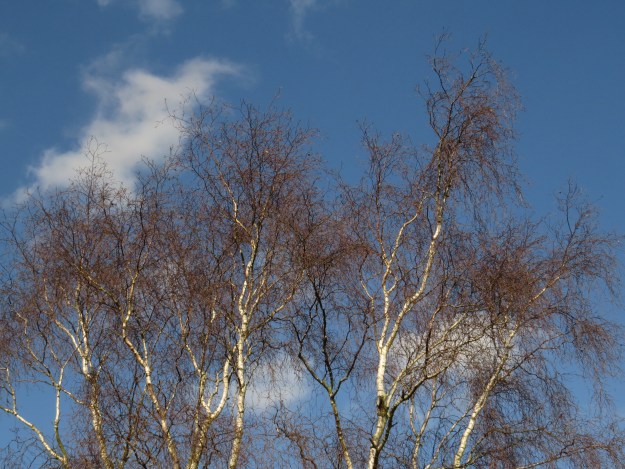
Dear Readers, this is a tree that can be found pretty much everywhere, and is often overlooked. How graceful it is, though, with its weeping twigs that, at this time of year, are a brownish-purple colour! And how ghostly that white bark can look, especially against a background of yews or other evergreens, though over time the bark develops deep, triangular black fissures. It was, in the 1920s and 1930s, a popular street tree, according to Paul Wood’s ‘Street Trees of London’ , but these days more exotic birch species such as the Chines red birch (Betula albosinensis) seem to be planted more frequently. As we shall see, silver birch supports a lot of biodiversity, so maybe it’s time for it to make a comeback, even though it’s a short-lived tree (it’s rare for a silver birch to live for more than 80 years.

Chinese Red Birch (Betula albosinensis)

The trees bear both male and female flowers in April and May. The male catkins are borne in groups of two or four, and look like dangling lambs’ tails. The female flowers are short, green and erect.

Illustration of silver birch features (Public Domain)

Although silver birch has a wide range, from Scandinavia through to Eastern Asia, I always associate it with the north. It seems to like heathland and moorland, and in the warmer parts of Europe it tends to grow at high altitudes. It is the national tree of Finland.

Photo One by By Percita at Flickr - Flickr, CC BY-SA 2.0, https://commons.wikimedia.org/w/index.php?curid=5986991

Birch forest in Finland (Photo One)

Birch forest is kind to other organisms – the canopy casts only light shade, and so an understorey can develop, as seen in the photo above. The ground beneath the trees can be full of primroses and wood sorrel, bluebells and wood anemone in spring, and in Scotland there may be blaeberry and cowberry growing underneath. The soft wood of the tree provides nest holes for woodpeckers, and the many insects that feed upon birch provide food for nightingales and warblers. This is a real contrast to the hardwood landscapes of hornbeam and oak woods, where the canopy is so shady that nothing apart from holly can survive outside of early spring, before the leaves form.

Photo Two by By Tony Holkham - Own work, CC BY-SA 3.0, https://commons.wikimedia.org/w/index.php?curid=33714192

Birch sawfly larvae (Photo Two)

More than 300 insect species are associated with the silver birch in the UK, including the larvae of the Kentish Glory moth.

Photo Three by Ilia Ustyantsev from Russia, CC BY-SA 2.0 <https://creativecommons.org/licenses/by-sa/2.0>, via Wikimedia Commons

Kentish Glory (Endromis versicolor) (Photo Three)

The tree is also associated with a whole raft of fungi, including fly agaric, birch knight and the birch polypore (or razor strop). The latter was actually used to sharpen razors, and is also used as a background for mounting dead insects in collections.

Photo Four by Jörg Hempel, CC BY-SA 3.0 DE <https://creativecommons.org/licenses/by-sa/3.0/de/deed.en>, via Wikimedia Commons

Birch Knight (Tricholoma fulvum) (Photo Four)

Photo Five by gailhampshire from Cradley, Malvern, U.K, CC BY 2.0 <https://creativecommons.org/licenses/by/2.0>, via Wikimedia Commons

Birch polypore (Piptoporus betulinus) (Photo Five)

So, it’s clear that birch trees, in life and death, support a whole range of species. As you might expect from a native tree, there is also a lot of folklore connected to silver birch. Bundles of birch twigs were used to drive out the spirits of the old year, and a besom, or broom, made of birch was used by gardeners to purify their gardens. In Finland,  birch twigs are used to beat the body when one comes out of a sauna. In the Scottish Highlands, a barren cow driven with a birch wand would become fertile, and a pregnant cow would have a fine and healthy calf.

Birch wood has been used for furniture, toys and for the bobbins used in Lancashire weaving factories, and birch bark is used for tanning leather. Traditionally, birch has been used as a treatment for rheumatism and arthritis, but recently there has been a resurgence in interest in birch syrup, which is made from the sweet and sticky sap of the tree in much the same way as maple syrup, although I note that this is usually made from the paperbark birches that are found in Alaska and Canada.

It comes as no surprise to me that these trees have been a subject for art – there is something about those shimmering white branches that begs to be painted. And artists as famous as Gustav Klimt couldn’t resist.

Photo Six by Ron Cogswell from https://www.flickr.com/photos/22711505@N05/26185760072

‘Birch Forest’ by Gustav Klimt (Photo Six)

And finally, a poem. Seamus Heaney, no less. How I love the way he manages to sum the man up in just a few tiny details. I laughed out loud. See what you think.

The Birch Grove by Seamus Heaney

At the back of a garden, in earshot of river water,
In a corner walled off like the baths or bake-house
Of an unroofed abbey or broken-floored Roman villa,
They have planted their birch grove. Planted it recently only,
But already each morning it puts forth in the sun
Like their own long grown-up selves, the white of the bark
As suffused and cool as the white of the satin nightdress
She bends and straightens up in, pouring tea,
Sitting across from where he dandles a sandal
On his big time-keeping foot, as bare as an abbot’s.
Red brick and slate, plum tree and apple retain
Their credibility, a CD of Bach is making the rounds
Of the common or garden air. Above them a jet trail
Tapers and waves like a willow wand or a taper.
“If art teaches us anything,” he says, trumping life
With a quote, “it’s that the human condition is private.”

Photo Credits

Photo One By Percita at Flickr – Flickr, CC BY-SA 2.0, https://commons.wikimedia.org/w/index.php?curid=5986991

Photo Two by By Tony Holkham – Own work, CC BY-SA 3.0, https://commons.wikimedia.org/w/index.php?curid=33714192

Photo Three by Ilia Ustyantsev from Russia, CC BY-SA 2.0 <https://creativecommons.org/licenses/by-sa/2.0>, via Wikimedia Commons

Photo Four by Jörg Hempel, CC BY-SA 3.0 DE <https://creativecommons.org/licenses/by-sa/3.0/de/deed.en>, via Wikimedia Commons

Photo Five by gailhampshire from Cradley, Malvern, U.K, CC BY 2.0 <https://creativecommons.org/licenses/by/2.0>, via Wikimedia Commons

Photo Six by Ron Cogswell from https://www.flickr.com/photos/22711505@N05/26185760072

Wednesday Weed (on Thursday) – Chickpeas

Photo One by Serife Gerenschier (bluecherry.at), CC BY 3.0 <https://creativecommons.org/licenses/by/3.0>, via Wikimedia Commons

Chickpeas (Cicer arietinum) (Photo One)

Dear Readers, is there any food more versatile than the chickpea? This little legume has, along with the lentil, been the mainstay of civilisations all around the Mediterranean and beyond since at least Neolithic times, and if you want to get into a delicious culinary argument, just ask someone who makes the best falafel, or where to buy the best hummus. For Greece, Turkey, Egypt, and all the countries of the Middle East right through to the Indian subcontinent,  the chickpea is one of the most important staple foods, turned into purees, fritters, pancakes and dumplings, flavoured with everything from garlic and lemon to tamarind and turmeric. In Italy the chickpea turns up as farinata, a delicious egg-free pancake, and in Mexico and the islands of the Caribbean it can be found as a spicy street food. If you go to the grocery shop you can have enough protein for several hearty main meals for less than a pound and chickpeas also freeze well once cooked.

I must confess to a special love for the chickpea, because my husband has probably eaten several tubs of hummus every week for the past twenty years. I have even caught him eating it surreptitiously by the spoonful straight from the fridge. Luckily, I would agree with Nicolas Culpeper the herbalist, who says that chickpeas are less ‘windy’ than dried peas, and more nourishing.

It occurred to me, though, that I had no idea what a chickpea plant looked like – as with so many foods, the actual production takes place somewhere else. It cheers me greatly that the English company, Hodmedods, is looking at restoring the reputation of some of the UK’s native beans, such as field beans, which are well-suited to our climate, but they have also recently started to grow their own chickpeas. Hooray! So maybe we’ll soon see these little chaps growing in our fields (although there are also some wild ones who have presumably popped up from spilled bird seed or human food).

Has anyone out there tried growing some of these beans? I somehow forget that what we’re eating are seeds, and that if plonked in a pot they might turn into something interesting.

Photo Two by H. Zell, CC BY-SA 3.0 <https://creativecommons.org/licenses/by-sa/3.0>, via Wikimedia Commons

Chickpea plant (Photo Two)

As you can see, the chickpea plant looks very much a typical ‘bean’, with those pinnate leaves. The flowers are even more of a giveaway. Incidentally, the plant’s scientific name, Cicer arietinum, is thought to have given rise to the Classical name Cicero.

Photo Three by Forest & Kim Starr, CC BY 3.0 US <https://creativecommons.org/licenses/by/3.0/us/deed.en>, via Wikimedia Commons

Chickpea flowers (Photo Three)

Chickpeas are a nutrient-dense food, with a 100 gram serving providing over 20% of an adult’s daily requirement for protein, fibre, iron and phosphorous. However, they have also been used medicinally: Pliny the Elder suggests that the way to treat warts is to touch each one with a chickpea during the new moon and to then throw the chickpea over the shoulder. One way to cure gout was to soak the feet in the water that the chickpeas had been cooked in. These days we know that this water can be used to make an egg-free meringue, which makes sense if you think about how full of protein this substance is. For the sceptics among you, there’s a recipe for vegan meringues here, and very pretty they look too.

Photo Four from https://www.bbcgoodfood.com/recipes/vegan-meringues

Vegan meringues (Photo Four)

Although chickpeas are very widely grown in cultivation, they come originally from a tiny area of Anatolia in what is now Turkey. They are thought to be descended from the wild chickpea, Cicer reticulatum, and there were several varieties even before the plant was domesticated. These days you can buy black chickpeas, green chickpeas and the more usual golden chickpeas. I’m fairly sure that if blindfolded I wouldn’t be able to tell the difference.

Photo Five by By Sanjay Acharya - Own work, CC BY-SA 3.0, https://commons.wikimedia.org/w/index.php?curid=3131388

Different varieties of chickpeas (Photo Five)

And finally, a poem. There is a poem by Rumi in which he envisions a conversation between a poor chickpea being boiled and the cook who has put it there, but it seems to have a view akin to ‘that which doesn’t kill us makes us stronger’, a sentiment that I loathe with every fibre of my being, along with ‘everything happens for a reason’. No, sometimes terrible things happen, and people are shaped in ways that hinder the rest of their lives by those things. But I do rather like this poem by Lauren Whitehead, which feels appropriate to the season, and mentions a tin of garbanzos, which is the US term for chickpeas, so I think I can get away with it. Let me know what you think, readers.

Not Everything Is Sex
BY LAUREN WHITEHEAD

Okay
Tell that to the palm

of this Black man’s hand
ever so slightly cupped

and carrying in its bend
the finger tips of another

Black man, both of them
arms stretching upward

toward the sky, measuring
their reach against one another

on a basketball court
in Brooklyn, in spring

Okay
Spring

And when I say spring
I mean bee-buzzing-near-a-pink-bud-

almost-bursting spring
tantric spring

everyone-outside-in-three-
quarter-sleeves-despite-the-virus-

buzzing-near-our-tongues
spring So you can’t tell me

it’s not sex Cause it’s not not sex
The risk of all this tenderness

all this giving of ourselves
all this inside on the outside

open, vulnerable I know sex
when I see it and I see it

everywhere: lips on the nipple
of a soft serve, an arm fist deep in

a grocery store shelf, digging
for the last can of garbanzo beans

It’s not not a ménage à trois
these three men snuggled

in the front seat of a moving
van, singing bachata

dancing from the hips up
in the window, open

throats open, their whole necks
to the wind, reckless

reckless, I tell you, full on
abandon So say what you will

about transmission
about fluid, skin to skin

about the necessary things
that make the deed the deed

I don’t care cause it’s spring
and I’ve never seen anything so intimate

as this touch still taken
in the face of an apocalypse

Photo Credits

Photo One by Serife Gerenschier (bluecherry.at), CC BY 3.0 <https://creativecommons.org/licenses/by/3.0>, via Wikimedia Commons

Photo Two by H. Zell, CC BY-SA 3.0 <https://creativecommons.org/licenses/by-sa/3.0>, via Wikimedia Commons

Photo Three by Forest & Kim Starr, CC BY 3.0 US <https://creativecommons.org/licenses/by/3.0/us/deed.en>, via Wikimedia Commons

Photo Four from https://www.bbcgoodfood.com/recipes/vegan-meringues

Photo Five by By Sanjay Acharya – Own work, CC BY-SA 3.0, https://commons.wikimedia.org/w/index.php?curid=3131388

Spring is Sprunging Earlier….

Spring Bulbs at Alnwick Castle in Northumberland (Photo by Rich Tea from https://www.geograph.org.uk/photo/4425798)

Dear Readers, you may remember that last year I ‘attended’ a talk by Alastair Fitter, on Plants and Climate Change. Fitter pointed out that plants were flowering earlier than they had in past years, and he had very good evidence from the studies done by his father Richard Fitter and himself over many years. Now, New Scientist is reporting on a new study by the University of Cambridge, which is showing that the flowering of spring plants has moved forward by a whole month since 1986. This is based on over 420,000 observations of the first flowering of 406 plant species in a citizen science project called ‘Nature’s Calendar’ which is hosted by the Woodland Trust.Ulf Büntgen who headed up the study explains that there are records dating back to 1753, from gardeners and naturalists as well as organisations such as the Royal Meteorological Society. The date of 1986 was chosen because there were as many records before this date as there were afterwards, so it was the midpoint of the data.

The study shows that flowers were opening an average of 26 days earlier than in 1986 (in Fitter’s talk there were wide variations between the different species). The effect seems to have been most marked on small plants, with those less than 20 centimetres high flowering on average 32 days earlier than in 1986.

The average temperature of the months between January and April had a direct correlation with the date of flowering – clearly spring-flowering plants are extremely temperature-sensitive. The scary thing is that the although the maximum average temperature across those four months has only risen by 1 degree Celsius, it’s resulted in a change of a month in flowering time. And this has a knock-on effect on all the insects that pollinate and feed on the plants, and in turn on the birds and other animals that feed on them.

The time is out of joint, as Shakespeare said.

Goings on in East Finchley

Statue of Susanna Wesley the ‘Mother of Malethodism’

Dear Readers, I was on my way to St Pancras and Islington Cemetery for my usual weekend walk when I was stopped in my tracks by this extraordinary statue. It appeared this week in the grounds of East Finchley Methodist Church. Last week, this was a red cedar tree, but this week it has been transformed.

The sculptor is Simon O’Rourke, and the funds for the project were raised after a 103 year-old parishioner died, and left money for something to be created ‘for the children’, with extra funds raised by local people and donated by the Heathfield Trust, a Methodist charity. The design of the sculpture incorporates some lovely details that I’m sure children will love.

Susanna Wesley was born in 1669, the youngest of 25 siblings. Although she never preached a sermon, she was a strong believer in the moral and intellectual education of young people, both boys and girls, and her meditations and commentaries on scripture attracted large crowds to her family services. Susanna and her husband had nineteen children, of whom only eight were alive at her death. Amongst the children were Charles and John Wesley, who went on to found Methodism, which now has about 80 million followers worldwide.

The whole of the area around the sculpture will be transformed into a garden for adults and children.

I rather like the statue, with its intricate details and the sense that Susanna Wesley is both welcoming everyone with open arms and simultaneously jetting off into heaven like a Red Arrow trailing smoke.

There is an explanatory sign hung on the railings.

In spite of this, I was intrigued to hear one male passerby describing Susanna Wesley as ‘John Wesley’s wife’. And this is how women are regularly denied their place in history and relegated to the role of appendages. Our assumptions betray us, every time.

After this, a walk in the cemetery was going to seem a little ordinary, unless the foxes would oblige with a spectacular showing. Alas they were keeping a low profile, but there were lots of more subtle delights on show. For example, my husband said that his hay fever was kicking in, and sure enough, lots of the conifers have their tiny cones just opening.

I love the way that the sun shows off the smooth silver bark of the young ash trees. It’s easy to forget how many there are in the cemetery. If/when ash dieback hits hard, it will be a very different place.

I love the way that horizontal branches develop their own ‘moss gardens’ as well. In the tropics they have bromeliads, in London we have moss.

The lesser celandine are really starting to kick off now….

And whilst in some places the snowdrops are in full flower…

…in other spots the buds are just starting to emerge, like little rockets.

Everything is starting to push up through the soil, and it will only be a few weeks until the cemetery is a riot of birdsong and crocuses. This year the winter has seemed very long to me, and the greyness unrelenting. How lovely to see the days grow longer (at least here in the Northern Hemisphere), and to feel winter losing its grip for another year.

You can read more about the Susanna Wesley statue in the Ham and High article below:

https://www.hamhigh.co.uk/lifestyle/heritage/susanna-wesley-sculpture-in-east-finchley-church-8652556

Snowdrops

Dear Readers here’s a reminder to those of you who, like me, are fed up with what seems like winter’s interminable grey; in just a few weeks the snowdrops will be in full bloom. I took the photo above in the cemetery on 21st of February, and it’s clear that these lovelies had been out for a while. So hold on, folks! In my garden I have one single patch of snowdrops that is looking pretty promising, so shortly I might be able to bring you some homegrown examples. In the meantime, though, here are two very different poems about snowdrops. These two Northern lads, Ted Hughes and William Wordsworth, could not be more different.  Which will you prefer, I wonder? I used to love Ted Hughes rugged machismo – only he could look at a snowdrop and see metal and brutality – but as I grow older, I find myself warming to the lyricism and hope in the Romantics in a way that I never did when I was first studying them.

First, the Ted Hughes.

Snowdrop

Now is the globe shrunk tight
Round the mouse’s dulled wintering heart.
Weasel and crow, as if moulded in brass,
Move through an outer darkness
Not in their right minds,
With the other deaths. She, too, pursues her ends,
Brutal as the stars of this month,
Her pale head heavy as metal.

A garden full of snowdrops in Dorchester

And here’s Wordsworth.

To A Snowdrop
BY WILLIAM WORDSWORTH

Lone Flower, hemmed in with snows and white as they
But hardier far, once more I see thee bend
Thy forehead, as if fearful to offend,
Like an unbidden guest. Though day by day,
Storms, sallying from the mountain-tops, waylay
The rising sun, and on the plains descend;
Yet art thou welcome, welcome as a friend
Whose zeal outruns his promise! Blue-eyed May
Shall soon behold this border thickly set
With bright jonquils, their odours lavishing
On the soft west-wind and his frolic peers;
Nor will I then thy modest grace forget,
Chaste Snowdrop, venturous harbinger of Spring,
And pensive monitor of fleeting years!

And finally, I couldn’t resist adding a third poem. Here’s something ebullient from Alfred, Lord Tennyson, another poet that I’m growing to love more as the years go by.

The Snowdrop
by
Alfred, Lord Tennyson

Many, many welcomes,
February fair-maid,
Ever as of old time,
Solitary firstling,
Coming in the cold time,
Prophet of the gay time,
Prophet of the May time,
Prophet of the roses,
Many, many welcomes,
February fair-maid!

And so say all of us!


A Winter Walk at Walthamstow Wetlands

Hazel catkins

Dear Readers, today was a perfect time for a walk around Walthamstow Wetlands – it was cold but not too cold, and there was a perfect crispness about the light that made everything so cheerful. Look at those bouncy hazel catkins, which look just like the tails of the lambs that will be born soon.

The twigs of the weeping willows were a perfect mellow yellow colour, and I think that the electricity pylon actually adds something to the scene. We are so lucky to have so much green space in London – the city certainly punches above its weight in terms of biodiversity.

There was a solitary coot rooting amongst the reeds, and not a hint of wind to ruffle the surface of the reservoir.

A tufted duck glided serenely away, before diving and leaving nothing but ripples.

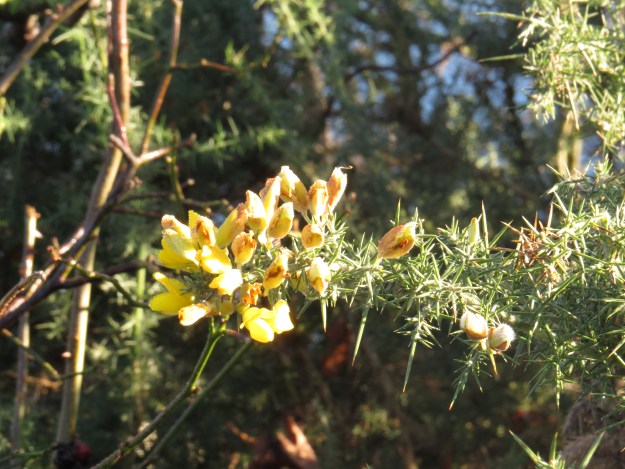
The gorse is in flower (so kissing must still be in fashion, as they say).

Herons glided over the path, looking positively prehistoric. In a few weeks time they will be setting up their nests on one of the islands, and the serenity will be broken by the sounds of heron chicks, but for now the main sound is the chorus of robins. This one was singing, then listening out for a rival, then singing again.

And a great-crested grebe patrolled the water. No sign of a mate today, but probably she or he is very close.

It was one of those days when I feel delighted just to be alive, and clearly I wasn’t the only one – one woman, who had been admiring the view over the water, just turned to us and remarked how beautiful it was. It was a day for pausing, and looking, and soaking it all in. They say that nature is restorative, and today it felt as if every breath was medicine. I felt so lucky and privileged just to be able to enjoy it. I wish the same for all of us.

Wednesday Weed – Chamomile

Photo One by By ianakoz - Own work, CC BY-SA 4.0, https://commons.wikimedia.org/w/index.php?curid=38538888

Chamomile tea (Photo One)

Dear Readers, you might remember that I am giving Veganuary a go this month, and while I am thoroughly enjoying my flat whites with oat milk (and I can heartily recommend drinking chocolate with coconut milk for anyone who remembers Bounty bars), I have not found anything that really works with my builder’s tea. And so, I am mostly drinking chamomile tea, and very delicious it is too – I always think that it smells very slightly of pineapple (not surprising as pineappleweed is a close relative), but the name is actually derived from the Greek words for ‘apple’ and ‘earth’ – you can certainly pick up an apple-y flavour too. This herbal tea doesn’t need the addition of milk, dairy or otherwise, and furthermore it has a long-established reputation for soothing frazzled nerves – Peter Rabbit was given chamomile tea to drink after being chased by Mr McGregor in Beatrix Potter’s ‘The Tale of Peter Rabbit’, and if it’s good enough for him, it’s certainly good enough for me.

As it turns out, lots of different, closely-related plants are known as chamomile (or occasionally camomile). The UK’s chamomile is Chamaemelum nobile, or Roman chamomile, which is considered a native rather than a present from the Romans (they gave us rabbits, horse chestnut trees, fallow deer, indoor plumbing and Hadrian’s wall after all so we shouldn’t be greedy). To look at, this is just a very delicate, daisy-like flower, but sadly it’s listed as Vulnerable – my Harrap’s guide describes it as ‘Very locally abundant in damp turf(especially old commons), on sandy, mildly acid soils, kept short by grazing, mowing, trampling or, on clifftops and other coastal grassland, exposure to the wind’. We will be returning to the theme of ‘trampling’ later in this piece!

The map in the book shows that it’s largely confined to the West Country and areas south and west of London in England, and in the far south-west tip of Ireland. Do let me know if you’ve seen it in your area – it seems such a shame to lose it!

Photo Two by By H. Zell - Own work, CC BY-SA 3.0, https://commons.wikimedia.org/w/index.php?curid=9482794

Roman Chamomile (Chamaemelum nobile) (Photo Two)

In researching this piece, I came across this wonderful post by Marion Mackonochie on the Mecklenburgh Square website – the square is in Islington, just around the corner from where I used to live. Mackonochie explains that in addition to its reputation as a mild sedative and mood-enhancer, chamomile has been widely used for skin inflammation, indigestion, the relief of hysteria and for the easing of muscle spasms. In Germany, the plant was known as ‘Alles Zutraut’, meaning ‘capable of anything’, and in Slovakia people have in the past bowed to the plant when they saw it. However, it can also set off an allergic reaction, particularly in people who are already allergic to ragweed (Ambrosia artemisiifolia) (a North American member of the daisy family, not to be confused with our yellow-flowered ragwort species), so it’s worth being circumspect.

Photo Three by By H. Zell - Own work, CC BY-SA 3.0, https://commons.wikimedia.org/w/index.php?curid=9482809

Roman Chamomile (Photo Three)

Now, you might remember a TV series called ‘The Chamomile Lawn’, based on a book by Mary Wesley (though as it was on television in (gulp) 1984 you’ll have to be in your prime to have seen it). It follows a family meeting up in Cornwall for a family reunion after the Second World War, and the lawn in question formed part of the garden of the aunt who owns the Cornish house. It was a roaring success, and I suspect that a lot of people were so intrigued that they decided that they’d attempt their own chamomile lawn. Alas, such lawns are not really meant for playing football on (pace Shakespeare, who in Henry IV Part I describes the attributes of chamomile as ‘the more it is trodden, the faster it grows’) and they certainly won’t work on heavy soil, or in dry or dingy conditions. You will need 80  – 100 plants per square metre. In a spot where there’s not too much footfall, I imagine that the smell of the lightly-crushed leaves would be delightful.

Incidentally, the variety of Roman chamomile that is recommended for creating a chamomile lawn, called ‘Treneague’, doesn’t flower, which rather defeats the purpose in my eyes. It’s nice to have the smell, but how about the flowers? The one in the photo below would be rather nice, though I do have my doubts about the good intentions of the cat.

A Chamomile lawn as shown on the Morehaven’s Camomile Lawn webpage (https://www.camomilelawns.co.uk/)

And finally, a poem. I love the way that Katherine Mansfield manages to make this both cosy and menacing at the same time, quite a trick to pull off. See what you think. 

Camomile Tea by Katherine Mansfield

Outside the sky is light with stars;
There’s a hollow roaring from the sea.
And, alas! for the little almond flowers,
The wind is shaking the almond tree.

How little I thought, a year ago,
In the horrible cottage upon the Lee
That he and I should be sitting so
And sipping a cup of camomile tea.

Light as feathers the witches fly,
The horn of the moon is plain to see;
By a firefly under a jonquil flower
A goblin toasts a bumble-bee.

We might be fifty, we might be five,
So snug, so compact, so wise are we!
Under the kitchen-table leg
My knee is pressing against his knee.

Our shutters are shut, the fire is low,
The tap is dripping peacefully;
The saucepan shadows on the wall
Are black and round and plain to see.

Photo Credits

Photo One By ianakoz – Own work, CC BY-SA 4.0, https://commons.wikimedia.org/w/index.php?curid=38538888

Photo Two by By H. Zell – Own work, CC BY-SA 3.0, https://commons.wikimedia.org/w/index.php?curid=9482794

Photo Three by By H. Zell – Own work, CC BY-SA 3.0, https://commons.wikimedia.org/w/index.php?curid=9482809

…And Plans

Photo One by Zeynel Cebeci, CC BY-SA 4.0 <https://creativecommons.org/licenses/by-sa/4.0>, via Wikimedia Commons

Winter Honeysuckle (Lonicera fragrantissima) (Photo One)

Dear Readers, I like to think that I’m a well-organised person, but a trip to the garden centre is usually enough to see me coming home with something completely random that I’ve spotted. This week it was a winter honeysuckle shrub – I remember watching the bumblebees feeding on one in February last year, and so I decided that it would be a good addition to the garden. Now it just has to stop raining long enough for me to actually plant the poor thing.

I have also taken advantage of the Royal Horticultural Seed Scheme this year. Seeds are collected in the various RHS gardens, and you can send off for up to 15 packets for a mere £10 if you’re a member. There’s no way that I could use a whole 15 packets, but I shall be sharing my seeds around. I’ve got a nice combination of natives, such as cow parsley, honesty and wild carrot, and some rather more unusual plants.

Photo Two by CC BY-SA 3.0, https://commons.wikimedia.org/w/index.php?curid=107188

Honesty (Lunaria annua) (Photo Two)

Photo Three by Quartl, CC BY-SA 3.0 <https://creativecommons.org/licenses/by-sa/3.0>, via Wikimedia Commons

Wild carrot (Daucus carota) (Photo Three)

One such unusual plant is  this Colour-changing Tobacco Plant (Nicotiana mutabilis), where the flowers start white but gradually change to pink.

Photo Four by scott.zona, CC BY 2.0 <https://creativecommons.org/licenses/by/2.0>, via Wikimedia Commons

Colour-changing Tobacco Plant (Nicotiana mutabilis) (Photo Four)

And how about this Large Yellow Foxglove (Digitalis grandiflora)? It will be interesting to see how this does.

Photo Five by Florian Grossir, CC BY-SA 3.0 <https://creativecommons.org/licenses/by-sa/3.0>, via Wikimedia Commons

Large Yellow Foxglove (Digitalis grandiflora) (Photo Five)

I seem to have also bought some Hairy Foxglove (Digitalis ciliata) seeds – this plant is smaller and more delicate than the Large Yellow Foxglove.  I see a lot of foxgloves in my future, especially as the ‘normal’ foxgloves that I planted last year have probably self-seeded all over the place. Clearly I need a country estate rather than a suburban back garden.

Photo Six by Don McCulley, CC BY-SA 4.0 <https://creativecommons.org/licenses/by-sa/4.0>, via Wikimedia Commons

Hairy Foxglove (Digitalis ciliata) (Photo Six)

Ooh, and before I forget, I also have some seeds for this cyclamen (Cyclamen mirabile). I find that Cyclamen do ok in the garden, so I thought I’d have a bash at another species to complement the Cyclamen hederifolium and Cyclamen coum that I already have.

Photo Seven by By Tejvan Pettinger - Cyclamen, CC BY 2.0, https://commons.wikimedia.org/w/index.php?curid=12226905

Cyclamen mirabile (Photo Seven)

Anyhow, I am fully expecting to have more seeds than I know what to do with, so I will be up to my ears in seed trays for the next few months. I will keep you posted on my progress, which has historically been rather hit and miss. My plan is to improve the shady, woodland part of the garden, which is lovely in spring but then rather sparse, so that will be my focus for 2022. Let’s see how I get on! And let me know if you have any particular plans for your garden/pots/house plants this year.

Photo Credits

Photo One by Zeynel Cebeci, CC BY-SA 4.0 <https://creativecommons.org/licenses/by-sa/4.0>, via Wikimedia Commons

Photo Two by CC BY-SA 3.0, https://commons.wikimedia.org/w/index.php?curid=107188

Photo Three by Quartl, CC BY-SA 3.0 <https://creativecommons.org/licenses/by-sa/3.0>, via Wikimedia Commons

Photo Four by scott.zona, CC BY 2.0 <https://creativecommons.org/licenses/by/2.0>, via Wikimedia Commons

Photo Five by Florian Grossir, CC BY-SA 3.0 <https://creativecommons.org/licenses/by-sa/3.0>, via Wikimedia Commons

Photo Six by Don McCulley, CC BY-SA 4.0 <https://creativecommons.org/licenses/by-sa/4.0>, via Wikimedia Commons

Photo Seven  By Tejvan Pettinger – Cyclamen, CC BY 2.0, https://commons.wikimedia.org/w/index.php?curid=12226905