Category Archives: London Plants

…And Plans

Photo One by Zeynel Cebeci, CC BY-SA 4.0 <https://creativecommons.org/licenses/by-sa/4.0>, via Wikimedia Commons

Winter Honeysuckle (Lonicera fragrantissima) (Photo One)

Dear Readers, I like to think that I’m a well-organised person, but a trip to the garden centre is usually enough to see me coming home with something completely random that I’ve spotted. This week it was a winter honeysuckle shrub – I remember watching the bumblebees feeding on one in February last year, and so I decided that it would be a good addition to the garden. Now it just has to stop raining long enough for me to actually plant the poor thing.

I have also taken advantage of the Royal Horticultural Seed Scheme this year. Seeds are collected in the various RHS gardens, and you can send off for up to 15 packets for a mere £10 if you’re a member. There’s no way that I could use a whole 15 packets, but I shall be sharing my seeds around. I’ve got a nice combination of natives, such as cow parsley, honesty and wild carrot, and some rather more unusual plants.

Photo Two by CC BY-SA 3.0, https://commons.wikimedia.org/w/index.php?curid=107188

Honesty (Lunaria annua) (Photo Two)

Photo Three by Quartl, CC BY-SA 3.0 <https://creativecommons.org/licenses/by-sa/3.0>, via Wikimedia Commons

Wild carrot (Daucus carota) (Photo Three)

One such unusual plant is  this Colour-changing Tobacco Plant (Nicotiana mutabilis), where the flowers start white but gradually change to pink.

Photo Four by scott.zona, CC BY 2.0 <https://creativecommons.org/licenses/by/2.0>, via Wikimedia Commons

Colour-changing Tobacco Plant (Nicotiana mutabilis) (Photo Four)

And how about this Large Yellow Foxglove (Digitalis grandiflora)? It will be interesting to see how this does.

Photo Five by Florian Grossir, CC BY-SA 3.0 <https://creativecommons.org/licenses/by-sa/3.0>, via Wikimedia Commons

Large Yellow Foxglove (Digitalis grandiflora) (Photo Five)

I seem to have also bought some Hairy Foxglove (Digitalis ciliata) seeds – this plant is smaller and more delicate than the Large Yellow Foxglove.  I see a lot of foxgloves in my future, especially as the ‘normal’ foxgloves that I planted last year have probably self-seeded all over the place. Clearly I need a country estate rather than a suburban back garden.

Photo Six by Don McCulley, CC BY-SA 4.0 <https://creativecommons.org/licenses/by-sa/4.0>, via Wikimedia Commons

Hairy Foxglove (Digitalis ciliata) (Photo Six)

Ooh, and before I forget, I also have some seeds for this cyclamen (Cyclamen mirabile). I find that Cyclamen do ok in the garden, so I thought I’d have a bash at another species to complement the Cyclamen hederifolium and Cyclamen coum that I already have.

Photo Seven by By Tejvan Pettinger - Cyclamen, CC BY 2.0, https://commons.wikimedia.org/w/index.php?curid=12226905

Cyclamen mirabile (Photo Seven)

Anyhow, I am fully expecting to have more seeds than I know what to do with, so I will be up to my ears in seed trays for the next few months. I will keep you posted on my progress, which has historically been rather hit and miss. My plan is to improve the shady, woodland part of the garden, which is lovely in spring but then rather sparse, so that will be my focus for 2022. Let’s see how I get on! And let me know if you have any particular plans for your garden/pots/house plants this year.

Photo Credits

Photo One by Zeynel Cebeci, CC BY-SA 4.0 <https://creativecommons.org/licenses/by-sa/4.0>, via Wikimedia Commons

Photo Two by CC BY-SA 3.0, https://commons.wikimedia.org/w/index.php?curid=107188

Photo Three by Quartl, CC BY-SA 3.0 <https://creativecommons.org/licenses/by-sa/3.0>, via Wikimedia Commons

Photo Four by scott.zona, CC BY 2.0 <https://creativecommons.org/licenses/by/2.0>, via Wikimedia Commons

Photo Five by Florian Grossir, CC BY-SA 3.0 <https://creativecommons.org/licenses/by-sa/3.0>, via Wikimedia Commons

Photo Six by Don McCulley, CC BY-SA 4.0 <https://creativecommons.org/licenses/by-sa/4.0>, via Wikimedia Commons

Photo Seven  By Tejvan Pettinger – Cyclamen, CC BY 2.0, https://commons.wikimedia.org/w/index.php?curid=12226905

Wednesday Weed – Christmas Cactus

Christmas Cactus (Schlumbergera x truncata)

Dear Readers, I used to have a bright pink Christmas cactus, that I nurtured for many years until, finally, someone overwatered it and it died. So I was very happy to see a fine selection in the Sunshine Garden Centre this week, and even happier when my lovely friend Jo bought me some as a Christmas present. I love the flowers on these plants – they always look to me a little like a bird leaping into the air. And with the array of buds on this one, I’m hoping that it will be flowering for quite some time.

Plus, I not only got a festive red cactus, but a white one…

and a magenta one, to match this extraordinary magenta cyclamen that I saw.

All cacti (with the exception of Rhipsalis baccifera, which has somehow found its way to Africa) are New World plants, but Christmas cacti are classified as forest cacti. These plants are very different from their desert relations: forest cacti are epiphytic, which means that they grow on the branches of trees or cracks in a rock face in their rainforest homes.  They get water from the humidity of the air or rain, and their nutrients come from organic debris that accumulates around their roots. They therefore hate being waterlogged, as in their native environments the water would just wash away. They live in dappled sunlight, and air circulation around them is also good. All this means that they have to be kept in free-draining soil, and yet like to be sprayed or kept on wet pebbles to keep the humidity up. You often see Christmas cacti in hanging baskets for just this reason – it’s a way to make sure that they get the air circulation that they need, while at the same time being able to spray them for humidity, and admire them from all angles.

In the wild, Schlumbergera grow at altitudes of up to 700 metres (2300 feet) in south-eastern Brazil, and there are six to nine wild species. In Brazil, Christmas cacti can form sizeable shrubs of up to four feet tall. The plants have no leaves, but their modified stems enable them to photosynthesise. The flowers are adapted to be pollinated by hummingbirds (hence the wild-type plant is red, a colour easily visible to birds). Hummingbirds also act to transfer the seeds from one tree to another – as in the post about mistletoe a few weeks ago, the birds wipe their bills to remove the sticky seeds after feeding on the front, hence moving the cactus to a nice new home.

There are two main ‘families’ of Christmas cactus that you’re likely to come across in the stores at this time of year. My plant is Schlumbergera truncata. How can I tell? Mainly because the stems are extremely ‘pointy’ (hence one alternative name of ‘crab cactus’…

and the pollen is yellow.

Christmas Cactus (Schlumbergera truncata)

However, you can also find Schlumbergera x buckleyi in the shops. It is a hybrid of Schlumbergera russeliana and Schlumbergera truncata. The stems of this plant are much less ‘prickly’, and the pollen is bright pink.

Photo One by By Schlumbergera_truncata_02.JPG: Lestat (Jan Mehlich)derivative work: Peter coxhead (talk) - Schlumbergera_truncata_02.JPG, CC BY-SA 2.5, https://commons.wikimedia.org/w/index.php?curid=17191427

Softer, more rounded stems, pink pollen = Schlumbergera buckleyi. (Photo One)

And here’s something rather lovely – the flowers of a Christmas cactus opening in a time-lapse sequence.

https://www.youtube.com/watch?v=Sbvh4GQru7Y

Christmas cacti have been cultivated in Europe since about 1818, with the first hybrid varieties appearing in the mid 1850s. They were very popular in the late Victorian period, but by 1900s they had fallen out of favour, and many varieties were lost. It’s funny how there are fashions in house plants – when I was growing up, everyone had spider plants and aspidistra, and these days these are something of a rarity. However, Christmas cacti staged a comeback: by the 1950s they were popular again, with breeders particularly keen on plants that flowered profusely and which also had more of an upright habit than the trailing habit of the wild plant (though I have noticed that most Christmas cacti revert to a more horizontal growth pattern once they mature). They also started to develop plants with different coloured flowers, such as this yellow one, Gold Charm, which is pretty but infertile.

Photo Two by By Maja Dumat - Weihnachtskaktus (Schlumbergera truncata)Uploaded by uleli, CC BY 2.0, https://commons.wikimedia.org/w/index.php?curid=9728034

‘Gold Charm’, a very unusual yellow Christmas cactus (Truncata group) (Photo Two)

However, colour can be problematic in cultivated varieties: it’s been found that the eventual hue of the flowers is influenced by the temperature during bud formation. A plant that might produce white or yellow flowers can be persuaded to produce pink or red-tinged ones instead if the temperature is above 57 degrees Fahrenheit, and plants that are already pink or red will produce much darker-coloured flowers. Iron is also said to influence flower colour.

If I look after my Christmas cacti properly, they can turn in to really magnificent plants – they don’t like being repotted, they don’t like sitting in water, but apart from that in my experience they are really easy-going plants. You can also propagate them pretty easily by breaking off one of the stem segments after the plant has flowered, letting it dry out for a week  and then potting it up in cactus compost. In this way, a Christmas cactus can be almost immortal, as it will live on its clones even after the parent plant has died. And I have read several stories of Christmas cacti that are decades old, and some which are advancing into their hundreds. I rather like this story of ‘A Christmas Cactus Named Junior‘ by Kathy Keeler at ‘The Wandering Botanist’ for example. ‘Junior’ is certainly looking good after his adventures!

There is a Brazilian legend that a small boy in a Brazilian village prayed for a sign that Christmas had come, and in the morning all the rainforest plants had broken into flower on Christmas Day. Sadly, in Brazil Schlumbergera flowers in May and is in fact known as the ‘May Flower’. Blooming botanists, ruining all the stories.

But here is a poem by Gaia Holmes, discovered in the online version of The Stylist magazine of all things. Gosh, I like this a lot, probably because it makes me uneasy, and that is exactly what this time of year does to me too – the darkness that gathers around all the light and sparkle, like wolves waiting just outside the glow of the fire. Not very festive, I know. Anyway, see what you think, lovely people. There is always a Christmas cactus to admire, with its fantastical flowers and leap of faith.

Shadow Play by Gaia Holmes 

He came in winter
when the house was always dark,
brought red Christmas cacti
fire-crackering from their pots
and a suitcase full of candles,
thickened my gloomy rooms
with light.
I met the shadows he bred
without caution
and did not complain
when he followed me to my bed.
Outside, frost had edged the world
with spite.
The city foxes were howling,
cracking their teeth on the ice.
The sharp scent of January scared me.
His big hands cast wolves on the walls.
Fear made me knot myself
around him.
He had a bristled chin
and smelled of fathers.
‘Tell me a story,’ I said
and he told me how lust
could turn an angel
inside out.

Published in Where The Road Runs Out by Gaia Holmes, Comma Press, £9.99, hive.co.uk

Photo Credits

Photo One by By Schlumbergera_truncata_02.JPG: Lestat (Jan Mehlich)derivative work: Peter coxhead (talk) – Schlumbergera_truncata_02.JPG, CC BY-SA 2.5, https://commons.wikimedia.org/w/index.php?curid=17191427

Photo Two by By Maja Dumat – Weihnachtskaktus (Schlumbergera truncata)Uploaded by uleli, CC BY 2.0, https://commons.wikimedia.org/w/index.php?curid=9728034


In Praise of Climbing Hydrangea

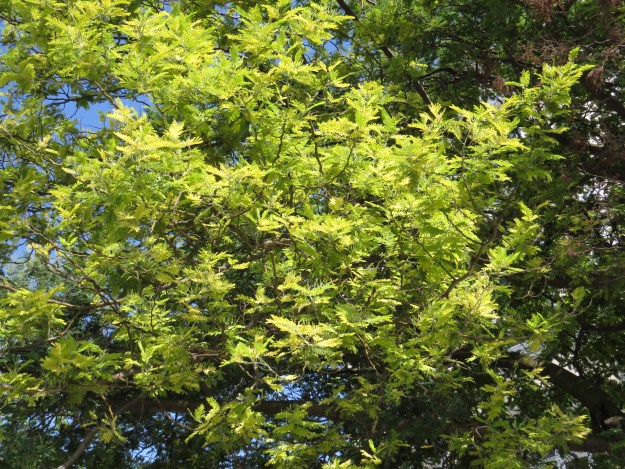
Dear Readers, my climbing hydrangea (Hydrangea petiolaris) is really excelling itself this year. The leaves are shades of custard-yellow and lime, and it’s finally beginning to provide some cover for the nest box in the corner.

This is a dark, damp, murky corner of the garden, but this plant just doesn’t seem to care. In the spring it’s covered with big lacy heads of tiny cream-coloured flowers, and I think they’re rather fine even when they’ve gone over.

But it’s the leaves that have really caught my eye.

And while I’ve been standing there photographing the leaves, lots of small birds have been visiting the newly-filled seed feeder. Here’s a rather blurry chaffinch…

And now a great tit….

And here’s someone I didn’t expect to see using a bird feeder…..s/he did actually snaffle a quick seed, though I imagine the suet would be more to their taste. Does anyone else have robins using their feeders?

Meanwhile, there is one brave marigold still in flower…

And finally, next door’s hebe has come back into flower for about the third time this year. It is such a boon for bumblebees when they decide they need a nectar top-up during the winter.

And so, spending ten minutes away from my spreadsheets was well worth it! And good for my poor old back, too.

Wednesday Weed – Ivy Broomrape

Ivy broomrape (Orobanche hederae)

Dear Readers, I was very excited when I spotted this plant at Camley Street Natural Park in Kings Cross last week. Actually, to be fair I didn’t spot it – it was mentioned on the list of ‘sightings’ by the cafe, but I had to ask the warden where to find it. She was very helpful, and of course once I’d seen it I felt like a right twit because it was everywhere.

Sadly, I’d missed the peak flowering for this most peculiar plant, but this is what it looks like when it’s in its prime – I think it looks like a slightly sinister hyacinth.

Photo One by By No machine-readable author provided. Aroche assumed (based on copyright claims). - No machine-readable source provided. Own work assumed (based on copyright claims)., CC BY 2.5, https://commons.wikimedia.org/w/index.php?curid=1162590

Photo One

Broomrapes are a fascinating family of parasitic plants, and some are very focussed and prey on only one species, while others are a bit less fussy. They have no chlorophyll of their own, hence their rather ghostly appearance, and so they are completely dependent on other plants for their nutrients. The seeds lurk in the soil until they detect the roots of their host plant. At this point they germinate and send out little roots of their own, which attach to, in this case, the ivy. They remind me of fungi, as they disappear altogether once the flower heads have finished.

The name ‘Orobanche’ means ‘bitter-vetch strangler’, not surprising as some species of broomrape are parasitic on various vetches (members of the Fabaceae or bean family). And while broomrape sounds as if it might refer to the plant’s parasitic nature, in fact it comes from the Latin for tuber, rapum – so broomrape actually means ‘tuber growing on broom’ rather than something more awful.

Ivy broomrape is largely a plant of Central and Northern Europe, though there is a single population in the University of Berkeley’s gardens, in California. There is a persistent rumour that the plant was introduced deliberately to try to control the spread of ivy, itself an alien plant. The consensus seems to be, however, that the parasite doesn’t do long-term or extensive damage to ivy, and certainly in Camley Street the whole understorey of the woods was covered in a lush carpet of green.

Photo Two by By Scott Zona from USA - Orobanche hederaeUploaded by pixeltoo, CC BY 2.0, https://commons.wikimedia.org/w/index.php?curid=7513606

More ivy broomrape in flower (Photo Two)

One or two members of the broomrape family can be problematic, however: branched broomrape (Orobanche ramosa) might look as pretty as a picture with its blue flowers, but it is a notorious parasite of food crops such as potatoes and tomatoes, and can cause total crop failure in parts of south-western Europe and North Africa.

Photo Three by By Javier martin - Own work, Public Domain, https://commons.wikimedia.org/w/index.php?curid=3864360

Branched broomrape (Orobanche ramosa) (Photo Three)

However, as revenge, humans eat the stems of the bean broomrape (Orobanche crenata) in the region of Apulia in Italy, where the plant is known as sporchia. 

Photo Four by By © Hans Hillewaert, CC BY-SA 3.0, https://commons.wikimedia.org/w/index.php?curid=6153027

Bean broomrape (Orobanche crenata) (Photo Four)

And here it is cooked, and looking very tasty. You can get the recipe here

Photo Five from https://www.cosedicucina.it/sporchia

Cooked sporchia (Photo Five)

Medicinally, the herbalist Nicolas Culpeper stated that broomrapes could be used as a cure for kidney and bladder stones, normally when decocted in wine. It was also considered efficacious when used in a poultice for ‘fretting ulcers’ and ‘scabby sores’. A strong solution of the flowers was  believed to remove freckles and blemishes.

And finally, a poem. I didn’t expect to find anything on broomrapes, but actually I found two! Here is one by Giles Watson, from a series of poems on plants and their history, folklore and biology. There are some very interesting works on the site here.

Broomrape (Orobanche spp.) by Giles Watson

Blanched as blood-drained flesh,

Broomrapes grow in deepest shade

Despising the sun. Their leaves

Are scales, their racemes rise

From soil, like vampires’ fingers,

The flowers shadowed, bruised

Like vampires’ eyes.

Hidden from sight, roots

Clamp round roots, suck

From the flux of life.

No need to grow green:

Flourish, rather, on others’ juices.

And here is a poem by Fiona Pitt-Kethley, which is rather more about minerals than plants, but fun nonetheless. You can see the stones that she’s writing about here.

The Opal Menilites of Agramón

Fiona Pitt-Kethley

Bright yellow broomrape bursting from the clay,
close to the minerals we’re searching for.
Nothing’s what you’d expect in Agramón.

Blue-grey on grey at first they look discreet
and crisp as sugared almonds in the walls
until we marvel at their varied forms.
This quarry’s the sex-shop of the mineral scene:
Willendorf Venuses, testicles, dicks
beside more toy-like marbles, skittles, ducks
and half-formed pre-pubescent young girls’ breasts.

A heavenly jest, perhaps. Exuberant,
tumescent, waiting in their matrixes.
If stones could speak these ones would say to me:
“Release us on an unsuspecting world…”

Photo Credits

Photo One by By No machine-readable author provided. Aroche assumed (based on copyright claims). – No machine-readable source provided. Own work assumed (based on copyright claims)., CC BY 2.5, https://commons.wikimedia.org/w/index.php?curid=1162590

Photo Two By Scott Zona from USA – Orobanche hederaeUploaded by pixeltoo, CC BY 2.0, https://commons.wikimedia.org/w/index.php?curid=7513606

Photo Three By Javier martin – Own work, Public Domain, https://commons.wikimedia.org/w/index.php?curid=3864360

Photo Four By © Hans Hillewaert, CC BY-SA 3.0, https://commons.wikimedia.org/w/index.php?curid=6153027

Photo Five from https://www.cosedicucina.it/sporchia

Thoughts on Ash

Dear Readers, I am continuing to read through Archie Miles’ book on British trees and thought that today I’d look at the ash tree. It’s one of my favourites, with its elegant leaves and those buds like tiny hooves, and the fact that we are likely to lose most of the species because of ash dieback makes them even more precious.

You might remember that in an earlier post this week, I was hoping that the Australian Raywood ashes in the cemetery might have some resistance to the disease. Alas, it appears not to be so, so even these beauties might not be spared.

An avenue of Raywood ashes in St Pancras and Islington Cemetery

In the cemetery, the ashes pop up all over the place, and Miles suggests that the ash was the tree that colonised most quickly after the hurricane in 1987, and the impact of Dutch elm disease. It is a fast-growing tree, and historically known as the husbandman’s tree, used for agricultural implements and as fuel wood – it is said to burn well even when green. I love its delicacy (which gave rise to the name of ‘Venus of the Woods’) but its very short season (it is one of the last trees to come into leaf and one of the first to lose them) has made it unpopular in gardens, though I suspect that some of the fancier varieties might tickle a gardeners’ fancy.

Although some people think of ash trees as mundance, workaday trees they have a very surprising capacity to change their sex from one year to another. This is particularly confusing because ash trees can produce male, female or hemaphroditic flowers, either on separate trees or all on a single tree. Botanists don’t know why the tree can do this, but speculate that it might give an advantage when the climatic conditions for setting seed are ideal, or when there is a lot of competition. It might also be handy if a space suddenly opens up for colonisation – in this case the more seeds the better! It might well explain why ash is capable of popping up anywhere (I have one in my garden that I have to coppice every year before it takes over completely).

Photo One by Rosser1954, CC BY-SA 4.0 , via Wikimedia Commons

Male Ash flowers and buds (Photo One)

Ash trees flower once they’re thirty to forty years old. The flowers appear on last year’s growth before the leaves appear, but they can bloom anytime from late March to May, and Miles tells us that it’s believed that this allows the tree to compensate for damage to the earliest flowers from the late spring frosts. The male flowers appear first (as in the photo above), then the hermaphrodite flowers and then the female ones. Only the.female flowers will turn into the ash keys (known as samaras).

Photo Two by By Pleple2000 - Own work, CC BY-SA 3.0, https://commons.wikimedia.org/w/index.php?curid=1564105

Ash tree samaras (Photo Two)

When you consider the long associations between ash and humans, it’s not surprising that there is a lot of folklore about the tree. Miles quotes a rhyme that young women said when they were hoping to find a sweetheart:

Even ash, even ash,
I pluck thee off the tree;
The first young man that I do meet
My lover he shall be.

The young woman was supposed to put the ash leaf in her left shoe and wait to see what happened.

Ash was also supposed to be protective against snake bites, and, if you did get bitten, it was said by Dioscorides, first-century Greek physician, to be ‘singularly good against the bitings of viper, adder or other venomous beast’. More usefully in our present day, when we are unlikely to be molested by serpents, Culpeper thought that an extract from the leaves would ‘abate the greatness of those who are too gross or fat‘.

Perhaps most fascinating, however, is the belief that ash could be used to cure a rupture in a child. Miles remarks that the Reverend Gilbert White, writing in 1776, described how parents of a child so afflicted would pass the infant through the trunk of an ash tree that had been split with an axe. The tree would then be bound up again, and once it healed, so would the child. The ritual was still being performed as late as 1902 in Devon.

What a beautiful and useful tree the ash is! A glimmer of hope on the preservation of the species in light of ash dieback is the Ash Archive, which consists of a collection of 3,000 ash trees planted in Hampshire. They comprise cuttings taken from ash dieback tolerant trees observed in the wild and grafted onto ash rootstocks. Their development will be monitored, in the hope that some will have a long-lasting resistance to the fungus that causes the disease. At some point in the future it might then be possible to plant these trees, or the seeds that come from them, back into the wild. Let’s hope that there is a future for this beautiful tree here in the UK.

Photo Three by Willow, CC BY-SA 3.0 <https://creativecommons.org/licenses/by-sa/3.0>, via Wikimedia Commons

Ash tree (Fraxinus excelsior) (Photo Three)

You can buy Archie Miles Book ‘The Trees that Made Britain – An Evergreen History’ here.

Photo Credits

Photo One by Rosser1954, CC BY-SA 4.0 , via Wikimedia Commons

Photo Two by By Pleple2000 – Own work, CC BY-SA 3.0, https://commons.wikimedia.org/w/index.php?curid=1564105

Photo Three by Willow, CC BY-SA 3.0 <https://creativecommons.org/licenses/by-sa/3.0>, via Wikimedia Commons

Thoughts on Oaks

Dear Readers, ‘The Trees that Made Britain – An Evergreen History’ by Archie Miles  was apparently made into a television series in 2006 and I can see why – it’s full to bursting with interesting facts about our native trees. I’m sorry I missed the programmes, but there’s something rather nice about reading at your own pace without being overwhelmed by images or (increasingly) overblown background music. There is a new TV series featuring David Attenborough called ‘The Mating Game’, where the music is so overwhelming that it’s difficult to concentrate. How I hate it when the music is designed to tell you what to feel – I blame Steven Spielberg meself.

But I digress, as usual.

I will be reading this book for a while, so today here are a few facts about that most English of trees, the Oak. Except that there are two species, the Pedunculate or English Oak (Quercus robur) and the Sessile Oak (Quercus petraea). Now, one of these species has short stems on the leaves and long stems on the acorns, and the other species has long stems on the leaves and short stems on the acorns. And do you think I can remember which is which? Well, now I will, because a peduncle is a long stem, and sessile comes from the Latin sessilis, meaning ‘low of sitting’, which is not too far from ‘no stem’ in my mind. All I need to remember now is that both terms relate to the acorns and I’ll be in business for once.

Then, Miles discusses Lammas growth, which I had never heard of. Apparently, oaks often throw a new flush of growth around 1st August (Lammas Day), to replace the leaves that were lost to insect infestations earlier in the year. As Miles puts it:

During this time the tree will bear two distinct sets of leaves, the older foliage having matured to a dark green, contrasting with the bright green (or in some cases slightly reddish) colour of the new.”

Has anyone else noticed this? Something to look out for in years to come, I think.

Photo One by Rosser1954, CC BY-SA 4.0 <https://creativecommons.org/licenses/by-sa/4.0>, via Wikimedia Commons

Lammas growth on a Pedunculate Oak (Photo One)

Miles also talks about ‘stag-headed oaks’, where the canopy on older trees has receded, leaving dead branches sticking out through the live growth. I’ve always thought of this as a bad sign, but Miles points out that it’s a way for the tree to preserve its strength – a smaller canopy needs a much smaller root system, so it’s less ‘expensive’ for the tree to maintain. I suspect that it also reduces the tree’s exposure to the extremes of wind and weather that younger trees are maybe more able to resist.

Photo Two by Kate Jewell / Stag-headed oak, Croxton Park

Stag-headed Oak in Croxton Park (Photo Two)

In his section on ‘The Useful Oak’, Miles talks about the role of the oak in shipbuilding. Until the second half of the nineteenth century when iron hulls were introduced, wood and especially oak was the principal material used for the creation of ships. Nelson’s flagship, HMS Victory, took the timber of 6000 trees, 90% of which was oak, with elm for the keel and fir, pine and spruce for the masts and yards. The ship cost £63,176 to build, the equivalent of building an aircraft carrier today.

Interestingly, though, Miles points out that the most valuable commodity ever extracted from oakwoods was not the timber, but the bark. Huge quantities were used in the tanning industry from 1780 to the mid nineteenth century, with coppiced oakwoods being managed on rotation to satisfy the demand for the commodity. Miles describes the process:

“In the spring, when the sap was rising, great gangs of men and women would head into the woods, the men to cut and carry, the women to strip the bark with distinctive spoon-bladed knives called barking irons or peeling irons”.

There is a fascinating article here about the Dartmoor ‘rippers’, the people who stripped the bark in the oakwoods of the area. This was a massive industry: an average tannery could get through a ton of bark in a week. Who knew? Not me, for sure.

And finally, Miles considers the myths and legends that surround the oak tree. Oaks that bore mistletoe were sacred to the Druids, and the mistletoe retained its mystical healing powers provided it was never dropped – its magic came from its never having touched the ground. Felling a mistletoe oak was considered a terrible deed, one that would bring disaster to all those involved. It’s a great shame that we haven’t retained such a sense of the importance of trees.

Many churches contain carvings of oak leaves and acorns, and as with so many things, these symbols provide a link to the pagan past. Acorns were thought to provide protection against lightning strikes, which is why you’ll often find them carved on stair banisters or as toggles for pulling blinds. People used to carry acorns in their pockets, not just to prevent themselves from being electrified unexpectedly but also because the acorn was thought to confer good health and fertility. It’s probably no wonder that the Green Man, another pagan figure who sometimes crops up as a sculpture in old churches, is often crowned with oak leaves.

Photo Three from https://curiousrambler.com/the-mysterious-green-men-in-medieval-churches/

Green man in Westminster Abbey (Photo Three)

And so I learned a lot about oaks from this wonderful book. The next chapter is on Ash, so let’s see what comes out of my study of that fine tree.

Photo Credits

Photo One by Rosser1954, CC BY-SA 4.0 <https://creativecommons.org/licenses/by-sa/4.0>, via Wikimedia Commons

Photo Two by Kate Jewell / Stag-headed oak, Croxton Park

Photo Three from https://curiousrambler.com/the-mysterious-green-men-in-medieval-churches/

A Bank Holiday Walk in St Pancras and Islington Cemetery

Dear Readers, it was extremely quiet in the cemetery today. I’m guessing that lots of people are away, what with it being the August Bank Holiday and all, but it meant that I spotted two handsome foxes (though they dashed away too quickly for me to get a photograph), and also saw two buzzards circling overhead, mewing to one another. I expected the crows to rise up in umbrage, but they didn’t for once – maybe they’re all on holiday too.

Some Japanese anemones are just coming into flower in the woodland grave area, along with some most unlikely-looking plants – they remind me of one of my house plants. Let’s hope they survive.

Look at the swamp cypress, people! I am waiting for the first hints of rust to appear. There is a definite increase in tempo this week, with the coal tits and blue tits cheeping and the robins starting to announce their winter territories. I love autumn though, it’s probably my favourite season – there is strangely more of a sense of possibility and new beginnings for me at this time of year than in the spring. Maybe it’s all those years of education, when the school year started in September, but it’s always been pivotal for me – I got married in September, as did my mother and father, and I started my most recent job in September too.

The swamp cypress

Anyhow, I’m starting to see a lot of wasps drifting about. I wonder what this one was after on this conifer? Maybe there’s something sweet and resinous being produced.

The Cedars of Lebanon are looking particularly magnificent, and several of them are producing their female flowers, which will be shedding pollen and irritating the noses of hay fever sufferers for the next few months.


The conkers are filling out nicely, and there are plenty of berries on the holly.

And here’s a holly-blue butterfly, sunning itself. This one is a female (you can tell by the black edges to the wings).

I always stop and give the Tibetan Cherry trunk a little rub as well, to keep it nice and shiny.

There is a definite meadow-ish feel to some parts of the cemetery at the moment – the gardeners are out with their strimmers and, I regret to say, their leaf-blowers, but it’s been such a wet summer that everything is springing up as fast as it’s trimmed. Some grave-visitors have taken to bringing in their own strimmers. Still, I thought I’d try to take a couple of grasshopper-eye views of the plants while they’re still around.

Red clover and ribworth plantain

Other notables today were the hedgerow geranium, with its intensely mauve flowers..

…the common toadflax…

…the bristly oxtongue…

….the nipplewort…

…and the Japanese Knotweed in full flower. Just as well it doesn’t spread by seed in this country, there’s quite enough of it in the cemetery as it is.

And in other signs of autumn, there’s the tarspot fungus in all its glory on the sycamore leaves…

and the hogweed seeds, which are rather pretty close up. I’m sure someone on Masterchef actually used these in a dish recently, I shall have to check (though the umbellifers are a tricky family with several, such as hemlock, being extremely poisonous).

And finally, it’s funny what you don’t notice, until you do. I walk this way every week, but never saw that the ivy had covered a whole row of graves just by one of the woodier parts of the cemetery. It’s amazing the way that ivy just reclaims things. Was this part of the cemetery once pristine and neat, I wonder? I know that I prefer it the way it is now. Although a lot of the wilder parts of the cemetery are being dug over for new graves, I imagine that there will always be older parts where it’s just not economical to cut down the trees. I hope so, anyway.

Graves disappearing under the ivy.

London Tree Walks by Paul Wood – A Pimlico Circular – Part Two

Variegated Chinese Privet on Alderney Street in Pimlico

Dear Readers, after my meander around the Churchill Gardens Estate I was in need of a coffee, a sit-down and a loo (though not in that order). I found the Brewhouse cafe, which had all three, including some seats outside. Highly recommended in an area that’s actually fairly devoid of hostelries. 

Onwards! I have fallen in love with these Chinese Tree Privets (Lugustrum lucidum var Excelsum superbum) and this variegated variety was particularly impressive. I could smell the perfume of the flowers from twenty feet away, and it was abuzz with bees.

On the other side of the road are two Chestnut-leaved Oaks (Quercus castaneifolia) – these trees come from Iran, but they seem to love it here. A tree planted in Kew Gardens is the largest in their Arboretum, measuring 37 metres tall and 8 metres in girth. These trees are rather smaller (at the moment).

Chestnut-leaved oaks (Quercus castaneifolia)

On Denbigh Street there’s a statue of Thomas Cubitt, who was the builder of much of Belgravia and Bloomsbury. His vision was to convert the area of marshy ground close to the river to a grid of stuccoed terraces and garden squares, and this he largely achieved. He is shaded by an Indian Horse Chestnut (Aesculus indica) – I met one of these trees in East Finchley Cemetery a few months ago. It is increasingly favoured by street arborists because the tree doesn’t attract the leaf-miners that ‘ordinary’ horse chestnut does.

Thomas Cubitt

The leaves of the Indian Horse Chestnut

I noted that the lions are locked up in these parts, though you’d need some muscles to run off with this chap.

And you can tell you’re in Westminster when the wheelie bins are decorated.

Onwards! Here is a very lovely mimosa, which Wood remarks has already become a local landmark, and I can see why.

Mimosa (Acacia dealbata)

Just around the corner, on Moreton Street, are some of the most unusual street trees in Pimlico. Can you guess what they are?

Yep, these are Australian Bottlebrush Trees (Callistemon citrinus). But why are they planted here?

Because Billy Hughes, Prime Minister of Australia, was born at No. 7 Moreton Street! I must pop back to see the trees when they’re in flower, they will look amazing.

Photo One by Zeynel Cebeci, CC BY-SA 3.0 <https://creativecommons.org/licenses/by-sa/3.0>, via Wikimedia Commons

Bottlebrush in flower (Photo One)

From here, I cross Vauxhall Bridge Road to find another London Plane-lined square, Vincent Square. This is private land (it forms the playing fields for Westminster School) and the trees are slightly younger than the ones that we saw on St George’s Square yesterday. There are splendid views through the square towards the Houses of Parliament and the London Eye, or there would be if it wasn’t for the vans and street furniture.

London Plane trees along the edge of Vincent Square

Then I head off to another square via Elverton Street, which has been recently planted with Chinese Red Birches (Betula albosinensis). Look at this lovely bark!

And then it’s along Horseferry Road. Things are certainly changing on the taxi front. This lot are all plugged in to fast charging points. The drivers grab a quick coffee and their vehicles are recharged within 30 minutes.

The day has gotten a lot hotter by now, and I’m beginning to regret my raincoat and scarf, so it’s a real pleasure to walk into St John’s Gardens. This is yet another place that I’ve never visited before. The notion of a park being like a cathedral is a bit of a cliché, but these trees are so tall, and the interior is so cool and tranquil that nothing else seems quite as good as a simile.

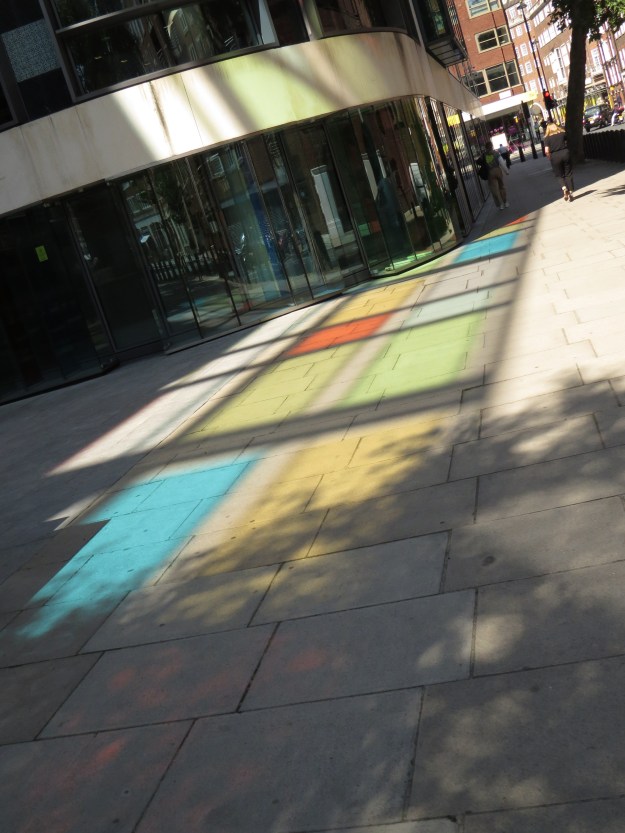
Then I take a wrong turning, which is always fun. I end up outside the new Home Office building. Considering how brutal a department this can be,  the building is light-hearted and colourful. The sun is shining through panels of coloured glass on its roof and throwing Mondrian patterns on the pavement.

And finally, when I get back on the official route, I find the Millbank Estate, 32 blocks that were built at the turn of the twentieth century. The plane trees were planted at the same time. I’ve often walked along one of the main roads after the trees were pollarded, and thought how ugly they looked, as if they had their fists raised to the sky in protest. But today they are in full leaf, and they lower the temperature of this broad expanse of concrete.

Someone has built a whole container garden at the entrance to one of the blocks.

The Millbank Estate was built at the turn of the twentieth century on the site of the old Millbank Prison, which covered not only the area of the current estate but also the land now occupied by Tate Britain. The red bricks of the estate were taken from the prison. Prisoners from all over Great Britain were held in the prison prior to deportation, and some of the features of the prison remain, like this moat, which once formed its boundary.

This walk around Pimlico has shown the interesting ways that built communities have evolved in this part of London, and the ways that green spaces and trees have been incorporated over the years. From stuccoed terraces to the Arts and Crafts-influenced Millbank Estate to the modernism of Churchill Gardens, it’s shown how ideas of social housing have changed, but also how many houses were built during this period. There seems to have been a consistent idea that it was important to house people properly, right in the centre of London.  What a reflection on the lack of vision and imagination around housing today.

London Tree Walks by Paul Wood – A Pimlico Circular – Part One

St George’s Church, Pimlico

Dear Readers, all I really knew about Pimlico prior to this walk was the route from the tube station to Tate Britain, so this walk was a real revelation. Pimlico has been the centre of wave after wave of utopian housing developments for the past two hundred years, and the range of architectural styles that I passed was astonishing. Plus, trees have been part of these plantings during the whole of this period, and it’s fascinating to see the different species that have made their homes in the Capital.

First off, we walk along Bessborough Street towards the St George’s Church. St George’s Square is open to the public, which makes it unusual. On side there are the  impressive stucco houses that I expected to find in Pimlico.

But in the square itself there are towering London Plane trees, some of the tallest that I’ve seen. The trees were probably planted at the same time as the houses, so between 1839 and 1843, making the trees about 180 years old. Given good conditions, they could easily live for another 180 years. How enormous will they be by then, I wonder?

At the north-west corner of St George’s Square was the site of the brutalist landmark the Pimlico Academy, described as a resembling a battleship. It was finally demolished in 2010, and its destruction was described as ‘arguably the most philistine architectural destruction since the demolition of the Euston Arch’ in The Guardian.

Photo One from https://www.theguardian.com/artanddesign/2019/jan/28/pimlico-school-was-architectural-jewel

The original Pimlico Academy (Photo One)

These days it’s rather more prosaic, though I do like the climbing wall on the outside. I note that it was recently the scene of protests by students about racism at the school, followed by the resignation of the Headteacher.

Pimlico Academy and the climbing wall

Pimlico Academy stands on Chichester Street, opposite Dolphin Square, which contains no less than 1,250 flats. These have been home to various politicians and grandees who needed a pied-a-terre, and Harold Wilson, David Steel and William Hague have all lived here, along with such notables as Christine Keeler and Mandy Rice-Davies of Profumo fame. Apparently the flats have a bucolic garden in the centre, but it’s private, so, as directed by Wood, I spent some time looking at the street trees instead. On the Pimlico Academy side of the road there are some small-leaved limes, who fell out of favour as a street tree because of the aphids that feed on the tree and secrete honeydew all over the cars below.

Small-leaved lime (Tilia cordata)

On the other side of the road, there’s a mixture of Chanticleer pear trees and ‘Beech Hill’ Pear trees. There’s lots of fruit on them too.

At the end of Chichester Street we turn into Claverton Street, which is a tale of two halves. On one side we have another stuccoed terrace, but on the other side we have a low-rise block, built during the 1970s. There are more pears alongside the older houses, but the new side of the road is planted with Italian Alders. I saw these before opposite St Pauls and they seem to have become a favourite, probably because, as Wood points out, they can survive in poor, rubble-rich soil.

An Italian Alder on Claverton Street

Then, it’s into the Churchill Gardens estate, which seems to go on forever, and does in fact cover 32 acres. The entrance includes some ‘Crimson King’ Norway Maples, which Wood tells me are the second most frequent London street tree after, you guessed it, the London Plane.

‘Crimson King’ Norway Maple

But who would have guessed that this estate of high-rises would feature such spectacular trees? First up is a Red Oak.

Red Oak (Quercus rubra)

Leaves of Red Oak

Behind it is a splendid Tree of Heaven, which is considered something of a pest tree these days. It’s still very magnificent though.

Tree of Heaven (Ailanthus altissima)

Then I manage to get a bit lost (as usual). What an interesting estate this is! The first five blocks were completed in 1951, and received the Festival of Britain Merit Award.

A lady sitting on a wall asks me (very fairly in my opinion) what I’m finding interesting enough to take photos of. When I’ve bent her ear for five minutes about how amazing the trees are, her worries are calmed. And then this tree catches my eye.

What on earth is it? I can smell a sweet, creamy scent from across the road. It reminds me of something….

and it turns out that this is a Chinese Tree Privet (Ligustrum lucidum). We’ll meet some more of these trees later in the walk, but for now I was happy to just watch the bees making themselves drunk on the nectar.

Then I am distracted by this.

This is the Accumulator Tower, that was once used to provide communal heating to the estate. Originally, waste heat from Battersea Power Station was used for this purpose, but nowadays it’s been converted to using gas. It’s still said to be much more efficient because the flats don’t need their own gas boilers, and the Pump House holds the biggest thermal store in the UK.

I retrace my steps past the Grade II listed bin store….

Grade 2 listed!

and look to see if I can find a Varnish Tree (or Chinese Lacquer tree) that Wood mentions. I think I’ve missed it – it looks rather more like an ash than I expected. Oh well.

I didn’t miss the Southern Catalpa (Catalpa bignoniodes) though. I always associate these trees with the Deep South of the USA. The tree has flowers that look like orchids, but not at this time of year.

Southern catalpa

Next to the catalpa is a Sycamore, but not as we normally see them – this is a purple-leaved ‘Spaethii’ variety

And then, I go off piste (as usual) and find something really delightful.

Tucked away behind one of the low-rise blocks is a tiny park with two meadows, one annual and one perennial.

There is not a soul around, although the people in the surrounding flats must have a lovely view.

The annual meadow is full of all sorts – I can imagine some people being sniffy about the flowers because they aren’t native, but there were plenty of bees. It was started with a grant from the London Wildlife Trust, and local children and residents are involved in its upkeep.

I thought it was lovely, and such a surprise.

I was pleased to see that there’s some dead wood left about as well.

I think this must be a really lovely spot to sit and enjoy the sunshine. I know that I did.

And finally, I head to Johnson’s Place. described by Wood as ‘a fine example of a mid-century civic open space’. And so it is. Churchill Gardens really is softened by the planting of trees and gardens and the availability of spaces to enjoy nature. I saw a good mixture of people walking their dogs, chatting, taking their children to and from the primary school in the middle of the estate. There’s a good range of shops on Lupus Road which skirts the estate too. I imagine there are plenty worse places to live in London.

Johnson’s Place

Johnson’s Place

So, after leaving Churchill Gardens I head off and find some most unusual things. But to find out what, you’ll have to wait until tomorrow.


Falling Down in St Pancras and Islington Cemetery

Swamp cypress leaves

Dear Readers, those who’ve been following me for a while will know that I have a strange tendency to trip over the smallest of imperfections in any surface. Some people think that I could stumble over a misplaced molecule, and they are probably right. However, today I fell in spectacular fashion over a pothole in one of the paths that could have been seen from space. Fortunately both my camera, my knees and my ankles survived, though my hands smarted for a while and I think my poor husband will be traumatised for the rest of the week.

I suppose it’s something to do with the fact that we are finally holding my Dad’s memorial service in a fortnight’s time – I have always found myself rather distracted when significant days that relate to Mum and Dad are coming close. The service will be at St Andrew’s Church in the lovely Dorset village of Milborne St Andrew, and it will be a chance to see some people that I haven’t seen for well over a year. Covid numbers are rising, which is concerning, but the vicar is asking for social distancing and face masks, and I suspect that things will get worse as the year wears on, rather than better. At any rate, while I hate the word ‘closure’ because it implies drawing a line under an event that can only be integrated rather than tidied away, it will feel as if Dad has been honoured properly, and that people who have not had a chance to mourn communally will have been able to do so. I shall keep you all posted on how it goes.

Anyhow, although it’s a very damp, drizzly day, there is much to enjoy in the cemetery today. Everything seems to be on pause, but there is such bounty in the shrubs and trees.

This is why a cherry laurel is called a cherry laurel. Don’t eat these though, they contain cyanide.

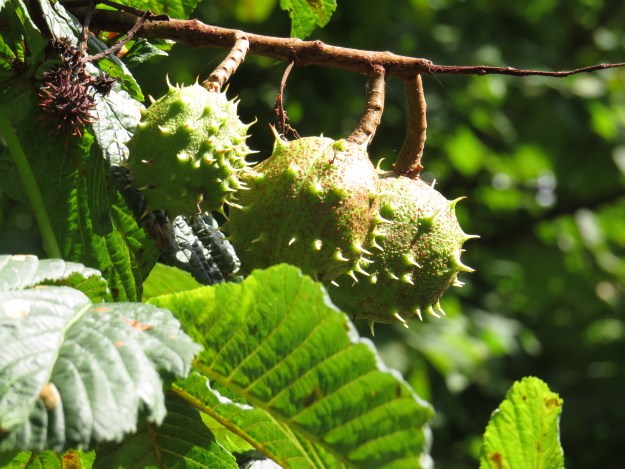
I am watching the progress of the conkers and the leaf miners on the horse chestnut trees with equal interest. The conkers are growing nice and fat, but seem to have some kind of rust growing on them.

The leaf miners are having a great time. I’m starting to see the little holes where the tiny moths have exited (as at the end of the long brown streak on the left-hand side of the central leaf). I just hope that some Southern Bush-Crickets find the tree soon.

I was rather taken by this lonely Fox and Cubs (Pilotella auriantica)…

and I love the constellations on the flowers of the ribwort plantain (Plantago lanceolata)…

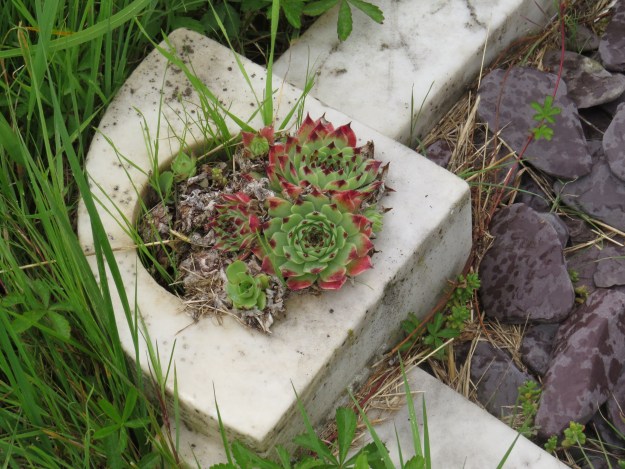
But this plant stopped me in my tracks completely. It’s so perfect that at first I thought it was plastic. It’s a houseleek (Sempervivum tectorum) though I’m not sure which variety. How splendid it is, and how utterly perfect.

There is a smaller plant in the other corner of the grave. Clearly this one isn’t in such a prime location but I have a suspicion that it will do its best to catch up.

It’s going to be a great year for hawthorn, my tree is bowed down with them.

It’s a good year for pyracantha, too.

And finally a long-standing mystery has been solved. I have been puzzling over this shrub for months – it has silvery, strap-like leaves. But finally I’ve seen the berries and all is clear. This is sea buckthorn (Hippophae rhamnoides), rare as hen’s teeth in the wild but flourishing here alongside the North Circular Road. You honestly never know what you’re going to see in this uninspiring little strip of shrubs and wildflowers.

Sea buckthorn berries have featured heavily in the menus created for cookery show ‘The Great British Menu’, where established professional cooks compete to have a dish at a banquet to honour a particular group of people – D-Day veterans, health and care workers, musicians, children’s authors. Sea buckthorn is universally hated by the judges, but the chefs seem to think that if they can only come up with the right dish, they will win. It hasn’t happened yet, sea buckthorn berries being something of an acquired taste – Wikipedia describes them as ‘astringent, sour and oily’, which doesn’t sound like a winning combination. They do have medicinal qualities, however, so all is not lost.

Sea Buckthorn (Hippophae rhamnoides)

Anyhow, by now it’s pouring with rain, and so we turn for home. I’m aware of a sudden chorus of agitated crows and jays screeching and cawing, and turn just in time to see a heron flying over, probably headed for the Dollis Brook or the lakes of Hampstead Heath. It looks more like a prehistoric animal than a bird, but of course birds are basically little dinosaurs so this isn’t surprising. What I need now is a cup of tea and some arnica for my grazes.