Category Archives: London Plants

Oh The Irony….

Dear Readers, there is something a little ironic about having gotten through 18 months of a pandemic without even being pinged by the NHS app, only to catch something and end up self-isolating when ‘Freedom Day’ is today, 19th July. On the other hand, ‘Freedom Day’ won’t be freedom for vulnerable people, people who have compromised immune systems because of chemotherapy, elderly people or anyone else who has reason to fear the devastating potential effects of this virus. With only 50% of the country double-vaccinated, would it really have hurt to keep things on an even keel for another month or so? I don’t doubt that most people will continue to be sensible, but there has been a leadership vacuum of colossal proportions in this country. My heart goes out to people working in the NHS who are seeing the numbers of the hospitalized rising inexorably. We have been abandoned. No wonder so many people are filled not with joy at the unlocking, but with trepidation.

Anyhow, I have done my Covid test and posted it, and now I wait to see if what I have is something known or something unknown. I feel a bit tired, but basically much better, so I will just have to be a patient patient. Thank you for all the good wishes, and in particular to the person who reminded me that even if  it’s not Covid it doesn’t mean that  I should rush headlong back into my usual frantic round of activity – I think the phrase was ‘other viruses are available’, which made me hoot.  That is excellent advice. I feel tired to my bones somehow: it’s sometimes a struggle just putting one foot in front of another. But then, there’s always the garden, and it’s too blooming hot to do any actual work so I just sat in the shade and tried to pay attention, as that is the cure for most ills.

If you look very carefully at the picture below, you can just see a tiny plane about to enter the clouds. Who remembers that feeling when you’re on a flight and the plane starts to judder as you enter the clouds, as if it’s flying through something viscous? Or that extraordinary sensation when you get above the clouds and there’s the sun and that perfect blue? It always reminds me of that Buddhist sense that behind all our nonsense there is that clear, vast ‘mind’ that is available to all of us if only we could put other things aside.

I wouldn’t want you all to think that I was being too lazy, so I actually got up and wandered over to the pot of ‘wild flowers’ that we planted about a month ago. It’s fair to say that they haven’t been a stunning success, but what’s with the brassica? It looks like oilseed rape to me.

But all is not lost, because I did notice a small white butterfly hanging around earlier this morning, and when I bent down for a closer look, she has laid a single egg. Now, if you’re a gardener I can imagine you not being that impressed, but at least Small Whites only lay one egg, as opposed to 50 like a Large White. I shall have to see if this one survives, and shall have to remind my poor long-suffering husband not to water too enthusiastically this evening when he gets the hosepipe out.

In other news, the Great Willowherb is just opening. Every year the buds are parasitized by some little moth, and every year it seems to make not a jot of difference to the flowering.

And the collared doves are huddled in the whitebeam for shade. I think these birds are underestimated on the looks front, with their subtle shades of cinnamon and fawn and dusty grey.

And so, there you have it. I expect a few more garden posts in the next few days, but the weather looks gorgeous. Stay safe out there, UK people, and avoid any idiots….

A Mid July Walk in St Pancras and Islington Cemetery

Dear Readers, after a most peculiar day yesterday, when I seemed to run completely out of energy, I felt a bit better this morning, so decided to go for a somewhat truncated walk in the cemetery. I can avoid getting close to people, and felt quite a lot better, so it felt like a reasonable thing to do. Alas, halfway round it seemed like I am still not myself, so I went home to isolate and have ordered a test. I still think it will be negative, but you can’t be too sure.

Anyhow, the first thing I noticed was that the cherry plums, who seem to have been in bloom only about twenty minutes ago, are now dropping their fruit. How quickly the year goes!

And just look at the swamp cypress. After a slow start, it’s now truly magnificent.

The wild carrot is in flower. The young flowerheads are a dusty pink, the older ones bright white.

The white flowerhead has the characteristic single red flower in the middle, and botanists think that this has evolved to convince pollinators to come visit – it looks just like a small beetle already feeding. The pink flowers have one too, but they aren’t as obvious (yet).

it’s certainly persuaded this long-horned beetle to drop by.

The conkers are doing very nicely, though the leaves of the horse chestnut are looking worse every week.

The yellow and white stonecrops are being overtaken by this pretty pink-flowered plant, which I think is Caucasion stonecrop (Phedimus spurius). I am fascinated by the way that some graves form a good habitat for these plants, and others don’t – I’m guessing it’s all down to a mix of soil, sun and exposure.

It really does have a mid-summer feeling to it today – temperature in the ’80’s, sun beating down….

We stop for a most uncharacteristic rest, and a jumping spider pops onto my leg…

The evening primrose is coming into flower.

And what a pleasure it is, on these long, hot days, to walk along a shady lane.


Five Minutes in the Garden

Dear Readers, it’s been one of those days when what I’ve mostly done is compare and contrast two spreadsheets and try to bring them together as one coherent whole, so what a pleasure it was to get up, stretch my legs and see what was going on in the garden. There are still a few damselflies about, I rather like that this one has a bar-code on her tail. This one is a Large Red Damselfly (Pyrrhosoma nymphula) and I know that it’s female because you can just about see a yellow band between some of the segments on the abdomen. She’s probably thinking about laying her eggs somewhere in the pond if she hasn’t done so already.

This plant has just popped up (as they do), and it’s a willowherb, probably Hoary Willowherb (Epibilium parviflorum),  a common willowherb of damp places. It’s so delicate that it’s hard to imagine how it held its own amidst the more vigorous plants, but here it is.

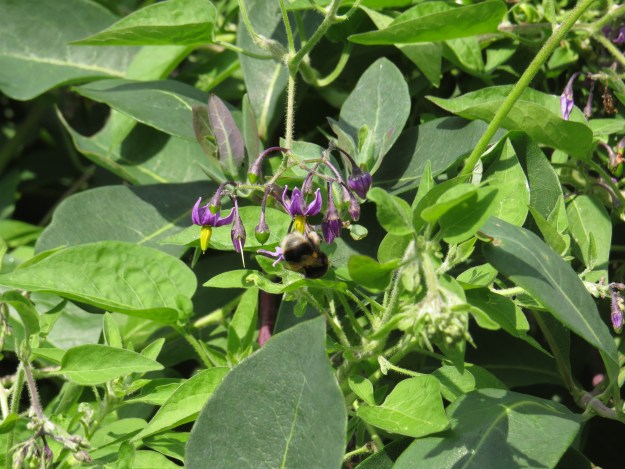
And over in the bittersweet there’s a bumblebee with bright orange pollen baskets on her legs. She looks as if she’s wearing a pair of tangerine-coloured bloomers.

This bee is carrying grey pollen, and interestingly you can tell what plant a bee has been foraging on by the pollen colour. Grey pollen can come from hazel or elder (probably elder at this time of year), and orange can come from lime – there are masses of lime trees in flower at the moment.

And having mentioned that I hadn’t seen any chaffinches for a while, a young one popped up on the seed feeder.

And finally, look who turned up on the guttering this morning while I was half-way through (yet another) Zoom call! The garden has been full of sparrows all week, and some were even belatedly examining my sparrow nesting boxes. Let’s hope they remember them next year.

How the Mighty Have Fallen….

Dear Readers, those who’ve been following this page for a few weeks might recognise this plant as the nine-foot tall angelica that popped up this spring. Well, the flowerheads have gone over and the plant has been looking a bit precipitous for a few days, but the rain and wind on Sunday night finally blew it over altogether. What a shame! But it’s clearly become handy for some of my local visitors, who find it very convenient.

The garden is still full of fledgling starlings – by this time in a normal year they’d be much more independent, and the garden would be falling silent. This year, the little devils are still everywhere. Each time I walk out to the shed they positively explode out of the surrounding trees and shrubs, followed by the woodpigeons, collared doves, goldfinches etc etc.

I’ve taken to saying “Calm down guys, it’s only me” every time I go out, but I’m not convinced it’s working.

And then, I had a very nice surprise this morning.

Fledgling sparrow marching along the hand rail.

Look at this fledgling house sparrow! I haven’t really seen sparrows in the garden for months, apart from the odd fleeting visit, but this morning the place was full of them. Here’s a Dad feeding his youngster…

For an enchanting ten minutes they seemed to be everywhere. Perching on the hemp agrimony….

..hanging out on the greater willow herb…

or just chilling on the hand rail waiting for some food….

…and every so often getting lucky…

Mum used to love sparrows.

“They’re so friendly!” she’d say. “You never see them fighting”.

Well, all I can say is she must have been watching a different species from the one that I observe, because I see sparrows squabbling all the time though, to give Mum her due, it does normally seem short-lived and non-serious. And today it was all about the difficult business of rearing these hard-earned balls of fluff to maturity. I always feel so privileged to host the local birds, especially when, like sparrows and starlings, they’ve become so much rarer than they were when I was a girl. The garden might look a bit wild and woolly, but goodness a lot of wildlife pops by, and that makes me much happier than a manicured plot would ever do.

Wednesday Weed – Creeping Jenny

Creeping Jenny (Lysmachia nummularia)

Dear Readers, I was rather taken with this pretty little plant when I spotted it at the cemetery last week. I have been thinking about getting some for the edges of the pond: it likes damp conditions and shade, which is just about perfect. It’s a member of the primrose family, though it superficially resembles a buttercup, and is a native plant, found mostly in the south of England. It’s also known as ‘moneywort’, probably because of its golden flowers and round leaves: its Latin name ‘nummularia’ also means ‘like a coin’.

Creeping Jenny (Lysimachia nummularia)

Creeping Jenny is also known as ‘herb twopence’, probably because of the leaves laying two by two along the stem. It was felt to be a most beneficial plant, one of the very best for treating wounds, and useful also for scurvy and haemorrhage. Boiled with wine and honey, it was believed to be a useful treatment for whooping cough. In Chinese traditional medicine it’s used to treat kidney and urinary stones, and it’s also said to be useful in the alleviation of gout.

Snakes were said to seek out the plant when they were in need of medicine, and yet another alternative name for it is ‘serpentaria’. I wonder if grass snakes, with their love of water and damp places, were often seen in association with the plant? This is often how these connections are made.

When burned, creeping Jenny was thought to deter insects and vermin in the house. Nobody will admit to actually eating the plant, but you can make a tea from its flowers and leaves.

A garland of creeping Jenny laid across the shoulders of yoked oxen is said to have made them work more peacefully together. As part of the loosestrife family (along with spotted loosestrife), it is said to generally increase serenity and lessen conflict, something that could come in very handy.

You may also have seen this golden version of creeping Jenny, which seems to be particularly popular for container displays.

Photo One by Photo by David J. Stang, CC BY-SA 4.0 <https://creativecommons.org/licenses/by-sa/4.0>, via Wikimedia Commons

Golden version of creeping Jenny (Photo One)

And finally, a poem. I rather liked this recent work by American poet Jack Ridl, published in Reformed Journal. I hope he has better luck with the sweet woodruff than I did, though.

Let Us Break Bread Together on Our Knees 

by Jack Ridl

And the angel said unto thee, Go thou
into your garden and plant Creeping Jenny,

alyssum, Sweet Woodruff to crawl across
the earth, and herbs to bring culinary alchemy

into each and every meal: oregano, rosemary,
lemon balm, chives, sage, and thyme. Then

set deep into the soil two wisteria vines, three
redbud trees, a butterfly bush, lupines, salvia,

zinnias, a hundred zinnias. Wait for the bees.
Wait for the 20,000 kinds of bees, from bumble

to honey to mason. Watch how they live in
harmony, all humming as if they can trust

one another and the petals, stamens, the ways
the flowers make their indifferent offerings

of pollen. Genuflect to the bees that ye may
eat of the fruit of the land. Be ever humble

in your unknowing. Learn the intelligence
of worm, vole, sparrow, spider, how none

needs even a holy word to linger and
work, becoming nothing more than what

they are under the benign disregard of sky,
the unpredictable nonchalance of weather.

Photo Credit

Photo One by David J. Stang, CC BY-SA 4.0 <https://creativecommons.org/licenses/by-sa/4.0>, via Wikimedia Commons

A July Visit to Barnwood

Nursery web spider (Pisaura mirabilis)

Dear Readers, Barnwood, a Community Forest in East Finchley, has become a real treasure-trove for biodiversity. I’d been sent a photo of a nursery web spider a few days ago, so I couldn’t wait to go and have a look for myself. In the photo above the proud Mum was looking after two balls of tiny spiderlings – a ladybird was roundly told off, though the spider clearly knew that the beetle wasn’t very tasty.

Nursery Web Spiderlings

The romantic life of a nursery web spider is fraught with danger for the male, who must woo the female with a wrapped gift of a fly or other tasty morsel. While she’s getting tucked in, he will hope to mate with her. If he’s lucky, he’ll make his getaway before she eats him. Then, the female lays a number of eggs which form a white ball – she will carry this around with her, and will also form the ‘nursery web’ that you can see in the photos. This is not used to catch prey – the spider hunts for these in the undergrowth – but for protection. The mother retreats into the sanctuary with her egg sac, which soon hatches to produce a mass of tiny spiderlings. At this point the mother stands guard outside until they disperse. 

I love the way that Barnwood has become not just a haven for wildlife, but a real community resource. Many of the fruit and nut trees are doing well, and the over-55s group has been making soup from foraged ingredients too. Here’s just a selection of the edible delights that are popping up…

Beech nut

Currants

Gooseberries

Apples

Medlars

One new development since my  last visit has been a lockable ‘shed’ – only someone who has had to lump garden tools backwards and forwards from their house without any way to store them on site will appreciate what a tremendous asset this is. And very fine it looks too.

The shed/lock-up

I tried to help ID some moths that had been caught in the trap overnight, but identifying these slightly worn noctuid moths is always a nightmare, at least for me. They will all be released into different places in the undergrowth so that the birds don’t learn where to find them. My friend L at Barnwood is going to ask a more experienced moth-er for some help with the ID. I am full of admiration for people who can understand the nuances of appearance between the different species.

We think that the tree growing by the entrance to Barnwood is an osier willow (Salix viminalis) – the plant’s flexible stems were historically used for basket weaving. It’s also a very useful plant for wildlife, and like all willow species can decontaminate heavy metals in soil.

Osier willow (Salix viminalis)

The prickly sowthistle and the common knapweed are in full flower – both are much favoured by bees and hoverflies. 

Prickly sowthistle (Sonchus asper\0

Common knapweed (Centaurea nigra)

And a speckled wood butterfly is basking in the sunshine. 

While we had a rest on the new benches in one of the clearings, a buzzard flew up from the locust tree opposite and soared off towards the cemetery. I wonder if it’s one of those that I regularly see over the cemetery? L remarked that he’d seen a red kite from Barnwood several times, and so we sat in companionable silence for a few minutes to see if one would cooperate and appear. We didn’t see one, but still, Barnwood feels like a place of great biodiversity, full of opportunities for all kinds of invertebrates and birds, and yet also a place that welcomes human diversity too. There is something for everyone at Barnwood.

For a great piece about Barnwood and its history, have a look here.

A Mid-Year Walk in St Pancras and Islington Cemetery

Reflexed stonecrop (Sedum rupestre)

Dear Readers, I have some page-a-day calendars in my office – one with a daily photo of cats, one of dogs, and one of nature scenes. And so, I have to break it to you that today is the day when we reach the mid-point of the calendar year, and all the photos have to be turned around so that I can start looking at the images for the second half of the year. How did THAT happen? It feels like Christmas was about twenty minutes ago. Nonetheless, there are plenty of signs in the cemetery that the year is already starting to think about autumn, although there are still plenty of flowers about too, like these lovely yellow reflexed stonecrop, which are popping up on certain graves where the conditions are right.

On the horse chestnut, the conkers are getting bigger, but the leaves are showing the very first signs of the leaf miners that will have nibbled them to a frazzle by the end of August.

And please forgive me for a few more shots of the fox and cubs (Pilosella aurantiacia) – they are stunning.

Here’s a new plant in flower – generally known as Creeping Jenny, this is a member of the primrose family, and very pretty it is too. It was a very damp day today, which suits this little plant very much – it loves damp places, and in fact I was thinking about getting some for around the pond to soften the edges.

Creeping Jenny (Lysimachia nummularia)

I pause to examine the numerous trivial plant bugs (Closterotomus trivialis) on some hogweed – they are everywhere this year! The males are mostly black and red, the females are mostly green, and all of them feed on pollen and nothing else, but help to pollinate the plants as they do so.

There are great frothy masses of white stonecrop (Sedum album) around too.

The yarrow (Achillea millefolium) is coming into flower – quite a lot of it seems to be pinkish this year.

And the goat’s rue is putting in an appearance in both pale mauve and white. This is one of those plants that has gone from being a relative rarity in this part of the world to being pretty much ubiquitous in the cemetery.

Goat’s Rue (Galega officinalis)

I spot my first meadow brown of the year….

Meadow brown(Maniola jurtina)

And here is a very fine black-and-yellow longhorn beetle (Rutpela maculata) – the larvae live in the deadwood of deciduous trees, and the adults hang out on umbellifers, as in the photos below. I advise getting up close and personal to any stands of wild carrot or hogweed that you see – they are a great place to see interesting insects.

What really struck me today, though, was the way that the leaves on some perennial plants were already turning, and how beautiful they were. Look at these dock leaves! The colour may be due to a rust fungus or insect infestation, or it might just be part of the natural cycle of growth and decay (or indeed both of these things).

The leaves on the garlic mustard (Alliaria petiolata) are going through a similar process, but in shades of purple-red and yellow.

And the herb Robert is starting to display the clearest crimson of all…

And let’s not forget this splendid agent of decay who was obviously enjoying the rain. This is the brown-coloured form of Arion ater, the Great Black Slug. A very fine slug indeed!

And of course, I had to say hello to the Scotsman, who is standing pretty much in a grove of spent stalks and dry foliage at the moment. He doesn’t seem unhappy though, for all that.

A Legal London Tree Walk from London Tree Walks by Paul Wood – Part 2


Dear Readers, after saying goodbye to the falconer and his Harris hawks yesterday, I made my way across the Strand and into the Middle Temple via a twisty little lane called Devereux Court. Wood describes this as ‘entering another world’, and so it is – the sound of traffic falls away, to be replaced, in Fountain Court, by the splashing sound of the oldest fountain in London, dating from 1681.

The two twisted trees to either side of the fountain are black mulberries – although they look ancient, they were planted for Queen Victoria’s Golden Jubilee in 1887. I was just a little early to see them in fruit, so a return journey is definitely in order! Although James I is credited with trying to kickstart the British silk industry by importing mulberries back in the 1600s, Wood explains that archaeologists have found Roman-era mulberry seeds in remains in the city, so the berries have probably been on the menu since well before the silk link was established. Incidentally, black mulberries are the wrong species for silk worms, who prefer white mulberries, but black mulberries are apparently infinitely better eating.

Leaves of the black mulberry

One of the black mulberries being given a helping hand…

The gardeners in the various parts of the Temple are obviously extremely busy people, as we shall shortly see. I love that they have adopted that most insect-friendly of plants, the echium, as a statement in some of their beds – they crop up everywhere, and I am possessed with a need to try to grow one, after my success with my giant angelica this year. Echiums are in the borage family, and viper’s bugloss is an echium, though this plant is probably Echium pinana from the Canary Islands, otherwise known as Giant Echium, for obvious reasons.

On I go, past some more magnificent plane trees and the Middle Temple Hall, said to be central London’s finest Elizabethan building. This is probably where the first ever performance of Twelfth Night was held, and Shakespeare himself is thought to have been in attendance.

Middle Temple Hall

I have a quick look at Middle Temple Garden, which is a lovely spot, notable for its splendid acers and a particularly lovely peach-coloured climbing rose.

Middle Temple Gardens

A splendid rose…

Then it’s off into Pump Court. I am rather taken by the geometrical branches of the Tree Cotoneasters in this gloomy spot – they seem to be trying to sketch out a Mondrian painting.

A pump in Pump Court

Some very geometrical cotoneaster branches

I pause briefly at Temple Church (where a barrister friend got married), and am very taken by the pale blue clematis (possibly Blue Angel, but feel free to put me right) growing up the banisters to the Master’s House. This is my kind of garden, and I know how much effort it takes to make something look this informal. However, I haven’t seen anything yet.

Steps up to the Master’s House

Clematis (Blue Angel?)


Then it’s a quick turn into King’s Bench Walk, which is mostly a car park, though again the London planes are magnificent.

London Planes in King’s Bench Walk

There is a heap of building work going on, and I felt a little sorry for these poor echiums peering out over a hoarding…

But then I entered Inner Temple Garden. Oh my goodness! If you have never been here before, do make time when you come to London – it’s one of the most idyllic, beautifully designed gardens that I’ve ever come across. It has a breezy informality and romanticism that must take a shedload of work. It’s extremely pollinator-friendly which of course keeps me happy, and, as you would expect from a tree walk, it has some magnificent trees.

So, here we go. First up is a hybrid strawberry tree with rust-red bark, which was full of fledgling blue tits when I visited.

Hybrid Strawberry Tree

Mexican fleabane and ox-eye daisies have seeded themselves in the cracks on the steps.

The entrance/exit to the gardens

On one side of the path, euphorbia and verbena and a host of other flowering plants pour over the gravel….

Euphorbia

…while on the other side, there is a meadow of mixed grasses, poppies, ox-eye and other daisies.

There is a magnificent Atlas Cedar with blue-grey foliage, and the sound of goldcrests coming from the branches…

Atlas Cedar

…and the bed on the other side of the path as I turn towards the Thames is themed in dark red and white, with the largest scabious I’ve ever seen….

…some amazing white foxgloves with deep magenta centres and a kind of lacy frill around the edge (much appreciated by bumblebees as you can see)…

and some deep purple poppies…

There is a very unusual Manchurian Walnut…

Manchurian walnut

And although the alliums are going over, their seedheads are still very striking.

Allium seedheads

There is a magnificent dawn redwood….

Dawn Redwood

And then there’s an avenue of London planes. I defy anyone’s blood pressure not to drop as you walk along this green passage, regardless of the traffic belting past just over the wall.

There are 3 enormous plane trees planted in the lawn which are thought to date to the 1770s, but the avenue is younger – Wood thinks that the trees on the northern side (on the right-hand side of the first photo above) are probably nineteenth century, the ones on the southern side (closest to the river) are early twentieth century. When you look at the girth of the trunks you can see that those on the left are clearly still slim and youthful, while middle-aged spread has taken the ones on the right.

There is a lovely little fountain with the waterlilies just coming into flower.

And a splendid view back to the Manchurian Walnut.

The next border is a positive cornucopia of different varieties of hydrangea – it’s not my favourite plant, but some varieties are attracting bees who are after the pollen.

I have just missed the flowering of the tulip tree, but it does gift me with one blossom. This is a very fine tree. Its branches look like a cupped hand. I also appreciate the way that the gardeners have left a wide circle unmowed under pretty much all the trees in the lawn.

Tulip Tree

Tulip Tree flower

Tulip Tree

I walk past a young woman who has posed a china tea set with a shortbread biscuit on a tiny miniature table with a gingham table cloth against a backdrop of pink hydrangeas, and who is clearly taking a photo for her Instagram feed. I imagine it will be very pretty.

I am rather taken by this enormous plant. The chair underneath it is full-size. It looks a bit like Gunnera but not as spikey – some giant version of Rodgersia perhaps? I obviously have a thing for giant plants currently….

And then there’s this very unusual fuchsia.

A final turn, and I’m heading back towards the gate. It’s like being kicked out of Narnia…..

…because just a few hundred metres out of the garden I come to the Embankment, and this is the sight that awaits me.

Holy moly, what’s going on? Well, apparently it’s the Tideway Super Sewer, which aims to collect and transport more of London’s sewage (the current Bazalgette sewer was built when London’s population was only half the size). Every year, millions of tonnes of raw sewage end up in the Thames and its tributaries, so if this can be cleaned up it can only be a good thing. At the moment it looks a bit of a nightmare, but it will no doubt be great once the carpet’s down, as my Nan used to say. In the meantime, I would stick to the peace and tranquillity of the Inner Temple Garden if I was you. It’s open from 12.30 to 15.00 on weekdays (nb not weekends or public holidays), and I would check before making a special journey as I think it’s sometimes closed for special events. Well worth a look though, and another splendid walk from Paul Wood’s book.

London Tree Walks by Paul Wood is available here.

One of the older plane trees, probably dating back to about 1770.

A Legal London Tree Walk from London Tree Walks by Paul Wood – Part 1

A Venerable London Plane on Kingsway

Dear Readers, doing Paul Wood’s ‘arboreal ambles’ has been a lovely way of reacquainting myself with London, after an absence of nearly eighteen months. I had forgotten how much I loved the city, and how a leisurely walk can bring so much more than you expect. So it was today, when I had a splendid and totally unexpected encounter with two species of birds of prey, discovered a ‘secret’ garden in the heart of the legal district, and met some of the most extraordinary London plane trees that I’ve ever come across. I’ve lived in the capital for my entire life, and yet there’s still so much to discover.

Anyhow, we commence on Kingsway, which runs past Holborn station. The road is lined by London plane trees and a few Trees of Heaven, all of which seem to lean out away from the buildings, presumably to catch more sunlight. These are not old by plane tree standards – these were planted after the Second World War, in 1947.

Next, I duck through a narrow lane towards the entrance to Lincoln’s Inn Fields. The square is lined by some fine early nineteenth-century buildings, including the Sir John Soane’s Museum, which I haven’t yet visited (some Londoner I am, but isn’t it always the way?)

The Sir John Soane’s Museum – a treasure chest of collected antiquities

I have to stop to admire a crow who is trying to work out how to get into the litter bin, and is trying to pretend that he isn’t.

‘Nothing to see here!’

Then it’s into Lincoln’s Inn Fields. For a while there was an encampment of homeless people here, in the middle of the biggest square in London, and one of the richest areas. In 1993 the fences were raised, and the people were booted out. Since then, the gates have been locked at dusk, but I noticed some people sleeping on the benches, and one soul curled up in a sleeping bag behind one of the shrubs. During the Covid lockdown we managed to provide a place to sleep for all the homeless people in London, which proves that it can be done, but as everyone seems to think we’re getting back to normal, it’s business as usual for the destitute.

There is a fine Canadian Sugar Maple enclosed in it’s own little paddock, as if the park keepers are afraid that it will uproot itself and catch the first plane back to British Columbia (though with temperatures in the 40s at the moment I would advise it to stay put). It was planted by Jean Chrétien, and as it’s a source of maple syrup it occurs to me that maybe the fencing is to keep sugar addicts out. It’s true that I would certainly do a lot for maple syrup, food of the gods.

The plane trees in the square are some of the oldest in London , and are certainly some of the stoutest. Many of them look as if all the weight has settled on their bottom halves. I can relate.

This one, to the left of the path, is particularly splendid. I had no idea that plane trees could grow into such robustness.

At the bottom of the path there’s an area planted with some very unusual tropical plants. As I nearly needed a machete to get through it’s safe to say that it isn’t much populated. My eye was much taken by this furry plant, hiding in the grove like a skinnier version of Chewbacca. If you know what it is, please tell!

And then, I leave the Fields and head towards Lincoln’s Inn itself.

The gates to Lincoln’s Inn

And I couldn’t have been more astonished to see this handsome chap.

This is a Harris hawk, one of two that are regularly flown in the area to try to deter the seagulls who have been digging up the lawns for worms and dive-bombing the lawyers on their way to and from their chambers. I had a great conversation with  the falconer who flies the birds, and found out a good deal about them. For one thing, they are weighed before being flown, because this gives an indication of how hungry they are, and how ready they will be to fly – a heavy hawk is more likely to disappear into a tree or not fly at all. The male hawk is very fond of the leather falconer’s glove (the falconer thinks that the bird likes the glove more than him), and comes readily to the hand of anyone who wears it, while the female bird is much more nervous around strangers, gloved or not.

The female is in moult at the moment, hence her slightly shabby look. Female hawks are always a good bit bigger than the males.

The female Harris hawk

These birds really are built to take small mammals rather than birds – the male hawk was recovering from a bite on the leg from a rat which he had taken before the falconer was able to separate them. Look at those talons! The beak is built for tearing, the eyes are protected by a ridge of bone which both keeps the sun out of their eyes and gives some protection from thrashing prey.

And then I got a chance to actually fly the bird! Glove on the left hand and arm outstretched (away from the face, just in case), I watched as the bird swept in and landed on the glove to tear into a morsel of food. The falconer said that there always has to be food, otherwise the bird (particularly the female) feels as if a deal has been broken. It’s not unheard of for her to head off into a tree and sit there for hours until she feels that her point has been made. It’s all about trust: these are never really tamed, these birds. After all, they could just fly off if the urge took them. They come back because their primary motivation is food, and the falconer is the main supplier.

For wild birds, though, it’s more complicated. The falconer mentioned that peregrine falcons were nesting on the spire of the building behind Lincoln’s Inn, and that the Harris Hawks were very interested when they heard them. As I headed off on the rest of my walk, I heard the familiar mewing sound of peregrines, and took two photos on the off chance that they would at least show something. I got more than I expected.

In the picture below, you can see that there are three birds, one at the top, one to the right, and one perched at the bottom. I’m assuming that this is either a pair of peregrines and a fledgling, or an adult and a couple of fledglings.

And then there was another bout of mewing and I got a second shot. I showed it to the falconer and we both think this is a food drop, where a parent is teaching a youngster to hunt by dropping food for it, or where the male is dropping food for the female. Peregrines are the fastest animals in the world (achieving up to 200 mph in a full stoop) and have been known to attack eagles to force them away from a nest site. I was so lucky to see them, and so lucky to catch even these images.

So, what a spectacular day! And it’s not over yet. Tomorrow we’ll discover one of the loveliest London gardens that I’ve ever seen, and meet some more very venerable trees…

A Late-June Walk in St Pancras and Islington Cemetery

Well, Dear Readers, there were no mammalian foxes in the cemetery today, but there was certainly lots of botanical fox and cubs (Pilosella aurantiaca), which is fast becoming my favourite June flower. Just look at it! Absolutely beautiful….


But there are lots of new things happening as well. The horse chestnuts have gone from upright to hanging down, in preparation for ripening and dropping to the ground.

And I noticed this rather fine lichen growing on an angel’s arm. Funny how it’s just in the one spot!

But this week really is insect week. The hogweed is attracting all sorts. Firstly, there are the trivial plant bugs that I wrote about last week. Apparently if they have white spots on the carapace and are largely green, they’re female (which I think these two are).

Some Trivial Plant Bugs (Closterotomus trivialis)

And then how about this handsome fellow? This is a male swollen-thighed beetle (Oedemera nobilis) – the female has much less impressive legs. The beetles feed on the pollen of the hogweed, and the young live in hollow plant stems.

Then they were joined by a long-horn beetle who was twice their size, but is equally harmless, feeding on pollen. I think this is a four-banded longhorn beetle (Leptura quadrifasciata).

We got great views of the buzzard riding the thermals today. For a good five minutes the bird circled in splendid isolation…

Until the crows started to appear to chase it out of town…

The salsify has gone over, leaving these fluffy seedheads…

But when we pop round to the toilets, there is fluff absolutely everywhere. There’s a hybrid black poplar, and the female catkins produce prodigious volumes of cotton wool.

Hybrid black poplar is (not surprisingly) black poplar crossed with American cottonwood. It makes for a rather lovely tree.

And here, for your delectation, is a film of the seeds falling, with an accompaniment of North Circular Road traffic. If you listen carefully, you can hear a wren bellowing above the din.

So, what else? There was this male Adonis blue butterfly (Polyammatus bellargus), which you can tell from the common blue by the chequerboard effect on the edges of the wings.

And there was this rather worn small copper butterfly (Lycaena phlaeas) – this species packs three generations into every year, so I’m thinking that this was a first generation insect who had already bred, and is now enjoying the sunshine.

On the plant front, there is the first of the meadow cranesbill (Geranium pratense) joining the many other cranesbills that are in flower at the moment.

And some of the graves are covered in sedums: there’s the white stonecrop (Sedum album) that looks like seaspray…

and reflexed stonecrop (Sedum rupestre). These two plants are confined to graves that have been covered with decorative stone chippings or gravel, which must make the perfect substitute for the scree slopes and shingle banks where you would normally find the plant.

And finally, another favourite member of the clover family, common birdsfoot trefoil (Lotus corniculatus), adding its yellow and orange flowers to the riot of colour in the grassy areas. I feel as if this week really has hit the peak for flowering in the cemetery. Let’s see if next week can outdo it!