Category Archives: London Plants

A St Pauls Perambulation from London Tree Walks by Paul Wood – Part Two

London plane tree in Bow Churchyard

Dear Readers, the second part of my tree walk features lots of plane trees. This is hardly a surprise in the middle of London, but what was startling was the size of some of them. Look at this one for example, in the courtyard of St Mary Le Bow, thought to be the ‘Bow Bells’ that Cockneys need to be born within the sound of (rather than the church at Bow in East London). However, spectacular as this is, there is another a few hundred metres away on the corner of Cheapside and Wood Street. This is the Cheapside Plane, a landmark for several hundred years, and a truly venerable tree.

The Cheapside Plane

In London Street Walks, Wood is of the view that the tree is likely to have been planted in the eighteenth century (there are older planes in the capital), and not only is it protected by local bye-laws, but the shops underneath it are too. The square that the tree stands in was the site of one of the 37 churches that was destroyed during the Great Fire of London: the tree also survived a direct hit during the Second World War. It stands with its roots in a very tiny, dark, damp square, surrounded on three sides by the fire escapes and air conditioning units of the adjacent buildings, but it looks healthy and strong. According to ‘The Great Trees of London’ it used to hold a rookery, but rooks are a very rare sight in even Greater London these days: it’s thought that the rooks left when the horses did, and when people no longer raised sheep locally. The rooks used the fur from these animals to line their nests, and the fact that the last major stronghold of rooks in the capital is close to Richmond Park, with its large herds of deer, supports this theory.

The shadows of the branches of the Cheapside Plane on nearby buildings.

At the end of Wood Street lies a most peculiar tower: this is St Alban Wood Street, all that remains of a Wren church destroyed in the Blitz. The tree at the bottom is a nettle tree (Celtis australis) which can live for 1000 years in its native Southern Europe, but is often seen off by the frosts in the UK. I imagine that living in the middle of an urban heat island must be helping this one to survive, The building is now a private residence, and I would give several eye teeth to have a look inside and see how they’ve managed to make it  habitable.


I love how the new and old buildings in London suddenly come into stark juxtaposition. Sadly I haven’t noted down which church this is, but I’m sure you get the general idea.

On I go to St Mary Aldermanbury, close to the Guildhall and site of a rather splendid copper beech.

But I managed to miss the Judas Tree, which I’d written about in an earlier post. Still, it’s looking very healthy, and there’s always next year. I’ve always wanted to see the magenta flowers bursting out from the branches and even the trunk. My tree book describes them as ‘budding endearingly’, and who could resist such a description? I must make a date in my diary.

Judas Tree (Cercis siliquastrum)

And now, here’s a thing, and many thanks to Wood for pointing it out. As you walk around the corner onto Aldermanbury Square, there are some plane trees which are being trained into a kind of pergola, akin to a wisteria or a vine. I imagine that this is a phenomenal amount of work – as we know, plane trees seem to want to grow up, rather than out. The shadows are very fine, however, and several people were enjoying a sandwich and a coffee under their shade. I was a little flabbergasted that plane trees could be ‘persuaded’ to grow in such a way, and I did wonder why the planners hadn’t chosen something more amenable to this kind of treatment, but I guess that only time will tell.

There are some Himalayan birch on the other side of the square, bang smack up against the hoardings for a major refurbishment of the Brewer’s Hall, rebuilt after the Great Fire of London so probably in need of some tender loving care. I have a strong suspicion that a couple of the birches have been removed to make room for the skips, though.

Himalayan birch plus skip.

On the other side of the passageway that skirts the Brewer’s Hall I stopped to listen to a blackbird singing from somewhere very high up. I thought that it might be in the Honey Locusts that shaded the spot, but I couldn’t see it. Maybe it was on top of one of the many, many cranes. I paused to look at this statue of ‘The Gardener’, by Swedish sculptor Karin Jonzen. It looked very familiar to me, and when I did some research I discovered why – he used to be in the gardens at Moorgate where I would often meet Mum before we travelled home together. Now he’s in this shady spot next to a building site, serenaded by blackbirds.

On I go, under the Terry Farrell-built Alban Gate and past Richard Rogers’s ’88 Wood Street’ with its brightly coloured steam-ship inspired heating outlets.

Air conditioning by Sir Richard Rogers

I pause to have a quick look at the Roman Wall on Noble Street, uncovered by war damage in the Second World War and now surrounded by a rather nice mixture of wildflowers of various kinds and ferns.

The Roman Walls

Trailing bellflower on part of the Roman Wall

On the roundabout there are some Chinese Red Birches, which Wood explains can be distinguished by the reddish-brown bark on the younger branches. They are a welcome sight in this traffic-heavy, intensely urban area.

Chinese Red Birch (Betula albosinensis)

But, Dear Readers, there is one more thing that I want to share with you, but to do it justice, I’m going to leave it until tomorrow. Not far to go now, I promise!

A St Paul’s Perambulation from London Tree Walks by Paul Wood – Part One

St Paul’s Cathedral with American Sweet Gum

Dear Readers, I have a great affection for the City of London, with its strange mixture of skyscrapers and old churches, broad avenues and higgledy-piggledy backstreets. As you might remember, when I was first going into the office at the Bloomberg building, I was desperate to find some green space, and finally managed it, so today I felt a strange urge to go and see what was happening. It was almost as if it might not be there, just because I hadn’t been there to see it.

I wanted to have some purpose rather than just a wander, so I took my cue from Paul Wood’s (relatively) new book, ‘London Tree Walks‘. Regular readers will remember that I did one of his walks from an earlier book and goodness only knows why I haven’t done some of the others because it’s a great way to pay attention to the magnificent trees that are all around us. This walk is a circular one from St Pauls, and I did a detour to check that my workplace did, in fact exist.

The walk begins in St Paul’s churchyard, but there was a small problem.

I can only assume that opening hours are more limited because of the Covid restrictions, but some signage explaining this would be good. However, I was undeterred – I particularly wanted to see the American Sweet Gum, because Wood points out that this has become a popular City street tree in the past few years. On Cheapside, the main route from St Pauls to the Bank of England, there are American Sweet Gums on the northern side of the road, and Spathe’s Alders on the shadier southern side. The one at the side of St Paul’s, though is truly spectacular. I have been doing a few calculations. The height of the top of the dome of St Pauls is 365 feet, and the dome itself is 278 feet tall. That means that the main building is about 87 feet tall and, although it’s not clear from the photo, the tree is nearly to the top of the windows.

American sweet gums can reach 45 metres tall, so this one is just a baby (it was planted just after the Second World War). However, they love swampy ground, which is clearly not available around St Paul’s, and the trees are also relatively short-lived. Nonetheless, this tree is a cracker even if I had to view it from outside the churchyard, and apparently its autumn colour is really something to behold, so I shall have to go back.

And how about this? Can anyone guess what it is?

How about now?

This is a tulip tree (Liriodendron tulipfera var Aureomarginata) and I think I was either just too late to catch it in full flower, or it didn’t have a great year – as we know, trees don’t always flower prolifically every year, and maybe this one is having a break. And who would blame it? This, too was an impressive tree, and as they can grow to nearly 200 feet tall I’m sure they need to put at least some of their energy into bark and woody stuff.

Then it’s across the road in the general direction of Tate Modern, and something was going on with these ladies in red. One reason that I love London so much is that there’s always something out of the ordinary to see. Last time I was around St Pauls, some photographers were using it as a backdrop for some pictures of a Chinese bride, and very lovely she looked too. Apparently having your photo taken in your wedding dress in front of a variety of iconic buildings is all the rage in China at the moment.

And if you want a little clip of the dancing, here we go…

Anyone who wants to point out that I missed a trick by not getting a photo with St Paul’s as the backdrop is probably right, but I was on a bit of a mission to find trees, as you will hear.

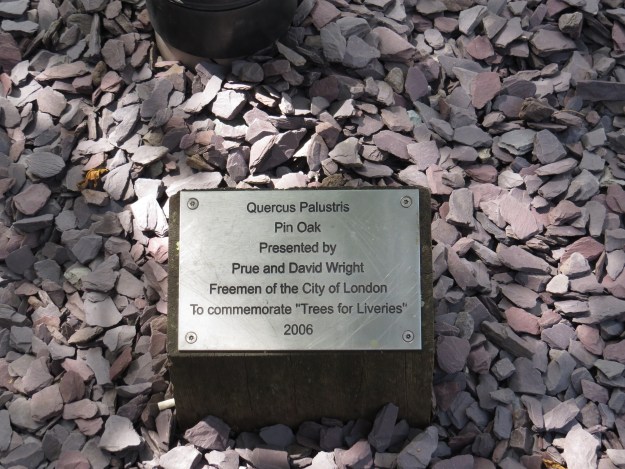
I made a brief stop to visit another North American tree, a Pin Oak on Old Change Court.

Pin Oak (Quercus palustris)

Pin oaks are part of the red oak family, and this is another tree that will look wonderful when autumn comes. But what’s this ‘Trees for Liveries’ business? A bit of digging has made some progress: The Liveries Wood Group is a collaboration between the five Livery companies who use wood in their craft, the Carpenters, Turners, Furniture Makers, Upholders and Joiners & Ceilers. The group exists to promote the use of wood, and protect this natural resource. So while I haven’t quite got to the bottom of exactly what was going on when this tree was planted, it’s interesting to know that these ancient companies, who go back to the Medieval period, are still promoting their skills.

Incidentally, an Upholder is an Upholsterer. Who knew?

Retracing my steps, I pass a row of recently planted Italian alders. I am very fond of alders, as you know, but the UK species likes wet feet, which they wouldn’t get here. My tree guide describes it as a tree of ‘vigour and polish’, and it is certainly doing very well, even though it’s the shady side of the road.

Italian Alders (Alnus cordata)

Then I nip down Distaff Lane, and pass the church of St Nicholas Cole Abbey, with its clear glass windows.

Then it’s time to cross Queen Victoria Street to visit an old favourite haunt, the Cleary Garden. This is a bittersweet place for me: when I was in my thirties I would sometimes meet Mum for lunch here, and I can still see her sitting on a bench with a sandwich. There is a new office building with some Snakebark Maples outside – I would never have noticed the astonishing stripy bark if Wood hadn’t mentioned it.

Snakebark maples

And then it’s into the Cleary Garden. There aren’t as many people around for sure (though to go by the queues outside some of the sandwich shops you wouldn’t necessarily think that), and the garden is so peaceful that I can sit down and commune with the swamp cypress (the first one I ever saw).

I’d already seen a wren singing its head off in the cypress, and I could hear baby birds, so I wasn’t so surprised to see this.

The great tits have some babies, and handily there’s a great selection of bird feeders right next door, enclosed in a cage to keep the squirrels and the big birds out.  How handy to have everything that you need right on your doorstep! My only worry would be dispersal – there are lots of trees around, but there are also a lot of crows and seagulls who love a tasty fledgling if they can catch one. Good luck, great tits!

And before I start on the second half of my walk, I pop down to my workplace to see how it’s looking. Quiet would be one description. The complicated fountain outside, meant to represent the river Walbrook which runs under the building, is fenced off for repairs yet again. Another part of the fountain has several workmen sitting in it and lovingly trowelling the gunk out of the spigots.

But here’s a thing! My favourite City pizza place has survived. Fingers crossed that we’ll be able to have a team get together soon…

And now, it’s time to cross the road and head towards one of my favourite trees in the whole of London. But for that, folks, we’ll have to wait until tomorrow….


Wednesday Weed – Meadow Vetchling

Meadow Vetchling (Lathyrus pratensis)

Dear Readers, one of the things that I love about St Pancras and Islington Cemetery is the sheer variety of habitats. We have damp woodland and dry woodland, grasslands and scrub, meadowy bits and watery bits, and I think it’s probably the best place for plants of anywhere locally because it is relatively little visited. When I saw the meadow vetchling this week it really made me think of the meadows of Austria, which are full of ‘beans’ – members of the Fabaceae family, such as clovers and trefoils and peas. These plants are able to process the nitrogen in the atmosphere (or rather, the bacteria in their root nodules are) and as such are a great help in returning the fertility to the soil. Plus, they are very popular with bees and pollinators of all kinds.

Meadow vetchling is also known as ‘meadow pea’ and ‘fingers and thumbs’. It’s a scrambler, which means that it intertwines with other plants, creating a tangled web of stems.  A similar thing is going on underground – the plant proliferates via rhizomes, which can reach up to 7 metres in length. The seedpods ripen to black, which is a good way of identifying them once the flowers have gone. The plant is native to the whole of Europe and Asia, but has also been introduced to North America, and is doing particularly well in Alaska and Oregon.

Photo One by By Didier Descouens - Own work, CC BY-SA 4.0, https://commons.wikimedia.org/w/index.php?curid=105462864

Meadow Vetchling (Photo One)

The flowers of all vetches are very particular and, botanists being how they are, you won’t be surprised to hear that the different parts of the bloom have specific names. In the flower below, the petal at the top is known as the ‘standard’, the two petals below are the ‘wings’, and the bottom two petals, which are joined together, are known as the ‘keel’.

Photo Two by By Ivar Leidus - Own work, CC BY-SA 4.0, https://commons.wikimedia.org/w/index.php?curid=96576036

Meadow vetchling flower (Photo Two)

Meadow vetchling is also the food plant for the caterpillar of the wood white butterfly (Leptidea sinapsis). This is the most delicate of our white butterflies, and has declined in number, largely because plants such as the meadow vetchling will not thrive in the complete cover of a mature woodland, and because so often the understorey of woods is neglected until only holly and the odd yew bush remain.

The male performs an extensive courtship ritual to attract the female, who is very choosy – the female will only mate once in her life, whereas the male will try to mate with as many females as possible. The males dance involves fluttering his wings and extending his proboscis. If the female remains still, it means that she’s either already mated or isn’t interested, but if she is attracted to the male she will move her abdomen in his general direction.

Photo Three by By Feel free to use my photos, but please mention me as the author and if you want send me a message. or (rufre@lenz-nenning.at) - Own work, CC BY-SA 3.0 at, https://commons.wikimedia.org/w/index.php?curid=25277317

Wood White Butterflies courting (Photo Three)

The wood white lays her eggs only on meadow vetchling and one or two species of trefoil. If given the choice, she prefers tall plants, and will lay more eggs on lanky specimens. The butterfly identifies the species of plant through chemoreceptors on her feet, and flies low over the foliage, occasionally touching down on a leaf to see if it’s the right one. The caterpillars, when they hatch, are beautifully camouflaged against the vetchling leaves. I wonder if the conditions in the cemetery would be right for wood whites? However, they tend to be local and are not expert fliers, so this would be a bit of a stretch. Plus, I’m not sure how far the gardeners at the cemetery use pesticides – fortunately the wilder bits look as if they aren’t sprayed.

Photo Four by By Gilles San Martin - Flickr: Leptidea sinapis egg, CC BY-SA 2.0, https://commons.wikimedia.org/w/index.php?curid=17005838

Egg of the Wood White butterfly (Photo Four)

In Ireland, meadow vetchlng is said to repel mice (and is known as mouse-pea in Donegal), and was also used to feed cattle in the past. But although the plant has been used medicinally to ease coughs and bronchitis, it is also said to be poisonous, causing a condition called lathyrism which can paralyse the limbs of human beings or grazing animals. However, you would have to eat an awful lot of the ‘peas’ to get this effect, so no reason to be pulling it up just yet!

And finally, a poem. This feels just right for the days after the summer solstice (here in the Northern Hemisphere anyway), as the year turns yet again. I hadn’t heard of K.V. Skene before, but she’s a Canadian poet, and I love this poem. I can just imagine every flower as she mentions it. My head is full of yellow blossom.

I am drinking yellow flowers

by K.V. Skene

After ‘At the Quinte Hotel’ – Al Purdy

daffodils       forsythia       marsh marigolds
the mellow meadow vetchling
last year’s dandelion wine       yesterday

I unfriended Facebook       Twitter       LinkedIn       quit
http://www.youtube.com       cached the laptop       iPhone       Fitbit
and hit the road unravelled       today

I am drinking buttercups       loosestrife
birdsfoot trefoil       lesser celandine       so long ago
those honeysuckle days

so short these sunflower years

Photo Credits

Photo One By Didier Descouens – Own work, CC BY-SA 4.0, https://commons.wikimedia.org/w/index.php?curid=105462864

Photo Two By Ivar Leidus – Own work, CC BY-SA 4.0, https://commons.wikimedia.org/w/index.php?curid=96576036

Photo Three by By Feel free to use my photos, but please mention me as the author and if you want send me a message. or (rufre@lenz-nenning.at) – Own work, CC BY-SA 3.0 at, https://commons.wikimedia.org/w/index.php?curid=25277317

Photo Four By Gilles San Martin – Flickr: Leptidea sinapis egg, CC BY-SA 2.0, https://commons.wikimedia.org/w/index.php?curid=17005838

Thunderstorm Asthma

Photo One by By Dartmouth Electron Microscope Facility, Dartmouth College - Source and public domain notice at Dartmouth Electron Microscope Facility ([1], [2]), Public Domain, https://commons.wikimedia.org/w/index.php?curid=14840522

Pollen from a variety of common plants: sunflower (Helianthus annuus, small spiky sphericals, colorized pink), morning glory (Ipomoea purpurea, big sphericals with hexagonal cavities, colorized mint green), hollyhock (Sildalcea malviflora, big spiky sphericals, colorized yellow), lily (Lilium auratum, bean shaped, colorized dark green), primrose (Oenothera fruticosa, tripod shaped, colorized red) and castor bean (Ricinus communis, small smooth sphericals, colorized light green). The image is magnified some x500, so the bean shaped grain in the bottom left corner is about 50 μm long. (Photo One)

Dear Readers, I was recently intrigued (and a little disquieted) to learn that people with asthma often suffer attacks (known as bronchospasms) following local thunderstorms, to such an extent that hospitals can be overwhelmed. I know that atmospheric conditions such as pollution can exacerbate many conditions, especially those that affect the heart and lungs, but the link with storms was a new one to me. Whilst my mother always maintained that the prelude to a thunderstorm always brought on a migraine, and my dad’s breathing was clearly worse in London than in Dorset, I was curious to see what was causing ‘thunderstorm asthma’.

Firstly, we need to consider pollen. Pollen contains the precursors to the male sperm of a plant, and needs to combine with an ovule (the female part) in order to germinate. The pollen is protected by a double-layered wall, and in the case of wind-pollinated plants ( known as anemophilous, which literally means ‘wind-loving’) the pollen may also contain an air-sac, to make it more buoyant. Grasses, ferns and many trees are wind-pollinated, and the majority of fungi add to the mix by producing spores. These fine, light particles are what makes life so miserable for hay fever sufferers.

However, one factor in thunderstorm asthma seems to be that many of the people who present at the hospitals are not normally asthma sufferers, though they often have hay fever. And there seems to be little doubt that storms are implicated. This study looked at incidents from the UK, Canada, USA and Australia. The Canadian report noted that emergency admissions for asthma made up between 5 and 17% of the total during thunderstorm periods, as opposed to only 2% normally. In Melbourne, the number of admissions for bronchospasms during two thunderstorms in different years were 154 and 277, compared with a non-thunderstorm count of 26 patients. This can lead to a crisis, with not enough nebulizers or steroids available, as happened in some of the UK events. Unfortunately, one episode of thunderstorm asthma can trigger subsequent attacks in people who had never had asthma before – one doctor believes that such an episode can hypersensitise the lungs, making them constrict in conditions such as cold weather.

So what’s going on? Thunderstorms are intensely active events. At the start of a storm, there’s a substantial updraft of air, which drags pollen, spores and other kinds of particulates up into the clouds. After a storm, there’s a subsequent downdraft as air rushes out of the storm area and back to earth. One theory is that the energy and moisture of the storm is enough to break down the pollen granules, resulting in much smaller particles (including ‘paucimicronic starch grains’ which are a particularly potent allergen). Normally, pollen is trapped by the nasal hairs, which mean that you might get a runny nose and eyes, but your breathing is unaffected. These broken-down particles can penetrate deep into the lungs, causing asthma attacks even amongst people who have never suffered from them before.

Scientists also think that such particles might be deposited in rain particles, and are then released after the water evaporates (often the way in a summer storm). A final consideration is that the electrical conditions in a storm might charge the broken-down particles in such a way that they are actually attracted deep into the lungs.

So, what to do? Given the possibility of local medical services being overwhelmed, there was some hope that an early warning system might be possible (such as those in the UK which give pollen levels and UV levels) but the situation is, as ever, more complicated. Not every storm causes thunderstorm asthma, and there is a nuanced dance between the location of the storm, the amount of pollen present, the levels of other kinds of pollution and the presence of fungal spores, which are just being recognised as another potential cause. It seems fairly clear that the spores produced by certain kinds of mould (such as the Cladosporium family) and by some plant pathogens (fungi in the Alternaria family, which include a variety of blights and cankers) can already cause hay fever, and are possibly the ‘smoking gun’ in outbreaks of thunderstorm asthma.

Photo Two by By http://phil.cdc.gov/phil_images/20030612/9/PHIL_3963_lores.jpg, Public Domain, https://commons.wikimedia.org/w/index.php?curid=763300

Spores of an Alternaria fungus (Photo Two)

It seems that we need a lot more research on what’s going on with asthma and thunderstorms, especially as, with climate change, we’re likely to be getting a lot more of the latter. At the moment, the main advice for asthma sufferers seems to be ‘stay indoors with the windows closed and make sure you’ve got your inhaler’. Meanwhile, there seems to be more awareness in health services globally that thunderstorms can cause more health problems than the occasional lightning strike. Yet again, we can see how closely intertwined human beings are with the planet as a whole, which is always worth remembering.

Photo Three from https://www.abc.net.au/news/health/2020-10-29/thunderstorm-asthma-event-in-covid-19/12795236

A public health poster on thunderstorm asthma from Australia (Photo Three)


CreditsThunderstorm asthma: an overview of the evidence base and implications for public health advice 

Thunderstorm asthma season is on now. Are we ready for another event if it happens during Covid-19?

Photo One By Dartmouth Electron Microscope Facility, Dartmouth College – Source and public domain notice at Dartmouth Electron Microscope Facility ([1], [2]), Public Domain, https://commons.wikimedia.org/w/index.php?curid=14840522

Photo Two By http://phil.cdc.gov/phil_images/20030612/9/PHIL_3963_lores.jpg, Public Domain, https://commons.wikimedia.org/w/index.php?curid=763300

Photo Three from https://www.abc.net.au/news/health/2020-10-29/thunderstorm-asthma-event-in-covid-19/12795236

Well, It’s Not All Bad….

Teasel

Dear Readers, I have never grown teasel before and so I was delighted to see that it looks for all the world like a group of happily cheering people, rather like the ones below. The meme is 100% me đŸ™‚

But what I wanted to say was that although a stem of my angelica plant has tumbled over, it has been instantly colonised. First of all the aphids came – I think this really backs up the argument of many organic gardeners, who say that plants that are weakened are much more likely to support masses of pests. The main, living part of my plant appears to be completely aphid-free.

And then these spiny predators turned up.

This is a harlequin ladybird larva. It’s true that harlequins are rather less picky about what they eat than other ladybirds, and that they are outcompeting our native species, but it’s much too late to worry about that now. This one was positively shovelling his way through the greenfly, leaving nothing behind but their poor, parched corpses. See, I told you this was a cheerful post.

And the head of the plant was alive with bugs – I am hoping that this chap was, joy of joys, a Trivial Plant Bug (Closterotomus trivialis), just for the sheer happiness of having a trivial insect in the garden. However, bugs are extraordinarily difficult to identify, so I’m prepared a) to be wrong and b) to be told that these two insects were different species. Hopefully one of them also likes aphids.

And then I spotted this fly. It seems to be a tachinid fly – this is a group of parasitic flies who lay their eggs on the larvae of other insects. My insect book mentions that some species can be ‘abundant on hogweed and angelica’. Who knew? I just thought that they were houseflies, and had no idea that they had such interesting lives. Apparently they find their host caterpillars, lay their eggs in the vicinity or actually on the larvae, and when the eggs hatch the flylets (a new word that I just made up) burrow their way in and eat away. One species, Phasia hemiptera, eats shieldbugs, so I am just wondering if this is what was going on.

In other news, the magpie fledglings have hatched, and very demanding they are too. My neighbours are a bit unhappy about the noise, and it’s true that these birds don’t have the sweetest of singing voices, and also that they get up very very early (the birds, not the neighbours). Here is one of the adults and a youngster on the television aerial opposite. I rather like that late evening light.

And finally, here is a rare find. My lavender is just coming into flower, and I noticed a most unusual bee feeding from it. Look how furry it is!

This is a wool carder bee (Anthidium manicatum) – if you have lambs-ears (Stachys) in your garden, you might see these bees gathering the hairs in order to form a nest ball – only the females do this, while the males (unusually for insects these are larger than the females) may establish a territory above a patch of flowers, and will do battle with any other bees, hoverflies or other flying invertebrates that appear. Fighting might involve head-butting, wrestling or using their abdominal spines to crush an intruder into submission. This individual hasn’t reappeared (yet) – they have a great liking for woundworts of various kinds and black horehound, along with other dead nettles, so maybe they are hanging out somewhere else. I actually gave away several lots of stachys earlier in the year, so maybe my neighbours will be reaping the benefits. Do watch out for these bees, they are a real treat, and with those hairy legs they’re (relatively) easy to tell from your average bumblebee.

Ups and Downs

Sicilian honey garlic or sheath of arrows?

Dear Readers, in yesterday’s post I mentioned that when Sicilian honey garlic flowers are pollinated, they reverse direction and stand up like little arrows. And so they do! One of the great things about writing the blog is that I read things, and then go back to investigate. Apparently this plant will also self-seed all over the place, which is no bad thing in my book.

But other news is not so great.

Tumbled angelica

Either my angelica simply outgrew its strength, or one of the neighbourhood cats or foxes rushed through the undergrowth a little too enthusiastically, but one of the stems on my angelica has keeled over. Such a shame! I have leaned it against the handrail while I decide what to do. It is pretty much broken off at the base, but the tallest stem is still fortunately doing very well.

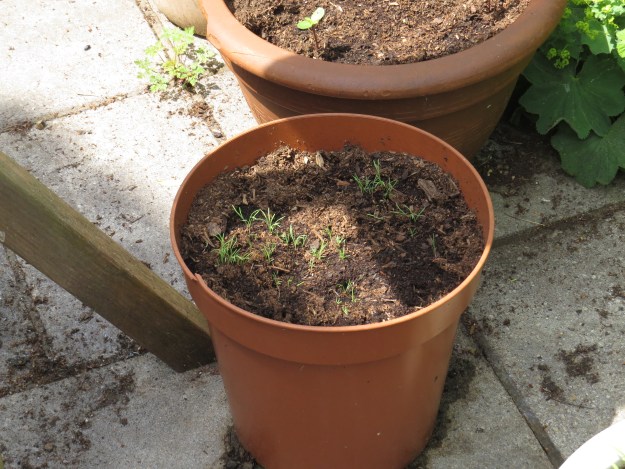
On one side of the garden, someone (I suspect a mollusc) is systematically eating all the new leaves off of my seeds as they germinate.

But on the other side of the garden, there is not a nibble to be seen. It’s a tiny bit sunnier, so maybe that’s enough to deter the slugs and snails.

And my blue water iris is in flower!

But what has kept me most amused today is the mating behaviour of the azure damselflies. The females are a pale green, the males brilliant blue, and once a male has mated, he grasps the female around the neck so that no other chap can ruin his genetic legacy. It’s quite a performance, and the males have to perform all kinds of gymnastics to stay attached. You can see their wings are just a blur as they try to keep their balance. The female probes about in the hornwort to find the perfect place to lay her eggs, and then she flies off, male in tow, to find another spot. What extraordinary animals they are! Meanwhile, unpaired males sit around on the reeds, waiting for their chance.

And finally, how’s this for some mimicry?

Bumblebee mimic hoverfly (probably Criorhina berberina)

This hoverfly not only looks like a bumblebee but sounded and behaved like one too: I heard a loud disgruntled buzzing, and when I looked I thought it was a bumblebee looking for a nesting site. I wonder how many hoverflies go completely under the radar because they look so much like another insect? How handy it must be to disguise yourself as a much more dangerous insect, especially as not many creatures in the UK eat bees, and lots eat flies. There is so much to learn about, even in an average back garden, that if I lived to be 500 years old I’d never get to the bottom of it.

Wednesday Weed – Sicilian Honey Garlic

Sicilian Honey Garlic (Allium siculum)

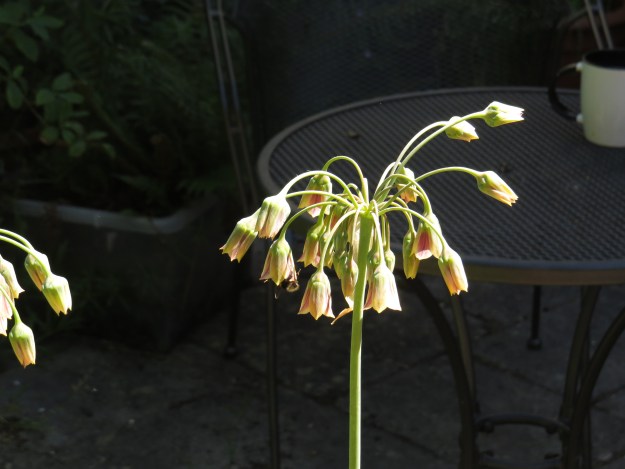
Dear Readers, I planted this bulb in a pot last autumn, and promptly forgot what it was. When all the other bulbs were finished it was still in bud, the flower wrapped in a fine tissue that gradually came to resemble cellophane. Who would have thought that all those blooms could be wrapped up in so small a package? Nature is great at compaction, for sure.

Sicilian honey garlic (or Mediterranean bells or Sicilian honey lily) is a member of the onion family, and comes originally from the area around the Black Sea, and from Italy. It grows there as a woodland plant, and indeed I have one lone Sicilian honey garlic popping up under my whitebeam, which indicates that I have been even more forgetful than I thought. Apparently when cut it has a ‘penetrating skunky odour’ so we won’t do that, but will leave it instead for the bumblebees, who seem to be the only bees with the intelligence to work out how to negotiate the flowers. How they love it, though! They fly in from all directions, and yesterday one actually flew into the back of my head in her haste to get to the nectar, which was quite a shock for both of us.

The flowers are extraordinary but it’s all a bit of a mess at the bottom of the plant, where the leaves are even more untidy than they usually are on bulbs (Wikipedia describes them as ‘unusual twisted foliage’, so maybe I just need to adjust my perceptions).  The flowers start by dangling downwards, but apparently turn to face upwards as they become seedheads. I shall make a point of taking photos daily from now on to see the whole process, otherwise I’ll only notice that things have changed when it’s too late.

As you might expect from an onion, Sicilian honey garlic has been used as an edible ingredient, particularly in Bulgaria, where the leaves of the wild plant (known there as samardala) turn up in spice mixes and salts. Indeed, you can buy some samardala salt for a very reasonable 1.41 GBP from the Bulgarian Spices website, and it’s recommended as a seasoning for egg sandwiches.

Photo One fromhttps://www.bulgarianspices.com/product/samardala/

Samardala spice (Photo One)

However, in a most splendid piece of research for the publication ‘Genetic Resources and Crop Evolution’, it appears that people in Bulgaria use samardala mostly with grilled, roasted or boiled meat. I never cease to be amazed at the sum of human knowledge.

Photo Two from https://www.researchgate.net/figure/Preferred-samardala-salt-food-pairings_fig2_323638847

Photo Two

Like all onions, Sicilian honey garlic contains ‘lachrymatory agents’ – in other words, chemicals that make you cry. I find that my response to cutting up alliums varies greatly according to the onion in question, and that, personally, it’s the little ones that are always the worst. I seem to have built up considerable tolerance over the years, but my husband only has to step into the kitchen when I’m frying up some shallots to start to weep (not as a direct consequence of my cooking skills, I should add). I’ve heard all of the supposed remedies – run your onion under water, wear a snorkel (really!) but my best advice is to use the sharpest knife you have and watch your fingers. Apparently damaging the onion cells causes them to release a chemical that converts to sulfenic acid on contact with the air, irritating the eyes. This chemical is protective for the plant, which might explain why many mammals and some invertebrates avoid garlic and onion-flavoured plants. Some gardeners recommend Sicilian honey garlic for woodland areas both because it is very shade tolerant, but also because (apparently) deer don’t eat it.

Now, I might be impressed by the bumblebees visiting my plant, but in North America you can sometimes see even more exciting visitors. Hummingbirds always know where the strongest, most plentiful nectar is.

Photo by Tony Spencer from https://www.inthehills.ca/2021/03/piet-oudolf-reimagined/

Ruby-throated hummingbird feeding from Sicilian honey garlic in Mono, Ontario, Canada (Photo Three by Tony Spencer)

Now, as you might expect nobody appears to have written a sonnet to this wonderful plant, but Denise Levertov, one of my favourite poets, did compose one on Alliums. I think she’s referring to the commoner purple one with its globe-shaped flowers, but this is also about the bees, and their relationship with all things oniony. I especially like the last two lines.

In Praise of Allium
by Denise Levertov
No one celebrates the allium.
The way each purposeful stem
ends in a globe, a domed umbel,
makes people think,
‘Drumsticks,’ and that’s that.
Besides, it’s related to the onion.
Is that any reason
for disregard? The flowers – look –
are bouquets of miniature florets,
each with six elfin pointed petals
and some narrower ones my eyes
aren’t sharp enough to count,
and three stamens about the size
of a long eyelash.
Every root
sends up a sheaf of sturdy
ridged stems, bounty
to fill your embrace. The bees
care for the allium, if you don’t ­–
hear them now, doing their research,
humming the arias
of a honey opera, Allium it’s called,
gold fur voluptuously
brushing that dreamy mauve.


Photo Credits

Photo One from https://www.bulgarianspices.com/product/samardala/

Photo Two from https://www.researchgate.net/figure/Preferred-samardala-salt-food-pairings_fig2_323638847

Photo by Tony Spencer from https://www.inthehills.ca/2021/03/piet-oudolf-reimagined/


A Mid-June Walk in St Pancras and Islington Cemetery

‘My’ Swamp Cypress

Dear Readers, with the temperatures expected to be in the mid-eighties this week, it seemed that a walk in the shadier parts of the cemetery would be a good idea. However, first I wanted to say hello to ‘my’ swamp cypress, one of my (many) favourite trees. It’s looking very splendid at the moment, even though it’s a good few weeks later than I expected in greening up – the cold May certainly held it back.

It’s the changing of the guard again this week – as you can see from the photo above, the cow parsley is almost finished, but the hogweed is just getting going.

I always think that it looks as if it’s exploding from the stem like a firework.

This shieldbug seemed to be enjoying it as well – it’s the creature with the triangular patterns on it towards the centre of the photograph. Pretty sure it’s a hawthorn shieldbug (Acanthosoma haemorrhoidale) though they’re normally brighter coloured than this one.

The real star of the show this week, though, is the grass, which is waist-deep in some places. The chaps who do the strimming are having a real job keeping up. I quite like it wild, but for people visiting graves it can be a source of some distress. One lady that we spoke to had lost her mother to Covid a few months earlier, and not being able to keep her Mum’s resting place neat and tidy was a real source of distress.  Getting the balance right between the wild spots and the more neatly-groomed one is always going to be tricky, especially with council cutbacks, and such a large area to look after.

Grasses are definitely not my area of expertise, but these have piqued my interest. Let me know if you know what they are, readers! I shall do some research and get back to you. Just about the only grass I’m confident on is wall barley.

Perennial rye-grass (Lolium perenne)??

Cocksfoot (Dactylis glomerata)??

It’s interesting to see how this year’s conkers are already forming on the horse chestnuts…

And the haws are already coming on the hawthorns.

However, spring isn’t quite finished for the birds – I saw a few unusual goings-on in the garden today, which I shall report back on tomorrow, and there was a song thrush singing his head off, so I thought I’d share the moment with you all. You can’t actually see the bird, so you can just relax and listen.

Along by the North Circular Road was a tree that looked like bird cherry, but is evergreen, with very shiny leaves. I’m thinking that it’s a close relative of cherry laurel, Portugal laurel (Prunus lusitanica) – it’s flowering just as the cherry laurel is finishing.

The ox-eye daisies are in full swing, too.

And look at this path. Doesn’t it just make you want to walk along it?

The hogweed always seems to know exactly where the sunny patches are.

And the Scotsman has the sun on his back too.


And all this abundance rather made up for what has happened on our road at home in East Finchley’s County Roads, because the council has been round with the glyphosate and have sprayed not only all the ‘weeds’, but the tree bed where my next door neighbour was growing some California poppies, and the poppy that had self-seeded under my lavender. We shouldn’t blame the people who are doing the spraying, because they are just doing what they’ve been told to do and are probably earning minimum wage for walking the streets all day, but Barnet Council should be listening to the locals, who largely don’t want weed killer sprayed willy-nilly around the places where they live.

My neighbour’s tree pit.

The weeds along the road

My ex-California Poppy

My California poppy last week (Eschscholzia californica)

The only good thing is that most of these annuals have already set seed, and so they’ll be back within a couple of days. And also, the man from the council missed the most enormous sow thistle that is hiding amongst the lavender flowers, which gives me a certain degree of glee. I feel a campaign for no-spraying coming on…..


Wednesday Weed – Sweet Woodruff

Sweet Woodruff (Gallium odoratum)

Dear Readers, I bought some sweet woodruff because I thought it would be perfect for the shady side of the garden. It was lovingly planted, watered and tended, and within about three days it had practically disappeared, with no sign of obvious nibbling. On the other hand, my good friend A has banks of the stuff in her garden, and so I know that the local conditions are not the problem. Still, that’s gardening for you, a succession of small disasters and happy accidents. If you have any illusions that you’re in control, I suggest you get a garden. It certainly put me right.

Anyhow, sweet woodruff is a really delightful plant. It’s a member of the bedstraw family (Rubiaceae), and is a plant of ancient woodland, with leaves that are said to be hay or vanilla-scented when bruised. It’s native to the UK but grows in a great swathe across Europe and Asia all the way to Japan, taking in Iran, Turkey and the Caucasus en route. In German it’s known as ‘waldmeister‘ or ‘Master of the Woods’ which seems a bit martial for this delicate beauty. It’s also known as ‘Wild Baby’s Breath’ – I assume that the ‘wild’ refers to the plant, not the baby (or indeed the breath).

As you might expect for something so sweet-smelling, sweet woodruff has been used for a variety of purposes. The sweet smell lingers on after the plant is dried, so it has often been used in pot pourri and cosmetics. It seems to have been particularly favoured as a flavouring in Germany, where it’s used in May Wine (Maitrank), an alcoholic beverage traditionally served on May Day. Maitrank involves steeping sweet woodruff in white wine, and very refreshing it looks too.

Photo One by By Dr. Bernd Gross - Own work, CC BY-SA 4.0, https://commons.wikimedia.org/w/index.php?curid=49057025

German May Wine (Photo One)

The plant was also used to flavour beer (Berliner Weisse), ice cream, brandy and a Georgian soft drink called Tarhun. It was used to flavour sherbet powder, though in the UK I’m sure we’re all much more familiar with the zesty lemon-flavoured substance that used to be eaten with a liquorice stick. Alas, the substance that gives woodruff its flavour is called coumarine, and in 1974 the Germans banned its use in products for children because it was found to cause liver damage (and children, being smaller, are more susceptible). Adults can still lay their hands on sweet woodruff-flavoured alcohol, but artificial substitutes are now used in sweets.

In Flora Britannica, Richard Mabey describes how dried woodruff was hung in wardrobes and laid amongst stored linen to deter moths. The leaf whorls were apparently used as bookmarks, and during Georgian times the leaves were placed in the cases of pocket-watches, so that the user could inhale their fragrance whenever they needed to tell the time. Mabey reports that woodruff no longer grows wild in London, but that it was once hung in churches on St Barnabas Day, the 11th June. And a turning close to the Tower of London, now called Cooper’s Row, was once called Woodruff Lane.

And finally, a poem. A few posts back, I wrote about friendship, and how it’s undervalued in our society compared with the love we feel for family and romantic partners. This feels like an intensely personal poem, and yet it made me think of so many of my female friends, past and present, and the things that we’d shared. See what you think.

Up, Over the Steep Hill
by Kathleen Ripley Leo

‘May we strive to touch and to know the great common woman’s heart of us all…’ Mary Stuart

Catch her by the waist, a woman friend,
whose laughter you hear in the night
ringing in your ears: over your elaborate strategy to lose weight;
over the grand joke you keep to yourselves;
over swearing her to secrecy for driving you
to the Secretary of State when you’re late renewing.

Catch her by the waist, a woman friend,
whose baby daughter crawls through your dining room
looking for all the world
like a pink shell on the carpet, she moves so sweetly;
whose son shares his bike lock with your son at school,
the son she cheers on to win the race, to make the grade,
to stay alive one more day in the isolette.

Catch her by the waist, a woman friend,
whose hostas and phlox bloom in your garden;
with whom you kneel and pray for peace;
with whom you silently walk in the woods
hoping the raccoon, sunning itself
on the branch overhead, does not wake up,
hoping the deer in the clearing does not bound away,
who watches with you, both apprehensive and in awe,
as two snakes curl and dance in the sun
on the cement pavement at Maybury;
who takes care of the cat, the mail, the paper,
the broken ground between your houses,
picking you up at the side of the road
when you’ve locked your keys in the car,
quelling the shaking wings of your heart.

Catch her by the waist, a woman friend,
who has lunch with you after the angel tour at the Art Institute;
who helps you overcome your panic attack at the mall,
or on that crowded street in Washington DC,
or at that Brighton home tour;
who asks you to write your poems and to read them outloud;
who helps you pick out glasses to fit your odd and funny face;
who carefully tends to the basil parmesan bread,
so you can take it to your progressive dinner party
and claim you made it;
who washes your clothes in her machine when yours gives out.

Catch her by the waist, a woman friend,
who tells you what happened to the bank of sweet woodruff you dug out
the spring your father died, because in the fall
you couldn’t remember doing that;
who tells you how to think about toxic criticism;
who helps you cope with aggressive jealousy;
who drives you to the hospital when your baby needs x-rays,
and then when your husband’s there;
who drives you to the doctor for the procedure,
and carefully holds you when you cry;
who sees your letters unanswered,
and your invitations refused, sees your hurt and stays quiet;
who catches your waist, too, and together, laughing and crying,
you pull each other up, over the steep hill.

Photo Credits

Photo One by By Dr. Bernd Gross – Own work, CC BY-SA 4.0, https://commons.wikimedia.org/w/index.php?curid=49057025

Tuesday Gardening Update

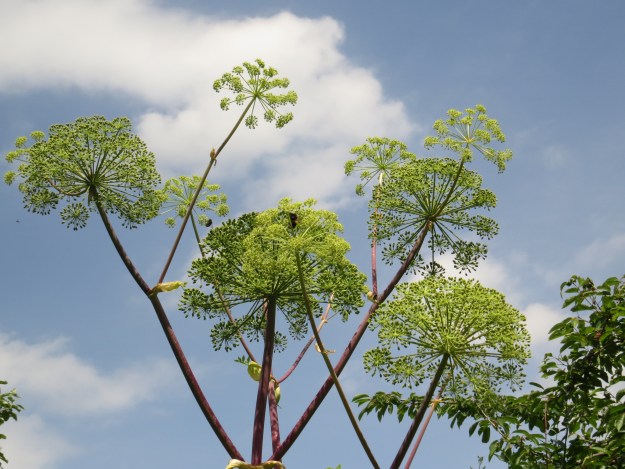
Dear Readers, I thought you might like to see my angelica aka ‘the triffid’ – the handrail is about three feet high, and the ground is about a foot below the stairs, so I think this plant is about ten feet tall. What a beauty! It’s still abuzz, mainly with honeybees but bumblebees and some tiny wasps/hoverflies have got in on the act too.

My plant guide suggests that in the wild it can grow to about eight feet tall, so this is clearly an outlier, but then I seem to have picked the perfect spot for it, largely by accident – it’s right by the pond, so it’s nice and damp at the root, but it gets sun for most of the day. Plus by the time it goes over the hemp agrimony will be coming into flower, so I’ve extended my flowering season. I just love it when there is a happy accident.

If you look very closely at the middle of the first photo you’ll see that there’s a little wasp/hoverfly, but I need him/her to stay still for a bit longer so I can get a better view. I do love the way that each individual flower on the angelica looks like a tiny acorn though.


Now, I wouldn’t want you to think that I’m so enamoured by the angelica that I’ve forgotten everything else. My blue water irises have buds on them now, which is very exciting, and one of the yellow flags has produced a flower too, the first of many I hope.

Blue water irises

And at the end of the garden, the mock orange is smothered in flowers and bumblebees, and the scent is extraordinary. In fact, there are so many bumblebees that I’m wondering if there’s a nest close by. That would really be a bonus.

I did see one ashy mining bee earlier on (typically when I didn’t have my camera handy), but I’m hoping that they’ll discover the climbing hydrangea flowers, which were a big favourite a few years ago. I’m seeing lots of ladybirds about too, but masses of aphids which are taking over the buddleia in the front garden again as they did last year. I think I’ll send my husband out with the hosepipe to give them a good dousing, that seems to slow them up a little bit.

And so, with the heady scent of the mock orange blossom indicating that summer is truly here, I shall bid you adieu until tomorrow.