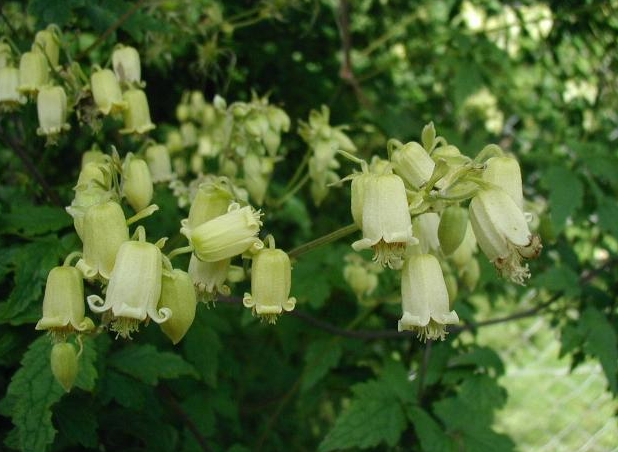
Clematis rehderiana (Photo One)
Dear Readers, as I no longer spend money on eating out (except for the odd pizza delivery) or on holidays or on cinema or theatre, I have two main sources of outlay left, once food and domestic ‘stuff’ is covered – one is books, and the other is the garden. This year I am determined to have a rethink, and to try out some new plants – who knows how we’ll get on, but there’s only one way to find out!
My first purchase is a Clematis rehderiana (otherwise known as ‘Nodding Virgin’s Bower’, but we’ll skip over that thank you very much). It was quite a puzzle finding one, and I only persevered because my Gardening For Wildlife book by Adrian Thomas mentions it as being the very best clematis for wildlife. Unlike some of the other types, it has primrose yellow bells and smells of cowslips. The Guardian describes it as a ‘romper’, which is just what the garden needs. I’ve planted it next to my lilac, which is pretty early in the year and boring for the rest of it, so I’m hoping the clematis can be persuaded to scramble over it and then onto the fence behind. At the moment it is a twig with exactly one set of leaves, so let’s hope it perks up now it’s in the ground.
Secondly, I was very aware that my north-facing garden is a bit of a desert for pollinators during the winter, and so I have chanced my arm on a Clematis cirrhosa var balearica – this one is ‘Wisley Cream’. It’s said to flower from November to March, and I am going to pop it in against my West-facing fence, and make sure that the roots are protected as I know it’s not necessarily fully frost hardy. The bittersweet and honeysuckle also grow on this fence, so I’ll have to make sure that they all share. And as it’s close to where we sit, it might even encourage us to brave the garden during the warmer days of winter.

Clematis cirrhosa var balearica ‘Wisley Cream’ (Photo Two)
In other news, I want to extend the range of geraniums in the garden, as they can be so good for pollinators – my Dusky Cranesbill (Geranium phaeum) are covered in bees early in the year, but they die back way too soon, and I want something else that will take up the mantle. I’ve planted some Geranium macrorrhizum in a slightly sunnier (but not too sunny) position – these do amazingly well in some places around here. The plants are nicely well-grown, so I hope they’ll soon be flowering away. Any advice on geranium varieties for shady places would be gratefully received. Even the geranium ‘Rosanne’ that everybody swears by gave up the ghost when I planted it.

Geranium macrorrhizum (Photo Three)
And I almost forgot that a lovely friend of mine gave me an envelope full of honesty seeds, so they’ll be going in pronto. I know they can be invasive but it’s such a struggle to get anything to thrive that invasive sounds like a feature rather than a bug, as us elderly IT folk sometimes say.

Honesty (Lunaria annua) (Photo Four)
In other news, I’ve planted winter aconite, snowdrops and lily of the valley (another plant that can get out of control, yay!) in the green. I’m hoping that the lily of the valley will give some leafy cover to my poor frogs, although they’ve gone really quiet for the past week or so – the temperature dropped to below freezing last night, so I’m sure that’s got something to do with it.

Lily of the Valley (Convallaria majalis) (Photo Five)
So let’s see how this lot get on. In other projects, we have just got a new tiny table and chairs for the back of the garden – it’s something of a sun trap and will be a nice place to sit in the spring and autumn, and so I’ll need to tidy that area up a bit as well. And I really, really want to sort out some enormous planters/raised beds for the south-facing front garden, so that I can extend the season for pollinators – they are spoiled for choice when the buddleia and lavender are out, but it’s boring during the rest of the year (though I do have some Lambs Ears (Stachys byzantina) in my window boxes and I’m hoping that some wool carder bees might turn up).
Whoever said that a garden is always a work in progress had it absolutely right.
Photo Credits
Photo One by https://upload.wikimedia.org/wikipedia/commons/f/ff/Clematis-rehderiana.JPG
Photo Two by sunoochi, CC BY 2.0 <https://creativecommons.org/licenses/by/2.0>, via Wikimedia Commons
Photo Three by I, KENPEI, CC BY-SA 3.0 <http://creativecommons.org/licenses/by-sa/3.0/>, via Wikimedia Commons
Photo Four from CC BY-SA 3.0, https://commons.wikimedia.org/w/index.php?curid=107188
Photo Five by liz west from Boxborough, MA, CC BY 2.0 <https://creativecommons.org/licenses/by/2.0>, via Wikimedia Commons


![By Franz Xaver (Own work) [CC BY-SA 3.0 (http://creativecommons.org/licenses/by-sa/3.0) or GFDL (http://www.gnu.org/copyleft/fdl.html)], via Wikimedia Commons](https://i0.wp.com/bugwomanlondon.com/wp-content/uploads/2016/02/crocus_vernus_5.jpg?ssl=1)