Category Archives: London Plants

Wednesday Weed – Snowdrop Revisited

Dear Readers, I hope you will forgive this cheekiness, but as I have been toiling away over a hot spreadsheet all day I figured that I could do with some snowdrops, and you probably could as well. I have a tiny clump emerging under the whitebeam tree in the garden, but it’s too dark and rainy to take a photo of the blooming (literally!) things so that will need to wait until the weather is a bit more clement.

I also wanted to alert you to the fact that the Devon Snowdrop festival, which usually attracts thousands of visitors, is now online due to the lockdown. I have been thoroughly enjoying it on Facebook and rumour has it that it’s also on the new-fangled Instagram.I often think that I should post there, but keeping up with the blog generally plus Facebook plus (very occasionally) Twitter is quite enough social-media-ing for one person, although there are some wonderful things to see. 

And finally, tomorrow is my birthday, and I plan to make myself a cake, though I shall hold fire on the 61 candles that it would require. I am thinking orange and almond, but chocolate is also calling. Maybe I could combine the two :-). What do you think, Readers? Let me know your favourite cake so that I can be inspired. Snowdrops in St Pancras and Islington Cemetery (Galanthus nivalis)

Snowdrops in St Pancras and Islington Cemetery (Galanthus nivalis)For me, the sight of the first snowdrops of spring is like a long drink of cold water after a hot, dusty walk. The dazzling white flowers and the fresh green-grey foliage seem fresh and toothsome, as delicious as the first asparagus.

IMG_1353This is especially true in a woodland setting, and in St Pancras and Islington Cemetery there are a number of unkempt, wild areas, where the graves have become overgrown with moss and lichen. Here, the Snowdrops have naturalised, creating a wash of white that glows in the dim spaces.

IMG_1359Some vernacular names for the Snowdrop include February Fairmaids, Candlemas Bells and, my own particular favourite, Snow Piercer. This last has a fine Saxon edge to it, as if the plant were a well-loved sword. And yet, there is much debate over whether it is a native plant or naturalised. The answer is probably that it is both. As Richard Mabey points out in Flora Britannica, it is native to Continental Europe, and grows wild in northern Brittany, so it may be that the colonies in the south-west of England are native, arriving while the UK was still part of the European mainland, while those elsewhere are the result of garden escapes, albeit from hundreds of years ago. The Snowdrop has long been associated with purity, and may have been deliberately planted in monastery gardens and churchyards.

St George's Churchyard, Near Damerham, Hampshire, UK ( © Copyright Miss Steel and licensed for reuse under this Creative Commons Licence.)

St George’s Churchyard, Near Damerham, Hampshire, UK ( © Copyright Miss Steel and licensed for reuse under this Creative Commons Licence.)

IMG_1354I have found Snowdrops extremely difficult to grow in my garden, and I have the feeling that they are not a hundred percent at home in our climate. They emerge too early for most pollinating insects, which makes sense if you consider that they probably come from an area with warmer winters and earlier springs. Because of this, they spread by division of the bulbs, rather than by seed. Many cultivated varieties are also sterile. Chelsea Physic Garden runs Snowdrop Days during February, to show off the sheer variety of cultivars: to read the Gentle Author’s account of a visit, and to see photos of some of them, have a look here.

IMG_1363The Latin name for the Snowdrop genus, Galanthus, means ‘milk-flower’, and the nivalis species name means ‘of the snow’. So, even if you had never seen a snowdrop you would have the definite impression that it was white. And such a white! But each flower also has exquisite green markings on the petals, and also inside the flower itself.

IMG_1355In Homer’s ‘The Odyssey’, a priestess, Circe, turns Odysseus’s crew into pigs. To protect against her enchantments, Odysseus is given the plant Moly by Hermes, and there is some agreement that Moly was, in fact, the Snowdrop. One theory is that the transformation of the crew was a metaphor for the euphoria and hallucinations induced by plants such as Deadly Nightshade and Datura. It just so happens that the Snowdrop contains a chemical called Galantamine, which can counteract the effects of these plants. I love the way that story and science mix here, as they so often do. In the painting below, Circe is offering Odysseus a nice refreshing drink, though the pig on her left-hand side is something of a warning. Just as well Odysseus has his Snowdrop to protect him.

Circe Offering the Cup to Odysseus, by John William Waterhouse. Note the tell-tale pig on the right hand side. Just as well Odysseus has his Snowdrops!

Circe Offering the Cup to Odysseus, by John William Waterhouse.

Snowdrops at Welford Park, Berkshire ("Welford Park Snowdrops 1" by Chris Wood (User:chris_j_wood). - Photograph by myself with original filename DCP_3674.JPG. Unmodified.. Licensed under CC BY-SA 3.0 via Wikimedia Commons - http://commons.wikimedia.org/wiki/File:Welford_Park_Snowdrops_1.jpg#mediaviewer/File:Welford_Park_Snowdrops_1.jpg)

Snowdrops at Welford Park, Berkshire (“Welford Park Snowdrops 1” by Chris Wood (User:chris_j_wood). – Photograph by myself with original filename DCP_3674.JPG. Unmodified.. Licensed under CC BY-SA 3.0 via Wikimedia Commons )

Because of their association with purity, the flowers were sometimes used in Victorian times to warn off over-passionate lovers – a few Snowdrops in an envelope might be enough to dampen a young man’s ardour. But Snowdrops have also been considered unlucky, and in some parts of the UK a single flower is still seen as a death-token, perhaps because, as Mabey explains, Victorians felt that the flower looks ‘for all the world like a corpse in its shroud’. But to me, the bloom looks more like a beautiful white and green moth, and, coming from Bugwoman, there is no higher praise.

"Snowdrop 'Viridi-Apice'" by Schnobby - Own work. Licensed under CC BY-SA 3.0 via Wikimedia Commons - http://commons.wikimedia.org/wiki/File:Snowdrop_%27Viridi-Apice%27.jpg#mediaviewer/File:Snowdrop_%27Viridi-Apice%27.jpg

“Snowdrop ‘Viridi-Apice'” by Schnobby – Own work. Licensed under CC BY-SA 3.0 via Wikimedia Commons – http://commons.wikimedia.org/wiki/File:Snowdrop_%27Viridi-Apice%27.jpg#mediaviewer/File:Snowdrop_%27Viridi-Apice%27.jpg


A Sunny Walk in St Pancras and Islington Cemetery

New growth on the weeping willow

Dear Readers, there was a definite touch of spring in the air this morning, so off we went for our usual trot around the cemetery. I always love the entrance with its cedars of Lebanon and stately weeping willow. Apparently the cemetery used to have a lovely lodge which was demolished in 1850 and replaced by a very functional brick building. The quest for modernity in the 1960s and 1970s seems to have involved many acts of vandalism, but at least the trees are still here. They make me feel more peaceful as soon as I see them.

One of the gravestones along the first path that we walk has fallen over, and turned into an impromptu birdbath. I often see crows taking advantage of the shallow water.

The spring weather seems to have kicked off a whole lot of corvid activity. There was a family of magpies in the ash trees, calling to one another and cheerfully picking through the twigs. I imagine there are lots of little insects who are having their hibernation brought to an abrupt end.

And then further on, I see a pair of crows, one of whom has what looks like a chocolate brownie in his beak. At least I hope that’s what it is. I suppose it could be something more unpleasant, but I don’t know of any animal that produces rectangular droppings, so I’m going with the brownie theory.

Down by the eastern entrance I notice a parakeet, perched up in a high branch. There seemed to be a lot of these birds around today, enjoying the sunshine.

Walking along Withington Road within the cemetery, I was struck by how the sun illuminated some of the angels.

And suddenly I had a sense of being watched.

And yes, it’s the statue of the Scotsman that I’ve mentioned before. He must only be visible from this point at the very turning point of the year, when all the leaves have fallen but the new growth hasn’t got going yet. There’s always something new to see here. And how splendid the rosehips are looking! There are still so many redwings here that I’m surprised there are any left at all.

Earlier, I’d seen two or three crows chasing the poor old kestrel. But as we were leaving there was a right old ruckus, with crows flying in from all points of the compass. Nowadays I always look up and try to get my camera ready.

And there, right in the middle of the whirl of wings was the buzzard. Poor thing, I am beginning to feel almost sorry for it. It’s the bird in the lower centre with the paler mottled underwings. The angle is deceptive, but it’s at least half as large again as the crows. I still haven’t worked out where it roosts, but I can’t imagine it’s popular in the cemetery.

The crows, on the other hand, seemed to be having the time of their lives. They’ll fly at anything – kestrel, sparrowhawk, buzzard or their particular favourite, the heron (which of course looks like a gigantic bird of prey in flight. As far as I know, none of these birds will take crow eggs or nestlings, so it seems almost visceral. Plus, crows generally hang out in family groups or pairs and aren’t supposed to be particularly social: however they’ll happily join in when a mob starts forming. I wonder what studies there have been? Let me know what you’ve noticed, readers: I’m intrigued.

A Mellow Walk in St Pancras and Islington Cemetery

Dear Readers, for once the elements were with us for this week’s walk in the cemetery. Things are so bad with the pandemic in London now that we wore our facemasks along the High Road until we were actually in and had room to social distance properly. Not all the pavements in East Finchley are wide enough to avoid getting closer than two metres to other people, and with the hospitals fit to busting, and the new variant apparently anything up to 70% more transmissible than previous ones, it seemed sensible to take every precaution we could think of. The last thing we want to do is to catch the virus ourselves or to inadvertently pass it on to anyone else, and I have to say that the vast majority of people are being extremely careful at the moment. I’m sure there are still a few folk who think that they are immortal, or don’t care enough to protect other people, but they really are few and far between around here.

But to get back to the walk – as we approached the entrance, I noticed that there were bits of car all over the place, and as we rounded the corner it became clear that a vehicle had gone bang into the wall of the cemetery. It’s been very icy around here, but this is a straight road so goodness only knows what happened. I just hope that nobody was seriously hurt.

Once we’re into the cemetery, I make a beeline for the chapel. My friend A told me that she’d spotted an interesting fungus growing from one of a group of plane trees, and her directions were excellent – it only took me about two minutes to find it. Having had a conversation with the experts on the British and Irish Fungi Facebook group, we think it might be the Spectacular Rustgill (Gymnophilus junonius),  and what an apt name that is! Apparently it tastes bitter and turns green when you cook it, but I’d have thought that the former fact precluded anyone doing the latter. Anyhoo, this is a very fine fungus, and I’m glad to have made its acquaintance.

Spectaccular Rustgill

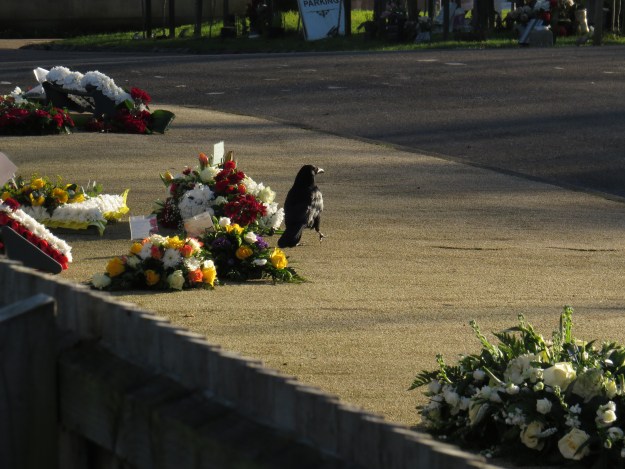
The crows, squirrels, parakeets and jays were all in abundance today, gathering food and chasing one another. The crows in particular were very evident. The chap below seemed to be about to peck over one of the mourner’s wreaths that has been left out after a service. When he saw me, he folded his wings and hustled away as if to indicate that there was nothing to see here.

There are already primroses in flower in the woodland burial site, which always cheers me up.

And how I love the sunbeams coming through the trees.

The sun is so low that there are places in the graveyard that the sun doesn’t touch at all. I loved this icy stone with its hieroglyphics of fern and moss and seed.

And there is another crow, pecking over the leaves of a conifer to see what s/he can find. Maybe there are some tiny insects trying to hibernate amidst the needles.

And I do love a good reflection in a pothole. Isn’t that what they’re there for?

Last week, someone asked me about people in the cemetery who were buried following the 1918 flu epidemic, and it got me to thinking. I feel as if I haven’t noticed many non-military graves from this period: I found the one below today, but my husband assures me that the worst of the flu would have passed through by November 1919, so probably this person died of wounds or from the effects of gassing. It’s a very interesting question though, and one that I shall think on further.

I love the way that the melting frost lights up every blade of grass, as if each one was holding up a candle at a rock concert. Remember them?

And then, on the way home, I notice this wall.

Look at the moss! The cracks and crevices between the bricks are positively furry with the sporangia, the reproductive bodies. The moss must have found this spot to its liking, and multiplied like billy-ho (this is a relatively new wall). I loved the green and red of the moss against the terracotta stonework. It just goes to show how nature will colonise even the most unpromising of habitats.

Wednesday Weed – Mango

Dear Readers, my Mum often used to get ‘stuck’ on a particular foodstuff, which she would eat daily for weeks. One year it was an apple with a packet of cheese and onion crisps. Another year it was those ‘fruit corner’ yoghurts. Then there was the time of the Solero ice lollies (tropical fruit flavour only if you please). But at some point she was introduced to the delights of a ripe mango, and that was it. She bought them by the boxful, and the sound of slurping and licking of fingers was often a bit much for the more delicate among us. How she loved them!

And then one day the inevitable happened (just after I’d sourced a box of Alphonso mangos, naturally). As usual, Mum cut one as close as she could to the skin on either side of the stone, cut the flesh into cubes, and after the first nibble she looked up, astonished.

‘You know,’ she said, ‘I think I’ve gone off of these’.

And that was that. Never a mango crossed her lips again.

So when I was presented with a red mango in my fruit and veg box today, it brought back so many memories. But sad to say, I have never had a really good ripe mango in the UK since the days of getting them for Mum. Are they storing them differently, I wonder? They seem stringier and more insipid than I remember them, and like so many other things they go from as hard as a shot putt to rotten without any intervening period. When I’ve been travelling, though (remember those days?) I have been party to some exquisite mangoes, ripened gently on the tree in someone’s garden and picked at the perfect moment.

Mango is an Asian fruit, and is the National Fruit of India, and National Tree of Bangladesh.  There are 27 edible species. The most familiar to us, and the most commonly cultivated, is Mango indica. All mangoes are in the cashew family (Anacardiaceae).

Photo One By Ram Kulkarni - Photograph taken by a digital camera, CC BY-SA 4.0, https://commons.wikimedia.org/w/index.php?curid=14897964

Fruits and flowers of Alphonso mango (Photo One)

Tropical mangoes (such as those from the Philippines) are typically yellow, while sub-tropical mangoes, from the cooler parts of India, are usually red and green, like my fruit. The world’s highest selling cultivar, Tommy Atkins, is liked because of (guess what) its transportability, long shelf life and ease of handling. Personally I much prefer Alphonsos, but there have been problems with importation, due to fear of bringing in, among other things, ‘non-European fruit flies’. The EU ban was lifted in 2015, but I well remember the 2014 ‘year without Alphonsos’. The season is short, but the fruit is remarkably lacking in the stringy fibres of other cultivars. India has a large number of different varieties, but exports very little – the Indian people very sensibly eat their mangoes themselves. The goddess Ambika is traditionally shown sitting under a mango tree, after all.

Photo Two By G patkar at English Wikipedia - Transferred from en.wikipedia to Commons., Public Domain, https://commons.wikimedia.org/w/index.php?curid=10899806

Alphonso mangos (Photo Two)

Photo Three By Y.Shishido - http://pipimaru.dyndns.org/india_2004/index.html, CC BY-SA 3.0, https://commons.wikimedia.org/w/index.php?curid=365739

The goddess Ambika sitting under a mango tree in the Ellora Caves, Maharashtra, India (Photo Three)

I love mangoes in desserts, and one of my favourites is mango shrikhand, a thick, creamy south Indian delicacy made with thickened yoghurt, cardamom, saffron, pistachios and mango. Oh my goodness! I used to go to a restaurant called Diwana on Drummond Street in Euston for their vegetarian food but in particular for the shrikhand. There’s a recipe here How could you resist?

Photo Four from https://www.manjulaskitchen.com/mango-shrikhand/

Photo Four

Incidentally, when mangoes were first discovered by the West, they were largely eaten as pickles, because they would rot before they could get there. So, the first taste of a mango was likely to have been a sour, pungent, hot affair, rather than the sweetness that we associate with them – there’s what looks like a great recipe here. Amchoor, or mango powder, is another popular ingredient in South Asian food, and adds a similar sourness.

Now, as you might expect, mangoes are not only eaten by humans, and lots of animals are involved in the dispersal of those giant seeds. In Florida (where the Tommy Atkins comes from) deer, squirrels and raccoons all eat the fruit. In tropical zones parrots, hornbills and lorikeets enjoy them, and monkeys and apes will eat them by the bucketload. Fruit bats also have a particular liking for a ripe mango. As the seed can happily survive a trip through an animal’s alimentary tract (if the seed is small enough and the animal is large), the seedlings often pop up a long distance from the ‘mother plant’, which is presumably why the fruit is so tasty. Elephants also eat mangoes, and in this they probably take on the role of the extinct gomphothere, which was also involved in the distribution of avocado seeds.

Photo Five By Unic - Own work, CC BY-SA 3.0, https://commons.wikimedia.org/w/index.php?curid=24434273

Gomphothere statues in Osorno, Chile (Photo Five)

What pollinates a mango, though? The flowers are plentiful but very simple in design, so it might come as no surprise that the main pollinators appear to be flies, along with solitary bees, some beetles and even ants. In fact, in India a method of attracting flies that was trialled involved hanging bags full of rotten fish or mutton from the tree branches. Although mango flowers are actually hermaphroditic, fruit production was much higher when the plant was cross-pollinated by insects.

Photo Six from http://blogs.ifas.ufl.edu/trec/2018/06/21/378/

Different mango pollinator species (Photo Six)

As you might expect from a plant that has grown in the company of humans for such a long time, mango has been used for an extraordinary range of medical purposes. Here is an excerpt from a paper on the National Library of Medicine website.

Studies indicate mango possesses antidiabetic, anti-oxidant, anti-viral, cardiotonic, hypotensive, anti-inflammatory properties. Various effects like antibacterial, anti fungal, anthelmintic, anti parasitic, anti tumor, anti HIV, antibone resorption, antispasmodic, antipyretic, antidiarrhoeal, antiallergic, immunomodulation, hypolipidemic, anti microbial, hepatoprotective, gastroprotective have also been studied. These studies are very encouraging and indicate this herb should be studied more extensively to confirm these results and reveal other potential therapeutic effects. Clinical trials using mango for a variety of conditions should also be conducted.

And here’s me thinking that mangoes are just tasty! The texture of the fruit of a good mango always screams ‘moisturising’ to me, and if only I could stop myself from eating them I might try plastering them all over my face to see if they help with my dry skin. This is probably not a good idea – some people have a very bad allergic reaction to mango flesh so maybe best to stick to the Oil of Ulay (though my Mum had a reaction to that too!)

And here, finally, a poem, by the inimitable Mary Oliver, who is up there with my top five favourite poets. I love the way that she shifts from the experience of eating the fruit to something else entirely.

The Mango by Mary Oliver

One evening
I met the mango.
At first there were four or five of them
in a bowl.
They looked like stones you find
in the rivers of Pennsylvania
when the waters are low.
That size, and almost round.
Mossy green.
But this was a rich house, and clever too.
After salmon and salads,
mangoes for everyone appeared on blue plates,
each one cut in half and scored
and shoved forward from its rind, like an orange flower,
cubist and juicy.
When I began to eat
things happened.
All through the sweetness I heard voices,
men and women talking about something—
another country, and trouble.
It wasn’t my language, but I understood enough.
Jungles, and death. The ships
leaving the harbors, their holds
filled with mangoes.
Children, brushing the flies away
from their hot faces
as they worked in the fields.
Men, and guns.
The voices all ran together
so that I tasted them in the taste of the mango,
a sharp gravel in the flesh.
Later, in the kitchen, I saw the stones
like torn-out tongues
embedded in the honeyed centers.
They were talking among themselves—
family news,
a few lines of a song.

Photo Credits

Photo One By Ram Kulkarni – Photograph taken by a digital camera, CC BY-SA 4.0, https://commons.wikimedia.org/w/index.php?curid=14897964

Photo Two By G patkar at English Wikipedia – Transferred from en.wikipedia to Commons., Public Domain, https://commons.wikimedia.org/w/index.php?curid=10899806

Photo Three By Y.Shishido – http://pipimaru.dyndns.org/india_2004/index.html, CC BY-SA 3.0, https://commons.wikimedia.org/w/index.php?curid=365739

Photo Four from https://www.manjulaskitchen.com/mango-shrikhand/

Photo Five By Unic – Own work, CC BY-SA 3.0, https://commons.wikimedia.org/w/index.php?curid=24434273

Photo Six from http://blogs.ifas.ufl.edu/trec/2018/06/21/378/

The First Cemetery Walk of 2021

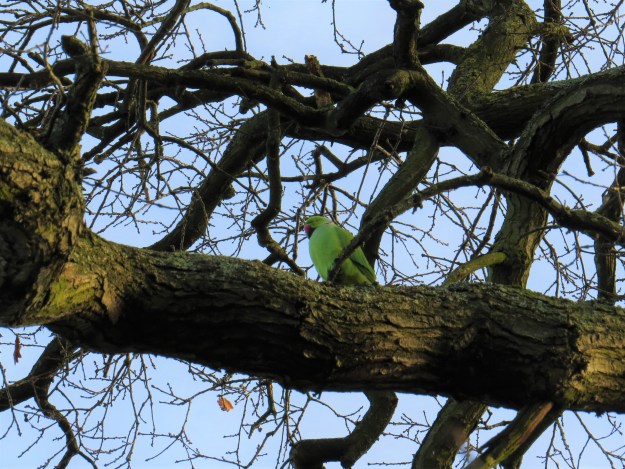
Dear Readers, our first walk in St Pancras and Islington Cemetery this year saw us getting some glorious weather for a change – this week it has felt as if the sun hasn’t really risen above the horizon, so some brightness was most welcome. The birds seemed to feel it too – this ring-necked parakeet was uncharacteristically obliging as s/he posed in this horse chestnut tree and munched the buds. I see that Defra are talking about culling parakeets, but only in areas where they are new. They are well-established around here, so hopefully they’ll be safe. Personally, I think that with everything else that’s going on, shooting a few parakeets should be low down on the agenda but there’s  no stopping some folk.

Elsewhere, the ash trees were a-twitter with goldfinches, who kept up a constant babble of contact calls that could be heard even over the traffic noise.

There were redwings everywhere, and they were being shy, as usual.

I must have counted twenty blackbirds, probably newly arrived from cooler parts of the continent – although it was long thought that blackbirds didn’t migrate, it’s now known that they often rear their young in one place, and over-winter somewhere else, with one bird spending every summer in a Devon garden and every winter in the south of France. In the winter the birds are much less aggressive and territorial, especially where there’s plenty of food, but they also seem shyer. Not one stood around long enough for a photo.

Fortunately, the moss is a lot more obliging, and on some of the older graves there is a whole miniature ecosystem.

I can just imagine all the tiny creatures slithering and creeping through the ‘jungle’ in search of safety, or prey. And look how the sun catches the moss sporophytes (the ‘flowers’ of the moss).

We have been walking different paths over the last few weeks, and every trip I find another new interesting grave. How about this one, for example?

Gillian Elinor was a bit of a late starter, having given up education to look after her children. However, she was nothing if not determined – she did her A-levels part time, followed by a degree in English and Art History at Birkbeck, followed by a Masters in the USA. Her first teaching job was at the Polytechnic of North East London (now UEL) where she started, at the age of 40, with a one day a week appointment. She stayed for 20 years, for the last 5 of them holding the post of Head of the Arts Department at the University of East London, and devoted many years of her life to the subject of women in the arts. She brought the African and Asian visual arts archive to the university, and was a founder member of Feminist Arts News and was heavily involved in the  Women Artists Slide Library. In 1987 she was joint editor of Women and Craft, published by Virago. She was also involved in the Women’s Art Group in Education, which sought to disclose how few women there were in academic posts.

In her later years, Elinor moved away from the visual arts and became more interested in poetry. Her headstone is an elegant and rather beautiful tribute to her dedication to the recognition of the talents of women, so many of whom are still unsung.

My husband is particularly interested in the war graves in the cemetery: there is a ‘proper’ war graves area, but many are scattered about, often hidden amongst the trees, although all of them have bright, well-scrubbed new headstones, dating from the hundredth anniversary of WW1. This week we found this one; the graves of those who were in the Navy when they died often have more details than those from other services, as in the one below.

A little bit of research shows that Able Seamen Dennis Watts died of ‘illness’ after the war, on 9th March 1946. H.M.S Orlando appears to have been a shore-based HQ on the Clyde in Greenock, sometimes also known as a ‘secret facility’. The trail goes cold at this point however (unless I want to shell out another £180 a year for Ancestry.com). What a sad loss of a human being, though, at only 22 years old.

And this one actually brought me to tears.

George W. Dell was killed at the land-based centre H.M.S Christopher, which was again in Scotland, and was a base for training personnel to use the anti-submarine and patrol boats which were on constant watch around the coast. There are no details, but the lad was only 19. We can only imagine the sorrow with which his parents, back in Barnsbury, Islington, received the news.

That heartfelt message ‘Just one of many – but he was ours’ echoes down the years. I’m sure that the people who are losing their loved ones in the pandemic are just as intent that those that they’ve lost shouldn’t just become another statistic, but should be remembered as the unique individuals that they were. When I read that Joe Biden is planning a remembrance event for 19th January in the US, the day before his inauguration, it makes me think how much we will need something similar when this is finally under control.

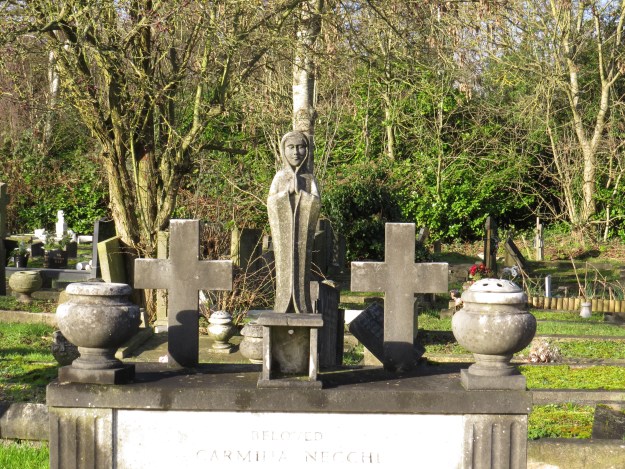
But finally, I had never noticed this very elegant little figure before. I am not sure if she is the Virgin Mary, or another saint, but I love how precise and neat she is, with that air of austerity that I usually associate with Japanese sculpture. I think she will be someone that I’ll look out for on future visits.

And finally finally, here are a few more goldfinches, because you can never have too many 🙂


A New Year’s Eve Walk on Muswell Hill Playing Fields

Dear Readers, if 2020 has taught me anything, it’s that beauty can be found by walking slowly and paying attention, even on the coldest and dullest of days. We’ve been avoiding the Fields for the past week or so because the mud was so pervasive and slippery that it was no fun trying to navigate it, but with last night’s freeze everything has turned deliciously crispy. The frost has touched all the seedheads and leaves, painting every detail with icy-white.

Brambles

We skitter down the slope beside the skate park, and then down a further slope to the bottom field. I think of this as ‘my’ wildflower border, though it is a pure accident, it appears. In the spring it was a mass of colour, but now it has a more austere and subtle beauty.

Muswell Hill Playing Fields in June

Each ‘scale’ on the seedheads of the greater knapweed seems to have attracted its own cap of ice.

The greater burdock seeds are iced into something that looks rather like the images of coronavirus that I’m seeing, or maybe a Sputnik (which of course is the name of the Russian vaccine). But they are also perfect examples of evolutionary design, with those hooks that inspired the creator of Velcro. All they need is a large hairy mammal to brush past and transfer them to pastures new.

Aren’t the seedheads of the fennel exquisite? They would be perfect for a winter wedding.

And even the long seedheads of the mugwort are lent an elegance by the ice that they didn’t have when fresh and new.

In this strangely monochrome world I find myself yearning for a bit of colour, however. At the pyracantha hedge on the other side of the field, I hear the familiar breathy call of a redwing. The cemetery in particular is heaving with these birds at the moment, as they pick over the ivy berries, but this little one had stopped for something orange.

This bird from the cemetery yesterday was too far away to get a decent shot, but it was glowing white and red against the ivy foliage.

As we come to the beginning of a new year, I am so glad that I have had a few open spaces to walk in. The birds, insects and plants that I’ve seen have been a real balm for the soul in these dislocating, troubling times. I hope that you have had some access to nature too. Although I managed to have a big birthday trip this year, it’s difficult to see exactly when overseas travel will be safe again. However, it seems to me that there is much to be discovered and marvelled at within a few hundred metres of ones own front door. I will never get to the end of learning about Coldfall Wood and the fields, or the local cemeteries, or even my own back garden, and praise be for that. There is no end of wonder in the world, no end to the connections and relationships that can be made.

I wish you all the happiest and healthiest of New Years. May 2021 bring you everything that you most need.

A Misty Walk in St Pancras and Islington Cemetery

Dear Readers, what an atmospheric walk we had in the cemetery today! The freezing fog seemed to muffle every sound except the cawing of crows and the screeching of jays. The frost had touched the plants on the more open areas, turning this stonecrop into what looks like a mass of miniature cacti.

We decided to take a slightly different path from the one that we usually do – when there’s no view of the sky it seems perverse to take the route next to the North Circular Road with its constant traffic. So we passed this enormous mausoleum which is the tomb of Ludwig Mond, a German industrialist and chemist who developed a way of extracting nickel from its ore (called the Mond process). He was a benefactor of many scientific institutions, including the Royal Society. The tomb is based on the Temple of Nemesis in Rome, and is Grade II listed.

On we go. I love the underused, overgrown paths through some parts of the cemetery, like ‘Straight Road’ here. To the right, the moss has grown over something. I think it looks rather like a sleeping dog.

A sleeping moss dog?

We pass the grave of poor Percival Spencer, described here as an aeronaut – he was in fact an early adherent of hot-air ballooning. Legend has it that this tomb once bore the effigy of a balloon, but there’s no sign here. Spencer was the third generation of balloonists in his family, and made many cross-Channel crossings. He was the first person to fly a hot-air balloon in India in 1889, and subsequently passed his knowledge on to Ram Chandra Chatterjee, who was the first Indian to fly solo later that month. In the same year, Spencer was the first person to parachute safely in Ireland (one worries somewhat about the unsafe parachute adventures, but history has drawn a veil over those proceedings). After such an exciting life, Spencer’s end was decidedly earth-bound – he passed away from pneumonia at his home in Highbury, aged only 49.

Close by is this splendid headstone – there are a few of these monumental blocks in the cemetery, but none of the others have an artist’s palette on the front. Sadly, the wording is almost gone so I’m unable to tell you who was buried here. My husband thought that the palette was the cartoon figure of a man’s head smoking a cigar, and once you’ve seen it it’s difficult to see it any other way.

Further on I passed this rather cubist piece of tree surgery. I find all the planes and the way that the algae is shading the faces fascinating. The tree itself seems none the worse for the experience, and is already bursting with buds.

Then we pass another very fine mausoleum, this one with gold mosaics and a finely-wrought angel over the door. It’s the tomb of Letizia Melesi who, in 1913, was struck and killed by a taxi cab – this might have been the first road accident. One of the panels at the front shows the poor lady being helped to heaven by an angel while an alarmed taxicab driver gesticulates from his vehicle. The other panel shows Letizia’s husband, Gaetano, praying beside the tomb. All progress comes at a cost, for sure.

Photo One from http://www.mmtrust.org.uk/mausolea/picture_view/214/Melesi_Mausoleum

Photo One

Photo Two from http://www.mmtrust.org.uk/mausolea/picture_view/214/Melesi_Mausoleum

Photo Two

I think I’ve featured William Alexander Lamond before, but I never fail to be impressed by his statue. He looks almost as if he’s just about to step off his pedestal. He died in 1926, aged just 57, but his loving wife, Helena, lived on until 1961 when she was 95. Whenever I pass, he always has a bunch of flowers in his hand. Someone still loves him, clearly.

By now I’m thoroughly chilled to the bone in spite of the thermals, so we head for home.

But what is this, blooming by the side of the path? Did no one tell this plant that it’s the end of December? Well, this is winter heliotrope (Petasites fragrans), introduced from Italy in 1806 and known from the wild since 1835. The little flowers are said to be strongly almond-scented, but there are too few of them, and it’s too cold for them to make much of an impression today. Still, if any bumblebee was foolish enough to stick her furry head outside for a quick nip of nectar, at least her search wouldn’t be totally in vain.

Flower of winter heliotrope

Photo Credits

Photo One from http://www.mmtrust.org.uk/mausolea/picture_view/214/Melesi_Mausoleum

Photo Two from http://www.mmtrust.org.uk/mausolea/picture_view/214/Melesi_Mausoleum

A Busy Walk in Highgate and Queen’s Wood

Bark!

Dear Readers, it’s Boxing Day and all those who have been at home, eating turkey and watching Strictly Come Dancing Christmas Special on the TV have suddenly burst out of their abodes and headed for the woods. We made the mistake of heading to Highgate Wood ‘for a change’ but it was so packed with people that ‘the dance of two metres’ became trickier and trickier, especially as the paths had been so trampled that there was thick mud on either side. It’s wonderful that people feel such a need to get out into nature at the moment (and I’m one of those people) but it does point up how much of ‘nature’ we’ve lost, when the small areas that remain are so overcrowded.

The love of the woods is clear, as seen by this bench, with its bowl providing water for dogs and its bunch of roses. The inscription reads:

I sit here with memories for company

Knowing  that if life were moments 

we’d all have a good time’.

Sean Hughes (1965 – 2017)

Sean Hughes was born in North London but raised in Ireland – he was a very successful comedian (the youngest ever winner of the Perrier Award for stand-up comedy at the Edinburgh Festival) and was one of the team captains in ‘Never Mind the Buzzcocks’, the TV music quiz (not that that exactly sums up the complete anarchy that characterised the show). He was a vegetarian and a lifelong animal rights activist, but had a long struggle with alcohol, ending with his death from cirrhosis of the liver in Whittington Hospital at Archway in 1917. I remember his cheeky grin and his way with a one-liner, and had no idea that this memorial bench was here. RIP Sean. The doggies love their water bowl.

On we go, side-stepping the runners and choosing paths largely based on which large groups are approaching. I do take a detour to admire some fungi. I’m thinking this is probably not the hairy curtain crust that I spotted in Coldfall earlier this week, but maybe something exciting like Stereum ramaele, which is often found on oak.

Anyhow, just after this point we give up and head into the slightly quieter and wilder environs of Queen’s Wood. For some reason this doesn’t attract quite the footfall of Highgate Wood, I guess because there is no children’s playground or grassy area for little ones to play. I like its slightly eerie atmosphere, and I find myself admiring the way that the trees grow into strange contorted shapes in order to reach the light.

There has been a lot of coppicing here over the years, which has helped to bring light into some of the darker areas. I must definitely come back in spring and see what appears (before it’s trampled into the ground anyhow).

And by one of the entrances there’s a warning as to why dumping garden rubbish can introduce all kinds of plants into ancient woodland. I think that this is probably yellow archangel (Lamiastrum galeabdolon ssp argentum), a popular garden plant and one which is widely naturalised in many hedgerows and woodlands across the UK. While the plain-leaved variety of the plant is a native, this variegated garden variety is not and, as it flowers earlier than the native plant it often out competes it. However, I am reserving judgement because I have no idea if the native species grows here, and this is still a useful plant for pollinators. David Bevan, who was the Conservation Officer for Haringey for many years, was relaxed about ‘introduced species’ in his recent LNHS talk, and my instinct is to agree with him.

By this time Queen’s Wood is getting a little busy for my taste as well, and so we head back towards Muswell Hill and home. On our way along Connaught Gardens I spot this street tree, which is covered in pink catkins. I rather think that this is a grey alder (Alnus incana var ‘Ramulis coccineis’) – if so it will have red shoots when spring comes. I must have a wander along and check.

Home we toddle, through Fortis Green, where we meet this very friendly cat. He does that ‘slow blink’ thing that cats do when they’re attempting to be chums, so I stand there like an eejit and do the same until my husband reminds me that it’s lunchtime.

And finally, I notice this single cyclamen in someone’s front garden, glowing like a small candle flame. I know that it’s not a fancy wild one, but it still cheered me up. And then it’s home for toast, and a cup of tea, while we wait for Storm Bella to arrive (70 m.p.h winds! Torrential rain!).

Yep, 2020 has definitely been a year for grabbing pleasures when you find them.


A Christmas Eve Walk in Coldfall Wood

Dear Readers, by the time you read this it will be Christmas Day, so for those of you celebrating I hope you have a peaceful time, especially as for many people it won’t be the kind of Christmas that you were hoping for. I am hoping that 2021 will be a lot less ‘interesting’ than 2020 was.

Onwards!

The temperature dropped overnight to the high 30’s (which is coldish for us – don’t laugh, people in Scotland and Canada and other chilly parts of the world). But it was sunny and DRY hallelujah. We decided to go for a quick mooch around Coldfall Wood, which has saved the sanity of many people this year, including me. Every time I go I notice something new, and I think that lockdown has heightened my appreciation for the gradual changes of nature. How about you?

So, on the way I noticed this little posse of starlings. For once they were eerily silent – normally they’re whistling and clicking and generally making a racket. From the amount of suet that they eat every day I’d say that the inhabitants of East Finchley are single-handedly preventing them from migrating. Who’d want to fly all the way to Africa when there’s an all-you-can-eat buffet in the County Roads?

Is it just me or is this one looking a little portly?

And then we stroll into the woods. We’re a little later than usual, so the place is full of dogwalkers and small children and people going for a walk. For many of us, the Christmas preparations are a lot simpler this year. While for me this is a source of sadness, it’s also rather nice not to be run ragged. It makes me wonder what I could have dropped during previous Christmases to make it a bit easier on myself (and to make me a bit less stressed and easier to be with).  Worth pondering if you’re in the middle of a Christmas frenzy I think. 

I noticed how the holly trees often spring up when a tree has fallen or been pruned – that little bit of light seems to help them to lurch into action. I wonder what seedlings are stirring under the fallen leaves even now?

Little holly and yew trees growing in an unshaded spot.

The cyclamen is doing very well behind its stockade of branches. How sweet that someone has cared enough to try to protect it. I think that it might need a bit more room next year though.

And here is another, more advanced holly tree growing up in a gap.

And here’s some ivy, to complete the picture.

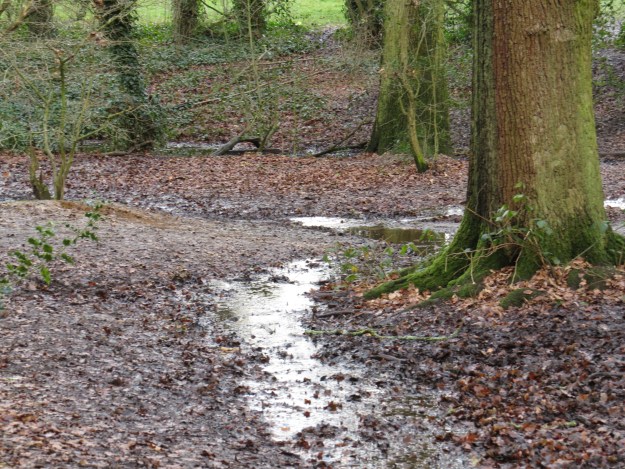
I’ve mentioned the mud before, so here’s a photo to give you an idea of how we’re doing (though it’s much better in the wood than it is on the field – at least in the wood there are lots of trees to drink up the excess water, though they are less thirsty without their leaves).

Some little hoodlum has been graffiti-ing the trees with this time-honoured fertility symbol, though why the testicles appear to have little faces is anybody’s guess.

Does anybody see the face of the elderly man in the trunk of this tree? I suspect he’s annoyed about the phallic symbol.

The little streams that run through the wood are making their way down to the wettest area of the wood. This year, so far, it hasn’t risen too far.

The wet woodland – bulrushes dying back, and the boardwalk well above the surface of the water so far.

I rather liked this completely surreal photo of a crow flying overhead. To some people it might be a blur, but to me it’s abstract art.

The crows are bathing in the stream, and turning over the leaves to find morsels to eat.

Squirrels seem to be chasing one another around and one was investigating the hole in a hollow tree. They don’t normally nest in holes, so I wonder if it was caching food, or looking for something to eat? They are very inquisitive and adaptable animals, so nothing would surprise me.

And when I look at the hornbeams in the wood now I am reminded of David Bevan’s talk about the ancient woodland of North London, in which he speculated that although the oak trees are probably several hundred years old, the hornbeams, cut back year after year for firewood, could easily be much older. When you see a hornbeam ‘stool’ like this one, you get the idea of how long the original tree could have been around, throwing up new stems every year only for them to be regularly cut back.

Hornbeam ‘stool’

And in some places in the wood which have been coppiced, allowing the light to get to the forest floor, young hornbeams are growing up as single-stemmed trees.

And so that was our walk for the day, and we headed back so that I could write the blog. Later we’ll be watching the Festival of Nine Lessons and Carols from Kings College on the television, filmed under social distancing rules and without a congregation. Will I manage to stay dry-eyed as those first notes of ‘Once in Royal David’s City’ sung by the boy soloist soar through the church? I wouldn’t bet on it.

A Muddy Walk in Coldfall Wood

Holly tree growing at the foot of a dead tree in Coldfall Wood

Dear Readers, I don’t know about where you are, but here in East Finchley the rain has been a big feature of the weather for the past few months. Couple that with clay soil and you have a positive quagmire which, while it hasn’t deterred me from Coldfall Wood, has made me a little chary about going out on to Muswell Hill Playing Fields. Why, only the other day I saw a man running in plimsolls and baggy shorts (clearly old school, no lycra at all)  come a cropper as he tried to spring like a gazelle over a particularly muddy patch. All was well, but I wouldn’t have liked to be doing his washing. Today, however, I decided that a vast stretch of slippery, squelchy ooze wasn’t going to keep me from my beloved ‘wildflower border’ beside the cemetery, and so off we went, clad in walking boots and optimism.

But first the wood. What a year it’s been for fungi! I am positively tripping over them now I’ve got my eye in. Here is some candlesnuff fungi (Xylaria hypoloxon) growing out of a stump for example. The spores, which are black, can apparently be seen as black smudges on the tree bark, but as this stump is rather damp I think that might not be visible here.

There are some felled branches further into the wood (the tree surgeons have been doing a bit of pruning and tidying up) and they are being gradually broken down by some rather lovely caramel-coloured bracket fungus which has been identified for me as hairy curtain crust (Stereum

And then it’s out across the mud and onto Muswell Hill Playing Fields. It really is a bit of a quagmire, but as with all things there are worse bits and better bits. And soon I’m distracted from the state of the ground by the austere beauty of the plants at this time of year. This shrub was glowing green, and when I got closer I could see why – it’s encrusted with lichens and moss. The branches are miniature habitats of their own. I can imagine tiny spiders patrolling through the ‘leaves’ of the lichen like panthers.

The Japanese Knotweed is a hundred shades of brown and grey. What a dense thicket of stems it forms! I would be amazed if some birds and small mammals didn’t take advantage of it.

But what concerns me a little is that I think it might even be able to outcompete bramble. I’m pretty sure it’s taking over in this part of the ‘border’ between the cemetery and the skateboard park.

There are a pair of alder (?) trees here, and I love the bark and the fruit. Look at all the different lichens on this tree! You might remember a talk that I reported on about the flora of Hampstead Heath by Jeff Duckett, where he mentioned how lichens made a comeback once the Clean Air Acts were introduced in the 1960s. It just goes to show that damage is not always irreversible if we act in time.

Incidentally, I’m not absolutely sure of the ID of this tree, so let me know what you think – the bark looks more birch-like to me, but it’s difficult to tell with all the pretty encrustations.

There are a few last maple leaves on the grass. Both of these look as if they’ve come from a Japanese Maple, and indeed there is a sapling ten metres away. Case closed, I think.

And then it’s a quick slide down a small hill to ‘the wildflower border’ that I fell in love with back in July. There isn’t much in flower now, though there is a single mallow flower, and some white deadnettle in case any bees are about.

But it’s the seedheads that I love. Everything from fennel….

to greater burdock….

to greater knapweed……

to the unexpectedly beautiful seeds of broad-leaved dock.

And maybe it’s no coincidence, but there was a flock of about 20 house sparrows flying between the shrubs and chattering away. At the very least, all the shrubs give the sparrows somewhere for cover and roosting. I wonder if they ever eat the seeds? I know that finches do.

Lots of parakeets about today as well, including this pair who seemed interested in the fruits on the London plane tree, though goodness knows why. We used to use the blessed things for itching powder.

And on the way home, I notice how the weeping willow is already changing colour. I do wonder if, when people plant weeping willows in their garden, they realise quite how big they’re going to get, or how thirsty they are. This one, I suspect, is taking advantage of the drainage ditch next to the fields.

Part of me wants to take a comb to that mane of ‘hair’.

And then it’s off home, for a cup of tea and a clean-up of those muddy boots. It’s always worth getting out for a walk, I find, especially if you can dodge the worst of the showers and stay warm. And as we turn into our street, there was a great tit absolutely singing its head off. Maybe he knows that the year has just turned, the solstice is passed, and spring is on the way.