Category Archives: London Plants

Bugwoman on Location – The Old and The New


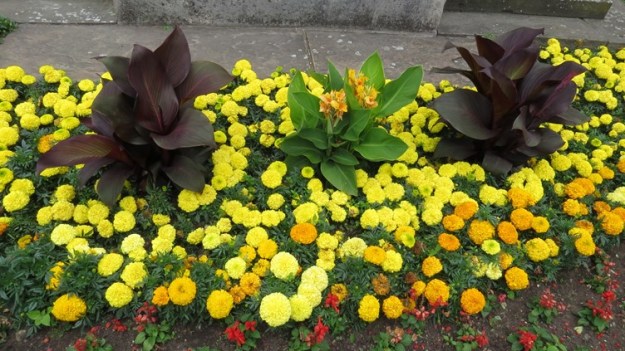
Conventional planting on Islington Green, North London. This replaced alliums, grasses and verbena. I’m not sure what caused the outbreak of conventionality, maybe budget cuts?

Dear Readers, municipal plantings in parks and public areas used to be the same wherever you were in the country. There would be regular ranks of blue lobelia and red geraniums, edged with white alyssum. Sometimes, the bolder councils would inject some double-flowered marigolds and petunias, and, if they were really going for broke, they might throw in a few bronze-leaved cannas, with big blousy golden flowers. Sadly, none of these plants have much to offer bees and other pollinators. And if you pop down to Islington Green in London today, you will see exactly the kind of planting that  I’m talking about.


This kind of planting stays in place for a few months, while bees and butterflies investigate and, disappointed, move on to something that will actually feed them. And then, one day, the plants will be pulled up and thrown in the compost, to be replaced with winter-flowering pansies and primroses. When summer returns, the whole ritual will happen all over again.

Now, there’s nothing wrong with this per se. Some containers of bedding plants add a certain joie de vivre to any garden, and these plants are hardy, long-flowering and low maintenance. The problem comes when city councils, in particular, miss the opportunity to do something a bit more pollinator-friendly. In London, where the gardens are small and the areas of concrete seem never-ending, bees regularly fall starving out of the sky. So on this bright July morning, I went to see what was being done to improve things.

My first stop was Whittington Park, on Holloway Road. My friend Penny tells me that Adolf Hitler is partly responsible for this park, because it is built on the remains of two whole streets that he bombed to bits during the Second World War. But it’s been Islington Council who have turned it into the rather remarkable spot that it is now.

On Holloway Road itself, there are two great swathes of perennial plants, most of them bee and butterfly-friendly.

IMG_3758

The blue spikes of eryngium mix with grasses and sunflowers and crocosmia and daylilies. The mauve of Verbena bonariensis stands out against the terracotta-coloured wall of the shop next door.

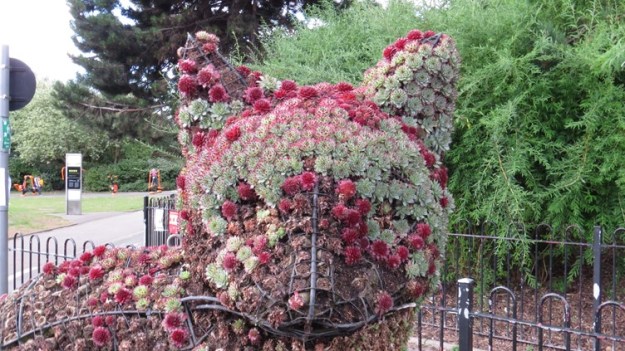
And in the middle of all this is a four-foot tall model cat, covered in sedum. This is in honour of Dick Whittington’s cat. Dick was a real person, but has become the stuff of legend. No one knows how ‘real’ the cat was, but I choose to believe in his existence, because it makes me happy to think of man and cat having adventures together.  It is said that Dick, as a very young man, fled his job as a scullion in the country and headed towards London , where the ‘streets were paved with gold’, along with his cat who was a renowned ratter.  It is from close to here that Dick, lonely, exhausted and broke,  is said to have been considering going back home  when he heard the bells of London saying ‘Turn again, Dick Whittington, Lord Mayor of London’. And so he turned and, together with his faithful cat, headed into the Capital and made his name and his fortune and did, indeed, become Lord Mayor.

What is lovely about Whittington Park is that it is a fully-functioning community resource. There’s an outdoor gym and a football pitch. There’s a nursery and a lovely playground for children. There’s a pond, where some pond-dipping was going on, and a skateboard park.

And there’s also a fenced-off area of wildflowers, which was originally an RSPB experiment to encourage house sparrows. Today it’s much used by bees and hoverflies, and also by a variety of birds who eat the seeds of the thistles and docks. In short, there is something here for everyone, human or animal, and in a very small space too. It just goes to show that wildlife-friendly planting doesn’t have to mean that the whole place turns into a jungle of nettles and bindweed.


Onwards! I jump onto a bus, and then another bus, and finally I arrive at the Barbican. This was previously another site full of red salvia and pots of agapanthus – pretty but sterile. But a few weeks ago, I noticed that it had had a makeover, so I wanted to revisit. And what a transformation it is. All of the beds at the entrance to the complex have been turned into a gravel garden. There are red-hot pokers and scabious and gaura and bee-friendly plants of many types. And it’s working! I saw honeybees and bumblebees, hoverflies and butterflies. At the moment some areas look a bit bare, as the plants are young, but I have no doubt that it will end up looking like an enormous prairie. It blends in well with the ageing Brutalist concrete towers around it, and people were sitting amongst the flowers, eating their sandwiches and relaxing. It’s a bold move to change the planting like this: some people hate the informal look of this kind of bed, and think that it seems ‘weedy’ and unkempt. So kudos to whoever did the Barbican design for sticking to their guns and not taking the easy route.


There is a place, of course, for any kind of plant design. Furthermore, it is much better to have a formal garden than no garden at all. Insects don’t much care whether your plants are native or non-native, and in a city there’s little chance that you’re destroying a pristine habitat by sticking in a couple of lantana. But looking at the drifts of flowers in Whittington Park and at the Barbican, it seems to me that with a bit of imagination we create wonderful spaces, which work for all members of the community, including the ones who aren’t human. My worry is that, with the budget cuts to local councils, the chance for innovation and creativity is restricted, even though a bee-friendly planting doesn’t have to cost more than a standard one. There is nothing like being ‘up against it’ to put a brake on new ideas, because there is no margin for error. Fortunately, these two parks already exist, and will hopefully be a beacon for other councils and other areas. What a boon it would be for all the creatures that pass through them.


Wednesday Weed – Buddleia

Every Wednesday, I hope to find a new ‘weed’ to investigate. My only criterion will be that I will not have deliberately planted the subject of our inquiry. Who knows what we will find…..

IMG_3716

Buddleia (Buddleia davidii)

Dear Readers, when two wild Buddleia plants started to grow in my front garden, I had no idea that they would be quite so enthusiastic. The one next to the front gate wallops everyone who tries to get to the front door with a whippy bloom-covered stem, which is particular fun when it’s been raining. The one by the wheelie bins is at least ten feet tall.

Apologies for the rain drops on the photo, it's been pouring down all morning...

Apologies for the rain drops on the photo, it’s been pouring down all morning…

But now that the lavender has finished flowering, it is the number one favourite of the pollinators around here. Have a look at this lot. The plant is also called Butterfly Bush, as I’m sure you know, and although I haven’t caught any photos of visiting Lepidoptera, it’s loved by every species from Cabbage White to Red Admiral.

IMG_3710 IMG_3708 IMG_3712 IMG_3711 IMG_3706Once the flowers have gone over, I will give both plants a healthy prune, and we’ll be able to access our house without having to go through a mini Tough Mudder assault course to get there.

IMG_3717Buddleia (Buddleia davidii) is originally from the mountainous areas of Hubei and Sichuan provinces in China, and was introduced to the UK when it was planted in Kew Gardens in 1896. It is named for the Basque missionary and explorer Father Armand David, who was the first European to see the Giant Panda, and who, in addition to his church duties, found time to identify no less than 63 species of mammal, 65 species of birds and and hundreds of species of plant which were previously unknown to Western science. In honour of his work, several species were named after him, including a very rare Chinese deer, which is known as Pere David’s Deer in the west. Several of the deer, which  were extinct in the wild,and survived only in the Emperor’s garden, were smuggled into Europe, including one animal which was ‘rescued’ by the good Father himself. As it turned out, it’s just as well that he did, because during the Boxer Rebellion in 1900 all the animals remaining in China were slaughtered and eaten. The European animals were brought together at Woburn Abbey, and bred so successfully that eventually some animals were able to be reintroduced back into China, a rare conservation success story.

Pere David's Deer (Elaphurus davidianus) ("Elaphurus davidianus 02" by DiverDave - Own work. Licensed under CC BY-SA 3.0 via Wikimedia Commons - https://commons.wikimedia.org/wiki/File:Elaphurus_davidianus_02.JPG#/media/File:Elaphurus_davidianus_02.JPG)

Pere David’s Deer (Elaphurus davidianus) (“Elaphurus davidianus 02” by DiverDave – Own work. Licensed under CC BY-SA 3.0 via Wikimedia Commons – https://commons.wikimedia.org/wiki/File:Elaphurus_davidianus_02.JPG#/media/File:Elaphurus_davidianus_02.JPG)

But, back to Buddleia. It’s a member of the Figwort family (Scrophulariaceae), a diverse group which includes such plants as Mullein and that little white-flowered plant you often see in garden centres, Bacopa. The grey-green leaves can look a little tatty late on in the season, but the glory of the plant are its flowers, long inflorescences of purple, lilac or white flowers which smell intensely of honey. I remember passing a boarded-up lot in Whitechapel, and being stopped mid-step by the sound of bees and the extraordinary perfume coming from behind the hoardings. When I peered through a gap, I could see a veritable Buddleia forest, the plants about twelve feet high, the blossoms bowed down under the weight of bees. No doubt this site is a block of luxury flats now, but then it was the equivalent of an East End watering hole for pollinators, and no doubt a refuge for other creatures too.

IMG_3707Each individual flower is ‘perfect’ – this means that it contains both male and female parts. The tiny seeds are very undemanding, requiring only the smallest patch of soil to germinate, and, like Oxford Ragwort Buddleia is likely to have spread along railway lines, its seeds caught up in the slipstream of trains. When I used to commute into Liverpool Street Station in London, the grim trackside was lit up with bush after bush of Buddleia, and as we pulled into the station, past the blackened Victorian walls which lined the route, an occasional shrub could be seen growing from a tiny crack in the brick work. I am sure that the poor soil and exposed location is similar to the scree slopes for which the plant was originally adapted. In its native environment, it has been christened ‘the Harbourage of Tigers’, but in my locality it is more likely to be cover for a neighbour’s cat.

Despite looking in all my usual books and perusing the internet, I could find no references to medicinal or culinary uses for Buddleia, and yet I have a feeling that in its native habitat those enormous sweet-smelling flowers must have been used for something – maybe to sweeten wine, or to make jam, or to adorn houses to keep evil spirits away. At the very least they are surely the favourite flower of some benevolent bee goddess, who will have her work cut out looking after her subjects at the moment, what with the sneaky reintroduction of neonicotinoids to the UK and the general decline in pollinator habitat. I imagine that she is polishing up her sting at this very moment.

IMG_3718I have several varieties of Buddleia in my garden – I am trying a few dwarf Buddleia in my containers, and also have a yellow-flowered variety where the blooms are spherical. But nothing attracts the interest of insects like these wild ones. They fill a gap at the end of the early summer-flowering plants, and before the late summer Sedum and Michaelmas Daisies really get going. I was interested to read that Butterfly Conservation recommends the planting of Buddleia in gardens as a nectar source, even though the plant has no value as a food plant for caterpillars, such is its value to adult insects. However, I would question the need to plant it, as if you live in an area where Buddleia grows wild, some will almost certainly turn up and save you the expense. If you are worried about your single plant turning into a Buddleia forest, note that the seed only ripens in the spring, so dead-heading and autumn pruning should keep it under some kind of control. If not, the seedlings are very easy to pull up. When I am Queen, I shall provide everyone with a Buddleia seedling to pop into their garden or grow in a pot, so that the bees and butterflies, for a few weeks at least, will have a honey-scented corridor of flowers to make their lives a little easier. In the meantime, if you don’t have one already, maybe you could consider finding one yourself? I guarantee you will have some very grateful six-legged visitors.


Wednesday Weed – Creeping Thistle

Every Wednesday, I hope to find a new ‘weed’ to investigate. My only criterion will be that I will not have deliberately planted the subject of our inquiry. Who knows what we will find…..

Creeping Thistle (Cirsium arvense)

Creeping Thistle (Cirsium arvense)

Dear Readers, no sooner was I back in London following my holiday in Austria, than I galloped down to Coldfall Wood to see what had been going on. And it seemed as if everything had burst into flower while I was away, and was now finishing its reproductive cycle. For most animals and plants, it’s already autumn – summer might be just beginning for us, but the woods are silent, the queen bumblebees are already looking for hibernation spots, and these Creeping Thistles were already mostly transformed into puffy seedheads. But many insects are still appreciating their bounty – thistles seem to be amongst the most valuable plants for pollinators.

White-tailed bumblebee

White-tailed bumblebee

Small Skipper butterfly

Small Skipper butterfly

IMG_3691

Honeybee

I imagine that few people would choose to cultivate Creeping Thistle, in spite of its wildlife benefits – like Groundsel or Sow Thistle, it’s one of those plants that looks a bit ramshackle and unkempt on the best of days. Furthermore, it is considered an ‘injurious weed’ in the UK, where it is native, and a ‘noxious weed’ in most countries to which it has been introduced. In Canada, it is known as ‘Canada Weed’, which is surprising as it is an alien species. The name ‘Creeping Thistle’ might imply a shy, diffident plant, but actually refers to the way that the plant surreptitiously takes over a field.

IMG_3688The problem is that Creeping Thistle is just too successful. It forms what are known as ‘Clonal Colonies’, like the one in the picture, where the roots send up multiple shoots and stifle anything else growing in the area, extending its range by up to 6 metres per year. It also sends out cloud upon cloud of fluffy seeds, although only 3% of these are viable, so the main ‘problem’ is with the rhizomes rather than the flowers.It is safe to say that it is not popular with humans, though other creatures may beg to differ.

Goldfinch feeding on Creeping Thistle ("Carduelis carduelis2" by photo MPF - Own work. Licensed under CC BY-SA 3.0 via Wikimedia Commons - https://commons.wikimedia.org/wiki/File:Carduelis_carduelis2.jpg#/media/File:Carduelis_carduelis2.jpg)

Goldfinch feeding on Creeping Thistle (“Carduelis carduelis2” by photo MPF – Own work. Licensed under CC BY-SA 3.0 via Wikimedia Commons – https://commons.wikimedia.org/wiki/File:Carduelis_carduelis2.jpg#/media/File:Carduelis_carduelis2.jpg)

The leaves of Creeping Thistle have been used as animal fodder for centuries, usually after being crushed to remove the prickles. The young leaves and stems have also been eaten by humans. The seeds are up to 22% oil, which can be extracted and used as cooking oil or to fuel oil-lamps, though I would imagine that it would be hard work for a small return.

IMG_3690Medicinally, Creeping Thistle has been used by the Mohican and Abnaki tribes for worms, by people in Northern India for fluid retention, and in the north of England, the stems have been used to treat cramp.

IMG_3686So, here we have the Creeping Thistle, a plant that is too generous with its roots and seeds  for gardeners and farmers, but which is a boon for birds and insects. Here on the edge of Muswell Hill Playing Fields, just beside Coldfall Wood, it is a-buzz with all manner of creatures, and  doing no harm at all. And, as the word ‘Thistle’ goes right back to Old English, I imagine that it has been a cause of back-breaking work for hundreds, if not thousands of years. We might just as well rub along as best we can.

Wednesday Weed – Redshank

Every Wednesday, I hope to find a new ‘weed’ to investigate. My only criterion will be that I will not have deliberately planted the subject of our inquiry. Who knows what we will find…..

IMG_3116

Redshank (Persicaria maculosa)

Dear Readers, this is a plant that most people would automatically think of as a ‘weed’. I found it growing at the base of a tree on my road in north London, and recognised it by the black blotches in the middle of the leaves (‘maculosa’ means ‘spotted’), and by the little hairs on the ochrea. I love learning new botanical words, and so I am glad to share with you that the ochrea is the tube that surrounds the stem where the new leaves emerge.

Note the black 'thumb-marks' in the middle of each leaf, and the slightly hairy ochreae (my favourite new word!)

Note the black ‘thumb-marks’ in the middle of each leaf, and the slightly hairy ochreae (my favourite new word!)

Some of the stems are red, hence the common name for the plant. This is a native perennial and a member of the same family as Japanese Knotweed (the Polygonaceae). It is rarely found far from human activity, and seems to flourish on our footpaths, by the sides of canals, and on cultivated land. It is said to hate lime, and to prefer acid peaty soils, but the one growing on the London clay that I saw seemed to be doing well regardless of what my plant book says.

IMG_3114So, what uses have been made of this inoffensive little plant? It is said to be good for treating rheumatism and, although not native to the US, the Iroquois tribe soon discovered its properties and used concoctions of Redshank for joint pain. They also rubbed the plant on their horses because it was believed to keep flies at bay. The Cherokee used it to treat pain and some urinary complaints, and, closer to home, it has also been used as a source of a yellow dye. In Ukrainian medicine, the plant is used for haemorrhoids and uterine bleeding, and also for colitis. It seems to me to punch above its weight in terms of benefits to humankind. So why, I wondered, does the plant have the alternative name of Useless? I found the answer on the ever-informative Plant Lives website. Here is what the author, Sue Eland, has to say:

‘In Christian lore one of the popular legends tells how Christ’s blood fell on the leaves of the plant as it grew at the foot of the Cross and this caused the dark triangular marks on the leaves. Another accounts for this marking by a very sad little story in which it was described how the Virgin Mary habitually prepared a special ointment from redshank and could not find any of the plant when she needed it. Later she came across some when her need was no longer urgent and in her annoyance not only relegated redshank to the status of a weed but also left an impression of her finger on the leaf. It was said that from then on the plant was the only one for which there was no use.’

I do wonder if this story was also the source of another alternative name for Redshank, which is Lady’s Thumb.

IMG_3110

Redshank is said to be edible, but bland. However, it is a rich source of vitamins and minerals, as most wild plants are. There are apparently reports that eating it can cause photosensitivity (i.e. a tendency to burn in even moderate sunlight), and as it contains oxalic acid, like all the rest of its family, I would beware if you have a tendency to kidney stones.  I personally won’t be picking any Redshank from my road, where the bottoms of the trees are regularly sprayed with weedkiller and visited by dogs, but in case you fancy a recipe, here is one from the rather wonderful Eatweeds website: Redshank and aubergine spring rolls. Bon Appetit!

IMG_3117

A Summer Walk in Coldfall Wood

054Dear Readers, it has been a difficult couple of weeks. A fortnight ago, my Dad was rushed into hospital with a suspected heart attack and chest infection, which turned into blood poisoning. For a few days he was delirious and didn’t even know who my Mum was, after 58 years of marriage. It is so hard to watch the people that you love suffer, and to feel so helpless, and my heart went out to my Mum, who is not well herself. But praise be for antibiotics, because after ten days in hospital my Dad was well enough to come home, and is now gradually getting back to his usual wry, patient self.

And so it was a rather wrung-out, raw Bugwoman who took herself off to Coldfall Wood to see what had been going on in her absence. And after about fifteen minutes, I started to notice the extraordinary mix of flora that is coming into bloom along by the stream. First of all, there was this plant.

Himalayan Honeysuckle (Leycesteri formosa)

Himalayan Honeysuckle (Leycesteria formosa)

016This is Himalayan Honeysuckle which, as the name suggests, is native to the Himalayas and south west China. I’ve noticed it a few times, not just in Coldfall but in Highgate Wood as well. It is also known as Flowering Nutmeg, and is considered invasive in Australia. Here, it doesn’t seem to be a particular problem, though it does grow to about 8 feet tall, and has bamboo-like stems that could, at a pinch, be mistaken for old friend Japanese Knotweed. Further along by the stream, the whole plant had collapsed, and I wondered if it had been unmercifully attacked. In fact, my plant books tell me that when the plant reaches a certain height, it faints away like a Victorian Lady who has glimpsed some naked male pectorals,  and then regrows from the roots.

Raspberry (Rubus idaeus)

Raspberry (Rubus idaeus)

Right opposite the Himalayan Honeysuckle there was an unexpected snack, in the form of a little stand of Raspberries. It’s easy to forget that these plants are natives, and indeed the only time that I ever contracted a tick was when I was standing up to my armpits in a patch of wild yellow raspberries in Scotland. I assume that the plants here have been transported from the gardens on the road above by the stream. At any rate, I have to say that the one in the middle of the photo was absolutely delicious, and that there is something about sun-warmed fruit that does wonders for the spirit.

Onwards!

019It surprises me how quiet it can be in the wood during the day, when most people are at work, the dog walkers have largely been and gone, and the children are all in school. The only bird song came from the Song Thrush, which is sad, because it means that he hasn’t been successful in finding a mate this year – Song Thrushes stop singing when they are paired up, unlike most birds who will continue to defend their territory with sound.

A Capsid Bug

A Capsid Bug

There were lots of insects about: a tiny capsid bug stayed long enough to get a photograph before flying away. Capsid bugs are ‘true’ bugs, insects that use tubular mouthparts to bore into a plant and suck its sap. Aphids are the best known ‘real’ bugs, but most go about their business unremarked, doing little damage and living out their life cycles without us even knowing what they are. If I looked hard enough, I would be willing to bet that there are insect species here that are unknown to science, as there are in most suburban gardens. For a great insight into the sheer biodiversity that is all around us, I recommend ‘Wildlife of a Garden – A Thirty Year Study’ by Jennifer Owen.

065

Woody Nightshade (Solanum dulcamara)

Entangled with the other plants was that distinctive scrambler, Woody Nightshade, or Bittersweet. Later in the year, it will have bright-red berries that are extremely poisonous, but also very bitter – the author of the Poison Garden website, John Robertson, has bravely tasted a couple, just so that we don’t have to . One look at the flowers will tell a gardener that this is a member of the same family that gives us tomatoes, potatoes and peppers, the Solanaceae. This family also provides us with Deadly Nightshade, but that is a small price to pay for chips and pasta al arrabiata.

063Now, what would you think if you saw the plant below?

Garden Escape, or Native Plant?

Garden Escape, or Native Plant?

There are several bushes with bright yellow flowers and rather attractive blushing berries along by the stream. I took one look, and thought ‘these have escaped from nearby gardens’. And indeed, maybe they have, but the story is a little more complicated than this.

051

Tutsan, or Sweet Amber (Hypericum androsaenum)

Tutsan is actually a native plant, a member of the St John’s Wort family. Its name is said to come from toute saine meaning ‘all-healthy’, and it is mentioned in Culpeper’s 1653 Herbal as being useful for gout and sciatica, and for healing burns. So, while these individual plants might have escaped, this is a plant with a long and venerable wild history. Which just goes to show how much there is to learn every time I step outside, and how things are never exactly as they seem.

I turn for home.

024But what’s this?

Hedge Woundwort (Stachys sylvatica)

Hedge Woundwort (Stachys sylvatica)

What a delicate and yet upright little plant this is, another favourite of herbalists, particularly John Gerard, the seventeenth-century plant healer. This is a common plant but I had never noticed it before, so I was delighted to add another species to my list of Deadnettles. A large bumblebee was obviously enjoying it as I arrived, and it reminded me that plants don’t have to have large, showy flowers to be full of nectar.

I was nearly out of the wood when it gave me another gift.

Black and Yellow Longhorn Beetle (Rutpela maculata)

Black and Yellow Longhorn Beetle (Rutpela maculata)

When this insect first landed, I thought that it was an ichneumon wasp or somesuch, but in fact it is a very handsome beetle. The larvae spend up to three years maturing in rotting wood, and then emerge, fresh-minted like this one. The beetle visits the flowers of cow parsley and Queen Anne’s lace (and helps to pollinate these plants in the process), finds a mate and the cycle begins all over again. And indeed, I managed to get just this single shot before the beetle lurched into the air again and headed off on his reproductive quest.

So, I headed back home, renewed by more than just my filched raspberry. There is something about walking in familiar places and deepening our knowledge of them that reminds me of the process of building a friendship, or even a marriage. We see the loved one in all moods and all weathers. Sometimes, as today, the whole wood feels open and generous. Other days, the wood seems closed and morose, and I need to be patient until I see what it is she needs me to see. I have never had such a relationship with a place before, and yet it feels as true as many human partnerships that I’ve had, and truer than some. I would recommend the slow burn of getting to know somewhere profoundly, over years or decades, especially in our fast-paced, easily-distracted, superficial society. We should all have a place that has become part of our heart.


Wednesday Weed – Opium Poppy

Every Wednesday, I hope to find a new ‘weed’ to investigate. My only criterion will be that I will not have deliberately planted the subject of our inquiry. Who knows what we will find…..

Opium poppy (Papaver somniferum)

Opium poppy (Papaver somniferum)

Dear Readers, the streets of East Finchley are currently populated by a most exotic invader, and not a recent one either. Opium Poppy has been grown in the UK since at least the Bronze Age, and is widely naturalised in our towns and villages.The ‘wild’ plant has a lilac flower, as in the photo above, but garden varietals include blooms in red, pink and white, and even double-flowered varieties. However, Opium Poppy It is easily recognised by its greyish, waxy (glaucous) foliage, its heavy-headed buds and its distinctive seed capsule, which is a wonder in itself.

IMG_3004

The Opium poppy is the root source of all the opiate drugs, including morphine, heroin, and codeine. It is the most effective painkiller for extreme pain that we have, and also one of the most addictive.  Its very name means ‘sleep-giving poppy’. The drug is harvested both by making slits in the seed-case and extracting the latex, and via ‘poppy straw’, which is the dried plant minus the seeds. Very little of the active ingredient is produced in the UK climate, but I did once have a boyfriend who optimistically grew a patch of the plants, lovingly  harvested the sap, smoked it and then threw up for two days, so let that be a lesson to us all. Please note that it is also ambiguously illegal to grow it in the USA (for an interesting story about Michael Pollan’s 1997 experience with Papaver somniferum click here ), and totally illegal in Canada, Austria, Switzerland, Germany and the UAE.

IMG_3005What a complicated history this plant has! The ancient Sumerian and Minoan peoples both knew of the medicinal and psychoactive properties of the plant. Much later, during the period 1830-1860, Britain flooded China with Indian-grown opium during the Opium Wars. This happened because Britain had a hunger for Chinese silks, porcelain and tea, but the Chinese were largely self-sufficient and needed no British goods. The balance of payments deficit alarmed the British, and so they started to export the drug into China. As the number of addicts grew, the Chinese Government started to impound the opium without compensation to the British.  This quickly escalated into war, by the end of which the Chinese markets had been ratcheted open, there were an estimated 12 million opium addicts in China, and the British had much improved their trade deficit.

IMG_3006Cultivation of the plant worldwide is complicated by the fact that it can be grown either for the illegal narcotics trade, or for the legal pharmaceutical trade. Indeed, a recent initiative by the International Council for Security and Development, called ‘Poppy for Medicine’ has suggested that poppies could be grown by Afghan villagers for medicinal purposes. Afghanistan is historically reliant on the income from opium generated by drug-trafficking, and also, ironically, has a shortage of opiate medicines for its own population. If controlled properly, the growth and harvest of poppies could help to alleviate both these problems, as it has done in areas of India and Turkey where the same strategy has been implemented.

IMG_3007Opium poppies also have less contentious uses. They produce the poppy-seeds for rolls and loaves, and for some truly delicious Eastern European confections, such as this Polish poppyseed cake. However, beware: a television programme called Mythbusters illustrated that someone could fail a drugs test after only two poppyseed bagels, even though the seeds have no narcotic effect. Certainly something to watch if you are a sportsperson.

Makowiec (Polish Poppy Seed cake) (By Silar (Own work) [GFDL (http://www.gnu.org/copyleft/fdl.html) or CC BY-SA 3.0 (http://creativecommons.org/licenses/by-sa/3.0)], via Wikimedia Commons)

Makowiec (Polish Poppy Seed cake) (By Silar (Own work) [GFDL (http://www.gnu.org/copyleft/fdl.html) or CC BY-SA 3.0 (http://creativecommons.org/licenses/by-sa/3.0)], via Wikimedia Commons)

As you might expect, a plant as powerful as the Opium Poppy has a wealth of folklore, and the wonderful Poison Garden website is a treasure-trove of facts. Here, I shall just pick a couple of my favourites:

  • Vampires are compelled to count poppyseeds if they come across them, so if you are ever pursued by such a creature just scatter a handful of seeds about to ensure you can make your getaway.
  • The phrase ‘hip’ (as in ‘cool’) is not so ‘hip’ anymore, but it came from the phrase ‘being on the hip’, i.e. lying on one’s side smoking opium in an opium den.
  • Hiding poppyseeds in a bride’s shoe will make her infertile
  • Scattering poppyseeds around the bed on St Andrew’s night would ensure a dream of one’s future husband
  • Eating a cake made with poppyseeds on New Year’s Eve would provide abundance for the year to come.

IMG_3000It interests me that the sedative effects of morphine on humans are not shared with other members of the animal kingdom. Cats in particular can become more excited rather than less when treated with the drug, and it is used with caution by vets with other creatures too. For people, though, the drug seems to fit our chemistry like a key to a lock, and this is what causes the dependency that can be such a terrible curse. Few plants that I’ve written about have such a capacity to help us, or to destroy us, according to the wisdom with which we use it. It is an unexpectedly powerful plant to find growing on a suburban street in North London.


Wednesday Weed – Scented Mayweed

Every Wednesday, I hope to find a new ‘weed’ to investigate. My only criterion will be that I will not have deliberately planted the subject of our inquiry. Who knows what we will find…..

Scented Mayweed (Matricaria chamomilla)

Scented Mayweed (Matricaria chamomilla)

Dear Readers, there are a large number of white daisy-like plants in flower at the moment, but the combination of a faint pineapple-scent and a ‘squashy’ receptacle (the round yellow bit) tells me that this is Scented Mayweed. It is one of a large family of plants which have the word ‘chamomile’ included in either their common or Latin names – ‘Chamomile’ comes from the Greek for ‘Earth-Apple’, which seems to be a reference to its fruity scent. Scented Mayweed is also known as German Chamomile, and is an annual plant of bright, open places, often with disturbed soil. ‘True’ or Roman Chamomile (Chamaemelum nobile) has a stronger scent, and is a rare perennial plant of damp turf and sandy, mildly acid soils. There has been a lot of confusion about these plants, but both have been used for their extensive medicinal and cosmetic applications. I was pleased to see Scented Mayweed in the Unadopted Road in East Finchley last week for another reason – its open flowers are very popular with pollinators such as hoverflies.

IMG_2843Scented Mayweed is described as an ‘Ancient Introduction’, which means that it arrived before 1500 (in this case from the warmer parts of mainland Europe and northern Asia). It has a venerable history: garlands of this flower were found in the tomb of Tutankhamun, and it is included in the herbal traditions of no less than 26 countries. It has been used for many things: as a tea for relaxation, as an insecticide, as an anti-inflammatory and for digestive disorders. No wonder it arrived in the UK – it sounds as if it would have been an indispensable part of any healer’s medicine kit. It does contain a small amount of a poisonous chemical called coumarin, which could cause nausea and vomiting, and on the Plant Lives website it warns that this is what will happen if the flowers are boiled for ‘more than seven minutes’.  It can also be an allergen for those susceptible to hay fever, which is one reason why my husband doesn’t drink chamomile tea – he finds it sets him to sneezing.

IMG_2842Scented Mayweed produces a yellow dye, which is used in many cosmetic products for blonde hair. It is also a perfumery ingredient: the oil which contains the distinctive pineappley smell is dark blue, and is called Azulene. I am indebted to the Fragrantica website for this information, which also contains the interesting fact that Chamomile is a keynote in Dior’s Fahrenheit for Men.

IMG_2841In the book by Beatrix Potter,Peter Rabbit’s mother gave him a cup of chamomile tea to help him after his ordeal on Farmer MacGregor’s farm, and what a wise thing this was. When I’m feeling anxious, I find that chamomile tea helps me too. What I had never done was make the link with Scented Mayweed. Plants have such a lot to teach us, if we have ears to hear, and curiosity, and that most wonderful resource, the Internet.


An Unadopted Road

IMG_2896Dear Readers, in the middle of East Finchley there are a number of what are called ‘unadopted roads’. These are strange little snickleways which are not the responsibility of the council or of the Highways Commission. In theory, they ‘belong’ to houses that front onto them, but this one has only the back gates of properties, so it is unclear who should be looking after it. In some places, the patches around the garages and back fences have been planted up with garden flowers, to the detriment of the wild plants – I turned up my nose at one patch of paeonies and pyracantha. In other places the brambles, ivy and nettles grow wild.The road might be unadopted, but it has been taken to the hearts of many weeds and creatures.

I was planning to write about Cherry Tree Wood this week, but once I was in the unadopted road, and having found a patch of bramble which was just about to open, I found myself detained by the sheer number of insects. First up was a metallic green Flower Beetle. I tend to forget how important insects which aren’t bees can be in pollination.

Flower Beetle (Oedemera lucida)

Flower Beetle (Oedemera lurida)

We also tend to forget that flies are pollinators too. There was a wide selection of hoverflies, some of them spending up to half an hour on a single blossom, others restlessly dashing about. So much biodiversity in one tiny spot!

IMG_2884

This rather fine hoverfly is, I think, Eupeodes luniger, a migratory species from southern Europe. Who would have thought that such a small insect could fly so far?

IMG_2851IMG_2865IMG_2875IMG_2895And then, there were the ladybirds. This one is a Harlequin, which was recently described as the UK’s fastest invading species. It is rather larger than our native species and, if you get close enough, you can see that it has two little dimples at the back of the wingcases. Although it is accused of out-competing other species, it is now so well ensconced that I doubt if anything will shift it, plus it eats aphids and all kinds of other pests in preference to more valuable insects. We will have to wait and see how things pan out.

IMG_2889

Harlequin Ladybird (Harmonia axyridis)

Another Harlequin ladybird - they are very variable in colour.

Another Harlequin ladybird – they are very variable in colour.

But it’s not all Harlequins. I also found a larvae of our largest native Ladybird, a 7-Spot. Maybe when there is enough food, the different species can coexist, and there were certainly plenty of aphids around. The larvae are just as predatory as the adults, and they always remind me of little tigers, prowling through the foliage.

IMG_2858

7-Spot Ladybird larva.

As I stood there with my camera, I was passed by:

  • A white van that was using this tiny road as a cut-through, and was probably doing his chassis a damage as he went
  • A man with a small dog, who let it crap on the path and then hurried past while I was busy photographing a creature. Shame on you, sir!
  • A very nice woman who lived in one of the houses, and who explained about the road’s unadopted status.

But as I stood there, I realised that I could hear buzzing, over and above the occasional passing bee. It led me to a huge bank of ivy, which was growing over a fence. I watched as bumblebees flew into and out of the foliage. On the way out, they flew like small furry bullets. On the way in they were more hesitant, as if trying to find their way, or even as if they were checking out if it was safe.

It dawned on me slowly – I’d found my first ever bumblebee nest! These are White-tailed bumblebees (Bombus lucorum). I’d always wanted to find one, and harbour dreams of a nest in my garden, but this was the next best thing.

In the spring, Queen bumblebees come out of hibernation, and look for somewhere to make a nest. This is often a deserted rodent nest. The Queen gathers pollen from whatever plants are available, and uses this to build a ball, onto which she lays her eggs. She also collects some nectar to sustain herself and the larvae, and puts this into a ‘honey pot’ out of wax. Then she broods the first eggs: bumblebees can control their body temperature through a considerable range, and can keep the eggs at a temperature of 25C even when it’s cold outside.  When the eggs hatch, she will be the sole provider for the larvae until they pupate and emerge as workers, which is why it is so important that there are early spring flowers for food. Once the workers leave the nest, they can start to forage, and the Queen’s responsibility is now mainly about laying more eggs. Bumblebee nests are much smaller than those of honeybees, with a maximum of 400 individuals, but this still requires a lot of pollen and nectar. As most of the bramble flowers were still closed, I wondered what the bees were feeding on. I didn’t have to walk far to find out. IMG_2924IMG_2925The Pyracantha bush that I’d been so sniffy about when I’d walked past it earlier was just ten metres from the nest, and was full of bumblebees. What a great illustration of the importance of providing pollinator-friendly plants in our gardens. I’m sure that this one plant is making a great difference to the number of larvae that the bees can feed, and to  their rate of growth. Plus, even in poor weather the bees will  be able to nip out for sustenance. The Pyracantha is filling the gap until the brambles opened fully, even if it was planted more with a view to security than to invertebrates.

As I walked back along this unprepossessing little track, I thought about all the things that go on around us that we don’t notice. I could easily have missed the bumblebee nest if I hadn’t slowed down to take some photos, and hadn’t noticed that tell-tale buzzing. I am often in such a rush, but if I settle down and really pay attention, there are fascinating things happening all around me, and around all of us. It’s a lesson to me of the value of slowing down.

Wednesday Weed – Broad-leaved Willowherb

Every Wednesday, I hope to find a new ‘weed’ to investigate. My only criterion will be that I will not have deliberately planted the subject of our inquiry. Who knows what we will find…..

Broad-leaved Willowherb (Epilobium montanum)

Broad-leaved Willowherb (Epilobium montanum)

Dear Readers, I am always surprised at what turns up along the dark, gravelly path that leads to the side entrance of my house. Yellow corydalis, greater celandine, forget-me-not, buddleia, Mexican fleabane, Canadian fleabane, sow thistle and chickweed all put in an appearance, but this is the first time that I have spotted this little beauty – Broad-leaved Willowherb (Epilobium montanum). I have a garden full of Great Willowherb, but this plant passed me by. It has a delicate, shy habit that means that it is often overlooked but once I’d noticed it, I realised that it was everywhere.

IMG_2815The plant has four, deeply-notched mauve-ish petals, and the stigma in the centre form a distinctive four-lobed shape. The leaves are rounded at the bottom (hence the ‘broad-leaved’), and are practically stemless.  Like most of the other willowherbs, it’s native.

Note the notched petals and the stigma, which are ways of identifying the plant (By Frank Vincentz (Own work) [GFDL (http://www.gnu.org/copyleft/fdl.html) or CC-BY-SA-3.0 (http://creativecommons.org/licenses/by-sa/3.0/)], via Wikimedia Commons)

Note the notched petals and the stigma, which are ways of identifying the plant (By Frank Vincentz (Own work) [GFDL (http://www.gnu.org/copyleft/fdl.html) or CC-BY-SA-3.0 (http://creativecommons.org/licenses/by-sa/3.0/)], via Wikimedia Commons)

IMG_2813As with all the willowherbs, the soft leaves seem irresistible to insects, and the plant that I used for identifications was covered in enthusiastic greenfly. However, the genus is also subject to the depredations of some larger creatures, such as the caterpillars of the Small Phoenix:

Small Phoenix (Ecliptopera silaceata) (By Donald Hobern from Copenhagen, Denmark (Ecliptopera silaceata) [CC BY 2.0 (http://creativecommons.org/licenses/by/2.0)], via Wikimedia Commons)

Small Phoenix (Ecliptopera silaceata) (By Donald Hobern from Copenhagen, Denmark (Ecliptopera silaceata) [CC BY 2.0 (http://creativecommons.org/licenses/by/2.0)], via Wikimedia Commons)

the Striped Hawkmoth:

Striped Hawkmoth (Hyles livornica) ("Sphingidae - Hyles livornica-1" by Hectonichus - Own work. Licensed under CC BY-SA 3.0 via Wikimedia Commons - http://commons.wikimedia.org/wiki/File:Sphingidae_-_Hyles_livornica-1.JPG#/media/File:Sphingidae_-_Hyles_livornica-1.JPG)

Striped Hawkmoth (Hyles livornica) (“Sphingidae – Hyles livornica-1” by Hectonichus – Own work. Licensed under CC BY-SA 3.0 via Wikimedia Commons – http://commons.wikimedia.org/wiki/File:Sphingidae_-_Hyles_livornica-1.JPG#/media/File:Sphingidae_-_Hyles_livornica-1.JPG)

and, most spectacularly, the Elephant Hawkmoth and the Small Elephant Hawkmoth, shown below:

Small Elephant Hawkmoth (Deilephila porcellus) ("Deilephila porcellus-01 (xndr)". Licensed under CC BY 2.5 via Wikimedia Commons - http://commons.wikimedia.org/wiki/File:Deilephila_porcellus-01_(xndr).jpg#/media/File:Deilephila_porcellus-01_(xndr).jpg)

Small Elephant Hawkmoth (Deilephila porcellus) (“Deilephila porcellus-01 (xndr)”. Licensed under CC BY 2.5 via Wikimedia Commons )

Plants of the Epilobium genus have long been used as a treatment for prostate and urinary complaints, and indeed a company which manufactures supplements made from willowherb has taken the genus name of Epilobium  for its company name (note that this is not an endorsement).  Although the showier members of the family are the ones most often used in herbal medicine, Broad-leaved Willowherb was singled out in an Austrian study as having a stronger effect than the others. While there is a lot of interest in Chinese herbal medicine and Ayurveda, herbal medicine in the West is still seen as something of a niche area. Maybe this is because when something grows all around us, it’s difficult to make money from it.

I love Rosebay Willowherb and Great Willowherb.  I admire the way that they can take over a spot of damaged and derelict land and turn it into a sea of cerise. But this little plant lurks in the interstices of the city, at the bottom of walls, in the crevices and the dark places, cheering them up with its mauve flowers and graceful habit. And, when the time is right, it fires its fluffy seeds with just as much vigour as its bigger relatives. It might be little, but it’s a plant with ambition.

Seeds of Broad-leaved Willowherb just waiting to emerge (By Frank Vincentz (Own work) [GFDL (http://www.gnu.org/copyleft/fdl.html) or CC-BY-SA-3.0 (http://creativecommons.org/licenses/by-sa/3.0/)], via Wikimedia Commons)

Seeds of Broad-leaved Willowherb just waiting to emerge (By Frank Vincentz (Own work) [GFDL (http://www.gnu.org/copyleft/fdl.html) or CC-BY-SA-3.0 (http://creativecommons.org/licenses/by-sa/3.0/)], via Wikimedia Commons)

Wednesday Weed – Oxford Ragwort

Every Wednesday, I hope to find a new ‘weed’ to investigate. My only criterion will be that I will not have deliberately planted the subject of our inquiry. Who knows what we will find…..

Oxford Ragwort (Senecio squalidus)

Oxford Ragwort (Senecio squalidus)

Dear Readers, Oxford Ragwort is one of those plants whose roots are so deeply entangled with humankind as to be rare outside of urban and industrial areas. Unusually, its path to freedom is well documented, and yet again Flora Britannica by Richard Mabey can be our guide. It was first planted in the botanical gardens of Oxford University, having been reputedly gathered from the rocks of Mount Etna. We have noted on several occasions that plants of mountain habitats often make excellent city dwellers, as they have a built-in tolerance for poor, scant soil and bright, dry, exposed situations. Furthermore, the genus name ‘Senecio’ refers to the way that the air-borne seeds resemble the white hair of an elderly person.  So, with its tolerance for city streets and its wind-carried seeds, it was tailor-made for urban colonisation. By the 1830s its seeds had wafted on to the old walls of Oxford, but it was soon provided with a mechanism for a much more ambitious journey. Like Buddleia, it was greatly aided by the railways, in this case particularly the Great Western. Oxford Ragwort loved the clinker beds by the side of the track, which maybe reminded the plant of its volcanic home, and its downy seeds were carried along in the slipstream of the passing steam engines. And so it advanced through England and Wales, providing a cheerful yellow chorus for mile after mile of the route. Indeed, on a recent trip to Surrey it seemed as if the whole trackside was a great flowerbed of Oxford Ragwort.

IMG_2579I have a great personal fondness for Ragwort, which dates back to the days when Bugwoman was Bug-girl. I was forever trying to rear caterpillars, and was particularly attracted to the yellow and black larvae of the Cinnabar moth. What child could resist these tiger-striped beauties? I found three, and spent the whole summer finding Ragwort for them to feed on. When, eventually, they turned into conker-coloured chrysalises, I put them in a big sweet jar containing twigs for them to climb up on when they emerged. I then put the jar into the cool darkness of the coal bunker under the stairs, and checked on them every single day.

Caterpillar of the Cinnabar Moth ("Tyria jacobaeae qtl1" by Quartl - Own work. Licensed under CC BY-SA 3.0 via Wikimedia Commons - http://commons.wikimedia.org/wiki/File:Tyria_jacobaeae_qtl1.jpg#/media/File:Tyria_jacobaeae_qtl1.jpg)

Caterpillar of the Cinnabar Moth (“Tyria jacobaeae qtl1” by Quartl – Own work. Licensed under CC BY-SA 3.0 via Wikimedia Commons)

The bright colouration of the caterpillar is a bit of a giveaway that the insect is poisonous, and it acquires this poison from its foodplant, which is any species of Ragwort that it can get its diminutive jaws into. The plant contains pyrrolizidine alkaloids, which can damage the liver of humans and some mammals, but it is these very chemicals which apparently excite the caterpillars, according to a study of ‘gustatory responsiveness‘. There has been a great deal of excitement in the UK recently about Ragwort being poisonous to horses. This is true, but a call to eliminate the plant altogether would be a disaster not just for the Cinnabar moth, but for the 150 other species of insect which eat it or feed on its nectar. For a measured response to the debate, I recommend this website, which lays out the issues for both horse and insect enthusiasts, and those lucky people who are both.

One day, I opened the door to the coal bunker to find that, responding to some innate signal, my moths had emerged. Two of them were hanging from the twigs, their wings like blood-streaked black velvet. One, however, had not made it. It had got trapped between the edge of the jar and the twig, and had died without its wings opening.

Adult Cinnabar moth ("Tyria jacobaeae-04 (xndr)" by Svdmolen - Own work. Licensed under CC BY 2.5 via Wikimedia Commons - http://commons.wikimedia.org/wiki/File:Tyria_jacobaeae-04_(xndr).jpg#/media/File:Tyria_jacobaeae-04_(xndr).jpg)

Adult Cinnabar moth (“Tyria jacobaeae-04 (xndr)” by Svdmolen – Own work. Licensed under CC BY 2.5 via Wikimedia Commons )

This was an early introduction to the unfairness of life. How could this creature have made it all the way to the door of adulthood and then died? The occasion called for a ritual, and so I dragooned my poor younger brother into a moth funeral. I put the moth into a matchbox lined with cotton wool, while my sibling did the hard work of digging a grave. We solemnly processed the ten feet from the back door to the graveside. I intoned a few words while my brother looked solemnly on. Then, we laid a tombstone which consisted of a tile from the recent demolition of our fireplace. On it, in wax crayon, were scrawled the words:

‘Born only to die’.

I was a child of Victorian sensibilities, as you can see.

My little brother aged about 4 in 1966. What a long-suffering sibling he was. And is.

My little brother aged about 4 in 1966. What a long-suffering sibling he was. And is.

When I see Ragwort, I am instantly reminded of those days of childhood, when time stood still at the sight of a caterpillar scraping endless half-circles from a leaf and when a small ritual seemed the only way to right the world when something went wrong. I still feel most truly myself when I am totally absorbed in the goings on of a plant or an animal – time seems to fall away, along with all my mundane concerns. The phrase ‘inner-child’ makes many people cringe, and yet I think that all of us are like Russian Dolls, with our earlier versions still alive and sometimes kicking. To me, there is nothing wrong with that non-judgemental state of child-like wonder, when we have no preconceptions but truly ‘see’. I’m sure it’s a better tonic than anything the doctor could prescribe, and with no side-effects other than a new bounce in the step and a softer, more open heart.

IMG_2587