Category Archives: Uncategorized

Moan, Moan, Moan

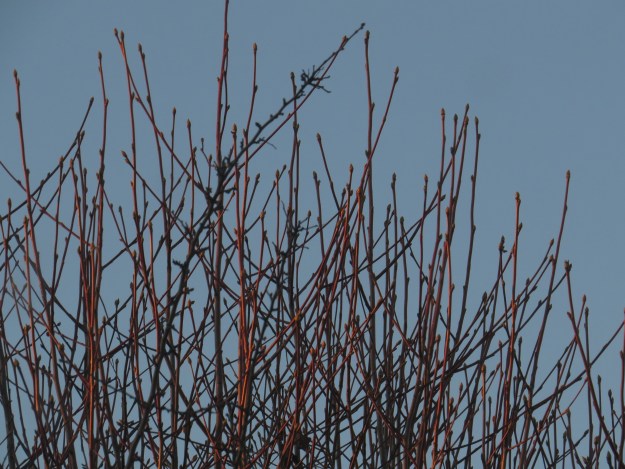
The top of my whitebeam tree without any redwings in it.

Dear Readers, I am on the 28th Day of my cough from hell. You’ll be glad to know that I’m now on antibiotics (though I loathe the things) and even had a chest X-Ray at our local hospital yesterday, which was a fun experience. Somebody put me in a small room and told me to get into the traditionally attractive Hospital Gown. And there I sat, wondering why I’d worn socks with a hole in the toe, when I heard an ethereal voice calling my name from the main waiting room. I wrapped my gown around me, stomped out but there was no medical person there. This happened several times, and finally the X-Ray technician burst in with another lady.

“No one told me you were here!” she said. “I thought you’d disappeared!”

Literally five minutes later my X-Ray was done and I was on my way back to get dressed. What a shame for the delay, because otherwise I swear it would have been the fastest appointment ever. The NHS is a truly wonderful thing when it’s working.

Anyhow, I don’t think the 20 minute wait for a bus in both directions helped, and today my cough is tighter and meaner than before. I am cancelling Christmas as we speak. Bah humbug doesn’t really cover it.

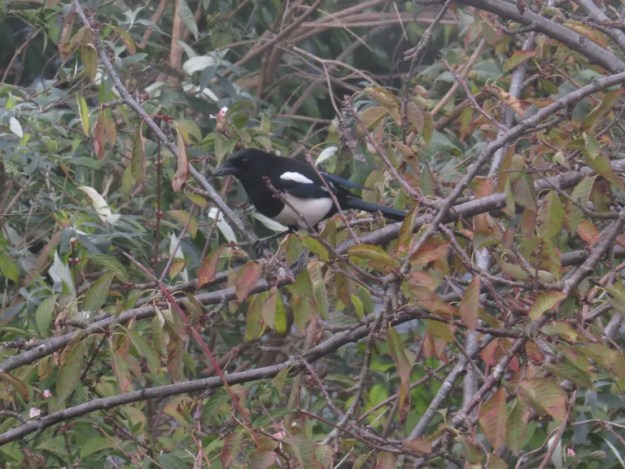
Anyhow, I wanted to get to some photos of the splendid bird life in the garden but it refused to cooperate (as you can see from the photo above). We’ve had redwings and fieldfares, blackbirds and jackdaws, assorted finches and a full house of tits. Actually, I did get some photos of the great tit. Enjoy.

Tail to the left.

Head to the right

Entire bird but slightly out of focus.


You’re welcome.In other news, the hebe in the garden next door, which was already a bit wonky, looks like it’s going to precipitate itself into the pond. It’s the shrub leaning at a 45 degree angle to the left.

I am rather moved that it is still flowering though, bless it.

And so another day ends with me cancelling all my social activities for tomorrow because I think I just need to rest. My husband is making me various combinations of lemon, ginger and honey, I have bed socks and a hot water bottle, and so things could be a whole lot worse, so don’t worry. And at least I won’t have to brave the icy pavements for a few days, it’s like a skating rink around here. Stay safe and warm, UK peeps! There are buds on the whitebeam, so at least the spring is on the way.

Wednesday Weed – Poinsettia

Poinsettia – Photo by Tony Hisgett from Birmingham,

Dear Readers, I can scarcely believe that I haven’t done a post on poinsettia before, but here it is, in all its Christmassy glory. Who would have thought that this plant is actually a Euphorbia? In the wild, it lives in Mexico and Central America, and is named after Joel Poinsett, the first United States Minister to Mexico. Poinsettia grow to the size of a small tree if left unmolested, but most of them live their lives in a pot as a temporary house plant, being thrown in the bin at the end of the Christmas period as they lose their leaves and start to look extremely sad. It doesn’t have to be this way, though! Read on!

As you probably know, the red ‘flowers’ are actually leaves, or bracts, with the actual flowers being the little yellow and green blobs in the middle. They have been cultivated to appear in a variety of other colours, including cerise,  white and salmon. However, pretty as they are, cultivated poinsettias are diseased, according to Clare Wilson at New Scientist – to make short, bushy plants, growers infect poinsettias with a bacteria that causes them to grow lots more side shoots that terminate in those colourful bracts.

Poinsettia varieties (Photo By Andy Mabbett )

If you are lucky enough to receive a poinsettia at Christmas, the advice is not to overwater it – wait until the plant’s leaves are just starting to droop, and then put them in to a bowl of water for about an hour. The plant should also be kept at a fairly stable temperature (i.e. not next to a window where they’ll be cold overnight) – Wilson’s article mentions that the plants don’t need high light levels for the month or two that they’ll be on display, so they can be positioned well away from a window.

But are poinsettias poisonous? There was an urban legend in the 1920s that a child had died after ingesting a leaf, but this was later found to be untrue. Like all euphorbias, they can cause skin irritation, and I wouldn’t want to eat a poinsettia risotto or feed any to my dog or cat, but generally they are inoffensive plants. The Aztecs used the plant for traditional medicine, and one of the active chemicals in poinsettia is being investigated as a potential drug to treat Alzheimers disease.

Poinsettias in front of an altar in the Philippines (Photo By Ramon FVelasquez)

In Mexico, a 16th century legend tells of a poor girl who wanted to bring some flowers to the altar at Christmas, but couldn’t afford to buy any. An angel told her to pick some weeds and in the morning they had turned into poinsettias. The red colour is supposed to represent the blood of Christ, and the flower shape the Star of Bethlehem. And goodness, we have just missed National Poinsettia Day, which is on 12th December. Apparently the poinsettia is the most valuable potted plant in the world in terms of sales, with over 70 million plants sold in the US every year, to a value of about $250m.

How sad, then, that by January most of the plants are looking very sad, with their leaves dropping off and their glory much reduced. My Dad was a dab hand at bringing them back to life for the following Christmas, and though I’m pretty sure that he didn’t do anything as scientific as the advice below, it’s certainly possible.

Andrew Fuller from Bridge Farm Group in Spalding, UK, recommends that the poinsettia gets 12 to 14 hours of darkness per day for about two months once it’s lost its leaves. You can do this by putting the plant into a cupboard for that period, or sticking a bag over it. In a commercial greenhouse, the plants are actually ‘put to bed’ by pulling the curtains every night, which seems rather sweet to me. You will have to remember to do it every night, though. I have a suspicion that Dad just put the poinsettia into a room that wasn’t well lit for a few months and held off on the watering, to ‘give it a rest’.

And finally, a poem, by Jamaican poet Claude McKay (1889 – 1948). As I look out at the snow, it reminds me that for many people, December is a warm month. What a thought.


Flame-Heart

Claude McKay – 1889-1948

So much have I forgotten in ten years,
  So much in ten brief years; I have forgot
What time the purple apples come to juice
  And what month brings the shy forget-me-not;
Forgotten is the special, startling season
  Of some beloved tree’s flowering and fruiting,
What time of year the ground doves brown the fields
  And fill the noonday with their curious fluting:
I have forgotten much, but still remember
The poinsettia’s red, blood-red in warm December.

I still recall the honey-fever grass,
  But I cannot bring back to mind just when
We rooted them out of the ping-wing path
  To stop the mad bees in the rabbit pen.
I often try to think in what sweet month
  The languid painted ladies used to dapple
The yellow bye road mazing from the main,
  Sweet with the golden threads of the rose-apple:
I have forgotten, strange, but quite remember
The poinsettia’s red, blood-red in warm December.

What weeks, what months, what time o’ the mild year
  We cheated school to have our fling at tops?
What days our wine-thrilled bodies pulsed with joy
  Feasting upon blackberries in the copse?
Oh, some I know! I have embalmed the days,
  Even the sacred moments, when we played,
All innocent of passion uncorrupt.
  At noon and evening in the flame-heart’s shade:
We were so happy, happy,—I remember
Beneath the poinsettia’s red in warm December.

A Winter Wonderland

Dear Readers, there’s something about snow that takes me back to being a child – last night I stood on the front door step and watch with wonder as the streetlights lit up the falling flakes. I know that later this week I’ll be worried about the ice, but when the snow first arrives, like a whisper, I am always thrilled. And I must confess that being able to work from home, rather than having to fight onto a crowded tube train and go to the office, makes the situation much more comfortable.

It’s not very comfortable for the birds, though, so the first thing that I did was clear the snow from the bird table.

Then it’s a quick walk to the bird bath with a kettle of boiling water to break the ice. However, before I did I stopped to admire the fox tracks. The fox came in through the front garden and under the somewhat decrepit wooden door at the side of the house…

Then round and round the patio – I hope she could smell the handful of dried dog food that we’d thrown out…

and then back out to the front garden and over the garden wall.

And I am very glad that I took my spider web photos yesterday, as today the weight of snow and ice has destroyed them utterly. It reminds me of that old saying about ‘seizing the day’, and I imagine it especially applies if you’re a photographer of the natural world. A sunset, a bird, a cobweb can all be here and then gone in seconds.

Revelation

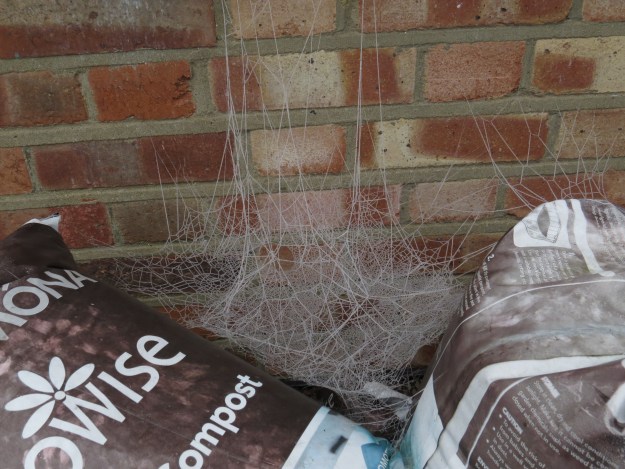
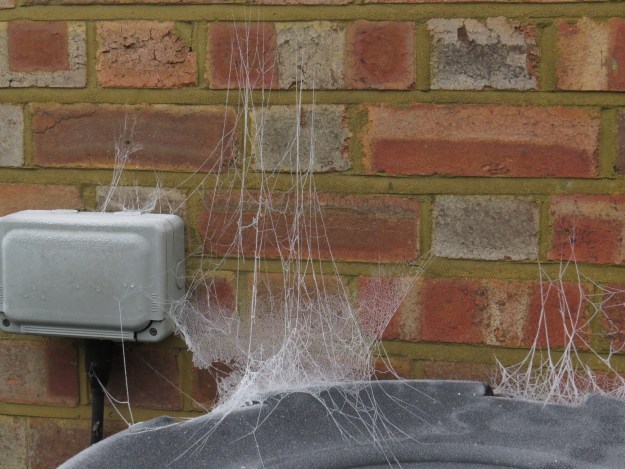
Dear Readers, the cold snap continues – the temperature as I write is a chilly 28 degrees (don’t laugh, Canadian readers). So far there’s no snow, but there’s a chance of some overnight and tomorrow, which, as I am working from home and don’t have to go out in it, makes me rather selfishly excited. But what was even more exciting this morning was the way that the overnight frost had exposed every single spider’s web in the garden. Who knew that they had been so busy?

I suspect that these have been built by lace-web spiders (Amaurobius sp.), though they could also belong to the noble false widows which seem to be cropping up everywhere, and which also make a sheet web. The frost has revealed every strand, and shows the structure, with long, thick strands anchoring the web, and then a multitude of smaller ones forming the basis of the web.

In this web, the spider who made the lacy web at the top has been joined by a garden spider lower down.

The bags of compost that I left on the garden table have formed the basis for some very impressive webs.

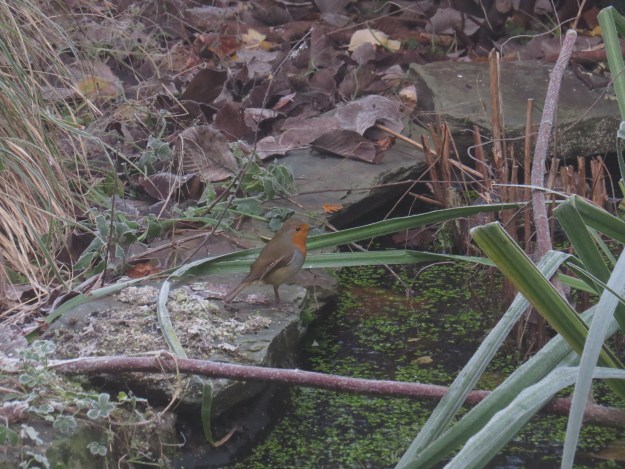
And a poor robin waits patiently above the frozen pond for someone to break the ice. Two minutes after my husband had broken it, the robin was back, having a bath. Clearly s/he got the memo about cold water being good for you.

And finally, a few more orb webs on the garden chairs.

It’s amazing what goes on in the garden that we can only see under very particular conditions. I love that the spiders were so busy during the summer, and that they left us these signs of their passing. These are the loveliest decorations that anyone could ever wish for.

A Cold Snap

Dear Readers, winter has arrived here in East Finchley. For the past few mornings I’ve been hearing the tell-tale sound of windscreens  being scraped as I log in to my computer for yet another day of spreadsheet wrangling. Outside, some of the plants have collapsed temporarily in the frost, though I know that they’ll all revive gradually as it thaws a little during the day. We’re in for another week of temperatures in the low to mid 30s though, so anyone with their pelargoniums still outside is in for a shock.

I’ve had a shocking cough for about three weeks now – everybody that I speak to is suffering from some variant on colds/coughs/Covid/flu. I’ve tested negative for Covid every time I’ve tested, but this does feel like something new. I smoked until I was about 30 and got bronchitis every winter (like the idiot that I was), but since giving up I’ve not had much worse than a tickle, until this year. At what point do I break and actually speak to the doctor (supposing I can get an appointment)? With the NHS under such stress I really don’t want to add to the burden, but this is getting me down a bit now. I keep thinking it’s improving, and then thinking that it isn’t. Oh well, at least I’m not the only one.

Between work and the lurgy I haven’t been outside much, but to my surprise today I spotted that my little clematis, planted last year, has a few fragile flowers. What a sweet little plant! It looks very straggly at the bottom, but then this is going on at the top. It pays to get outside even if it’s just for a few minutes. There are always surprises. I have no idea how to look after this particular clematis re pruning etc by the way, so if anyone has any ideas, fire away!

My poor potted mahonia is flowering again. Every year I think about putting it in the soil, and every year I forget. Maybe 2023 will actually be the year when I release it from its imprisonment. If any bee was so daft as to come out of hibernation today (and it’s sunny, so if the hibernation spot gets the sunbeams it might warm up enough to encourage a queen bumblebee to take a chance) at least there will be something to eat.

And the pond is frozen solid, but we’ll break it a little around the edge so that the birds can drink. My husband has been out in his parka pouring boiling water on the bird bath and filling up all the feeders, bless him. I can hear the goldfinches massing already, and apparently he was mugged by a robin as soon as he came out of the shed with the suet. He has optimistically put some orange segments on the bird table, so I shall be fascinated to see if anyone is interested.

The  leaves on the ribes are looking very splendid in their slightly-frosted condition.

The cold is decorative but for those already struggling with energy bills it’s a disaster. I had a Zoom call with someone yesterday who has had  long covid, and yet is living in a freezing house, to such an extent that he took the call wrapped in a scarf, hat, several jumpers and an anorak. So many people are feeling the strain already. The foodbank collectors on our street have set themselves a target of getting 70 bags of food in the next five days, and I’m sure that they’ll achieve it. If there’s one thing that the last few years have taught us, it’s that we have to look out for one another and help where we can, for both our animal and human communities.

Incidentally, for those of you in the UK who are reeling from your energy company’s estimated bills, here are two calculators so you can see if you’re being ripped off…

https://www.moneysavingexpert.com/utilities/what-are-the-price-cap-unit-rates-/#tool

https://www.moneysavingexpert.com/utilities/lower-energy-direct-debits/#calc

And now I’m off for some ginger and lemon and honey tea, lovingly concocted by my husband. I’ll let you know how it goes !

An Adventurous Listener

William Blake – ‘Angels Hovering over Christ in the Sepulchre’ from http://www.thehypertexts.com/

Dear Readers, you might remember how much I’m enjoying Ronald Blythe’s book ‘Next to Nature’, and last night I read something that I thought I’d share with you all. To set the scene, Blythe is riding home from Bury St Edmunds in a minicab.

‘.…an extraordinary confession from the Polish taxi-driver on the last phase home. Glancing at me, summing up whether I could take it, young, and, I thought, rather sad, he asked if I was ‘religious’. Adding that he could tell that I was ‘a gentleman’. What next?

Swerving past some cyclists, summoning up his courage, he said that he had seen an angel. Did I believe him? I told him about a great English poet called Blake, who saw angels in Golden Square in London. He told me that he was married and had a little girl. I praised his English. He was, I thought, about twenty-two and rather lost. Or maybe found. He was certainly an adventurous driver. There are times when one must be an adventurous listener. 
William Blake wrote:

‘And we are put on earth a little space,

That we may learn to bear the beams of love’.

This reminded me of a taxi ride that I took in Cork, in Ireland. The conversation turned, as it does, to children. The driver wasn’t to know that I had recently had a miscarriage, and so I quickly turned the subject to his little ones, and asked how many he had.

He hesitated for a second.

‘Four’, he said. ‘Three boys and a girl. The girl only lived for a few hours, but I can’t deny her’.

‘She lived, and was loved’, I said, swallowing hard. ‘No need to pretend she didn’t happen’.

And so we drove on, fellow travellers in the truest sense, through the impossible green of the Irish countryside.


A Clever Bustard

A great bustard (Otis tarda) – Photo by By Andrej ChudĂ˝ from Slovakia

Dear Readers, I have always been fascinated by the way that animals seek out particular plants or other substances when they feel ill, and use them to self-medicate. Lots of grazing animals do this, and chimpanzees were observed to apply small, winged insects to one another’s wounds, though scientists are unsure whether this is because of chemicals in the bodies of the insects (such as formic acid) or just as a caring gesture. Pregnant elephants in Kenya are thought to eat particular leaves to induce birth, and female lemurs eat leaves that kill parasites and encourage milk-production. But in New Scientist this week, there’s the first case that I’ve heard about of a creature using plants to treat a sexually-transmitted disease.

Male great bustard displaying (Photo by Francesco Veronesi at https://www.flickr.com/photos/francesco_veronesi/15370854417)

Great Bustards are amongst the world’s largest flying birds. They used to be native to the UK, until the last one was shot in 1832, but a population of about 40 have been reintroduced to Salisbury Plain, where they benefit from it being Ministry of Defence land which is off-limits to most people. The birds are a real success story – their numbers have been boosted over the years by eggs collected from larger populations abroad (n the wild, they live mostly in Spain and Portugal), but now it’s hoped that they will be self-sustaining going forward. You can watch a short snippet about the reintroduction below – I love the way that humans have to wear ‘dehumanisation suits’ to stop the birds becoming accustomed to people.

https://www.youtube.com/watch?v=iG4z1uvegAQ

As you can see, Great Bustards are impressive birds, especially in the breeding season, when the males gather in leks. The display includes throat-puffing, tail-flashing, and rather importantly for our discussion, revealing the cloaca (the multipurpose orifice which in birds serves for excretion, egg-laying and reproduction), which the female apparently peruses with some interest. Before the breeding season, the males snack upon blister beetles (which contain some very nasty chemicals, but which are thought to reduce parasites). The males also seem to eat common poppy (Papaver rhoea) and purple viper’s-bugloss (Echium plantagineum), plants which have little nutritional value and which are actually toxic, just before they start to breed. Scientists from the Spanish Natural Research Council in Madrid took extracts from these two plants, and tested them against three parasites that can be transmitted during sexual contact  – a protozoan, a worm and a fungus. The plants killed up to 98% of the protozoans and up to 81% of the worms, while the viper’s-bugloss had a moderate effect on the fungus, killing over 50%. It may be that when the females inspect the males, they are looking for signs of the infections that the pathogens cause.

Breeding is a very exhausting time, particularly for male animals like the Great Bustard. Only ten percent of males actually find a mate, but those that do are very successful, mating with at least five females. Parasites are more likely in animals that are already under the weather, and once an infection starts, it can make the animal appear dishevelled, and impact on its energetic display. it’s perhaps no wonder that Great Bustards seem to have hit on a way to make sure that they’re in tip-top condition for the breeding season.

You can read the whole report here.

So, as usual, this is a positive story for Friday, both about the Salisbury Plain Great Bustards (who appear to be on track to be the first successful re-establishment of a population of the species anywhere in the world) and on the subject of the mysterious world of animals and their ability to heal themselves. We clearly have much to learn by paying attention to animal behaviour.

Great Bustards from the Crossley ID Guide


Red List 2022 – Number Seven – Lesser Spotted Woodpecker

Lesser Spotted Woodpecker (Photo by Ron Knight from Seaford, East Sussex, United Kingdom)

Dear Readers, the rarest of our woodpeckers is also the smallest- the Lesser Spotted Woodpecker is scarcely bigger than a sparrow. Not only is it rare, and small, but it’s also much more secretive than its larger cousins – if you catch a glimpse of it, it’s likely to be at the very top of a tree during the early spring, because once it nests, it makes sure that it slips by like a shadow.

Like the Greater Spotted Woodpecker, it ‘drums’ to announce its territory, but as you might expect, the sound is rather different from that of the Greater Spotted Woodpecker. Have a listen below…

This is the Lesser Spotted Woodpecker (recording by Paulo Alves in Portugal)

And this is the Great Spotted Woodpecker (recording by Ulf Elman in Sweden)

As you can hear, one sounds like a teeny tiny typewriter, and the other one sounds like a jackhammer, to my ears at least.

The species has had a catastrophic decline over the past decade – surveys suggest that numbers could have fallen by as much as 50%. The reasons, as usual, are many, but the bird seems to have low breeding success. They are reliant on dead wood to make their nest holes, and are not large enough to push out other birds, or defend their homes against larger woodpeckers or parakeets. They rely on insect food, so a poor spring, or a failure of timing (all the commoner due to climate change) can wipe out an entire brood. But, before we get too despondent, there is hope.

The Woodpecker Network is a Citizen Science group that is keeping an eye open specifically for Lesser Spotted Woodpeckers. The dedicated birdwatchers who report on the bird have found that there are probably about 2000 pairs in the UK, more than was originally thought. They are now turning their attentions to monitoring what the birds are feeding to their nestlings – for example, in a bad year blue tits are reduced to collecting aphids for their chicks instead of caterpillars, which is clearly an inferior food source. Information really is power when it comes to protecting species, and I am reminded that, during a bird survey in our local ancient woodland, Coldfall Wood, the calls of a Lesser Spotted Woodpecker were recorded, so maybe I should get off my own backside and do a bit of bird watching myself.

The photo below is from the Crossley ID guide, and, from left to right, we have a juvenile, a male with his red cap, and a female. They always look a little unkempt to me, but if we only looked after big, flashy birds, where would we be? After all, many human beings are not beautiful to look at, and some are even, dare I say it, scruffy, but none the less worth paying attention to. The woods would be diminished without this diminutive bird.

Lesser Spotted Woodpeckers from the Crossley ID Guide


Sciencing – The Results!

Dear Readers, I know you are all agog to hear the results of my Open University science experiment with doughballs, and now that my assignment has been sent off, I can finally share what the results seemed to show.

You might remember that the task was to prepare some red and some yellow doughballs for the birds to enjoy, Typically for me, I decided that lard and flour wasn’t quite tasty enough, so I also incorporated some whizzed-up dry mealworms and some bird-friendly peanut butter. This all made the balls a little darker in colour than they would have been, and I wondered if the colours would be different enough for the birds to discern. I also took care to use bird-friendly colouring, which was probably not as strong as the artificial colours that some people used.

Then, I had to run twenty trials, ten with 45 red and 5 yellow balls, and then ten with 45 yellow and 5 red balls. The reason for this was that we were testing for two different things.

Firstly, were the birds just taking whichever colour was commonest without any regard for its features? If this was the case, they shouldn’t care which colour was presented, so long as there was lots of it.

Secondly, were the birds choosing one colour in preference to the other?

Well, the results are in, and the magpies were clearly choosing the red balls, even after I’d done all kinds of fancy statistical stuff to make sure it wasn’t by chance. How exciting! We know that birds have colour vision, and in my experience it’s the red berries in the garden that always go first, so I imagine that the red colour is an advertisement for ripeness.

The effect of choosing prey based on colour will depend on what kind of prey it is. If it’s an insect, and the red ones always get eaten, they will become rarer and rarer, until they finally find it hard to survive. If the prey is a berry, however, and it can survive a trip through the bird’s gut, being eaten is a great advantage, as the seeds will be dispersed far and wide. I expect to see lots of baby red doughballs popping up all over the garden.

Of course, like all scientific experiments this one opens up as many questions as it answers. Is it only these two magpies who prefer red, or all magpies, or indeed all birds? I know that many bird-pollinated flowers are red, so that might be an indication. Secondly, I wasn’t as careful as I could have been with the size of the balls, so did the birds also choose larger balls for preference? Finally, would the results have been even more marked if the difference between the colours was clearer?

At any rate, this was a most interesting experience, and it felt as if I was doing ‘real’ science. It will be fun to compare the results with my classmates, and to see if anyone had anything really strange ( I know that one woman was using her pet chickens to test out the theory, and another kept having her doughballs stolen by squirrels, who are pretty much colourblind as far as I know).  And for now, I have so much excess dough that the magpies are enjoying it without having to do any work at all.

Our next experiment is on leaf stomata, which sounds rather less exciting, but I’ll keep you posted!

Red List 2022 – Number Six – Woodcock

Eurasian Woodcock (Scolopax rusticola) Photo by Imran Shah from Islamabad, Pakistan

Dear Readers, I have never seen this little bird, and when you look at its extraordinary camouflage, you can see why – look at that combination of rusts and ochres, beiges and chocolates, against the dead grass. The woodcock has long been thought of as a magical bird – although some stay in the UK all year round, the population is bolstered in the winter by migrants from Scandinavia and Russia, and the first full moon in November is known as a ‘woodcock moon’. It used to be believed that woodcock flew to the moon during the time when they were not apparent, and that they generously carried other, smaller birds that couldn’t make the trip on their own on their backs – the goldcrest, the UK’s smallest bird, was considered to be the usual ‘passenger’. One vernacular name for the goldcrest is ‘the woodcock pilot’.

Woodcock in flight – Photo by Craig Nash at https://www.flickr.com/photos/peregrinebirdphoto/5290007239

In the spring, the male performs a display flight at dusk called ‘roding’, which is described as ‘bat-like’ – they call as they fly, and you can watch them here. The call always reminds me a bit of a frog. The females have been known to carry their young on their backs, or in their claws, when threatened. Alas, this secretive little bird has also been hunted, although (or perhaps because) it is extremely difficult to shoot, being small, fast and shy. There is some concern about the hunting of over-wintering birds in France and in the UK. When shot, the birds are cooked whole without being gutted. They sound like one of those delicacies that would take a lot of getting used to though they were apparently a favourite of Edwardian gentlemen. Fortunately these days if you see ‘Scotch Woodcock’ on a menu, you’re likely to get scrambled eggs on toast with anchovy paste, though as anchovies are also endangered it might not be that much of an improvement. The pin feathers of the woodcock were used for painting miniatures, removing the proverbial ‘mote in someone’s eye’, and drawing the gold stripe down the side of a Rolls Royce motorcar.

The woodcock is red-listed in the UK because of a severe decline in breeding range, of over 30%. The main cause seems to be our old favourite, fragmentation of habitat – the birds need large forests and these are increasingly rare, plus over-grazing by deer and over-management of forests makes the habitat less suitable for breeding. Studies in the New Forest have also shown that although the bird spends its days in the forest, at night it can travel for many miles to find the right sort of pasture so it can suck up a few worms. There is much more to be discovered about these cryptic birds, for sure.

Woodcock eating earthworm (Photo By Ronald Slabke – Own work, CC BY-SA 3.0, https://commons.wikimedia.org/w/index.php?curid=5703078)

This is such a characterful bird – feisty, round, well-camouflaged and even Shakespearian (In Hamlet, Polonius describes his plot to put Ophelia in Hamlet’s way so that he can observe their conversation as a ‘springe (trap) to catch woodcocks’). Let’s hope that, with good forest management, their decline can be halted.