Category Archives: Uncategorized

The London Tree Map

Dear Readers, I hope that you’ll forgive a very London-centric post today, but I’ve been playing a bit with the London Street Tree online map, and I thought I’d share it with you so you can play too. You can find it at

https://www.london.gov.uk/programmes-and-strategies/environment-and-climate-change/parks-green-spaces-and-biodiversity/trees-and-woodlands/london-tree-map

And this should take you to the screen above. Now you probably need to zoom in a bit to avoid all the trees just being blobs.

You can enter your postcode in the search box at the top left-hand corner, or you can zoom in yourself…

And once you’re in, hovering over a tree will tell you what it is  – as you can see, the tree on Huntingdon Road below is a Rowan, looked after by Barnet council

What, though, if you’re trying to find a particular species of tree, as I was earlier this week?

First, click on the ‘Hide’ button to get rid of all the trees.


Then, click on the tree that you’re interested in. You might remember a while back that I discovered that one of the ‘County Roads’ here in East Finchley was unlike the others, because it had lots of lime trees. And here is the proof, in case I needed any….

So, you can use the map to identify trees, or to find a particular kind of tree. There are a few drawbacks – a lot of the more recently planted trees are classified as ‘other’, which doesn’t give one a whole lot to go by. On the other hand, there is a Google View photo of each tree, at least in theory, so we probably shouldn’t quibble too much.

Anyway, I foresee hours of innocent fun exploring my local street trees with this, and I find myself wondering if other councils have done the same? Let me know readers! A street tree map of the UK, or indeed of every city in the world, would be a very fine thing.


My Neighbour Totoro at the Barbican

Dear Readers, we were very, very lucky to get tickets for this play, which apparently sold out even faster than Benedict Cumberbatch’s ‘Hamlet’ which was at the Barbican a few years ago. And what a delight it was! The audience was full of children of all ages, most of them under 12 but a good few of them in their 60s (ahem).

I had always loved the Studio Ghibli film of the story. It tells of a father and his two daughters, one about four years old and one about eight, who move to the country to be closer to their mother, who is in hospital, suffering from an unspecified disease. I love that, at the end of the story, it’s no clearer if there’s going to be a happy ending, and the play also avoids any Disney-fied tying-up of all the loose ends. There are big themes in the story – not only sickness and loss, but the anxiety of moving house, the fear of change, the difference between urban and rural living (the family were previously living in a flat in Tokyo). I love that the whole story of Totoro doesn’t pretend that these things happen, but shows how they can be dealt with. I imagine that there could be quite a lot of conversations between adults and children on the way home from the play.

When the family move into their new house, they realise that they are sharing it, and the forests around it, with a variety of sprites and forest guardians, including the eponymous Totoro. I was looking forward to seeing how these creatures were brought to life, and wasn’t disappointed. Suffice it to say that the puppeteers who ‘wrangle’ the creatures must be extremely fit. There are various versions of Totoro, one of which practically takes up the whole of the stage. There is also a magic bus in the form of a cat that puts in several appearances.

‘Magical’ is a very overused word, but that’s exactly what it was. There is one part, where the forest creatures work together to make the seeds that the girls have planted grow, that had me wiping away surreptitious tear, old softie that I am.

Totoro and the girls from the Studio Ghibli film

I had forgotten, too, that the film has a strong eco message, probably because it’s so interwoven into the story that it doesn’t feel like preaching. A grandmother explains that the forest guardians used to be visible to everyone, but that these days they’re afraid of humans and hide away. The teacher at the local school tells the oldest daughter that there used to be bears and wolves in the forest, but not anymore.

Although there are themes of sickness and loss threaded throughout the story, it is also extremely funny in places – the youngest girl, Mei, has all the fearlessness of the very young, and although she gets into scrapes, her friendship with the forest guardians and with the local people always see her through. Her older sister is indomitable. The father is an academic, kind but a bit witless when it comes to things like discipline or getting the breakfast done. There is a boy who finds it hard to speak to girls, but who eventually comes to the rescue. It’s a story about human beings as well as one about huge furry creatures.

The cast are excellent, the music is wonderful (it was composed by Joe Hisaishi, who wrote the score for the animated film), and although there’s a lot of ‘action’, there are also peaceful moments, when we have time to gather our breath.

You can tell a lot about how good a play was by the buzz when people leave the auditorium – on Saturday, the place was uproarious, and complete strangers were talking to one another in the queue for the ladies toilet, which is always a good sign. I hope that ‘My Neighbour Totoro’ gets another run, or tours, or that it’s filmed for the cinema so that lots more people can see it. Do take the chance if you’re able.

Thoughts on Mum’s Birthday

Mum at the Royal Oak pub in 2012

Dear Readers, Mum would have been 87 years old this Saturday, 26th November. It’s strange how even when I’m not consciously remembering, there’s a sad heaviness about this time of year. Sometimes I wonder why I’m feeling so bereft only to glance at the calendar and realise what’s coming. The shortening of the days, the turning of the leaves all remind me that a few years ago Mum and Dad went into a nursing home, and that a few months later Mum died.

The pang is not so sharp, now, but I still miss her, especially as we head into Christmas, her favourite time of the year. When people at work talk about the family getting together, playing games, I remember how Mum was always up for charades, and what a good actress she was. She had a party piece in which she imitated me sorting out my contact lenses which was so accurate that it had us crying with laughter. Give Mum a glass of wine and she was unleashed. I was always sorry that she didn’t find an Amateur Dramatics society, she would have stolen the show every time.

I want to tell people to appreciate their loved ones, to relish these moments because things change. On the other hand, I don’t want to be the party pooper. Would I have really listened if someone had said that to me before Mum and Dad were gone? I think I might have just brushed it aside as being too morbid for the season. And so I keep my mouth shut except with those I know the best. I think the message is valid, regardless. The good memories are worth making, and sometimes the arguments that flare when people are stuck together with too much rich food and too much to drink are not worth having.

I am sending love out to everyone who finds this season painful. There will be people reading this who have lost someone close to them this year, and for whom this will be the first Christmas without their loved one. Be gentle with yourself. Do what you need to do. Don’t strive for perfection, there’s no such thing under the sun. Follow the old family traditions where they bring comfort, but be prepared to ditch them if they no longer make sense, or are too painful. Grief is a process that never truly ends, and there is no right way to feel or not to feel, and don’t let anybody tell you anything different.

And finally, I rediscovered this piece from 2019. I think it captures some of how Mum was, and what her legacy was, to me and to everyone who knew her. I hope you enjoy it.

Dear Readers, 26th November would have been my Mum’s 84th birthday, had she not died in December last year. These firsts are hard, as people who have trodden this path before warned me: on Tuesday I went into work, did fancy things with spreadsheets, cried in the toilets intermittently and went home. And then, when I started to prepare the cabbage for dinner, I heard her voice in my head.

‘Look!’ it said.

And so I did. If Mum had still been alive, she would have called to me from the kitchen, and wouldn’t have given up until I came to see what was interesting. I can remember her in the days when she could still walk, hunched over with scoliosis and poised over a chopping board.

Maybe she’d found a carrot shaped like a pair of crossed legs, or something ruder.

Maybe she was entranced by the glistening magenta seeds inside a pomegranate.

Maybe there was a five-pointed star in the middle of a potato.

Or maybe it was the way that water drops form pure, translucent pearls amongst the indentations and veins of a Savoy cabbage.

She would have gestured at the vegetable with her (always blunt) knife.

‘Can you see it?’ she’d ask.

‘Can I see what?’ I’d say, with a greater or lesser degree of exasperation.

She’d smile enigmatically and wait for me to get it.

And then, like one of those optical-illusion puzzles that change suddenly, I’d see what she saw.

‘There’s a tormented demon in your cabbage’, I’d say, and she’d laugh. She saw characters everywhere – in wallpaper, in the grain of wood, in clouds, in the upturned faces of the pansies in the garden. She would have loved the fuse box that I spotted at Walthamstow Wetlands the other week.

For Mum, the world was full of people that went unnoticed, both in terms of images, and in terms of real folk who are often passed by. It was not unusual for me to meet her somewhere, only to find her sharing a cigarette with a homeless person that she’d made friends with outside the tube station, or ‘chatting’ with a lost tourist who spoke not a word of English. She reached beyond speech to find the common language that we all share:  a need for connection, empathy, and beauty. She would compliment a complete stranger if she liked their dress, and once told a very well-dressed young man that the newspaper he was carrying had left a big print smudge on his face.

‘I could tell that he was going to an interview because he looked very nervous and kept checking his A to Z’, she said, ‘and he was very grateful when I told him. And I was right, he was going to an interview!’

Once, in Finsbury Square, Mum noticed a pigeon with its feet wrapped in string much like the one at Waterloo Station above. She had a pair of scissors in her bag, and, with some trepidation, approached a besuited chap at the next bench.

‘Excuse me’, she said, ‘but if you could just get hold of that poor pigeon, I’m sure I could cut it free’.

The guy looked at her with complete incredulity.

‘Madam’, he said, ‘you must be completely mad’.

And so the pigeon remained entangled, and Mum went back to work, sad and exasperated.

‘All he had to do was grab it!’ she told me that evening.

I should add that Mum also brought home many of the house plants from work that the company who looked after them deemed too tatty to grace the office. She would nurse them back to health with great satisfaction.

‘All they needed was a bit of TLC’, she’d say. People, animals and plants flourished under her kind attention, and she taught me that no living thing should ever be treated without respect, or written off. Her passion for the underdog was the thing that I loved most about her, and it was that that propelled me into so many of my own choices in life. She believed that that a community is only strong when there is room for everyone, and so do I.

But truly, Mum saw beauty everywhere. She loved the night sky, and I remember us standing at the back of the bungalow one night, not long before she died. It is very dark in the village, and we stood there, holding hands and looking up. Suddenly, there was a shooting star.

‘Quick, Mum, make a wish!’ I said, and she closed her eyes, and so did I. I wished for her to have better health, and to find peace, and one of those wishes was granted, though not in the way I wanted.

And so, I go on, as we do. But I often find myself trying to get complete strangers to pay attention to what’s around them. I point out a red moon, a flock of waxwings, a pied wagtail trying to find food outside Kentucky Fried Chicken, a robin singing at first light, and when I do I know it’s Mum speaking through me, still.

‘Look’.

Waxwing (Bombycilla garrulus)


Next to Nature – A Lifetime in the English Countryside by Ronald Blythe

Dear Readers, I have been very much enjoying this book by Ronald Blythe, who is 100 years old this year. His most famous book, Akenfield, told the story of the village of Debach and the town of Charlsfield, 10 miles from Ipswich. The conversations with the people who lived in both places were real, but the details of the characters were slightly fictionalised. The book was loved so much that it was turned into a film by Peter Hall.

This latest book is a collection of pieces collected from Blythe’s columns for the Church Times. They are arranged by month, with each month being introduced by what feels like a pantheon of other nature writers, Richard Mabey, Olivia Laing and Mark Cocker amongst them. I am finding it the perfect bedtime reading – gentle enough not to cause nightmares, closely observed, often wry, and never sentimental. Although some of the Biblical references pass me by (Blythe is a Christian and has been a lay-reader for many years), they bother me not a jot, and indeed pique my curiosity, as I suspect that there’s a whole other layer of meaning here that I’m missing.

I spotted the book in Waterstones in Islington, and picked it up out of curiosity. By the time I’d read this passage I knew I had to bring it home. Blythe describes the May Bank Holiday downpour, and then wanders into the larder.

Whether the bees and hornets in the larder were taking shelter it was hard to say, but a furious murmur met me when I entered it in search of marmalade. It is a long brick-floored room in which the tall fridge-freezer is in constant battle with the iciness of the larder itself. It was as I thought, a poor fat bee was glassily imprisoned on the washed jam jars shelf, and I set it free by means of the classic postcard and glass method. When I returned the buzzing was still there, only now there was a great choir of it coming from all directions, a kind of orchestrated sibilance in which rage was being expressed symphonically. Thus, sic times did I set both bees and hornets free, carrying them one by one into the garden, displaying immense courage. Meanwhile Henry our vicar was innocently laying a hand on an unseen hornet in the church, with dreadful result. Mercifully all he suffered was agony. Hornets provide a kind of first strike in the Pentateuch when God sends them before the Israeli forces to scare the enemy. They dwell peacefully in my vine, sunning themselves in the garden-lamp. No one knows a time when they were not there. But how could they not fly from a lidless jam-jar? Why did they come so near to death in their glass gaol when the door was wide open?” (Page 183)

There have been some fine pieces written on Blythe and his centenary, such as this one in The Guardian  by Patrick Barkham (a very fine nature-writer himself). It made me sad to read that Blythe has now been diagnosed with dementia, and yet I hope that his still living in the place that has been his home, surrounded by friends who support him, and the nature that has provided his inspiration will soften his situation. I read this piece, on ‘The Death of Miss Helen Booth’, and thought of Blythe, his acceptance and his generosity. One of his heroes is John Clare, the poet of the countryside from an earlier century, I think of Blythe as carrying on his tradition.

“I am walking to Helen’s funeral. The afternoon air is moist and still. Birds sing loudly. Where the lane twists the hedge grows invisible under a mat of wild rose and traveller’s joy. Fine stands of agrimony and mallow rear on its banks. Cars whisper by. Helen’s cars, beginning with a Bullnose Morris and continuing with various Estates, make ghostly journeys. She ceased counting after the very public centenary and withdrew to her slip of a bedroom, and was comfortable enough. Her mind revisited where she had been, who she had been. We visited her, being careful not to harp on about her age, for the worst thing about being over a hundred is being told how wonderful it is. It is not wonderful at all – just the persisting heartbeat and life not knowing when to stop. Just another day announcing itself through the thin curtain and jumping into one’s consciousness like a jack-in-the-box.” (Page  208)

This is a wonderful book, full of things to ponder and descriptions to marvel at. It’s available at our old friends the Natural History Bookshop, and in all the other usual places.


Red List 2022 – Number Five – Fieldfare

Fieldfare (Turdus pilaris) (Photo by Ian Kirk from Broadstone, Dorset, UK)

Dear Readers, when I was growing up I loved my ‘Ladybird Book of British Birds’. In my mind’s eye, I see a painting of ploughed and snowy fields, with fieldfares circling gently down like smuts from a fire. Although we most commonly see these autumn migrants in  hawthorn bushes and rowan trees, they are happier pulling up earthworms and digging for beetle larvae, and much prefer fields and hedgerows to our gardens.

Sometimes, though, when the earth is too frozen to get a beak into, a fieldfare will deign to see what we have to offer. About ten years ago, during a particularly harsh winter, and a fieldfare lost track of his flock and spent a few days in the garden. What a fierce bird he was! I put out a dish of grated apple, and he defended it against all comers, so I had to put out two and then he tried to defend them both. Then, one day, a flock of birds went over and he must have recognised them as his kind, because he flew up and away, leaving the blackbirds to feed unmolested.

This vigour in defence has been noted by many observers. They have been seen to ‘ram’ magpies and crows in flight, and in the British Trust for Ornithology piece on the species there is a report that some birdwatchers believe there are ‘guard’ fieldfares in a colony, who will ‘escort’ predators away. The usual defence, however, is apparently well-aimed defecation in the direction of the intruder. I can’t help thinking that the blackbirds got away lightly.

In Scandinavia, fieldfares are known as ‘birch thrushes’ and they feel quintessentially northern to me, birds of the pale wintery birch forests that I remember from Norway. ‘Fieldfare’ comes from the Old English ‘feld’ (field) and ‘fara’ (to go). In her piece on the bird in the British Trust for Ornithology book ‘Into the Red’, Brigit Strawbridge mentions that this name is sometimes interpreted as ‘the traveller of the fields’. In winter, the fieldfares, along with the smaller redwings, leave the taiga and head south to the UK.

The journey south by the fieldfares is largely determined by the availability of food – the BTO reports that some birds make regular visits to UK orchards, while other Scandinavian birds have been recovered from as far south as Ukraine. The Red List designation refers not to the migrant population, but to the tiny breeding population, which was largely limited to the far north of Scotland. The breeding population has gotten even tinier, but in truth, as the climate warms, it might be easier for the birds to breed further north rather than make a hazardous trip across the water to Scotland. Our breeding population was probably always an outlier, and I suspect that fieldfares will never become a reliable breeding bird in the UK. Let’s just be glad that they visit us at all.

I loved this description of fieldfares by Nick Acheson from the BTO’s previous book about Red-listed birds, ‘Red Sixty Seven’. See what you think.

‘…Fieldfares are birds of the lead and iron late October sky, which bears them from the north. As they come – these fierce-faced Valkyries – they drop their welly-squelch calls to the earth. Next they themselves materialise from the cloud, stroking the wing with their too-large wings, stalling and guiding their fall with their black square tails. Like that the Nordic summer, the Green Sandpiper’s song, the shrill whine of midges and the Crane’s yell fall to the sad mud and the autumn-tousled grass of Britain. In the being of a bird. (pp 102).

I am not 100% convinced about ‘welly-squelch calls’, but maybe I have the wrong kind of wellies. Recording by Stein Ã. Nilsen, from Norway.

So, if it’s a harsh winter, maybe we’ll be graced by one of these elegant visitors, but even if not, it’s well worth surveying the rowan trees and hawthorn bushes to see who has turned up. You never know who you might see.

Photo by Teresa Reynolds

The Cricket on the Hearth

A House Cricket (Acheta domesticus) Photo by By Geyersberg, Professor emeritus Hans Schneider – Own work, CC BY-SA 3.0, https://commons.wikimedia.org/w/index.php?curid=19915899

Dear Readers, when I was writing my piece about the field cricket on Friday, it suddenly occurred to me that an insect which lived with us for most of our existence as human beings has suddenly been turfed out into the wild. The house cricket was so ubiquitous in Victorian times that Charles Dickens’s Christmas short story ‘The Cricket on the Hearth’ was almost as popular in its day as all that shenanigans with Scrooge and the turkey.

This is the story of the Peerybingle family, their nanny Tilly Slowboy and, more importantly for our purposes, a cricket who lives on the hearth, and who is the family’s guardian angel. The cricket sings when things are going well, and shuts up when tragedy is in the air, as it frequently is in this novella, which has undertones of jealousy, mistaken identity and familial reconciliation. As it’s Christmas, not only does everything work out well for the family, but the villain of the piece is converted to the ways of good fellowship.

Apparently Vladimir Lenin left during a performance of the play in Russia, because he found it boring, and the sentimentality got on his nerves. It seems that some hearts are not meant to be melted. George Orwell apparently mentioned the incident in his book on Charles Dickens, so that might be worth a look.

I might also remind the reader of Jiminy Cricket in Pinocchio, an overly cheerful creature in the Disney version, at least for my taste. I was the only child in the cinema who cried when the whale was killed and Pinocchio was released, so clearly I’m not the best judge. I love the description of him on Wikipedia:

Jiminy Cricket’s appearance differs somewhat from that of actual crickets, which range from black to light brown and have long antennae and six legs; Jiminy Cricket has short antennae, a greenish-brown hue, and four limbs; like most Disney characterizations, he is bipedal. He dresses in the manner of a 19th- or early 20th-century gentleman, characteristically wearing a blue top hat and carrying a burgundy umbrella.”

Indeed.

Why, though, are our houses no longer haunted with crickets? Is it pesticides, or the fact that we generally no longer bring in coal or wood that the cricket might be living amongst? In my British Wildlife magazine this month, Peter Sutton and Björn Beckmann have dug up a letter from the famous Gilbert White (who wrote The Natural History of Selborne ) to a friend on the subject of house crickets in 1778.

When they increase to a great degree, as they once did in the house where I am now writing, they become noisome pests, flying into candles, and dashing into people’s faces; but may be blasted and destroyed by gunpowder discharged into their crevices and crannies”. 

Well that seems a bit harsh. Fortunately, other pest-control measures are available. Here’s White again, in gentler mood:

Crickets may be destroyed, like wasps, by phials half filled with beer, or any liquid, and set in their haunts; for, being always eager to drink, they will crowd in until the bottles are full’. 

And so, it can be seen that species come and go, and presumably the house cricket is now largely confined to those little plastic tubs that people buy when they have tarantulas or poison arrow frogs to feed. But this is the very species which is often mentioned as a possible way out of our need for protein that isn’t as damaging to the climate as beef or chicken (and which is also pretty damaging to the animals themselves I might add). Crispy crickets are sometimes hailed as a delicacy, and I foresee cricket flour becoming a popular additive to all kinds of foodstuffs.

As an insect lover, I feel that this is no way to treat Jiminy. I’ll be sticking to my tofu thank you.

Deep fried crickets from a market in Thailand. You’re welcome (By Takeaway – Own work, CC BY-SA 3.0, https://commons.wikimedia.org/w/index.php?curid=26774492)

The Capital Ring – Streatham Common to Balham Part Two

Well Readers, here we are, advancing across Tooting Bec Common. There’s a lake hidden away behind the woods, and it seems to have been mostly taken over by black-headed gulls, who got very excited at the sight of someone with some crusts for the ducks.

There was an optimistic cormorant watching from the top of a tree too, though these birds seem very unimpressed by our human offerings.

And maybe it’s just the angle, but these guys look rather like rooks (or at least one of them does), a most unusual bird for inner London.

The lake is the source for the Falcon Brook, one of those hidden rivers of London. It’s completely underground now, but according to Paul Talling (whose ‘Lost Rivers of London” book and website are real gems) it burst up through the pavement in 2007 and flooded most of Falcon Road near Clapham Junction. What’s with all these Falcons, though? They were probably named for the Lords of Battersea Manor, the St Johns, whose family crest was a falcon.

Tooting Bec itself was probably named for its granting to the abbey of St Mary de Bec in Normandy in the 12th Century. The Common is a rather damp spot, with some very interesting trees – have a look at this willow, presumably vigorously coppiced and then left to burst out.

There is some gorse here too, and some bumblebees happily foraging on it.

But what’s with the blue spray paint everywhere? It seems pretty random, but it could maybe be marking something up.

And I only learned this week that when a dead tree is allowed to remain standing but has most of its limbs removed, it’s known as ‘monolithing’. At least it retains the rotting wood as habitat for everything from woodpeckers to stag beetles.

And after my post on bollards last week, I bring you this rather particular South London version.

The tree below is a Railway Poplar (Populus x canadensis), so named because of its usual location alongside the railway lines. I imagine the shape means that it doesn’t need as much maintenance as some trees.

And then we’re back into the land of some magnificent houses.

I love how the shingles on this one are mimicked in the concrete tiles on the one below.

But honestly, Balham has definitely come up in the world. Just look at all these cracking architectural details.

All topped off with this splendid tree.

And then we’re on Balham High Street, opposite Du Cane Court. This is an Art Deco building, and very splendid it looks too. Comedian Tommy Trinder used to live here, and during the Second World War the rumour went around that Nazi Officers planned to live here when they invaded, and that the building was shaped like a swastika. And we think that conspiracy theories are a new thing….

It’s a shame that this building doesn’t crop up on Open City,  as I’d love a peek at a flat, but for now, here’s a photo of the lobby…

And what do we find for lunch but a branch of Taro, the Japanese restaurant? Many a bowl of noodles has been slurped down at the restaurant’s Soho branch, and so we had to stop and finish off our walk here. And how nice to go home via the Northern Line from Balham without having to change! And I can also report that my feet have held up nicely, so it’s a win all round.

The Capital Ring – Streatham Common to Balham Part One

The peppermint-green mosque close to Streatham Common Station

Dear Readers, it was a short walk this week – I am road-testing a new combination of walking boots, socks and strategically-placed plasters, plus my Open University assignment is due on 30th November and I have to write up my Sciencing! experiment, so it’s all a bit full-on. Plus, I need to write my Christmas cards for my friends outside the UK, and with the post workers going on strike, I need to allow a bit of extra time.

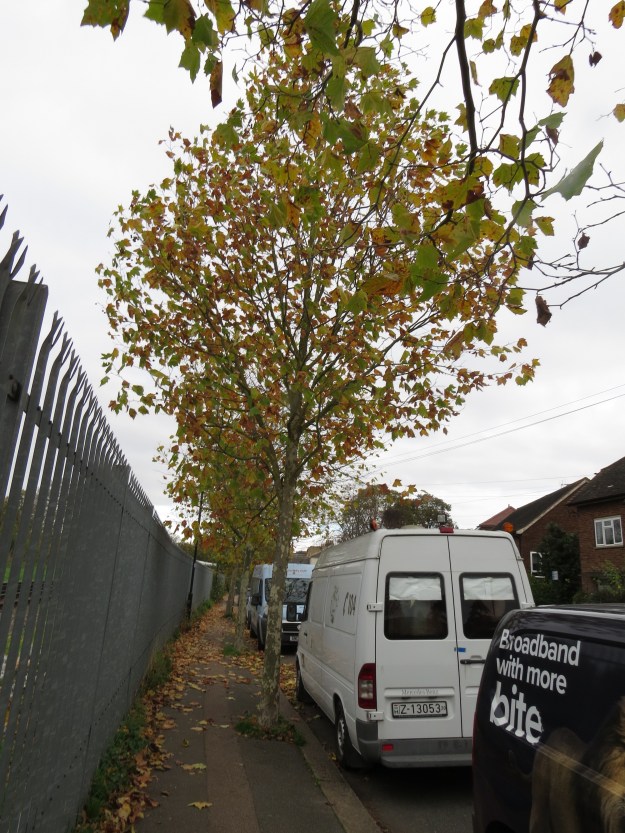
And so off we went on Saturday morning to Streatham Common station. For the first 200 metres we walk alongside the railway line, with the pale-green local mosque on the other side of the road. The council (London Borough of Lambeth ) seems to have planted some London Plane trees here, and I can’t help wondering if they’re storing up trouble for themselves at some point in the future, as we’ve seen how large these trees can grow. At the very least there will be some ambitious pollarding.

On the other side of the fence is the main line to Brighton and Gatwick Airport – the line itself dates back to 1846. In 1953, a short film called ‘London to Brighton in 4 Minutes’ was filmed in the driver’s cab of a train whistling along this route, and great fun it is too. If you have four minutes to spare, buckle up! I must confess to finding it rather exciting. Plus, Victoria Station didn’t look too different to this when I was a child in the 1960s, and there were slam-door trains until the 1980s.

https://www.youtube.com/watch?v=TtiWQkW0v0o

If you want to do a ‘compare and contrast’, they remade the film in 1983, complete with electronic music which sounds like sub-par Kraftwerk to me. It’s very interesting to see how much additional building has taken place in 30 years, and also that the quality of the film has actually gotten worse.

https://www.youtube.com/watch?v=ahabRHUYO4A

And Gawd help us if in 2013 they didn’t do it again, but this time running all three films alongside one another, with slightly better music.

https://www.youtube.com/watch?v=tGTwSNPqAqs

I can’t help thinking about how exciting the first film must have seemed – fast motion photography wasn’t so common then, and I imagine some viewers must have been on the edge of their seats. There’s a real sense of doing something new in the first film that I find rather enchanting.

Anyhoo, today we passed under the railway line via the underpass, which has just about the lowest head room of any such structure that I’ve used recently. The second part has an attractive arch, but the first part is very low indeed.

There are lots of plants still in flower at the moment, among them Green Alkanet, a spikey member of the borage family with the most delicious bright blue flowers.

But what is this on the other side of the road? Is it a temple? Is it some kind of council palace?

No, it’s Streatham Pumping Station, built in 1888 for the Southwark and Vauxhall Waterworks Company.

What a very fine building it is! You might remember that we passed another impressive pumping station many miles ago when we were in East London. Those Victorians loved to make functional buildings such as railway stations and waterworks look like cathedrals, and this one is no exception. Take note, too, of the coloured panes of glass in the left-hand side of the photo above, which are something of a theme on this walk.

When originally built, the pumping station accessed groundwater via a borehole. As with all many water sources, this had started to dry up by the 1940s, and so the pumping station now acts as a booster station, moving water from Norwood Reservoir. Apparently there is still sufficient water in the old borehole to be used in an emergency – the water is stored in an enormous tank under the lawn at the front of the building.

Onwards! We interrupt a large-ish flock of pigeons who are taking advantage of a householder’s generosity.

We pass this magnificent oak tree. There are a number of splendid trees on this walk.

We pass Streatham Methodist Church, which has a little patch of wildflowers at the front. Last time we did this walk (about twenty years ago), we remember the churchgoers setting up for a jumble sale, with someone carrying in trays of cupcakes, and someone else arriving on a bicycle with a hugely precarious bag of clothes tied to the back. Today, all was quiet, and we noted that part of the building now seemed to be being used as a Montessori nursery.

The wildflowers outside Streatham Methodist Church

There are some very, very impressive houses around here, and they haven’t gone unnoticed. Some are looking a little ramshackle and have been subdivided into flats, but still have their original features, like these panes of coloured glass (see, I told you there was a theme).

Some buildings have real terracotta shingles.

There are decorative plaques on some buildings.

But amidst all this splendour, there are some buildings where a whole ecosystem is growing in the gutter, and the damp is spilling down the walls and along the drive.

But wait. Look at this excellent photo of a cat in someone’s front window.

And then the cat blinked, and we realised that s/he was a real cat, and very pretty too. There is something soft-focussed about this photo, as if there was vaseline on the lens, but I fear that it might just be condensation inside the flat.

And then we’re on the corner of Tooting Bec Common, waiting to cross the road, when I see this. Does anybody know what this thing is? I’m inclined to think that it’s the modern day equivalent of a stink pipe, but I could be completely wrong. Let me know if you know! It has a number of big metal boxes at the base that could contain all kinds of measurement equipment.

Finally (for this part of the walk) we pass Tooting Bec Lido, opened in 1906 and named for the famous Venetian bathing beach. It is the largest freshwater swimming pool in the United Kingdom, at 100 metres long and 33 metres wide. It was nearly closed in the 1990s but was saved by the campaigning work of the South London Swimming Club, who have exclusive access to the Lido during the winter months (though anyone can join for an annual fee of £28 plus £110 for year-round access). It looks like a splendid way to spend a couple of hours (or possibly a couple of very invigorating minutes at this time of year).

Tooting Bec Lido (Photo by Nick Cooper)

And so, we head off across Tooting Bec Common, in the general direction of lunch. See how we got on tomorrow!

Rolling Down the Hill…

Dear Readers, this morning I decided to catch the bus from East Finchley down to Islington where I do my pilates (and I’m not sure if a more middle-class sentence than that was ever written). It was the most glorious day, after a week of rain, and I am always awestruck by the view as you head down from Archway towards the City. I didn’t have my camera, so these images are from my (ancient) phone, but hopefully you’ll get the idea. First up, St Pauls Cathedral and the Walkie-Talkie coming into view through the grubby bus window in the photo above.

This is a very complicated junction (the bus is heading towards central London and Holloway) but does anyone else think that this looks like a man standing on one leg while balancing a brick on one arm?

And then there’s the Shard in the distance, which looks ridiculously out of scale with everything else in London, at least at the moment.


The spire of St John the Evangelist church comes into view – at the moment there’s an enormous Christmas Tree ‘plantation’ popping up in the grounds, which will no doubt contribute to the traffic problems of the area.

But what I’m really loving are the leaves, like these yellow specimens close to the junction with Seven Sisters Road.

And how about these at the Nag’s Head junction? Everything really was illuminated this morning, in a last hurrah before the wind and the rain blow the leaves into mulch. And now, for some much-needed stretching and bending, after a week hunched over a computer.

Back From the Brink – The Field Cricket

Field Cricket (Gryllus campestris) (Photo by Roberto Zanon)

Dear Readers, the field cricket is a sturdy insect, and at almost an inch long one of our larger invertebrate inhabitants. Alas, their physical robustness did not save them from coming close to extinction – in the 1980s there were less than 100 individuals at just one site in West Sussex.

Field crickets have only one brood per year and are flightless, so they clearly can’t travel very far. In the spring, the male digs a burrow (a task which takes less than ten minutes), makes himself a little platform and then ‘sings’ his heart out, beating up any other males that wander within range. The females travel about listening to the various ‘songs’, and when they hear one that they like, mating takes place. The female then lays her eggs close to or in the male’s burrow. The nymphs hatch in the summer and shed their skins until they are large enough to survive winter hibernation, finally emerging for their final moult in April of the following year, whereupon they join the chorus. Have a listen to some field crickets in the recording below (made by Gareth K in the UK, these are some of the insects from the species recovery programme)

Field cricket next to his burrow – Photo by Roberto Zanon

So, why were field crickets so endangered? Our old friend intensive agriculture was part of the reason, along with the breaking up and reduction of habitat. But one established way of helping a species to survive is to enlarge the area where they currently live, making the edge of the habitat more suitable, and also to translocate the insects to another suitable habitat. And this is exactly what happened. Field crickets were reintroduced to the RSPB reserves at Farnham Heath and Pulborough Brooks, and corridors were established between parts of the existing sites so that the crickets could travel to ‘meet’ one another more easily. As you can see from the photo above, crickets need areas of bare ground to construct their burrows, and so areas of bramble were cleared from some parts of the reserves.

The results were very heartening.  In 2010, 12 field cricket nymphs were moved to Farnham Heath. By 2013, just three years later, 43 males were heard calling at the reserve. And by spring 2019, 337 males were heard calling, a truly remarkable result, with other populations becoming established at Pulborough Brooks.

As with last week, this success story was the result of collaboration between a number of wildlife and conservation charities, but it was also picked up by the media, and the ever-popular UK wildlife TV programme Springwatch did a feature on the field cricket, an insect that I’m sure most people had never heard of or met. The collaboration continues, with local landowners meeting to discuss ways to extend the range of the field crickets even further. Although this is still a delicate recovery (after all, 337 crickets is not really very many), it is a sign of what can be done when people work together. And here is a short film of a field cricket doing what it does best – stridulating. Long may it continue.

https://www.youtube.com/watch?v=YAaAZdVeoRU

A young field cricket. More of these, please! (Photo By Lilly M)