Category Archives: Uncategorized

Good News on the Moth Front….

Dear Readers, you will remember that although I am definitely a Londoner, my second allegiance is to the County of Dorset, which was home to my Mum and Dad for almost twenty years, and which I have fallen in love with. So, it gives me great pleasure to report on the success of a project to bring back the Barberry Carpet Moth (Pareulype berberata). The caterpillars of the moth feed only on the leaves of the Barberry plant (Berberis vulgaris), which could have been introduced to the UK in Neolithic times, and which was once widely used as hedging. Sadly, the plant was found to harbour a species of rust which could infect cereal crops, and so Barberry was dug up all over the country. As the plant went, so did the moth. Some insect species feed on many different types of plants, but some, like the Barberry Carpet Moth, were extremely specific.

Butterfly Conservation included this species in its ‘Back from the Brink’ programme. By the time it was featured, there were only ten small populations in the whole of the UK. Most cereal varieties are now rust-resistant, and so the danger to foodstuffs from Barberry was minimal. So, the charity set itself the aim of planting nearly 4000 Barberry plants over a four year period, as close to the Dorset population as possible – this included Blandford Forum, one of Mum and Dad’s favourite spots for a bit of shopping. Local people were invited to get a plant for free and plant it in their garden, or in a local community amenity such as a churchyard or school garden. Volunteers also planted Barberry in various sites agreed with landowners, at the edge of forests or in other suitable sites.

UK stamp featuring the Barberry Carpet Moth

And a few weeks ago, it was reported that Barberry Carpet caterpillars had been found in much increased numbers in one of the planted sites, Blandford Forest. 50 caterpillars were found, up from 14 in 2018. This is a very hopeful sign, although clearly more needs to be done. It does go to show what can happen when communities recognise a problem and start to do something about it, which always cheers me up. Fingers crossed that the Barberry Carpet continues to re-establish itself, with a little bit of help from us.

Barberry Carpet Moth caterpillar (Photo by By Hectonichus)


The Tree of the Year 2022

The Waverley yew (Photo from the Woodland Trust)

Dear Readers, this year’s UK tree of the year is the Waverley Yew, which grows over and around the ruins of the first Cistercian monastery founded in the country over 900 years ago. The monastery was dismantled after the Reformation of 1536, and it appears that this tree was just a seed then, as its age is estimated at no more than 480 years. The roots appear to ripple like lava before plunging back down into the ground, while above the many limbs reach out from the trunk like arms. It really is a stunning tree, elegant and poised.

The Waverley Yew will now go forward to represent the UK in the European Tree of the Year 2023.

The trees are selected from a range of ancient and veteran trees by experts from the Woodland Trust, and are chosen to highlight the vulnerability of trees, few of which have any formal protection in spite of their age, value for wildlife or position as venerable elders in the community. Here are a few more of the shortlisted trees:

The Escley Oak (Photo by Woodland Trust)

The Escley Oak is one of the largest and oldest oaks on the Ancient Tree Inventory, and is thought to be at least 400-500 years old. It stands beside a public footpath in Michaelchurch Escley, Herefordshire.

The Holly on the Hill, Hawnby, North Yorkshire (Photo by Woodland Trust)

The Holly on the Hill is a most unusual broad rounded crown, which implies that it might have been harvested for its foliage and berries for many years, maybe to decorate nearby churches and houses. It could be up to 300 years old, but experts believe it probably dates to the mid-nineteenth century.

One of the Twelve Apostles lime trees from St James’s Church, Chipping Campden, Gloucestershire (Photo by Woodland Trust)

As you know, I have a great fondness for lime trees, and 12 of them were planted along the path leading to St James’s Church in Chipping Campden to represent the twelve apostles. The original avenue was probably planted in the 1770s, but five of the trees have died and been replaced. The one in the photo is the oldest of the original trees.

The Langley Park Chestnut, Angus, Scotland (Photo from the Woodland Trust)

And finally, I rather like this battered tree, which looks as if it has been in the wars but has survived, nonetheless. Just look at the size of it! It has a girth of 7.81 metres, and the central trunk is hollow at the top. Langley Park House, which overlooks the Montrose Basin between Dundee and Aberdeen, was built in the 18th Century, and it’s thought that the tree possibly predates it.

So, let’s see how ‘our’ tree does in the European competition next year. At a time when trees are being cut down willy nilly to appease insurance companies and homeowners, to clear plots for development and roads and just because they’re seen as ‘messy’, anything that highlights their importance, and gets people involved and thinking about them, can only be a good thing.

The Capital Ring – Beckenham Junction to Crystal Palace Part Two

Dear Readers, now that we are suitably fuelled after our visit to the Pride of Venice café yesterday we head up Penge High Street under two railway bridges towards Crystal Palace Park. This first rather unprepossessing bridge carries one of the oldest railway lines in London and takes trains from London Bridge station to the South Coast. It formed part of the London and Croydon Railway, and when it was built in 1839 it operated by something called ‘atmospheric traction’, which my Capital Ring guide describes as ‘ (the trains) being vacuum-drawn through a continuous pipe’. This sounds very space-age to me, and indeed the trains were not in the pipe (as I had first thought), but the pipe was used as a power source. You can read all about it here, and I have even found an etching showing the locomotive-less carriages, and the pumping station that was used to create the vacuum at Norwood Station on the London and Croydon line.

The ‘Atmospheric Railway’ at Norwood Junction (then called Jolly Sailor station)

The next bridge is much grander, and dates to 1854 – it was built to ferry people to Crystal Palace station, of which more shortly. You will see that a very fine pigeon is using it as a roosting/nesting place.

The 1854 bridge

And then we enter Crystal Palace Park. The Crystal Palace was a glass and steel creation, three times the volume of St Paul’s Cathedral, and originally built for the Great Exhibition of 1851, which took place in Hyde Park. The whole structure was moved to what was then Penge Place, next to Sydenham Hill, but which was quickly renamed ‘Crystal Palace’.

The Crystal Palace after its reconstruction in Penge

The venue became London’s major exhibition space, hosting everything from circuses to dog shows, Handel concerts to the first ever display of flushing toilets. Alas, it never managed to turn a profit in spite of its many visitors, and in 1911 the company that owned Crystal Palace declared bankruptcy. The building was taken into public ownership, and in 1920 it became the site of the first Imperial War Museum, before the museum was moved to Lambeth. Gradually, the Crystal Palace was renovated and restored, and by the end of the 1920s it was turning a profit.

In 1936, the manager of the site, Sir Henry Buckland, was walking his dog with his daughter Crystal (!) when he noticed a red glow coming from inside the building. He entered to find two employees fighting a small fire that had started after an explosion in the Ladies Cloakroom. They were unable to extinguish it and, in spite of the presence of 89 fire engines and 400 firefighters, neither was anyone else.

Crystal Palace fire, 1936

100,000 people gathered on Sydenham Hill to watch the fire, which is said to have been visible from eight counties. Sir Winston Churchill said that ‘This is the end of an age’, and so it was. But, as we shall see, some remnants from the Crystal Palace do live on.

We walk up past the café (showing considerable fortitude by not stopping for another coffee) and are greeted by these creatures.

An Irish Elk (Megaloceros giganteus)

The ancient animals in Crystal Palace Park date back to 1854, and were designed and sculpted by Benjamin Waterhouse Hawkins under the guidance of scientist Sir Richard Owens. Although we know a lot more about what dinosaurs etc would have looked like these days, these models were based on the most up to date scientific knowledge of the time, and were a wonder of the age when they were first exhibited. The dinosaurs were extremely popular, to the extent that small models were sold to children and other interested Victorians, but the full-size animals were very expensive to produce, and so some creatures were never made, including, to my eternal sadness, the giant armadillo or glyptodon.

However, what remains is now Grade I listed, and many of the creatures have recently been renovated. Clearly the Irish elk is waiting for some antler repair and a new coat of paint, however, and I fear that, in such a prominent position, some eejit will always be wanting to swing from the antlers.

The other creatures are positioned on less accessible islands, and are faring rather better. In the original design the level of the lake would have gone up and down, revealing more or less of the animals which would have been very interesting. Furthermore, the planting, with lots of Aracuarias and (my favourite) swamp cypress trees, makes for an evocative setting.

The Iguanodons are the first large dinosaurs that the visitors see. Sadly, Owen thought that a thumb-bone which had been found could be a small horn, seen here on the Iguanodon’s nose (though even Owen described this as ‘doubtful’. The nose horn has  caused much hilarity amongst later scientists, who can be an unfeeling bunch.

Iguanodon

The Megalosaurus is depicted here as being a quadruped, but we now know that it was more likely to be bipedal, something discovered in 1858, just after the model was completed. I love the way that the dinosaur is becoming an ecosystem all of its own.

Hylaeosaurus

There is a range of aquatic dinosaurs and other creatures. Owen thought that the large eyes of the Ichthyosaurus meant that it had good night/underwater vision. This one is depicted basking like a giant many-toothed seal, but in reality they were totally aquatic.

Ichthyosaurus

The plesiosaurs are thought to have unnaturally flexible necks by current day scientists. The teleosaurs, on the other hand, are pretty accurate – Owen conjectured that they would resemble modern-day crocodilians such as the gharial of India.

Plesiosaurus at the front, teleosaurus at the back.

A small group of Labyrinthodons are tucked away at the corner of the island – Owen thought that they would resemble giant frogs in body shape, though we now know that they looked more like salamanders. They look just the right size to take for a walk on a leash, and they would certainly scare the life out of any rottweilers that they encountered.


And so with some reluctance we climb away from the dinosaurs. I don’t personally give a hoot that they’re not anatomically correct – I love the way that they lurk amongst the autumn colours, giving a sense that we are just part of a history that goes way back into deep time.

Swamp Cypress

And finally, we get a really good view of Crystal Palace transmitting tower, the site of the first ever television broadcast by John Logie Baird in 1933. It was the tallest structure in London (219 metres/719 feet) until the topping-out of the main tower at Canary Wharf in 1990. As an indication of how London has ‘grown up’, it’s now the eighth tallest building, the tallest being The Shard at 310 metres/1016 feet.

And so, we complete our walk via Crystal Palace Station, which was built to accommodate the many thousands who visited the Crystal Palace, and which is still a very impressive station. But our train was due as we arrived, so no time for photos. I shall take a few at the start of our next walk, which will take us from Crystal Palace to Streatham. However, as there is a train strike next Saturday, that will probably be in a fortnight. Who knows what we will get up to next week?

The Capital Ring – Beckenham Junction to Crystal Palace Part One

Battersea Power Station from the train

Dear Readers, this week we are heading back to Beckenham Junction to continue our walk around the Capital Ring. And what a splendid view you get of Battersea Power Station as you head south from Victoria Station! You might remember that I visited the site earlier this year, before the refurbished power station was opened, and I’m due for a revisit now you can actually get inside the building. For today, though, it was enough just to trundle past and admire it from a distance.

And what on earth is this strange object, photographed through a rather grimy Southern Railways window? It is a silver swan in the Pullman carriage next door. I got very excited in case there was a steam engine attached, but although this amazing vintage carriage is going to be part of a tour called ‘The Golden Age of Travel by Steam’, presumably the engine arrives later, as when I wandered down the platform all I could see was a boring old diesel engine. Each carriage is decorated differently, and this one appeared to be called ‘Vera’ – they all date to the 1920s. Apparently you can never be overdressed, which is very exciting, but as this trip was £540 per person, I expect that it would need to be a very special occasion indeed.

Anyway, we were soon arrived in the rather less plush surroundings of Beckenham Junction Station, and after a quick toilet stop at Waitrose (yes, we did a bit of planning this time) we were off through the leafy streets of South London. Not so long ago this was all farmland, and you can still see occasional signs of the old farms and estates, such as this set of gatehouses.

I thought this tree had a very ent-ish look (the Ents were the tree gods in Lord of the Rings). (Or possibly The Hobbit). No doubt someone will put me right 🙂

And look! Mistletoe.

We pass the church of St Paul’s Beckenham, which was established in 1863 by the Cator family – you might remember them from Beckenham Place Park and Mansion last week. Cator anticipated that his estate would include no less than 3,750 people, and so he wanted to build something suitably grand to cater for their spiritual needs. In the event, about 600 people would attend the Sunday services during the 19th Century, though only 40 would take communion because the rest of them had not been confirmed, and therefore weren’t allowed. The church was badly damaged during the Second World War by incendiary bombs and a land mine, but had a particularly diligent vicar who managed to get the restoration work completed before he retired in 1949. In the sixties the church was apparently ‘affected’ by the charismatic movement, and there were dance groups and a wind band (you can almost hear the author of the history section of the church’s website ruefully shaking his or her head) ‘though this is not our practice now’.

St Pauls, Beckenham

I was much entertained by a pair of magpies who were clearly up to something, but I’m not sure what. I suspect it involved picking little hibernating insects out of the stonework.

And then we’re off again. We have been so lucky with the weather on these walks, I don’t believe that a single drop of rain has dampened our heads.

Then we take a turn ‘between house numbers 173 and 175’ – I love how precise the Capital Ring guide is, if you’re paying attention it’s (almost) impossible to get lost. We enter into Cator Park (that name again!) and cross two little streams, first the Beck

and then Chaffinch Brook…

…which both end up in the Ravensbourne, the stream that we met last week. Cator Park is very fine, full of some energetic dogs and small children learning to steer their scooters and bicycles, some with more accuracy than others.

I was much taken by these dandelions. I think the low sun at this time of year really makes them glow.

Someone who designed the park clearly had a great love for conifers, because there are half a dozen stands of them, looking just a little incongruous in South London but none the less magnificent for all that.

And look at this magnificent Raywood Ash! It’s not quite in full splendour yet, but it’s getting there. I photographed some in St Pancras and Islington Cemetery last year, so have a look to see how they are at their best.

Raywood Ash

And looky here! A stink pipe, and in a rather better state of preservation than most of the North London ones that I’ve seen. In the end I spied two, both with a tulip design at the top. While my local stinkpipes mark the route of the Northern Outfall Sewer, these beauties presumably follow the Southern Outfall Sewer, which eventually ends up in Crossness. The idea was that the methane and other gases would be vented high above the heads of the public, and would waft away in the breeze, presumably adding to the burden of carbon in the atmosphere that we are all suffering under now.

This rather uninspiring corner marks the site of Kent House, so-called because it was the first building on the road out of London that was actually in Kent (no longer – these days it’s the London Borough of Bromley. For most of its life (and it appears to have been built in the 13th century) Kent House was a farmhouse, before a brief period as a nursing home in the early 20th century. It was demolished in 1957, which seems rather a shame.

Kent House in 1910

The site of Kent House today

There are some extremely fine houses on this road. In one of them, a gardener with a leaf blower (an invention of the devil if ever I heard one) stopped in his task to pick up a single tiny leaf from the driveway. I suspect that his clients might have been of the extremely picky kind.

Many of the houses had some lovely plaster work detailing.

On we go, getting a first proper look at the Crystal Palace radio mast…

And then walking through yet another park, where the sports pavilion has this lovely mural…

…and past this house with its twisted pillars.

We cross over the platforms at Penge East Station and pass the Roman Catholic Church of The Good Shepherd. The building dates from 1887 and was probably originally the Mission Hall for nearby Holy Trinity Church. I love the coloured glass in the windows,

And now we are getting hungry, and what better than a quick bite in The Pride of Venice café? Most of the other diners seemed to be hungover clubbers, but the sandwiches were of the doorstep variety and the tea was good and strong, so just what the doctor ordered. And now, we were on the last leg of the walk, and were hoping to see something prehistoric. Let’s see how we got on tomorrow….


If Only Animals Could Talk….

Ornate Wood Turtle (Rhinoclemmys pulcherrima) Photo by Tornadohalt, CC BY-SA 3.0 <http://creativecommons.org/licenses/by-sa/3.0/>, via Wikimedia Commons

Dear Readers, the whole idea of ‘dumb animals’, which was always a bit dubious as far as I’m concerned, has been thrown into even greater doubt following the discovery that over 58 species of animals that were thought not to communicate with one another do, in fact, chat away to one another.

Many vertebrate animals with lungs are known to be able to produce sound by forcing air up and through structures in their throats. However, scientists thought that many of the sounds were either produced accidentally, or in extremis – wailing because you’re being eaten by a crocodile doesn’t count as communication, apparently. Turtles in particular were thought to lead quiet lives.

Fortunately, scientist Gabriel Jorgewich-Cohen of the University of Zurich was curious about this idea, and he started by paying close attention to his pet turtles.
I decided to record them, just to check it out,” he says. “I found several sounds there, and then we just kept going [with more species]. And suddenly, I had good sampling and I could understand a bigger picture.

And what a bigger picture it is! Turtles, the Australian tuatara and even a species of lungfish ‘talk’ – circumstances differ, but include parental care, mate selection, and marking territory. The most garrulous communicators are apparently males when fighting other males or when they are trying to woo a partner. I am resisting the urge to make any comparisons with any other species.

A Talkative Tuatara (Not a lizard!) (Photo by By Sid Mosdell from New Zealand – Tuatara, CC BY 2.0, https://commons.wikimedia.org/w/index.php?curid=70735190


And how about this critter? ‘What the hell is that?’ I hear you cry. This is a Cayenne Caecilian (Typhlonectes compressicauda), a kind of amphibian which lives in muddy water, and which has no functional eyes. No wonder sound is more important to this animal than was thought. It’s thought to detect its prey by touch or by vibration, but if it can communicate vocally presumably it can also hear. Fascinating stuff.

A Cayenne Caecilian (Photo By User:Haplochromis – Self-photographed, CC BY-SA 3.0, https://commons.wikimedia.org/w/index.php?curid=3037073)

And finally, and in a way most extraordinarily, this lungfish has also been found to communicate vocally. The South American lungfish lives in the swampy regions of the Amazon, and, in the breeding season, the parents work together to build a nest. The male develops special fins at this time which he waves to oxygenate the water so that the eggs and young fish can breathe. Once hatched, the youngsters are said to resemble tadpoles. With this degree of parental care, it’s not surprising (to me anyway) that the species is able to communicate vocally, especially as muddy water would make anything else difficult.

South American lungfish (Lepidosiren paradoxa) Photo Vassil, CC0, via Wikimedia Commons

What is particularly interesting is that this means that the ability to communicate vocally evolved way earlier than scientists previously thought – at least 407 million years ago. As most fish don’t have lungs, and it’s known that they can produce a wide variety of sounds, it probably goes back even further than that. Clearly, vocal communication has been part of the lives of animals pretty much since they came into existence.

You can read the whole article here.

And of course, I couldn’t leave this subject without including some examples of the vocalisations of these ‘mute’ creatures – you can have a listen here. Enjoy!

Into The Red – A Collection of Words and Art Inspired by Britain’s Most Vulnerable Birds

Dear Readers, this book, curated by Kit Jewitt and Mike Toms, pairs images of 70 of Britain’s most vulnerable bird species with writing from 70 authors, and it is a source of both joy and sorrow. There is joy at the sheer variety and beauty of the birds depicted, but there is sorrow at the possible loss of some of our most iconic and familiar birds. There are birds that I’ve never seen, like Montagu’s Harrier and the Red-Backed Shrike, but who would not pause at the inclusion of Swifts and House Martins, Pochard and Bewick’s Swan, Puffin and Starling, House Sparrow and Lapwing? The causes are varied, but everything points to the increasing impoverishment of our natural world.

Capercaillie. Words by Benedict MacDonald. Image by Federico Gemma. Taken from ‘The Making of Into the Red’ https://www.bto.org/community/blog/making-red

The artists are a varied bunch, from sculptors and printmakers to painters working in mixed media, oils, pastels and watercolours. cartoonists and digital illustrators. The writers include long-established and well-loved nature writers such as Richard Mabey, Kate Bradbury and Isabella Tree (of ‘Wilding’ fame) alongside children’s authors, scientists, activists and enthusiasts. The approach works well – I liked some collaborations more than others, but there is something here for everyone. Best of all, all of the profits from the work go to the British Trust for Ornithology, which couples a scientific approach with a deepfelt passion for the birdlife of this country.

House sparrow by Esther Tyson

So, if you have any spare cash rattling around (hah!) I would definitely invest in this book. It’s also inspired me to think about a new series of new posts, on the birds that are declining, the possible causes, what they mean to me, and what we can do about it. Let’s see how we get on…

Merlin by Ruth Weaver

You can read more about the making of ‘Into the Red’ below…

https://www.bto.org/community/blog/making-red


The Capital Ring – Downham to Beckenham Junction

The entrance to Beckenham Place Park

Dear Readers, after our lunch in Downham yesterday we headed off for the last part of the walk, which is in Beckenham Place Park. One thing that I love about the Capital Ring is that I’ve visited places that I had no idea existed, and this was one of them. It’s the largest green space in Lewisham, and was originally founded in the eighteenth century by John Cator the Younger. He was a timber merchant, and many of the trees in the estate are sweet chestnut, grown not for food but for their wood. However, he also planted many other trees, including what was for a while the second oldest turkey oak tree in the UK (this tree eventually succumbed to wind, old age and vandalism in 2002).

We crossed the Ravensbourne, a stream that wends its slow way to the Thames at Deptford Creek. Apparently it was so named after Caesar’s army, camping at nearby Keston, noticed some ravens behaving strangely and, following them, found a spring.

The Ravensbourne

The estate originally had a large lake, which was filled in when part of the park became a municipally owned golf course in 1929. In 2019, the golf course was closed and the lake reinstated. What, though, to do with all the soil and rocks that had to be dug out? The ziggurat below was the result. Apparently from the top you get a good view of the railway line.

The Mounded Garden

On we go, through the woods. There are some areas where the sweet chestnut is being coppiced, which allows the light to penetrate to the forest floor. This in turn ‘wakes up’ any slumbering plants in the seedbed, and encourages biodiversity.

Sweet chestnut coppice

The way that trees lose their leaves always fascinates me. Some seem to start to yellow tentatively, as if just kissed by the sun.

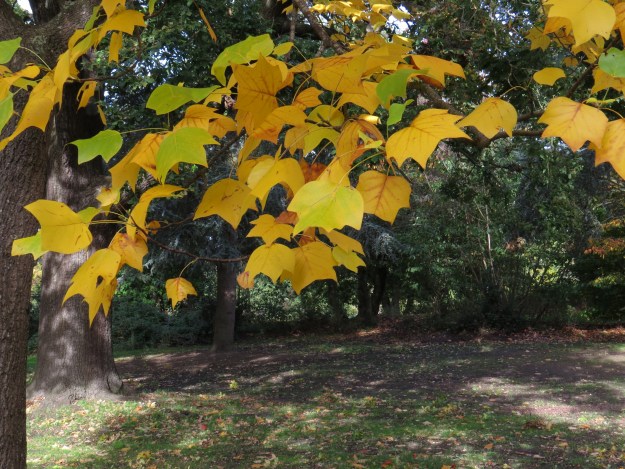
Others go for it, and turn golden it what feels like the blink of an eye, like this tulip tree (Liriodendron tulipifera).

As we get out of the wood, and pass the reinstated lake (where people are learning to paddleboard, which looks like a most precarious exercise, though I imagine it’s very satisfying once you can stay upright) we get our first view of Beckenham Place Mansion. It looks very imposing, sitting there on the top of the hill. These days it’s a community centre and I suspect a wedding venue, judging by the number of very impressively-dressed people heading towards it.

We pass a giant red plaster squirrel with a most endearing expression.

And this is a very fine, and I suspect very aged, black mulberry tree.

There is a café in the old coach house which gets very good reviews. By now I was a bit footsore though, and we decided not to indulge (again) but instead to head towards Beckenham Junction station, for a train to Victoria and home.

We had been hearing cheery, loud music, and the reason why soon became clear. I remember how excited we used to get as children when the Fun Fair came to Wanstead Flats, close to where we lived in Stratford. The smell of popcorn and frying onions, the lights, the sounds of all the different rides still get my pulse racing. Strangely enough, although I’m still game for a rollercoaster, I can no longer deal with Waltzers or even the Galloping Horses, as I find I get dizzy and nauseous with all that going round and round. Still, it’s lovely to see other people enjoying it all.

The view of the front of the Mansion is even more impressive than the side view. There was a catering van pulled up in front, and as we got to the main road a woman in full- length red brocade stepped out of a small electric car and headed up the hill, a most impressive sight.

Next week (weather, train strikes and feet willing) we’re off to Crystal Palace to see the dinosaurs!

The Capital Ring – Grove Park to Downham

An Autumn scene near Grove Park in South London

Well, dear Readers, here we are again, on the Capital Ring on another bright and sunny autumn Saturday morning. We have travelled here via Charing Cross Station, so far my feet are behaving themselves (I have a very irritating corn, a sore ankle and all sorts of other nonsense) and so we head off through the woodlands and parklands of Lewisham. First up is the old Grove Park Hospital, some of which has been redeveloped as housing, but clearly some is still in medical use, as there is a sign for the Long Covid clinic. The buildings have an extraordinary history, though, and many thanks to The Lost Hospitals of London website for the information below.

Grove Park was originally used as a workhouse – these were places where the destitute poor were housed, and used for (free) hard labour. My great grandmother (who had polio, a husband who was gassed during WW1 and a number of children with various degrees of illness and disability) had an absolute terror of ending up in the workhouse, lest we think that they were a relict of early Victorian times. At Grove Park the main occupation was breaking up granite, which was sold to local councils for road building, and the building only ceased to be a workhouse in 1914, when it was requisitioned by the army as a training camp for soldiers heading off to the front. In 1919, the place became an Asylum, but for most of its history it was a hospice for Tuberculosis patients. During 1940 the building was set alight by an incendiary bomb. Two nurses, Mary Fleming and Aileen Turner, crawled through one of the upper windows and across the swaying floor of a ward to reach trapped patients. The floor collapsed a few minutes after the rescue. Both nurses were awarded the George Medal.

Grove Park Hospital

In 1967 there was a major train crash, in which 92 people died (of which more later). Many of the injured were brought to Grove Park for treatment.

In 1977 the hospital was repurposed as a home for patients with learning disabilities but, following the ‘Care in the Community’ initiative of the late 70s and early 80s many patients were moved out. The hospital finally closed for good in 1994, as did many local and ‘cottage’ hospitals all over the country, in favour of large, centralised facilities. And so, Grove Park, which has had an even more interesting history than most hospitals, is now a collection of houses and apartments. At least it has largely been repurposed, rather than being torn down.

And now, we turn down a rather unprepossessing alley, and find that it’s named Railway Children Walk.

This is not the Railway Children walk that visits all the very picturesque scenes around Haworth in Yorkshire where the book was set, but it is the site of the house of Edith Nesbitt who wrote the book – her house overlooked the railway line. She might be a bit surprised at the view from the railway bridge today.

As mentioned earlier, in 1957 this stretch of railway was the site of a train crash that killed 92 people and injured 173. A train travelling from Hastings towards Charing Cross derailed, with many of the carriages full to the gunnels with standing passengers. It was found that a rail had broken, and the Ministry of Transport criticised the maintenance of the line, which was subsequently improved (rather a case of ‘shutting the stable door after the horse has bolted’). Among the casualties was James Gordon Melville Turner, who won the George Cross for saving two wounded shipmates when his merchant ship was torpedoed in 1939. He subsequently lost a leg when a second ship that he was serving on was torpedoed, and he spent the remainder of the war in a German Prisoner of War camp. For this man to be lost in a train crash after surviving so much feels very ironic to me.

Amongst the survivors was, believe it or not, Robin Gibb of the Bee Gees. I’m afraid I can’t resist it.

Looking back over the railway line at Grove Park

Anyhow, at this point we are both in need of a toilet, and I tell you this because until I’d started doing this walk I hadn’t quite realised the paucity of such facilities in the Capital. How does anyone who regularly needs a toilet (the pregnant, those with bladder problems, those with diseases like Crohns) manage to travel or get out and about? It really is an accessibility issue. Some towns (including East Finchley under its new Labour council) are looking at schemes whereby local cafes and restaurants will make their toilets available to the general public without the visitors having to buy anything. We went to the garage (no toilets), couldn’t find an open cafe, and the betting shop was less than prepossessing. In desperation I asked at the florists, and the lovely lady there invited us in to use her facilities. She was clearly a wingless angel. We chatted for a while about how, during 2020 and 2021, it was only the funeral flowers that kept her little family business afloat, and how bad she felt about it (Hither Green Crematorium is right opposite the shop).

“At least I’m doing a few weddings and christenings as well now,” she said.

So, if ever you find yourself at Hither Green in need of some flowers (hopefully for a pleasant occasion), pop into Karen Woolven Flowers on Verdant Lane.

Much refreshed and with more of a bounce in our step, we head towards the Downham Woodland Walk. Some of the roads around here have ‘greens’ in the middle, with mature oaks and squirrels everywhere.

Downham Woodland Walk is a tiny strip of ancient woodland that runs along the boundary of what were once fields, something that explains why the wood keeps changing direction and character. It is apparently home to the nationally rare hawthorn  jewel beetle, and if only I’d known I’d have paid more attention (though my husband’s tolerance for my entomological searches is not limitless). So, I didn’t see one, but here it is for your delectation.

Agrilus sinautus (the Hawthorn Jewel Beetle) – By James Lindsey at Ecology of Commanster, CC BY-SA 3.0, https://commons.wikimedia.org/w/index.php?curid=7205608

The Downham Woodland Walk

We were literally tripping over squirrels here – one shot out in front of my husband and leapt across the little stream that tinkles alongside the path. This is a very urban patch – a man was having a noisy argument with his lady friend, a group of youngsters were gathered and were clearly trying to decide at whose house it would be best to spend the afternoon (it seemed to be largely dependent on how long various mothers were going to be out shopping), a lone youth with his headphones on was sitting on the back rest of a bench, nodding his head and smoking a joint. Ah London, how much I love you.

And then we arrived at Downham, a place that I had never heard of, but which had a thriving High Street which seemed to spread in all directions. By this stage we were after a sandwich (and yet another toilet) and found Café Treat, which was buzzing, efficient, and had a great range of food, including some breakfasts that sounded pretty enormous and then a range of Hearty Breakfasts which were even larger, including a couple of Turkish breakfasts with feta and olives and hummus and bread, and a very tasty falafel wrap. And so, dear Readers, here I will leave us for today, with me guzzling down a huge mug of builder’s tea. Let’s see where we get to next.


Of Pigeon’s Throats….

Collared doves at slow shutter speed.

Dear Readers, earlier this week I was sent this poem by sllgatsby, a regular reader with a fine taste in verse, and I thought I would share it with you. There is something so gentle and reassuring about the cooing of pigeons of all kinds – I remember the way that the call of the woodpigeon would echo down my parents’ chimney when they were having their afternoon naps in Dorset, almost like a lullaby. This poem has an enigmatic, melancholy beauty, a handful of images that feel very cinematic to me. Hans Ostrom is a very interesting poet, who has taught African-American literature and has written books on poet Langston Hughes, and has also taught at Uppsala University in Sweden and in Germany. All in all, he has a most ecletic and intriguing mix of interests and influences.

Of Pigeons’ Throats

by Hans Ostrom

Trickling cold water springs bubble up
in throats of pigeons.

In pigeon throats, weary
orderlies push medicine carts

down dim hospital corridors, and
one weak, wobbly wheel eeks.

Old folks sit around
tables, mutter alibis, lullabies,

and goodbyes in parlors I’ve
imagined there in pigeons’ throats,

which speak in pigeon-code of untraveled
highways upholstered in ground-mist…

gray, green, and purple purses full of coins from
lost currency… pearl light of railroad windows, dawn.

And so that you can enjoy the sounds of our native doves and pigeons, here’s a selection for your delectation.

This first one is the aforementioned woodpigeon. In my Crossley Guide to the Birds of Britain and Ireland, it’s suggested that the call sounds like ‘my TOE BLEEDS Betty’, and it’s certainly a five-syllable call, with lots of emphasis on the second and third syllables. I have one local bird who repeats this pattern three times and then sticks an extra ‘word’ on at the end. The call is particularly fine when heard down a chimney.

This is a bunch of feral pigeons. The actual call is, I’m sure, a male doing his little ‘whirligig’ dance to impress a female. I particularly like the wing claps as they all take off.

This is a turtle dove. The call is supposed to sound like ‘turrr-turrr’, and the bird is named for its call, rather than any resemblance to a marine reptile. The call reminds me of an old-fashioned ‘ringing’ tone on a telephone, but I bet most of you are Far Too Young to remember such things.

This is a stock dove, which has the most unassuming call of all the pigeons, to go along with its generally placid and gentle nature. The call is basically a series of ‘ooo’ sounds, but, as the Crossley guide puts it, it’s ‘a soft sound from the treetops very easily missed in bird chorus’.

And this is a collared dove. The first sound is the ‘landing call’, which sounds to me a bit like a kazoo. The normal call is a quite fast three-note cooing: Crossley says that it’s in the rhythm of ‘U-NIII-ted’ and I think that’s just about right. See what you think.

And just to add a bit of Transatlantic interest, here’s the melancholy song of the mourning dove (Zenaida macroura), recorded in Arizona by Richard E. Webster.

And finally, for our Australian friends, here’s the call of the Crested Pigeon (Ocyphaps lophoteswhich has pared back its song to the most minimalistic (recording by Marc Anderson)

However, the sound of the bird in flight is extraordinary – have a listen to these wing beats (recording also by Marc Anderson)

Crested pigeon mating display (Photo  By Lip Kee Yap, CC BY-SA 2.0, https://commons.wikimedia.org/w/index.php?curid=5985226)

The pigeon family is extremely diverse, but even our feral pigeons, so often overlooked, are intelligent, adaptable and attractive birds. It saddens me that they when they aren’t overlooked they’re often seen as ‘feathered rats’ (and don’t get me started on the virtues of rats or we’ll be here all night). Suffice it to say that pigeons are much maligned, and deserve a little more of our care and attention and a little less of our contempt.

A pair of pigeons in Bunhill Fields, City of London

Around the Block on the County Roads

Dear Readers, today was an ‘in tearing haste’ kind of day, but I am sticking to my resolution to at least walk around the block every lunchtime, and as usual I was glad that I did. There’s always something to notice if you can clear your head of spreadsheets and other shenanigans. First up, Mexican Fleabane is getting well established in the cracks and crevices in some front gardens, and very handy it is too – it flowers prolifically and the hoverflies love it. I am very fond of it myself, having a few windowboxes full of the stuff in the front garden.

Here it is advancing along the garden wall, before no doubt making a break for freedom along Lincoln Road.

Someone has some plain and simple honeysuckle in their hedge, and although there are fancier varieties, you cannot beat the old-fashioned plant for scent, even on a chilly-ish October day. I always have to stop for a quick sniff.

And how about this tree?

What a very fine specimen it is! This is a hornbeam, but not as we usually see it in the wood.

It’s a variety known as ‘fastigiata’ or ‘pyramidalis’ – it has a very neat conical shape more suited to a street tree than the sprawling giants of Cherry Tree or Coldfall Woods. However, according to Paul Wood in ‘London’s Street Trees’, a City of London hornbeam was found to be more biodiverse than any other tree in the Square Mile, and that includes the oak trees.

I am very happy to see that the bollard on the corner of Lincoln Road is still upstanding. This must be a record for its longest period in an upright position. Please don’t take that as a challenge.

And what else is there to see? An abundance of Michaelmas Daisies, another great plant for late summer/early autumn. The ones in my front garden are flowering and flowering, though most of them are very pale lilac/white rather than this lavender colour. I have one honeybee left who visits them regularly, but everyone else seems to have already called it a day.

And yes, I know that Virginia Creeper is a) common and b) a bit of a thug, but just look at it. How could the spirits not be lifted by the sight of all that red and copper?

And, finally, as I turn for home I have to take another photo of the rowan, so heavy with berries, so yellow of leaf. Wherever you are, I would really recommend getting outside, even if it’s just for fifteen minutes. This year has been so spectacular for berries and leaf color that it would be a shame to miss it.