Category Archives: Uncategorized

Of Pigeon’s Throats….

Collared doves at slow shutter speed.

Dear Readers, earlier this week I was sent this poem by sllgatsby, a regular reader with a fine taste in verse, and I thought I would share it with you. There is something so gentle and reassuring about the cooing of pigeons of all kinds – I remember the way that the call of the woodpigeon would echo down my parents’ chimney when they were having their afternoon naps in Dorset, almost like a lullaby. This poem has an enigmatic, melancholy beauty, a handful of images that feel very cinematic to me. Hans Ostrom is a very interesting poet, who has taught African-American literature and has written books on poet Langston Hughes, and has also taught at Uppsala University in Sweden and in Germany. All in all, he has a most ecletic and intriguing mix of interests and influences.

Of Pigeons’ Throats

by Hans Ostrom

Trickling cold water springs bubble up
in throats of pigeons.

In pigeon throats, weary
orderlies push medicine carts

down dim hospital corridors, and
one weak, wobbly wheel eeks.

Old folks sit around
tables, mutter alibis, lullabies,

and goodbyes in parlors I’ve
imagined there in pigeons’ throats,

which speak in pigeon-code of untraveled
highways upholstered in ground-mist…

gray, green, and purple purses full of coins from
lost currency… pearl light of railroad windows, dawn.

And so that you can enjoy the sounds of our native doves and pigeons, here’s a selection for your delectation.

This first one is the aforementioned woodpigeon. In my Crossley Guide to the Birds of Britain and Ireland, it’s suggested that the call sounds like ‘my TOE BLEEDS Betty’, and it’s certainly a five-syllable call, with lots of emphasis on the second and third syllables. I have one local bird who repeats this pattern three times and then sticks an extra ‘word’ on at the end. The call is particularly fine when heard down a chimney.

This is a bunch of feral pigeons. The actual call is, I’m sure, a male doing his little ‘whirligig’ dance to impress a female. I particularly like the wing claps as they all take off.

This is a turtle dove. The call is supposed to sound like ‘turrr-turrr’, and the bird is named for its call, rather than any resemblance to a marine reptile. The call reminds me of an old-fashioned ‘ringing’ tone on a telephone, but I bet most of you are Far Too Young to remember such things.

This is a stock dove, which has the most unassuming call of all the pigeons, to go along with its generally placid and gentle nature. The call is basically a series of ‘ooo’ sounds, but, as the Crossley guide puts it, it’s ‘a soft sound from the treetops very easily missed in bird chorus’.

And this is a collared dove. The first sound is the ‘landing call’, which sounds to me a bit like a kazoo. The normal call is a quite fast three-note cooing: Crossley says that it’s in the rhythm of ‘U-NIII-ted’ and I think that’s just about right. See what you think.

And just to add a bit of Transatlantic interest, here’s the melancholy song of the mourning dove (Zenaida macroura), recorded in Arizona by Richard E. Webster.

And finally, for our Australian friends, here’s the call of the Crested Pigeon (Ocyphaps lophoteswhich has pared back its song to the most minimalistic (recording by Marc Anderson)

However, the sound of the bird in flight is extraordinary – have a listen to these wing beats (recording also by Marc Anderson)

Crested pigeon mating display (Photo  By Lip Kee Yap, CC BY-SA 2.0, https://commons.wikimedia.org/w/index.php?curid=5985226)

The pigeon family is extremely diverse, but even our feral pigeons, so often overlooked, are intelligent, adaptable and attractive birds. It saddens me that they when they aren’t overlooked they’re often seen as ‘feathered rats’ (and don’t get me started on the virtues of rats or we’ll be here all night). Suffice it to say that pigeons are much maligned, and deserve a little more of our care and attention and a little less of our contempt.

A pair of pigeons in Bunhill Fields, City of London

Around the Block on the County Roads

Dear Readers, today was an ‘in tearing haste’ kind of day, but I am sticking to my resolution to at least walk around the block every lunchtime, and as usual I was glad that I did. There’s always something to notice if you can clear your head of spreadsheets and other shenanigans. First up, Mexican Fleabane is getting well established in the cracks and crevices in some front gardens, and very handy it is too – it flowers prolifically and the hoverflies love it. I am very fond of it myself, having a few windowboxes full of the stuff in the front garden.

Here it is advancing along the garden wall, before no doubt making a break for freedom along Lincoln Road.

Someone has some plain and simple honeysuckle in their hedge, and although there are fancier varieties, you cannot beat the old-fashioned plant for scent, even on a chilly-ish October day. I always have to stop for a quick sniff.

And how about this tree?

What a very fine specimen it is! This is a hornbeam, but not as we usually see it in the wood.

It’s a variety known as ‘fastigiata’ or ‘pyramidalis’ – it has a very neat conical shape more suited to a street tree than the sprawling giants of Cherry Tree or Coldfall Woods. However, according to Paul Wood in ‘London’s Street Trees’, a City of London hornbeam was found to be more biodiverse than any other tree in the Square Mile, and that includes the oak trees.

I am very happy to see that the bollard on the corner of Lincoln Road is still upstanding. This must be a record for its longest period in an upright position. Please don’t take that as a challenge.

And what else is there to see? An abundance of Michaelmas Daisies, another great plant for late summer/early autumn. The ones in my front garden are flowering and flowering, though most of them are very pale lilac/white rather than this lavender colour. I have one honeybee left who visits them regularly, but everyone else seems to have already called it a day.

And yes, I know that Virginia Creeper is a) common and b) a bit of a thug, but just look at it. How could the spirits not be lifted by the sight of all that red and copper?

And, finally, as I turn for home I have to take another photo of the rowan, so heavy with berries, so yellow of leaf. Wherever you are, I would really recommend getting outside, even if it’s just for fifteen minutes. This year has been so spectacular for berries and leaf color that it would be a shame to miss it.

The Big Butterfly Count – Winners and Losers

Jersey Tiger (Euplagia quadripunctaria)

Dear Readers, Butterfly Conservation have just published their report based on the Big Butterfly Count this year, and it makes for very interesting reading. First up, the Jersey Tiger, the Vulcan Bomber of the moth world, is up by an amazing 136%, making it the species with the biggest single increase. Anecdotally, people have been tripping over these moths all over London, and at one point there were three in my garden alone. The caterpillars feed on hemp agrimony, of which I have several unruly clumps, so this might be part of the explanation.

In other news, blue butterflies have had an excellent year, with Holly Blues up 120% from 2021, and Common Blues up 154%, although the blues had a very bad year in 2021 so it isn’t quite as impressive as it seems.

Holly blue (Celastrina argiolus)

Gatekeepers had a very good year too, with nearly 143,000 spotted, making them the commonest butterflies in the count. They were up 57% on 2021.

Gatekeeper (Pyronia tithonus)

However, while we celebrate these winners, it’s worth noting that overall, numbers are down – each person who counted for the survey only saw an average of 9 butterflies, an all time low for the 13 years that the survey has been running. There was a hope that the numbers would be up because of the hot summer, but clearly habitat destruction has a bigger impact. Some species, such as the Jersey Tiger and the blue butterflies are heading north, as climate change makes the temperature conditions more amenable, but some very common, iconic butterflies are still declining.

The Red Admiral was down 20% on the 2021 figures.

Red Admiral (Vanessa atalanta)

The ringlet is down 38%

Ringlet (Aphantopus hyperantus)

And the Marbled White is down 71%. This, however, is a butterfly that has been making a comeback in London in particular, and which likes unimproved grassland. It lives very briefly as an adult (less than six weeks), and I wonder if the timing of the count didn’t quite coincide with its emergence this year. Fingers crossed. You can read more about this species, and some other London butterflies, here.

Marbled White (Melanargia galathea)

So, there are ups and downs but it is something of a depressing picture. When we’re planning our gardens (if we’re lucky enough to have one), or campaigning for local green space, it’s so important to make sure that there’s something for caterpillars as well as adult butterflies, even if that makes the place a little untidier than we’d like. Let’s see if No Mow May has had an impact when the count takes place next year – I get the feeling that it was taken up as a challenge by more people than usual, which will have saved a lot of eggs and caterpillars. Long may it continue.

You can see the full results at the link below, including a breakdown by country which made for very interesting reading.

https://butterfly-conservation.org/news-and-blog/results-of-this-years-big-butterfly-count-revealed


In The Garden

Sparrows in the hawthornt

Dear Readers, in addition to all the Sciencing that’s been going on just lately, there’s been all the usual autumnal increase in activity after the quiet of the late summer. For one thing, a small flock of house sparrows has been hanging out in the garden every day. They take some suet pellets, are completely uninterested in my deluxe red and yellow dough balls, and are such a delight. They seem to me to be picking up small insects in the hawthorn tree – they don’t seem to want the berries, but there’s definitely something going on. I’m just very happy to see them.
The whitebeam has turned a shade of custard yellow that I don’t remember seeing before. I am having a bit of a dilemma here. I normally have it trimmed about every five or six years, along with the hawthorn, but it’s so stressful for both trees, and after the drought this year I wouldn’t want to cause them any more grief. On the other hand, they are both now pretty large and dominant in the garden, and I also worry in case the whitebeam in particular gets blown over in a storm. I wish there was someone that I could ask who didn’t have a financial interest in the outcome – if you have any ideas, do let me know.

The leaves on the whitebeam

On the other hand, the woodpigeons are loving the seed feeder that dangles from one of the branches. Although it’s a large feeder, it appears that only two woodpigeons are allowed on it any one time, otherwise there’s fisticuffs. One of those woodpigeons looks less than pristine, now that I’ve looked at the photographs. Maybe it’s just young.

We did a bit of tidying up today (not too much, we want the invertebrates to have somewhere to hide), and the robin appeared out of nowhere to check out what we were doing, and to investigate any grubs or worms who appeared. The plant supports that I bought for the hemp agrimony seem to provide a very convenient perch.

And finally, a small collared dove popped in to try her luck on the seed feeder. She’s only about two-thirds the size of the woodpigeon and I noticed that when she landed she seemed to try to make herself very small, and had one wing outstretched to protect her head from any pecks – those woodpigeons can be very aggressive. She only lasted for about 30 seconds before she thought better of it, and headed off to a branch to wait her turn. The whitebeam is valuable precisely because it provides so many perching and hiding opportunities – I’m always amazed to see the squirrel dreys, remnants of nests and other ‘artifacts’ amongst the branches once the leaves come down.

And finally, here’s a last house sparrow surveying his kingdom. I’m so glad that they’re visiting the garden again, after an absence of almost a year. Who knows what makes them come, and what made them go? The lives of even our most familiar birds can be such a mystery.

An Autumnal Walk in Bluebell Wood

Ancient Oak in Bluebell Wood

Dear Readers, I have been to Bluebell Wood, close to Bounds Green station and the wonderful Sunshine Garden Centre, several times, and am always impressed by the magnificent oak and hornbeam trees. This is a tiny snippet of ancient woodland in a very surburban area, and yet it hints at what used to be – once upon a time, this woodland would have covered most of this part of North London, from Cherry Tree Wood in East Finchley to Coldfall Wood a little further north, before the forest faded into Finchley Common. Today, you were in danger of being bounced on the bonce by falling acorns – I don’t think I’ve ever seen so many as this produced as this year, maybe as a result of the earlier drought. There is a theory that when under stress, trees will produce more fruit and seeds because they fear that this year will be their last.

Some low dead hedges have been put in this year, presumably to protect the eponymous bluebells and other woodland flowers – I have certainly seen wood anemones here in previous years, and the additional footfall during Covid would meant much more trampling and soil compaction than in previous years. They wouldn’t keep a determined person or dog out, but they do give a ‘nudge’ in the direction of keeping to the paths.

There are a lot of leaves still to fall, but the leaf litter is already building up. Leaf fall provides an extraordinary amount of biomass every year which is recycled to feed the soil and all the detritivores that feed on rotting material.

On the way back to the garden centre, I was struck by the leaf colour in the front gardens. This Acer is stunning…

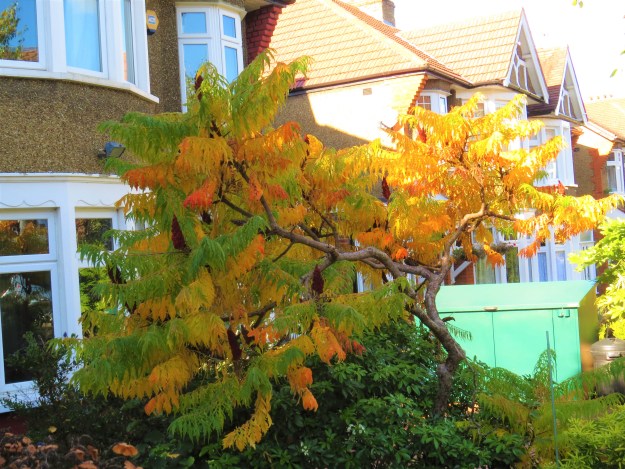
But there seems to be a fashion for Staghorn Sumac on this road, something I haven’t seen very much in other places. I wonder if someone planted one, and everyone else thought how splendid it looked in autumn?

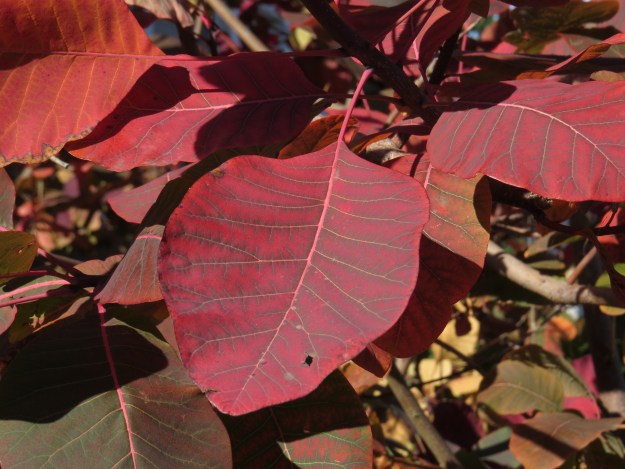
And this is a very splendid smokebush (Cotinus), especially against the blue sky.

There are some very gravid spiders about too.

But what makes me really happy is this sign, because it shows that hedgehogs are finally coming back, even if they are at risk of being squished. How thoughtful to put up a warning! I hope that drivers pay attention.

And finally, as we walk back along the edge of the garden centre, the Pyracantha is magnificent. Will this be a waxwing year? These occasional migrants absolutely love these berries, and often turn up in hedges like this. Fingers crossed.


Eating to Extinction by Dan Saladino

Dear Readers, I am only part way through this book, but I wanted to share with you a story from it that I found extremely moving. Saladino is writing about various foodstuffs that are becoming extinct as we tend more and more towards a global monoculture – all of our bananas are clones of one variety, for example, and our cereals and other staple foods are barely any better. The author describes how, within living memory, different regions would have unique cereals, vegetables and fruit that grew happily in the local microhabitats, but how nowadays four companies control global cereal production, providing seeds that are hybrids and so don’t breed ‘true’, meaning that farmers have to buy new seeds every year, instead of saving them as they used to. Many of these varieties require much more fertiliser and pesticide than the original plants. The same goes for domestic animals, where again the multitude of breeds specific to a particular part of the world are disappearing – it’s estimated that 95% of America’s dairy herd are Holsteins, for example, and I suspect that the numbers are not much more diverse in the UK.

So far, so depressingly familiar. What I didn’t know, though, was the story of visionary  Nikolai Vavilov (1887 – 1943), who, as Saladino explains, was the first scientist to make the link between food security and plant diversity.

Vavilov coined the term ‘centres of origin’, believing that all the crops that feed us today originated as wild plants somewhere in the world, and that a plant’s origin is where its diversity will be greatest. That diversity will include plants that have pest resistance, or drought tolerance, or a multitude of other genetic attributes that might save us in the event of catastrophe.

One of these centres of origin was the ‘East Asian centre’, where Vavilov estimated 20 per cent of the world’s cultivated flora had evolved (including millet and soybeans). Another was the Inter-Asiatic, where wheat, rye and most of our fruit came from. The Central American centre was home to beans, pumpkins, cocoa, corn and avocados.

To check his theory, Vavilov travelled for 25 years on 180 expeditions, spending much of the 1920s and 1930s on horseback, travelling through the Soviet Union, Afghanistan, Iran and Korea, across Spain, Algeria and Eritrea, and then on to Central and South America. Vavilov and his colleagues, working tirelessly, collected over 150,000 seed samples, and housed them in the world’s first seed bank, in what was then St Petersburg.

Vavilov realised that many of the habitats that the plants were taking from were disappearing due to urbanisation, industrialisation and increasingly intense agriculture. He recognised the risks inherent in monoculture – the Irish Potato Famine had showed what could happen if just one variety of a plant was relied upon for sustenance, and there had been crop failures in Russia that had led to widespread loss of life.

Alas, Vavilov found himself on the wrong side of a bitter feud during the late 1930s. Soviet biologist Trofim Lysenko had a theory that plants could be ‘educated’ and forced to be more resilient if exposed to harsh conditions, a belief that had more to do with Communist ideology than genetics. Vavilov fell out of favour with Stalin and was sent to a prison camp in Siberia.

His seed collection came close to being lost during the 28-month long Siege of Leningrad (St Petersburg) in 1942-44. The Soviets had plans for protecting the works of art at the Hermitage, but didn’t see the point in protecting the seedbank. The Nazis saw it as a possible source of food for the Russians, and planned to target it. But Vavilov’s fellow scientists had been so inspired by him that they moved hundreds of boxes of seeds to a basement and took shifts inside the dark building, in sub-zero temperatures, to protect the collection.

As Saladino says, what happened next is well known to botanists, but it’s a story that we should all know. In his words:

Surrounded by seeds they could have eaten, the caretakers of the collection faced hunger rather than jeopardise the genetic resource. By the end of the 900-day siege, in the spring of 1944, nine of them had died, including the curator of the rice collection. He was found at his desk surrounded by bags of rice. ‘We were the students of Vavilov’, one survivor said, explaining their heroic efforts to protect the seeds. By then, Vavilov was already dead. In 1943, at the age of 55, he was claimed by the very thing that he had spent his life working to prevent – starvation. He died in a Soviet prison and was buried in an unmarked grave”.(Page 54)

In these times of changing climate, it is more important than ever to respect and nurture biodiversity. Putting all our eggs in one basket has never looked like a more stupid tactic. Vavilov was a true visionary, and was ‘rehabilitated’ in 1955, with the seed collection that his colleagues saved in St Petersburg now bearing his name. He also has a crater on the far side of the moon named for him and his brother. Let’s hope that the ideas that he championed, which have already resulted in seedbanks all over the world, will continue to gain traction. Goodness knows, we need all the diversity that we can get.

‘Eating to Extinction’ is a wonderful book, full of interesting and thought-provoking stories. I’m sure I’ll return to it in a later post.

Sciencing Day Four….

Dear Readers, you might remember that I am just about to start an experiment for my Open University biology course, which requires my local birds to cooperate and to eat some sumptuous multicoloured doughballs that I’ve made, packed full of lard and bird-friendly peanut better and homemade mealworm flour. Well, the tray above is the result of my endeavours – this morning it was picked clean before the sun was even up. But who are the early risers? I haven’t yet actually caught them in the act, but a pair of magpies have been showing a great deal of interest in the garden, and tonight I heard both jackdaws and crows on the local rooftops. Collared doves and woodpigeons have also been popping down for a look. Sadly, the experiment is all about colour preference rather than the species of the bird that pops down, and as they now seem to clear the lot it seems that they don’t care one jot whether the dough is red or yellow.

However. On Monday morning, I looked out of the window to see that every single red dough ball had gone, leaving all the yellow ones. I had been very silly though, and had put all the red balls on one side of the bird table, and all the yellow ones on the other, so I suppose a bird could have methodically cleared away the ones nearest to him or her and then been disturbed. I have been careful since to provide equal numbers but all mixed up.

As you can see, at the end of a working day (today I have wrestled a £3.2m project to the ground just in time for final reporting) I am maybe not as meticulous about the size of the doughballs as I would normally be. I must perfect my dough-rolling for when the experiment actually starts, which will be on Sunday I think, now that someone is actually eating them. I hope to get some photos of the little darlings in the act very soon. But for now, let’s hope the weather isn’t too wet. Cleaning soggy doughballs off of the bird table is no one’s idea of fun.

The Season Turning….

Dear Readers, in the interests of retaining my (limited) sanity, I am trying to go out for a brisk walk around the block at lunchtime, and it’s amazing what you can see in ten minutes, even in the relatively urban surroundings of East Finchley’s County Roads. This rowan is absolutely busting out with berries.

My poor old busted tree is looking very pretty in its autumn finery.

And look at this very friendly blue cat. She sometimes turns up in my back garden, but I have completely forgotten her name.

Someone has done such a lovely job of this front garden – previously it had two enormous conifers (Leylandii I suspect), but now it’s as cute as a button. There’s lots here for pollinators! I’m most impressed.

We’ve had a number of new trees planted, including this ginkgo, which looks just about ready to start turning butter-yellow.

But at the end of the day, it’s all about the leaves. Going for a walk every day means that I should be able to take real notice of the way that they’re changing, and it (almost) compensates for the way that the nights are drawing in.

Good Heavens!

Calceolaria uniflora, or Darwin’s Slipper

Dear Readers, I spotted this photo on Facebook earlier this week, and it stopped me in my tracks – it looks for all the world like a gang of happy Muppets running down to the sea for a paddle. But, in fact, it’s a plant, and furthermore one that you might have had as a houseplant – I remember Calceolaria being very popular when I was growing up.

Calceolaria pot plant (Photo by Bernard Spragg. NZ from Christchurch, New Zealand, CC0, via Wikimedia Commons)

Otherwise known as lady’s purse or slipperwort, in the wild Calceolaria species can be found from Mexico to Patagonia. I inadvertently described the plant as an orchid in my Facebook post, but actually this is a member of the Scrophulariaceae or Figwort family, most of whom are very unobtrusive and are pollinated by various bees and hoverflies.

Scrophularia nodosa (Figwort)

The Darwin’s Slipper is a Patagonia specialist, and is pollinated by a bird called the Least Seedsnipe (you couldn’t make this up, clearly).

Least Seedsnipe (Thinocorus rumicivorus)

The Least Seedsnipe pecks at the white ‘lower lip’ of the Darwin’s Slipper, and while that’s happening, the plant is depositing pollen on the back of his or her head. What a splendid example of co-evolution this is! The bird is rewarded with rich, energy-giving nectar, and the plant gets to scatter its pollen as widely as the bird flies. What fascinates me is that this bird is not normally a nectar-feeder, but eats seeds, as its name suggests. This plant seems to have seduced the seedsnipe into changing its behaviour, something that occasionally happens with other species – the crown imperial, for example, is now sometimes pollinated by blue tits, who are normally insectivores.

Darwin’s Slipper, showing the white ‘pecking spot’ (Photo by By Michael Lejeune – Self-photographed, CC BY-SA 3.0, https://commons.wikimedia.org/w/index.php?curid=3133546)

I have always been fascinated by Patagonia, though it is a very, very long way away for a visit. Maybe I’ll just have to be content with looking at photos of these extraordinary plants.

Photo by By Thomas Mathis – Own work, CC BY-SA 3.0, https://commons.wikimedia.org/w/index.php?curid=1026481


Sciencing…..

Dear Readers, what you see in the photo above is the result of two hours work, a lot of swearing, a Kenwood mixer driven to the edge of madness and various ethical dilemmas around what to feed my long-suffering birds. Yes, it’s my OU ‘prey discrimination test’, which works by offering birds food in two different colours, and then noticing which they prefer.

You might remember that last week, when I first mentioned this, I was concerned about the food colouring used. After doing some research (after all, what are university libraries for?) I discovered that the issue with the red food colouring used in hummingbird feeders in North America related to a particular artificial colouring called Red 40. But anyway, I shopped around for the most ‘natural’ colourings that I could find, and found one which is basically cochineal and glycerine, and another which uses turmeric. The ‘red’ version is therefore not pillar-box red, as you can see, but I’m sure it’s different enough for my purposes.

Then I wanted to tweak the recipe. In the original, it’s basically just flour, water, lard and food colouring, but I added some mealworm flour and some ‘flutter butter’ (peanut butter for birds with no salt).

How, I hear you ask, do you buy mealworm flour? Well, in my case I get a handful of dried mealworms and whizz them up in my spice mill. Don’t tell my husband. Actually, I’d always been a bit sceptical about people willingly eating insects, but as a powder I don’t think you’d know – it looked and smelled a bit like bran. I don’t really want us to be eating our six-legged friends, but as a way to produce protein that doesn’t destroy the planet it might be a winner.

Anyhow, then I threw half the mixture into the Kenwood Mixer (last used to make focaccia but it didn’t seem to mind) and used various hooks and mixing devices to try to get a dough, and an evenly-coloured one at that. Getting the texture right is always tricky – too wet and it’s difficult to handle, too dry and you can’t get the colour mixed in correctly. Speaking of colour, after I’d made the ‘red’ dough the kitchen looked as if they’d been a nasty knife attack, and I’ve thrown red colouring all over my favourite jumper, so now it looks like a crime scene. I guess that’s what aprons are for (doh).

The yellow colouring was much more biddable, and apart from what I suspect are some permanent stains on my work top, all has gone well.

So here we have two massive amounts of dough, and the next thing to do is to persuade the birds to have a nibble. I put some pea-shaped amounts outside, and a woodpigeon has inspected them and left in disgust. I hope that isn’t going to be the general reaction, but with birds you never know. The experiment itself doesn’t start for a few weeks, so hopefully by then it will be acceptable. Wish me (and the birds) luck….