The James Cropper Wainwright Prize Longlist – Nature Writing

Dear Readers, this is probably my favourite writing prize of the year, and this year’s longlisted books look like a fine, varied selection. They are:

Belonging’ by Amanda Thompson – described as ‘a personal memoir about what it is to have and make a home. It is a love letter to nature, especially the northern landscapes of Scotland and the Scots pinewoods of Abernethy.’ I love this part of Scotland, and will be interested to read Thompson’s book.

‘Ten Birds that Changed the World’ by Stephen Moss – Moss is a prolific and accomplished nature writer, and birds are his particular passion.

‘The Swimmer – The Wild Life of Roger Deakin’ by Patrick Barkham – This biography of one of my favourite nature writers is a real must-read for me.

‘The Flow – Rivers, Water and Wildness ‘ by Amy-Jane Beer – I very much enjoy Beer’s regular column in British Wildlife, she is always thoughtful and well-informed, so this is well up my list.

Where the Wildflowers Grow – My Botanical Journey Through Britain and Ireland’ by Leif Bersweden – I do love a good journey, and it will be interesting to compare this to Mike Dilger’s ‘botanical journey’, A Thousand Shades of Green.

‘Twelve Words for Moss’ by Elizabeth-Jane Burnett – This sounds intriguing. Moss is ubiquitous but overlooked, and Burnett is a poet and academic as well as a non-fiction writer. The book is also part memoir following the loss of Burnett’s father, so this resonates on a personal level.

‘Cacophony of Bone’ by Kerri Ni Dochartaigh – Ni Dochartaigh’s first book, ‘Thin Places’ was Highly Commended in the 2021 Wainwright Prize, and this book too, set in the heart of Ireland during the pandemic, sounds as if it is very specific about place, but universal in its themes of home, what changes and what doesn’t, and hope. I can’t wait to get my reader’s teeth into this one.

‘Sea Bean’ by Sally Huband – Set in Shetland, this is Huband’s first book, but she is an ecologist and naturalist, and her story, of how beachcombing during a difficult pregnancy enables her to explore not just natural but human history, sounds like a very interesting read. Plus, how I long to go to Shetland! Maybe one day.

‘A Line in the World – A Year on the North Sea Coast’ by Dorthe Nors, translated by Caroline Waight – Now, this is something a bit different. Nors was born in Jutland, and her fictional work ‘Mirror, Shoulder, Signal’ was shortlisted for the Man Booker International Prize. In this book she examines the wild coastline from Northern Denmark down to the Netherlands. It’s interesting to have a book in translation on the list (I’m not sure I can remember it happening before) and it’s an area that I don’t know, so I’m looking forward to it.

‘Landlines’ by Raynor Winn – Many people were entranced by Winn’s first memoir, ‘The Salt Path’ about being made homeless and walking the South-West Coast Path with her ailing husband, Moth. In this book, they set out to walk from North West Scotland back to the south west. I found the first book very moving, so it will be interesting to see how this one compares.

‘Why Women Grow – Stories of Soil, Sisterhood and Survival’  by Alice Vincent – In this book, Vincent writes about women and their relationship with gardening and the earth. She speaks of a ‘deeply rooted desire to share the stories of women who are silenced and overlooked.’ I am looking forward to reading it very much.

And finally….

‘The Golden Mole’ by Katherine Rundell, with illustrations by Talya Baldwin – I have been looking at this book every time I spotted a copy in a bookshop. It really is beautiful, and I very much enjoy Rundell’s writing – she manages to find something fresh and new even in topics that I think I know lots about. She also wrote a book with what must be the best title of recent years – Why You Should Read Children’s Books, Even Though You Are So Old And Wise. That puts me in my place, for sure.

So, Dear Readers, have you read any of these yet? What do you fancy for the shortlist? And if you do want to read them (like me) you need to get a move on, as the shortlist is announced on 10th August, and the final prize on 14th September. There are another 12 books on the Conservation Longlist, and yet another 12 on the Children’s Longlist, (you can see all the titles here) but I think realistically the Nature Writing Longlist is about all I can cope with this year. For the first time ever, all three longlists are dominated by female writers, so maybe the age of the ‘lone enraptured male’ is giving way to a range of voices, which can only make things more interesting.


Obergurgl Day Thirteen – The Last Day, and Some Exciting News….

View down the valley this morning…

Dear Readers, it’s an unalloyed truth that however horrible the weather has been for the past two weeks, on the last day the sun will come up and the Oetz valley will look as beautiful as it’s ever looked. It will be even better tomorrow, for sure. I think the weather gods do it on purpose to remind us of how beautiful this place can be, and to encourage us to come back next year. And so today we decided to wander through the meadows for the last time this year, and so off we trotted.

The river Gurgl is looking very fine in all its incarnations. I’m guessing that the name is onomatopoeic, but it should actually be ‘roar’ rather than gurgle, at least at this time of year when all the snow is melting.

I haven’t seen many beetles this year (the rose chafers are my favourites and can often be spotted on the melancholy thistles) but there are masses of other pollinators about.

And just look at the mountains!

One reason that the meadows are so spectacular is that people are very respectful of them – no one runs through them, and dogs are kept off.

Many of the Highland cows are feeling the heat, but at least they have some shade…

I think this plant might be European Goldenrod (Senecio virgaurea) – it grows right across Europe, North Africa and Asia. and is held in high regard as a medicinal plant.

European Goldenrod (Senecio virgaurea)

And how about this beauty – Jacob’s Ladder (Polemonium caeruleum). I hadn’t noticed it in Obergurgl before, but it’s another flower of clearest blue. It likes damp places with some shade, so it’s not surprising that it was in dense cover beside the Gurgl.
 

And here is another butterfly on Melancholy Thistle – not sure what species this one is, so feel free to chip in if you know! Its wings remained resolutely closed, which wasn’t helpful.

And then on, across another tributary of the Gurgl…

This little Houseleek was growing in the middle of the river on a massive boulder. If you follow the river down, you reach the cascades at Zwieselstein that we visited on our second day.

And then we reach the Frog Pond – we’d walked right past this earlier in the week without paying the slightest attention, but today we actually stopped, and sat, and watched the many, many tadpoles going about their business. It makes me homesick for ‘my’ frogs in East Finchley. I suspect that there will be a need for a whole lot of duckweed removal on Sunday.

The Frog Pond

And what’s that terrible noise in the background? Well, the warm weather can mean only one thing – time to cut and bring in the hay, and there were several tractors/cutters doing exactly that. On the steeper slopes people use hand-held mowers or even scythes, but the flatter fields get done by more intensive methods.

Two people and a ‘helpful’ sheepdog mowing a field

A bigger field mown by tractor

And who is this, taking advantage of fallen seeds and small insects? I do believe it’s a fieldfare. I had no idea that they came this far south.

Fieldfare


And then, because of a landslide which means that we can’t proceed any further, we get the bus down to Solden for some lunch at this spot.

We like it because there’s always something going on – there are mountain bikers heading up the Gaislach to use the trail down, there are house martins and alpine swallows nesting in the Parkhaus opposite (as there have been for many years), sometimes a parade of multi-coloured Porsches come past, and the food is good and cheap-ish for the Oetz Valley.

And then, since we’re here we clearly have to go up the Gaislachkoglbahn again. It would be churlish not to.

View from the top station of the Gaislachkoglbahn (that’s part of the James Bond Museum to the right)

Yet again, we had some very chatty people in our gondola to the top, not helped by the fact that suddenly the theme tunes from the James Bond movies started to play. Dad always loved James Bond, and every Christmas involved getting into the Christmas spirit by watching Sean Connery indulging in the usual sex and violence. Still, the music for some of those films was great. Who can forget Louis Armstrong’s ‘We Have All the Time In the World’?

And that seems like a rather nice segue into my exciting news – I’ve decided to retire! Because we don’t have All the Time in the World, and there are a lot of things that I want to do – travel a bit more, devote more time to my degree, find some more exciting things to share with you, Readers, here on the blog, and even learn some German so that I’m not completely flummoxed every time I look at a road sign. I also want to do  some more work in the East Finchley community, especially regarding our wood and new meadow.  So, I leave my job on Friday 15th September (hopefully giving them enough time to find a replacement, and for me to help train them up). It feels like a bit of a leap in the dark, but I have no doubt at all that I will wonder how on earth I found the time to work once I’ve given it up. I realise how fortunate I am to be able to grab back a few years (I’m 63, so my actual retirement age is 66), and I intend to make the most of it. Any thoughts, those of you who are contemplating/have already retired? Do share!

For one thing, it always feels like I’m just about getting in the swing of things here when it’s time to go home. 3 weeks in Obergurgl next year, maybe?

Obergurgl Day 12 – Rain!

View from our balcony

Goodness, Readers, when it rains it really rains in Obergurgl. Here I am on Thursday afternoon looking out at the view above, and you literally can’t see a thing. Last night there were some very fine storms that happened more or less all night, and here’s a brief excerpt of the rainfall (sound up!)

Still, it’s one reason that the hills around here are so green, so we shouldn’t really complain. This morning we popped out during a brief interlude of dryness and headed up the Hohe Mut lift to see what was going on. There was a little bit of blue sky for about twenty minutes (sunglasses on!)

We spotted several marmots, but only got a blurry photo of this one. Who knew that the Hohe Mut lift would become the key location for marmots this year? Sadly, a new bike track is being built, so I imagine they’ll all have moved again by next year…

Blurry marmot!

I spot a raven circling above the Gaislach valley (to the left of the hut) so hotfoot it over to see if it’s still around. And of course I need to  take a few more photos of the Hohe Mut saddle and the Gaislach and Rotmoos valleys on either side.

There are little pockets of gentians here – I wish I could bottle up that extraordinary blue for when I’m back in London. Nothing comes close and the photo doesn’t do it justice.

We pop along to the Hohe Mut Alm for a cuppa, and watch as the cloud starts to come in again.

The Hohe Mut Alm

The view along the Rotmoos

The cloud percolating back along the valley

And then there’s the lift back down.

And on the way we pass this blob of snow, which has been puzzling me somewhat. I’m wondering if it has a blanket on it, like the ones we saw in the Tiefenbach glacier? See what you think. It looks a bit curly at the edges to me, which might indicate a nylon glacier-duvet…

And then it’s down to the Backerei (Bakery) for a cappuccino. It closes between 12.30 and 14.00 every day, which is a bit inconvenient but then it is run by one woman all on her own, and she definitely needs a break. I love just sitting here, watching the buses coming and going and the drivers getting into arguments about whether the Piccard monument is the centre of a roundabout or not. Plus today there was a huge red coach parked in one of the local bus stops, en route back to Hamburg, and the Guide was an enormous chap wearing lederhosen and a hat with a feather in it. Don’t let anyone tell you that village life isn’t full of excitement.

Obergurgl Day Eleven – The TOP Mountain Motorcycle Museum

Dear Readers, even if you are not a big fan of motorbikes there is something so impressive about the TOP Mountain Motorcycle Museum that you can’t help but find something interesting to look at. What a labour of love (and money) this place is! It burned down in January 2021, but reopened in November 2021, and you can catch the Timmelsjoch bus from Obergurgl and pop up here for a look. It’s also free if you have the Otzal card (otherwise it’s 15 euros for adults). There is also a very nice, but rather pricey restaurant, and you can catch the cable car up to the top of a nearby mountain.

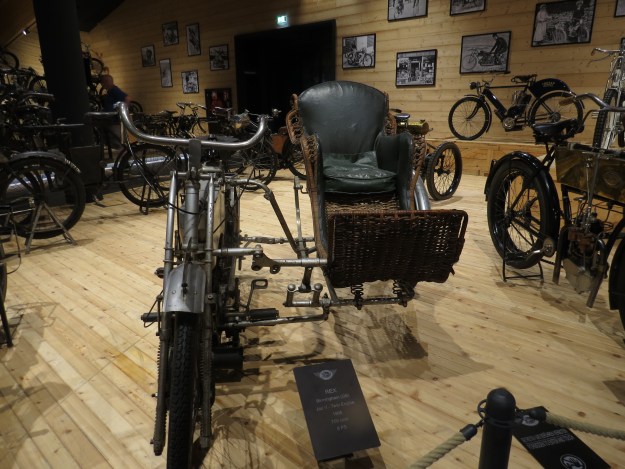
Today, however, the weather was so abysmal that we decided to stick with the motorcycles. My Dad was a big fan, and I was trying to remember what make our motorbike and sidecar was – we would go everywhere with Mum riding pillion and me, my brother and my Nan in the sidecar. So seeing things like this made me realise how squashed we probably were.

I loved some of the old motorbikes, which looked literally like a bicycle with a rocket attached. Others appeared to have armchairs instead of saddles.


Some appeared to be bathchair/motorcycle hybrids. I imagine travelling in the ‘side car’ would have been quite stressful on a downhill incline.

Of course, sidecars could transport objects as well as people.

The Museum has a ‘Motorcycle of the Month’ – this month it’s this rather fine Honda.

And they have this very fine Indian (name of the company) custom motorbike in pride of place at the end of the museum. If you fancy it, you can also ‘ride’ down from the Timmelsjoch pass, with its multiple hairpin bends, on some stationary bikes in front  of a gigantic screen. You can also press various buttons to hear what the bikes sound like, which is rather cool. Of course, there are now electric motorbikes, but I don’t remember seeing any in the Museum (I might just have missed them). I have a feeling that the smell of the petrol and the roar of the engine might be part of the appeal.

Downstairs in the Museum there’s an exhibition about Austrian travel writer and explorer Max Reisch, who travelled pretty much the whole world in the 1930s and 1940s on various motorbikes and cars. There was a film showing some of his exploits in Afghanistan, India and China, and they pretty much all involved lots of local people digging him out of the mud/helping him through swamps/pushing him uphill/pushing him downhill. I wonder how many of the customs that he documented still exist? In what used to be Indo China, for example, people had an interesting rowing style where they wrapped their leg around the oar and used the power of their lower body to row the boat – they had the equivalent of dragon boat races and seemed to get to a remarkable speed, so it was clearly quite a good way of doing things.

Max Reisch’s expeditions in the 1930s and 1940s

Max Reisch’s car

Max Reisch’s motorbike

This museum is pretty much the work of Alban and Attila Scheiber (remember that name? The Scheiber family also own many of the hotels and lift complexes in the area), and if you had any doubt that they are motorcycle fans of the first order, you have only to visit the toilet.

Puch early motorcycle permanently parked in the WC

And so, the weather dried up, and we headed home, completely motorcycled out but pleased to have seen the museum. Well worth a couple of hours if you’re in this area and it’s a rainy day (or more if you’re a petrol head :-)). I enjoyed it more than I expected to, and it was only the fact that there is no bus between 11.17 and 13.47 that stopped me having a lazy lunch and then heading up the attached cable car. Something to remember if you’re ever holidaying in these parts.

Obergurgl Day Ten – The Tiefenbach Glacier

Dear Readers, the temperatures are in the low 80s here in the Oetz valley today, and so we decided to go somewhere a bit chillier – the Tiefenbach Glacier, which lies south-west of the village of Söelden. During the winter it’s a very popular skiing venue, but during the summer it looks a little bit sad and unloved compared to something like the Gaislach area that we visited last week, with its state-of-the-art lift infrastructure and mega-cool glass cube restaurant. To get here, you get the Gletscherbus, which is an experience in itself – (handy hint – if you don’t want to stand up for the full 25 minutes and multiple terrifying hairpin bends it’s best to get on fairly close to where the bus starts at the north end of Söelden). The bus careers around bend after bend, through pine forests, over various cattle grids (usually at breakneck speed) and then onwards and upwards. First stop is the Rettenbach glacier, which has a cable car, but which doen’t open until 7th August, a day after the Tieffenbach cable car closes. Such are the machinations of the local lift owners – I suspect there would be enough custom for both,  but clearly the profits are doled out in a very particular way.

Anyhow, when you eventually get to the car park for the Tiefenbach (with slightly sweaty palms if you’re anything like me), there are toilets, and a café (the aircraft-hangar sized restaurant used to be open in summer, but these days the lovely people in what looks like a yurt supply the caffeine.

The Tiefenbach cafe

The talk this year is all about the heat. The man serving the cappuccinos said that it was going to be 32 degrees back in Söelden, and nearly 40 degrees in Innsbruck. I always bring a fleece to the Tiefenbach but this is the first time that I haven’t needed it.

Then we attempt to get onto the cable car. This proves to be a problem as the turnstile can’t read our Oetzal cards (these give you free buses and lifts in the valley for the duration of your stay). The young man looking after the lift took the passes away, fiddled about but still the computer said ‘no’. The lift mechanic came out to help us but to no avail. Finally we were waved through.

The lift itself is the most elderly in the valley – it’s low enough that you have to stoop to get into it if you’re over six feet tall, and the glass is scratched, plus the lift makes a slightly worrying grinding sound. Still, I managed to take a few nervous photos, mostly to take my mind off the prospect of the lift stopping. Which it then did, twice on the way up and twice on the way down. Usually this is just because someone needs a hand getting on, or they’re loading up supplies to go up or down the cable, but this time there was no obvious reason at all. There’s something quite disconcerting about just swinging there, and it gives one (well me anyway) plenty of time to notice just how high up you are.

Not to worry though! They are putting blankets over certain parts of the glacier, I assume to try to preserve them from the worst of the sun/rain, and I’m sure that would cushion our fall. In fact, the main element seems to be that the white colour reflects the sunlight, preventing the glacier from warming up and inhibiting melting – when the snow starts to fall again in autumn, the blankets are removed so that the snow layer can continue to build up. Holy moly, though, what a state of affairs. Apparently the Swiss have covered an entire glacier in blankets for just this reason. 

The blanketed glacier

The rocks are very pretty – rusty-coloured in a way that makes me think that there’s a lot of iron about.

Some more blanketed glacier

Anyhow, we spring (carefully) out at the top. What an amazing view!

And there is this nerve-tester, which I like to admire from a distance. John sometimes wanders out, but the floor is glass, and it’s very narrow. Maybe one day….

And then it’s back to the lift…

…and back down to the car park, with a fine view of a snowplough ploughing some snow. I seem to remember that there’s sometimes summer skiing here, but not today.

Small red snowplough travelling at speed!

And so then it’s back on the bus, and down to the tropical (ish) temperatures of Soelden for an eiscaffee and an apfelsaft gespritzt (coffee with icecream and cream and a fizzy applejuice). Not much walking today (though we might go for a trot around the meadow after dinner), but fun nonetheless. 


Obergurgl Day Nine – Almost to Am Beilstein

Dear Readers, this has been a bit of a frustrating trip in some ways – catching a cold/cough on Day Two was a pain, and then for the past few days it’s been very hot and humid, which makes walking, particularly uphill, something of a challenge. Still, we thought we’d have a bash at the Am Beilstein walk today – it passes some very fine waterfalls and takes you to an outlook over the Gurgl River, towards the Gurgl Glacier. Spoiler alert! We didn’t get there today, but you can read about our 2015 trip here. What’s interesting about Am Beilstein itself is that it’s thought to be part of a prehistoric path used by hunter gatherers, and then by ancient farmers – there is a sheep compound there which dates back to the Twelfth century (see the photos at the end of the post)

This is a walk of subtle pleasures – there’s a long and tricky track up, which involves spending a lot of time looking carefully at where you’re going to put your feet, and of course this turns into a long and tricky track back down. But it was the track up that was the problem this time. I seemed to have a real problem catching my breath, but initially decided to keep going slowly and see how it panned out.

The view along the river

The peak of Hangerer looking very fine in the distance

Well, we got to three-quarters of the way up, and I started to feel a bit faint – discretion is definitely the better part of valour on these occasions, and so I plonked down on a rock. After a few minutes I felt better enough to notice how the rocks around here form a whole ecosystem all on their own.

And then John noticed a very active spider.

She seemed to be spinning a web of long threads between the individual strands of grass, more like a set of Mission Impossible trip wires than a proper web. I loved the way that she just launched herself from one stem to another, completely ignoring the huge humans who were sitting inches away. By the time I’d finished watching her, I was feeling much better, and had also made the very sensible decision that I’d had enough for one day. I’ve done harder walks than this during this holiday, but I think it pays to listen to how you’re feeling, and hopefully tomorrow will be a bit cooler, and the walking a bit easier.


It is hard to turn back, but maybe it’s a skill that we need to cultivate. One of the challenges of life is knowing when to push through, and to when to stop, when your body is just complaining gently and when your body is ringing alarm bells. I have seen too many people push past their limits here, and end up in hospital, or unable to enjoy the rest of their stay. I’m determined that one of them won’t be me.

So goodbye for this year, Am Beilstein. Maybe next time!

The view from Am Beilstein in 2015

The 12th century goat/sheep compound


Obergurgl Day Eight – The Ötztaler Cycle Marathon

Dear Readers, we are in Obergurgl for one of the sporting highlights of the summer season, the Öztaler Cycle Marathon (or Radmarathon which sounds even cooler to me, though I suspect that ‘Rad’ means ‘Road’ rather than anything more exciting). It covers 227 kilometres, and over 5500 metres of ascent and descent, including the Brenner, Timmelsjoch and Jaufen passes, and the Kuhtai saddle). The fastest cyclists will do the whole lot in less than seven hours. It makes me feel exhausted even reading about it. It’s warm today too – in the mid twenties here in Obergurgl, so it will be a lot warmer down the valley in Söelden, where the race starts and finishes. As I write this, the first man across the line was Manuel Senni  who managed the whole lot in 6 hours and 49 minutes, with Janine Meyer first woman across the line in 6 hours and 55 minutes. It makes me feel exhausted even reading about it, but 4400 people started the race this year, and the last ones will complete it around 21.30 tonight. In some ways it feels like an even bigger achievement if you aren’t a super athlete. Good luck to all of them!

For us here in Obergurgl however, the road closures mean that we are somewhat confined to quarters, with no buses and most of the lifts and huts closed too. Fortunately we’ve decided to have a little rest day, as various parts of my body are complaining, as they do, and this cold seems to be lingering on. What a pleasant day for a walk in the good old Zirbenwald, though, followed by a coffee at the Zirben Alm. This used to be called David’s Hutte and was not a very happy place when we visited, but there are new owners and it feels much more welcoming, though I’m not sure if there isn’t something a tiny bit sinister about that smiley face.

On the way back down, I stop to take some photos of the various shrines along the way. In some places, these are placed beside roads where accidents have happened, but in Obergurgl I think that they are more meant as remembrances of people who have passed, and as reminders of Jesus and Mary, and the local saints such as John of Nepomuk. They are very beautiful, and often appear in unexpected places.

This one is at the entrance to the Zirbenwald.

This one is on the bridge before the Zirben Alm, and below it there is a small collection of engraved padlocks. It doesn’t seem to have grown much since I first noted it a few years ago, which is probably for the good – there are bridges in Paris and Prague where the whole superstructure has been compromised by the weight of all that romance. There must be a metaphor in there somewhere…

And then there’s this one, which I hadn’t noticed before – the carving of the Virgin and Child is really lovely. This is a valley of woodcutters, so it’s nice to see the tradition being continued.

And then it’s back to the hotel to have a cheese roll on the balcony and watch the swifts, who clearly have a nest nearby. I didn’t realise until recently that they basically hoover up insects until they have a kind of ball of food in their crop, to bring home to their nestlings. We spotted the lesser kestrels who live in the valley yesterday, and when one of them appeared the sky cleared of birds, even though the kestrels live on  small mammals. I hope to get a photo of them at some point to share with you, but they were feeling uncooperative today, and who can blame them?

I spent some time watching the tiny bit of path down from the Hochgurgl lift which should contain cyclists, but they are either too fast or taking an alternate route, because I didn’t see one. I did see a helicopter though, so I can’t have been too far off the mark. Fingers crossed for a safe and happy outcome for all the participants.

Obergurgl Day Seven – Hochgurgl to Obergurgl, and Attacked By Goats!!!

View from the start of the walk.

Dear Readers, today we took a bus to Hochgurgl, which is an ‘interesting’ ride – it’s hairpins all the way, and you are sharing the road with cyclists who are plodding their way up the curves, motorcyclists who are frustrated with being behind a bus and so overtake without being able to see what’s coming, and vehicles coming down much too fast, who are then surprised at how much room it takes for a bus to get around a tight corner. Still, we arrived in one piece at the old Hochgurgl Lift middle station – it’s sad to see it unused in the summer, especially as it used to give easy access to some of the valleys around here.

The Hochgurgl Middle Station

In the winter there is a toboggan-run, which starts from this hut, currently occupied by a shade-loving cow, who was eating all the green shoots that were popping up underneath.

I love this walk. We said hello to the snow blowers, which sit here in the summer like so many jet engines just waiting to take off.

I love this walk – usually, when we get to this point, there are ponds with tadpoles and dragonflies, but this year there’s just mud, which surprises me as we’ve had a fair bit of rain.

And, after a bit of uphill, I suddenly remember how much downhill there is on this walk – you can see the path in the photo below, and this is only the start – the path winds on through the woods all the way to Obergurgl. It can be a bit hard on the knees and ankles (and toes if your boots aren’t tied up properly). It goes down, crosses the next valley (the Konigstal) and then down again.

But this path is also a great site for black vanilla orchids(Gymnadenia rhellicani), one of my favourites. I managed to get a blurred photo (probably being so close to the edge of a precipitous drop didn’t help), but I’ve also attached a decent one. They are said to smell very faintly of chocolate.

Black Vanilla Orchid

Photo By © Hans Hillewaert, CC BY-SA 3.0, https://commons.wikimedia.org/w/index.php?curid=5463004

It’s these little things that are what I come to Austria for – the sheer abundance of plant life just popping up along a footpath, and probably going largely unnoticed.

At the entrance to the Konigstal you have to cross a rather rickety bridge over a vigorous mountain stream. A few years ago it had been washed away and so you had to walk up another couple of hundred metres and then cross the torrent. It’s always a relief to see that it’s actually in place.

And then the descent becomes much steeper, and wetter and more slippery. Oh joy! As we head into the trees, I can hear multiple nutcrackers calling but couldn’t see a single one. However, I did find this feather as a momento. I do hope that I catch more than a glimpse of a whole bird one of these days.

Nutcracker feather

Nutcracker (Nucifraga caryocatactes) Photo By Dominik from Poland – Spotted NutcrackerUploaded by Toter Alter Mann, CC BY 2.0, https://commons.wikimedia.org/w/index.php?curid=18467127

So, after all this excitement, we spotted this lot laying about in a leafy glade.

The second that they saw us their ears pricked up, and then the whole lot stampeded across the undergrowth towards us. Well I’m not usually fazed by domestic animals, and I used to have quite a lot to do with goats in a previous life, so I was more amused than anything. However, I had forgotten that John still had our lunchtime cheese rolls in his backpack. The Billy goat took one sniff of John and started to rub his horns against him very forcefully, while all the female goats galloped past and then stood there to see what would happen. Well it was all getting a bit much with the rubbing (and now the standing up and nibbling at the backpack) especially as we were on a very narrow path with a substantial drop on one side, and the Billy goat was a very robust and determined creature. I drew myself up to my full height and shouted at the Billy, who moved on reluctantly, and not without glancing back wistfully several times. Honestly, these are the cheekiest animals, and as a souvenir we found the ear tag of one of the goats further down the path – she seems to have the name ‘Francesca’ which is rather sweet, though she’s certainly no saint.

So we finally got back to our hotel. it’s surprising how many aches and pains you can acquire in a relatively short walk when it uses muscles that don’t usually get exercised in an urban setting, but I’m sure that a good night’s sleep and a bath will see me ready for anything tomorrow. Let’s just hope that it doesn’t involve goats.


Obergurgl Day Six – The Rotmoos Valley

Dear Readers, after a week of not feeling very well and having weather that was thundery and grey, today dawned in perfect walking weather (sunny but not too hot) so we pounded up the steep service road towards the Rotmoos valley. This is one of my very favourite walks in Obergurgl – at the start of the walk there’s the Schonweissehutte,  which was renovated a few years ago but which still serves a decent goulasche soupe.

From here, you edge past the reservoir, with it’s rather confusing warning sign. I imagine it freezes in winter, so maybe it’s a warning to intrepid skaters that this might not be the best spot. If anyone reads German, feel free to correct me.

Then it’s off along the path towards what’s left of the Rotmoos glacier. In 1872 it came to the location of the boulder with the red and white stripes in the photo below. Today, as you can see, it’s barely there at all.

So this adds a sombre note to this bright and shiny day. I remember the glacier being much more developed when I first came here in 1994. It’s shocking to see how diminished it is. The University of Innsbruck has one of the world’s most important centres for the study of glaciation, and the weather station in the valley has been here since the 1930s, continually recording data.

The weather station

But still, the flowers and the insect life here are absolutely stunning. I saw my very first gentians of the holiday…

This orange plant looks rather like our Fox and Cubs, but is a closely-related species, known here as Golden Hawksbeard (Crepis aurea).

There is the delightfully-named Crimson-Tipped Lousewort, a member of the Figwort family…

…Kidney Vetch, which we have in the UK, though I’ve never seen it in such profusion…

There are no true ‘trees’ at this altitude, but there are these little prostrate willows (Salix retusa), who survive in the poor, thin soil.

Further along the path there’s Moss Campion (Silene acaulis), hunkering down close to the ground to survive the cold and the scouring wind (even today there was a chill breeze blowing from what’s left of the glacier). The Alps are a paradise for members of the Pink family, I must have seen at least eight species.

And there’s some Round-Headed Rampion (Phyteuma orbiculare), another plant that I associate very strongly with Alpine meadows.

We were surprised not to see any marmots, though there were a few whistles from the other side of the valley. But there was this female Northern Wheatear with a beak full of bugs – clearly she has a nest somewhere near, and kept a very close eye on us. The birds spend the winter in Africa, but in summer they spread out across the rocky places of Europe. Here in Austria they often make their nests in disused marmot burrows. I’d never been able to identify these birds before, so it was lovely to be able to do so with the assistance of the European Bird Identification Facebook page.

And of course, the paths are full of butterflies and moths. Have a look at these blue butterflies, feeding on a patch of earth that I suspect had been peed or pooed on by some passing creature, leaving behind minerals that the insects needed.

And then, there is a sight that has lifted my heart every time I’ve visited Obergurgl. The local Haflinger horses spend the summer in the meadows around the village, pleasing themselves about where they go and when, and only coming back to their stable if they sense an oncoming storm. They are all palominos, and are led by an experienced mare who knows the territory and calls the shots. I honestly believe that they are some of the most beautiful horses on earth. Once I’ve seen them, I know that I’m truly back in the Tyrol.

Obergurgl Day Five – Around the Village

Edelweiss, but not as we know it….

Dear Readers, my cold is starting to improve but the weather today has been pretty appalling (though things are meant to brighten up from tomorrow). Still, there was a brief window this morning, so we popped out to have a look around the meadows and the village to see what’s new.

First up, the Edelweiss and Gurgl hotel, the oldest and arguably the most prestigious hotel in Obergurgl, has built some raised beds containing, well, Edelweiss. This is an extremely difficult flower to find around here, even on the high mountain slopes: there is said to be one location in the Gaisbergtal on some of the steep, inaccessible areas, which is just as well as it is a rare and protected plant. These days they are also cultivated for displays such as the one at the hotel. I always think that they look slightly strange and out of place if not nestled in a granite cleft, but as most people will never see one, it is at least nice to see what they look like up close.

The Edelweiss and Gurgl’s new rock garden.

The church of St John Nepomuk was consecrated in 1737 – last time we were here one of the cranes that was building the new ‘town hall’ had accidentally damaged the spire. But who was John of Nepomuk? He was a Bohemian priest who was drowned in the river Vltava on the orders of  King Wenceslas IV (presumably not the one from the Christmas carol). Apparently John Nepomuk refused to betray the confessions of the queen, which angered Wenceslas as he believed that the queen had taken a lover. St John Nepomuk is therefore designated as the patron saint protecting against false accusation and, because of the manner of his death, against floods and drowning.

The Church of St John Nepomuk

In the centre of the village is the statue of Martinus Scheiber, who built the Edelweiss and Gurgl hotel and the Ramolhaus, a famous mountain hut perched like an eagle’s nest above the glacier – he was clearly pioneer, and many of his descendants are still actively involved in tourism today. Now that the building work in the village is largely finished he is now clearly pointing towards the Ramolhaus, rather than towards a building site as he has been on previous visits.

It’s nice to see that the Tyrolean grey cattle are still kept in the village too – every morning they leave their shed to graze on the meadows, and every evening they wander back to be milked. There are pictures of the awards that the cattle have won at shows in the noticeboard outside the shed.

The cow shed

It’s easy to forget how many options for walks there are in the valley. Here is just a selection…

…and some young people were heading off for the Klettergarten, which is a series of bridges and via ferrata for assisted climbing. I admire their courage, but it’s not for me!

The meadows were looking particularly fine after the rain…

Meadow with lupins!

Damp catsear…

…and one of my favourite thistles, the Spiniest Thistle (Cirsium spinosissimum) is just coming into flower. It is most unprepossessing close up, but with the sun behind it it looks rather splendid.

Spiniest thistle (Cirsium spinosissimum)

And finally, there are a few new additions on the hotel front. There seems to be some kind of outdoor pool behind the new Grünerhof hotel, but I’m not sure if it’s for wild swimming or for plunging into after a sauna. It’s also difficult to estimate the size. I shall have to take a cheeky detour one evening to see what’s going on.

And I am very impressed with the paintings on the front of the Grünerhof too. The Grüners are another major family in Obergurgl, and I think this hotel might give the Edelweiss a run for its money!

Finally, we stop for (yet another) coffee, and I’m pleased to see that the bus drivers are doing the same. Here’s to drier weather, the passing of my cold and some more exciting walks from tomorrow.