Bugwoman is Nine Years Old!

Dear Readers, on 15th February 2014 I published my first ever blog post here at Bugwoman. What a journey it’s been! I was inspired by a course on blogging by The Gentle Author at Spitalfields Life (a great course and a wonderful blog if you haven’t come across it before). At first, I was going to only write about the wildlife and plants that I saw in East Finchley. Well, it soon became apparent that I was interested in a much wider spectrum of things than that.

The Wednesday Weed was meant to be an exploration purely of wild plants in my half-mile ‘territory’, and so it was for the first nine months of 2014. But then I realised that once winter came, it was hard to find wild plants, and so eventually I succumbed, and started writing about plants that I saw in people’s gardens, house plants and even fruit and vegetables. The things I discovered! There was an orchestra that had all its instruments made out of carrots, for example. And I really enjoyed writing this piece on the humble spider plant. Fast forward to the very last paragraph for a novel way of enjoying a shower.

I soon learned that I could extend my half-mile territory by designating a piece as ‘Bugwoman on Location’. This meant I could include my annual trip to Canada, my other annual trip to Obergurgl in Austria, and my occasional sorties to see exhibitions, animal related or otherwise. So now although East Finchley is my home turf, I can extend my antennae to take in most of the planet, which is a very fine thing indeed. To give you a taste, here is my piece on my most recent (and probably last) trip to Collingwood in Ontario, an adventure in Obergurgl and my eventful sixtieth birthday trip to Borneo in 2020, when we were running just ahead of the pandemic closedown the whole way.

Longtime readers will know that there has been a lot of loss along the way, too. Since I started the blog, I have lost both my parents and three beloved aunties, including our aunties in Collingwood. The blog gave me a chance to write about my parents as they became increasingly sick, and about my dad’s dementia. I connected with many people who were going through similar situations, and I got so much support, and learned so much, by sharing with them. The internet has a reputation as a battlefield full of trolls, but it can also be somewhere that brings people together, and that helps us to keep up one another’s spirits.

When lockdown came, it coincided with my Dad’s death. It was then that I decided that I’d blog every day, partly to give myself some structure, and partly because I knew how many people were struggling, and that the first thing that they turned to in the morning was the blog. As someone who needs external accountability to keep going, this was a great spur. It meant that I had to go out every day and hunt down something to write about. Never one to give myself an easy time, I also started on an Open University science degree, something I’d been meaning to do for ages. And so, I found myself with plenty to intrigue me, and to write about, and even though now we’re back to ‘normal’, I still feel the pull every day. What have I learned? What have I seen? What’s amused or enraged me? What is it about this day that I want to share? I sometimes liken myself to a magpie, collecting little bright objects for my collection, but to mix a metaphor I also think of the blog as the equivalent of a nature table, full of ‘stuff’ for people to dip into. And after nine years, there’s a lot of ‘stuff’! According to WordPress I have written 1750 posts, which just goes to show how far a little bit every day goes.

And so, I would like to say thank you, to those of you who’ve been following for years, and for those of you who have just found the blog. I hope you find it interesting, and I am always open to feedback, either here or on my Facebook page or on Twitter (just search for Bugwoman). I read all comments, and try to respond to everything, so feel free to make contact. My main aim here was to build a community of people who shared interests in their local nature, but it has become much wider than that, somehow. Who knows what the next few years will bring? One thing’s for sure, it will be difficult to predict.

Wednesday Weed – Lilac Revisited

Lilac (Syringa vulgaris)

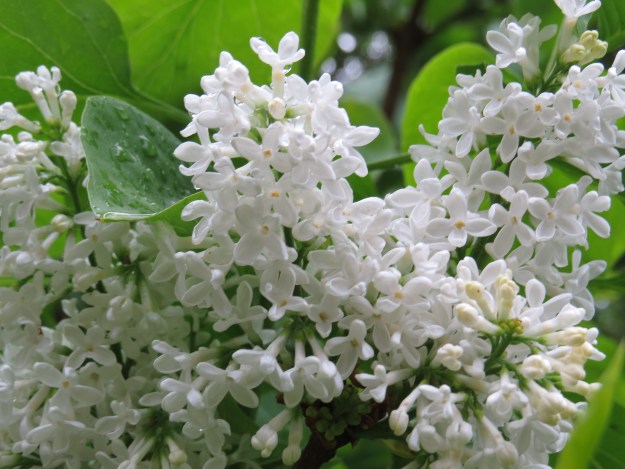
Dear Readers, having hunkered down and got through a) year end and b) forecasting we’re now into c) the reports for January 23. Ah, the roundabout that is finance! Before I know it, it will be December. However, for now I am just beginning to notice the buds on my white lilac bush (above) – they won’t be fully in flower until April, but it already feels like spring (at least here in East Finchley), and I’m watching the pond eagerly to see if any of the frogs have woken up.

And although there is a fine lengthy lilac poem by Amy Lowell at the end of my original 2018 post, I am rather fond of this Robert Burns poem. See what you think.

O were my love yon Lilac fair
Robert Burns – 1759-1796

O were my love yon Lilac fair,
Wi’ purple blossoms to the Spring,
And I, a bird to shelter there,
When wearied on my little wing!
How I wad mourn when it was torn
By Autumn wild, and Winter rude!
But I wad sing on wanton wing,
When youthfu’ May its bloom renew’d.
O gin my love were yon red rose,
That grows upon the castle wa’;
And I myself a drap o’ dew,
Into her bonie breast to fa’!
O there, beyond expression blest,
I’d feast on beauty a’ the night;
Seal’d on her silk-saft faulds to rest,
Till fley’d awa by Phoebus’ light!

And now, let’s whizz back to 2018 to see what I had to say for myself then.

Dear Readers, you might remember that I spent some of my formative years working in a night shelter for homeless people in Dundee. Sunday evenings there were typically quiet, and the men often spent them sitting in the kitchen and listening to the radio. There were two songs which many of them found particularly affecting. One was ‘The Lady in Red‘ by Chris de Burgh,  which would often end with someone surreptitiously wiping their eyes, lost in memories of happier days. But the one that would really get everybody going was ‘Lilac Wine’, originally by Nina Simone but recorded by Elkie Brooks in the ’90’s. Was there ever a better song about the melancholy drinker? Everything from her wavering notes to her tear-filled eyes encapsulates the way that alcohol both distorts thinking and intensifies emotion. However, I do wonder if she has a different lilac tree from mine, as even on a good day I would not characterise the scent as ‘heady’, maybe because my plant flowers in April when the rain and the wind (and the occasional snow) make sitting outside a heroic endeavour. Maybe it’s also because my lilac is white, rather than the usual eponymous lilac? Do tell me of your lilac experiences, especially if they involve ‘feeling unsteady’ and seeing things that aren’t actually there.

https://www.youtube.com/watch?v=aH55XKMddJ8

My venerable lilac tree has grown to prodigious proportions. When I first moved into the house, all the flowers were at the top, some six feet above my head, and their fragrance was mainly enjoyed by passing starlings. Over the past few years I have been pruning out the old wood in an attempt to renovate the plant, and it seems to be working – this year I had flowers at eye-level for the first time in years. I cut a small bunch, put them in a glass jar and popped them down on my writing desk. For a while I just inhaled and admired them, until a moving pea attracted my attention. And when I took my glasses off for a better look, I saw a tiny spider, seemingly made out of green glass.

A cucumber spider (Arienella curcubita)

My garden wildlife book tells me that this is a cucumber spider, and I could not have been more surprised if I’d found out that it was a wildebeest. All my pruning and hacking suddenly seemed worthwhile, because if the lilac blossoms had still been at the top of the ‘tree’ I’d never have cut them.

Lilac has been in the UK since at least the sixteenth century, and is thought to have been brought here not from the Balkans, where it grows wild, but from the courts of the Ottomans. It didn’t reach North America until the eighteenth century, but has become so naturalized there that it is the state flower of New Hampshire. You can occasionally find lilac growing wild in the UK too, but generally close to human habitation. Indeed, a lone lilac bush can often be the first indication that there was once a garden on the site.

Now, to loop back to Elkie Brooks, I found myself wondering if lilac was much used as a culinary ingredient (after all, the plant is a member of the Oleaceae or olive family). I wandered out to the garden to munch on a flower, and found it a rather under-whelming experience – it was quite astringent (i.e. it dries up the saliva), floral, and a bit ‘green’, almost salady. My hunting through the internet revealed a recipe for lilac syrup on The Practical Herbalist, and from here I found a recipe for actual Lilac Wine. The latter website also has a link to all kinds of other ‘country’ wines, including rhubarb, beetroot and something enticing called ‘scuppernong’ wine. I am old enough to remember the days when any kind of fruit or vegetable was fair game for a spell of vinification. My Uncle Roy’s parsnip wine would knock your head off.
Medicinally, lilac was believed to be an ‘anti-periodic’ – that is, it could help to treat diseases such as malaria which occur cyclically. It has also been used to treat fever. In North America, the Iroquois people used it to treat sores.

Lilac (the white variety in particular) is yet another of those plants which have a reputation for bringing bad luck if brought into the house  – I have listed so many of these lately that it’s a wonder that there are any bouquets at all! A five-petalled lilac flower is also thought to be a bad omen, except in some accounts where it appears to be lucky, so my advice is, if in doubt, go for the happier interpretation. Lilac was thought to bring protection against evil if planted at the corners of a house, and I have always thought of it as a happy plant, one of the earlier signs that summer is on its way.

On the Plant Lives website, Sue Eland records a legend about the origin of the lilac in the UK:

According to legend its introduction to the British Isles is owed to a falcon that dropped the
seed in an old lady’s garden in Scotland. The bush grew without flowering until the day
when a passing prince stopped to admire it and a purple plume from his headdress
dropped into it. Thenceforth the bush bore purple flowers and the purple shrub brought
such joy to a young local girl that when she died on the eve of her marriage a cutting was
planted on her grave. This cutting flourished and eventually grew into a bush that bore
white flowers.


Maybe as a result of this story, wearing white lilac is said to mean that you will never marry.

During the 19th century there seems to have been a lot of enthusiasm for the complicated, abundant flowers of the lilac. Impressionists were particularly enamoured, and they seem to have been trying to outdo one another in their depictions. I particularly like the Manet one, but maybe that’s because the flowers are so recognisably like the ones in my garden. I am also very partial to the hexagonal glass vase.

Bouquet of Lilacs by Pierre-Auguste Renoir, 1875-80 (Public Domain)

Lilacs in the Sun by Claude Monet, 1872 (Public Domain)

Lilacs in a Vase by Edouard Manet c.1882 (Public Domain)

And finally, here is a poem by the American poet Amy Lowell (1874-1925). This speaks to me, newly returned from North America, and it helps to settle in my mind the conundrum of why the lilac, a flower from Europe, has so intertwined itself in the American imagination that it is the state flower of the Granite state, the ‘Live Free or Die’ state of New Hampshire. This work takes my breath away. I hope you enjoy it too. Read it slowly, preferably with a cup of tea.

Lilacs’ by Amy Lowell

Lilacs,
False blue,
White,
Purple,
Color of lilac,
Your great puffs of flowers
Are everywhere in this my New England.
Among your heart-shaped leaves
Orange orioles hop like music-box birds and sing
Their little weak soft songs;
In the crooks of your branches
The bright eyes of song sparrows sitting on spotted eggs
Peer restlessly through the light and shadow
Of all Springs.
Lilacs in dooryards
Holding quiet conversations with an early moon;
Lilacs watching a deserted house
Settling sideways into the grass of an old road;
Lilacs, wind-beaten, staggering under a lopsided shock of bloom
Above a cellar dug into a hill.
You are everywhere.
You were everywhere.
You tapped the window when the preacher preached his sermon,
And ran along the road beside the boy going to school.
You stood by the pasture-bars to give the cows good milking,
You persuaded the housewife that her dishpan was of silver.
And her husband an image of pure gold.
You flaunted the fragrance of your blossoms
Through the wide doors of Custom Houses—
You, and sandal-wood, and tea,
Charging the noses of quill-driving clerks
When a ship was in from China.
You called to them: “Goose-quill men, goose-quill men,
May is a month for flitting.”
Until they writhed on their high stools
And wrote poetry on their letter-sheets behind the propped-up ledgers.
Paradoxical New England clerks,
Writing inventories in ledgers, reading the “Song of Solomon” at night,
So many verses before bed-time,
Because it was the Bible.
The dead fed you
Amid the slant stones of graveyards.
Pale ghosts who planted you
Came in the nighttime
And let their thin hair blow through your clustered stems.
You are of the green sea,
And of the stone hills which reach a long distance.
You are of elm-shaded streets with little shops where they sell kites and marbles,
You are of great parks where every one walks and nobody is at home.
You cover the blind sides of greenhouses
And lean over the top to say a hurry-word through the glass
To your friends, the grapes, inside.

Lilacs,
False blue,
White,
Purple,
Color of lilac,
You have forgotten your Eastern origin,
The veiled women with eyes like panthers,
The swollen, aggressive turbans of jeweled pashas.
Now you are a very decent flower,
A reticent flower,
A curiously clear-cut, candid flower,
Standing beside clean doorways,
Friendly to a house-cat and a pair of spectacles,
Making poetry out of a bit of moonlight
And a hundred or two sharp blossoms.
Maine knows you,
Has for years and years;
New Hampshire knows you,
And Massachusetts
And Vermont.
Cape Cod starts you along the beaches to Rhode Island;
Connecticut takes you from a river to the sea.
You are brighter than apples,
Sweeter than tulips,
You are the great flood of our souls
Bursting above the leaf-shapes of our hearts,
You are the smell of all Summers,
The love of wives and children,
The recollection of gardens of little children,
You are State Houses and Charters
And the familiar treading of the foot to and fro on a road it knows.
May is lilac here in New England,
May is a thrush singing “Sun up!” on a tip-top ash tree,
May is white clouds behind pine-trees
Puffed out and marching upon a blue sky.
May is a green as no other,
May is much sun through small leaves,
May is soft earth,
And apple-blossoms,
And windows open to a South Wind.
May is full light wind of lilac
From Canada to Narragansett Bay.

Lilacs,
False blue,
White,
Purple,
Color of lilac.
Heart-leaves of lilac all over New England,
Roots of lilac under all the soil of New England,
Lilac in me because I am New England,
Because my roots are in it,
Because my leaves are of it,
Because my flowers are for it,
Because it is my country
And I speak to it of itself
And sing of it with my own voice
Since certainly it is mine.

Sheep and Shade

Dear Readers, this year we will (fingers crossed) be going back to Obergurgl in Austria, one of the loveliest spots in the world. Before the pandemic we used to visit every single year for the chance to walk in the mountains amongst the spring flowers, but clearly that hasn’t been possible for a while. However today, I wanted to talk about sheep. These lovely creatures are Tyrolean sheep, and every year they’re walked over the Alpine passes to graze on the lush meadows of the Oetz valley. They often have their lambs here, and so when they go home in the autumn there are lots of gangly adolescent sheep following along. It has been this way for a long time (there are the remains of sheep pens from about 6,500 years ago), but as we all know the climate is changing, and increasingly I’m seeing sheep who are far too hot. When you get the cable car up to the Hohe Mut ( a very fine ‘hut’ with panoramic views over the nearby valleys), all the sheep are clustered together in the shade of the cable car machinery and the chalet. On the mountain valleys themselves, the sheep will often follow what shade there is, and you can often find them huddled in the lee of a large rock, there being no trees to speak of.

So it was with some interest that I read about this study on the effects of putting solar panels in grazing fields. In spite of what Liz Truss seemed to think (who was she again?), sheep appear to love solar panels, particularly for the shade that they provide, but also because the grass that grows near to them is particularly nutritious – it’s shaded from the worst effects of the sun, and benefits from rain running off from the panels themselves. This most recent study, led by Emma Kampherbeek while working at the University of Wageningen in the Netherlands, showed that the sheep spent up to 70% of their time under the solar panels, and grazed for 8% more time than sheep in fields with no panels. Furthermore, the sheep eat any weeds that grow on the panels and, unlike goats, they don’t nibble at the cables (which can only be a good thing).

Kampherbeek suggests that solar panels in fields should always be planned with a partner animal in mind – what a great idea! It feels to me as if this is an idea that could benefit both nature, the farmer, the animals and help to reduce climate change all in one go. I shall be keeping an eye on future developments.

Sciencing on Myself!

Dear Readers, this has been a science-packed weekend. Firstly, I’ve been hard at work on my Biology of Survival assignment with the Open University, and it’s fair to say that things have stepped up a bit since the first one – I had a few rocky weeks before Christmas and it’s been uphill all the way to catch up. Still, it’s not due till the 22nd February so I have a little bit of time left.

We’ve been looking at cold adaptation in rats – fortunately this is all done with cyber rats rather than the real animals, as if it was real ones I’d have to decline. Still, it is fascinating stuff – many animals (including little new born human babies) have something called brown adipose tissue (BAT) for short, which can generate its own heat. Normally we shiver when we get cold, but BAT takes the energy that we’d normally use for movement and short-circuits it so that heat is generated instead. You see it a lot in animals that hibernate, and in small animals that dive. The experiment should show that rats that are kept in cold conditions develop more brown fat, but I’m not sure that my pretend rats have. Still, let’s see how it all turns out when I crunch the numbers next week.

I’ve also been looking at a very interesting paper on, of all things, guppies. I remember one of my relatives used to keep guppies, and I was always intrigued by how different the males were – you could identify each one by the pattern on his tail. Apparently this diversity of colours is carried on in the wild, and the question is, why? You’d normally expect one pattern or another to become dominant, either because females preferred it, or because it was less or more attractive to predators, but this doesn’t happen. Is it because the females prefer novelty, or is it that predators have a fixed idea about what a tasty guppy looks like, and ignore the ones that don’t fit the stereotype? We shall see.

But most interestingly (to me at least), is that I’ve just joined a study run by Zoe – this was originally set up to monitor Covid, and continued to record data long after the government had given up. This particular study, though, looks at blood sugar, blood fat and gut health. I am currently wearing a very nifty blood sugar monitor, which sits on your arm – you can access the results via an app on your phone. I’ve been fasting for most of today, except for some bland muffins that are supplied so that everyone is eating the same thing. And half an hour ago I did a finger-prick test, which resulted in a bit of a blood bath (ahem – well I always was a bit over-enthusiastic). How it made me feel for my poor Mum, who at one point was having her fingers pricked in hospital every hour. And there’s a poo test to do too, but that’s probably far too much information.

I will be very intrigued to see what spikes my blood sugar and what doesn’t – I tried my monitor out with raspberries and icecream yesterday evening and there was barely a hump, let alone a spike. But these things are very individual, and it will be fun to see what my personal nemesis is. And also to see how my gut biome is getting on. I love citizen science, and my results will be compared with those for other people who are taking part. For now, though, I’m just glad that the fasting is over, and I’m off to sort out my Sunday dinner. I hope you enjoyed yours!


Fear of the Market

Monument Valley – Photo by Scott Ingram at https://www.flickr.com/photos/scingram/503034864

Dear Readers, I strongly suspect that one of the side effects of living through the pandemic has been a rise in agoraphobia (literally ‘fear of the market’, and usually expressed in terms of being afraid of crowds, wide-open spaces or even just leaving the house). In the past few days I have talked with several people whose loved ones are now terrified of going outside the front door. These were people who were previously adventurous and confident, but now experience panic attacks, dizziness, a feeling of being out of control, breathlessness, sweating and disorientation, even for a brief trip to the shops.

I’m no psychologist, but observing my poor Mum in her last years brought out a few common factors for me. Being housebound, or at least spending a long period of time indoors seems to shrink not only our physical but our mental worlds, to the point where we only truly feel safe inside four walls. Couple this with social isolation and you have a recipe for anxiety. Then, there are the added problems of hearing and sight deterioration which happens as we get older – if we are going out regularly we may adapt to these changes, but if we are confined and then suddenly broach the outside world, it can all feel too much. Next, there is a genuine fear of falling, made worse by feeling giddy and by having lost fitness over months of walking no further than the fridge or the end  of the garden.  And finally, there’s the fear of infection and of the possibility of getting sick, especially as so much of the world has gone back to ‘business as usual’.

Personally, I have long had a fear of being in situations that I couldn’t escape from, and that has definitely gotten worse. Just before Christmas, we went to see a play in the West End, and passed through Leicester Square tube station. It was absolutely rammed, to the point that I was afraid that there would be an uncontrollable crush as there wasn’t room for people to get off the escalators. I could feel myself beginning to panic in a way that I probably wouldn’t have done pre-pandemic -after all, I’ve lived in London all my life and being surrounded by people is nothing new. Fortunately nothing happened, but it’s a long time since I’ve been so afraid.

It feels to me as if there has been a great mental forgetting of the cost of Covid in human terms, but for many people, their bodies haven’t forgotten, and are bearing the fear and anxiety that it’s no longer acceptable to express openly. Personally, I hate that we have had no real, official reckoning with what happened, no acknowledgement of the history that we lived through, and of the price of it for so many of us. There can be no true moving into the future without weighing up and acknowledging what’s happened, the mistakes that were made, the things we learned, and what needs to be put in place for the future. For those still mourning a loved one, or suffering from Long Covid, or still sheltering, the pandemic has ongoing consequences. And for those who still don’t feel ‘normal’, who sometimes panic in open spaces, who hyperventilate in crowds, who still automatically do ‘the dance of social distancing’, I know how you feel. I would be intrigued to know how you’re doing, lovelies. Do you know people who are struggling? Are there things that you notice about yourself that have changed? Or is it just me?

This Is Not a Dog Blog, But….

Dear Readers, following my article about Spock my childhood dog yesterday, I remembered this article from New Scientist, which suggests that dogs know far more about our intentions than we might realise.

48 pet dogs were filmed as they sat on one side of a transparent plastic screen, with a hole in it. A human being on the other side of the screen showed them a treat, and then either teased them by drawing it back when they went to take it, or ‘accidentally’ dropped it. All the dogs got all the treats after 30 seconds, but their behaviour in the meantime was fascinating.

Where the dogs were teased, they often backed away, sat down and refused to make eye contact. I imagine if they could have said ‘harrumph’ (or something stronger) they would have done.

When it looked as if the human was just being clumsy, they maintained eye contact, wagged their tails and stayed close to the screen.

This might not sound like much, but it implies that the dogs clearly knew the intentions of the humans, something which had previously only been proved with non-human primates – I’ve heard of many experiments/observations of animals such as crows understanding the thought processes of another member of their own species, but am not sure that I’ve come across one which demonstrates such an understanding of us and our funny little ways.

And in a delightful detail, the dogs confronted with a ‘clumsy’ human wagged their tails more on the right-hand side, which apparently shows that they are happy. It seems that they can forgive us for being hopeless, but are less tolerant of us being asshats, and well done them. We should all be forgiving of mistakes and general human-ness, and a bit less forgiving of cruelty.


A Very Fine Dog Indeed

Dear Readers, in the fading photo above you can see me aged about 10 with our new puppy, named Spock because of his black shiny fur (rather than his ears, which were of a distressingly-normal size). I had always wanted a dog, but there were five large humans crammed into our little two-up, two-down house, and my Mum wasn’t sure she could cope with one more living creature underfoot. I don’t blame her, but mine was a long-standing campaign – there’s a photo of me aged five clutching a toy dog and looking wistfully into the camera. When asked what I was thinking about, I apparently replied ‘getting a doggy’. Who could resist? Well, clearly my parents as it was five long years until I finally got my hands on a real live dog. I look utterly besotted in this photo, and so I was, but having a dog soon proved to be rather more of a challenge than I’d thought.

From the start, Spock was a nervous and highly-strung dog, characteristics not helped by the fact that he was at everyone’s beck and call, and had nowhere to call his own. In the end, we took to ordering him to go under the armchair: on the cry ‘Under!’ he would slink behind the legs of whoever was sitting in the chair and would peer out with the biggest eyes you ever saw. Ours could be a fractious house, and, being a sensitive animal, he must have picked up on the nervous energy in the air. It wasn’t helped by the fact that our resident cat (Fuzzy) had no time for the puppy at all. Spock would occasionally jump on her back in a frenzy of sexual frustration and she would run up the garden with him clinging on like a baby giant anteater. Eventually, he took things too far: she was sitting on the fence one afternoon when he jumped up and, with impeccable timing, she drew a single claw down his nose, leaving a perfect line of blood. That was that, and he never bothered her again.

It probably didn’t help that I took to knitting clothes for Spock, including, on one occasion, little booties. How gentle he was as I put each one on, and how eager he was to shake them off! The tam o’shanter that I knitted didn’t last very long either. What he did like was when we set up a show-jumping ‘ring’ in our tiny back garden, though he was prone to go under the obstacles rather than over them. He would probably have loved agility training, but this was unheard of in East London in the 70s. He must have been stressed and bored, a difficult combination.

Walking Spock was a nightmare. He was so pent up and so excitable that he wanted to murder any passing dog, child or pram, so we took to only taking him out after dark. Sadly he was also afraid of passing large, parked vehicles and took a serious dislike to any peculiar shadows. Poor, poor little dog. We were all on edge in our house, and Spock absorbed all of it. Sometimes I’d be sitting on the sofa and the dog would look at a spot just behind my head. His hackles would rise and he’d start to growl. There would be nothing there when I turned around. On other occasions, he would sit in the middle of the floor and howl. I always felt as if he expressed the feeling of claustrophobia that we all felt.

And then, a miracle happened.

We managed to move house to Seven Kings, just a few miles up the road from Stratford where I grew up, but a completely different world. Our ‘through lounge’ was nearly thirty feet long. We had a garden. We had room to get away from one another, although on the first night that we moved in all of us, dog and cat included, huddled in a little circle in the living room. And then, the following morning, Spock, tail wagging, tongue lolling, started to run from one end of the living room, through our fancy new ‘sun lounge’, before descending to the garden with a huge leap. He’d gallop to the end of the garden, turn on a sixpence with a great scatter of turf, and then run back, over and over again. At some points it was as if he was trying to become airborne. I have never seen such unfettered joy in an animal. Overnight, most of his ‘neuroses’ fell away. I suspect many of ours did, too.

My platform-soled foot with Spock.

What a very good boy he was! So tolerant of being at everyone’s behest, so gentle with his family, so determined to protect us from terrifying vans and passing toddlers. He died when I was at university: Mum and Dad found him collapsed in the middle of the living room that he loved to run through so much. When he saw them, he gave a feeble wag of his tail and tried to get up, but he’d had the doggy equivalent of a stroke, and the vet could do nothing for him. He was my first, and so far my only dog. For the longest time I’d catch sight of a black shadowy shape out of the corner of my eye when I was at home, but it was never there when I looked head on. I am not sure where animals go after they die, but if there is a heaven then they deserve to be in it. I hope that they can finally be utterly, uncompromisingly themselves.

Not On The Red List, But Maybe It Should Be? Rock Dove

Wild Rock Dove from the Outer Hebrides (Photo by Will Smith, article athttps://www.bto.org/community/blog/wild-rock-doves-solving-genetic-enigma)

Dear Readers, I can already sense you asking why the feral pigeon appears to have infiltrated my Red List piece for this week (in addition to wondering why someone is handling the bird in the first place). Well, as you may know, feral pigeons are descended from rock doves, birds that used to inhabit sea caves, cliffs and mountainous areas right across Europe, Asia and Africa. However, over the years the rock dove has morphed into the feral pigeon, which, while it’s the same species as the rock dove, is genetically distinct. As you know, feral pigeons come in every colour under the sun, and there are other differences too.

The original rock dove only comes in one colour – grey- with a distinctive white patch above the tail and two black wing bars. The wild birds also have longer,thinner beaks and a more pronounced forehead than their feral cousins. Unlike your typical feral pigeon, these birds are extremely shy and difficult to catch, as the author of the study, Will Smith, points out.

Fieldwork was often challenging and involved long nights in Outer Hebridean meadows, climbing through ruined buildings to study the doves as they roost. One of the privileges of this is getting familiar with all the other animals and plants that make their home there, including the Corncrake. These fascinating birds seem to purposefully move gradually closer and closer to the tent each day until they are shouting ‘crex-crex’, at maximum volume, all night, a metre from my head. At least Rock Doves don’t test an ornithologist’s patience quite that much!’

Actually it sounds like absolute bliss (except for the Corncrake). What Smith discovered was that the birds in the Outer Hebrides are actually still genetically distinct and very similar to the ancestral pigeons of the feral birds. This is a real find, as in many fairly isolated places, such as the Orkneys, the wild rock doves have bred with ferals and are now no longer similar to the original birds. A similar thing has happened with the Scottish Wild Cat, which interbreeds with domestic cats and is so in danger of disappearing as a distinct species. We are moving towards a much less biodiverse world, and so preserving these relict species is important for the planet as a whole.

Rock Dove (Photo by Will Smith)

There are many opportunities for further research and protection for the wild dove – there is a population in Ireland which has not been the subject of a study (yet), and there may well be populations in many places in Europe, particularly on some of the islands in the Mediterranean. While homing pigeons and other ‘stray’ feral pigeons will join rock dove flocks, the bigger danger is if people start to keep free-flying pigeons and these interbreed with the wild birds. Another danger seems to be that feral pigeons are more likely to survive trichomoniasis, the disease which has wiped out 90% of our greenfinches and which is a danger to rare birds, including pigeons, wherever it turns up. However, for now, the rock doves of the Outer Hebrides are living by the sea just as they’ve always done. It will be interesting to see if they eventually attain some kind of conservation status to help protect them in the coming years.

You can read the whole of Will Smith’s article here, and jolly interesting it is too.


Wednesday Weed – Cyclamen Revisited

Cyclamen in my garden at the weekend.

Dear Readers, the last time that I wrote about cyclamen was back in 2016, so I thought they would be worth a revisit, especially as the ones in my garden are doing so well. I rather suspect that these are Cyclamen coum, the Eastern Sowbread, as they come into flower after the autumn-flowering Cyclamen hederifolium discussed below but all the plants are so confused at the moment that it’s anybody’s guess. It would be rather nice to plant both to extend the planting season especially if, like me, you have a preponderance of dry shade.

The cyclamen is certainly far away from its Mediterranean home (though it has been here for a long time, as you can read in the piece below). D.H Lawrence got very carried away with it in his poem ‘Sicilian Cyclamen’ – there are some lovely things here, but rather too many of them, which is often the case with D. H. Lawrence in my opinion. When I was younger I found the abundance of metaphor to be almost as dramatic as I was, but these days I just feel a little disgruntled and overwhelmed. Anyway, see what you think, lovely people!

Sicilian Cyclamens
BY D. H. LAWRENCE

When he pushed his bush of black hair off his brow:
When she lifted her mop from her eyes, and screwed it
in a knob behind
—O act of fearful temerity!
When they felt their foreheads bare, naked to heaven,
their eyes revealed:
When they left the light of heaven brandished like a knife at
their defenceless eyes
And the sea like a blade at their face,
Mediterranean savages:
When they came out, face-revealed, under heaven, from
the shaggy undergrowth of their own hair
For the first time,
They saw tiny rose cyclamens between their toes, growing
Where the slow toads sat brooding on the past.

Slow toads, and cyclamen leaves
Stickily glistening with eternal shadow
Keeping to earth.
Cyclamen leaves
Toad-filmy, earth-iridescent
Beautiful
Frost-filigreed
Spumed with mud
Snail-nacreous
Low down.

The shaking aspect of the sea
And man’s defenceless bare face
And cyclamens putting their ears back.

Long, pensive, slim-muzzled greyhound buds
Dreamy, not yet present,
Drawn out of earth
At his toes.

Dawn-rose
Sub-delighted, stone engendered
Cyclamens, young cyclamens
Arching
Waking, pricking their ears
Like delicate very-young greyhound bitches
Half-yawning at the open, inexperienced
Vistas of day,
Folding back their soundless petalled ears.

Greyhound bitches
Bending their rosy muzzles pensive down,
And breathing soft, unwilling to wake to the new day
Yet sub-delighted.

Ah Mediterranean morning, when our world began!
Far-off Mediterranean mornings,
Pelasgic faces uncovered
And unbudding cyclamens.

The hare suddenly goes uphill
Laying back her long ears with unwinking bliss.

And up the pallid, sea-blenched Mediterranean stone-slopes
Rose cyclamen, ecstatic fore-runner!
Cyclamens, ruddy-muzzled cyclamens
In little bunches like bunches of wild hares
Muzzles together, ears-aprick

Whispering witchcraft
Like women at a well, the dawn-fountain.

Greece, and the world’s morning
While all the Parthenon marbles still fostered the roots of the cyclamen.
Violets
Pagan, rosy-muzzled violets
Autumnal
Dawn-pink,
Dawn-pale
Among squat toad-leaves sprinkling the unborn
Erechtheion marbles.

And now, back to 2016.

Dear Readers, I have always loved cyclamen – there is something about the way that the petals stream ‘backwards’ that remind me of the wings of a bird as it lands. At this time of year you can see lots of naturalised cyclamen in hedgerows, parks and other dryish places (the photos this week were taken in my Aunt Hilary’s Somerset garden). The plants have been showing their cherry-blossom flowers in the UK since 1597(they are originally from the area around the Mediterranean), and have been here long enough to acquire a vernacular name – ‘Sowbread’. There are variations on this name in several of the European countries from which the plant came: ‘pain de porceau’ in France, for example – and this is presumably because the pigs ate the tubers when they were rooting in the woods in autumn.

img_8471At first glance, it’s difficult to imagine what plant family cyclamen belong to, but if you look into to the lower part of the flower, where the stamens are, you’ll see that it looks rather like the middle of a primrose. And this is the family to which cyclamen has finally been allocated, after a brief flirtation with the Myrtles, a most unlikely place for this plant to end up. Genetics has solved a lot of strange taxonomical anomalies: when I was growing up, giant pandas and red pandas were placed in a family together, even though they shared few obvious similarities. What a relief when geneticists discovered that giant pandas were exactly what they looked like –  bears – and popped them back with the rest of the family. Though I imagine it made no difference whatsoever to the pandas, who just carried on munching the bamboo.

img_8479There are 23 species of cyclamen in total, but the one that is naturalised in the UK is Cyclamen hederifolium. One reason that the plant is so valuable in a garden is its very late flowering: the leaves and flowers die back completely during the spring and summer (probably a mechanism for avoiding the worst of the Mediterranean heat) and then reappear, almost miraculously,  in the autumn. The leaves themselves are exquisite, heart-shaped and patterned in cobweb-white and the palest of green, and the species name ‘hederifolium’ means ‘like the leaves of the ivy’. I can see the resemblance. ‘Cyclamen’, incidentally, comes from the Greek word for ‘circle’. Many sources rather prosaically mention that this is because the tubers are round, but I wonder if it is because of the way that cyclamen appear, flower and disappear in a circle of life. As they can be remarkably long-lived plants (up to a hundred years) I wonder if they seemed both mysterious and eternal.

img_8475Although the flowers are usually pink, there is occasionally a white one.

img_8473The tubers of cyclamen were used in a variety of ways. In ‘A Modern Herbal’,  it is suggested that a tincture of the root, applied as a liniment, would cause ‘purging of the bowels’ (so stand well back!) Juice from the root is said to be poisonous to fish, and an ointment made from the tuber is said to expel worms. All in all, the action of the plant seems to have been about getting various things out of the body which shouldn’t be there.

img_8523Given that the root of cyclamen has such purgative qualities, and that it also contains saponin, a most unpleasant-tasting chemical, I was surprised and pleased to find that there is one recipe which uses cyclamen leaves rather as vine leaves are used in dolmades in Greece. The History of Greek food website is a great source of information on the uses of many of the foods of this area, and for a Fava Stuffed Cyclamen Leaves recipe, just click here.

img_8520From Sue Eland’s ‘Plant Lives’ website I learn that, in the language of flowers, cyclamen is said to represent voluptuousness, diffidence and goodbye, a rather difficult combination to carry off I would have thought. A small cake made from the plant and baked will cause paroxysms of love in whoever eats it. The plant is said to offer protection from the ‘evil eye’ (and its close relative, Cyclamen persica, has been a house plant for centuries), but if a pregnant woman stepped over a cyclamen it was believed to cause miscarriage. If it appears in your dreams, it is a sign of calamity. All in all, it appears that you never know where you are with a cyclamen.

img_8523When I was in Hilary’s garden, I should have hunkered down and had a sniff of the cyclamen, for the pink ones, at least, are said to have a sweet scent. Here is Walter Savage Landor (1775 – 1864) on the cyclamen:

‘Thou Cyclamen of crumpled horn

Toss not thy head aside;

Repose it where the loves were born

In that warm dell abide.

Whatever flowers, on mountain, field,

Or garden, may arise,

Thine only that pure odor yield

Which never can suffice.

Emblem of her I’ve loved so long,

Go, carry her this little song. ‘

img_8474As you might expect, the unusual form of the cyclamen made it a favourite with still life painters, such as the remarkable Ambrosius Bosschaert the Elder, who worked in the Netherlands during the 17th Century.

'Bouquet of Flowers in a Glass Vase' by Ambrosius Bosschaert the Elder (1621)

‘Bouquet of Flowers in a Glass Vase’ by Ambrosius Bosschaert the Elder (1621)

However, they have also inspired more recent painters. Koloman Moser, whose painting is below,  was a member of the Viennese Secessionists, a group that included Klimt. The plant was to be a big influence in Art Nouveau generally, with its love of the natural world and the exotic. And I can see why people were influenced to record the fleeting beauty of cyclamen. To see those flowers, poised as if to take flight, amongst the fallen leaves of autumn is to experience a brief moment of wonder.

'Cyclamenstock' by Koloman Moser (1868-1918)

‘Cyclamenstock’ by Koloman Moser (1868-1918)

Images of paintings in Public Domain. All other photos copyright Vivienne Palmer. Free to use and share non-commercially, but please attribute and link back to the blog, thank you!


Josh’es Book of Animals and My Auntie Marie

Josh Gabbatiss and the book that he started when he was nine years old (Photos from The Guardian Man, 30, completes encyclopedia of animals he started at nine | Zoology | The Guardian

Dear Readers, I’m not quite sure why this story made me teary-eyed, but I loved it so much that I wanted to share it. Josh Gabbatiss started his ‘Book of Animals’ when he was just nine years old. I love that, as he says, he knew even at that age that he was in it ‘for the long haul’ – he started with worms, corals and other invertebrates, and planned to work his way through the animal kingdom until he arrived at the primates.


I suspect that he didn’t know that it was going to take him twenty-two years, however, because he finally finished the book earlier this year. In the meantime he’d become a zoologist, and then a climate consultant. Josh says that he worked away at the book pretty much consistently until he was in his early teens, when there started to be big jumps in time between sections. In his late teens, he moved onto mammals, but then when he went to university, it all stopped – the book was ‘too precious to move to a different city’. Finally, during the Covid lockdown he got stuck in again. What a talented artist he is! This is the final picture.

The final page.

Wouldn’t it be wonderful if someone out there published it? Josh’s website is here in case anyone has a hankering.

I have a great fondness for animal encyclopaedias, because when I was growing up, I was gifted one by my Auntie Marie. Auntie Marie wasn’t a real auntie – she worked with Mum, and they had a great fondness for one another, despite being chalk and cheese. Marie had, let’s say, a theatrical background – her hair was always black as coal, her lipstick ruby-red, her eyes lined with kohl. In my memory she has a cigarette holder (though I am possibly conflating her with Cruella de Ville, most unreasonably). We were a very poor family, just about making ends meet, but Marie would lend us her caravan in Whitstable once a year for free so we could have a holiday. And when we went to visit her in her huge apartment, which overlooked Clapham Common, she would always live up to her reputation as being the world’s worse cook, something that my poor younger brother bore the brunt of. She heard that he loved saveloy sausages, and so she cooked him up six of them, and looked on with pride while he tried to eat the lot. Once, she made a trifle out of stale Christmas cake, including the icing and the marzipan. No amount of begging could stem her largesse.

But, her generosity in the giving of books was the thing that I most remember. She introduced me to Thelwell, he of the little fat ponies, and to the Molesworth books, my favourites to this day. And the Readers’ Digest Encyclopedia of Animals that she gave me was so pored over that I memorised whole sections. It gave me a way to fit the animal kingdom together, even though so much has changed in the years since I was a child (I just found out that anteaters and sloths are no longer Edentates, but Xenarthrans). We didn’t have a lot of books, so this one was my most treasured possession. At some point, it got water-stained (probably through me reading it in the bath when we finally got a bathroom) and then, somehow, it just disappeared from my life, leaving a spark of interest that has never gone out.

The last time that Mum saw Marie, she was in hospital and her hair, still black in her eighties (a miracle!) had finally grown out, and was white. Mum told her that it suited her, but Marie was adamant.

“As soon as I get out of here, I’m grabbing that dye bottle”, she said. “I don’t want people to think I’m old”.

When she died, the only people at her funeral were the gay couple from the flat upstairs, who had taken her under their wing much as she’d been doing with other people all her life, and Mum and Dad. But the ripples of her life went much further probably than she ever realised. She helped me to make the connection between the animals that I saw in the garden and the world of scientific inquiry, something that I’m finally uniting in my life now with my Open University degree.

And she gave my brother a life-long loathing of saveloys.