Goodness readers, there isn’t much going on in the garden at the moment – the couple of cold snaps that we’ve had in December and January have put nearly all the plants back, and who can blame them – in my north-facing plot it takes long enough to warm up in the best of years. But I was very cheered by these cyclamen, who have taken several years to establish themselves but are now going great guns. I’ve always had a great fondness for this plant, whether as a house plant or in the garden, and I remember my late Aunt Hilary’s garden, where all the spring flowers had naturalised themselves. I imagine it’s something of a building site now.
Cyclamen in Aunt Hilary’s garden
And my one patch of snowdrops is also spreading. How I love spotting their pristine white flowers from the kitchen window! If I stay in the house until I’m about 120 years old, maybe they’ll have filled up the rest of the garden. Or maybe I should divide them this year. Truth be told, they’ve been such a long time coming that I’m nervous about interfering.
And then the buds are coming on the flowering currant, one of the finest of the early flowering shrubs, and a magnet for the hairy-footed flower bees in late March.
Flowering currant buds…
The flowering currant in April
I don’t know about you, Readers, but it’s felt like a very long winter this year. However, as I was taking a few photos this afternoon I noticed a trio of great tits chasing one another round and round the whitebeam, a robin singing, and the first shy heads of the grape hyacinths appearing. We’re nearly there. One more push and we’ll have gotten through another year!
Dear Readers, ‘terrified’ would be a strong word, but ‘daunted’ would be closer to the mark, as I get stuck into my t-tests and Mann-Whitney U tests and chi-squared tests, all to see if the results that I’ve got in my experiments for my OU course are actually worth the paper that they’re printed on. It’s all good stuff, though – I can feel my brain creaking as it expands, and the delight when I actually work out how something works is quite something to behold. This afternoon, I couldn’t work out how to do something, so I told my husband how frustrated I was and, miraculously, all he had to do was stand behind me and squint at the calculation and suddenly it all became clear. He didn’t have to say a word!
To be fair, I have a similar effect when he’s lost something (which is a fairly common occurrence). Early on in our relationship, I learned that, instead of joining him in the hunt for the missing object, all I had to do was say ‘you’ll find it, you never really lose anything’ and the item would appear, though generally not in any place that a sane person would expect. I swear that there is a tear in the fabric of the universe through which wedding rings/valuable pieces of paper/keys/wallets/work passes drop, only to reappear elsewhere on the space/time continuum (usually a pile of something completely unrelated). Go figure, as us statisticians say.
Anyhow, when I looked up from my endeavours it was to read that the oldest dog in the world has been verified by the Guinness Book of Records. Bobi is not only the most elderly dog in the world at the moment, at an extraordinary 30 years old, but the oldest dog ever. He lives with the Costa family in the village of Conqueiros in Portugal, where he has lived all his life after a narrow escape – he was one of four siblings, the rest of whom were ‘euthanised’ (I suspect this is a euphemism for ‘drowned in a bucket’ but I could be wrong) because they were too many, as Thomas Hardy would have described it in ‘Jude the Obscure’. Anyhow, Bobi was rescued by eight year-old Lionel Costa, who kept the puppy a secret by hiding it in an outhouse and sneaking food to him. When the puppy was discovered the family decided to keep him, and Bobi has continued to eat whatever his family have for dinner. Clearly it’s done him no harm – it’s only recently that he’s had trouble walking and deteriorating eyesight. He is clearly a Very Good Boy.
Bobi the oldest dog in the world and feline friend
And for those of you who are dog lovers, there’s a real treat coming up at the Wallace Collection in London. ‘Portraits of Dogs – From Gainsborough to Hockney’ runs from 29th March to 15th October this year, and jolly good fun it looks too. I shall take myself off and review it for you when it opens, but for now, here’s a taster of what’s coming up.
Dad and Mum at their 60th Wedding Anniversary Party in 2017
Dear Readers, as you are great at keeping me honest, I wanted to let you know that I am currently working on a book about Mum and Dad, and particularly Dad’s dementia and how our relationship developed in spite of/because of it. I have promised my lovely writing group that it will be completed by my next birthday in January 2024, so I thought it would be mean not to share it with you as well. Accountability is a great thing, so I’m hoping it will work. I’ve already written quite a lot of it, but keep thinking of other things to include, like you do. Keep your fingers crossed for me!
I came across this poem by George Barker, about his mother, and it rather reminded me of Dad at his most outgoing and rambunctious, though he could also be a quiet, thoughtful man. Like all of us, he had many facets, according to how the light fell. As we approach the third anniversary of his death, I find I still miss him and Mum every day. I guess I always will, but that’s no bad thing because it means that they’re still loved and still held in my heart.
To My Mother by George Barker
Most near, most dear, most loved and most far,
Under the window where I often found her
Sitting as huge as Asia, seismic with laughter,
Gin and chicken helpless in her Irish hand,
Irresistible as Rabelais, but most tender for
The lame dogs and hurt birds that surround her –
She is a procession no one can follow after
But be like a little dog following a brass band.
She will not glance up at the bomber, or condescend
Dear Readers, I am always so impressed by these 3-D murals – it’s hard to believe that this one doesn’t feature an actual rowboat or jetty. 2nd February was World Wetlands Day, and so this work, at Cabot Circus in Bristol, shows a pond that’s full of rubbish at one end, and then full of dragonflies at the other. It was commissioned by the Wildlife and Wetlands Trust, and the artists were 3D Joe and Max, who clearly have form with this kind of thing.
3D Joe and Max’s installation in Leicester
A Roman Bath mural in Gloucester….
A scary chasm in Newcastle…
A leaping crocodile in Bristol
So all of these look like a lot of fun, though I’m not sure that ‘mural’ is actually the right word, seeings as these are on the floor. ‘Floorals’ maybe? You can read all about 3D Joe and Max at their website here, which includes some very interesting videos.
I wonder what the reaction of a dog or cat to one of these would be, or a small child come to that. And I hope they’re always positioned with lots of room to walk round them for the delicate of constitution or the unsteady of foot (puts hand up). But they are rather fun, and very confusing. Anything that makes us do a double-take is surely a pleasure.
Turtle Dove (Streptopelia turtur) Photo by Mike Pennington
Dear Readers, in The Guardian today I read that a team of scientists are raising a ‘further’ $150m in order to pursue their attempt to resurrect the dodo, a relative of the pigeon which became extinct in the 17th century. We’ve been here before of course – I wrote a piece about the ‘resurrection men‘ a while ago. What makes me particularly cross about this case is that the turtle dove, one of our most iconic birds (number two on the Twelve Days of Christmas for one thing) is threatened not just in the UK but globally, and I can’t help but think that a ‘further’ $150 million would be better spent trying to preserve the species that we have, rather than trying to ‘create’ a no doubt lonely and miserable bird from the past. You can probably hear the harrumphing from wherever you are.
The turtle dove has gone from over a quarter of a million birds in the UK in 1960 to just a few thousand now. A survey in Surrey found just 80 singing males, with 20 of them on the Knepp Estate, which has been a triumph of rewilding, but which needs to be duplicated all over the country if we’re to save our endangered species. The turtle dove seems to love the thorny scrub that’s been allowed to grow at Knepp, and it’s a species that loves the tiny seeds of scarlet pimpernel and ramping fumitory. It may also eat tiny snails and it needs clean water, as do all our birds. Its return to Knepp gives me a little hope, for who would want to lose the sound of the turtle dove from our countryside altogether?
This is a recording by Frank Lambert from the Knepp Estate, and what’s so wonderful is not only the sound of the turtle doves but the choir of other birdsong in the background.
So what has happened to this bird, to make it so rare?
Turtle Dove – Photo by Charles J. Sharp
Current research seems to show that the birds are making fewer nesting attempts, and that those that are made are less successful. This could be because of a lack of breeding sites, and a lack of food – birds that are not well-nourished are less likely to breed, As if this wasn’t enough, the birds appear to be prone to trichmoniasis, the same disease which has done such damage to greenfinches. Finally, the birds are hunted across their migration route, which encompasses much of Europe, North Africa and Russia. But interestingly, it seems that it’s the loss of breeding habitat which is the most crucial factor, and fortunately several conservation organisations are trying to persuade landowners to improve their land so that it’s more welcoming for the turtle doves. You can read about some of their initiatives here, and it makes for a little bit of hope. Fingers crossed for these elegant birds, and let’s hope that they can be prevented from going the same way as the dodo.
Dodos at the Oxford Museum – Photo By BazzaDaRambler
Dear Readers, yesterday evening I took a monumental tumble in my living room – I had been knitting and watching re-runs of ‘Great British Menu’ when I suddenly remembered that I’d not put the water on for the pasta. So I sprang up, but unfortunately my leg had gone to sleep and so I crashed to the floor managing to twist not one, but two ankles in the process. So, today I am creeping around very gingerly with much wincing and groaning. The cat is extremely alarmed, probably because she’s afraid I’m going to fall on her and flatten her. Every time she sees me she looks goggle-eyed with fear and then slithers off like an SAS person trying to creep into a tent and garrotte someone.
But never fear! I am confident that nothing is broken, and I have compression bandages/ibuprofen/comfrey/arnica/ footstools in abundance, so normal service will be resumed soon.
In the meantime, after seeing the Rowan berries yesterday I thought I’d share this piece with you. Rowan is yet another of my favourite trees (how many are you allowed to have, I wonder?) and so it’s only right that it gets a second bite of the cherry. So here’s what I said a couple of years ago.
Dear Readers, if there is a better tree than the rowan for a small garden, I have yet to hear of it. In spring, it’s covered in frothy white blossom.
Photo One
In summer, its leaves are filmy and cast little shadow. In the autumn it’s often covered in berries, and its leaves turn to a variety of orange/copper/scarlet shades. Plus, the berries will stay on the tree through the winter, unless they are all gobbled up by birds.
A roadside Rowan in County Wicklow, Ireland (Photo Two)
Rowans are native from Madeira and Iceland right the way to Northern China. They tolerate poor soil, and one of the pioneer species that pop up when a new habitat becomes available. Their good manners and graceful appearance have made them a popular choice for a street tree, with one road in Archway planted with just this species.
Rowans in Archway
However, just as the only problem with dogs is that they don’t live as long as we do, so it is with the rowan. In his excellent book ‘London’s Street Trees’, Paul Wood suggests that 25 years is a ‘good innings’ for a rowan, after which another tree will have to be planted in its place. So, this street could conceivably lose all its rowans at once.
The North London trees look surprisingly tall for what is often a stunted little tree. However, there is one individual tree in the Chilterns which is 28m tall, quite a height for a rowan.
Apart from its year-round attractiveness, the rowan is a most excellent tree for wildlife. You might be lucky enough to see waxwings munching on the berries, and redwings and fieldfares are also big fans, along with blackbirds.
Bohemian waxwing (Bombycilla garrulus)
35 different species of butterfly and moth caterpillar are also associated with the rowan, from the rather dandy leopard moth (Zeuzera pyrina) to the beautiful brocade (Lacanobia contigua)
Rowan has a rich folklore: it used to be planted as a protection against witches, and in parts of Scotland there is still a taboo against cutting down a rowan tree, especially when it is close to houses. In Flora Britannica, Richard Mabey stresses that it’s the wood of the tree that is seen as potent, rather than the berries:
‘Rowan boughs were hung over stables and byres in the Highlands, used for stirring cream in the Lake District and cut for pocket charms against rheumatism in Cornwall’.
The poet Kathleen Raine and the author Gavin Maxwell (of Ring of Bright Water fame) had a most difficult relationship: passionate and all-encompassing on her side, rather more utilitarian on Maxwell’s side, as he was gay and Raine couldn’t accept this. On one occasion, when Maxwell had brought a lover home with him , Raine went to the rowan tree outside Maxwell’s house on the West Coast of Scotland and cursed him:
“Let Gavin suffer in this place, as I am suffering now.“
Shortly after this, Maxwell’s pet otter Mijbil was run down and killed (partly as a result of Raine letting the animal off its lead). Raine always believed that her curse had called something evil down upon Maxwell’s head and never forgave herself, though Maxwell, generously, forgave her. Then Maxwell’s house burned down. It seems that there might be rather more to the power of the rowan than we give it credit for. Leastways, it’s probably best not put such things to the test.
I recently acquired a rather lovely book called ‘Scottish Plant Lore – An Illustrated Flora‘ by Gregory J. Kenicer. In it, he describes how shepherd girls would usually drive their sheep with a staff made from Rowan wood, and how in Strathspey livestock were made to pass through a hoop made of rowan in the morning and evening, as a charm against black magic. It was also noted that rowan trees often grew around standing stones, and that one eighteenth century writer, Lightfoot (1777) thought that these might have been the remnants of trees planted by the druids who used to gather there.
Rowan Tree on Feinn Loch, Kimelford (Photo Five)
Now, you might be tempted to do something clever with the berries of the rowan, and indeed they are edible (though like so many things they are said to be better after frost). They contain very high levels of Vitamin C (good) but are also high in tannins (bad). The most common use is to turn them into a jelly that can be eaten with cold meats or cheese, but look! Here’s a recipe for rowan Turkish delight. I include it in honour of my poor old Dad, who loved the stuff, and who could get himself covered in powdered sugar faster than anyone I ever met.
Incidentally, the eattheweeds website is a most excellent source of inspiration for anyone who forages. There are some really imaginative ideas.
Rowan Turkish Delight (Photo Six)
Medicinally, the berries have been prescribed for stomach complaints and to staunch bleeding – I suspect that the tannins have a lot to do with any perceived efficacy. Be careful though, as some sources suggest that the berries can be poisonous.
The leaves have been used to make remedies for sore eyes, asthma, rheumatism and colds.
Photo Seven
Now, as previously mentioned, the wood of rowan is thought to be the most potent part of the plant, so it comes as no surprise that when I search for ‘rowan wood’ I find a plethora of wands, walking sticks and amulets made from the material. But what an attractive timber it is! One sculptor in wood described it as his ‘favourite wood for turning’.
There also seem to be a wide variety of Harry Potter-themed items made out of rowan, but having only read the first volume in the series (and that decades ago) I’ll have to rely on you to tell me what the possible connections are.
Freshly cut rowan wood (Photo Eight)
Incidentally, the word ‘rowan’ is thought to come from an Old Norse word meaning ‘to redden’, probably a reference to the berries (though at this time of year it occurs to me that it could also refer to the leaves). And I had totally forgotten that the rowan is mentioned in the lovely Scottish folksong ‘Mairi’s Wedding’:
Red her cheeks as rowans are,
bright her eyes as any star,
fairest of them all by far,
is our darling Mairi.
Gosh, this almost has me dancing. Have a listen here and see if you can avoid jiggling about.
And, to end with, a poem by Seamus Heaney. He decided on the last line after he heard an interview with Fionn mac Cumhaill, the legendary Irish figure, who, when asked what the best music in the world was, replied ‘the music of what happens’.
Song by Seamus Heaney
A rowan like a lipsticked girl. Between the by-road and the main road Alder trees at a wet and dripping distance Stand off among the rushes.
There are the mud-flowers of dialect And the immortelles of perfect pitch And that moment when the bird sings very close To the music of what happens.
Dear Readers, I am still in the throes of year end but am determined to get out for a quick walk at lunchtime – there’s always something to see, and even old familiar sights, like All Saints here on Durham Road, look all the lovelier against a colour-washed blue sky. I dragged my husband across the road to examine the bulbs, and some of the daffodils are almost in flower already.
And then there’s the fact that all the bollards are upright, as opposed to reclining drunkenly to the horizontal having been backed into by a passing van.
And I rather think that this tree is an alder, though it isn’t marked as such on the London Tree Map. I could of course be wrong though – I’ll have to have a closer look next time I whizz past.
In sad news, the tree that was walloped and damaged when a skip was being loaded a year or so back has finally been cut down. It sustained a huge wound and as it wasn’t treated, the trunk started to rot.
The crab apple originally
Following the encounter with the skip
Today
It’s always a shame when a mature tree is cut down, especially when I suspect that if it had not been damaged, the crab apple would have survived for many more years. But accidents happen, our road is narrow and tricky to manoeuvre around, and everyone is under such pressure these days. And clearly you can’t have branches descending onto the noggins of innocent passersby. Plus, the street has received half a dozen new trees this year – although they’re just saplings at the moment, hopefully they’ll have a chance to mature and grow into fine specimens.
But, to end on a more cheerful note, I cannot pass this row of houses on Lincoln Road without smiling.
Each one has a presiding spirit above the doorway. There’s a very sad Poseidon…
..a chap with a very fine moustache…
and this lady, whose rather serious demeanour is offset by that splendid lipstick. I can just imagine someone standing on a stepladder, determined to give her a suitable starlet makeover.
And then, finally, I loved these rowan berries against the moss. It looks like game of bowls played by some mice.
And now, suitably buoyed up, it’s back to the spreadsheets. And goodness, it’s almost February! Soon year end will be over, and I’ll be able to get back to some sort of normality.
Dear Readers, putting peanuts on the bird table was clearly not the best idea for the Big Garden Birdwatch this year: I have numerous very cute photos of grey squirrels (and one of a feral pigeon, a most unusual visitor) but none of the other birds could get a look in, though a very bold robin did have a go. Still, fortunately other feeders are available and so it wasn’t a complete washout. Clearly I’ll have to limit the seed and peanuts to the hanging feeders, which are a bit more of a challenge for the mammals.
So, we had a blackbird…
2 blue tits…
3 chaffinches (and at this point I feel like saying ‘and a partridge in a pear tree’, but I shall resist)…
1 collared dove (and no woodpigeons during the hour, probably too many squirrels…)
A dunnock, photographed through the back of a garden chair because s/he was very flighty and uncooperative…
Two very busy great tits, who I suspect are nesting nearby…
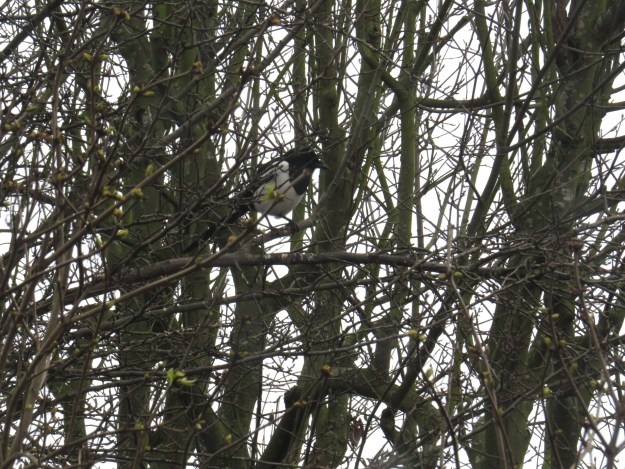
2 house sparrows, 2 magpies…
The magpies were in an altercation with the squirrels at one point – the birds seemed to be set on dismantling the remains of a drey in the whitebeam, probably for nesting material (it’s too early for baby squirrels), and the largest of the squirrels managed to drive them off.
Oh, and a robin…
and no less than fifteen starlings. At one point I thought that they might divebomb the squirrel, but those little dudes have very sharp teeth, so they thought better of it. There were so many of them that I thought I’d taken a photo, but this is the only one. Still, you get the general idea.
So, apart from the woodpigeon other no-shows were the goldfinches (where have they gone?), the ring-necked parakeets who’d popped in earlier, the blackcaps who are usually around, and the coal tit. But an hour isn’t very long in bird-time, and so I’m not unhappy – at least there’s something for the team at RSPB to punch into their computers. I shall be interested to see what effect, if any, the summer drought and the recent cold snaps have had on numbers. First winter survival is a key factor for the success of many garden birds.
Did you do the Big Garden Birdwatch? How did it turn out for you?
Dear Readers, it has been a difficult start to the year for several of my friends, including the person that is usually my buddy when we visit Walthamstow Wetlands. My friend is off looking after her mother, who is in her nineties, and is trying to sort out carers, finances, and all the many, many things that go with trying to look after someone you love when you normally live several hundred miles away. And so, this Saturday I went for a walk to see what was going on, but my heart goes out to my friend, and I hope that soon she’ll be back and we’ll be exploring together again.
You might not think that there’s much going on at this time of year, but just look at this board, showing recent sightings!
However, don’t get too excited because we saw none of these on this visit, though I was very pleased to see whatever chose to show itself.
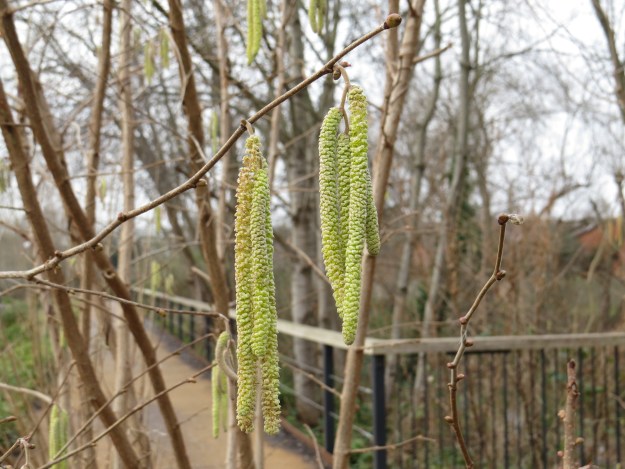
First up were some very fine hazel catkins. I think the ones in the bottom photo look like little people, but maybe it’s just me.
Signs of spring are everywhere in spite of the gloom – I love the new growth on the weeping willow reflected in the reservoir.
And you can tell that it’s spring when the coots are getting antsy, and bobbing around like rather ferocious black shuttlecocks.
The gorse is in flower, as it usually is (isn’t the saying that when the gorse isn’t in flower, kissing’s out of fashion?)
And look at this tiny critter! It’s a little grebe (otherwise known as a dabchick), and it lives up to its name by being only about half as big as a tufted duck. I spoke to one of the London Wildlife Trust volunteers, and she said she thought this species was her favourite – so little and so determined. Here one minute and gone the next, they have been called ‘floating rabbits’ because in better photos than these, they have a fluffy tail.
The better-known great crested grebe was also about – these birds are such a success story, and are much commoner than they were when I was growing up in the 60s. Such elegant birds!
A pair of Egyptian geese were getting very over-excited, and defending their territory against all comers, including the much larger Canada geese. I
There was a female pochard…
and lots of tufted ducks, including this female…
and a tree full of cormorants…
and great tits were much in evidence, along with robins and blue tits and long-tailed tits and all manner of tiny birds.
I thought that this bird (please excuse the blurry photo) was a great egret (and in fact there was one on one of the islands, but it was keeping a low profile). However, the black beak means that it’s a little egret. It didn’t look all that little from where I was standing, but it’s hard to judge sometimes.
So there is a definite sense of life stirring and of the pace picking up. I wasn’t sure if this coot was gathering material for a nest, and neither did s/he – when s/he got to the side of the lake she dropped the leaves, picked them up and dropped them again, before having a half-hearted nibble.
I love the Wetlands at this time of year – there are interesting reflections everywhere, like this one of a willow with its new growth…
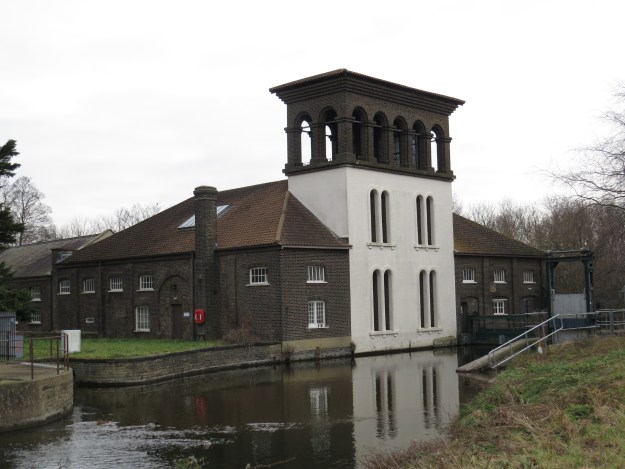
..or this one of the Coppermill building.
And here’s a visitor who probably isn’t very welcome. I love cats, but there’s a lot of vulnerable wildlife here. Hopefully this feline is just popping in for a look around.
I’ve been having one of those low weeks – winter feels never ending sometimes, we’re in the throes of year end at work and the news is as sombre as ever. But there is much to be said for getting out into nature in order to get some perspective.
Dear Readers, I always like to feature a success story and there was a very fine one in The Guardian today. The grey seal (whose Latin name Halichoerus grypus means ‘hook-nosed sea pig) was reduced to a population of about 500 individuals by the beginning of the 20th century – they were often hunted, and were seen as pests by local fishing communities. Today, the UK population has reached no less than 120,000, which represents 95% of the grey seals in Europe, and over 40% of the grey seals worldwide. The main reason for their rise seems to be the ending of persecution (they’ve been protected by law throughout Great Britain and Ireland), but there is also some thought that they might be benefitting from the fish that cluster around the artificial reefs created by wind turbines, in a nice display of the law of unintended consequences.
Grey seals are such big, curious animals, always popping up from below the waves to see what’s going on. They can live for up to 40 years, and often return to the same beaches to breed. The pups are born at various times around the UK coast, from August to January. They are fed with their mother’s rich milk for a few weeks, and then the females leave, to feed and to get ready for their next pup. By now, most of the pups will be thinking about braving the waves and going it alone for the first time. You can see grey seals at any time of year though – just take a boat to the Farne Islands, or Skomer, or walk along the beach at Donna Nook in Lincolnshire or the cliffs at Flamborough Head, and keep your eyes open for that retriever-shaped head. I have a great love for marine mammals of all kinds, but seeing a seal on a grey, blustery day is always a real tonic. The Wildlife Trusts have a list of places to see seals here.
The pups are very chunky creatures (as well they have to be – it’s cold in the North Sea and the Atlantic, and they need to be well upholstered). The pups are a bit prone to wandering once they’ve been left alone by their parents, and one was recently rescued from outside a kebab shop in Hemsby, Norfolk. As they can weigh up to 45 kg they can require quite a bit of muscle to move – they are usually loaded onto a stretcher and then two strong people carry them back down to the beach, which can be hundreds of metres away. One pup was found behind a closed gate in someone’s garden, which was a bit of a puzzle. Yet another one had swum up the river Ribble and ended up in a farmer’s field. Fortunately there’s something about these animals that people seem to love, and there are many people who act to rescue lost pups, and to act as volunteers when the pups are born, keeping onlookers at a safe distance and helping them to learn about the seals.
Incidentally, seals are quite closely related to dogs, and can catch diseases such as distemper, so please be very careful not to allow your hound to approach a seal, even if s/he is only being friendly.
Londoners don’t have to go quite so far from home to see seals though – grey and the smaller harbour seals are regularly spotted in the Thames, with the former being seen as far inland as Putney Bridge. Let’s hope that the deteriorating water quality of the past year (thanks for the sewage, water companies!) doesn’t affect them too much.
Mike Pennington / Grey Seal (Halichoerus grypus) pup, Easter Lother, Fair Isle
And, since it’s been a while, here’s a poem by Gillian Clarke. I love the image of the milk in the water, and the pup in his ‘cot of stone’. See what you think.
Seal by Gillian Clarke.
When the milk-arrow stabs, she comes, water-fluent, down the long green miles.
Her milk leaks into the sea –
blue blossoming in an opal.
The pup lies patient in his cot of stone.
They meet with cries, caress as people do.
She lies down for his suckling,
lifts him with a flipper from the sea’s reach
when the tide fills his throat with salt.
This is the fourteenth day.
In two days, no bitch-head will break the brilliance listening for baby-cries.
Down in the thunder of that other country, the bulls are calling
and her uterus is empty.
Alone and hungering in his fallen shawl,
He’ll nuzzle the Atlantic and be gone.
If that day’s still, his moult will lie a gleaming ring on the sand,