A Bit of a Dilemma

Large Red Damselflies laying their eggs

Dear Readers, nothing is ever simple when you’re a wildlife gardener. Today there were half a dozen pairs of Large Red Damselflies (Pyrrhosoma nymphula) laying their eggs in the pond, which, as mentioned on several occasions, is pretty much covered in duckweed this year. However, have a look at this little film and see exactly what the female is doing…look away for the first few seconds if you’re prone to sea-sickness but it does steady down after that.

It looks to me as if she’s quite deliberately laying her eggs under the duckweed leaves, which means that we really shouldn’t be clearing them at the moment. On the other hand, if they completely cover the pond the oxygenating plants won’t be able to photosynthesise, so that won’t be good for the pond either.

What also interests me as that towards the end of the film, you can see another tandem pair of damselflies heading in. Apparently in this species, the sight of one pair laying their eggs seems to attract other pairs – maybe there’s safety in numbers, or maybe the sight of one pair laying indicates that this is a suitable spot. It might also indicate that frogs, one of the damselfly’s most important predators, are not around at this particular bit of the pond.

Apparently the eggs hatch in two to three weeks, so I think the answer is maybe to just clear away a window so that the light can get into the pond, and worry about a bigger clear out later on. Getting the balance right between one thing and another is tricky, and too much meddling can cause more problems than it solves. Still, having too many damselflies reproducing is a quality problem for sure.

And then, I was thinking about cutting back the marsh marigold, but as I passed about 6 frogs jumped out from under its droopy leaves, so I think I’ll leave that as well. By the sound of it, I’ll just be able to put my feet up at the weekend….

Battling Damselflies

Dear Readers, the Large Red Damselflies are out in force today, and while you might think that a garden with a pond is a peaceful place, at the micro scale it’s nothing but small creatures beating one another up. Take this inoffensive looking male damselfly. There he sits on a leaf, occasionally cleaning his enormous eyes with his front legs, and looking as if butter wouldn’t melt.

And here are a loving couple. Well, as loving as you can be when a male has his claspers wrapped around your neck.

Still, although this looks a bit drastic, it’s the way that the male tries to make sure that the female doesn’t run off and mate with anyone else. She decides when it’s time to lay her eggs and flies off with the male attached, dashing her rear end into the water and letting go of a few eggs at a time.

However, the other male is waiting for just this opportunity.

Mating couple above, single male below

When the couple leave the leaf, the lone male flies up like a fighter plane, there’s a flurry of wings, and the ‘ownership’ of the female changes hands so quickly that you almost can’t see it. And then peace reigns again, briefly, until the next time.

What elegant creatures these are, though, and how it brightens my day to see them! They have been breeding in the pond every year for the past four or five years, and although their nymphs no doubt put paid to many tadpoles, they help to maintain the balance of the ecosystem. Plus, I often see them at the front of the house, perched on the buddleia or flittering around the green alkanet. They are gradually dispersing, and hopefully they’ll colonise any other ponds that people have in the neighbourhood, much as the frogs are doing.

And fortunately the duckweed doesn’t seem to have slowed them up too much.  My husband is on duckweed duty every Sunday, and by every Saturday the blooming stuff is back. I wonder why it’s so bad this year, having been entirely absent last year? Another mystery.

Still, it hasn’t slowed up the flag iris.

And the honey garlic will be in flower soon…

And the climbing hydrangea is gently opening too – it has a very faint floral scent which is lovely in the confined space of the side of the house. A few years ago this was visited by ashy mining bees, and what a treat that was! So fingers crossed that they’ll be back, and that I’ll have the time to actually sit and watch them.


Fascinating Phyllody

Dear Readers, when my friend A delivered this to me on Friday I was puzzled. What the hell is this? It was growing on my friend’s ivy, and where there should have been a flowerhead there was this bunch of little leaflets, probably close to a hundred in total. At the time I couldn’t remember the name for this phenomenon, but then it occurred to me, and a very fine word it is indeed.

Phyllody.

Phyllody occurs when the flower of a plant is replaced by leafy tissue . Also known as phyllomorphy or (an even better word in my view) frondescence. It was first identified by the poet Goethe, who guessed that the structures that create leaves and flowers are essentially the same, and that at some point the plant ‘chooses’ which to make. Occasionally this goes wrong, usually as a result of damage at the tip of the growing stem – it can be caused by everything from bacteria, viruses and insect damage to frost or drought conditions, though if the condition is caused by environmental conditions it will usually right itself. Some insects, in particular leafhoppers, can transmit the bacteria that cause phyllody.

However, humans being humans we have found some variations on phyllody that we actually like, and have bred for these characteristics. The ancient Chinese had a passion for roses, and developed a form of Rosa chinensis called Viridiflora, where the petals on the flowers are replaced by leaves to give a ‘green’ rose.

Photo One by By Obsidian Soul - Own work, CC BY-SA 3.0, https://commons.wikimedia.org/w/index.php?curid=22581891

The ‘Green Rose’ of China (Rosa chinensis var viridiflora) (Photo One)

Interestingly, according to the RHS strawberries can be particularly prone to phyllody, with the tiny seeds on the fruit turning into leaves instead of luscious red fruit. In strawberries the damage is often caused  by a bacteria, but weedkillers can also cause abnormal growth, in particular glyphosate. Lordy people, why the hecky-deck would anyone spray such a biocide close to their food? One variety, Malwina, can sometimes be hit with what the RHS calls ‘genetic fail’, when all the fruit in the first year is replaced by leaves (very frustrating I’d imagine). Strangely, the plant is said to produce normal fruit in subsequent years. If anyone has experience of this I would love to know all the details, it sounds most peculiar to me.

Photo Two from https://www.researchgate.net/post/Found-this-on-our-strawberries-Can-anyone-help-us-identify-what-it-is-cause-and-treatment-thereof

Strawberries showing phyllody (Photo Two)

Phyllody is often found in members of the bean, rose and daisy families, but I can’t find any mention of it on ivy before. The specimen that I have is showing some signs of aphid or mite damage, so maybe one of these little lovelies has transmitted some kind of bacterial disease. It will be very interesting to see if this is a one-off on a few buds, or if it affects the ivy next year. I shall wait with bated breath.

Photo Credits

Photo One By Obsidian Soul – Own work, CC BY-SA 3.0, https://commons.wikimedia.org/w/index.php?curid=22581891

Photo Two from https://www.researchgate.net/post/Found-this-on-our-strawberries-Can-anyone-help-us-identify-what-it-is-cause-and-treatment-thereof

A Spring Walk in St Pancras and Islington Cemetery

Well, Dear Readers, finally I have the bandwidth to write about my walk in the cemetery yesterday, as my assignment has been sent off and now I just have the exam to worry about (on 13th June, so keep your fingers crossed). This has been a very wide-ranging, demanding module, on all aspects of science from geology to quantum mechanics via environmental science, chemistry, biology and physics, so my brain has been very well stretched. Let’s just hope that it doesn’t ping back to its normal size over the summer.

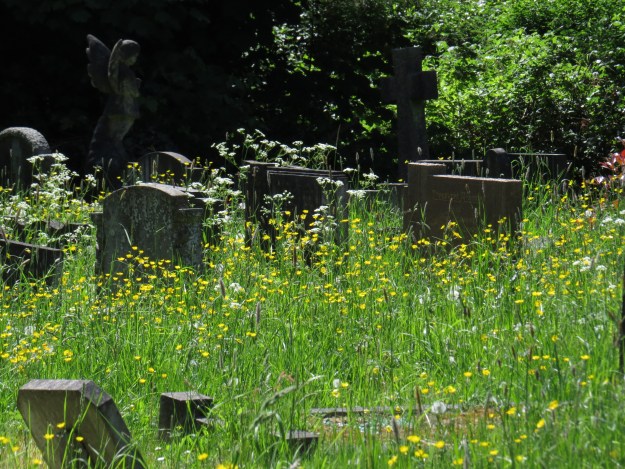
Anyhow, we haven’t been to the cemetery for at least a month, and there has been another ‘changing of the guard’ as far as the plants are concerned. I was very pleased to see that the chaps in the cemetery are having a bash at ‘no-mow May’, at least in a few pockets of the lawns. The sound of strimming was pretty relentless in some areas, but there are still places where there are old graves where the plants grow long and wild.

No Mow May in action!

The horse-chestnuts are in full flower now, and at this time of year (before the leaf-miners get them) they look absolutely magnificent.

The buttercups and the cow parsley (Queen Anne’s lace) has taken over from the bulbs and lesser celandine.

Cow parsley in the woodland grave area

Buttercups always attract the smaller pollinators

I am much amused by the salsify, which seems to be pinging up all over the place. Where did it come from? It is so spikey and stately and somehow eccentric. There is something very medieval about it, to my eye.

The dog rose is in flower, and very pretty it is too. I love the way that the flowers start out blush pink and end up white.

We saw some butterflies too – a fresh new comma, a rather worn peacock and a very energetic male orange-tip who was much too fast to photograph.

Peacock (Aglais io)

Comma (Polygonia c-album)

The crack willow is exuding pollen from its catkins, and my husband is sneezing as a result…

And I suppose it was inevitable but the green space close to the stream and to the beehives is being dug up for graves. I guess it’s easier to do this here than in the woodier parts of the cemetery, but last year this was alive with butterflies.

The azaleas and rhododendrons are just coming into flower by the crematorium, and some of them are magnificent – just look at this orange one! These are not amongst my favourite plants, but they are very striking all the same.

No, what I like are those woody paths through dappled sunlight, where you barely meet a soul.

The clenched fists of the hogweed are unfurling, ready to take over from the cow parsley…

And in some places the buttercups and dandelions are putting on quite a show. It reminds me of the few drowsy summer days that I had as a child – on one occasion, we drove to Waltham Abbey and I remember laying down among the wild flowers and  watching all the insects moving through a miniature jungle. That’s really where Bugwoman was born, I think.

And finally, we were standing under these three plane trees when we heard the most extraordinary noise from very high up in the branches.

We’ve been watching ring-necked parakeets around here, and after a few minutes an adult flew off. I suspect that there’s a nest up there somewhere, and we will certainly keep an eye open next time we’re in the cemetery. Everyone seems to be producing babies at the moment, so why should the parakeets be an exception?

And to round off our trip, we saw this handsome crow. No doubt s/he will have babies to feed too.

Aaargh!

Darling Readers, I am mightily up against it today because I have my final Open University assignment for this year due in on Monday, and what with having two weeks in Canada/jetlag/ work yadda yadda I am a bit behind. Which is a shame because my subject is the appearance of green algal balls on the beaches of Sydney, Australia, and if I had more time I would rabbit on about all the interesting things that I’ve discovered (though I should probably wait till the deadline for the paper is over because, plagiarism etc etc).

Image from https://juliacooke.net/2015/09/23/solving-the-mystery-of-the-algal-balls-at-dee-why/

Anyhow, fortunately I had time this morning for a sanity-saving walk in St.Pancras and Islington Cemetery. I shall write a bit more about this tomorrow (and at some point soon will also get into the swing of quizzes again), but for now, here are a few of my favourite photographs. Enjoy! I might have known that as soon as I had to get stuck into something indoors we’d have a heat wave, but there we go. 

Primroses and Red Kites and Babies!

Candelabra primula (Primula bulleyana)

Dear Readers, as you might imagine I have been pretty swamped with work since getting back from Canada, but it was such a beautiful day today that I actually managed to pop out to see what was happening in the garden. First up, I noticed that some of the candelabra primulas that we planted last year have actually survived, and are coming into flower – these are orange and yellow, but we have some purple ones for later in the year. The patch at the top end of the pond is often a bit bleak at this time of year, before everything else gets going, so it was lovely to see them. We have put in supports for the hemp agrimony this year, so hopefully they won’t be overwhelmed before they’ve finished for the year.And then, I was having a cup of tea when I thought I heard the sound of baby birds. The blue tits have been all over the hawthorn this year gathering caterpillars, and then one of them shot past me and headed for the nest box that we put up on the balustrade of our loft.

And here’s a shot of his or her tail disappearing into the nest. I am so excited! We will keep the curtains on the room drawn so that we don’t disturb them. I feel like a proud surrogate parent.

I am hoping that at some point the climbing hydrangea will reach the balustrade, it would provide some extra cover and hiding places. I reckon about another two years at the rate it’s growing. Believe it or not, we cut it back level with the ground floor window (above the green door) in January 2020.

And then, finally, after looking for them for the past year, I saw a red kite in the sky over East Finchley.

At one time, these birds were so valued as scavengers that to kill one was a capital crime. But over time, with habitat destruction, cleaner streets, less carrion about and the rise of egg-collecting as a hobby, the bird became extremely rare, retreating from its range across the whole of the UK to a few sites in Wales, where it was never able to raise enough chicks to expand.

By the 1930s there were only 30 birds in the whole of the UK, all derived from one female bird. It was decided to bring in birds from Sweden and Germany to improve genetic diversity, and the birds were released in various sites around the UK. This was so successful that there are now an estimated 10,000 birds, and their range is increasing every year. They are the most elegant of birds, with their forked tails and narrow wings, and it was a real joy to see one so close to home. The main risks now to the birds are poisoning from rodenticides used to kill rats (this also kills many other birds of prey and mammals, including domestic dogs and cats). They also have a habit of colliding with power cables. Still, this is a real success story, and we could all do with one of them!

The Prehistoric Sea Swans of Japan

A

Artist’s impression of the prehistoric sea swan (Artist’s reconstruction from the Gunma Museum of Natural History)

Dear Readers, scientists in Japan have been learning about the lives of two ancient, flightless ancestors of our present-day swans. The first, Annakacygna yoshiiensis, was discovered in 1995, was about the size of the Trumpeter swans of North America (these are the largest existing swans in the world). The second, Annakacygna hajimei,  is smaller, the size of a black swan, and was discovered in 2000.

I know we only had the photo below a few weeks ago, but it’s one of my favourites.

Trumpeter at Wye Marsh in Ontario, March 2019

What is unusual about both these swans is not only that they were flightless, but that their forewings are very short. The scientists involved in the project think that they may have used their wings to cradle their cygnets – modern-day mute swans can be seen carrying their young on their backs in a similar way, and the structure of the wings of the prehistoric species would have made this even easier. Couple this with a mobile tail, and you have a perfect little ‘box’ in which to hold your youngsters in choppy seas.

Photo One by rufre@lenz-nenning.at) - Own work, CC BY-SA 3.0 at, https://commons.wikimedia.org/w/index.php?curid=4077472

Mute swan with wings in ‘piggyback’ position (Photo One)

The swans also had much heavier bones and broader bodies than extant swans – they didn’t fly, so weight wasn’t an issue, while stability in the water probably was.

Skeleton of flightless swan. Note the strange wings! (Photo from Gunma Museum of Natural History)

And finally, these swans were not the delicate grazing birds that modern swans were – they have much heavier beaks which the scientist in charge of the project, Dr Hiroshige Matsouka, compares to that of the shoveler duck. These swans would have fed on sea-going plankton rather than nibbling at grasses, and all in all were very robust birds.

Prehistoric swan at the top, whooper swan at the bottom (Photo from Gunma Museum of Natural History)

These swans must have been amazing birds, perfectly adapted to their marine lifestyle. They date back to the Miocene, 11 million years ago. Who knows what caused their eventual demise? Being flightless is often a liability when things change though – it only takes a new predator, or a problem with the food supply, to cause fatal problems. What a shame that we can’t see giant, flightless swans cradling their cygnets and dabbling for plankton in our current oceans.

There are full articles in New Scientist and in The New York Times. 

Photo Credits

Photo One by rufre@lenz-nenning.at – Own work, CC BY-SA 3.0 at, https://commons.wikimedia.org/w/index.php?curid=4077472

‘Trees’ by Peter A. Thomas

Dear Readers, I need to tell you a quick story about this book,’Trees’ by Peter A. Thomas, which arrived while I was in Canada. The courier left it behind the wheelie bins (which is where he usually leaves them), but it wasn’t there when we returned. However, it was eventually found, still in its cardboard wrapping, in the side return to the house – a fox had clearly found it, dragged it under the whole in the back gate, and had been munching on it before deciding that it wasn’t edible. If my husband hadn’t been watering the garden (and since then we’ve had rain every day but that’s another story) I would never have found it. Fortunately the book itself was intact, and just as well, because it’s an absolute delight, and a fine addition to the teetering pile on my bedside story. I haven’t read enough to actually review it yet, but I thought that I would just share one piece of information that I’ve gleaned by opening it randomly.

There has long been a mystery about the relationship between bumblebees and lime trees. The lime trees provide abundant nectar for a very long period, and so they are beloved by pollinators of all kinds. I well remember sitting under a lime tree when I went to visit my parents in Dorchester, and almost being lulled to sleep by the sweet, heavy perfume. However, towards the end of the season great heaps of dead bumblebees have been found under the lime trees, particularly Silver Lime (Tilia tomentosa) and Caucasian Lime (Tilia x euchlora).

Photo One by By Jean-Pol GRANDMONT - Own work, CC BY 3.0, https://commons.wikimedia.org/w/index.php?curid=2788202

Silver Lime (Tilia tomentosa) (Photo One)

At first, it was thought that the nectar might be somehow poisoning the bees. Then, it was thought that the nectar might contain mannose, a sugar which is largely indigestible by bees. But then, it was noticed that the dead bees contained very few honeybees, and this was a clue. Honeybees will visit a plant or not depending on its nectar abundance, whereas bumblebees seem to return again and again to a site that once had nectar. So, as the year wore on and there was less nectar (especially in a dry year), the honeybees looked elsewhere, but the bumblebees seemed to be addicted to their lime tree, even when it didn’t provide them with enough food. Furthermore, the nectar of lime trees contains caffeine – could this have helped the bumblebees to become dependent? I know I ‘need’ my morning coffee, so perhaps it has a similar effect on our small furry flying relatives. At any rate, the mystery is not yet solved, but the hypothesis is that the bumblebees are not in any way poisoned, but simply starve to death. Fascinating stuff (to me at least), and I look forward to finding out what other things this book has to teach me, so that I can share them with you all.

Photo Two byIvar Leidus (Own work) via Wikimedia Commons

Bumblebee on Lime Flower

Photo Credits

Photo One by By Jean-Pol GRANDMONT – Own work, CC BY 3.0, https://commons.wikimedia.org/w/index.php?curid=2788202

Photo Two byIvar Leidus (Own work) via Wikimedia Commons

Wednesday Weed – Bog Bean

Bog Bean (Menyanthes trifoliata)

Dear Readers, I thought that the Bog Bean that I mentioned yesterday deserved a few moments of attention. This is a native plant, though not a bean (the leaves apparently look a bit like those of the broad bean), and the genus name comes from the Greek for ‘disclosing flower’ as the flowers open sequentially along the stem. I love the pink buds, and the ‘hairy’ flowers are apparently unique, though I imagine that this must surely have something to do with whatever creature originally pollinated them. Fossil seeds of bog bean have been found in the Carpathian Mountains, and they date back to the middle Miocene (about 16 million years ago), so this is a plant that co-existed with giant sloths, three-toed horses and ‘bone-crushing dogs’. The plant is related to the water lily, though not closely – it’s the only plant in its genus.

Photo One by peupleloup, CC BY-SA 2.0 <https://creativecommons.org/licenses/by-sa/2.0>, via Wikimedia Commons

A Bog Bean in Quebec (Photo One)

Bog bean is also known as ‘bog hop’ in Northern England and some parts of Europe, and has been used to flavour beer and schnapps.  It is the County Flower of Renfrewshire. Apparently there are chemicals in the leaves which can attract cats in the same way that catnip does, though as this is a plant of ponds and other wet places that seems somewhat ironic.

The plant has been used extensively for medicinal purposes, especially in Ireland and parts of Scotland. The leaves are boiled to make a medicine for arthritis and rheumatism, congestion, indigestion, constipation, blackheads and boils. There’s a pool in Bute, Scotland, known as The Pool of Healing because the bog bean grows there. In Chinese medicine the plant is used as a cure for insomnia.

In Devon, children were said to say this rhyme if they had to pass through a dark passage or dangerous place. ‘Biddy Bene’ comes from the Anglo-Saxon word ‘biddan‘, meaning to entreat or pray. I rather like the notion that the goose and the fox were the things that children were afraid of.

Buckee, Buckee, biddy Bene,
Is the way now fair and clean?
Is the goose ygone to nest,
And the fox ygone to rest?
Shall I come away?’

Photo Two by Sally from https://www.geograph.org.uk/more.php?id=4042853

Bog Beans from a remote Scottish lochan (Photo Two)

And of course, this is a plant of the bog lands, the most underrated and undervalued of habitats in spite of their role in capturing carbon and preserving all manner of delicate plants and rare insects. There is nothing as evocative, or as tricksy, as a bog, as anyone who has ever tried to cross one will know. Only those who really know the lie of the land can navigate a bog without wet socks, or worse. And so, I was delighted to find this poem by Irish poet Eileen Casey. If you would like to hear more of her work, there’s a short film here, which I highly recommend.

Treasure by Eileen Casey

Dappled light pleats lilac shadings.

Blue meshes with pink; bog weathered

morning enters its stride. Colour

sharpens as light deepens. Spider webs

drape lacy antimacassars across purple

heathers, yellow flowered asphodel.

Early frost begins to thaw, burgeons

sphagnum’s already swollen hoard.

Dew glistens pearly frogspawn,

dragonflies hover close-by. Skylarks

rise with meadow pipits and willow

warblers or stall over a bog-bean pool.


Man and beast leave traces in their wake.

A thumbprint traced in buried bog butter.

A psalter creased by righteous devotion.

Elk bone fragments. Bodies. Stabs of bog

shadow struggle with bog memory;

sacrificial wounds. We glimpse survival

in russet-edged leaves, mauve bruises

ruffled onto moss.


Bog is like a treasure filled galleon,

centuries deep. Imperial measure in peat.

We lose sight how, even inconsequential

elements become more than their sum of parts.

Faithful to its seasons, bog keeps track.

Photo Credits

Photo One by peupleloup, CC BY-SA 2.0 <https://creativecommons.org/licenses/by-sa/2.0>, via Wikimedia Commons

Photo Two by Sally from https://www.geograph.org.uk/more.php?id=4042853


The Battle Against the Duckweed

Dear Readers, this is a shot of the pond after we spent an hour yesterday getting rid of at least some of the duckweed – you couldn’t see any open water when we got home, so this is a bit of an improvement (believe it or not). We didn’t want to remove all of it (as if that’s even possible) because it provides a bit of cover for the tadpoles, and also, as it turns out, for the adult frogs, like this one sheltering under the marsh marigold.

I was also pleased to see that the bog bean is in flower, though as it’s said to be a bit of a thug I might not be happy for long. Let’s see. I rather like those extraordinary furry flowers.

This rather fine hoverfly put in an appearance too. I think it’s an Eristalis species, which breed in ponds and bogs appropriately enough.

And finally, this Herb Robert has made itself at home outside the kitchen door. I should probably pull it up, but I haven’t got the heart. I think it looks rather fine against the arsenic-green paintwork.


In other news the cat, who caterwauled about two dozen times all through the night that we arrived home has now reduced her complaints to two, although as one was at 3 a.m. it’s still not optimal. Let’s hope lots of strokes, titbits and brushing (her favourite things) restore us to favour. And let’s be very glad that, unlike one foster cat we had, her irritation doesn’t drive her to crapping right in the middle of the bed when we go away. That really wasn’t fun to come home to.