Wednesday Weed on Thursday – Sea Buckthorn

Sea Buckthorn (Hippophae rhamnoides)

Dear Readers, Bank Holidays always get me confused, and this week was no exception, so, for one week only, the Wednesday Weed will be on Thursday. Normal service will be resumed next week (with any luck).

So, this week’s plant was spotted in my local cemetery, but Sea Buckthorn is by nature a plant of sand dunes and coastal areas. It is quite an impressive-looking plant once the berries come out, but the rest of the time it’s just a mass of long, narrow, silvery leaves and rather nasty thorns. It’s a native plant, Nationally Scarce in its wild state, but becoming increasingly common both as an ornamental and as a method of stabilising sand dunes. Here, though, I must quote from my pal Liz Norbury who lives in Cornwall and has first-hand experience of the plant:

Much of our local sea buckthorn was planted around 30 years ago to help stabilise the sand dunes, but it can be extremely invasive, and in recent years, our conservation group, Friends of the Towans, has been cutting it back. It’s not the most pleasant task – I’ve found sea buckthorn to be even more vicious than gorse! We’re now involved with the national Dynamic Dunescape project), which aims to restore life to dunes by encouraging natural movement – a complete reversal of the old stabilisation policy – https://friendsofthetowans.co.uk/archive/funding-boost-for-west-cornwalls-dynamic-dunescape/

In fact, it’s the extensive root system of sea buckthorn that makes it such a boon in the east and such a pest elsewhere – the roots bind the sand dunes together, and also enrich the soil with nitrogen, a fairly unusual attribute as the plant is not a legume but a member of the Oleaster family.

The genus name Hippophae means ‘shining horse’, and comes from a belief that feeding horses with sea buckthorn would improve their condition and give them glossy coats. The plant was also believed to be the favourite food of Pegasus, the flying horse. One particularly gruesome bit of folklore comes from the time of Genghis Khan, when boiling your enemies alive in oil was apparently a popular entertainment. Recommended oils were olive oil and animal fat, but not sea buckthorn oil which was supposed to have such an array of curative powers that any enemy brought to a simmer would be healed rather than fried.

Sea buckthorn is remarkably hardy, capable of withstanding temperatures of -43 degrees Centigrade, which is handy when you consider that its native range includes the Baltic Coast and the chillier parts of Russia, Ukraine and Mongolia.

Now, as I’ve mentioned previously, anyone who watches ‘The Great British Menu’ will remember the sharp intake of breath when a chef mentions that they’re going to incorporate sea buckthorn into their dish.

“The judges don’t like sea buckthorn”, some clever-clogs will say, and they will usually be proved right. Having never tasted it, I suspect that the berries are probably quite astringent, though Liz says that they remind her of passionfruit. What do you think, Readers? I am happy to be educated, and indeed I would taste the ones in the cemetery were it not that they are right next to the North Circular Road and therefore probably dripping with pollutants, poor dears.

There can be no doubt about the food value of the berries, though – they are richer in Vitamin C than citrus fruits. However, they are notoriously difficult to harvest – the bushes are thorny, the berries are reluctant to disengage from the branches to which they are attached, and the crop is small. One for the dedicated forager, I suspect, though apparently if the fruit is frozen (as it frequently is) it could be removed by a ‘trunk clamp-on vibration harvester’, whatever that is. Even then, there is a danger of leaf and wood contamination and so the berries need to be cleaned by hand.

When pressed, the berries separate into three layers – a thick orange layer, an oily middle layer and then the juice. The top two layers are frequently used for skin lotions and cosmetics, and the juice is popular in some countries, though presumably mixed with something to offset the sourness.

The berries do, however, make for very pretty, orange-tinted food. No wonder the chefs love them.

Medicinally, sea buckthorn has been used for slow digestion, stomach malfunctioning, cardiovascular problems, liver injury, tendon and ligament injuries, skin diseases and ulcers.

Sea buckthorn is also loved by a variety of animals. Fieldfares love the berries, and are not put off by the thorns.

Fieldfare munching on sea buckthorn – Photo by Sandy MacLennan at https://www.flickr.com/photos/16732277@N05/38454558615/

A surprising variety of rather splendid moth caterpillars feed on the plant, including the Oak Eggar (Lasiocampa quercus), who you might reasonably expect to prefer oak.

Oak Eggar – photo by Ben Sales

The Sharp-angled Peacock moth (Macaria alternata) is something of a coastal specialist, often feeding on tamarisk as well as sea buckthorn.

Sharp-angled Peacock moth, photo by Ilia Ustyantsev from Russia

And, finally, here’s a poem. It’s a bit lateral this week:there is a  lovely poem by Helen Cruickshank called ‘Sea Buckthorn‘ which is in Scots dialect, and very fine if you can understand it. But I was also very taken by this poem by the Irish poet Frank Kavanagh, called ‘Pegasus’. When I was a child, Pegasus was easily my favourite mythical creature – when we went out in the car I would often imagine him running and jumping and flying alongside us, leaping over motorway bridges and outrunning police cars. So here it is. See what you think.

Pegasus by Frank Kavanagh

My soul was an old horse
Offered for sale in twenty fairs.
I offered him to the Church–the buyers
Were little men who feared his unusual airs.
One said: ‘Let him remain unbid
In the wind and rain and hunger
Of sin and we will get him–
With the winkers thrown in–for nothing.’

Then the men of State looked at
What I’d brought for sale.
One minister, wondering if
Another horse-body would fit the tail
That he’d kept for sentiment-
The relic of his own soul–
Said, ‘I will graze him in lieu of his labour.’
I lent him for a week or more
And he came back a hurdle of bones,
Starved, overworked, in despair.
I nursed him on the roadside grass
To shape him for another fair.

I lowered my price. I stood him where
The broken-winded, spavined stand
And crooked shopkeepers said that he
Might do a season on the land–
But not for high-paid work in towns.
He’d do a tinker, possibly.
I begged, ‘O make some offer now,
A soul is a poor man’s tragedy.
He’ll draw your dungiest cart,’ I said,
‘Show you short cuts to Mass,
Teach weather lore, at night collect
Bad debts from poor men’s grass.’
And they would not.

Where the
Tinkers quarrel I went down
With my horse, my soul.
I cried, ‘Who will bid me half a crown?’
From their rowdy bargaining
Not one turned. ‘Soul,’ I prayed,
‘I have hawked you through the world
Of Church and State and meanest trade.
But this evening, halter off,
Never again will it go on.
On the south side of ditches
There is grazing of the sun.
No more haggling with the world….’

As I said these words he grew
Wings upon his back. Now I may ride him
Every land my imagination knew.


Tuesday Quiz – Crumble or Crumple? – The Answers!

Hawthorn Berries – Edible but astringent.

Dear Readers, it seems that you are all pretty reliable on the foraging front – even where people didn’t get the species right, you had a pretty good eye for what was edible and what wasn’t, which is a relief.  So, to the scores, which are out of 28 because I forgot to include Number 5: Christine got 22 out of 28, Rachael got 22 1/2 out of 28, and Claire and Mal at FEARN both got a perfect 28 out of 28, so well done everybody! I am going to open up the comments with your answers, and there are some great suggestions for how to use the edible berries – Mal mentions using sea buckthorn as a topping for cheesecake and Claire tells me that they are used for hand cream. Plus, Claire says, holly berries, though inedible, are macerated in alcohol to make brandy in Alsace. Who knew?

1) Edible – Sea Buckthorn (Hippophae rhamnoides)

2) Edible – Dog Rose (Rosa canina)

3) Not Edible – Bittersweet (Solanum dulcamara)

4) Not edible – Holly (Ilex aquifolium)

6) Not edible – Cherry Laurel (Prunus laurocerasus)

7) Not edible – Yew (Taxus baccata)

8) Edible – Elder (Sambucus nigra)

9) Edible – Himalayan Honeysuckle (Leycesteria formosa)

10) Edible – Guelder Rose (Viburnum opulus)

11) Not Edible – Ivy (Hedera helix)

12) Not Edible – Black Bryony (Tamus communis)

13) Not edible – Deadly Nightshade (Atropa belladonna)

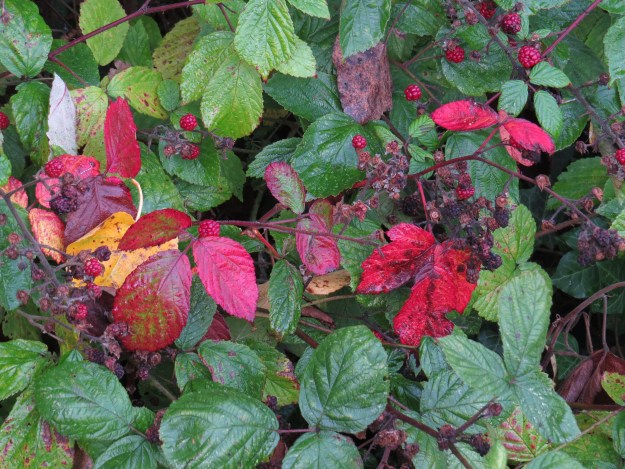
14) Edible – Bramble/Blackcurrant (Rubus fruticosus agg.)

15) Not Edible – Cuckoopint/Lords and Ladies (Arum maculatum)


At Golders Green Crematorium

Dear Readers, today we decided to take a look at Golders Green Crematorium, and its memorial gardens. This is the first crematorium to built in London (it was opened in 1902): cremation only became legal in the UK in 1885, with the first crematorium being built in Woking in 1878 as part of the cemetery there. Cremation was championed by the Cremation Society of Great Britain – it was believed that the burning of remains was much healthier than burial, and as many city cemeteries were full, it was seen as a more practical way to deal with the dead. A declaration stated that

We, the undersigned, disapprove the present custom of burying the dead, and we desire to substitute some mode which shall rapidly resolve the body into its component elements, by a process which cannot offend the living, and shall render the remains perfectly innocuous. Until some better method is devised we desire to adopt that usually known as cremation.”

Some of the undersigned included Anthony Trollope, John Everett Millais and the illustrator John Tenniel, along with the president of the Cremation Society, Sir Henry Thompson.

Since it opened, Golders Green Crematorium has held more than 323,500 cremations, more than any other crematorium in the country. In an average year there are 2,000 cremations, with three chapels being available for the services. The crematorium is secular and open to people of all faiths and none.

I was struck by how different the memorial gardens are: without any graves, people are remembered by plaques which might accompany rose bushes, or trees, or shrubs. The gardens are remarkably peaceful, even on a Bank Holiday.

The Lily Pond in the Memorial Gardens

I loved this purple magnolia, its flowers just about ready to open. At least, I think it’s a magnolia. Enlighten me if not, readers!

I liked this statue of G.D. Birla, an Indian businessman, writer and philanthropist who was a close associate of Mahatma Gandhi.

Statue of G.D. Birla

And here is a memorial bench to Marc Bolan, who died in a car accident in 1977 at the age of 29. For those of you too young to remember, the swan refers to the T-Rex hit ‘Ride a White Swan‘, a big favourite when I was, ahem, 10 years old.

There are some stunning acers…

…some fine Japanese anemones…

and a very fine pond, with a magpie happily trawling for titbits on the plants.

I was very taken by this sculpture by Henry Pegram, called ‘Into the Silent Land’. It was gifted to the crematorium by the Royal Society of Arts in 1937, the year of Pegram’s death.

This extraordinary building is the Philipson Mausoleum, designed by Sir Edwin Lutyens and built  in 1914. It was built originally to house the remains of Florence Philipson, and when her husband RH Philipson died, he stipulated that his money should be given to a home for boys in his birthplace, Newcastle, with any remainder being used to preserve the mausoleum. It’s an extraordinary design – roses were to be planted between the inner and outer walls, and originally the oculus in the dome was open to the sky (like the Pantheon in Rome), with an upturned basin underneath to catch rainwater. Sadly, today it’s padlocked, and the dome (the oculus is now glazed) looks increasingly like the hanging gardens of Babylon.

The Philipson Mausoleum, designed by Lutyens

Intriguingly, there is a ‘Communist’s Corner’, where the plaques of communists past and present are collected together.

‘Communists Corner’

What a wonderful vista along the cloisters!

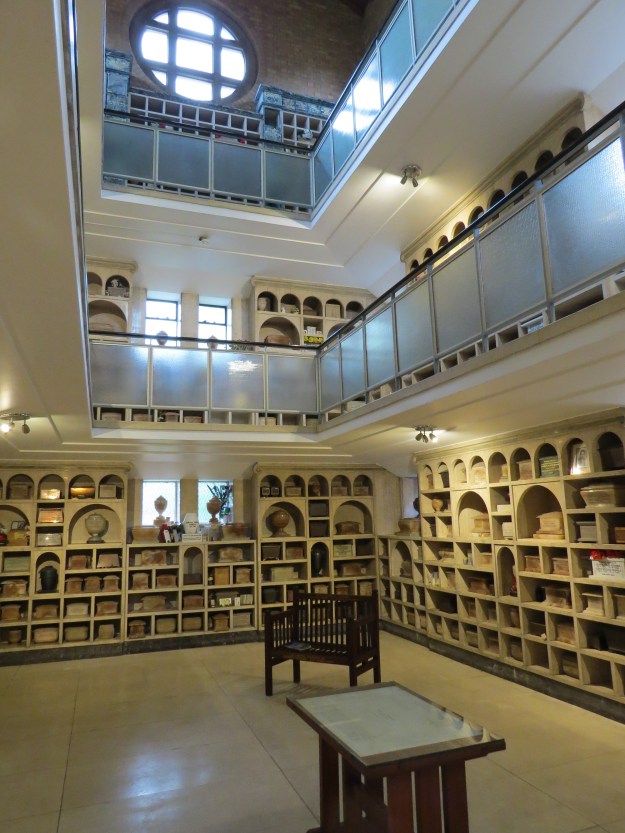
One feature that I hadn’t seen before is a columbarium: this is a room that stores the funerary urns in niches. The range of choices that have to be made when someone dies can sometimes be overwhelming – to cremate or to bury? To scatter or to store?  The variations on each theme multiply like a particularly complex flow chart. It’s really helpful to know what the loved one wanted in advance, so thanks to Mum and Dad for their foresight.

And finally, on the way out I was much taken by this plaque. ‘Mors janua vitae’ means ‘Death is the Gateway to Life’. Historic England describe it as ‘a plaque in Art Nouveau style’, which indeed it is, though I can’t find out if there is anything that links those who are commemorated on it. Nonetheless, it’s another sign of how much there is to explore at the crematorium and the memorial gardens. I shall certainly be visiting again. For one thing, I completely missed the ‘Freud Corner’, where the funerary urns of Sigmund Freud and his family are held, and it would be good to find and pay my respects to Joyce Grenfell, one of the funniest comedians of her (and any) generation.

What’s Going On? – Raccoon Bank Robbers and Octopus Athletes

Photograph: Peninsula Humane Society & SPCA (PHS/SPCA)

Dear Readers, I was completely devoid of inspiration for today’s post until I came across this little gem in The Guardian. It’s actually nearly a year old, but then I’m often the last to know anything exciting. Two raccoons apparently crawled through the air ducts (eat your heart out Tom Cruise) and broke through the ceiling into the bank. I love the photo above – one of the raccoons seems to be checking the coast is clear while the other is acting as lookout. They were spotted by a customer who was withdrawing some money, and after ten minutes the Humane Society was able to usher the animals outside. I just hope nobody had left their lunch around in their desk drawer.

Photograph: Peninsula Humane Society & SPCA (PHS/SPCA)

And there’s more! Scientists from the University of Sydney have been studying a population of octopuses who live in Jervis Bay, off the coast of Australia. This is a small area of sandy, silty soil suitable for den building, and so octopuses gather there in unusually large numbers to make their homes. This can lead to social friction, as you might expect. Scientist Peter Godfrey-Smith had observed the animals ‘throwing’ silt at one another, but wasn’t sure until recently if the behaviour was intentional. However, after a lengthy study Godfrey-Smith is sure that it is, and that the females in particular hurl silt at males who are irritating them.

In 2016, for instance, one female octopus threw silt 10 times at a male from a nearby den who was attempting to mate with her. She hit him on five occasions. “That sequence was one of the ones that convinced me [it was intentional],” says Godfrey-Smith.

On four of these occasions, the male tried to “duck”, though he didn’t always succeed. In two cases, he anticipated the throws from the female’s movements and started dodging before the silt was propelled at him”.

Normally the octopuses just squirt out the silt, but I absolutely love this.

On one occasion, the researchers did see an octopus throw a shell at – and hit – another octopus by flinging it with a tentacle like a frisbee, rather than by propelling material with its siphon”.

And it’s not just other octopuses that are getting walloped.

“On two occasions, an octopus hit a fish, though one of these collisions appeared to have been accidental. The animals also seemed to target the camera on occasion, hitting the tripod twice.”

The scientists also believe that the octopuses might throw things about when they get frustrated.

What’s more, some throws that happen after intense social interactions aren’t directed at another octopus but into empty space, suggesting the animals might be venting their frustration.

In one case, after a male’s advances to a female were rejected, he threw a shell in a random direction and changed colour.”

A Sydney Octopus (Octopus tetricus) (Photo from Nature Picture Library / Alamy)

There is nothing about this story that I do not love. It sounds as if we are only at the very start of our understanding of the emotional lives of these remarkable animals.

Read more: https://www.newscientist.com/article/2287879-female-octopuses-throw-things-at-males-that-are-harassing-them/#ixzz74waRCYpj

A Bank Holiday Walk in St Pancras and Islington Cemetery

Dear Readers, it was extremely quiet in the cemetery today. I’m guessing that lots of people are away, what with it being the August Bank Holiday and all, but it meant that I spotted two handsome foxes (though they dashed away too quickly for me to get a photograph), and also saw two buzzards circling overhead, mewing to one another. I expected the crows to rise up in umbrage, but they didn’t for once – maybe they’re all on holiday too.

Some Japanese anemones are just coming into flower in the woodland grave area, along with some most unlikely-looking plants – they remind me of one of my house plants. Let’s hope they survive.

Look at the swamp cypress, people! I am waiting for the first hints of rust to appear. There is a definite increase in tempo this week, with the coal tits and blue tits cheeping and the robins starting to announce their winter territories. I love autumn though, it’s probably my favourite season – there is strangely more of a sense of possibility and new beginnings for me at this time of year than in the spring. Maybe it’s all those years of education, when the school year started in September, but it’s always been pivotal for me – I got married in September, as did my mother and father, and I started my most recent job in September too.

The swamp cypress

Anyhow, I’m starting to see a lot of wasps drifting about. I wonder what this one was after on this conifer? Maybe there’s something sweet and resinous being produced.

The Cedars of Lebanon are looking particularly magnificent, and several of them are producing their female flowers, which will be shedding pollen and irritating the noses of hay fever sufferers for the next few months.


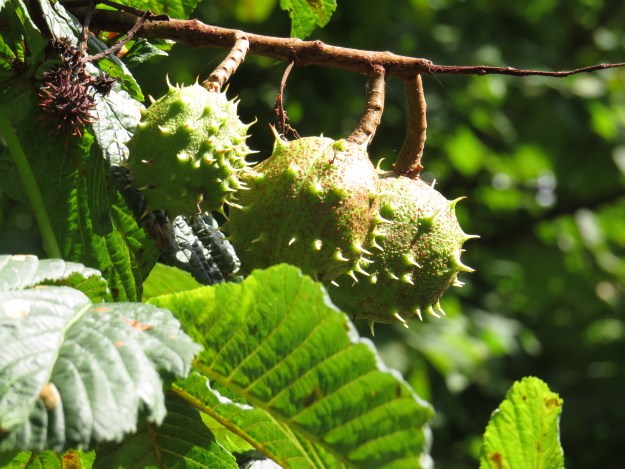
The conkers are filling out nicely, and there are plenty of berries on the holly.

And here’s a holly-blue butterfly, sunning itself. This one is a female (you can tell by the black edges to the wings).

I always stop and give the Tibetan Cherry trunk a little rub as well, to keep it nice and shiny.

There is a definite meadow-ish feel to some parts of the cemetery at the moment – the gardeners are out with their strimmers and, I regret to say, their leaf-blowers, but it’s been such a wet summer that everything is springing up as fast as it’s trimmed. Some grave-visitors have taken to bringing in their own strimmers. Still, I thought I’d try to take a couple of grasshopper-eye views of the plants while they’re still around.

Red clover and ribworth plantain

Other notables today were the hedgerow geranium, with its intensely mauve flowers..

…the common toadflax…

…the bristly oxtongue…

….the nipplewort…

…and the Japanese Knotweed in full flower. Just as well it doesn’t spread by seed in this country, there’s quite enough of it in the cemetery as it is.

And in other signs of autumn, there’s the tarspot fungus in all its glory on the sycamore leaves…

and the hogweed seeds, which are rather pretty close up. I’m sure someone on Masterchef actually used these in a dish recently, I shall have to check (though the umbellifers are a tricky family with several, such as hemlock, being extremely poisonous).

And finally, it’s funny what you don’t notice, until you do. I walk this way every week, but never saw that the ivy had covered a whole row of graves just by one of the woodier parts of the cemetery. It’s amazing the way that ivy just reclaims things. Was this part of the cemetery once pristine and neat, I wonder? I know that I prefer it the way it is now. Although a lot of the wilder parts of the cemetery are being dug over for new graves, I imagine that there will always be older parts where it’s just not economical to cut down the trees. I hope so, anyway.

Graves disappearing under the ivy.

The Lark Ascending by Ralph Vaughan Williams

Dear Readers, I have been hard at work this week planning my Dad’s memorial service, which is taking place on 4th September. I want to have a combination of music and spoken word, and while some pieces are non-negotiable (some Spanish guitar, the theme from Last of the Summer Wine), it felt important to have something both contemplative and uplifting. Unlike at the cremation, where it was just my husband and I and the vicar, this will finally be a chance for people who knew and loved Dad to gather together to remember him, and so while it will be sad, it will also be a chance to consider his whole life now that we are not all still reeling from shock.

I chose this piece to play midway through the ceremony, for several reasons. One is that it brings back memories of holidays in Dorset when we were children. We walked around Maiden Castle, a huge earthwork, on one hot, sunny day, and the skylarks were everywhere, rising into the blue sky as if they were powered by the volume of their song. Up and up they went until they were tiny specks, their song drifting down like rain.

Maiden Castle in Dorchester (Photo by Ray Beer)

Secondly, the piece manages to combine both a wistful sadness for loss of innocence with a sense of hope, for me at least. It was composed in 1914 but extensively reworked by Vaughan Williams after the First World War. Although in his forties by the time the war started, Vaughan Williams served in the Royal Army Ambulance Corps, driving ambulances through the mud and rain. He later served in the Royal Artillery, and his hearing was damaged by the continual sound of the guns, leading to deafness in his later years. I wonder if, like other veterans of the war, he also heard the birds singing when there were moments of quiet between bombardments. In any event, there is a wistfulness about ‘The Lark Ascending’ that always makes me feel thoughtful.

And finally, I can’t listen to ‘The Lark Ascending’ without thinking of Dorset, and how much it meant to Dad and Mum. Although there was a lot of sadness in the last years of their lives, it was made easier by their living in such a peaceful and beautiful part of the country. Even when they could no longer explore, Mum would stand at the bedroom window and look at the view of the fields and trees at the end of the road. Sometimes, the moon would rise and paint everything silver. Once, we even saw shooting stars. My parents felt safe and well-loved in Dorset, and although nothing could save them in the end, they were at least surrounded by people who cared about them.

Have a listen here, and give yourselves a well-deserved rest.

https://www.youtube.com/watch?v=FaO0432Gl18


London Tree Walks by Paul Wood – A Pimlico Circular – Part Two

Variegated Chinese Privet on Alderney Street in Pimlico

Dear Readers, after my meander around the Churchill Gardens Estate I was in need of a coffee, a sit-down and a loo (though not in that order). I found the Brewhouse cafe, which had all three, including some seats outside. Highly recommended in an area that’s actually fairly devoid of hostelries. 

Onwards! I have fallen in love with these Chinese Tree Privets (Lugustrum lucidum var Excelsum superbum) and this variegated variety was particularly impressive. I could smell the perfume of the flowers from twenty feet away, and it was abuzz with bees.

On the other side of the road are two Chestnut-leaved Oaks (Quercus castaneifolia) – these trees come from Iran, but they seem to love it here. A tree planted in Kew Gardens is the largest in their Arboretum, measuring 37 metres tall and 8 metres in girth. These trees are rather smaller (at the moment).

Chestnut-leaved oaks (Quercus castaneifolia)

On Denbigh Street there’s a statue of Thomas Cubitt, who was the builder of much of Belgravia and Bloomsbury. His vision was to convert the area of marshy ground close to the river to a grid of stuccoed terraces and garden squares, and this he largely achieved. He is shaded by an Indian Horse Chestnut (Aesculus indica) – I met one of these trees in East Finchley Cemetery a few months ago. It is increasingly favoured by street arborists because the tree doesn’t attract the leaf-miners that ‘ordinary’ horse chestnut does.

Thomas Cubitt

The leaves of the Indian Horse Chestnut

I noted that the lions are locked up in these parts, though you’d need some muscles to run off with this chap.

And you can tell you’re in Westminster when the wheelie bins are decorated.

Onwards! Here is a very lovely mimosa, which Wood remarks has already become a local landmark, and I can see why.

Mimosa (Acacia dealbata)

Just around the corner, on Moreton Street, are some of the most unusual street trees in Pimlico. Can you guess what they are?

Yep, these are Australian Bottlebrush Trees (Callistemon citrinus). But why are they planted here?

Because Billy Hughes, Prime Minister of Australia, was born at No. 7 Moreton Street! I must pop back to see the trees when they’re in flower, they will look amazing.

Photo One by Zeynel Cebeci, CC BY-SA 3.0 <https://creativecommons.org/licenses/by-sa/3.0>, via Wikimedia Commons

Bottlebrush in flower (Photo One)

From here, I cross Vauxhall Bridge Road to find another London Plane-lined square, Vincent Square. This is private land (it forms the playing fields for Westminster School) and the trees are slightly younger than the ones that we saw on St George’s Square yesterday. There are splendid views through the square towards the Houses of Parliament and the London Eye, or there would be if it wasn’t for the vans and street furniture.

London Plane trees along the edge of Vincent Square

Then I head off to another square via Elverton Street, which has been recently planted with Chinese Red Birches (Betula albosinensis). Look at this lovely bark!

And then it’s along Horseferry Road. Things are certainly changing on the taxi front. This lot are all plugged in to fast charging points. The drivers grab a quick coffee and their vehicles are recharged within 30 minutes.

The day has gotten a lot hotter by now, and I’m beginning to regret my raincoat and scarf, so it’s a real pleasure to walk into St John’s Gardens. This is yet another place that I’ve never visited before. The notion of a park being like a cathedral is a bit of a cliché, but these trees are so tall, and the interior is so cool and tranquil that nothing else seems quite as good as a simile.

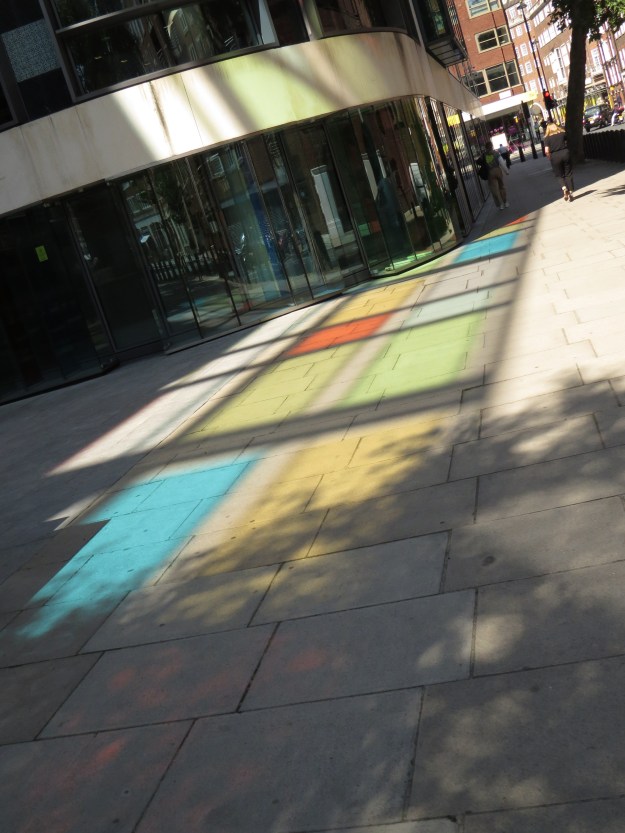
Then I take a wrong turning, which is always fun. I end up outside the new Home Office building. Considering how brutal a department this can be,  the building is light-hearted and colourful. The sun is shining through panels of coloured glass on its roof and throwing Mondrian patterns on the pavement.

And finally, when I get back on the official route, I find the Millbank Estate, 32 blocks that were built at the turn of the twentieth century. The plane trees were planted at the same time. I’ve often walked along one of the main roads after the trees were pollarded, and thought how ugly they looked, as if they had their fists raised to the sky in protest. But today they are in full leaf, and they lower the temperature of this broad expanse of concrete.

Someone has built a whole container garden at the entrance to one of the blocks.

The Millbank Estate was built at the turn of the twentieth century on the site of the old Millbank Prison, which covered not only the area of the current estate but also the land now occupied by Tate Britain. The red bricks of the estate were taken from the prison. Prisoners from all over Great Britain were held in the prison prior to deportation, and some of the features of the prison remain, like this moat, which once formed its boundary.

This walk around Pimlico has shown the interesting ways that built communities have evolved in this part of London, and the ways that green spaces and trees have been incorporated over the years. From stuccoed terraces to the Arts and Crafts-influenced Millbank Estate to the modernism of Churchill Gardens, it’s shown how ideas of social housing have changed, but also how many houses were built during this period. There seems to have been a consistent idea that it was important to house people properly, right in the centre of London.  What a reflection on the lack of vision and imagination around housing today.

London Tree Walks by Paul Wood – A Pimlico Circular – Part One

St George’s Church, Pimlico

Dear Readers, all I really knew about Pimlico prior to this walk was the route from the tube station to Tate Britain, so this walk was a real revelation. Pimlico has been the centre of wave after wave of utopian housing developments for the past two hundred years, and the range of architectural styles that I passed was astonishing. Plus, trees have been part of these plantings during the whole of this period, and it’s fascinating to see the different species that have made their homes in the Capital.

First off, we walk along Bessborough Street towards the St George’s Church. St George’s Square is open to the public, which makes it unusual. On side there are the  impressive stucco houses that I expected to find in Pimlico.

But in the square itself there are towering London Plane trees, some of the tallest that I’ve seen. The trees were probably planted at the same time as the houses, so between 1839 and 1843, making the trees about 180 years old. Given good conditions, they could easily live for another 180 years. How enormous will they be by then, I wonder?

At the north-west corner of St George’s Square was the site of the brutalist landmark the Pimlico Academy, described as a resembling a battleship. It was finally demolished in 2010, and its destruction was described as ‘arguably the most philistine architectural destruction since the demolition of the Euston Arch’ in The Guardian.

Photo One from https://www.theguardian.com/artanddesign/2019/jan/28/pimlico-school-was-architectural-jewel

The original Pimlico Academy (Photo One)

These days it’s rather more prosaic, though I do like the climbing wall on the outside. I note that it was recently the scene of protests by students about racism at the school, followed by the resignation of the Headteacher.

Pimlico Academy and the climbing wall

Pimlico Academy stands on Chichester Street, opposite Dolphin Square, which contains no less than 1,250 flats. These have been home to various politicians and grandees who needed a pied-a-terre, and Harold Wilson, David Steel and William Hague have all lived here, along with such notables as Christine Keeler and Mandy Rice-Davies of Profumo fame. Apparently the flats have a bucolic garden in the centre, but it’s private, so, as directed by Wood, I spent some time looking at the street trees instead. On the Pimlico Academy side of the road there are some small-leaved limes, who fell out of favour as a street tree because of the aphids that feed on the tree and secrete honeydew all over the cars below.

Small-leaved lime (Tilia cordata)

On the other side of the road, there’s a mixture of Chanticleer pear trees and ‘Beech Hill’ Pear trees. There’s lots of fruit on them too.

At the end of Chichester Street we turn into Claverton Street, which is a tale of two halves. On one side we have another stuccoed terrace, but on the other side we have a low-rise block, built during the 1970s. There are more pears alongside the older houses, but the new side of the road is planted with Italian Alders. I saw these before opposite St Pauls and they seem to have become a favourite, probably because, as Wood points out, they can survive in poor, rubble-rich soil.

An Italian Alder on Claverton Street

Then, it’s into the Churchill Gardens estate, which seems to go on forever, and does in fact cover 32 acres. The entrance includes some ‘Crimson King’ Norway Maples, which Wood tells me are the second most frequent London street tree after, you guessed it, the London Plane.

‘Crimson King’ Norway Maple

But who would have guessed that this estate of high-rises would feature such spectacular trees? First up is a Red Oak.

Red Oak (Quercus rubra)

Leaves of Red Oak

Behind it is a splendid Tree of Heaven, which is considered something of a pest tree these days. It’s still very magnificent though.

Tree of Heaven (Ailanthus altissima)

Then I manage to get a bit lost (as usual). What an interesting estate this is! The first five blocks were completed in 1951, and received the Festival of Britain Merit Award.

A lady sitting on a wall asks me (very fairly in my opinion) what I’m finding interesting enough to take photos of. When I’ve bent her ear for five minutes about how amazing the trees are, her worries are calmed. And then this tree catches my eye.

What on earth is it? I can smell a sweet, creamy scent from across the road. It reminds me of something….

and it turns out that this is a Chinese Tree Privet (Ligustrum lucidum). We’ll meet some more of these trees later in the walk, but for now I was happy to just watch the bees making themselves drunk on the nectar.

Then I am distracted by this.

This is the Accumulator Tower, that was once used to provide communal heating to the estate. Originally, waste heat from Battersea Power Station was used for this purpose, but nowadays it’s been converted to using gas. It’s still said to be much more efficient because the flats don’t need their own gas boilers, and the Pump House holds the biggest thermal store in the UK.

I retrace my steps past the Grade II listed bin store….

Grade 2 listed!

and look to see if I can find a Varnish Tree (or Chinese Lacquer tree) that Wood mentions. I think I’ve missed it – it looks rather more like an ash than I expected. Oh well.

I didn’t miss the Southern Catalpa (Catalpa bignoniodes) though. I always associate these trees with the Deep South of the USA. The tree has flowers that look like orchids, but not at this time of year.

Southern catalpa

Next to the catalpa is a Sycamore, but not as we normally see them – this is a purple-leaved ‘Spaethii’ variety

And then, I go off piste (as usual) and find something really delightful.

Tucked away behind one of the low-rise blocks is a tiny park with two meadows, one annual and one perennial.

There is not a soul around, although the people in the surrounding flats must have a lovely view.

The annual meadow is full of all sorts – I can imagine some people being sniffy about the flowers because they aren’t native, but there were plenty of bees. It was started with a grant from the London Wildlife Trust, and local children and residents are involved in its upkeep.

I thought it was lovely, and such a surprise.

I was pleased to see that there’s some dead wood left about as well.

I think this must be a really lovely spot to sit and enjoy the sunshine. I know that I did.

And finally, I head to Johnson’s Place. described by Wood as ‘a fine example of a mid-century civic open space’. And so it is. Churchill Gardens really is softened by the planting of trees and gardens and the availability of spaces to enjoy nature. I saw a good mixture of people walking their dogs, chatting, taking their children to and from the primary school in the middle of the estate. There’s a good range of shops on Lupus Road which skirts the estate too. I imagine there are plenty worse places to live in London.

Johnson’s Place

Johnson’s Place

So, after leaving Churchill Gardens I head off and find some most unusual things. But to find out what, you’ll have to wait until tomorrow.


Wednesday Weed – Bladder Senna

Bladder senna (Colutea arborescens)

Dear Readers, having spotted this plant growing over a railway embankment en route to Blackhorse Road tube station I couldn’t resist doing a post on it. At first, I thought that the poor thing had been attacked by some particularly unpleasant insect. Plus, does anyone else think that the seedpod with the seeds in it looks like the skull of a Tyrannosaurus Rex? The flowers are pretty too, but it’s the pods that really make it stand out.

My photo of the flowers. Taking a picture from the front would probably have been a good idea….

Photo One byBy AnRo0002 - Own work, CC0, https://commons.wikimedia.org/w/index.php?curid=32811803

A rather better photo of the flowers (Photo One)

This is a plant that is native to Europe and North Africa, but not to the UK. However, it is often used in landscaping and to prevent soil erosion, and so I wonder if it was actually planted deliberately – the wall that it was growing over is about ten feet tall, so short of a rope ladder I had no way of looking over to see what else was going on. As it is, it is just a rather intriguing alien, with those deflated balloons all over it.

As you might have gathered from the flowers, it is a member of the Fabaceae or bean/clover family. In his book on Alien Plants, Clive Stace notes that it’s a plant that is very tolerant of dry conditions (hence its thriving on the artificial scree slope of a railway embankment), and indeed Stace says that this is the most likely habitat in which to find this ‘infrequent alien shrub’. If we hadn’t crossed the road to get away from the constant building work that’s taking place in this area, I would never have spotted it. Some of the most wonderful things in life occur though just such happy accidents.

Photo Two by Gailhampshire found athttps://www.flickr.com/photos/gails_pictures/45597194582

Some rather more inflated ‘bladders’ (Photo Two)

Apparently, when the pods are dried they become a natural rattle, which has led to them being called ‘wolf-scarer’ in some parts of Portugal and Spain. I’d have thought that wolves were a bit less flighty than that, but who knows?

Bladder senna has a number of cultivated varieties – not surprising when you consider how much it likes tough conditions. Colutea x media, or small bladder-senna, has bright orange flowers, and isn’t actually that small, reaching a height of 3 metres.

Small Bladder-senna (Colutea x media) (Public Domain)

Now, the name senna may provoke memories in older readers – various senna pod preparations were the laxatives of choice prior to some of the gentler alternatives that are available these days. However, the herbalist John Gerard cautions that ‘our’ plant is not true senna, and he calls it ‘bastard senna’. The plant first made an appearance in the UK in 1568, and was probably imported for medicinal reasons – it does still act as a purgative, but is much milder than ‘real’ senna, and the leaves are also diuretic. However, I read with some alarm that the plant is said to be ‘unreliable medicinally’, and that the seeds are both emetic and toxic. It might be best if we limited our interactions to admiration from a distance, although I am rather intrigued by the notion that the seedpods explode with a gratifying bang if squeezed when at their prime.  I note that in the Victorian Language of Flowers, the Bladder Senna represents ‘frivolous amusement’, so pop away!

Although there are no human edible uses for the plant, it is the foodplant for the caterpillar of the long-tailed blue butterfly (Lampides boeticus), a very rare migrant to the south coast of the UK. In Europe it’s seen as a pest on various bean species, including bladder-senna, in the UK I suspect most entomologists would fall on their knees rejoicing at the very sight of it, especially since caterpillars were spotted in 2013, raising hopes that maybe it will start to breed here rather than merely visiting.

Photo Three by RachidH, from https://www.flickr.com/photos/rachidh/11736544085/

Long-tailed Blue (Lampides boeticus) (Photo Three)

Now, whilst looking for a poem to cast some light on this plant, I discovered that ‘Senna’ is a form of Old Norse poetry, which involves “an exchange of insults between participants, ranging from the use of expletives to accusing an opponent of moral or sexual impropriety” (thank you Wikipedia). But rather more edifying is this poem by Clive James, written on the death of Formula i1 driver Ayrton Senna, named as the greatest racer who ever lived by his fellow drivers. I remember how upset my Dad, who loved Formula 1, was when Senna died.

Just a few notes: an Armco is a crash barrier. Michael Schumacher was seriously injured in a skiing accident, after a career as a Formula 1 driver (though with a rather more chequered reputation than Senna’s).

See what you think.

Ayrton Senna Killed at Imola by Clive James

Thousands of miles away in Buenos Aires
Juan Manuel Fangio, five times world champion,
Watched Senna hit the Armco and sit still.
The world over, we were all interpreting
The silence. Fangio needed only that first glance
And turned the TV off.
Such stillness was a language,
The signal that the angel had departed.

As I write this now
Schumacher is out walking at his home
On Lake Geneva,
Getting the exercise he just might need
If ever his mind comes back.

Moss when he spun across the grass
At Donington with me beside him looking
As if I had seen my own ghost;
Or Derek Warwick on the autostrada
Driving me down to Monza;
Or Alan Jones in that brutal Lamborghini
In Adelaide when we entertained the crowd
With our brilliant imitation of a champion driving
His panic-stricken friend to hospital …
But now all these faces are from long ago
And even
When Damon, in my dreams, comes back to drive me
Under police escort to the airport in Hungary,
I can’t believe how very young he looks.

Deborah, my elder daughter’s friend,
A magnet for adventurous men,
Was taken to a Grand Prix one weekend.
She got so bored she lay down for a sleep
Beside a pile of tyres.
When she woke up again she couldn’t see.
Her eyes were full of rain.

Photo Credits

Photo One By AnRo0002 – Own work, CC0, https://commons.wikimedia.org/w/index.php?curid=32811803

Photo Two by Gailhampshire found at https://www.flickr.com/photos/gails_pictures/45597194582

Photo Three by RachidH, from https://www.flickr.com/photos/rachidh/11736544085/

Completely Surprising Tuesday Quiz – Crumble or Crumple?

Hawthorn Berries – Edible but astringent.

Dear Readers, I meant to sort out a quiz for the weekend but I completely forgot, so here’s something to see if you are safe to be out foraging. Have a look at the photos below. Are these chaps edible, or are they going to land you in the emergency room? Just say ‘edible’ or ‘not edible’. A bonus point if you know the species, and a completely subjective extra point for your favourite recipe using any of them.

Closing date will be 5 p.m. UK time next Monday (August 30th). Results and recipes will be posted on Tuesday 31st August. As usual, put your answers in the comments and I will disappear them as soon as I see them, but write them on a piece of paper first if you are easily influenced like me, then you won’t be swayed by the brilliance of your peers.

Onwards! Edible or Not Edible?

1)

2)

3)

4)

6)

7)

8)

9)

10)

11)

13)

14)

15)