Thursday Poem – It’s Fungi Time!

Photo by Mario Maculan

Well, Readers, we have our Coldfall Wood fungi walk on Sunday, so here are my two favourite fungi-related poems. The first, by Sylvia Plath, seems to me to sum up the slow nature of the mushroom, as it grows beneath the earth before popping up its little head and also the slow growth of all kinds of movements, good and bad.  The second, by Derek Mahon, is about so many things….image after image pours out of the man. See what you think.

Mushrooms (1959) by Sylvia Plath

Overnight, very
Whitely, discreetly,
Very quietly

Our toes, our noses
Take hold on the loam,
Acquire the air.

Nobody sees us,
Stops us, betrays us;
The small grains make room.

Soft fists insist on
Heaving the needles,
The leafy bedding,

Even the paving.
Our hammers, our rams,
Earless and eyeless,

Perfectly voiceless,
Widen the crannies,
Shoulder through holes. We

Diet on water,
On crumbs of shadow,
Bland-mannered, asking

Little or nothing.
So many of us!
So many of us!

We are shelves, we are
Tables, we are meek,
We are edible,

Nudgers and shovers
In spite of ourselves.
Our kind multiplies:

We shall by morning
Inherit the earth.
Our foot’s in the door.

A Disused Shed in Co. Wexford

By Derek Mahon
Let them not forget us, the weak souls among the asphodels.
—Seferis, Mythistorema

(for J. G. Farrell)

Even now there are places where a thought might grow —
Peruvian mines, worked out and abandoned
To a slow clock of condensation,
An echo trapped for ever, and a flutter
Of wildflowers in the lift-shaft,
Indian compounds where the wind dances
And a door bangs with diminished confidence,
Lime crevices behind rippling rain barrels,
Dog corners for bone burials;
And in a disused shed in Co. Wexford,

Deep in the grounds of a burnt-out hotel,
Among the bathtubs and the washbasins
A thousand mushrooms crowd to a keyhole.
This is the one star in their firmament
Or frames a star within a star.
What should they do there but desire?
So many days beyond the rhododendrons
With the world waltzing in its bowl of cloud,
They have learnt patience and silence
Listening to the rooks querulous in the high wood.

They have been waiting for us in a foetor
Of vegetable sweat since civil war days,
Since the gravel-crunching, interminable departure
Of the expropriated mycologist.
He never came back, and light since then
Is a keyhole rusting gently after rain.
Spiders have spun, flies dusted to mildew
And once a day, perhaps, they have heard something —
A trickle of masonry, a shout from the blue
Or a lorry changing gear at the end of the lane.

There have been deaths, the pale flesh flaking
Into the earth that nourished it;
And nightmares, born of these and the grim
Dominion of stale air and rank moisture.
Those nearest the door grow strong —
‘Elbow room! Elbow room!’
The rest, dim in a twilight of crumbling
Utensils and broken pitchers, groaning
For their deliverance, have been so long
Expectant that there is left only the posture.

A half century, without visitors, in the dark —
Poor preparation for the cracking lock
And creak of hinges; magi, moonmen,
Powdery prisoners of the old regime,
Web-throated, stalked like triffids, racked by drought
And insomnia, only the ghost of a scream
At the flash-bulb firing-squad we wake them with
Shows there is life yet in their feverish forms.
Grown beyond nature now, soft food for worms,
They lift frail heads in gravity and good faith.

They are begging us, you see, in their wordless way,
To do something, to speak on their behalf
Or at least not to close the door again.
Lost people of Treblinka and Pompeii!
‘Save us, save us,’ they seem to say,
‘Let the god not abandon us
Who have come so far in darkness and in pain.
We too had our lives to live.
You with your light meter and relaxed itinerary,
Let not our naive labours have been in vain!’

Wednesday Weed – Turnip Yet Again

Dear Readers, as we shuffle ever closer to Halloween it seemed like a good moment to resurrect (yet again) one of my favourite posts, wherein I try to love the turnip, and fail. Also, I am rushing to get my first Open University Assignment done, and it will have to be done early as I am soon off on a mysterious adventure (more soon). In the meantime, here we go…first up are a few words from 2023, and then we zip back in time to 2020. 

Dear Readers, as those of you in the UK will have noticed we are having a bit of a problem getting our usual fruit and veg, and our illustrious Secretary of State for Enviroment, Food and Rural Affairs has suggested that as we can’t lay our hands on tomatoes and cucumber we might like to turn to the humble turnip instead. So, this seems like a good moment to resurrect this piece which I did a few years ago. I still don’t like these knobbly little chunks of nastiness, but maybe you have a turnip recipe to convince me that they have some redeeming features. We might all need to get onboard the root vegetable train very soon. 

So now, let’s shuttle back to 2020…

Dear Readers, when I got these turnips in my vegetable box last week, I admit to being stumped, because of all the roots in the world, this is the one I like least. In Scotland, a ‘neep’ is a completely different animal – in England we’d call it a swede, in the US it’s a rutabaga, and whatever it’s called I’m  rather fond it, especially when mashed and served with ‘stovies’, a delicious mix of leftover meat, potatoes, onions and gravy. In fact, swedes probably merit a blogpost all to themselves, so I shall move on (with regret) for now.

Photo One by By No machine-readable author provided. Rainer Zenz assumed (based on copyright claims). - No machine-readable source provided. Own work assumed (based on copyright claims)., CC BY-SA 3.0, https://commons.wikimedia.org/w/index.php?curid=1356751

A swede or a neep, depending on where you live (or indeed a rutabaga) (Photo One)

I have a long and unhappy history with turnips, however. Back when I was a young thing and was working in Dundee, I had a blond Adonis of a boyfriend who was very into self-sufficiency. One of the things he grew was turnips, and when they were in season that is basically what we ate. There were turnips and broccoli for lunch (with additional earwigs which we where meant to pick out and put to one side). There was turnip and blackberry jam, following a war-time recipe. There was turnip and blackberry pie with custard made with wholemeal bread flour (don’t ask). There was turnip curry (which at least disguised the taste). Suffice it to say that turnips became my nemesis and I have never willingly or knowingly eaten one since. But here they are, and I am not going to waste the poor darlings.

Anyhow, what is a turnip anyway? Its Latin name is Brassica rapa subspecies rapa, and the wild plant is another of those mustardy cabbage plants with yellow flowers that are so confusing to the amateur botanist.

Photo Two By TeunSpaans - Own work, CC BY-SA 3.0, https://commons.wikimedia.org/w/index.php?curid=96733

Wild turnip (Brassica rapa) (Photo Two)

The name ‘turnip’ rather charmingly comes from the word ‘turn’ (as in ‘turn on a lathe/make round) and ‘neep’ from napus, the Latin word for vegetable – so, ’round vegetable’. The poet Sappho apparently called one of her lovers Gongýla, which means ‘turnip’, and I have to admit that when I was arranging the vegetables for the photo they reminded me so much of a pair of breasts that I had to turn one of them at an angle to avoid offending anyone’s modesty. Clearly, this lockdown is affecting my brain.


Turnips actually have a double whammy when it comes to food – the green tops can be eaten as a substitute for spinach or chard, although they have a punchier, more mustardy flavour. In fact, some varieties of turnip are grown solely for their greens, and I’m sure that they’re all the better for it – broccoli rabe, bok choy and Chinese cabbage are all actually turnips. The root is apparently milder when cooked (but still, I would argue, not mild enough), but turnips are also often used as animal feed.  In 1700 Viscount Townsend, a Whig statesman, retired to his country house and became involved in agriculture, no doubt to the delight of the local yeomanry. He did, however,  invent a four-year crop rotation system featuring turnips, barley, wheat and clover, and became an enthusiastic proponent of using turnips as a year-round animal feed. Such was his association with the vegetable that he became know as Charles ‘Turnip’ Townsend.

Photo Two By Godfrey Kneller - one or more third parties have made copyright claims against Wikimedia Commons in relation to the work from which this is sourced or a purely mechanical reproduction thereof. This may be due to recognition of the "sweat of the brow" doctrine, allowing works to be eligible for protection through skill and labour, and not purely by originality as is the case in the United States (where this website is hosted). These claims may or may not be valid in all jurisdictions.As such, use of this image in the jurisdiction of the claimant or other countries may be regarded as copyright infringement. Please see Commons:When to use the PD-Art tag for more information., Public Domain, https://commons.wikimedia.org/w/index.php?curid=6363752

Charles ‘Turnip’ Townsend (18 April 1674 – 21 June 1738), probably not wearing his gardening clothes (Photo Three)

While turnip greens are high in Vitamins K, A and C. the root is hardly a nutritional powerhouse, containing 14% of an adult’s daily requirement of Vitamin C and rather a lot of water and carbohydrate. Nonetheless, some people have leapt into the fray and tried to make something of it. Its radish-y qualities mean that it is sometimes grated and used in salads. I note that the Good Food recipe site has turnips in marmalade, turnips with duck, crispy salmon with turnip, mandarin and noodle salad and turnip tartiflette . I am going to put my turnips into a red lentil and turnip chilli from one of Hugh Fearnley-Whittingstall’s books, but as my husband’s stomach can’t tolerate chilli I shall be splashing on the pepper sauce after cooking. If you have any failsafe turnip recipes that don’t taste too much of turnip, do let me know.

Photo Four from https://www.bbcgoodfood.com/recipes/marmalade-braised-turnips

Marmalade glazed turnips (Photo Four)

There seems to be something essentially comedic about the poor old turnip. For example, in an attempt to puncture what’s perceived as the po-faced nature of the Turner Prize ( the UK’s chief prize for ‘modern’ art of all kinds), some wag dreamed up the Turnip Prize. The prize is given to exhibits that display a lack of effort, and which are rubbish, though I also detect a very British love of puns. Some of its winners have included a builder’s hard hat with elf’s pointy ears attached (‘Elfin Safety’), a lump of dough with toy children embedded in it (‘Children in Knead’) and a pole painted black (‘Pole Dark’). The prize is, of course, a lump of wood with a turnip nailed to it.

Nonetheless, the turnip has also played a more serious role in history. During the winter of 1916-17, the German populace were close to starvation. The harvest of the potato, a staple food in the country, failed and this, combined with the Allied blockade, the seizure of farm horses for the army, the diversion of nitrogen fertilizers to make explosives and the lack of agricultural manpower as people were drafted into the army made for a perfect storm. The government attempted to substitute turnips, normally used for animal feed, for the lost potatoes, but turnips have a much lower nutritional value, and mortality, particularly among women, increased by 30% in 1917. Furthermore, it’s believed that the malnutrition also had a lasting effect on the immune systems of those who survived, making them more vulnerable to the so-called Spanish flu pandemic which ravaged the world right after the war. The Germans call this period ‘The Turnip Winter’, and a loathing of turnips lingers to this day amongst the older population.

Strangely enough though, just across the border in Austria, the municipality of Keutsch am Zee features a very splendid turnip on its coat of arms, probably a nod to the agriculture which was the chief source of income for the area until tourism came along.

Photo Five By Fahnen-Gärtner GmbH, Mittersill, AUSTRIA - Source: "Fahnen-Gärtner GmbH, Mittersill"This image shows a flag, a coat of arms, a seal or some other official insignia. The use of such symbols is restricted in many countries. These restrictions are independent of the copyright status., Public Domain, https://commons.wikimedia.org/w/index.php?curid=1049906

The Coat of Arms of Keutsch am Zee (Photo Five)

And finally, did you ever wonder what people made Halloween lanterns out of before pumpkins arrived from the New World? Well, again it’s our old friend the humble turnip, though I suspect the larger swede is more often involved. Apparently these lanterns are still made out of turnips on the Isle of Man, and in Ireland and Scotland (so do let me know if the pumpkin has made inroads into lantern-making in your neck of the woods – I do suspect that pumpkins are much easier to carve).

Photo Six By Bodrugan - Own work, CC BY-SA 3.0, https://commons.wikimedia.org/w/index.php?curid=22472756

A traditional Cornish Jack-O-Lantern carved, as I suspected, from a swede (Photo Six)

And so, a poem. How delighted I was to find that Seamus Heaney had written a poem about a turnip snedder, a machine used to slice up the turnips to make feed for the animals. Here is one from Sentry Hill in County Antrim, from an excellent blog by Anne Hailes – well worth a look.

Photo Seven from https://www.annehailesblog.co.uk/2018/04/29/sunday-blog-water-water-everywhere-and-a-good-dollup-of-sunshine/

Wesley Bonar, Museums and Heritage Officer at Sentry Hill with a turnip-snedder (Photo Seven)

THE TURNIP-SNEDDER by Seamus Heaney
In an age of bare hands
and cast iron,
 
the clamp-on meat-mincer,
the double flywheeled water-pump,
 
it dug its heels in among wooden tubs
and troughs of slops,
 
hotter than body heat
in summertime, cold in winter
 
as winter’s body armour,
a barrel-chested breast-plate
 
standing guard
on four braced greaves.
 
‘This is the way that God sees life,’
it said, ‘from seedling-braird to snedder,’
 
as the handle turned
and turnip-heads were let fall and fed
 
to the juiced-up inner blades,
‘This is the turnip-cycle,’
 
as it dropped its raw sliced mess,
bucketful by glistering bucketful.

Photo Credits

Photo One By No machine-readable author provided. Rainer Zenz assumed (based on copyright claims). – No machine-readable source provided. Own work assumed (based on copyright claims)., CC BY-SA 3.0, https://commons.wikimedia.org/w/index.php?curid=1356751

Photo Two By TeunSpaans – Own work, CC BY-SA 3.0, https://commons.wikimedia.org/w/index.php?curid=96733

Photo Three By Godfrey Kneller –  Public Domain, https://commons.wikimedia.org/w/index.php?curid=6363752

Photo Four from https://www.bbcgoodfood.com/recipes/marmalade-braised-turnips

Photo Five By Fahnen-Gärtner GmbH, Mittersill, AUSTRIA – Source: “Fahnen-Gärtner GmbH, Mittersill”This image shows a flag, a coat of arms, a seal or some other official insignia. The use of such symbols is restricted in many countries. These restrictions are independent of the copyright status., Public Domain, https://commons.wikimedia.org/w/index.php?curid=1049906

Photo Six By Bodrugan – Own work, CC BY-SA 3.0, https://commons.wikimedia.org/w/index.php?curid=22472756

Photo Seven from https://www.annehailesblog.co.uk/2018/04/29/sunday-blog-water-water-everywhere-and-a-good-dollup-of-sunshine/

Open University – The Final Year!

Dear Readers, I almost can’t believe it, but here I am in the final year of my Open University science course. This year it’s Environmental Science again (after the heavy lifting of biology last year), and a lot of the work will be centred around a project.

We can choose whether to look at food/crop diversity or the ecosystem services provided by trees, so it was pretty much clear which one I’d be looking at – as you might remember, I’m involved with our local Ancient Woodland, and there have been several instances where the economic value of trees has come up against their more intrinsic values. In fact, my personal jury is out on the whole idea of putting a monetary value to something like an oak tree – the calculation usually involves all the things that a tree does for us (sequestering carbon, reducing temperature, absorbing pollution, stabilising soil etc etc) without taking into account things like the trees value to other organisms, or its cultural/aesthetic/social value. Hah! You could argue that we know the price of everything and the value of nothing. However, for some people the only thing they understand is money, so maybe this was inevitable.

To do the calculations, I’ll be using something called Treezilla – from the species of the tree and the circumference of the trunk, it can calculate the rough ecosystem services it provides. This includes Runoff prevented, C02 absorbed, air quality improved and water intercepted. I tried it out with the three trees in my garden, and the largest, a Whitebeam, apparently saves the planet about £43 per year (this would be the cost of humans providing the same services). Well, if some chappie with a chain saw wanted to cut it down, I suspect that £43 wouldn’t be much of a hindrance (though me being chained to the trunk might give him a brief pause for thought).

For my actual project, I’m intending to work out the ecosystem services value of the big trees on the High Road (London plane and lime, largely) and compare them to the range of small trees on my actual road (crab apples, cherries, crape myrtle, hibiscus, rowan and hawthorn). Without wanting to pre-empt the question, I suspect that the ecosystem value of the trees on the High Road will be much higher, even though the biodiversity value of London plane is pretty low compared to a crab apple. The project proposes that we lose all of the trees on either the High Road or the residential street (this is all hypothetical, obviously – in real life you would probably lose some trees from each location, or indeed none at all). In this scenario, although I won’t be sure until I do the calculations, I’m pretty sure that it’s the High Road trees that would stay.

And so, this looks to be an exciting and stimulating year, with lots to think about. Let me know if you have any thoughts so far! I’ll keep you posted on progress.

High Road London Plane

Autumn Colour on Huntingdon Road

Early Autumn on the County Roads

View along Hertford Road

Dear Readers, we’ve been promised a bumper year for autumn  colour this year and, on this Sunday afternoon walk along the County Roads here in East Finchley, I wasn’t disappointed. Although we don’t have the sugar maples and red oaks that are often seen in North America, we do have a wide collection of other trees, many of which I expect to come into full colour over the next few weeks.

Amelanchior canadensis (otherwise known as Serviceberry) on Huntingdon Road

There are several Serviceberries around, and what a great street tree they are – white blossom in the spring and chocolate-coloured leaves which gradually turn to rust and scarlet as the nights draw in. I will be eternally sad that the one practically outside our house fell over a few years ago in high winds, and they do seem to have a tendency to lean. Fingers crossed that this one hangs on.

Chinese Privet (Ligustrum lucidum)


This is a rather interesting street tree – at this time of year it’s covered in a haze of black berries. I suspect that it’s one of the ornamental privets, probably Chinese Privet. As it matures, it will be covered in creamy-white flowers in August and September, which attract clouds of bees.

Honeysuckle

And speaking of scent, this mass of honeysuckle flowers smells divine. I think that the wild type plant has a much richer perfume than the more decorative kinds, but let me know if your honeysuckle is both ornamental and fragrant.

You may remember that the bollards on the County Roads have had a rather up and down existence. Well, they’re doing well at the moment, and are relentlessly vertical. Let’s see how long that lasts.

And here is a photo of Michaelmas Daisies, for a dear friend of mine who maintains that she doesn’t like them because they are floppy. Well, floppy they may be, madam, but I am convinced that they have a certain charm nonetheless. And these had three different types of bee on them, so there.

Amelanchior x lamarkii (Shadbush/Serviceberry)

And here’s another Amelanchior/Serviceberry – a slightly different cultivar, but splendid nonetheless. Both the photos above are of the same tree – although it looks very red from a distance, close up you can see that it’s a mosaic of red,gold and even a touch of green.

Flowering Cherry (Prunus serrata)


The cherry trees are another fine street tree, with at least three seasons of interest. The leaves are just turning to lime and honey now.

Hawthorn (poss Crataegus persimilis)

And it’s always nice to see a hawthorn, especially a rather dapper one like this  one. It will be interesting to see how long the haws stay put once the birds notice them.

And finally, here’s a cooler customer – these are the leaves of the Lime tree, Tilia x europaea. This is not a citrus tree (climate change hasn’t made that possible just yet) but it is one of my favourite large trees, mainly because of its unruly nature, and the scent of its flowers. I  love the greens and yellows here, which will only get more pronounced as the autumn wears on. And what a joy it is to take a little walk and to really notice the change of the seasons!

White Tip and Goblin Settle In….

Well, Readers, it’s been five days now since White Tip and Goblin, the Shark Kittens moved in, and they’ve certainly made themselves at home. White Tip is the black one, and he is extremely friendly, with a few entertaining quirks, such as grooming you whether you want to be groomed or not. I think he sometimes sees his own reflection in your glasses, and is most intrigued.

It’s fair to say that they aren’t the most relaxing of cats…

…and if there’s a dangling cord or necklace or house plant that has the audacity to dangle, they are prone to find it. But then they doze off, and it’s as if the proverbial butter wouldn’t melt! Sound up for maximum purring action.

They’re still not on the RSPCA website – my local branch has been absolutely inundated. But I will post the link as soon as they’re on. In the meantime, I’ll try to keep the house as intact as possible 🙂

New Scientist – Birds Can Understand One Another’s Calls

Superb Fairy Wren fledglings (Photo by Patrick Kavanagh at https://www.flickr.com/photos/patrick_k59/50754327287)

Dear Readers, it’s probably no surprise )to those of us who spend time watching our garden birds at least) that different species of birds react to one another’s alarm calls. I’ve watched birds scatter at the cacophony raised by a blackbird, or by the chinking call of a robin. However, scientist Will Feeny and his colleagues at the Doñana Biological Station in Spain have discovered that 21 different bird species react to a very specific vocalisation – it’s a kind of whining call which indicates the presence of a cuckoo or other brood-parasite.

The species who react one another’s calls include the Fairy Wrens of Australia, the Tawny-Flanked Prinia in Africa, Hume’s Leaf Warbler in Asia, and Greenish Warblers in Europe. All of these birds are targeted by different species of cuckoo, and the last common ancestor of these birds lived about 53 million years ago. And yet, they have all retained this particular vocalisation to warn of the danger.

Tawny-flanked Prinia (Prinia subflava) Photo By Bernard DUPONT from FRANCE – Tawny-flanked Prinia (Prinia subflava), CC BY-SA 2.0, https://commons.wikimedia.org/w/index.php?curid=39582043

As Feeny explains, brood parasites attack eggs and nestlings, but not adult birds. On hearing the ‘whining call’, adult birds flock together and start to mob the cuckoo, attempting to drive it away. Often, birds of several different host species will gather together to see the intruder off. Feeny found that when the alarm calls of species from other continents were played, the behaviour was the same – adult birds gathered together in ‘mobbing’ behaviour.

Greenish Warbler (Phylloscopus trochiloides) Photo by By Dibyendu Ash –  CC BY-SA 3.0, https://commons.wikimedia.org/w/index.php?curid=33466390

Was it that the ancestor of all these different birds suffered from brood-paratism, or is there just something about this vocalisation’s pitch or quality that is is especially useful when combatting cuckoos? The jury is out, but this is an interesting example of how birds can communicate not just within their species, but with other species as well, even if separated by thousands of miles.

You can read the whole article here.

Review – Hamlet at the National Theatre

Hiran Abeysekera as Hamlet at the National Theatre

Dear Readers, I must have seen Hamlet half a dozen times – I’ve seen Derek Jacobi play the lead role in pink tights, humping Gertrude in a very Freudian manner. I’ve seen Jonathan Pryce playing both Hamlet and the Ghost of his father simultaneously. I’ve seen Benedict Cumberbatch taking his shirt off. Every staging I’ve seen brings something new to this play that is so full of what now feel like clichés, but which were new minted when first performed. So I was looking forward to this production, which is the first season from Indhu Rubasingham, the new Director of the National Theatre. It was great to see a packed house for a weekday matinee, which always adds a certain frisson to the occasion.

Hiran Abeysekera plays Hamlet with a lithe, energetic, one could almost say manic style. He can be very funny, but I think he’s at his best when he slows down a bit. ‘To be or not to be’ is rushed through, whereas ‘Alas poor Yorick’ is allowed to breathe, and is all the better for it. It’s as if Hamlet grows older, wiser and more thoughtful through the play.

Polonius is played for laughs too, but then he is a bit of a windbag. At one point he launches into his ‘Never a borrower nor a lender be’ speech, and both his children join in with him, affectionately. What is moving about this version of the play is how dearly loved he is by Laertes and Ophelia, which makes her ‘mad’ scene after Polonius is murdered all the more moving.

And let’s talk about Ophelia. What a thankless role this is! And yet Francesca Mills takes the role and shakes it up – she is feisty, intelligent and, in the end, brings a true note of tragedy. Watching her mourn her dead father was the one point in the play that brought tears to my eyes. She is a little person, but there is nothing little about her performance. I would say that it’s worth the price of entry to see her alone.

Francesca Mills in Hamlet at the National Theatre

And so, an entertaining afternoon at the theatre. Although the play is 2 hours 50 minutes long, it didn’t drag – I shall have to have a look and see if anything was missed out. There is always something new to see in Hamlet, and I welcome the way that the National is continuing to embrace a whole range of actors who can bring their own unique takes on these roles. If this is a taste of what’s to come, I’m very excited.

Thursday Poem – A New National Anthem by Ada Limón

On the uses of flags. This about the stars and stripes, but it resonates with the UK experience  too. Ada Limón is the US Poet Laureate, and I love her work. See what you think…

A New National Anthem

By Ada Limón

The truth is, I’ve never cared for the National
Anthem. If you think about it, it’s not a good
song. Too high for most of us with “the rockets
red glare” and then there are the bombs.
(Always, always, there is war and bombs.)
Once, I sang it at homecoming and threw
even the tenacious high school band off key.
But the song didn’t mean anything, just a call
to the field, something to get through before
the pummeling of youth. And what of the stanzas
we never sing, the third that mentions “no refuge
could save the hireling and the slave”? Perhaps,
the truth is, every song of this country
has an unsung third stanza, something brutal
snaking underneath us as we blindly sing
the high notes with a beer sloshing in the stands
hoping our team wins. Don’t get me wrong, I do
like the flag, how it undulates in the wind
like water, elemental, and best when it’s humbled,
brought to its knees, clung to by someone who
has lost everything, when it’s not a weapon,
when it flickers, when it folds up so perfectly
you can keep it until it’s needed, until you can
love it again, until the song in your mouth feels
like sustenance, a song where the notes are sung
by even the ageless woods, the short-grass plains,
the Red River Gorge, the fistful of land left
unpoisoned, that song that’s our birthright,
that’s sung in silence when it’s too hard to go on,
that sounds like someone’s rough fingers weaving
into another’s, that sounds like a match being lit
in an endless cave, the song that says my bones
are your bones, and your bones are my bones,
and isn’t that enough?

Wednesday Weed – Michaelmas Daisy Revisited

Michaelmas Daisies on Twyford Avenue

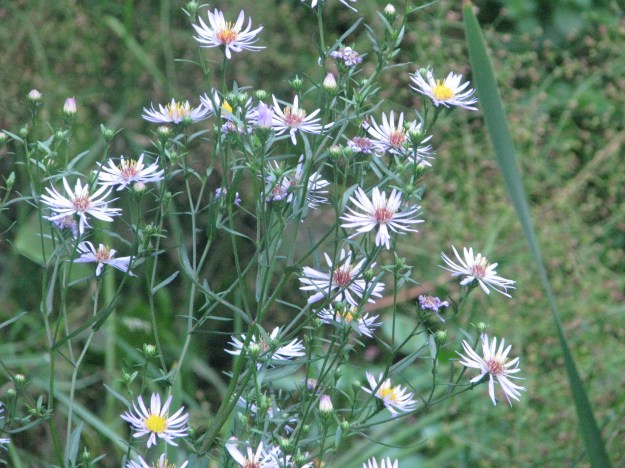
Dear Readers, what a splendid year it is for autumnal flowers here in East Finchley! The Michaelmas Daisies are particularly fine, and it’s easy to forget that this ubiquitous plant is not a UK native, but came here originally from North America, as mentioned in my original piece below. There are at least seven Michaelmas Daisy species that are naturalised in the UK, according to Stace and Crawley’s ‘Alien Plants’ – some are attractive (and you can see how they could have graced a garden), while others are not: of the ‘decidedly dull‘ Delicate Michaelmas Daisy (Aster concinnus) the authors remark that ‘the reasons for …. importation must remain a mystery’. I rather like it, but see what you think.

Delicate Michaelmas Daisy (Aster Concinnus) Photo by Emily Oglesby at https://fsus.ncbg.unc.edu/show-taxon-detail.php?taxonid=6481

Michaelmas Daisies are named for Michaelmas, the quarter day and feast of St Michael celebrated on 29th September, which is also peak flowering time for these flowers. An old rhyme records this:

“The Michaelmas daisies, among dead weeds, Bloom for St Michael’s valorous deeds …”. 

Incidentally, this is also the day that Old Nick (the devil) was supposed to spit on/urinate on blackberries, so they shouldn’t be harvested after this date. However, I don’t know about where you live, but around here the blackberry harvest has been prolific, but the berries themselves a bit dry and disappointing (not enough rain at the right time, I guess).

And here is a rather sweet poem, by Victorian poet Letitia Elizabeth Landon (1802 – 1838). She published her first poem aged only 9 and wrote four novels and several poetry collections. Alas, much as today, her personal life was the subject of constant cruel speculation, and she died, aged only 36, after drinking prussic acid.

The Michaelmas Daisy by Letitia Elizabeth Landon

Last smile of the departing year,
Thy sister sweets are flown;
Thy pensive wreath is far more dear,
From blooming thus alone.

Thy tender blush, thy simple frame,
Unnoticed might have past;
But now thou contest with softer claim,
The loveliest and the last.

Sweet are the charms in thee we find,
Emblem of hope’s gay wing;
‘Tis thine to call past bloom to mind,
To promise future spring.

And now, let’s see what I had to say about Michaelmas Daisies back in (gulp) 2014….

The Cup of Gold 010This small, lilac member of the daisy family seems to be popping up all over the place in my half-mile territory. These photos were taken in Coldfall Wood, where it makes the dried-up winter pond look like an Impressionist painting. But this delicate-looking plant has had a long journey. It comes originally from North America (it was introduced to England by John Tradescant in 1633), and it is a prairie plant rather than a woodland one. Nonetheless, it seems to made itself at home in all kinds of damp and neglected places, bringing a wash of pale lavender amongst the green

This is not an easy plant to identify at the species level. We have Common, Confused, Narrow-Leaved, Glaucous, Hairy and Changing Michaelmas Daisies, and every possible hybrid. As I squint at my photographs, I suspect that my daisies are Confused . On a bad day, I know exactly how they feel.

The Cup of Gold 011The great thing about Michaelmas Daisies, as anyone who has planted them deliberately will know, is that they are full of energy and colour when most other plants are giving up. They seem to be particularly attractive to hoverflies, a creature that prefers flat, easily-accessible blossoms.

The Cup of Gold 009Until 1752, this plant was known as Starwort. But when the Gregorian calendar was introduced, it was renamed the Michaelmas Daisy because its flowering coincided with St Michael’s Day on 29th September. However, I rather like the notion of a patch of Starworts, flowering under the harvest moon in a tiny ancient wood in North London, just as they have done for hundreds of years.


Farewell Biscuit Kits, Hello Shark Kits!

The Biscuit Kits, McVitie and Jaffa

Dear Readers, our foster cats McVitie and Jaffa were re-homed on Sunday – they’ve gone to an absolutely perfect home, with people who are going to love them every bit as much as I did. It’s always sad for me when the kitties go off, but it’s also so great that they’ve gone from some little flu-raddled waifs to the confident cats that they are now. Plus, I got a box of very nice chocolates to say thank you, so that’s all good. And we got some photos of the kittens in their new home last night, and they look as if they’re already ruling the roost, which is just as it should be.

And now, we have our new ‘kittens’, Goblin and White-tip. Clearly there have been a lot of kittens through the RSPCA this year, and someone decided to name them after sharks. I suspect there’s maybe a Hammerhead and a Great White out there somewhere.

Goblin

White Tip

It would be a mistake to describe these guys as ‘kittens’ – they might only be seven months old, but they are real bruisers. We’ll be keeping in them in a small room for a couple of days, but I suspect they’ll soon be rampaging up and down the stairs like lunatics. White Tip came out from hiding within seconds of smelling food, has already given me a kiss and climbed on my lap, and spends the whole time purring like a small train. Goblin is a bit more reserved, but has also been out for a stroke. 

We only have four weeks until I go off on my mystery holiday, so fingers crossed someone will fall for these lovely guys as soon as possible. It would be a real shame for them to have to go back into the shelter. I’ll post a link as soon as they’re on the RSPCA rehoming website, but do let me know if you’re in the London area and are suddenly interested in a pair of friendly boy cats (already neutered and vaccinated!)