Expected and Unexpected

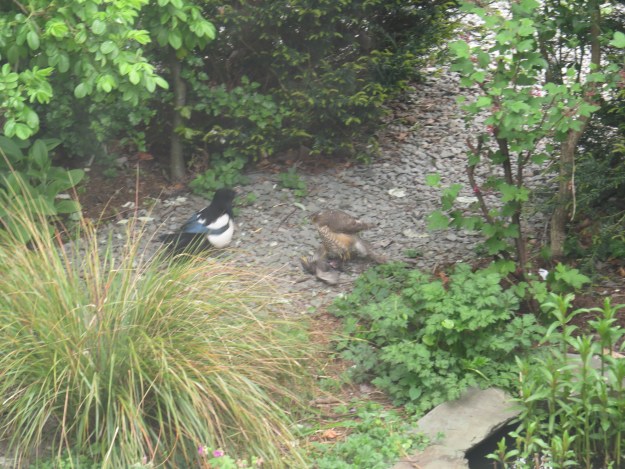
Dear Readers, as I was saying earlier this week, the fledgling starlings are the most wide-eyed innocents I’ve ever seen. While everyone else is alarm calling and flying for safety, they often stay perched, looking around to see what all the fuss was about. But there is no call more blood-chilling than that of a young starling in the jaws of a cat, or under the talons of a bird of prey, so when I heard the familiar keening on Tuesday morning I rushed to the window to see what was happening and there, sure enough, was a sparrowhawk standing on a screaming starling.

This didn’t surprise me, though it saddened me – the sparrowhawks have an unerring sense of when there’s easy pickings, though it’s amazing that they can navigate through the tangle of buildings and trees to strike. This is, I think, a male (apologies for the blurry shot, it was the only one I got a chance to take), and he probably has babies in the nest somewhere himself.

What did surprise me, though, was the behaviour of the other animals. Firstly, I was too slow to catch a squirrel on camera, but it approached within striking range of the sparrowhawk. I knew that squirrels were omnivores who will eat carrion, eggs and baby birds if they get the chance, but to try to steal prey from a sparrowhawk seemed pretty daring. However, I’m pretty sure that the squirrel that I saw has babies in the nest, so she probably needs all the protein she can get.

And then, the squirrel ran for it and one of the pair of magpies who’ve been haunting the garden landed. It’s actually bigger than the sparrowhawk and has much more attitude – it would have stolen the newly-expired starling from right under the hawk’s foot. By this stage the raptor seemed to have had enough, as it took off vertically with the starling dangling from one foot and headed off over the rooftops to eat its food in peace.

And a strange, eerie peace descended on the garden, as it always does when a sparrowhawk has paid a visit, but within half an hour everybody was back. Normally all the baby starlings emerge at once, but it’s been a bit more spread out this year, which I think favours the predators who can pick them off more easily. I also worry that I haven’t yet been inundated with youngsters, but maybe that will come later. At any rate, it was a bit less like Disneyland and a bit more like ‘When Animals Attack’ in the garden today, and I’ll be very glad when things get a little less dramatic.

Wednesday Weed – Bird Cherry

Bird Cherry (Prunus padus)

Dear Readers, those of you who read my earlier post about Cherry Tree Wood might have guessed which way my Wednesday Weed was tending this week! I have often walked past these trees without paying them much attention, and yet they are glorious at this time of year, with their spikes of white flowers going off in all directions like little fireworks. The plant likes damp conditions, and there are plenty of streams and rivulets arising in the wood, so I think it feels very at home.

In other parts of the world the tree is known as Hackberry, Hagberry or the Mayday tree. It’s native to Eurasia but has been naturalised all over the world. It was apparently planted by home owners in great quantities in Anchorage, Alaska, which goes to show how hardy it is.

The tree was probably planted for its beauty, but it is popular with bees and other pollinating insects, and although the fruit is generally too tannic for human tastes, birds don’t care (as the name of the plant might suggest).

Photo One by By Anneli Salo - Own work, CC BY-SA 3.0, https://commons.wikimedia.org/w/index.php?curid=5084318

Fruits of the bird cherry (Photo One)

However, it wouldn’t be true to say that no one has ever eaten the fruit. Herodotus, writing 2500 years ago, describes a race of people known as the Agrippeans, who were all bald from birth and appear to have lived in the foothills of the Ural Mountains. They used the fruit of what appears to be the bird cherry as a staple food, pressing the cherries for their juice and then making a kind of cake from the residue. They sound like rather lovely people – in the winter they made their yurts around the bird cherries, using the trunk as a kind of living tentpole. According to Herodotus:

They dwell each man under a tree, covering it in winter with a white felt cloth, but using no felt in summer. These people are wronged by no man, for they are said to be sacred; nor have they any weapon of war. These are they who judge in the quarrels between their neighbours; moreover, whatever banished man has taken refuge with them is wronged by none.

– Herodotus, Ἱστορίαι (The Histories) Book IV, Chapter 23

In Siberia the berries are milled for flour, which is again baked into a kind of cake, and jam is also made from the fruit. For further details of this, I was fascinated by Professor Gordon Hillman’s website ‘Wild Food Plants of Britain’, which explains how the pits of bird cherry contain various toxins (including cyanide), but their preparation by native peoples living in the Amur valley of Far Eastern Russia eliminates the poison – the fruits are pounded in a pestle and mortar and then laid out in the sunshine to dry. Cyanide is a rather unstable compound, and so exposure to the sunlight and air makes it safe to eat. The berries are then turned into a kind of fruit ‘leather’ for consumption right through the winter.

In Scotland, the fruit is sometimes made into brandy.

Photo Two by By Oleg Bor - Own work, CC BY-SA 4.0, https://commons.wikimedia.org/w/index.php?curid=80467614

Bird Cherry Pie from Siberia (Photo Two)

According to my Harrap’s Wild Flower guide, Bird Cherry is largely found in the north of the UK, and it’s here that we find most of the folklore about the plant. In the north-east of the country it was considered to be a witches tree (which is presumably where the common name ‘hagberry’ came from), and this meant that the branches should never be used for staves or walking sticks, and the flowers should never be taken into the house. However, confusingly, in Wester Ross in Scotland, a walking stick made from bird cherry was supposed to mean that you would never get lost in the mist, so I suppose it was a choice between upsetting a witch and falling into a bog. I think falling into the bog was probably the wiser choice, but as I’m getting into my own ‘crone years’, maybe that’s just me.

In Wales, Bird Cherry is said to be considered unlucky, as it’s ‘the tree that the devil hung his mother from‘. Has anybody ever heard the details of this legend? Goodness, even the Kray Twins were good to their mother.

In the north of England, the tree was sometimes known as ‘Yorkshire lilac’, and indeed it does bear a passing resemblance to my white lilac bush, which is in full bloom at the moment.

The bark of bird cherry has an acrid smell, and it used to be believed that nailing it to your front door would keep the plague away. The bark was also used as a pesticide to deter insects and rodents from eating crops, and a dye derived from the bark was used to colour fishing nets brown.

Medicinally, Bird Cherry was used to treat many ailments, including conjunctivitis, fevers, kidney stones, anaemia and bronchitis.

And finally, a poem. Am I the only one who sees a similarity to the ecstatic poetry of Gerard Manley Hopkins here? Let me know, readers.

And I Was Alive

by Osip Mandelstam

And I was alive in the blizzard of the blossoming pear,
Myself I stood in the storm of the bird-cherry tree.
It was all leaflike and starshower, unerring, self-shattering power,
And it was all aimed at me.

What is this dire delight flowering fleeing always earth?
What is being? What is truth?

Blossoms rupture and rapture the air,
All hover and hammer,
Time intensified and time intolerable, sweetness raveling rot.
It is now. It is not.

(4 May 1937)
Translated from the Russian by Christian Wiman.
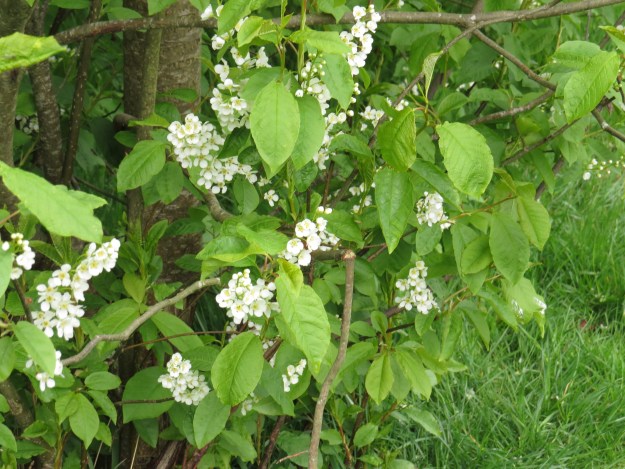
Photo Credits

Photo One by By Anneli Salo – Own work, CC BY-SA 3.0, https://commons.wikimedia.org/w/index.php?curid=5084318

Photo Two by By Oleg Bor – Own work, CC BY-SA 4.0, https://commons.wikimedia.org/w/index.php?curid=80467614

First Fledglings…

Dear Readers, I had my second vaccination yesterday (Astra Zeneca, bit of a sore arm but so far none of the flu symptoms that sent me to bed last time). As I walked back to the house, I heard a familiar wheezing sound and there, on the handrail, was the first of this year’s starlings. What a fluffy little dude s/he is! And how completely lacking in any sense of danger. As I’ve noted before, the starlings that survive are the ones that pretty quickly pick up on the alarm calls and the behaviour of the birds around them (and not just their own species either – I’m pretty sure that the alarm calls of robins and blue tits put them on high alert too).

The adult starlings seem to be able to identify whose chick is whose, but the chicks will beg from any passing adult. Who could resist them? They couldn’t be any more plaintive. Anyone would think that they hadn’t eaten for weeks. Just as well I’m well stocked up with live mealworms and suet pellets.

By the time they’ve finished I’ll have to take the wire wool to the hand rails again – the fledglings love to perch here, and to run along it like some toddler on a low wall, and to basically crap everywhere. It won’t take them long to begin pecking at things themselves – last year I was astonished at how quickly they learned to get the pellets out of the suet feeder, which requires a fair measure of dexterity.


This will be the tenth generation of starlings that I’ve fed in the garden. The Breeding Bird Survey shows a decline of 63% in London from 1995-2018, and places where they used to gather in their thousands (such as Leicester Square and St James’s Park) seem to be bereft of them these days. I remember watching a murmuration in St James’s Park with Mum back in the ’80s, when great flocks of the birds reeled and turned over the islands in the middle of the lake, before settling down to roost. You can still see birds in the low thousands at places like Rainham Marshes, Walthamstow Wetlands and Beddington Farmlands, but ‘proper’ murmurations seem to be rarer and rarer. And so, every noisy, messy youngster is precious, especially as they are taken in huge numbers by cats and corvids, and as they are forever getting tangled in things and drowning themselves.

This spring has been cold compared to last year, so I suspect the amount of insect prey is lower – no self-respecting caterpillar is going to hatch while there is still frost on the ground. What will happen to our bird life as the seasons, so delicately tuned, start to become more unpredictable? In towns and cities, feeding softens the blow, and because these places are warmer than the surrounding countryside the effect might not be felt quite so severely. And soon there will be hawthorn berries, and it looks like a good year for the fruit on the rowan and the whitebeam. There are things that we can do to help our besieged wildlife, and the sight of the fledglings always gives me hope.


Birds Seen and Unseen

Robin

Dear Readers, I was scanning the garden yesterday when I noticed a blur of movement down by the pond. Out came the binoculars! And after a few anxious minutes, I was able to focus on a quintessential ‘little brown job’ – definitely a warbler of some kind, and my money is on a chiffchaff, though it didn’t call so I wasn’t able to identify it for sure. The bird didn’t stick around for long enough to get a photo either, so here is a much better photo from someone else.

Photo One by Andreas Trepte, CC BY-SA 2.5 <https://creativecommons.org/licenses/by-sa/2.5>, via Wikimedia Commons

Chiffchaff (Phylloscopus collybita) (Photo One)

However, this got me thinking about the birds that have been seen in my garden, and I thought I’d knock up  a quick list. I’d be fascinated to know how this list is different from those of you in other parts of the country, and also in other places in the world – I know that Anne from SomethingOverTea lives in South Africa and has a garden list about four times as long as mine, which just illustrates how birds definitely prefer warmer climes with lots of insect food. But how does it compare with a list from Switzerland, for example? Anyhow, here are all the birds that have been seen in the garden since I moved here in 2010 (I’m not including those that have flown over, so no cormorants or swallows or black-backed gulls).

  1. Grey heron (Ardea cinerea)
  2. Sparrowhawk (Accipter nisus)
  3. Rock dove/Feral pigeon (Columba livia)
  4. Woodpigeon (Columba palumbus)
  5. Collared dove (Streptopelia decaocto)
  6. Ring-necked parakeet (Psittacula krameri)
  7. Great-spotted woodpecker (Dendrocopos major)
  8. Jay (Garrulus glandarius)
  9. Magpie (Pica pica)
  10. Carrion crow (Corvus corone)
  11. Jackdaw (Corvus monedula)
  12. Blackbird (Turdus merula)
  13. Song thrush (Turdus philmelos)
  14. Redwing (Turdus iliacus)
  15. Fieldfare (Turdus pilaris)
  16. Long-tailed tit (Aegithalos caudatus)
  17. Great tit (Parus major)
  18. Blue tit (Cyanistes caeruleus)
  19. Coal tit (Periparus ater)
  20. Wren (Troglodytes troglodytes)
  21. Dunnock (Prunella modularis)
  22. Robin (Erithacus rubecula)
  23. Blackcap (Sylvia atricapilla)
  24. Common chiffchaff (Phylloscopus collybita)
  25. Goldcrest (Regulus regulus)
  26. Pied wagtail (Motacilla alba)
  27. Grey wagtail (Motacilla cinerea)
  28. House sparrow (Passer domesticus)
  29. Chaffinch (Fringilla coelebs)
  30. Common redpoll (Carduelis flammea)
  31. Siskin (Carduelis spinus)
  32. Greenfinch (Chloris chloris)
  33. Goldfinch (Carduelis carduelis)
  34. Starling (Sturnus vulgaris)

Blackbird

So, a few things strike me about this list.

  1. If I  hadn’t had the pond, I wouldn’t have been visited by the heron (or the grey wagtail), and lots of other birds stop by to drink too – the ‘chiffchaff’ yesterday was chiefly interested in the water.
  2. Many of the birds only visit in very bad weather – that would cover the fieldfare (who was grounded during a snowstorm), the siskins (who only come when it’s actually snowing) and the redpolls.
  3. Many of the birds pop over from nearby Coldfall Wood (the song thrush and the great-spotted woodpecker for sure)
  4. I have more of the warbler-type birds since my vines and hedges have grown a bit thicker – the blackcap spent most of her time in the tangle of bittersweet this year.

However, there are also some notable omissions.

  1. Although the waxwings often visit the street trees locally, they never come to see me in the garden – I guess there just isn’t the necessary concentration of berries. The rowan and the whitebeam are having a great year though, so let’s see what happens this winter.
  2. I always hope to see a brambling on its way through, or a bullfinch, but so far neither has stopped by (at least when I’ve been watching). If you see them in your garden, what’s your secret?
  3. Some of the birds that I see regularly in Coldfall Wood (stock doves, treecreepers, nuthatches) never come to see me – I imagine they’re quite happy where they are.
  4. I have a lot of predators for such a small patch – not just the occasional sparrowhawk taking out a collared dove, but magpies and jays and, of course, lots of cats. The cover for the birds can also provide cover for a marauding cat. I’ve learned to listen for the alarm calls, and will go outside and shoo off any felines that I think are rather too interested in what’s going on, but of course I can’t be there all the time. There were lots of babies last year (blue tits, blackbirds, robins, wrens) but it would be fascinating to know how many of them actually survive to adulthood. This year I have been ‘adopted’ by a pair of magpies, and the rest of the bird community are very unimpressed.

So, over to you, readers. What do you get in your garden? What would you love to see? What have you done that has made your garden more friendly for birds? Let’s share our experiences. The birds need all the help they can get.

Nuthatch in the cemetery, but never in my garden 🙁


A May Walk in Cherry Tree Wood

Dear Readers, regular visitors to the blog will know that we are lucky enough to have two remnants of ancient woodland in East Finchley – one is Coldfall Wood, and the other is Cherry Tree Wood. On Thursday I decided to have a little trot around Cherry Tree Wood – for one thing, last time I was there the grassy area was under so much water that someone decided to have a little kayak there, and secondly it punches above its weight in terms of natural history interest. This is particularly surprising as it’s so well used – it has a children’s playground, a café and tennis/basketball courts. Still, I’ve noticed some very visible green woodpeckers on previous visits, mistle thrushes nest here (and I’ve never seen them in Coldfall), and even here you can get away from people if you take some of the secondary paths.

Down by the café there was this lovely patch of almost-English bluebells. The pollen is white, which often indicates that they are English rather than hybrids, but there is something about the colour and shape that looks as if there might have been a bit of shenanigans going on. They are rather lovely nonetheless.

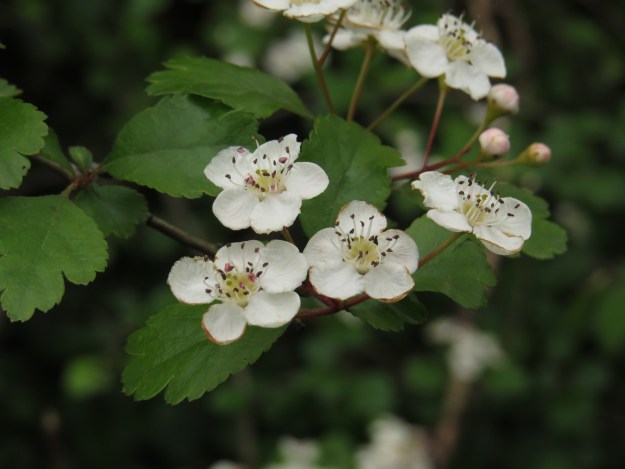
And look at the hawthorn! It’s going to be a bumper year for this plant I suspect, I have never seen so much blossom. Maybe our cold spring suits it. I rather think this is Midland hawthorn (Crataegus laevigata) – the leaves are described as ‘shallowly three-lobed’, and as the plant is typical of ancient woodland I’m feeling fairly confident. As usual, let me know what you think, botanist friends! I am learning all the time. Like the bluebells, hawthorns can also hybridise.

There is going to be lots of honeysuckle later in the year too, I came across these patches right at the back of the wood close to the back fences of the neighbouring houses, so whether the plant has jumped out of the garden or will shortly be jumping in is anyone’s guess.

The oaks, hornbeams and horse chestnuts are just coming into leaf, and the grassy area has changed from quagmire to dust. There’s lots of rain forecast for the next few days, though, so it will be interesting to see what happens next.

Next to the toilets and the tennis courts is a patch of yellow flag iris, growing very happily. This part of the wood is also positively boggy for much of the year. The Mutton Brook rises somewhere around here, and is captured and culverted and directed under the railway line at the southern edge of the Wood.

The culvert that takes the Mutton Brook into Hampstead Garden Suburb

Why, though, do you think this area is called Cherry Tree Wood? Actually, in its early life it was called Dirthouse Wood – night soil was collected from North London and left at the Dirthouse on the opposite side of the road, where the White Lion pub  is now. This was then spread as fertiliser on the nearby hay meadows. But there are lots of bird cherries in the wood, and very pretty they are too at this time of year.

The trees have previously been home to the netted webs of bird cherry ermine moth, but no sign this year – again, maybe it’s been too cold for them.  Plus, looking back at my photos from 2018 I have a feeling that these guys are probably cyclical breeders, with a big outburst every few years. It’s good to see that the trees are none the worse for the onslaught.

Ermine moth caterpillars from 2018

And so it’s good to see the wood looking so good. The tennis and basketball courts have been resurfaced and repainted, and are looking very spruced up, just in time for the summer. The rickety old pavilion has finally been demolished, and I assume that some sort of café will spring up soon as well. My heart really does belong to Coldfall, but this area is a really valuable community resource, enjoyed by many people. Every little bit of green space has been a godsend during the lockdown, and I suspect that it’s opened a lot of people’s eyes to what’s happening right on their doorstep.

I also suspect that our good friends the N2 Community Gardening Group have been at work close to the entrance opposite the station – some lovely scabious have sprung up as if by magic! I’m sure the bees will be very grateful.


Saturday Quiz – Of Cabbages and Kings

Title Photo by Terren, CC BY 2.0 <https://creativecommons.org/licenses/by/2.0>, via Wikimedia Commons

Ornamental Cabbages (Title Photo)

Dear Readers, the cabbage family (Brassicaceae) has some of the commonest ‘weeds’ in the UK, and yet it is very tricky as far as identification goes. So, this week, I am going to make the quiz a multiple choice, and I’m going to try to avoid including too many easily-confused tiny plants with white or yellow flowers. There are some real beauties to be found among the little chaps – some ‘Kings’ if you’ll forgive me :-).

So, here we go. All  you need to do is to match the photo to the species name – so, if you think the plant in Photo 1 is Oilseed Rape, your answer is 1) A).

All answers in the comments by 5 p.m. UK time next Thursday (13th May) please. I’ll post the answers on Friday 14th May. As soon as I see your reply in the comments I shall hide it away so it can’t influence the easily-swayed (like me) but write your answers down first if you don’t want to be affected by the brilliance of others 🙂

Onwards!

Species Names

A) Oilseed Rape (Brassica napus)

B) Danish Scurvygrass (Cochlearia danica)

C) Thale Cress (Arabidopsis thaliana)

D) Cuckooflower/Lady’s Smock (Cardamine pratensis)

E) Watercress (Nasturtium officinale)

F) Sea Kale (Crambe maritima)

G) Honesty (Lunaria annua)

H) Shepherd’s Purse (Capsella bursa-pastoris)

I) Wallflower (Erysimum cheiri)

J) Charlock (Sinapsis arvensis)

K) Hairy Bittercress (Cardamine hirsuta)

L) Dame’s Violet (Hesperis matronalis)

M) Horseradish (Amoracia rusticana)

N) Hoary Cress (Lepidium draba)

O) Garlic Mustard (Alliaria petiolata)

Photo One by Bob Jones 

1)

Photo Two by H. Zell, CC BY-SA 3.0 <https://creativecommons.org/licenses/by-sa/3.0>, via Wikimedia Commons

2)

Photo Three by Enrico Blasutto, CC BY-SA 4.0 <https://creativecommons.org/licenses/by-sa/4.0>, via Wikimedia Commons

3)

Photo Four by H. Zell, CC BY-SA 3.0 <https://creativecommons.org/licenses/by-sa/3.0>, via Wikimedia Commons

4)

Photo Five by Tony Atkin / Garlic Mustard - Alliaria petiolata

5)

Photo Six by Niccolò Caranti, CC BY-SA 4.0 <https://creativecommons.org/licenses/by-sa/4.0>, via Wikimedia Commons

6)

Photo Seven by Sten, CC BY-SA 3.0 <https://creativecommons.org/licenses/by-sa/3.0>, via Wikimedia Commons

7)

Photo Eight by Nick Moyes at https://www.flickr.com/photos/21874898@N05/2120901133

8) (The little white plant, not the daisy) (The location is the clue 🙂 )

Photo Nine by Σ64, CC BY 4.0 <https://creativecommons.org/licenses/by/4.0>, via Wikimedia Commons

9)

Photo Ten by CC BY-SA 3.0, https://commons.wikimedia.org/w/index.php?curid=133378

10)

Photo Eleven by Sten Porse, CC BY-SA 3.0 <http://creativecommons.org/licenses/by-sa/3.0/>, via Wikimedia Commons

11)

Photo Twelve by CC BY-SA 3.0, https://commons.wikimedia.org/w/index.php?curid=107188

12)

Photo Thirteen by Stefan.lefnaer, CC BY-SA 4.0 <https://creativecommons.org/licenses/by-sa/4.0>, via Wikimedia Commons

13)

Photo Fourteen by Anneli Salo, CC BY-SA 3.0 <https://creativecommons.org/licenses/by-sa/3.0>, via Wikimedia Commons

14)

Photo Fifteen by Aiwok, CC BY-SA 3.0 <https://creativecommons.org/licenses/by-sa/3.0>, via Wikimedia Commons

15)


Saturday Quiz – Legless – The Answers

Title Photo by Greg Schechter from San Francisco, USA, CC BY 2.0 <https://creativecommons.org/licenses/by/2.0>, via Wikimedia Commons

Eastern Garter Snake (Title Photo) – Definitely not from the UK!

Good Morning, Dear Readers! Some splendid scores this week, and everyone did remarkably well. In fifth place we have Belinda with 17.5 out of 24, only just behind Rosalind and Mike with 18. Then came Fran and Bobby Freelove with 22 out of 24, but the winner this week is Claire with 23.5 out of 24. Congratulations to everyone, and let’s see what I have in store for you all tomorrow 🙂

Photo One by Andreas Eichler, CC BY-SA 4.0 <https://creativecommons.org/licenses/by-sa/4.0>, via Wikimedia Commons

1) Grass Snake (Natrix natrix)

Photo Two by Bernard DUPONT from FRANCE, CC BY-SA 2.0 <https://creativecommons.org/licenses/by-sa/2.0>, via Wikimedia Commons

2) Slow-worm (Anguis fragilis)

Photo Three by Ryan Hodnett, CC BY-SA 4.0 <https://creativecommons.org/licenses/by-sa/4.0>, via Wikimedia Commons

3) Leopard/Great Grey Slug (Limax maximus)

Photo Four by Bj.schoenmakers, CC0, via Wikimedia Commons

4) Ramshorn Snail (Planobarius corneus)

Photo Five by s shepherd schizoform on flickr, CC BY 2.0 <https://creativecommons.org/licenses/by/2.0>, via Wikimedia Commons

5) Earthworm/Lob Worm (Lumbricus terrestris)

Photo Six by By Flickr user Rae's - https://www.flickr.com/photos/35142635@N05/15390553766/in/set-72157647844789000, CC BY 2.0, https://commons.wikimedia.org/w/index.php?curid=39818346

6) New Zealand Flatworm (Arthurdendyus triangulatus)

Photo Seven by Bernard DUPONT from FRANCE, CC BY-SA 2.0 <https://creativecommons.org/licenses/by-sa/2.0>, via Wikimedia Commons

7) Adder (Vipera berus)

Photo Eight by By Prashanthns - Own work, CC BY-SA 3.0, https://commons.wikimedia.org/w/index.php?curid=4194945

8) Large Black Slug (Arion ater)

Photo Nine by Public Domain, https://commons.wikimedia.org/w/index.php?curid=1732361

9) Garden Snail (Cornu aspersum)

Photo Ten by Thomas Brown, CC BY 2.0 <https://creativecommons.org/licenses/by/2.0>, via Wikimedia Commons

10) Smooth Snake (Coronella austriaca)

Photo Eleven by By FelixReimann - Own work, CC BY-SA 3.0, https://commons.wikimedia.org/w/index.php?curid=7433690

11) Aesculapian Snake (Zamenis longissimus) – There was a population by the Regent’s Canal in London following an escape from London Zoo….

Photo Twelve by A. Abrahami, CC BY-SA 3.0 <https://creativecommons.org/licenses/by-sa/3.0>, via Wikimedia Commons

12) Brown-lipped Banded Snail (Cepaea nemoralis)

Photo Credits

Title Photo by Greg Schechter from San Francisco, USA, CC BY 2.0 <https://creativecommons.org/licenses/by/2.0>, via Wikimedia Commons

Photo One by Andreas Eichler, CC BY-SA 4.0 <https://creativecommons.org/licenses/by-sa/4.0>, via Wikimedia Commons

Photo Two by Bernard DUPONT from FRANCE, CC BY-SA 2.0 <https://creativecommons.org/licenses/by-sa/2.0>, via Wikimedia Commons

Photo Three by Ryan Hodnett, CC BY-SA 4.0 <https://creativecommons.org/licenses/by-sa/4.0>, via Wikimedia Commons

Photo Four by Bj.schoenmakers, CC0, via Wikimedia Commons

Photo Five by s shepherd schizoform on flickr, CC BY 2.0 <https://creativecommons.org/licenses/by/2.0>, via Wikimedia Commons

Photo Six by By Flickr user Rae’s – https://www.flickr.com/photos/35142635@N05/15390553766/in/set-72157647844789000, CC BY 2.0, https://commons.wikimedia.org/w/index.php?curid=39818346

Photo Seven by Bernard DUPONT from FRANCE, CC BY-SA 2.0 <https://creativecommons.org/licenses/by-sa/2.0>, via Wikimedia Commons

Photo Eight by By Prashanthns – Own work, CC BY-SA 3.0, https://commons.wikimedia.org/w/index.php?curid=4194945

Photo Nine by Public Domain, https://commons.wikimedia.org/w/index.php?curid=1732361

Photo Ten by Thomas Brown, CC BY 2.0 <https://creativecommons.org/licenses/by/2.0>, via Wikimedia Commons

Photo Eleven by By FelixReimann – Own work, CC BY-SA 3.0, https://commons.wikimedia.org/w/index.php?curid=7433690

Photo Twelve by A. Abrahami, CC BY-SA 3.0 <https://creativecommons.org/licenses/by-sa/3.0>, via Wikimedia Commons

A May Walk in Highgate Wood and Queen’s Wood

Sunlight through hornbeam leaves

Dear Readers, sometimes when I walk through one of North London’s ancient woodlands, I am reminded of how much I have learned through writing the blog over this last 7 years. Although there is still so much to find out, it makes me happy that I can look at the muscular trunk of a hornbeam and identify it, and that I can imagine it as a younger sapling, a mass of twigs that were probably cut back once or twice when the tree was a baby, before coppicing was abandoned and the tree was left to grow.

The tree above has five distinct trunks growing from the same ‘stool’ – they interweave with one another in a kind of slow-motion dance as they reach towards the light. I love the silvery bark of hornbeam, and the way that it is covered in a web of ‘veins’ and ‘sinews’ like a weight-lifter’s arms.

There is so much to notice, and yet so often we don’t, absorbed in our thoughts or in our phones.

And here’s a horse-chestnut seedling, optimistically growing in a patch of sunlight.

Last time we walked in these woods it was Boxing Day, we were ankle-deep in mud, and there were hundreds if not thousands of people on the paths. But today it’s a weekday, the children are back at school, most folk are at work and it feels as if the woods are breathing again.

There is a new dead-hedge around the little pond, though whether this will keep an enthusiastic golden retriever out of the water remains to be seen.

A pair of great tits have made their nest in this dead tree stump, a great advert for leaving dead wood where it is.

The coppiced areas in the middle of the wood really show off the oaks as they reach for the sky.

But hang on, who is that on the path? My keen-eyed husband spots a creature just past the ‘cross walk’ in the picture.

There are rats in all of the woodlands that I’ve visited this year. There are always a few around, but with more people also in the woods they’ve been noticed a bit more. In Cherry Tree the council have put down poison, so there are now dead rats. Let’s hope that they don’t become food for foxes, dogs, cats, crows, buzzards, magpies, owls etc etc.

Rat populations (like pigeon populations) are almost entirely governed by availability of food. There has been a huge increase in littering in wild places and parks all over the country, with people seeming incapable of taking their rubbish home. Lots of creatures have taken advantage. Plus there is a kind of hysteria about rats. We have become so detached from wildlife that some people seem to feel that if their toddler sees a rat they will keel over with Weil’s disease. I understand that you wouldn’t necessarily want to share your house with wild rats, but in a woodland?

Someone recently posted a short film on our local community Facebook page of an elderly rat being harassed by crows, so let’s not forget that in the natural world these rodents are way down the food chain. However, this crow was rather more interested in something in the stream.

I wonder if the crow is looking for invertebrates in the mud at the bottom of the rivulet? They are such intelligent animals generally, but all members of the crow family seem to be super-attuned to possible food. You can almost see them working out what’s what.

There is a little drift of wood anemones here too, an indicator of ancient woodland because they don’t travel very far over the generations. They are partially protected by the fence, which is probably why they’ve survived the huge growth in footfall in the woods during the lockdown.

And then, there is a patch of hybrid bluebells in the sun, close to where the boundary of the wood meets the local housing. Sometimes people throw their garden rubbish over the fence in these situations, which is why there is often such diverse non-native flora in these places. The evidence seems to show that in a ‘real’ bluebell wood, hybrids can’t outcompete the native bluebells, though they may still make incursions at the edge where there is normally more light. At any rate, these are pretty and have some value to pollinators clearly. In an urban wood such as this I suspect any increase in biodiversity isn’t to be sniffed at.

Wednesday Weed – Sticky Mouse-Ear

Sticky Mouse-ear (Cerastium glomeratum)

Dear Readers, some plants are so small, so unobtrusive and so ubiquitous as to go completely unnoticed. Sticky Mouse-ear, also known as ‘Clammy Chickweed’, is a member of the Carophyllaceae, which includes stitchworts, campions and pinks. It is extremely hairy, which gives it that ‘sticky’ feel, and has a starburst of tiny white flowers. The Latin genus name ‘Cerastium’  comes from the Greek word for ‘a horn’, and refers to the seed capsules. ‘Glomeratum‘ means ‘collected together’ (think of agglomerate). And so, the whole name means ‘horns collected together’. Not a bad description of the flowers, either. And as far as the ‘mouse-ear’ bit goes, the leaves are certainly small and furry.

Photo One by CC BY-SA 3.0, https://commons.wikimedia.org/w/index.php?curid=98387

Sticky Mouse-ear flowers (Photo One)

The plant was probably initially native to Eurasia, but has since spread to pretty much the whole world. It’s an annual that would have been harvested with grain or entangled in sheepskin, but it rarely occurs in such quantities as to be a pest. It is also a plant that likes it damp and shady (a typical woodland plant in other words), and it looks as if those delicate leaves could be shrivelled up very easily. No doubt one of my gardening/allotment friends will tell us that it has the tenacity of a hungry anaconda :-).

You might think that the plant would be way too small to be a valuable food, and you’d be (largely ) right, although it was eaten as a famine food in China (B.E. Reid’s Famine Foods of the Chiu-Huang Pen-ts’ao via Sticky Mouse-ear Chickweed, CERASTIUM GLOMERATUM (backyardnature.net)). Ordinary chickweed has been eaten as a salad vegetable in many cultures, but I imagine that the hairs probably put most people off. However, several caterpillars like the plant: the larvae of the small yellow underwing (Panemeria tenebrae) eats the ripening seeds of sticky mouse-ear, firstly by hiding inside the seed capsule, and then later by laying along the stem, where it is very well camouflaged.

Photo Two by Ilya Usyantsev from https://www.flickr.com/photos/155939562@N05/27206255498

Small yellow underwing moth (Panemeria tenebrata) (Photo Two)

It’s also one of the foodplants of the Coast Dart moth (Euxoa cursoria), a most unusual moth that is believed to spend all day hiding underground (usually in sandy coastal soils), emerging at night to feed. Several species of mouse-ear are coastal specialists, so I imagine that the caterpillars usually eat these, but ‘our’ plant may well be taken if these aren’t available. The moth is also thought to be an immigrant, landing on our coasts every year. It’s an easily overlooked species, but is currently classified as ‘nationally scarce’.

Photo Three by Garry Barlow, from https://www.norfolkmoths.co.uk/index.php?bf=20830

Coast Dart (Photo Three)

Medicinally, the whole of the plant has been used as a diuretic, to encourage milk flow in nursing mothers, and as a general tonic. N. P Mandanhar’s book on Plants and People of Nepal describes how the juice from sticky mouse-ear was dropped onto the forehead as a treatment for a headache, and into the nostrils to staunch a nosebleed.

And now, here’s something interesting. The folk singer Bella Hardy was Musician in Residence in Yunnan, China, and combined several of the classic poems of the Shijing (written from 11 to 7BCE) with Chinese and Western instruments, to create something that is still distinctively Chinese but is cross-pollinated with traditional Western folk styles. Also, Bella has the most beautiful voice. This song is called ‘Gathering the Mouse-Ear’. Well worth a listen.

Photo Credits

Photo One by CC BY-SA 3.0, https://commons.wikimedia.org/w/index.php?curid=98387

Photo Two by Ilya Usyantsev from https://www.flickr.com/photos/155939562@N05/27206255498

Photo Three by Garry Barlow, from https://www.norfolkmoths.co.uk/index.php?bf=20830

A May Walk in Coldfall Wood and Muswell Hill Playing Fields

Coldfall Wood

Dear Readers, after many months of trudging through the mud during the winter, it’s astonishing how the wood has now dried out. It’s true that we haven’t had any serious rain for several months (though some is forecast overnight), but even so the clay soil has turned into a miniature relief-map of ruts and runnels. Still, the place is alive with bird song – robins, song thrushes, blue tits and nuthatches to name but a few.

Someone has moved some branches to protect this multi-coloured group of hybrid bluebells from trampling, and very pretty they are too. There’s not a sign of the wood anemones that I remember from back in 2011 when I first arrived in East Finchley, though – maybe they’re hiding out in some of the less-trodden corners.

The hornbeam is flowering – it’s monoecious, which means that it has male and female flowers on the same tree. In the photo below, the prominent catkin right in the middle is the male one, but on the lower right-hand side you can see a collection of green slender outward-pointing ‘seeds’ which are the female flowers. As in many trees which have both male and female flowers, all the trees in the area are likely to set seed at the same time, so that there will be at least some cross-pollination. There might also be a slight time-lapse between the different sexes on the same tree, to prevent self-pollination. The sex-lives of plants are extremely confusing, and don’t even get me started on fungi.


Male and Female hornbeam catkins/flowers

In fact, there are flowers and catkins everywhere today. The crack willow has ridiculously long catkins (these are the female ones)

And here are some completely different catkins – this is black poplar (Populus nigra), though I’m not sure whether it’s the vanishingly rare native subspecies (ssp betulifolia) or the more commonly seen hybrid black poplar. It would be great if it was the first, as this is our rarest native tree, but let’s see – I’ll keep you all posted.

And what a fabulous year it’s been for the blackthorn. I have never seen so many flowers.

Blackthorn

And I rather like the catkins on the sycamore too.

I had to have a quick look at what I’m beginning to think of as ‘my’ wildflower bed in the far corner of the fields, although I am a bit nervous about the encroachment of the Japanese Knotweed, which seems to increase year on year. It looks to me as if children have been thrashing their way through it, which will only help to spread the stuff. Still, there are plenty of plants in flower already:

White Deadnettle

Green alkanet

Forget-me-not

Red campion

More green alkanet

However, it was on the walk home that I noticed that the whole path was full of flies. What a twit I am! I’ve been hoping to see St Mark’s Flies (Bibio marcii) – these jet-black, slightly hairy flies are so-called because they normally emerge around about St Mark’s day, which is 25th April. The males have enormous eyes, largely because they fly around at head height looking for females to mate with. The females have much smaller eyes because presumably all they have to do is avoid predators. Look at the beautiful iridescence on the wings of this chap – like pastel-coloured stained glass.

St Mark’s Fly (Bibio marci)

I soon realised that the flies were all over the path, which led to some very delicate ‘tiptoe through the tulips’ type manoeuvres.

I think the fly on the grass is just sorting out his wings preparatory to his maiden flight….

And here is some wobbly film of one of the St Mark’s Flies having a little wash and brush-up. You’re welcome 🙂

And now I realise that the ‘little hoverfly’ that I mentioned in my Saturday post was actually a St Mark’s Fly, and furthermore, the reason that the starlings have been behaving in a most peculiar manner (hawking and diving around very energetically) is because they’re catching these little chaps by the beakful. Doh.

A blooming St Mark’s Fly.