Some Titbits from British Birds

Dear Readers, one of the pleasures of having a whole fortnight off has been that it’s given me a chance to catch up on my magazines. I am a sucker for a specialist periodical – I receive the quarterly publication from the  British Arachnological Society, British Wildlife and, just lately, British Birds. This can be a very niche read – territorial behaviour of the Hen Harrier in winter? Breeding Marsh Warblers in Britain? Song periods of breeding birds in Norfolk? It’s all here, and more besides. But my guilty pleasure is the shorter articles sent in by bird enthusiasts from around the country, who are reporting on the strange behaviour of the rather commoner species who turn up in their gardens.

This month, my eye was caught by a tale of a wood pigeon and a sparrowhawk locked in mortal combat for twenty minutes in October last year. Paul Grimmett from Cheshire takes up the story:

Each time the Sparrowhawk attempted to attack the pigeon with its bill, the Wood Pigeon flapped its wings furiously. Shortly afterwards we realised that the only bird moving was the Wood Pigeon; the Sparrowhawk lay dead, its neck seemingly broken by the constant flapping of the Wood Pigeon’s wings. The Wood Pigeon survived, and three days later it was still being fed by an adult’.

My goodness! I have seen wood pigeons beating one another up on the bird table on many occasions, and there is quite a retort from a sharply-snapped wing, but who would have thought that a juvenile bird could see off a fearsome predator such as a sparrowhawk? There is a photo to prove it, but sadly not one that I can share with you, so you’ll just have to run out and get a subscription :-).

Wood pigeons beating one another up in the garden last year

And then, we have a tale of a young cuckoo being fed some Wonderloaf (other white bread is available) by its parent, a (no doubt exhausted) dunnock. This story, by Ann Mettam, is interesting to me a) because I didn’t know that dunnocks were ever ‘foster parents’ to cuckoos, b) because generally baby birds are offered insectivorous food by their parents, and c) because who knew that cuckoos were so various in their tastes? But the big lesson for me here is the sheer size of the baby cuckoo compared to the adult dunnock.

Juvenile Common Cuckoo Cuculus canorus being fed white bread by its Dunnock Prunella modularis foster parent, Yorkshire, August 1996. Photo by Ann Mettam

There is a further fascinating cuckoo story, in a report by David H. Hatton.  In Emilia Romagna in Italy back in 2019, a pair of common redstarts built their nest in a bedroom occupied by the house-owner’s son. This would have been unlikely enough, but the redstart eggs were swiftly ejected by a cuckoo who took up residence. The bedroom was used continually by the son throughout the whole of the nesting and fledging period from April to June, but the loyal redstarts continued to feed the cuckoo right the way through, until it  finally left the nest on 11th June.

Juvenile Common Cuckoo Cuculus canorus on nest behind a window shutter in an occupied bedroom of a house in Emilia Romagna, Italy, 8th June 2019. Note the discarded egg of the Common Redstart Phoenicurus phoenicurus foster parent at the base of the partially open window shutter. Photo by Rosina Costoli

And lest you think that the May issue was exceptionally interesting, the April issue featured a hybrid blue tit x great tit.

Great Tit Parus major x Blue Tit Cyanistes caeruleus hybrid, Northumberland, February 2019. Photo by Chris Redfern

The article, by Charles Enderby and Chris Redfern, describes mist-netting for blue and great tits (CE has been looking at these species since 1985). Chris Redfern was able to provide an independent opinion on the bird, and it appears that it is the result of a mating between a female great tit and a male blue tit – if it had been the other way round, the egg is unlikely to have been viable as the mother would not have been big enough to carry it. Mixed pairs of blue and great tits may occur in the wild, but this seems to be the first time that a hybrid offspring has been observed. Very interesting stuff!

And finally, how about this very intrepid eider duck? The article, submitted by Douglas E. Dickson, shows a female eider who had made her nest less than a metre from an access road in Kirkcaldy, Scotland, in the only patch of vegetation along the entire harbour wall. She was nesting from at least 14th May, and when a dog frightened her off the nest on 25th May she was seen to be incubating two eggs. Despite the disruption she continued to brood, and on 30th May she was discovered swimming in the harbour with a single duckling (the other egg didn’t hatch). Although there are eider ducks nesting on Inchcolm, an island in the Forth Estuary, this seems to be the first confirmed record of the species nesting within the central Forth area.

Female Common Eider Somateria mollissima at a nest on the harbour wall, Kirkcaldy, Fife, May 2020. Photo by William Dickson

So, what can I say? For all things ornithological, be they unusual nesting sites, new hybrids or incidents of bird-on-bird murder, have a look at British Birds. There are sightings, ornithological papers and details of what it’s possible to see at the UK’s bird reserves too. Plus it has made me pay more attention to what ‘my’ birds get up to. Who knows, maybe one day I’ll spot something interesting enough to get published!


A May Day Walk in St Pancras and Islington Cemetery

May (Hawthorn) blossom

Dear Readers, the May blossom was right on time this year, in the cemetery at least: the few flowers that had opened last week have been joined by thousands of others, and the sunnier parts of the cemetery are abuzz with early bumblebees. Now that the queens are mostly underground, laying eggs and being provisioned by the workers, there’s a noticeable decrease in size – some of the early workers are very little indeed, but are collecting pollen diligently.

Some of the flowers that the bees have chosen to collect from have been a surprise, I must admit. I have always thought of narcissi as not being particularly bee-friendly, but the ones planted in the woodland grave section seem to be popular with this female hairy-footed flower bee at least. The orange pollen looks most inviting, and the design of the flowerhead seems very easy to navigate.

My poor husband is the victim of much ‘womansplaining’ when we go for a walk. Sometimes I have the audacity to quiz him on things that I told him last week, just in case he wasn’t paying attention. This week he was able to tell me that forget-me-not flowers go pink after they’ve been pollinated, and that this probably acts as a signal to the bees to look elsewhere. My work here is done, clearly.

Forget-me-nots demonstrating post-pollination colour change

And look at this lovely cowslip which has popped up! There would have been lots of these in East Finchley Cemetery too if someone hadn’t been so over-zealous with the strimmer.

Cowslip (Primula veris)

‘My’ Tibetan cherry is in flower. I first noticed it because of its shiny bark, but it has abundant blossom too. I always give the bark a little polish when I go past, it’s irresistible.

The candelabra flowers on the horse chestnut are developing nicely too. I am looking forward to telling my husband that they change colour after pollination too. What a joy I am to be married to! To be fair, he does fill me in on the various battles that many of the war graves commemorate, so he is not totally without defence.

There is a fine selection of ‘weeds’ under the horse chestnuts. I cannot make up my mind if this little geranium is the ubiquitous hedgerow cranesbill (Geranium pyrenaicum) with particularly small flowers, or a small-flowered cranesbill (Geranium pusillum) with non-standard leaves. Why does nothing ever look exactly the way that it does in my field guide?

And just look at the dandelions…

A blackbird serenaded us from the top of a willow.

The white dead-nettle is in flower everywhere.

And some of the dandelions have already set seed. No wonder there are so many of them!

And there are fine patches of ground ivy. Every year on the UK wildflowers website, someone notices these tiny flowers for the first time and asks if they’re orchids. I am always touched by their wishful thinking and I must confess that I live in hope of spotting an orchid in one of the hidden parts of the cemetery, but no luck so far.

Ground ivy (Glechoma hederacea)

The wrens are belting out their songs, but it’s hard to get a photo of one.

The stand of Japanese Knotweed is getting more extensive every year, and grows thickly right through the fence and alongside the playing fields next door. At this time of year it’s bursting through the ground like the spears of those skeletons who ‘germinated’ from dragon’s teeth in the Ray Harryhausen film (‘Jason and the Argonauts’ if I remember correctly).

And then it’s back into my favourite ramshackle part of the cemetery, where the graves are covered in moss and ivy and nature holds sway. There is a fine crop of sticky mouse-ear (Cerastium glomeratum) which is one of those tiny plants that no one ever notices. This is a member of the chickweed and campion family, and I feel a Wednesday Weed coming on, so I shall say no more for now.

Sticky Mouse-ear (Cerastium glomeratum)

The garlic mustard is looking very fine, but no orange-tip butterflies today – I guess it’s a tiny bit too cold. All I spotted was a single speckled wood, flying away at speed.

Garlic mustard

And here’s another of those tiny plants that goes unnoticed, though this one has featured in a Wednesday Weed. This is ivy-leaved speedwell (Veronica hederifolia) and it is growing in such profusion in some parts of the cemetery that it makes the edges of the walks look positively furry.

The tiny flowers are a very pale lilac blue, and the whole plant is so delicate that it’s difficult to imagine how it survives in the rough and tumble world under the trees, but here it is, thriving. It has a high tolerance for shade so, as the lesser celandine goes over and dies back beneath the ground, the ivy-leaved speedwell sees its chance. And here it is. In nature, timing is everything.

The bluebells have almost finished, but not quite.

And a detour took us past this wonderful tree. I’m thinking hornbeam from the leaves, although strangely enough there aren’t many hornbeams in the main part of the cemetery, except along the perimeter fence where it meets Coldfall Wood. The trunk has that muscular look that I associate with hornbeam, but I’m guessing that this could be beech at a push. See what you think (leaves below).

And so, our first May walk in the cemetery came to an end. I am loving the way that the flora and fauna changes week after week, and I am also constantly surprised by how quick the transitions can be: one week the cemetery is full of redwings, the next week they have all left for their breeding grounds in Scandinavia. There is something about the rhythms of nature that I’ve found very consoling during this past year, the sense that the cycles of breeding and flowering are carrying on even as we reel from shock after shock. Soon the ivy-leaved speedwell be gone, but I am looking forward to whatever will grow in its place. The walk in the cemetery shows me that there is always something interesting and beautiful going on, I just have to slow down enough to notice it.

And so, here is the bark on a horse chestnut tree in one of the shady spots in the cemetery. I love all the cracks and crevices, which are no doubt home to all manner of little critters. The recess in the centre has been colonised by algae, probably because it’s damper than the surrounding bark. And there are little spots of lichen starting to form too. I imagine that in the whole of the cemetery there are more species of microorganism, plant, bird and invertebrate than I could possibly count. For some reason, this cheers me up enormously.


Saturday Quiz – Legless!

Title Photo by Greg Schechter from San Francisco, USA, CC BY 2.0 <https://creativecommons.org/licenses/by/2.0>, via Wikimedia Commons

Eastern Garter Snake (Title Photo)

Dear Readers, many creatures make their way in this world without having a leg to stand on, and so I thought this week we’d see how many we can identify.  Reptiles and invertebrates seem to have the monopoly on going legless (although biologists in Victorian times thought that birds of paradise didn’t have legs because that’s how the skins were prepared), so that’s what we’ll concentrate on!

One mark for each correct identification to species level, and I reserve the right to give half a point for a good try. I’ve just selected twelve critters this week as this isn’t a multiple choice, so I think it’s probably a bit harder! One of the snakes is only known from three populations in the UK, two in Wales and one close to London Zoo, so there’s a clue 🙂

As usual, answers in the comments by 5 p.m. UK time on Thursday 6th May, and the results will be posted on Friday 7th May. I will hide the answers in the comments as soon as I see them, but if you are easily influenced you could write your answers on a piece of paper first.

So, let’s see how good your ID skills are, and have fun!  🙂

Photo One by Andreas Eichler, CC BY-SA 4.0 <https://creativecommons.org/licenses/by-sa/4.0>, via Wikimedia Commons

1)

Photo Two by Bernard DUPONT from FRANCE, CC BY-SA 2.0 <https://creativecommons.org/licenses/by-sa/2.0>, via Wikimedia Commons

2)

Photo Three by Ryan Hodnett, CC BY-SA 4.0 <https://creativecommons.org/licenses/by-sa/4.0>, via Wikimedia Commons

3)

Photo Four by Bj.schoenmakers, CC0, via Wikimedia Commons

4)

Photo Five by s shepherd  schizoform on flickr, CC BY 2.0 <https://creativecommons.org/licenses/by/2.0>, via Wikimedia Commons

5)

Photo Six by By Flickr user Rae's - https://www.flickr.com/photos/35142635@N05/15390553766/in/set-72157647844789000, CC BY 2.0, https://commons.wikimedia.org/w/index.php?curid=39818346

6)

Photo Seven by Bernard DUPONT from FRANCE, CC BY-SA 2.0 <https://creativecommons.org/licenses/by-sa/2.0>, via Wikimedia Commons

7)

Photo Eight by By Prashanthns - Own work, CC BY-SA 3.0, https://commons.wikimedia.org/w/index.php?curid=4194945

8)

Photo Nine by Public Domain, https://commons.wikimedia.org/w/index.php?curid=1732361

9)

Photo Ten by Thomas Brown, CC BY 2.0 <https://creativecommons.org/licenses/by/2.0>, via Wikimedia Commons

10)

Photo Eleven by By FelixReimann - Own work, CC BY-SA 3.0, https://commons.wikimedia.org/w/index.php?curid=7433690

11)

Photo Twelve by A. Abrahami, CC BY-SA 3.0 <https://creativecommons.org/licenses/by-sa/3.0>, via Wikimedia Commons

12)


Saturday Quiz – The Joys of Spring – The Answers

Lesser celandine in St Pancras and Islington Cemetery, favourite flower of William Wordsworth

Dear Readers, it was a close-run thing this week, with Fran and Bobby Freelove getting a most creditable 42 out of 45. The winner this week though, with an amazing 45 out of 45, is Anne from Something Over Tea. Well done Anne!

The Answers

Photo One by cheloVechek / talk, CC BY-SA 4.0 <https://creativecommons.org/licenses/by-sa/4.0>, via Wikimedia Commons

1) L Nightingale – from ‘Ode to a Nightingale’ by John Keats

Photo Two by Philip Halling / Wild daffodils in Hallwood

2) G Wild Daffodils from I Wandered Lonely as a Cloud by William Wordsworth

Photo Three by © Copyright Andrew Curtis and licensed for reuse under this Creative Commons Licence.

3) I Wood Anemones from Wood Anemonie by John Clare

Photo Four by Ómar Runólfsson, CC BY 2.0 <https://creativecommons.org/licenses/by/2.0>, via Wikimedia Commons

4) K Skylark – from ‘To a Skylark’ by William Wordsworth

Photo Five by Andrew2606 at English Wikipedia, CC BY 3.0 <https://creativecommons.org/licenses/by/3.0>, via Wikimedia Commons

5) A – Dipper by Norman MacCaig

Photo Six by By Phil Nash from Wikimedia Commons CC BY-SA 4.0 & GFDLViews, CC BY-SA 4.0 <https://creativecommons.org/licenses/by-sa/4.0>, via Wikimedia Commons

6) D) Primrose – From ‘The Primrose’ by Percy Bysshe Shelley

Photo Seven by Caroline Legg from https://www.flickr.com/photos/128941223@N02/49898514632

7) E – Brown Hares. From March Hares by Andrew Young

Photo Eight by Laura Nolte at https://www.flickr.com/photos/laura_nolte/5602766470

8) O Forget-me-nots from ‘A Bed of Forget-me-nots’ by Christina Rossetti

Photo Nine by PiggiusMax, CC BY-SA 4.0 <https://creativecommons.org/licenses/by-sa/4.0>, via Wikimedia Commons

9) B – The Lamb by William Blake

Photo Ten by Artur Rydzewski at https://www.flickr.com/photos/119200904@N07/24395314677/

10) M Northern Lapwings/Peewits – from ‘Two Pewits’ by Edward Thomas

Photo Eleven by Mike McKenzie, CC BY-SA 2.0 <https://creativecommons.org/licenses/by-sa/2.0>, via Wikimedia Commons

11) J Cuckoo. This is from an old song, so so whatever you’ve written gets a mark from me!

Photo Twelve by Joe Pell, CC BY 2.0 <https://creativecommons.org/licenses/by/2.0>, via Wikimedia Commons

12) H Linnet – from ‘I Heard a Linnet Courting’ by Robert Bridges

Photo Thirteen by gailhampshire from Cradley, Malvern, U.K., CC BY 2.0 <https://creativecommons.org/licenses/by/2.0>, via Wikimedia Commons

13) C) Sweet Violets – The Violet by Jane Taylor

Photo Fourteen by Greg Hume, CC BY-SA 3.0 <https://creativecommons.org/licenses/by-sa/3.0>, via Wikimedia Commons

14) N Dandelion from ‘Dandelions’ by Louis MacNiece

Photo Fifteen by Takuya Matsuyama, CC BY 3.0 <https://creativecommons.org/licenses/by/3.0>, via Wikimedia Commons

15) F Cherry Blossom. From The Loveliest of Trees (A Shropshire Lad) by A.E.Housman

Photo Credits

Photo One by cheloVechek / talk, CC BY-SA 4.0 <https://creativecommons.org/licenses/by-sa/4.0>, via Wikimedia Commons

Photo Two by Philip Halling / Wild daffodils in Hallwood

Photo Three by © Copyright Andrew Curtis and licensed for reuse under this Creative Commons Licence.

Photo Four by Ómar Runólfsson, CC BY 2.0 <https://creativecommons.org/licenses/by/2.0>, via Wikimedia Commons

Photo Five by Andrew2606 at English Wikipedia, CC BY 3.0 <https://creativecommons.org/licenses/by/3.0>, via Wikimedia Commons

Photo Six by By Phil Nash from Wikimedia Commons CC BY-SA 4.0 & GFDLViews, CC BY-SA 4.0 <https://creativecommons.org/licenses/by-sa/4.0>, via Wikimedia Commons

Photo Seven by Caroline Legg from https://www.flickr.com/photos/128941223@N02/49898514632

Photo Eight by Laura Nolte at https://www.flickr.com/photos/laura_nolte/5602766470

Photo Nine by PiggiusMax, CC BY-SA 4.0 <https://creativecommons.org/licenses/by-sa/4.0>, via Wikimedia Commons

Photo Ten by Artur Rydzewski at https://www.flickr.com/photos/119200904@N07/24395314677/

Photo Eleven by Mike McKenzie, CC BY-SA 2.0 <https://creativecommons.org/licenses/by-sa/2.0>, via Wikimedia Commons

Photo Twelve by Joe Pell, CC BY 2.0 <https://creativecommons.org/licenses/by/2.0>, via Wikimedia Commons

Photo Thirteen by gailhampshire from Cradley, Malvern, U.K., CC BY 2.0 <https://creativecommons.org/licenses/by/2.0>, via Wikimedia Commons

Photo Fourteen by Greg Hume, CC BY-SA 3.0 <https://creativecommons.org/licenses/by-sa/3.0>, via Wikimedia Commons

Photo Fifteen by Takuya Matsuyama, CC BY 3.0 <https://creativecommons.org/licenses/by/3.0>, via Wikimedia Commons

Book Review – Around the World in 80 Plants by Jonathan Drori, Illustrated by Lucille Clerc

Dear Readers, this book is such a pleasure for the eye and for the brain that if I could I would buy you all a copy! Jonathan Drori was a Trustee on the board of the Royal Botanic Gardens, Kew, and was Executive Producer of more than fifty science documentaries. He’s currently a Trustee at the Eden Project. His wide-ranging interests have seen him be a fellow of the Linnean Society, the Zoological Society of London and the Royal Geographical Society. From all of this you might expect that this book would be heavy on information, but Drori knows how to keep the reader entertained at the same time as they are educated.

A good part of the pleasure of this book is the illustrations by Lucille Clerc, who has worked with fashion houses, museums and Historic Royal Palaces. The drawings are not straightforward botanical impressions, but also show the plant in its context, sometimes alongside the people and animals who have made use of it. There is much fun to be had from reading part of the text, and then studying the illustration to see if you can spot the bug.

Take this illustration of the indigo plant from Bangladesh. I had no idea that it was a member of the pea family, but this is clear from the pictures of the flower. Drori explains how the leaves are fermented, then dried and cut into briquettes, as you can see. The briquettes are then powdered and added to water, along with an alkali that turns the water colourless. As he says,

‘It is only once the cloth is withdrawn from the vat and the air reaches it that – ta-da! – stunning, intense colour reappears’.

Who knew? Not me for sure.

Indigo

And how about the rhododendron, and why is it included in an entry for Scotland? Well, largely because Rhododendron pontica was planted in the estates of landowners on the West Coast, both as a decorative plant and as cover for game birds. Tolerant of shade and acidic soils, it spread inexorably. Over to Drori:

A vast area of western Scotland is now colonized, with a profound effect on native biodiversity: where rhododendrons are present, almost every other species of plant is at risk. In their native range and without the helping hand of humans, rhododendrons play nicely in the ecosystem, but in Britain and Ireland they out-compete local species for light and nutrients. There’s worse. Rhododendrons also harbour Phytophthora ramorum( phytophora is Greek for ‘plant-destroyer), a microscopic fungus-like water mould that attacks trees, especially larches, beeches and sweet chestnuts’. 

You might also recall that the honey of the rhododendron is sometimes called ‘Mad Honey’, and was reputedly left by the Persian king Mithridates for the Roman army who was pursuing him to find – the honey can lower the blood pressure dangerously and slow the heart. Drori again:

‘Mad Honey’ is still collected in the Black Sea area and used occasionally as a pick-me-up or recreational drug to induce a tingling wooziness. It also has a reputation for enhancing sexual performance, which doubtless explains why most of the inadvertent poisonings are among men of a certain age‘.

And for a final taster, how about this strange tree, known as the Cook Pine? In California they all tilt to the south quite dramatically (Drori explains that they average twice the tilt of the Tower of Pisa, which is quite some lean. In Hawaii they stand up relatively straight, but in Australia they lean precariously towards the north. Wherever they are in the world, Cook Pines lean towards the equator, and they are the only tree species in the world that’s been observed to do this. Most plants, as we know, grow towards the light, but this tree doesn’t, and no one knows why.

Cook Pine

If I have whetted your appetite, you might also like Drori and Clerc’s earlier book, ‘Around the World in 80 Trees’. It’s just as delightful, though the colours are generally a little more subdued.

If you wanted to find out about everything from the Kapok tree to the Chinese Lacquer tree, this is the book for you.

Chinese Lacquer Tree

So, as you can see I am very taken with these two books. If you are lucky enough to have a local library that’s still lending, it might be a way to have a look without shelling out nearly £18 for each one. Or maybe you have a birthday coming up?

If you fancy buying them (or sending the link to a beloved 🙂 ) I recommend the NHBS website for all things natural history related…

https://www.nhbs.com/en/title?slug=around-the-world-in-80-plants-book

https://www.nhbs.com/en/title?slug=around-the-world-in-80-trees-book

Wednesday Weed – Bay

Bay (Laurus nobilis)

Dear Readers, I feel a bit of an idiot concerning this plant. When I spotted it in East Finchley Cemetery yesterday, I suspected that it was Mediterranean because of those grey-green, waxy leaves, but as I had never seen a bay tree in flower before, I thought I’d found something much rarer and more exotic. However, seeing that fluffy yellow blossom has given me a whole new perspective on a plant that I’d previously thought of as small, clipped and well-behaved. This beautiful tree was at least thirty feet tall, elegant and abundant. It just goes to show what a plant that is normally seen in a terracotta pot can do when it’s liberated.

Photo One by By Petar43 - Own work, CC BY-SA 3.0, https://commons.wikimedia.org/w/index.php?curid=33242606

Bay in a pot (Photo One)

I was right about the plant’s Mediterranean origins though – there used to be Laurel forests which covered most of the area. Before the drying out of the area during the Pliocene era (between 5 and 2.5 million years ago), evergreen forests flourished in the high humidity and constant temperatures. Today, there are only a few relict areas of laurel forest in places such as Madeira, the Canary Islands and the wetter areas of Spain. However, the inheritance of these damp, rainy places can be seen in the shape of the leaf of the bay tree – it has a sharp, pointed tip, and a waxy surface, enabling the rain to trickle down and drip off rather than accumulating on the leaf. The wax acts to prevent the leaves from drying out in the much hotter, drier climate of the Mediterranean basin today, too.

Photo Two by By Inkaroad - Own work, CC BY-SA 3.0, https://commons.wikimedia.org/w/index.php?curid=16991162

Laurel Forest in Tenerife (Photo Two)

Photo Three by By PicsART05 - Own work, CC BY-SA 4.0, https://commons.wikimedia.org/w/index.php?curid=48893760

Laurel Forest in La Gomera (One of the Canary Islands) (Photo Three)

When anyone mentions bay, though, thoughts turn to stews (or mine do, anyway). My Mum always tucked a random dried bay leaf into a beef stew, though not a chicken casserole. The leaves that we had seemed to serve no purpose at all other than being something of a surprise when they were accidentally eaten at dinner time, but I have been experimenting with using more bay, in different dishes, and I’ve finally come to the conclusion that the dried leaves can add a subtle but delicious background flavour in conjunction with ingredients such as garlic, thyme and rosemary. It appears that the fresh leaves have rather too much of the menthol and eucalyptus flavour that comes from the essential oils, so bay is one of the few herbs that most chefs prefer to use dried. I have also used it in rice pudding, and rather liked it, plus it’s one of those herbs that is regularly thrown into pickling mixtures. Let me know how you use it, readers! I am always keen to learn.

Photo Four from https://www.pinterest.co.uk/pin/377950593703120990/

Beef casserole with bay leaf(Photo Four)

The essential oils in bay leaves probably developed to dissuade insects from nibbling them (as is the case with other herbs such as rosemary, thyme and lavender). Interestingly, some entomologists used crushed bay leaves in their killing jars; the insects subjected to the fumes die slowly and peacefully, making them easier to mount. Not that Bugwoman approves, obviously. The leaves can also be used to repel clothes moths, silverfish, mice and many other small unwelcome visitors (though not children 🙂 )

Bay has a very long cultural history too. In Ancient Greece, bay leaves were used to make the laurel wreath that adorned the foreheads of competition winners and poets, and in Rome it became the symbol of emperors. Originally it represented the god Apollo, and his priestess was said to chew laurel leaves before giving her prophecies. The laurel is deeply embedded in our language even today – we have a poet laureate (i.e. a poet who wears the laurel wreath), and we speak of someone ‘resting on their laurels’ or suggest that they should ‘look to their laurels’ in the face of new competition. The name of the French examination the Baccalaureate comes from the same root.

Photo Five by By Auréola - Own work, Public Domain, https://commons.wikimedia.org/w/index.php?curid=7654436

Ovid wearing a laurel wreath (Photo Five)

The Romans also believed that bay trees were immune to lightning, and so the Emperor Tiberius always wore a laurel wreath when there was stormy weather. As with so many things, there is an element of truth here – bay is very resistant to fire, but when it does burn it does so with a loud crackling noise, leading the Romans to believe that the tree was inhabited by a fire demon who protected it. Pliny the Elder advised against burning bay on altars, for example, because the noise that it emitted sounded as if it was angrily protesting. Apparently the devil is rendered helpless by bay, so wearing a laurel wreath might be a useful precaution during most every day activities, if you don’t mind the funny looks.

Medicinally, bay has been used as a preventative during epidemics, and for rheumatism. The berries of the bay tree were believed by Culpeper to be efficacious against all kinds of bites from venomous creatures. A tincture of bay was used for ear drops, and bay oil was used for sprains (something very useful for those of us who are inclined to trip over stray microbes or infinitesimally small imperfections in a paving slab).

Photo Six by By Itineranttrader - Own work, Public Domain, https://commons.wikimedia.org/w/index.php?curid=5781348

Lauris nobilis essential oil (Photo Six)

Incidentally, the bay tree is not closely related to the similar-looking cherry laurel, which seems to have taken over half the country. This is an important distinction because while you can obviously eat the leaves of the bay tree, those of the cherry laurel are packed full of cyanide. You have been warned.

Photo Seven by By Karduelis - Original image, Public Domain, https://commons.wikimedia.org/w/index.php?curid=470021

Leaves of the cherry laurel (Prunus laurocerasus) (Photo Seven)

And finally, a poem. I rather love this, because it’s about a pigeon, and a bay tree, and lots else besides.

by Lachlan Mackinnon
Any time I happen to open my front door

a pigeon batters out the bay-tree opposite and stumbles

into flight as implausibly as a jumbo.

At night, more

ominously, when the garden gate goes, it shambles

loudly off through the same shaken, protesting tree,

having slept, as it must, on its nerves. The bay-leaves

subside, and my own jumpy heart, before my key

goes home.

The pigeon’s world is no better than it believes

but I have sometimes known acts of kindness make me weep

for shame.

Most nights, most people are not afraid to sleep.


Photo Credits

Photo One By Petar43 – Own work, CC BY-SA 3.0, https://commons.wikimedia.org/w/index.php?curid=33242606

Photo Two  By Inkaroad – Own work, CC BY-SA 3.0, https://commons.wikimedia.org/w/index.php?curid=16991162

Photo Three  By PicsART05 – Own work, CC BY-SA 4.0, https://commons.wikimedia.org/w/index.php?curid=48893760

Photo Four from https://www.pinterest.co.uk/pin/377950593703120990/

Photo Five By Auréola – Own work, Public Domain, https://commons.wikimedia.org/w/index.php?curid=7654436

Photo Six by By Itineranttrader – Own work, Public Domain, https://commons.wikimedia.org/w/index.php?curid=5781348

Photo Seven by Karduelis – Original image, Public Domain, https://commons.wikimedia.org/w/index.php?curid=470021

A Blossom-Filled Walk in East Finchley Cemetery

Goodness Readers, although East Finchley Cemetery is a much posher, more manicured cemetery than my favourite, St Pancras and Islington Cemetery, it certainly has some very trees. Today, the rose-garden was looking a bit bare, but the trees more than made up for it.

One of the disadvantages of roses is that, although they look and smell wonderful when they’re in flower, they are very uninteresting for the rest of the year (and many varieties need a fair bit of looking after as well, what with the pruning and the feeding and the keeping an eye open for black spot). Furthermore, this part of the cemetery, which has an ornamental pond and then a small stream running down the middle, has been a bit of a problem for the landscape gardeners – the bit at the bottom was a quagmire earlier this year, though the weeping willows loved it.

However, there are some very pretty trees here. There is the usual Kanzan cherry tree, not my favourite but very ebullient.

Kanzan cherry. Look at all those petals!

There are some magenta-coloured crab apples too – I think this is purple crab (Malus x purpurea) but am happy to be corrected, as always.

But I think my favourite is this tree, which I think could be Siberian crab (Malus baccata), possibly the Lady Northcliffe variety? I think that it might be the prettiest blossom tree I’ve ever seen, what with those cherry-pink buds. Let me know what you think, you clever people!

Elsewhere, I find an Indian horse chestnut (Aesculus indica) – it has much narrower, more dainty leaves than ‘our’ horse chestnut, and is smaller and more delicate. I love the way that this cemetery makes a feature of its specimen trees – some of those in St Pancras and Islington are rather swallowed up with undergrowth, though this is much better for wildlife. I’m lucky to have both types of cemetery within a twenty-minute walk.

Indian horse chestnut (Aesculus indica)

And the pollen from this fir tree is absolutely everywhere. No wonder my husband’s nose is twitching. I’m thinking it looks most like a Nordmann Fir (i.e. the one that’s used as a Christmas tree), and if so these are the male flowers.

The ‘willow garden’ is coming on nicely, with lots of spring flowers, including this rather nice white Dicentra.

And the tree below rather caught me out – it’s a bay tree. I’d never seen one in flower before. What a twit.

I always stop to pay homage to the Cedar of Lebanons as well. What magnificent trees they are, planted when the cemetery first opened in 1854. I love the barrel-shaped cones, which gradually disintegrate, allowing the seeds to fall.

And the monkey-puzzle tree is putting on lots of new growth too – look at those cones! Apparently they will break up on the tree, rather than falling on someone’s head.

While I was admiring the monkey puzzle, my husband spotted that I had a hitchhiker – this bee. I’m thinking that it’s an orange-tailed mining bee (Andrena haemorrhoa) but these are tricky critters to ID to species level. As it likes south-facing grassy slopes to nest in, there will be plenty of opportunities for it in the cemetery – in some places the turf is kept very short, but there are also areas that are more overgrown.

The cemetery is a hot-spot for bats, too. What a shame that it closes at 4.30 p.m! But then there are signs outside prohibiting alcohol and barbecues, so I imagine that it has been the site of what I loosely describe as ‘urban vibrance’. Maybe it’s just as well that the bats, birds and bees have the whole place to themselves as dusk falls.

A fine array of bat boxes


My Favourite Things….

Dear Readers, over the years I’ve built up a collection of objects that remind me that insects and other invertebrates have been essential to my love of the natural world. When I was a little girl, our tiny back garden was a haven for all kinds of creeping and crawling things, and I was taking notice of their lives from as soon as I could walk. And so, I suppose it’s not surprising that if I’m going to wear clothing or a piece of jewellery, it’s likely to have an entomological theme.

Take the brooch above, for example. It’s made by Canadian designer Danny Pollak, and is a combination of vintage stones and new materials.  My Aunt Rosemary bought it for me in Creemore, Ontario, on a visit to Canada many years ago.  It was on this very same visit that I made the close acquaintance of a young turkey vulture, who was perching on the roof of someone’s car, oblivious to the stir that he was creating. And I also bought a vegan cookbook in the  local bookstore by a Canadian author, Angela Liddon – it has the most fabulous recipe for a sweet potato, peanut and red pepper soup. Highly recommended.

This brooch was made by Annie Sherburne, who uses salvaged stones to make one-off pieces. I fell in love with this beetle, and dropped enough hints to get it as a Christmas present from my lovely friend J. I think of her whenever I wear it, and there is something very special about owning something that brings together a warm feeling of friendship and the joy of a very quirky object.

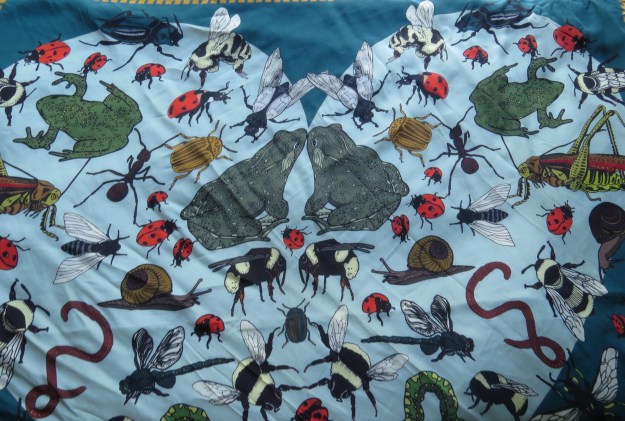
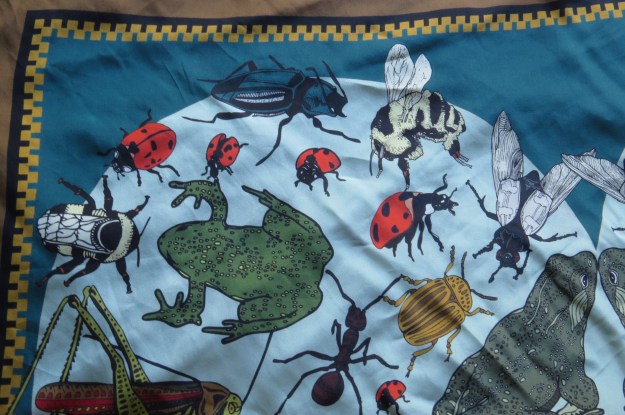
J also bought me this scarf for my birthday a few years ago. It has images of pretty much all my favourite creatures – frogs and toads, bees and beetles, earthworms and ants. I’m just sorry I didn’t iron it before I took the photograph. I love that it looks like one of those elegant lady scarves, but turns out to be covered in creepy crawlies. Many a person has done a double-take when they’ve looked at it closely.

And this is the brooch that got me into trouble with my boss, who I was meeting ‘in real life’ for the first time in Dublin. We’d gone out for a team dinner, and it turned out that she was arachnophobic. I ended up popping the poor spider into my pocket for the duration.

And of course I could never resist a bee. I had a lovely holiday with my dear friend S, who was working in Washington D.C, so I got a chance to go to the Smithsonian Museum of Natural History. A visit to the museum shop is obviously essential, and they had the best selection of insect jewellery that I’d ever seen in one place. Sadly most of the pieces aren’t online, and my friend works from London now.

Smithsonian bees!

I fell in love with this quirky chap when I saw him at a craft market in London. Sadly, the pink gemstones have been falling out all over the place – I used to wear him a lot when I was travelling for work in Europe, and I know for a fact that one stone is in Prague, one is in Helsinki and another one is most likely in Copenhagen. Never mind. Whenever I look at him, I’m reminded of the days when such lunatic levels of travel were not only condoned but expected, and I’m happy to be more settled, and less of a carbon liability.

And finally, how about this Bugwoman-themed cardigan? If I ever do personal appearances, I shall have to wear this.

It’s funny how I am so drawn to images of ‘bugs’, even after all these years. For me, they are still a source of fascination, and nothing cheers me up more quickly than the discovery of a new insect, or a new piece of information about their lives. I can quite see myself as an elderly lady in a care home with a secret pet spider in the corner of the room. This last few years have really made me consider what is important, and what isn’t, and I know that being connected to the natural world is so fundamental to me that without it, life wouldn’t be worth living. It’s always worth thinking about and stating these things while you still can.

An Insect-Filled Walk in St Pancras and Islington Cemetery

Dear Readers, it was the most beautiful spring today, and while the cherry plums in the cemetery have mostly lost their blossom, the heavy candy-floss pink flowers of the cherry trees are just starting to emerge. It’s a shame that many of the prettiest are behind fencing at the moment, while the cemetery tries to turn yet another area of rough scrub into a site for graves, but nonetheless the tree is still exuberant. The blossom on these trees can sometimes seem almost too much: I suspect that these trees are of the Kanzan variety, with each blossom having up to 28 petals. There is a road close to where I used to live in Islington which was lined with these trees on each side: when the blossom started to fall, it could be like scuffling through a thin layer of pink snow.

The cherry plums have lost every last flower now, and are instead glorying in their copper foliage.

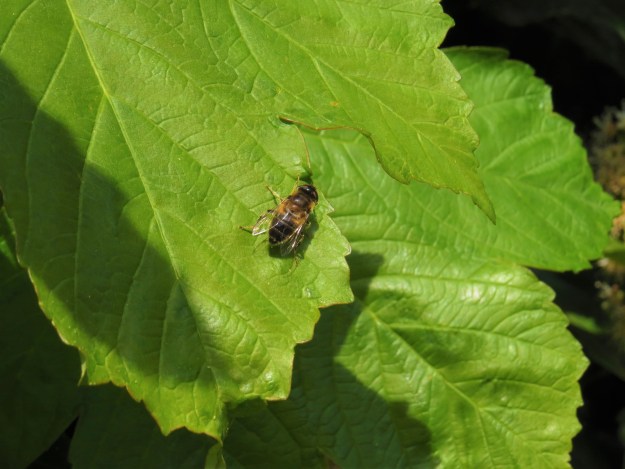
The cow parsley is just starting to flower in the woodland grave area, and is already attracting pollinators, like this little hoverfly. The photo is not good enough to identify the species, but it does give an indication of how varied this group of insects can be – at first glance you’d think this was a flying ant.

I had to pause for a quick look at the swamp cypress, which appears to have been in suspended animation for weeks. Not for much longer, though! I can’t wait until it’s decked out in fluorescent green.

I had to pause for a quick look at the cherry laurel by the main path – it is covered in strange, spidery flowers, and has a most nose-tingling smell, somehow dusty and honey-ish at the same time.

Another hoverfly was sunning itself on the leaves. I’m going to hazard a guess and say that this is probably a female Eristalsis pertinax. The males of this fly defend territories around flowering plants, and I imagine that the cherry laurel must be a very appealing site. The young go by the appealing name of ‘rat-tailed maggots’, and live in drainage ditches and other stagnant water: the ‘tail’ is actually a breathing tube.

And here’s an insect that I haven’t come across before. Superficially it looks rather like a shield bug, but it is narrower in the body and has much thicker, more pronounced antennae. This is a box bug (Gonocerus acuteangulatus) and it isn’t named after the plant directly but after Box Hill in Surrey (which was, admittedly, named after the box hedges that grew there).  The bug was considered endangered, and in 1990 it was known only in the area around the eponymous Box Hill, but since then it has expanded its range to most of south-east England. It seems to have expanded the variety of foodplants that it eats to include hawthorn, bramble and rose, and I predict a sunny future for it as it munches its way northwards.

The dandelions are still out in force.

The leaves on the horse chestnut are getting bigger every week.

And the first flowers are opening on the hawthorn.

But what I’ve really noticed this week are the bluebells. The vast majority of the ones in the cemetery are hybrids, and they come in the most astonishing array of colours. I doubt that the cemetery was ever a pristine environment for bluebells, and in fact I suspect that if there weren’t hybrids here, there wouldn’t be any bluebells at all.

  The primroses are doing their hybridizing thang as well. In the beds at the entrance to the cemetery there is the most extraordinary range of primulas and polyanthus, and I suspect that they are all cross-breeding and coming up with multiple varieties across the rest of the area. Genetic exuberance is certainly in evidence here.

In one of the sunnier parts of the cemetery I saw, in quick succession, a brimstone butterfly, a peacock butterfly, and a male orange-tip. I managed to get photos of two out of the three, which wasn’t bad considering how quickly the brimstone was flying. They apparently emerge from hibernation from March onwards, and will only be on the wing till May, so I cherished this glimpse of a butterfly in a tearing hurry!

Brimstone butterfly(Gonepteryx rhamni)

And then we almost trod on two peacock butterflies in quick succession, both of them sunning themselves on the path. These adults will have been hibernating over winter, and are now looking for someone to mate with, and somewhere to lay their eggs. They looked very ragged and tired, poor things.

The orange-tip will have been very happy to see the abundance of garlic-mustard which has popped up everywhere, and is now coming into flower. It’s good that there is so much of the stuff, as the caterpillars are cannibalistic and so the female normally lays each egg on a different plant – when an egg is laid, the female also deposits a pheromone which will prevent other females from laying there. Furthermore, the females will only lay their eggs on plants which are already in flower, but will also refuse to lay if the flower is starting to age. This is an insect which wants to give their young the very best start in life, for sure.

Photo One by By Charles J. Sharp - Own work, from Sharp Photography, sharpphotography, CC BY-SA 4.0, https://commons.wikimedia.org/w/index.php?curid=48875414

Male orange-tip (Anthrocharis cardamines) (Photo One)

Garlic mustard and lesser celandine

I couldn’t resist getting a photo of this watchful crow, and I rather liked the backlit dandelions too.

And for my final butterfly of the day, here’s a newly-minted speckled wood (Parage aegeria). These are woodland butterflies, flitting through the dappled shade. The males are fiercely territorial, and spend a lot of time flying into the air to investigate every insect that goes past. If it’s another male, an aerial battle will take place that could last up to 90 minutes. The battles are fiercest if the incumbent male has already been visited by a female – presumably this proves that his territory is a good spot. What a lot of hard work this reproduction business is.

Speckled wood (Parage aegeria)

And so, it seems that, with the arrival of flies and bugs and butterflies, and with bluebells and garlic mustard springing up all over the cemetery, we are now into what I think of as ‘mid-spring’, the period when the battle to mate and rear young and get pollinated is at its height. All I need now is the arrival of the house martins to know that spring is fading, and summer is beginning.


Saturday Quiz – The Joys of Spring

Dear Readers, we haven’t had a poetic quiz for a while, and as spring is the season that gets all red-blooded poets into a frenzy of verse-making, all I need you to do this week is to match the photo to the quote, with one extra point for identifying the poet and a further point for identifying the animal or plant, so that makes 45 points going begging in total.

As usual, all answers in the comments by 5 p.m. on Thursday 29th April (UK time) please; I’ll publish the results on Friday 30th April. And where did April go, exactly? They say that time speeds up as you get older, but this is ridiculous.

Also as usual, I will ‘hide’ your answers as soon as I see them but if you are easily influenced you might want to write your thoughts down on a piece of paper before you put them in the comments 🙂

So, if you think Quote A refers to the bird in Photo 1, your answer is 1) A. which, if correct will give you one point. If you think the poet is William Shakespeare and the bird is a penguin, you would get a further two points if you were correct (unlikely in this case :-))

Onwards!

Quotes

A) ‘When he perches on a stone
it’s a wet one.
He stands there, bobbing and bobbing
as though the water’s applauding him’

B) ‘Gave thee life, and bid thee feed,
By the stream and over the mead;
Gave thee clothing of delight,
Softest clothing, woolly bright’.

C) ‘Yet there it was content to bloom,
In modest tints arrayed;
And there diffused its sweet perfume,
Within the silent shade’.

D) ‘ Yet Spring’s awakening breath will woo the earth,
To feed with kindliest dews its favourite flower,
That blooms in mossy banks and darksome glens,
Lighting the greenwood with its sunny smile’.

E) ‘ I watched them leap and run,
Their bodies hollowed in the sun
To thin transparency,
That I could clearly see
The shallow colour of their blood
Joyous in love’s full flood’.

F) ‘ Loveliest of trees, the xxxxx now
Is hung with bloom along the bough,
And stands about the woodlands ride
Wearing white for Eastertide’.

G) ‘ Continuous as the stars that shine
And twinkle on the milky way,
They stretched in never-ending line
Along the margin of the bay:
Ten thousand saw I at a glance,
Tossing their heads in sprightly dance’.

H) ‘ The phrases of his pleading
Were full of young delight;
And she that gave him heeding
Interpreted aright
His gay, sweet notes,-
So sadly marred in the reading,-
His tender notes. ‘

I) ‘ What pretty, drooping weeping flowers they are,
The clipt-frilled leaves the slender stalk they bear
On which the drooping flower hangs weeping dew’.

J) ‘ The xxxxx she’s a pretty bird,
She sings as she flies,
She brings us good tidings,
She tells us no lies;
She sucketh white flowers
For to make her voice clear,
And the more she sings ‘xxxx’
The summer draws near.’

K) ‘Ethereal minstrel! Pilgrim of the sky!
Dost thou despise the earth where cares abound?
Or, while the wings aspire, are heart and eye
Both with thy nest upon the dewy ground?
Thy nest which thou canst drop into at will,
Those quivering wings composed, that music still!’

L) ‘That thou, light-winged Dryad of the trees,
In some melodious plot
Of beechen green and shadows numberless,
Singest of summer in full-throated ease’.

M) ‘ Under the after-sunset sky
Two xxxxx sport and cry,
More white than is the moon on high,
Riding the dark surge silently;
More black than earth. Their cry
Is the one sound under the sky’.

N) ‘ Incorrigible, brash,
They brighten the cinder path of my childhood.
Unsubtle, the opposite of primroses,
But unlike primroses, capable
Of growing everywhere, railway track, pierhead,
Like our extrovert friends who never
Make us fall in love, yet fill
The primroseless, roseless gaps.

O) ‘ I love its growth at large and free
By untrod path and unlopped tree,
Or nodding by the unpruned hedge,
Or on the water’s dangerous edge
Where flags and meadowsweet blow rank
With rushes on the quaking bank’.

Photos

Photo One by cheloVechek / talk, CC BY-SA 4.0 <https://creativecommons.org/licenses/by-sa/4.0>, via Wikimedia Commons

1)

Photo Two by Philip Halling / Wild daffodils in Hallwood

2)

Photo Three by © Copyright Andrew Curtis and licensed for reuse under this Creative Commons Licence.

3)

Photo Four by Ómar Runólfsson, CC BY 2.0 <https://creativecommons.org/licenses/by/2.0>, via Wikimedia Commons

4)

Photo Five by Andrew2606 at English Wikipedia, CC BY 3.0 <https://creativecommons.org/licenses/by/3.0>, via Wikimedia Commons

5)

Photo Six by By Phil Nash from Wikimedia Commons CC BY-SA 4.0 & GFDLViews, CC BY-SA 4.0 <https://creativecommons.org/licenses/by-sa/4.0>, via Wikimedia Commons

6)

Photo Seven by Caroline Legg from https://www.flickr.com/photos/128941223@N02/49898514632

7)

Photo Eight by Laura Nolte at https://www.flickr.com/photos/laura_nolte/5602766470

8)

Photo Nine by PiggiusMax, CC BY-SA 4.0 <https://creativecommons.org/licenses/by-sa/4.0>, via Wikimedia Commons

9)

Photo Ten by Artur Rydzewski at https://www.flickr.com/photos/119200904@N07/24395314677/

10)

Photo Eleven by Mike McKenzie, CC BY-SA 2.0 <https://creativecommons.org/licenses/by-sa/2.0>, via Wikimedia Commons

11)

Photo Twelve by Joe Pell, CC BY 2.0 <https://creativecommons.org/licenses/by/2.0>, via Wikimedia Commons

12)

Photo Thirteen by gailhampshire from Cradley, Malvern, U.K., CC BY 2.0 <https://creativecommons.org/licenses/by/2.0>, via Wikimedia Commons

13)

Photo Fourteen by Greg Hume, CC BY-SA 3.0 <https://creativecommons.org/licenses/by-sa/3.0>, via Wikimedia Commons

14)

Photo Fifteen by Takuya Matsuyama, CC BY 3.0 <https://creativecommons.org/licenses/by/3.0>, via Wikimedia Commons

15)