Wednesday Weed – Michaelmas Daisy Revisited

Michaelmas Daisies on Twyford Avenue

Dear Readers, what a splendid year it is for autumnal flowers here in East Finchley! The Michaelmas Daisies are particularly fine, and it’s easy to forget that this ubiquitous plant is not a UK native, but came here originally from North America, as mentioned in my original piece below. There are at least seven Michaelmas Daisy species that are naturalised in the UK, according to Stace and Crawley’s ‘Alien Plants’ – some are attractive (and you can see how they could have graced a garden), while others are not: of the ‘decidedly dull‘ Delicate Michaelmas Daisy (Aster concinnus) the authors remark that ‘the reasons for …. importation must remain a mystery’. I rather like it, but see what you think.

Delicate Michaelmas Daisy (Aster Concinnus) Photo by Emily Oglesby at https://fsus.ncbg.unc.edu/show-taxon-detail.php?taxonid=6481

Michaelmas Daisies are named for Michaelmas, the quarter day and feast of St Michael celebrated on 29th September, which is also peak flowering time for these flowers. An old rhyme records this:

“The Michaelmas daisies, among dead weeds, Bloom for St Michael’s valorous deeds …”. 

Incidentally, this is also the day that Old Nick (the devil) was supposed to spit on/urinate on blackberries, so they shouldn’t be harvested after this date. However, I don’t know about where you live, but around here the blackberry harvest has been prolific, but the berries themselves a bit dry and disappointing (not enough rain at the right time, I guess).

And here is a rather sweet poem, by Victorian poet Letitia Elizabeth Landon (1802 – 1838). She published her first poem aged only 9 and wrote four novels and several poetry collections. Alas, much as today, her personal life was the subject of constant cruel speculation, and she died, aged only 36, after drinking prussic acid.

The Michaelmas Daisy by Letitia Elizabeth Landon

Last smile of the departing year,
Thy sister sweets are flown;
Thy pensive wreath is far more dear,
From blooming thus alone.

Thy tender blush, thy simple frame,
Unnoticed might have past;
But now thou contest with softer claim,
The loveliest and the last.

Sweet are the charms in thee we find,
Emblem of hope’s gay wing;
‘Tis thine to call past bloom to mind,
To promise future spring.

And now, let’s see what I had to say about Michaelmas Daisies back in (gulp) 2014….
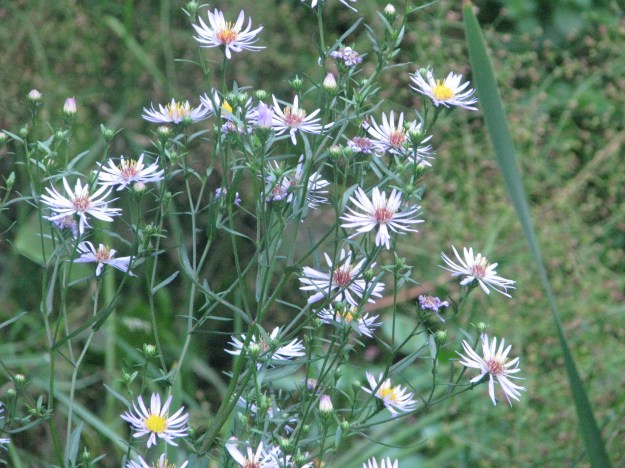
The Cup of Gold 010This small, lilac member of the daisy family seems to be popping up all over the place in my half-mile territory. These photos were taken in Coldfall Wood, where it makes the dried-up winter pond look like an Impressionist painting. But this delicate-looking plant has had a long journey. It comes originally from North America (it was introduced to England by John Tradescant in 1633), and it is a prairie plant rather than a woodland one. Nonetheless, it seems to made itself at home in all kinds of damp and neglected places, bringing a wash of pale lavender amongst the green

This is not an easy plant to identify at the species level. We have Common, Confused, Narrow-Leaved, Glaucous, Hairy and Changing Michaelmas Daisies, and every possible hybrid. As I squint at my photographs, I suspect that my daisies are Confused . On a bad day, I know exactly how they feel.

The Cup of Gold 011The great thing about Michaelmas Daisies, as anyone who has planted them deliberately will know, is that they are full of energy and colour when most other plants are giving up. They seem to be particularly attractive to hoverflies, a creature that prefers flat, easily-accessible blossoms.

The Cup of Gold 009Until 1752, this plant was known as Starwort. But when the Gregorian calendar was introduced, it was renamed the Michaelmas Daisy because its flowering coincided with St Michael’s Day on 29th September. However, I rather like the notion of a patch of Starworts, flowering under the harvest moon in a tiny ancient wood in North London, just as they have done for hundreds of years.


Farewell Biscuit Kits, Hello Shark Kits!

The Biscuit Kits, McVitie and Jaffa

Dear Readers, our foster cats McVitie and Jaffa were re-homed on Sunday – they’ve gone to an absolutely perfect home, with people who are going to love them every bit as much as I did. It’s always sad for me when the kitties go off, but it’s also so great that they’ve gone from some little flu-raddled waifs to the confident cats that they are now. Plus, I got a box of very nice chocolates to say thank you, so that’s all good. And we got some photos of the kittens in their new home last night, and they look as if they’re already ruling the roost, which is just as it should be.

And now, we have our new ‘kittens’, Goblin and White-tip. Clearly there have been a lot of kittens through the RSPCA this year, and someone decided to name them after sharks. I suspect there’s maybe a Hammerhead and a Great White out there somewhere.

Goblin

White Tip

It would be a mistake to describe these guys as ‘kittens’ – they might only be seven months old, but they are real bruisers. We’ll be keeping in them in a small room for a couple of days, but I suspect they’ll soon be rampaging up and down the stairs like lunatics. White Tip came out from hiding within seconds of smelling food, has already given me a kiss and climbed on my lap, and spends the whole time purring like a small train. Goblin is a bit more reserved, but has also been out for a stroke. 

We only have four weeks until I go off on my mystery holiday, so fingers crossed someone will fall for these lovely guys as soon as possible. It would be a real shame for them to have to go back into the shelter. I’ll post a link as soon as they’re on the RSPCA rehoming website, but do let me know if you’re in the London area and are suddenly interested in a pair of friendly boy cats (already neutered and vaccinated!)

‘Only a Matter of Time’….

European Praying Mantis (Mantis religiosa) Photo By Charles J. Sharp – Own work, from Sharp Photography, sharpphotography.co.uk, CC BY-SA 4.0, https://commons.wikimedia.org/w/index.php?curid=122275476)

Well Readers, a while back I was having a ruminate about what I thought could be the next mainland  European insects to arrive in the UK, and one suggestion was that the Praying Mantis could turn up – there are already breeding populations on the Isle of Wight and the Channel Islands, but this year two were found in Cornwall, one in Truro and  one in Mousehole. However, I am a little surprised at all the excitement, as in 2020 a colony of Praying Mantis  were found in a garden as far north as Oxfordshire. Maybe that  occurrence was found to be the result of escaped insects from a pet collection, rather than a ‘real’ colonisation, but nonetheless, it seems that Praying Mantis are increasingly at home in our gardens.

Female Praying Mantis (Photo By AlaskaDave – Own work, CC BY-SA 3.0, https://commons.wikimedia.org/w/index.php?curid=20804648)

The breeding habits of Praying Mantis are well-known – females often eat the males during copulation, which provides them with lots of nutrition for their eggs. However, it’s been noted that males aren’t necessarily happy about this, and will actively try to avoid being eaten by approaching females who are cleaning themselves, eating or otherwise distracted. A male can continue to copulate even after his head is removed, which gives a whole new meaning to the phrase ‘losing your head’ over someone.

Incidentally, females are larger than males, and have a black mark close to their ‘armpits’ as you can see in the photo above.

Praying Mantises mating (Photo by By I, Zwentibold, CC BY-SA 3.0, https://commons.wikimedia.org/w/index.php?curid=2382243)

Females then lay an ootheca, which contains 100-200 eggs. When the mantises hatch, they are tiny replicas of their parents, but are only about one tenth of the size.

Ootheca (Photo by By Ryan Hodnett – Own work, CC BY-SA 4.0, https://commons.wikimedia.org/w/index.php?curid=36274081)

As the European Praying Mantis has a very wide distribution (including being found in North America) it’s maybe not surprising that it’s made the short hop to the south coast of England. It’s not certain whether the animals here have travelled in luggage, escaped from a pet collection or flown here. Yes, Praying Mantises can fly, particularly the males, who tend to be more active, and are much lighter than the females.

Male European Praying Mantis (Photo by By Abalg – Own product, CC BY-SA 4.0, https://commons.wikimedia.org/w/index.php?curid=5108294)

So, I guess it’s only a matter of time before these impressive insects become part of our  native fauna. It’s not thought that they’ll have a deleterious effect on other insects, and they are harmless to humans, though they do look very impressive, particularly with wings spread and ‘arms’ raised in a threat display. Climate change continues to throw us curve balls. Let’s see who turns up next.

A Windy Walk

Dear Readers, today was intended to be a walk through three woods – Cherry Tree, Highgate and Queen’s Wood. However, Mother Nature intervened, and the winds of Storm Amy meant that the latter two woods were closed in case a branch fell on someone’s head – sensible following a fatality a few years ago when a tree fell on a car and killed a poor young woman. Still, Cherry Tree Wood was open and it is very clearly a mast year, for oak at least – the jays and the squirrels will be delighted, I’m sure, but they won’t be able to eat everything, and this is the point – at least some acorns will survive to make little oak trees. Mast years usually happen after a warm, dry spring, and occur every five to ten years – making acorns needs a lot of energy and plentiful resources, so the tree can’t do it every year.

Oak and hornbeam canopy in Cherry Tree Wood.

You may well have noticed a lot of other berries about – hawthorn seems to be having a great year, as do rowan trees, and there are lots of rose hips about too. The birds will have a good autumn, by the look of it.

Hawthorn berries in Cherry Tree Wood

Then we head towards Queen’s Wood, in blissful ignorance of the fact that the place is closed. Still, we pass this poor tree at the corner of Fordington Road and Woodside Avenue. It was cut down because it was unwell (and I think it really was) but still, what a shame….

As we walked up the path towards Highgate Wood, a young woman stopped us to tell us the wood was closed, which saved us a stiff-ish and frustrating climb. So, we decided to head to Muswell Hill for a bagel at Roni’s Bagel Bakery. En route, we passed this amazing hydrangea – it’s been a very good year for them…

We walk up past some allotments and the trees are laden down with crab apples…

I’ve written before about how the bark seems to peel off of at least some plane trees when it’s very dry and hot (I know they always lose some bark, but it’s much worse when the weather is more extreme). Have a look at these…

But I love the bark on these River Birch trees….


We cut through an alleyway to Fortis Green Road. Just look at the colour on this Virginia Creeper, pouring over a wall in a carpark…

And here’s a quick look at this amazing Arts and Crafts building on Fortis Green Road, Birchwood Mansions. I’ve written about this area before, but it’s always a pleasure to walk around….

And then we go into the new bookshop right opposite, and I find this!

It was last updated in 1971, but who cares? I love a ‘New Naturalist’, so much love and attention went into every one of them, and this one features several illustrations of  jumping spiders courting, so that’s me sold….

Anyway, then it’s time to head home.  Look at this magnificent Norway Maple on Twyford Avenue!

And finally, a quick nod to the Michaelmas Daisies. I love these flowers, and the way they offer some of the last nectar and pollen of the summer to bees and hoverflies. Truly, a great plant for late-summer/autumn colour in any garden. There is such abundance of colour and form at this time of year, for those of us in the Northern Hemisphere at least. It’s well worth taking a breezy walk to soak it all in.

New Scientist – Shimmery Mammals Might Be More Common Than We Thought

Juliana’s Golden Mole (Neamblysomus julianae) Photo by Craig R. Jackson (DOI: https://doi.org/10.11647/OBP.0177

Dear Readers, for some time now we’ve known that some mammals have iridescent fur – in particular the golden moles of Sub-Saharan Africa glint most attractively, These unusual mammals are blind and deaf to airborne sound, but have very well-developed organs in their ears for picking up seismic vibration – as they spend most of their time underground, this is a useful adaptation. But why is their fur iridescent?

A recent study by scientist Jessica Leigh Dobson at Ghent University has picked up iridescence in the fur of a further 14 mammal species, including 10 rodents and the otter shrew (neither an otter nor a shrew). All showed glints of green or purple in their fur when viewed from a certain angle – this effect is seen most commonly in birds such as hummingbirds, and a number of insect species.

Even a common species such as the Vlei Rat turns out to shimmer – you can see an image of the fur here.

But why? The jury is out, but the commonest explanation is that the iridescence is a side-effect of the smoothing of the cuticle of each individual hair. All of the mammals found with this phenomenon so far either live in the soil, or spend a lot of time in water – they theory is that the smoother hairs help the animal to travel through their chosen medium more easily, and that the structure also helps to keep the fur clean.

Some have suggested that the iridescence could be used for communication, as it definitely is with male hummingbirds, who display the changing colours of their feathers to attract mates and to scare off rivals.

Anna’s Hummingbird (Photo by James Marvin at https://www.flickr.com/photos/mandj98/54172229556/)

However, I find this less convincing, when you think that the golden moles can’t see, and they are the group with the widest range of iridescence. However, many of the mammal species with iridescent fur so far discovered can see, and as Dobson points out, there are 2500 rodent species, and only a handful have so far been assessed for iridescence. It will be interesting to see if more species are found, and what conclusions are reached. In the meantime, it appears that even the humblest of mammals are turning out to have a whole range of new characteristics.

An Ordinary Walk Around Walthamstow Wetlands

Dear Readers, I have a friend who lives in Walthamstow, and so we meet fairly regularly at the Wetlands, for a walk and a coffee. There’s something about walking along the paths on a still, sunny autumn day that loosens up conversation, and so we talked about funeral planning, and where we’d like to be buried, and what we would want for our last days. It might seem a bit morbid, but then I am in training to be a Death Doula (the second part of the Foundation course takes place later this week), and so it’s all good practice. Plus, isn’t it easier to consider these things when looking at a heron, or watching a flock of long-tailed tits working their way through the hawthorn?

My friend and I are both in our sixties, and have both lost close family members over the past few years. Although it’s difficult to contemplate our own demise (existential therapist Irvin Yalom describes it as ‘staring at the sun’), neither of us want to leave a lot of complication and mess for our loved ones, and that does somewhat concentrate the mind. We’ve sat with people who are dying, and, for me at least, that makes it much more real, and somehow less frightening. The paperwork can be frightening, though, so better to get that sorted while we’re happy and healthy-ish.

We got to one of the reservoirs, and I had never seen so many birds here – half a dozen herons, dozens of cormorants, lots of ducks  in their eclipse plumage, gulls by the hundred. By the time I got the camera out, most of them had gone, but here’s a few snaps. I wasn’t going to take any photos because I wanted to concentrate on my eyes and ears (for once), but then I felt a need to share, so here we are.

From a distance this looks like mostly cormorants….

but close up, you can see that there are great crested grebe too…


What a perfect day to be alive! On the way back, we talked about the stories that we tell ourselves about our lives, and about how we can change how we think about things. We can hold grudges, or we can let them go. We can linger on the things that went wrong, or we can incorporate them into our story, and be pleased that we survived them. We can’t change the past, but we can change how we think about it.

My mother had a life that was marred with terrible physical pain. And yet, when asked, she said that she’d had a wonderful life – she had people to love, who loved her. She said she’d visited some amazing places, and had also  been very happy at home. She loved London, and she loved Dorset. She’d been blessed in her neighbours, and she loved her garden. She considered herself lucky, and she was grateful every day. And this was a blessing, not just for her but for the rest of us who were left behind.

We can all be the authors of our story, and choose what the story means to us.

Thursday Poem – ‘Portrait in Nightshade and Delayed Translation’ by C. Dale Young

The Return of the Prodigal Son (Rembrandt 1688)

Dear Readers, I featured this poem once before, but I think it deserves a post on its own. Who hasn’t broken, unexpectedly? See what you think. 

Portrait in Nightshade and Delayed Translation

C. Dale Young
1969 –

In Saint Petersburg, on an autumn morning,
having been allowed an early entry
to the Hermitage, my family and I wandered
the empty hallways and corridors, virtually every space

adorned with famous paintings and artwork.
There must be a term for overloading on art.
One of Caravaggio’s boys smirked at us,
his lips a red that betrayed a sloppy kiss

recently delivered, while across the room
the Virgin looked on with nothing but sorrow.
Even in museums, the drama is staged.
Bored, I left my family and, steered myself,

foolish moth, toward the light coming
from a rotunda. Before me, the empty stairs.
Ready to descend, ready to step outside
into the damp and chilly air, I felt

the centuries-old reflex kick in, that sense
of being watched. When I turned, I found
no one; instead, I was staring at The Return
of the Prodigal Son. I had studied it, written about it

as a student. But no amount of study could have
prepared me for the size of it, the darkness of it.
There, the son knelt before his father, his dirty foot
left for inspection. Something broke. As clichéd

as it sounds, something inside me broke, and
as if captured on film, I found myself slowly sinking
to my knees. The tears began without warning until soon
I was sobbing. What reflex betrays one like this?

What nerve agent did Rembrandt hide
within the dark shades of paint that he used?
What inside me had malfunctioned, had left me
kneeling and sobbing in a museum?

Prosto plakat. Prosto plakat. Osvobodi sebya
said the guard as his hands steadied my shoulders.
He stood there repeating the phrase until
I stopped crying, until I was able to rise.

I’m not crazy, nor am I a very emotional man.
For most of my life, I have been called, correctly, cold.
As a student, I catalogued the techniques, carefully
analyzed this painting for a class on the “Dutch Masters.”

Years later, having mustered the courage to tell
this ridiculous story, a friend who spoke Russian
translated the guard’s words for me: “Just cry. Just cry.
Free yourself.” But free myself from what, exactly?

You see, I want this whole thing to be something
meaningful, my falling to my knees in front of a painting
by Rembrandt, a painting inspired by a parable
of forgiveness offered by a father to his lost son.

But nothing meaningful has presented itself. Even now,
after so much time has passed, I have no clue
what any of this means. I still haven’t figured out
whether or not I am the lost son or the found.

Wednesday Weed – Tall Nightshade

Tall Nightshade (Solanum chenopodiodes)

Dear Readers, it’s always interesting to spot a completely new ‘weed’, and so it was today on my walk back from the wonderful Walthamstow Wetlands. Tall Nightshade (Solanum chenopodiodes) is a native of South America , like its relatives the potato, the aubergine and the sweet pepper, but it seems to have jumped across the pond and made itself at home here. According to Clive Stace and Michael Crawley’s ‘Alien Plants’, Tall Nightshade is a particular pest at Wisley, so whether it was brought in with some more exotic plant remains to be seen.

Tall Nightshade flower (Photo By Ixitixel – eigene Arbeit, selbst fotografiert, CC BY-SA 3.0, https://commons.wikimedia.org/w/index.php?curid=3826231)

One look at the flowers will tell you that this is a Solanum, but it is a shrub, and the plants that I saw were several feet tall. The plant is also known as ‘Whitetip Nightshade’, presumably because of the buds, and ‘Velvety Nightshade’, because of its leaves. It’s said to be a ‘very rare casual’ plant, mostly found around London, which is an epicentre for all sorts of interesting ‘weeds’ – with such a long history, and such a varied population, it’s not surprising that our plants should also be a weed-hunter’s dream.

Tall Nightshade has a long history of medicinal use in its native South America, where it is believed to be a painkiller and antibiotic. However, like most of the family it contains toxic alkaloids, so I wouldn’t be munching it if I were you, at least not without some specialist knowledge.

It can also be used as a dye plant, and produces a purple pigment.

Interestingly, some experts say that the berries can be eaten, but they must be very ripe and almost falling off the plant. I suppose my question is, why would you want to eat them (unless you were alone and starving with only a Tall Nightshade for company). The plant has naturalised in Australia, but only survives in wet conditions. One for the Bushtucker Challenge in ‘I’m a Celebrity, Get Me Out of Here’ maybe? At least it would give the poor old invertebrates a rest.

Tall Nightshade berries (Photo by Adam Grubb and Annie Raser-Rowland at https://www.flickr.com/photos/87106229@N05/7981599873)

And now a poem. I rather like this skipping rhyme and the underlying message – don’t get mad, get even. Hah! This is from a collection called ‘Skipping Rhymes for the New Age‘ by Kate Holly-Clark, and very interesting they are too….

Skipping Rhyme from Chokely in Wynterset

“I have a deadly nightshade
So twisted does it grow-
with berries black as midnight
And a skull as white as snow
The vicar’s cocky young son
Came to drink my tea
He touched me without asking
now he’s buried ‘neath a tree”


Kitten Update (Probably the Last One….)

Dear Readers, it looks as if we might have a lovely home for the two foster kitties, McVitie and Jaffa (otherwise known as White Chin and Black Chin). They will be staying in North London, but in a much posher bit, and the people who are adopting them seem perfect. When they came to visit at the weekend, the kittens were on their very best behaviour (which makes a change, I must say). So here is a quick compendium of recent shots, just to show them in all their splendour…

And here, for your delectation, are a few  seconds of kitten purring. Sound up! I will miss these little guys, but I’m so glad to have helped to launch them into their new lives. They are adorable, and I’m sure their new owners will love them every bit as much as I do.


A Bird Walk in Coldfall Wood

Dear Readers, I don’t know what you were doing at 8 a.m. on Sunday morning, but I was out with local birder Gareth Richards and some other intrepid birdwatchers to see what was going on in Coldfall Wood. Last time we did a formal walk we spotted a Firecrest, which was a wonderful find. No such luck this time, but we did get a splendid view of a Treecreeper, which is not uncommon, but is fairly elusive.

Treecreeper (Certhis familiaris)

Birding in woodland at this time of year can be a little frustrating – there is still a lot of leaf cover, and you can hear about three times as many birds as you actually see. We were blessed with a good view of swallows and house martins flying over however – they were flying south-ish, but Gareth explained that the birds like to fly into the wind, which is the exact opposite of what you’d think. We all wished them the best – these fragile wisps of life heading off on a journey of so many miles, many for the first time, always move me.

We saw lots of smaller birds foraging in the trees – mixed flocks of tits and goldcrests were everywhere. Strangely enough, there weren’t any finches (I’ve seen flocks of dozens of chaffinches in the past) and although we heard long-tailed tits, they couldn’t be enticed any closer, even with Gareth making his famous ‘psshing’ sound which is usually irresistible. I imagine that as insects become (even) less common, the birds will concentrate on trying to find food.

And here’s some video of a Coldfall Wood treecreeper – not from this occasion, but fun nonetheless, especially if you can stomach the slight vertigo induced by my wobbly filming.

All in all we saw and heard over twenty species of bird during our 90 minute walk, including one of my favourites, the often-overlooked stock dove. You might take a quick look and think this is a wood pigeon, but note the lack of any white on the body, and those ‘kind’ dark eyes, as opposed to the rather manic stare of the wood pigeon. Worth keeping an eye open for, for sure!

Stock Dove (Calumba oenas)

And so, this was a walk of small pleasures, and a great chance to get out and about on a rather overcast day, when the inclination might be to just curl up in bed. Nothing wrong with curling up in bed, but you are most unlikely to see a treecreeper!

Many thanks to Gareth, and to everyone who came on the walk.