A Brisk Walk on Summerlee Avenue

Some Peace roses on Summerlee Avenue

Dear Readers, today was Wednesday, which means a 9 a.m. work call for my husband and so a rather more energetic and speedy early morning walk than usual. Today, we did a quick loop along Summerlee Avenue, which features a splendid selection of 1920’s and 1930’s houses, with their big bay windows, and medium-sized front gardens. I was struck by the array of Peace roses in the garden above – this was my Mum’s favourite rose variety (along with an inexplicable fondness for ‘Blue Moon’, which always seemed to me to be grey rather than blue).

This part of East Finchley is probably technically known as Fortis Green, and is slightly posher  than the County Roads where I live. This particular road slopes gently downwards towards Cherry Tree Wood.

There are some wonderful gardens here. I especially like this one.

I love a garden that looks as if you couldn’t fit in another leaf, and this one hits the spot. I love the bright orange and red of the alstroemeria as well, plus the sedum just starting to change from green to pink. I imagine the pollinators will be delighted.

Further along the road there is a positive sea of ox-eye daisies.

And this is the most magnificent hydrangea, fully the size of a small tree.

This garden used to have a fountain in the front, but now it has a pond. I’m not sure if the netting is to deter humans or herons, or maybe it’s just to keep the leaves out. I am enjoying the yellow loosestrife, very cheerful!

And then it’s into the woods, and our usual game of dodging the runners and dog walkers whilst waving and shouting ‘hello’. Cherry Tree Wood, like Coldfall Wood, used to be part of a much larger tract of ancient woodland, and so it has the same mix of hornbeam with oak standards. There are some magnificent trees here, but it’s more of a ‘park’ and less of a ‘woodland’. The Friends group for Cherry Tree are hoping to create a development plan, which will probably include some coppicing, as in our wood – it’s amazing what’s lurking in the seedbank ready to spring forth once it gets some sunshine.

I love the way that this oak has twisted as it’s grown.
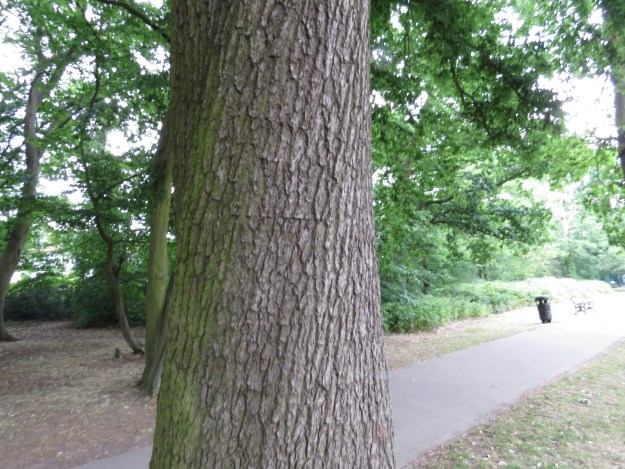
This is a very mature wood, with little understorey. It’s very atmospheric, though. I half expect a wolf to run along the pathway (though normally it’s a labradoodle which is not at all the same thing).

Then it’s out of the wood and along the unadopted road where I found the corncockle a few weeks ago. The corncockle has faded, but there are still a few poppies and cornflowers holding on, and some rather lovely corn marigolds. These are listed as vulnerable, and are yet another declining arable weed.

Poppies (Papaver rhoeas)

Corn marigold (Glebionis segetum)

There is a magnificent stand of pendulous sedge too. I just hope that no-one ever wants to get rid of it, as they’ll need a machete for sure.

My field guide to plants describes this plant as ‘easily overlooked’, and so it is – I’d been cheerfully writing it down as red deadnettle, when it clearly isn’t. In fact, it’s black horehound (Ballota nigra), and I definitely feel a Wednesday Weed coming on.

I used to know this grey-foliaged, yellow-flowered plant as Senecio, but these days apparently it’s Brachyglottis. It comes originally from New Zealand, and loves full sun. This one was doing extremely well.

Now, Readers, I need your help with this one, that I have fallen in love with. The flowers remind me of tansy, but the whole plant has a cool, pale green air about it which I find very appealing. What on earth is it, though?

Mystery plant!

Someone is growing a crop of Hedge Bindweed (Calystegia sepium) which is pink and white candy-striped – very interesting! Field bindweed (Convulvulus arvensis) is a small-flowered pink and white plant, but I’ve never seen this colouration on the larger plant. If it wasn’t such a pain one could almost grow it on purpose.

And no walk in this area is complete without a quick look at this unpromising bit of garden at the top-end of Park Hall Road. This has provided me with some very unusual Wednesday Weeds – I can only wonder if some soul planted it with wildflower seeds many moons ago. It is the only site locally that I know for : tufted vetch (Vicia cracca)…

Tufted vetch

hedge bedstraw.(Galium album)…

….and lucerne (Medicago sativa ssp sativa)

And then it’s a final loop back to the High Street as we hot-foot it for home. I am delighted to see that the pollarded London plane trees are starting to fight back: each branch looks as if it’s holding a leafy bird’s nest aloft. It really surprises me how many plants it’s possible to see in half an hour, even if one is travelling at speed. And a walk always sets me up for the day. I heartily recommend it if it’s possible for you in your lockdown circumstances, and if it isn’t, I hope it will be soon. I have so much to be grateful for.


Wednesday Weed – Crack Willow

Crack willow (Salix x fragilis)

Dear Readers, I am rather fond of this ‘weedy’ willow, with its shiny, elegant leaves and graceful habit. Its common name comes not from any connection with the Baltimore drug trade (I am just catching up with the TV series ‘The Wire’, nearly 20 years after everyone else) but from its habit of dropping branches or splitting with a loud cracking sound. This plant, which has parked itself next to Muswell Hill Playing Fields, is a mere baby – the tree can grow up to 25 metres tall. Crack willow is dioecious, which means that an individual plant can be either male or female: the female catkins are green, and the males are yellow. I took a photo of this tree a few weeks ago, and the catkins were green, so I think it’s a girl! There are several crack willows in the area, and the bees love the pollen, so I suspect that pollination isn’t a problem.

Crack willow catkins

Like many willows, crack willow loves damp places, and I suspect that there are the remnants of some kind of drainage ditch here, or at least a spot where the water collects. It is useful for a variety of insect species: the puss moth that I described here would have been very happy on this plant.Other stunning species that munch on crack willow include the caterpillars of the eyed hawk-moth and the red underwing.

By Didier Descouens - Own work, CC BY-SA 4.0, https://commons.wikimedia.org/w/index.php?curid=26868574

Eyed hawkmoth (Smerinthus ocellatus) (Photo One)

Photo Two byBy Simon A. Eugster - Own work, CC BY 3.0, https://commons.wikimedia.org/w/index.php?curid=7712401

Eyed hawkmoth (Smerinthus ocellatus) caterpillar (Photo Two)

Photo Three byBy John de Haura - first uploaded to en wp by Lode (2006-07-30): Red underwing - catocala nupta (wings closed) Photographed by John de Haura Free to use, CC BY-SA 3.0, https://commons.wikimedia.org/w/index.php?curid=1509408

Red underwing (Catocala nupta) (Photo Three)

The ‘cracking’ of crack willow is most probably a way of colonising river banks – the twigs and branches that break off can root themselves downstream if they happen to fall into the water. It can also often be seen along the banks of canals for the same reason. This has led to the plant, which is originally a native of mainland Europe and Western Asia, becoming an invasive species in South Africa, New Zealand and the northern part of the USA. Left to its own devices it can form stands of crack willow which squeeze all the other plants out. In New Zealand, however, only the male plants have been imported, but there is always the risk that it will hybridise with other willows. In their book ‘Alien Plants’, Clive Stace and Michael Crawley note that crack willow is ‘capable of achieving biomass at which it is likely to influence vegetation structure). Incidentally, willow is one of the plants being considered as fuel for biomass power stations.

In the UK, crack willow is counted as an archaeophyte (a plant that arrived here prior to 1500). It has also recently been discovered that the plants in the UK are not ‘pure’ crack willow, but a hybrid between white willow (Salix alba) and a species from Turkey and the Caucasus (Salix euxina). However, it has been around for such a long time that it forms part of the most typically English landscapes: it was often used to stabilise riverbanks, and was pollarded at about 3 metres so that browsing animals couldn’t nibble the new growth.

Photo Four from http://www.artuk.org/artworks/pollard-willows-44903

Hugues, Victor Louis(1827 – 1889) Pollard Willows; The Bowes Museum (Photo Four)

And here’s rather haunting picture by Jean-Baptiste Corot (1796 – 1875) called ‘The Willows of Marissel’. Where are the couple heading off to, I wonder?

Jean-Baptiste-Camille_Corot_-_The_Willows_of_Marissel (Public Domain)

The inner bark and leaves of many willow species, including crack willow, have been used for their ability to relieve pain: the ancient Assyrians suggested that chewing the leaves was a way to alleviate the pain of arthritis, and Hippocrates suggested that the plant could help with the pain of childbirth. As the plant is one of the sources of salicylic acid (aspirin) it can also reduce inflammation, and calm a fever. Although commercial aspirin is synthetically produced these days, many herbal practitioners still consider that decoctions of the bark are just as effective. In a rather interesting book on Herbal Treatments in Veterinary Science, I note that okapis have been seen to develop neuropathy after treatment with salicylic acid, so I guess the various permutations of drug and species can’t always be foreseen.

Willows of all kinds are often associated with sadness, and with lost love: the ‘willow grows aslant a brook, that shows his hoar leaves in the glassy stream’ in Gertrude’s recounting of Ophelia’s death in Hamlet is most likely a weeping willow, but wearing willow in one’s hat or on one’s clothing in remembrance of a loved one seems to have encompassed all the willow species. And who could forget Steeleye Span singing ‘All Around My Hat’? Have a listen, I guarantee you’ll be singing it for days. The version above was recorded in (gulp) 1975, but here’s the same group singing it in 2016. I rather like the way that age and experience has added a whole new dimension to the way that Maddy Prior puts the song across. What do you think?

In some parts of England, the crosses for Palm Sunday were made of willow, and the ‘floors of churches were strewn were the green leaves of willow. In Dorset, a fragment of willow is left in each of the church pews on Palm Sunday. It’s also said that if you have a burning secret that you can’t tell another human, you should tell it to a willow, who will keep the secret for you.

And now, a poem. This is only tangentially related to the willow, but I love the way that it conjures a summer’s day, and the way that the song of the ploughman, and the croaking of the crow, seem to form a kind of harmony. Plus, doesn’t it complement ‘All Around My Hat’ very nicely? John Clare is for me the quintessential English poem, more so than even Wordsworth, because his observation of the countryside is so acute that I sense that he feels it in his bones, to his marrow. Let me know what you think.

The Crow Sat on the Willow Tree by John Clare (1793 – 1864)

The crow sat on the willow tree
A-lifting up his wings,
And glossy was his coat to see,
And loud the ploughman sings,
'I love my love because I know
The milkmaid she loves me';
And hoarsely croaked the glossy crow
Upon the willow tree.
'I love my love' the ploughman sung,
And all the fields with music rung.

'I love my love, a bonny lass,
She keeps her pails so bright,
And blythe she trips the dewy grass
At morning and at night.
A cotton dress her morning gown,
Her face was rosy health:
She traced the pastures up and down
And nature was her wealth.'
He sung, and turned each furrow down,
His sweetheart's love in cotton gown.

'My love is young and handsome
As any in the town,
She's worth a ploughman's ransom
In the drab cotton gown.'
He sang and turned his furrow oer
And urged his team along,
While on the willow as before
The old crow croaked his song:
The ploughman sung his rustic lay
And sung of Phoebe all the day.

The crow he was in love no doubt
And [so were] many things:
The ploughman finished many a bout,
And lustily he sings,
'My love she is a milking maid
With red rosy cheek;
Of cotton drab her gown was made,
I loved her many a week.'
His milking maid the ploughman sung
Till all the fields around him rung

Photo Credits

Photo One by Didier Descouens – Own work, CC BY-SA 4.0, https://commons.wikimedia.org/w/index.php?curid=26868574

Photo Two by Simon A. Eugster – Own work, CC BY 3.0, https://commons.wikimedia.org/w/index.php?curid=7712401

Photo Three byBy John de Haura – first uploaded to en wp by Lode (2006-07-30): Red underwing – catocala nupta (wings closed) Photographed by John de Haura Free to use, CC BY-SA 3.0, https://commons.wikimedia.org/w/index.php?curid=1509408


Photo Four from http://www.artuk.org/artworks/pollard-willows-44903


Sunday Quiz – Love A Duck! -The Answers

Shelduck at East India Docks

Hi Everyone, winners of this week’s quiz were Fran and Bobby Freelove, with 20 out of 20 (and you can’t get better than that!) Second was Anne, who got 17 out of 20 which is remarkable cosidering that she lives in South Africa. And third was Alittlebitoutoffocus, with a respectable 12 out of 20 – it was the ladies who tripped him up. Well done to all of you, and let me know how you got on if you didn’t submit your answers. Next week, plants!

Hi Everyone, here are the answers to Sunday’s quiz. I hope you enjoyed it!

Part One

The correct answers were: 1) f 2)h 3)i 4)g 5)b 6)j 7)e 8)c 9)a 10)d

By Bengt Nyman - Own work, CC BY-SA 4.0, https://commons.wikimedia.org/w/index.php?curid=49064212

1) Mallard (Anas platyrhyncohos)

Tony Hisgett from Birmingham, UK / CC BY (https://creativecommons.org/licenses/by/2.0)

2) Gadwall (Anas strepera)

AshishTripurwar / CC BY-SA (https://creativecommons.org/licenses/by-sa/4.0)

3)Northern shoveler (Anas clypeata)

Andreas Trepte / CC BY-SA (https://creativecommons.org/licenses/by-sa/2.5)

4) Wigeon (Anas penelope)

DickDaniels (http://carolinabirds.org/) / CC BY-SA (https://creativecommons.org/licenses/by-sa/3.0)

5) Eurasian teal (Anas crecca)

Dr. Raju Kasambe / CC BY-SA (https://creativecommons.org/licenses/by-sa/4.0)

6) Pochard (Aythya ferina)

Andreas Trepte / CC BY-SA (https://creativecommons.org/licenses/by-sa/2.5)

7) Tufted duck (Aytha fuligula)

Ross Elliott / CC BY (https://creativecommons.org/licenses/by/2.0)

8) Eider (Somateria mollissima)

DickDaniels (http://carolinabirds.org/) / CC BY-SA (https://creativecommons.org/licenses/by-sa/3.0)

9) Smew (Mergellus albellus)

https://www.flickr.com/photos/sbern/ / CC BY (https://creativecommons.org/licenses/by/2.0)

10) Common Goldeneye (Buchephala clangula)

Part Two

The answers were: 10)d 11)b 12)j 13)e 14)f 15)i 16)g 17)a 18)d 19)c 20) h

Josephus37 / CC BY-SA (https://creativecommons.org/licenses/by-sa/4.0)

11) Teal

Alpsdake / CC BY-SA (https://creativecommons.org/licenses/by-sa/3.0)

12) Pochard

Andreas Trepte / CC BY-SA (https://creativecommons.org/licenses/by-sa/2.5)

13) Tufted duck

Kyores / CC BY (https://creativecommons.org/licenses/by/3.0)

14) Mallard

DickDaniels (http://carolinabirds.org/) / CC BY-SA (https://creativecommons.org/licenses/by-sa/3.0)

15) Shoveler

Photo by Laitche / CC BY-SA (https://creativecommons.org/licenses/by-sa/4.0)

16) Wigeon

Tony Hisgett from Birmingham, UK / CC BY (https://creativecommons.org/licenses/by/2.0)

17)Smew

Mehmet Karatay / CC BY-SA (https://creativecommons.org/licenses/by-sa/3.0)

18) Common goldeneye

Thomas Quine / CC BY (https://creativecommons.org/licenses/by/2.0)

19) Eider

Tony Hisgett from Birmingham, UK / CC BY (https://creativecommons.org/licenses/by/2.0)

20) Gadwall

Photo Credits

1)By Bengt Nyman – Own work, CC BY-SA 4.0, https://commons.wikimedia.org/w/index.php?curid=49064212

2) Tony Hisgett from Birmingham, UK / CC BY (https://creativecommons.org/licenses/by/2.0)

3) AshishTripurwar / CC BY-SA (https://creativecommons.org/licenses/by-sa/4.0)

4) Andreas Trepte / CC BY-SA (https://creativecommons.org/licenses/by-sa/2.5)

5) DickDaniels (http://carolinabirds.org/) / CC BY-SA (https://creativecommons.org/licenses/by-sa/3.0)

6) Dr. Raju Kasambe / CC BY-SA (https://creativecommons.org/licenses/by-sa/4.0)

7) Andreas Trepte / CC BY-SA (https://creativecommons.org/licenses/by-sa/2.5)

8) Ross Elliott / CC BY (https://creativecommons.org/licenses/by/2.0)

9) DickDaniels (http://carolinabirds.org/) / CC BY-SA (https://creativecommons.org/licenses/by-sa/3.0)

10) https://www.flickr.com/photos/sbern/ / CC BY (https://creativecommons.org/licenses/by/2.0)

11) Josephus37 / CC BY-SA (https://creativecommons.org/licenses/by-sa/4.0)

12) Alpsdake / CC BY-SA (https://creativecommons.org/licenses/by-sa/3.0)

13) Andreas Trepte / CC BY-SA (https://creativecommons.org/licenses/by-sa/2.5)

14) Kyores / CC BY (https://creativecommons.org/licenses/by/3.0)

15) DickDaniels (http://carolinabirds.org/) / CC BY-SA (https://creativecommons.org/licenses/by-sa/3.0)

16) Photo by Laitche / CC BY-SA (https://creativecommons.org/licenses/by-sa/4.0)

17) Tony Hisgett from Birmingham, UK / CC BY (https://creativecommons.org/licenses/by/2.0)

18) Mehmet Karatay / CC BY-SA (https://creativecommons.org/licenses/by-sa/3.0)

19) Thomas Quine / CC BY (https://creativecommons.org/licenses/by/2.0)

20) Tony Hisgett from Birmingham, UK / CC BY (https://creativecommons.org/licenses/by/2.0)


The Good Father

Dear Readers, as we approach the first Fathers’ Day since my own Dad died, my thoughts have been turning to what makes a good father. I believe that nature often has lessons for us, although, humans being humans, we cherry-pick what appeals to us. After all, many fathers in nature do nothing more than provide the DNA for their offspring, as do many mothers, and their children are none the worse for it. Take frogs, for example. Once the spawn is laid, the mothers take off, and it’s still not clear to scientists where exactly they go. The males may hang around in the pond for longer, and there are one or two individuals left in my garden, but they show not the slightest interest in the next generation, apart from occasionally looking at them with a hungry eye.

Mr Frog

I used to wonder if the male frogs were actually occasionally eating the tadpoles, but fortunately they’re all too much of a mouthful now. I love the way that they are all developing at different rates, which I imagine gives the generation as a whole an advantage – who is to know when the best time is to leave the pond? There are baby frogs hopping around at the moment, but also individuals who seem resigned to being tadpoles for as long as possible. Some might even spend the winter without metamorphosing completely, to emerge next spring. In the photo below you can see four different stages of development – tadpole, tadpole with long tale, froglet with short tail and, on the bottom left-hand side, froglets.

But what has intrigued me most this week has been the male blackbird. I wrote about him a few weeks ago – I’m pretty convinced that this is his first brood. What a champ he’s being, though! He’s prepared to tough out a whole bird table full of argumentative young starlings, for a start.

I have never seen a bird who is able to stuff so many mealworms into his beak at one time, and this makes sense: by the time you come back, the whole lot might have been hoovered up by somebody else.

And that somebody else might be a lot, lot bigger than you are, as in the case of this jackdaw who was stuffing his or her crop with food.

The male sparrow in the background of this photo is a very determined little character as well – he too often holds his own with the young starlings, though discretion was the better part of valour here.

And when the jackdaw, who is actually much more nervous on the bird table than the blackbird, took fright, the blackbird was in like a shot.

And so, somewhere close at hand there is a nest full of baby blackbirds. I am hoping that they will fledge successfully, and that I’ll get to see some young ones in the garden. If I don’t, it certainly won’t be because their father has lacked courage, intelligence or determination.

Incidentally, the mealworms that I’m feeding at the moment are live ones; much as it pains me to offer live prey, the dried mealworms aren’t suitable for nestlings, but they do need protein, and natural insect prey such as worms are very difficult to come by in the semi-drought that we’re having at the moment. So, I’ve put my scruples to one side for a bit. I also notice that some of the mealworms manage to escape, so maybe some of them get a reprieve. Things are never straightforward, are they?

Sunday Quiz – Love A Duck!

Shelduck at East India Docks

Good morning Readers! Here is your Sunday Quiz. I think that our ducks are some of our most underrated birds for sheer good looks – the males are often magnificent, and the females, though their colouration is more subdued, often have a subtle beauty all of their own.

For Part One, can you identify the species of the handsome drake in the photo? And for Part Two, can you match the duck to the drake? Simple, huh?

As usual, pop your answers in the comments if you want to be marked (not compulsory!) If you don’t want to be influenced by those who’ve already had a go, write your answers down first on a piece of paper (or on a slate if you’re as old as I am).

Ready? Ok, let’s go!

Part One

Here are some very handsome male ducks. Can you match the photo to the name? So, if you think drake 1 is a smew, your answer is 1)a.

Possible answers:

a) Smew

b) Teal

c) Eider

d) Goldeneye

e) Tufted duck

f) Mallard

g) Wigeon

h) Gadwall

i) Shoveler

j) Pochard

By Bengt Nyman - Own work, CC BY-SA 4.0, https://commons.wikimedia.org/w/index.php?curid=49064212

1)

Tony Hisgett from Birmingham, UK / CC BY (https://creativecommons.org/licenses/by/2.0)

2)

AshishTripurwar / CC BY-SA (https://creativecommons.org/licenses/by-sa/4.0)

3)

Andreas Trepte / CC BY-SA (https://creativecommons.org/licenses/by-sa/2.5)

4)

DickDaniels (http://carolinabirds.org/) / CC BY-SA (https://creativecommons.org/licenses/by-sa/3.0)

5)

Dr. Raju Kasambe / CC BY-SA (https://creativecommons.org/licenses/by-sa/4.0)

6)

Andreas Trepte / CC BY-SA (https://creativecommons.org/licenses/by-sa/2.5)

7)

Ross Elliott / CC BY (https://creativecommons.org/licenses/by/2.0)

8)

DickDaniels  (http://carolinabirds.org/) / CC BY-SA (https://creativecommons.org/licenses/by-sa/3.0)

9)

https://www.flickr.com/photos/sbern/ / CC BY (https://creativecommons.org/licenses/by/2.0)

10)

Part Two

Same thing, but for ducks! What species do these lovely ladies belong to? I think this is pretty tricky, but here’s a hint – the shape and colour of the beak is often the key to identification.

So, if you think duck 11) is a wigeon, your answer is 11)g

Possible answers:

a) Smew

b) Teal

c) Eider

d) Goldeneye

e) Tufted duck

f) Mallard

g) Wigeon

h) Gadwall

i) Shoveler

j) Pochard

Josephus37 / CC BY-SA (https://creativecommons.org/licenses/by-sa/4.0)

11)

Alpsdake / CC BY-SA (https://creativecommons.org/licenses/by-sa/3.0)

12)

Andreas Trepte / CC BY-SA (https://creativecommons.org/licenses/by-sa/2.5)

13)

Kyores / CC BY (https://creativecommons.org/licenses/by/3.0)

14)

DickDaniels (http://carolinabirds.org/) / CC BY-SA (https://creativecommons.org/licenses/by-sa/3.0)

15)

Photo by Laitche / CC BY-SA (https://creativecommons.org/licenses/by-sa/4.0)

16)

Tony Hisgett from Birmingham, UK / CC BY (https://creativecommons.org/licenses/by/2.0)

17)

Mehmet Karatay / CC BY-SA (https://creativecommons.org/licenses/by-sa/3.0)

18)

Thomas Quine / CC BY (https://creativecommons.org/licenses/by/2.0)

19)

Tony Hisgett from Birmingham, UK / CC BY (https://creativecommons.org/licenses/by/2.0)

20)

Have fun! Answers will be posted on Tuesday, so if you want to be marked, please get your answers in before 5 p.m. UK time on Monday.


The Front Gardens of East Finchley

Dear Readers, today was a gloomy, drizzly day, and so I decided to go for a brisk walk around the County Roads in East Finchley, just to see what was going on. During the lockdown I’ve been mainly going to our two local woods, or to the cemetery, but I’ve missed the quirkiness of the tiny front gardens round about. I love how individual they are, and this year it feels to me as if they are even prettier than usual. To start with my garden, the lavender has just come into flower, but it isn’t warm enough for bees today. I notice that my buddleia also has flowers on it – they seem to be coming earlier and earlier every year.

Lavender

The flowers on the cabbage palm next door have been exquisitely scented – when the window of my office is open the perfume wafts in deliciously. They’ve been  full of honeybees as well.

And in many windows there are the rainbows and other drawings of children.

I notice, for the first time (well I have only lived here for ten years) that there are attractive terracotta plaques in the bay windows of some of the houses, and rather fine ‘things’ on the top of the gables as well. If anyone knows what the ‘things’ are called, do tell – I know they probably have some architectural name but goodness only knows what.

A male sparrow was feeding a younger one on one of the windowsills, which always gladdens my heart – these birds are so much rarer nowadays.

And on the subject of scent, the smell of this mock orange can be inhaled from several houses away.

I love how ‘bunny-rabbit flowers’ (antirrhinums) pop up unannounced every year. This one is a splendid deep pink.

And then the rain starts properly pouring down, so I take cover under a neighbouring street tree. I spot the most perfect rose blooming in the garden of the house next door.

The rain makes an abstract painting on the wall.

The bellflower is everywhere – it self-seeds into the tiniest cracks. There are two species, trailing bellflower (Campanula poscharskyana) from the Dinaric Alps in former Yugoslavia, and peach-leaved bellflower (Campanula persicifolia) from the Italian/Austrian Alps, and you can find both in North London. Both are garden escapes, but pretty and resilient nonetheless.

I am seeing lots of Mexican Fleabane, and I can see why people plant it – it’s long-flowering, trouble-free and (from my point of view) a magnet for hoverflies.

I love the clashing colours of the pelargoniums and the roses, they are so cheering to look at.

And how about these bear’s breeches?  Otherwise known as acanthus, the plant adorns the capitol of many a Roman pillar.

I adore the tiled pathway of this house as it makes its way through the lavender to that sky-blue door.

Someone has pruned the false acacia, but it’s fighting back!

I love the juxtaposition of the golden  leaves of the mock orange and the purple of the mallow here, but apologies for the raindrops on the lens. I was fighting a losing battle with the weather.

I thought the plant below was an evergreen clematis, but now I’m thinking evergreen jasmine, if there is any such thing. What do you think, Readers?

I love these blood-red hollyhocks against the whitewashed wall.

And this is the most magnificent magenta-pink mallow, next to a California lilac that’s just finished flowering. What a spectacular plant the mallow is, and something of a London speciality – it seems to love our claggy clay soil.

I have a great fondness for this lady’s ‘wild’ front garden. She popped out to tell me that the Mexican fleabane has sowed itself and I love the way that it has infiltrated the lavender. There is always something of interest here. I must stop by more often.

Further down the road I stop to take a photo of this perfect dandelion clock. I see lots of blackfly too – it has certainly been a great year for aphids, as I’ve mentioned before.

The front gardens outside these new-build flats are very small, but this one shows what can be done, with a lovely mixture of lavender, gaura, purple osteospurmum and Bowle’s mauve perennial wallflower.

And how about these fantastic red and black poppies!

Finally, as I turn for home I spot this front garden, with its mixture of foliage plants – there are various colours of heuchera here, plus a heavenly bamboo and a fern and several other interesting things. It goes to show that you don’t need to have full sun to grow something attractive and interesting.

Well, all things considered this was a most satisfying walk, and I only managed to do two and a half County Roads. Just when you think you’ve gotten to know your neighbourhood, a whole new set of interesting plants and gardens pop up. The lockdown is helping me to pay attention to the small things locally that I would otherwise miss, in my rush to head off to pastures new, and I think I’m all the better for it. I’m at a time of life when I’d rather dive deep than just skim the surface.

Friday Book – Field Guide to the Caterpillars of Great Britain and Ireland

Dear Readers,

Who would have thought that a field guide to caterpillars could invoke a trip down Memory Lane? When I was a little girl, I spent a lot of my time in our pocket-handkerchief sized garden in Stratford, East London, looking for caterpillars. How I loved them! I could watch the way that they ate ever-increasing half-circles out of the leaves for hours. I adored the feeling of the little hook-y legs at the front of their bodies, and the slight pull of the suckers at the back. We often had garden tiger moth caterpillars, who were as furry and sleek as kittens, and I had no worries about letting them walk all over my hands. I feel so sad for the many children who don’t get to mess about in the dirt these days: I invented all my own games, and was forever finding various creatures and putting them into sandwich boxes with their food plant to see what would happen.

Sometimes, what happened was horrific. I well remember the shudder that went down my back when one of my tiger moth caterpillars, who I had thought was just about to pupate, erupted instead into a mass of parasitic wasp grubs. What an education into the relationships between the different animals that inhabited the garden, though! I’m sure my parents didn’t know half of what I got up to. They were certainly displeased at the slug invasion that followed me popping some interesting-looking eggs into the air-brick under the house, but I’m not sure if I ever confessed to that one.

My most successful rearing was of four cinnabar moth caterpillars – these tiger-striped larvae eat ragwort, which was a plentiful weed in the East End. I remember running around our local street and picking the plant from the few remaining bomb sites round about. I did everything right with these guys, and watched them slow down and then turn into lacquer-red pupae, as beautiful as any Japanese netsuke. I put them in a big sweetie jar with some twigs so that they could climb up and stretch their wings when they finally emerged. I remember that I put the jar with the gas metre under the stairs, so that it was cold and dark. I checked on them every day. And one day, when I looked, the jar was filled with three perfect military-green and red moths, and one poor dead one, who seemed to have emerged but then somehow got stuck between the side of the jar and a twig.

What a palaver ensued! I felt horribly guilty. First we released the living moths close to a patch of ragwort which I’d been protecting from Dad’s weed-eradication instincts for several months. Then I dragged my brother into a funeral ritual for the remaining moth, who was buried in a Woodbine cigarette packet under a fragment of tile remaining from the creation of our 1950’s fireplace. I seem to remember a poem written on the tile in wax crayon. Looking back, I reckon that a 75% survival rate was probably better than the moths would have done in nature, but, as always, I remember the failure, not the success.

And sometimes, caterpillars can give us a shock. My Mum was on her way to work one day when she found a most surprising creature on a twig in one of the gardens in the City.

“It was waggling its tail”, she said, “and it was as fat as my finger!”

“So what did you do, Mum?” I asked.

“Well, I thought it looked a bit vulnerable standing there where anyone could see it”, she said, “so I tried to get it onto another twig and it stood up on its back legs and spat at me!”

Yes, Dear Reader, my Mum was trying to rescue a puss moth caterpillar who clearly didn’t want to be rescued. They can spit formic acid if they feel they are being harassed, however kindly the intent. They used to be a fairly common (if spectacular) sight on willow and aspen, but I haven’t seen one for many years. Maybe I need to spend more time just mooching about without an agenda, rather than hurrying through my gardening tasks.

And so, this book is highly recommended. The illustrations, by Richard Lewington who also did the drawings for the Guide to Garden Wildlife, give you an idea of the sheer range of caterpillar forms and colours. The text tells you exactly what you can see, when, and where. Most Lepidoptera are caterpillars for much longer than they are adults, and so it can be a way of finding out what you are nurturing in your gardens. There is a lot of attention paid to growing plants for pollinators, but growing plants for their caterpillars is at least as important, and the book also contains a list of foodplants. All in all a worthwhile investment if you have any spare cash laying about (as if) and currently on sale at the NHBS bookshop.

Field Guide to the Caterpillars of Great Britain and Ireland by Barry Henwood and Phil Sterling


A Whole Lot of Processioning Going On

Oak processionary moth caterpillars (Thaumeetopoea processionea) (Photo by Joanne Jordan)

Dear Readers, the poor old woods have taken a right battering over this past few months. Firstly, I would say that footfall is up by about 300% as people go for a walk before, after and probably during work. Then, it’s been extremely dry. Add to that the flooding in the spring, and the amount of litter that some people think it’s ok to leave after a picnic on the fields, and it’s all been very trying. I imagine the oak trees have seen it all before, so I can only imagine how delighted they were when a bunch of oak processionary moth caterpillars emerged and started, well, processioning.

They look cute and fluffy, but the hairs can be very irritating, both when in direct contact with the skin, and if they are inhaled.  Furthermore, a heavy infestation can seriously defoliate a tree – the caterpillars prefer pedunculate and turkey oaks, but on the Continent, where they originated,  they will also munch their way through beech (although they can’t complete their life-cycle without oak). Unfortunately, the ‘treatment’, which involves a heavy dose of insecticide, can be as almost as bad as the insects themselves. Normally this treatment is most effective when young caterpillars are sprayed – later in the year it can be just as efficient to remove the nests, which will be full of pupating caterpillars and will hence help to prevent the adults from flying off and affecting other trees.

OPM (as I will call the insect from now on to save my typing fingers) was ‘accidentally’ introduced to the UK on some imported oaks in 2005, and is largely London-based at the moment, so the plan is to try to prevent it from spreading to the rest of the UK. To give you an idea of how quickly they are spreading, there were fifteen nests on Hampstead Heath, Highgate Wood and Queen’s Wood in 2005: by 2018 there were over two thousand nests. These are prolific little devils, to be sure. From 2019 we have implemented much stronger restrictions on the import of oak trees, but the words ‘stable’, ‘horse’ and ‘door’ come to mind, though not necessarily in that order.

OPMInfestation_2019

The caterpillars live in a nest of silk, usually high up on the trunk of a tree.

OPM nest (Photo by Joanne Jordan)

But in the evening they head out in search of tasty leaves. Each one follows a silken strand left by the one in front. They are actually rather attractive caterpillars in my view, with their wizard-like flowing white hair, but it’s the little short hairs underneath that cause all the problems – they float down from the trees and irritate people’s skin and eyes, and can also be problematic for dogs and cats.

Photo by Joanne Jordan

Where one OPM goes, they all seem to go – they feed together, they pupate together in the original larval nest, and when the adult moths lay their eggs they do that in a solid, single-layer of eggs called a plaque. The adults only live for four or five days, so they have to get down to business at great speed.

Photo One byBy Gyorgy Csoka, Hungary Forest Research Institute, Bugwood.org - This image is Image Number 5371232 at Insect Images, a source for entomological images operated by The Bugwood Network at the University of Georgia and the USDA Forest Service.(cropped), CC BY 3.0 us, https://commons.wikimedia.org/w/index.php?curid=7021924

Adult Oak Processionary Moth (Photo One)

In the Netherlands, an alternative control method that’s being tried is to set up lots of nestboxes in affected woods for great tits to use: these birds apparently greatly enjoy the younger caterpillars, before they get those irritating hairs. You can also, apparently, use a special vacuum to hoover them up, which must surely be more environmentally friendly (unless you’re an OPM of course).

And so, the UK’s history of lax biosecurity continues. Dutch Elm disease (in timber), ash dieback, chestnut blight and box tree moth, xyllela and bleeding canker have largely been introduced with imported plants. Climate change is making it easier for these various organisms to flourish, and is causing stress to plants more accustomed to a colder, wetter world. I suspect that our landscape is going to look very different in a few decades’ time. Who can say with any certainty who the winners and losers will be?

Photo Credits

Photo One By Gyorgy Csoka, Hungary Forest Research Institute, Bugwood.org – This image is Image Number 5371232 at Insect Images, a source for entomological images operated by The Bugwood Network at the University of Georgia and the USDA Forest Service.(cropped), CC BY 3.0 us, https://commons.wikimedia.org/w/index.php?curid=7021924


Wednesday Weed – Corncockle

Corncockle (Agrostemma githago)

Dear Readers, it isn’t often that one comes across a plant that is ‘more or less extinct’ in the UK according to Harrap’s Wildflowers, but here it is – a corncockle, in full bloom. Of course, it hasn’t just popped up by magic – someone has planted a packet of wildflower seeds and very pretty they are too, a mixture of poppies and cornflowers and scented mayflower. But it was the corncockle that caught my eye, because it has been one of humankind’s companions since the Iron Age, and is now gone.

Corncockle was one of the weeds that used to pop up when ever a field was sown. It’s an annual, so it relied on being harvested with the crop and re-sown with the seed saved from the previous year. It was so common that for centuries it was regarded as a pest, as it was said to make bread taste bitter.   According to Roy Vickery’s Folk Flora, there was a whole ceremony in Herefordshire on Easter Day based around the separating of the corncockle seeds from the seed corn:

At Easter the rustics have a custom of corn-showing. Parties are made to pick out cockle from the wheat. Before they set out they take with them cake and cider, and, says my informant, a yard of toasted cheese. The first person who picks the first cockle from the wheat had the first kiss of the maid and the first slice of cake’.

Sadly, as humans got better at cleaning the seed that they saved, and more prone to use broad-based herbicides, so corncockle became rarer, with its decline starting to be noticed from the 1950’s onwards.

Nowadays, you might occasionally come across it in fields which have not become heavily industrialised, or which have been recently ploughed, turning up the seeds. However, you are more likely to see it, as I did, in a tiny urban meadow planted by someone who wants to see some wildflowers.

Corncockle is part of the Caryophylaceae or campion family, and is instantly recognisable because those long green sepals (the part of the flower that used to protect and encase the bud) protrude a long way beyond the petals. Those green ‘teeth’ gave it the delightful name of ‘Puck the Goblin’ in Sussex. As you might expect for a plant with such a long association with humans, it has a whole variety of vernacular names: in Dorset it was known as ‘little-and-pretty’, in Northumberland it was called ‘hard heads’, in Somerset it was ‘cockles’, and in Scotland ‘popille’. However, even though it has been here for such a long time, it is still not ‘native’, and is classed as an archaeophyte (a plant which arrived in the UK before 1500 CE).

There was a bit of a kerfuffle a few years ago when the TV programme Countryfile sent out packets of wild flower seeds which contained corncockle: the plant was described as ‘poisonous’ and in Royal Wootton Bassett a patch of seedlings planted by the local Brownies was fenced off to prevent a calamity. It is true that if you ate large quantities of the seeds (as in the aforementioned poisoned bread), you might suffer a stomach ache and vomiting, but that’s about as far as it goes. Plus, as the plant contains the soap-creating chemicals called saponins, it apparently tastes awful. The Daily Mail and Daily Express have a lot to answer for for their scaremongering about this plant and many others: our gardens are full to busting with poisonous plants, from yew and foxgloves to poppies and lilies, not to mention daffodil bulbs. Our children are much more likely to be mown down by a car than they are poisoned by a plant, especially if they are taught not to put random things in their mouths once they are old enough to understand. Harrumph!

In spite of being poisonous, corncockle was also used extensively in folk medicine – like many mildly toxic plants, it was useful as a treatment for intestinal worms (though no doubt you had to get the dosage right). It has been used to treat jaundice, oedema, constipation and gastritis, and the powdered seeds mixed with honey were used as an expectorant and a diuretic. Like so many wild plants it was both blessing and curse, depending on how it was used, and who was using it. In the Language of Flowers it was seen as representing gentility, innocent charm and daintiness, and was considered to be a good luck charm for a woman.

And finally, here’s something a bit different. The Moravian composer Leos Janacek (please forgive the absence of accents on some of the letters, my keyboard is not obliging me at the moment), had a deep passion for folk poetry and songs – he believed that

the dance song should choke in sweat, in people’s vapour and steam, while the melancholy weeping of the bride should be reflected in wedding songs.

He wrote a number of songs with plant names, and one of them was ‘corncockle’ (otherwise known as ‘into the woods’), which definitely sounds like a song that could be sung in a barn once the crop had been gathered in. . You can have a listen to it below, but you might want to hang on for the next track, too, called ‘Guelder Rose’, which is a deeply romantic tune. See what you think!

Moravian Folk Poetry by Janacek – Corncockle


Sunday Quiz – Tricky Trees – The Answers

Dear Readers, didn’t we do well again! First place this week goes to Sarah, with 17/18 correct, take a gold star! Fran and Bobby Freelove were very close behind with 16/18, and then we have Alittlebitoutoffocus with 11/18 and Andrea with 9/18. Thanks to everyone for taking part, and I hope you enjoyed it!

Dear Readers, let’s see how you did! The correct answers are below.

1.b.iii

2.e.vi

3.d.i

4.f.ii

5.h.vii

6.a.iv

7.g.viii

8.c.v

See the photos for more details!

Photo One by Innocenceisdeath / CC BY-SA (https://creativecommons.org/licenses/by-sa/3.0)

1) London plane fruit (b)

Photo Two by Sycamore (Acer pseudoplatanus) - fruit cc-by-sa/2.0 - © Evelyn Simak - geograph.org.uk/p/5798921

2) Sycamore samaras (winged seeds) (e)

Photo Three by This illustration was made by Matthieu SontagEnglish: This photo has been taken by Matthieu Sontag (User:Mirgolth) and released under the licenses stated below. You are free to use it for any purpose as long as you credit me as author, Wikimedia Commons as site and follow the terms of the licenses. Could you be kind enough to leave me a message on this page to inform me about your use of this picture.Example: Photo : Matthieu Sontag, Licence CC-BY-SA.Français : Cette photo a été prise par Matthieu Sontag (User:Mirgolth) et placée sous les licences ci-dessous. Vous êtes libre de la réutiliser, pour n'importe quelle utilisation, tant que vous me citez en tant qu'auteur, Wikimedia Commons en tant que site et suivez les instructions des licences. Pourriez-vous avoir l'amabilité de me laisser un message sur cette page pour m'informer de votre utilisation de cette image.Exemple : Photo : Matthieu Sontag, License CC-BY-SA.Vous souhaitez faire apparaitre cette photo sans crédit ? Contactez moi ! If you want to use the photo without credit, please contact me. / CC BY-SA (https://creativecommons.org/licenses/by-sa/3.0)

3) Ash leaves (d)

Photo Four by Alvesgaspar / CC BY-SA (http://creativecommons.org/licenses/by-sa/3.0/)

4) Lime leaves (f)

Photo Five by David Hawgood / Beech mast on trees, Cockshoots picnic site

5) Beech leaves and mast (h)

Photo Six by Chiswick Chap / CC BY-SA (https://creativecommons.org/licenses/by-sa/3.0)

6) Hornbeam leaves (a)

Photo Seven by Mehmet Karatay / CC BY-SA (https://creativecommons.org/licenses/by-sa/3.0)

7) Pendunculate oak leaves (g)

Photo Eight by MPF at the English language Wikipedia / CC BY-SA (http://creativecommons.org/licenses/by-sa/3.0/)

8) Silver birch catkins (c)

Part Two – Identify the same trees from some more difficult bits!

Photo i) by Philip Halling / Ash tree buds

i) Ash twigs and buds

Photo ii) by Sten / CC BY-SA (https://creativecommons.org/licenses/by-sa/3.0)

ii) Lime buds

iii) London plane bark

iv) Hornbeam bark

Photo Five by Chris Reynolds / Bark on Old Silver Birch tree

v) Silver birch bark

Photo Six by gailhampshire from Cradley, Malvern, U.K / CC BY (https://creativecommons.org/licenses/by/2.0)

vi) Sycamore leaves with tar spot fungus

Photo (vii by © El Grafo / CC-BY-SA-3.0 / CC BY-SA (https://creativecommons.org/licenses/by-sa/3.0)

vii) Beech bud

Photo viii) by Bj.schoenmakers / CC0

viii) Knopper gall on pedunculate oak.

An extra point for recognising the tar spot fungus and another one for the knopper gall.

Thanks everyone! Hope you enjoyed it, and all comments gratefully accepted as always.