Wednesday Weed – Staghorn Sumac

Staghorn Sumac (Rhus typhina)

Dear Readers, for the longest time I wondered why people planted staghorn sumac – it’s a small elegant tree, to be sure, but for most of the year the only interest are those fuzzy fruits. But come autumn, they take on some of the most brilliant autumn colour that you can see around the County Roads in East Finchley, and all becomes clear. These trees are the belles of the ball when October comes around and on a cold, blustery, rainy day like today they stand out like traffic lights.

Although all the photos today come from ‘domesticated’ sumacs, you don’t have to look far to see them growing ‘in the wild’. There is a fine stand of them along the railway embankment on the way into Waterloo for example, and they often pop up on wasteground. In ‘Alien Plants’, Clive Stace describes it as ‘a favourite plant that all too soon becomes oppressive, at which point it gets thrown over the garden fence’. He believes that its location alongside railways is probably because these can be difficult spots to eradicate, though the vigorous use of weed killer as I zoom through Wimbledon and Clapham Junction makes me think that Transport for London has redoubled its efforts just lately. For the third week in succession I am featuring a plant that is on the RHS’s list of ‘thugs’ – staghorn sumac largely spreads from a rhizome, but can throw up suckers a fair way from the parent plant, and go grow into dense thickets, crowding out other plants.

Sumacs are native to the eastern side of North America – I saw them growing wild in Collingwood, Ontario for example. The name’ staghorn sumac’ refers to the hairy stems and and the forking branches of the tree, which resemble a stag’s antlers. They are members of the cashew nut family, of all things, the Anacardiaceae, which also includes mangoes and the marula tree. Marula is  an African fruit which is much loved by elephants, but which makes them drunk if the fruit has begun to  ferment. I remember a rather lovely cream liqueur called Amarula which was all the rage when I was a student and knew no better.

Photo  One By Laurentius - Own work, CC BY-SA 4.0, https://commons.wikimedia.org/w/index.php?curid=71227883

A glass of Amarula (Photo One). You’re welcome.

In North America, the leaves and berries of the tree were dried and smoked, on their own or mixed with tobacco. The stems could also be used as pipes, making the plant a handy source of all things smoking-related. The grain of the wood is exquisite.

Photo Two by Shihmei Barger at https://www.flickr.com/photos/beautifulcataya/8735837935

Sumac wood (Photo Two)

The strange velvety fruits can be used to make pink lemonade, known as ‘sumac-ade’ and considered both refreshing and health-giving – for a recipe, have a look here.Sumac is a spice much used in North Africa and the Middle East, but this comes from a closely related shrub, Rhus coriaria.

Photo Three By Oneconscious at English Wikipedia, CC BY-SA 3.0, https://commons.wikimedia.org/w/index.php?curid=35737301

The fruit of Rhus coriaria, the source of sumac spice (Photo Three)

All parts of the plant can be used to make a dye for cloth, and it is rich in natural tannins – this may have led to the plant’s French and German common name, the vinegar tree. You can read a bit more about using staghorn sumac as a dye in the last part of Jenny Dean’s blog here. On the Plant Lives website, Sue Eland records that

‘…several tribes used the plant to obtain various dyes. Menominee Indians used the root for a
yellow dye, the Cherokee made a red dye with the fruit, an orange dye was achieved by some of the Chippewa by using the inner bark and stem pith with other ingredients, and the fruit also yielded a black dye for the Cherokee tribe.’
In short, choose what colour you fancy, and which part of the plant, and off you go! I am sometimes tempted to have a go at using natural dyes (one of these days when I have a bit more time), do let me know if it’s something that you’ve ever experimented with.

Staghorn sumac is a powerful antioxidant, and the fruits were used by Native Americans for everything from treating sore throats to helping to alleviate diarrhoea. It was a veritable medicine chest, with different tribes using it for different purposes. It was believed to cure venereal disease and tuberculosis, to aid childbirth, to treat stomach upsets and as a general tonic.

Some North American tribes believed that staghorn sumac could foretell the weather, although try as I might I cannot work out how. On the Plant Lore website, gardeners in Bromsgrove, Worcestershire seem to believe that planting staghorn sumac in a garden will bring marital strife (though in no other region is this a belief). This is a change from the usual litany of disasters that will occur when a plant is brought into the house, but still. It’s a wonder that anyone plants anything, such are the predictions of disaster for almost everything that you might want to grow.

And here, for our poem and to celebrate the season, is a deceptively simple poem by William Wilfred Campbell (1861 – 1918), a Canadian poet who had no doubt seen plenty of staghorn sumacs in his day. I say ‘deceptively simple’ because each line of this poem conjures up an  photographic image of a Canadian autumn in the mind’s eye, and because of the air of wistfulness that flavours it. You may think you could knock this up in an hour, but I suspect it ain’t so easy. Anyhoo, see what you think!

Indian Summer

Along the line of smoky hills
The crimson forest stands,
And all the day the blue-jay calls
Throughout the autumn lands.Now by the brook the maple leans
With all his glory spread,
And all the sumachs on the hills
Have turned their green to red.

Now by great marshes wrapt in mist,
Or past some river’s mouth,
Throughout the long, still autumn day
Wild birds are flying south.

Photo Credits
Photo One By Laurentius – Own work, CC BY-SA 4.0, https://commons.wikimedia.org/w/index.php?curid=71227883
Photo Three By Oneconscious at English Wikipedia, CC BY-SA 3.0, https://commons.wikimedia.org/w/index.php?curid=35737301

Bugwoman on Location – A Glimmer of Hope

Dear Readers, my Dad has always grown roses. They seemed to love the heavy clay soil of London, and all that was needed was some pruning and a bucket of horse manure, and off they went. It has been a little more difficult in the light soil of Dorset, but there are fifteen varieties in flower around Mum and Dad’s bungalow. There is the heavy-headed ivory-pink  rose that Mum could see from the kitchen window, when she was able to stand long enough to do the washing up. There are the standard roses, one cerise, one velvet-red, that Dad’s sisters bought for their diamond wedding anniversary. There are blue-grey roses and yellow roses, and an apricot one that doesn’t have many flowers, but makes up for it in the perfection of those petals.

Hidden in the garden are fairies and fawns and meerkats, all peeking up through the undergrowth. There is a model of St Francis of Assisi who often has a live robin perched on his head. The twelve-foot high beech hedge is a-twitter with sparrows, and a blackbird nests there.

This week I went gathering roses in the rain. I found some blooms on the ivory rose that weren’t yet speckled pink from the rain. The red rose was bowed down, the edges of some of the petals dry and crinkled like the pages of an old book. A yellow rose disintegrated as soon as I touched it. I cut the loveliest blooms in the garden, arranged them in a rose bowl and took them into the living room. I put them on the table next to Mum’s reclining chair.

‘Pretty’, she said, ‘But they smell too much, can you put them over there?

Mum has been smelling things that aren’t there – fish, burning, faeces. It’s strange how she never imagines honeysuckle or jasmine or freesia. And normal everyday smells, like a bunch of roses or a roasting chicken, are overwhelming to her. She came out of hospital, after seven weeks, a shadow of the woman who went in, and with a worsened pressure sore, a lot of physical weakness and much increased confusion. Hospital has had a bad effect on both Mum and Dad – after a two week stay, Dad’s dementia symptoms skyrocketed.

So much has been going on, but the general trend is downwards. Take last night, for example. Dad had a doctor’s appointment on Friday, and he was anxious about it, so he popped into my bedroom at 11 o’clock, 1 o’clock, 3 o’clock and 4 o’clock to ask me if it was time to go yet. Then at four o’clock Mum woke up and was extremely agitated. She wants to get out of bed, then she wants to get back in. She no longer remembers the layout of the house. She no longer remembers how to operate her reclining chair. Sometimes, she doesn’t quite remember where parts of her body were. I managed to hurt my back moving her over in the bed, and when she was solicitous of my pain I had to walk outside for a quick weep and to pull myself back together.

And this morning, dad’s chest is bad (he has COPD) and so he didn’t get to the doctor anyway. As I write this, he is back on the antibiotics and the steroids, and we’re praying that he doesn’t end up back in hospital.

And it is to counteract scenarios like this that I finally talked to the doctor, who advised that finding a nursing home for Mum and Dad was now the best option. In a nursing home they could keep Mum and Dad together, and endeavour to reduce the amount and duration of hospital visits that they required. Plus, they would be looked after properly, 24 hours a day.

I was sceptical at first. I visited one nursing home that had an artificial beach and a dedicated cinema room, and still didn’t feel that it was right for Mum and Dad. I ruled out many on the grounds of their CQC reports. It’s hard to find a home that will look after both people with dementia and who are physically frail, (though this could be a red herring since Mum has been less coherent since she came out of hospital). And then I visited a home in the centre of Dorchester, and as soon as I walked through the door I got the feeling that this was an open, friendly, person-centred place. I talked to the manager, and we clicked straight away. And, unusually, she had two rooms available.

Do you sometimes get a feeling that something is fate?

The reason that I was going to this home was because Mum and Dad’s GP had had a relative stay there until she died, and he had visited it frequently. It soon seemed that everyone had a good word to say for it – one of our lovely carers had worked there, the taxi driver’s partner still worked there, the district nurse had worked there. All of them reported back to Mum and Dad that it was a good place.

Dad went from ‘I don’t want to try that’ to ‘I don’t want to sell the bungalow for less than £300k’ in 24 hours. I’m not sure that Mum really understands what’s going on a lot of the time. But I honestly think that this is the best chance they have for a fourth act in their lives, a chance to have a wider circle of people to talk to and things to do. They have both agreed to give the home a go, and so we have an assessment happening next Tuesday. I hope and pray that it goes well, and that Mum and Dad are prepared to try it, because we are running out of choices.

Certainly I can’t go on the way I am at the moment. I had terrible chest pains that turned out to be nothing when investigated, but which scared me at the time. I am exhausted, and stressed, and not, I fear, the good and patient nursemaid that I was when all this started several years ago. Not enough is written about how caring for people long-term changes the whole nature of the relationship. To me, for much of the time,  Mum and Dad are not primarily my parents, but have become patients, a project to be managed. I  don’t have time to sit down and actually talk to them because I’m sorting out medications, doctors’ visits, transport to the hospital, the online grocery order, the army of carers and agencies. I would like to be able to spend some real time with Mum and Dad, to listen to them, to hear their stories while there is still time. I want to know them as people again, and I have gradually lost that in the slowly rising flood of other responsibilities.

I am travelling down again next week for the assessment meeting on Tuesday and if all goes well, Mum and Dad could possibly be ensconced by the end of the week. It’s all happening so quickly that I’m struggling to keep up but if something feels right, it seems appropriate to go with the flow. We won’t do anything hasty with the bungalow until we’re absolutely sure that Mum and Dad are happy (in spite of Dad’s encouragement to do otherwise). I recognise that it will be a big transition for Mum and Dad, and that there will be bumps along the way, but it feels like the right thing to do.

And I also have to deal with my own grief that things are changing. A way of life could be coming to an end for me, too. As I cut the roses and bury my face in those soft, fragrant petals, I realise that this might be the last time that I am able to fill a bowl with them. Mum and Dad have loved this bungalow, and especially the garden, and so have I. But if things work out, this garden will soon be someone else’s delight, and that’s as it should be. And I will have to let go of my role as primary carer and organiser, and to let someone else manage all that, and that will be hard too. But everything changes, in nature and in our lives, and so much suffering is caused by grimly hanging on when we could be letting go. There will be much sorrow during the next few weeks, I’m sure, but in my heart I feel the tentative growth of hope.

Still life with medications

Wednesday Weed – Passionflower

Passionflower (Passiflora caerulea)

Dear Readers, I have always been fascinated by the flowers of this plant. What on earth is going on? Away from those waxy white petals there are those blue spikey things, which always remind me a little of porcupine quills, and then that strange arrangement of five boat-shaped things and three kidney-shaped things in the middle. Humans being humans, we have attached all kinds of symbolism to the flower.

In Christian iconography, the blooms are said to contain all the instruments of the Passion – the three stigma are thought to represent the three nails that held Christ to the cross, the tendrils of the plant are the whips that were used to scourge Him, and the 5 anthers are the five wounds. However, in Japan, Israel and Greece that plant is called ‘Clockflower’ because the there are twelve petals, the tendrils reminded people of the inner workings of a clock, and there’s something that looks like the winding mechanism in the middle.

In India blue passionflower is known as Krishnakamala, with the centre representing Krishna, and the radiating blue filaments representing his aura.

In short, it’s hard to look at the flower without attaching some symbolism to it.

Passionflower bud

Blue passionflower (Passiflora caerulea), the commonest cultivated species in the UK, is a vigorous vine that often looks a little tatty at this time of year. It comes originally from South America, and later in the year will be hung with bright orange fruits that look most appetising, but taste very insipid.The wrinkly brown fruits that you can buy in the greengrocer come from a related species, Passiflora edulis, and are among my very favourite things to eat.

Photo One by By No machine-readable author provided. Taka assumed (based on copyright claims). - No machine-readable source provided. Own work assumed (based on copyright claims)., CC BY 2.5, https://commons.wikimedia.org/w/index.php?curid=360496

Fruit of the blue passionflower (Photo One)

Passiflora edulis, which produces ‘proper’ passionfruit (Public Domain)

A tea can be made from the flowers of the blue passionflower, which is said to aid sleep – the word ‘passion’ is all about the Passion of Christ rather than anything romantic, and the plant is said to calm you down rather than get you going. The leaves contain cyanide, so I  wouldn’t be nibbling on these if I was you.

Blue passionflower is listed as one of the RHS ‘thugs’ (much like the Japanese Anemones that I talked about last week) and has naturalised in several countries, including Spain, though it is not such a problem in the UK, especially not when compared to Russian Vine

The flowers of the Passiflora tend to be pollinated by very specific groups of animals. ‘Our’ passionflower is cross-pollinated by bumblebees. Some species, however, are linked together even more closely: the sword-billed hummingbird (Ensifera ensifera) is the sole pollinator of 37 separate species of Andean passionflower, especially Passiflora mixta.This is the only bird which has a beak longer than its body, and the plant has an especially long corolla which only this species can exploit. This is a splendid example of co-evolution, and also an illustration of the risks of this as a biological strategy: if the plant becomes extinct, so will the bird.

Photo Two by By Michael Woodruff from Spokane, Washington, USA - Sword-billed Hummingbird, CC BY-SA 2.0, https://commons.wikimedia.org/w/index.php?curid=5165020

Sword-billed hummingbird (Ensifera ensifera) with Passiflora mixta bloom (Photo Two)

There are several cultivated varieties of blue passionflower, including a pure white one called ‘Constance Elliott’. I’m not sure how it is an improvement over the blue one, but then I always did have extravagant tastes.

Photo Three by By Kelly Cookson from Lafayette, USA - Various Views...Uploaded by uleli, CC BY-SA 2.0, https://commons.wikimedia.org/w/index.php?curid=22953221

White passionflower ‘Constance Elliott’ (Photo Three)

For our poem this week, I would like to present to you that hoary old chestnut ‘Come Into the Garden, Maud’ by Alfred Lord Tennyson. This is a poem that rewards close attention for, far from being romantic there is something deeply sinister about it. The poet is waiting in the garden for Maud to return – she has been at a dance, to which he has not been invited. He seems to think that he is the only one in the world for her, and his thoughts have all the obsessive monomania of a stalker. I find the mention of her ‘little head, sunning over with curls’ rather troubling. And then, he mentions the passionflower, with which has dropped a ‘splendid tear’ for the death of Christ, and seems to think that his plight is comparable. Run away, Maud! Or at least keep your pepper spray handy.

from Maud (Part I)

A Monodrama
Come into the garden, Maud,
      For the black bat, night, has flown,
Come into the garden, Maud,
      I am here at the gate alone;
And the woodbine spices are wafted abroad,
      And the musk of the rose is blown.
   For a breeze of morning moves,
      And the planet of Love is on high,
Beginning to faint in the light that she loves
      In a bed of daffodil sky,
To faint in the light of the sun she loves,
      To faint in his light, and to die.
   All night have the roses heard
      The flute, violin, bassoon;
All night has the casement jessamine stirr’d
      To the dancers dancing in tune;
Till a silence fell with the waking bird,
      And a hush with the setting moon.
   I said to the lily, “There is but one
      With whom she has heart to be gay.
When will the dancers leave her alone?
      She is weary of dance and play.”
Now half to the setting moon are gone,
      And half to the rising day;
Low on the sand and loud on the stone
      The last wheel echoes away.
   I said to the rose, “The brief night goes
      In babble and revel and wine.
O young lord-lover, what sighs are those,
      For one that will never be thine?
But mine, but mine,” so I sware to the rose,
      “For ever and ever, mine.”
   And the soul of the rose went into my blood,
      As the music clash’d in the hall;
And long by the garden lake I stood,
      For I heard your rivulet fall
From the lake to the meadow and on to the wood,
      Our wood, that is dearer than all;
   From the meadow your walks have left so sweet
      That whenever a March-wind sighs
He sets the jewel-print of your feet
      In violets blue as your eyes,
To the woody hollows in which we meet
      And the valleys of Paradise.
   The slender acacia would not shake
      One long milk-bloom on the tree;
The white lake-blossom fell into the lake
      As the pimpernel dozed on the lea;
But the rose was awake all night for your sake,
      Knowing your promise to me;
The lilies and roses were all awake,
      They sigh’d for the dawn and thee.
   Queen rose of the rosebud garden of girls,
      Come hither, the dances are done,
In gloss of satin and glimmer of pearls,
      Queen lily and rose in one;
Shine out, little head, sunning over with curls,
      To the flowers, and be their sun.
   There has fallen a splendid tear
      From the passion-flower at the gate.
She is coming, my dove, my dear;
      She is coming, my life, my fate;
The red rose cries, “She is near, she is near;”
      And the white rose weeps, “She is late;”
The larkspur listens, “I hear, I hear;”
      And the lily whispers, “I wait.”
   She is coming, my own, my sweet;
      Were it ever so airy a tread,
My heart would hear her and beat,
      Were it earth in an earthy bed;
My dust would hear her and beat,
      Had I lain for a century dead,
Would start and tremble under her feet,
      And blossom in purple and red.


Photo Credits

Photo One by By No machine-readable author provided. Taka assumed (based on copyright claims). – No machine-readable source provided. Own work assumed (based on copyright claims)., CC BY 2.5, https://commons.wikimedia.org/w/index.php?curid=360496

Photo Two by By Michael Woodruff from Spokane, Washington, USA – Sword-billed Hummingbird, CC BY-SA 2.0, https://commons.wikimedia.org/w/index.php?curid=5165020

Photo Three by By Kelly Cookson from Lafayette, USA – Various Views…Uploaded by uleli, CC BY-SA 2.0, https://commons.wikimedia.org/w/index.php?curid=22953221

The Golden Hour

Dear Readers, it has been a difficult few weeks. Mum was in hospital until yesterday (Wednesday) but has been weeping because she wants to come home for at least a fortnight. At one point I honestly thought that Dad would ‘spring her’ from the hospital and drive her home, in spite of his dementia. Now she is home, and I am trying to make sure that we have the correct care at the correct time. My worry is that whatever we plan it still won’t be enough. Mum is intermittently confused, extremely weak, and seems to have forgotten many of the things that she was able to do just a few short months ago. Getting off the toilet is a problem, for example, not because Mum is too weak to do it, but because she has forgotten the sequence of physical actions necessary to make it happen. I hope that the muscle memory will come back, but in the meantime it is a worry for all of us.

Meantime, Dad has been ringing me up more or less every night in the wee small hours, asking me where Mum is, where the carers are, when the cab is coming to take him to hospital. At least now that Mum is home I might get a little bit of a break from all that, though it’s possible that all that will happen is that the questions will change.

The situation is evolving faster than we can respond. I am up and down to Dorset visiting nursing homes ‘just in case’. It is very hard to find somewhere where Mum and Dad can be together with their different needs, but I shall keep trying. As much as anything else, I want to be prepared for the next emergency. So far in the last few months they’ve spent 9 weeks apart because one or the other has been in hospital. At least in a nursing home they wouldn’t have such frequent admissions, and would be released more quickly.

In short I am at my tether’s end, and beyond.

However, outside my rapidly shrinking world of care rotas and supermarket orders and medical appointments, the world goes on.Between 17.30 and 18.30 on a fine day in October, the light has a quality that is unlike that at any other time. Photographers call it ‘the golden hour’, that short window when the sun’s rays are low and diffuse, and everything is lit up as if from within. On Wednesday my husband came home early, and more or less dragged me out of the door, onto the County Roads in East Finchley and down to Coldfall Wood.

I hadn’t noticed that the trees had started to redden, but it must have been going on for ages. And look at the berries! My heart lifts at the thought of redwings and waxwings and blackbirds having something sweet(ish) and natural to fatten them before winter comes.

I hear the chuckle of jackdaws overhead, and it puts me in mind of Dorset, where they are commonplace. Here in North London, a pair moved in a few years ago, and this year I was visited by a family of five. The crows are still more commonplace though, perched on the television aerials and surveying the scene for a feeding opportunity.

And then into the woods. By the main entrance the colours are subdued and muted, shadowy and understated, but as we walk west, everything is touched with the setting sun. The leaves of the twisted hornbeams catch the last rays and shimmer.

The sun hits some trees like a searchlight, illuminating every detail of bark, revealing the corrugations, the crisscross stems of ivy, the spikes of holly.

A single leaf dangles from a strand of spider silk, and is transformed.

And when I look back, I see that the sun has painted a long pathway into the woods that seems to open for a few short moments before the sun sinks too low, and it’s gone.

I have been so busy, moving quickly because I think that I can outrun what’s coming for me, and for Mum and Dad. The last thing I want to do is meander through the trees and let myself be caught. But here in the woods there’s the sense of life proceeding on a scale that is far greater and older than our human span. The sun goes down whether I want it to or not, and sometimes all there is to do is to drink in both the poignancy and the beauty of that  moment.


Wednesday Weed – Japanese Anemone

Japanese Anemone (Anemone hupehensis)

Dear Readers, many of the gardens in East Finchley, including my own, are in the final stages of the flowering year. I have spent the afternoon cutting back the greater willowherb (and getting covered in the fluffy seeds in the process), and next week the buddleia will finally get its demi-annual pruning. But one plant that is absolutely busting out all over East Finchley is the Japanese anemone. Its big single flowers are a final source of pollen for pollinators, and the plant looks delicate and graceful. I have a great fondness for the white varieties, but the plant comes in all shades of pink as well. It doesn’t mind poor soil and, like many other members of the buttercup family (Ranunculaceae), it will tolerate dappled shade.

Japanese Anemone comes originally from China, but has been naturalised in Japan for many years. Indeed, it belies its sylph-like elegance with the belligerent nature of a heavyweight boxer, and, once established, can spread by a proliferation of suckers. The RHS list it as one of their ‘thugs’, meaning a plant that will require judicious management if it is not to take over.

The plant was first described in Carl Thunberg’s Flora Japonica in 1784. It was introduced to the UK from China in 1844 by the plant hunter Robert Fortune, who spotted it popping up between the gravestones in a cemetery in Shanghai. I can imagine that this ethereal plant brought a touch of late-autumn beauty, and looked exquisite against the reddening foliage.

Photo One by By Abraham Jacobus Wendel - book by H. Witte and A J Wendel: Flora: afbeeldingen en beschrijvingen van boomen, heesters, éénjarige planten, enz. voorkomende in de Nederlandsche tuinen, Groningen: Wolters, [1868]., Public Domain, https://commons.wikimedia.org/w/index.php?curid=53895628

A painting of Japanese Anemones by Abraham Jacobus Wendel, 1868 (Photo One)

Whilst the Chinese Anemone (Pulsatilla chinensis) is one of the Fifty Essential Herbs of Chinese Traditional Medicine, I can find no mention of Japanese Anemone being used medicinally. Nor can I find anyone who has tried to eat them – the plant has a reputation for being poisonous, but most sites that I’ve looked at suggest that it is merely unpalatable rather than being positively toxic. Maybe this is one of those plants that can be loved for its beauty alone.

And for my poem this week, here’s an excerpt from ‘Sentenced to Life’ by the Australian writer Clive James. James has leukaemia and COPD, and has been writing valedictory poetry for the past few years. An experimental drug treatment has bought him some extra time, and he has been extraordinarily prolific, writing everything from a translation of Dante to book reviews, and this latest collection. I won’t quote the whole poem (in line with my preference for not taking bread from the mouths of living poets), but in this verse he gets to the heart of things.

“Once, I would not have noticed; nor have known

The name for Japanese anemones,

So pale, so frail. But now I catch the tone

Of leaves. No birds can touch down in the trees

Without my seeing them. I count the bees.”

Photo Two by By Schnobby - Own work, CC BY-SA 3.0, https://commons.wikimedia.org/w/index.php?curid=19091330

Japanese Anemone seeds (Photo Two)

Photo Credits

Photo One by By Abraham Jacobus Wendel – book by H. Witte and A J Wendel: Flora: afbeeldingen en beschrijvingen van boomen, heesters, éénjarige planten, enz. voorkomende in de Nederlandsche tuinen, Groningen: Wolters, [1868]., Public Domain, https://commons.wikimedia.org/w/index.php?curid=53895628

Photo Two by By Schnobby – Own work, CC BY-SA 3.0, https://commons.wikimedia.org/w/index.php?curid=19091330


Bugwoman on Location – That Condor Moment

California Condor (Gymnogyps californianus) (Photo by Peter Dunn)

Dear Readers, although my recent trip to Monterey was mainly about the hunt for cetaceans, we would have been remiss not to take time out to  look for the largest land bird in North America, the California Condor. Its wingspan is just a shade under ten feet, it weighs in at 26lbs, and there are just 463 individuals left. This is, however, something of an improvement on its condition in 1987 when there were just 27 birds alive, due to a combination of poaching, lead poisoning and habitat destruction.  In an extraordinary conservation effort, these last remaining wild birds were captured and a breeding programme was started at San Diego Wild Animal Park and Los Angeles Zoo. The first individuals from this attempt to reestablish the species were released in 1991, and you can now see this extraordinary bird soaring above the coastal areas of California, the Baja California peninsula and some of the desert areas of Arizona and Utah.

California condors are, in effect (whisper it!) giant vultures. Their larger Andean cousins occasionally kill things, but the California condor is a cleaner-upper, an invaluable part of the ecosystem but not a bird of prey. Close up it looks almost primeval, with its midnight-black plumage and bald face, but it is unquestionably magnificent.

Photo One by CC BY 3.0, https://commons.wikimedia.org/w/index.php?curid=3189483Hoto

The face of a California Condor (Photo One)

Their role as scavenger hasn’t stopped them the California condor from featuring as both a creator and a destroyer in the legends of Native American peoples: the Yokut people believed that the bird sometimes ate the moon, causing lunar eclipses, whereas the Wiyot tribe of California believed that the condor recreated the human race after it was wiped out in a flood. Many peoples use condor feathers in their headdresses and ceremonial costumes, and the bones of the birds have been discovered in tombs. In many cultures, birds that fly so close to the sun are believed to have an affinity with the gods, and with returning the souls of the dead back to their ‘home’ in the sky.

Back to our trip to Monterey. We had spotted several birds in the distance, but were completely unprepared when we turned a corner to see a condor, in its characteristic legs-down posture, flying not twenty feet above a lay-by. We screeched to a halt in a tangle of cameras and binoculars, just in time to see the bird swooping low into a stand of trees. The guy repairing the overhead cables nearby  shook his head. I suspect he sees a lot of tourists nearly doing themselves a damage on their first close encounter with this extraordinary bird.

All the released birds wear a number tag, which enables them to be identified. The bird pictured at the start of this piece has the id number ‘ red twenty-six’, and has the name ‘Beak Boy’. He was hatched in Los Angeles Zoo in 1997, and was fostered by a pair of Andean Condors. These birds accidentally damaged his beak while feeding him, and although the beak has now healed it has a characteristic ‘lump’ on it.

In 2006 he paired with ‘Solo’ (#208) who was also reared in Los Angeles Zoo. This bird preferred the isolated areas of Monterey County, which are also hunting country. This exposed the bird to the risk of lead poisoning from shot left in the carcasses that the birds feed upon. In 2005 she was spotted in severe distress, and was taken into Los Angeles Zoo for treatment. Fortunately she survived, and was released. In 2008 an act was passed in California which bans the use of lead shot in condor territory, but this doesn’t protect the birds when they fly into other areas. Even the US military doesn’t use lead ammunition, and lead shot for anglers has been banned in the UK for many years. Come on American hunters, get with the programme! It isn’t just condors that are affected but all kinds of birds, from swans and loons to bald eagles.

In 2007, Beak Boy and Solo laid the first fertile condor egg in the wild in Monterey for over a century. Scientists were worried about this first egg, and so it was hatched in captivity. When the bird fledged she was released and joined her parents, no doubt learning all about what it means to be a condor. Beak Boy and Solo have hatched another five eggs since.

All this gives you an idea of the amount of micro-management involved in bringing a species back from the brink. Condors live for a long time (they can reach sixty years old) and breed slowly, not attaining sexual maturity until they are six, and only laying one egg every other year. However, if an egg or youngster goes missing, the birds will lay another egg: this was used by the conservationists as a way of doubling the ‘production’, with the original egg being raised in captivity by humans or condor foster parents, and the parents raising the second egg.

The birds are taught to avoid humans and overhead cables during the rearing process, which has increased their chance of survival in the wild. One of the measures involves feeding the nestlings via a condor ‘glove-puppet’ to prevent them associating humans with food. The less these birds come into contact with humans, who have caused them so much harm, the better.

Nestling condor being fed via a condor ‘glove-puppet’ to avoid habituation/imprinting on humans (Public Domain)

Let’s have a look at the story of another bird.

Photo by Peter Dunn

This is blue 52 or ‘Ferdinand’. He was hatched in 2012 but is already a large and impressive bird, though apparently with a sweet nature, hence his being named after the gentle bull ‘Ferdinand’ in the cartoon. Apparently when he was released, instead of flying off, he walked up the hill to where the other condors were feeding and joined in without any bickering or argument. He already weighs in at 23lbs and this is not surprising – his father, condor #1 or ‘Topa Topa’ to his friends, was the first condor to be taken into captivity in 1967 and is the largest captive condor ever recorded, at almost 26ibs.

And one last story…

Photo by Peter Dunn

This is green 11, or ‘Big Gulp’. He is a very young bird, hatched in 2015, and was named for his entertaining way of eating, which involved bolting down great chunks of semi-frozen meat. Since his release he has paired up with a much older, more established male #566, or ‘Mike’s Bird’, named for a conservationist who was killed the day after the bird was released. Mike’s Bird is the dominant bird in the area, but has been alone since the death of his mate a few years ago. Condors pair for life, and so maybe in his loneliness he is enjoying palling around with ‘Big Gulp’. The two birds apparently sit together and preen one another. It seems to me that California condors are generally most accommodating and tolerant birds, gentle giants.

The California condor preservation effort is probably the most expensive in US history, costing over $35m since the Second World War, and about $2m per year. I am not sure what price you can put on the sight of these birds soaring above the hills around Big Sur, but for me they are capable of inducing true awe, a sense of the sublime. They are ugly-beautiful, maybe the closest thing that we have to the great pterodactyls of old, in size if not in actual genetic proximity. Preservation of their habitat will protect a whole raft of other, less spectacular but nonetheless vital creatures and plants. The return of the California condor is a story about what humans can achieve when they put their minds to it. When we live in an age of such destruction, it’s important to celebrate our successes as well as bewail our failures.

Photo Credits

Photo One by CC BY 3.0, https://commons.wikimedia.org/w/index.php?curid=3189483Hoto

You can see the biographies of all the Californian birds at the Condorspotter website

Wednesday Weed – Turkish Sage

Seedhead of Turkish sage (Phlomis russeliana)

Dear Readers, Turkish sage was a new plant to me when I first saw it in Dad’s garden a few years ago, but since then I have seen it all over the place. When in flower, it reminds me of nothing so much as those dishes of peeled prawns surrounding a bowl of cocktail sauce that were such a staple of buffets in the 1980’s. The seedhead, on the other hand, reminds me of a miniature wasps’ nest.

Photo One by CC BY-SA 3.0, https://commons.wikimedia.org/w/index.php?curid=2061452

Phlomis from above (Photo One)

The plant is a member of one of my favourite families, the Lamiaceae or deadnettle family, and as its name suggests, it comes originally from Turkey and Syria. The plant’s generic name ‘Phlomis’, which means ‘flame’ in Greek, may relate to its use as a lampwick in ancient times, or to the strange shape of the flowers. As is often the case with complicated blooms, only bumblebees have the knowledge and the weight to open and pollinate this plant. The furry leaves are fed upon by the caterpillars of two tiny moths in the Coleophora genus – these are ‘case-bearer’ moths, in which the individual larvae build themselves tiny protective cases out of silk and bits of plant. It’s difficult to identify these creatures down to the species level because they are so discreet and the differences are so subtle. Quite possibly there are whole new species in our gardens just waiting to be discovered.

Photo Two by By J. Lång - http://wibe.ath.cx/hyonteiset/index.php?option=com_content&view=article&id=16159, Copyrighted free use, https://commons.wikimedia.org/w/index.php?curid=9566878

Protective ‘case’ of Coleophora serratella (Photo Two)

Phlomis has been grown in the UK since at least the 1700’s – the head gardener of Chelsea Physic Garden, Philip Miller, grew many species between 1722 and 1771, while he was curator. The plants have spread into the wild in some places in the south west, and, while frost-hardy, do seem to prefer sunny, well-drained sites. Like so many Mediterranean plants they do not seem to mind poor soil.

Photo Three By Krzysztof Ziarnek, Kenraiz [CC BY-SA 4.0 (https://creativecommons.org/licenses/by-sa/4.0)], from Wikimedia Commons

Photo Three

Although called a sage, I can find no reasonable evidence that Phlomis is edible, or has been used in cookery, even in its native range. I suspect that with so many other tasty true woody herbs, such as thesages and thymes and lavenders and rosemaries being available, no one would bother with this plant. Plus, there are several references to those hairy leaves causing itching in those prone to dermatitis, so perhaps it’s best to admire from a safe distance.

Photo Four by CC BY-SA 3.0, https://commons.wikimedia.org/w/index.php?curid=2061557

Photo Four

Medicinally there is a rumour that the leaves were used in a tea to cure sore throats, but I suspect that this is more likely to have been ‘proper’ sage (Salvia officinalis). As noted in previous posts, the use of common names can get one into all kinds of trouble. However, one scientific paper  from Turkey suggests that a member of the Phlomis genus, Phlomis grandiflora, gives some protection to people with stomach ulcers. A further paper from Jordan suggests that Phlomis brachydon may have anti-microbial properties. Maybe I should not be so quick to dismiss this plant. People often know exactly what medicinal purposes their local plants can be used for, having worked with them for centuries.

For the gardener, one of the most spectacular features of Turkish sage is the seedhead. How magnificent a stand of these will be after the first frost, and I can’t help wondering if tiny bees will hibernate in those inviting nooks and crevices.

For our poem this week, I hope you will permit me a rather loose connection. Undoubtedly the sage in this poem is not Phlomis, but Salvia. But the poem is about Turkey, where our plant comes from, and so there is a link, in my mind at least. The poet, Fady Joudah, is a Palestinian-American doctor as well as being a poet, and has worked for Medecin sans Frontieres in Zambia and Sudan.

The Tea and Sage Poem

At a desk made of glass,
In a glass walled-room
With red airport carpet,
An officer asked
My father for fingerprints,
And my father refused,
So another offered him tea
And he sipped it. The teacup
Template for fingerprints.
My father says, it was just
Hot water with a bag.
My father says, in his country,
Because the earth knows
The scent of history,
It gave the people sage.
I like my tea with sage
From my mother’s garden,
Next to the snapdragons
She calls fishmouths
Coming out for air. A remedy
For stomach pains she keeps
In the kitchen where
She always sings.
First, she is Hagar
Boiling water
Where tea is loosened.
Then she drops
In it a pinch of sage
And lets it sit a while.
She tells a story:
The groom arrives late
To his wedding
Wearing only one shoe.
The bride asks him
About the shoe. He tells her
He lost it while jumping
Over a house-wall.
Breaking away from soldiers.
She asks:
Tea with sage
Or tea with mint?
With sage, he says,
Sweet scent, bitter tongue.
She makes it, he drinks.

Photo Credits

Photo Two by By J. Lång – http://wibe.ath.cx/hyonteiset/index.php?option=com_content&view=article&id=16159, Copyrighted free use, https://commons.wikimedia.org/w/index.php?curid=9566878

Photo Three By Krzysztof Ziarnek, Kenraiz [CC BY-SA 4.0 (https://creativecommons.org/licenses/by-sa/4.0)], from Wikimedia Commons

Photo Four by CC BY-SA 3.0, https://commons.wikimedia.org/w/index.php?curid=2061557


Bugwoman on Location – An Update from Milborne St Andrew

Dear Readers, on this very day last year Mum and Dad had their 60th Wedding Anniversary Party, and what a great day it was! This year, however, the celebrations were rather more subdued.

Mum has been in hospital for six weeks now. Well, more accurately, she’s been in ‘hospitals’ – the County Hospital twice, Wareham Community Hospital once and now she’s in Blandford Community Hospital. When I saw her after my week in Monterey I was shocked at how much weight she’d lost. She had her elegant cheekbones back, but at a cost – the doctors have been treating Mum for a blockage/pseudo-blockage/infection (take your pick), but the outcome has been that Mum has not been able to eat solid food for all this time. The fact that someone dropped and broke her bottom dentures didn’t help. She looks about a hundred and ten years old, as people do when they don’t have their teeth in, but her sense of humour and feistiness are in fine fettle.

For example, since she has been in hospital she has been asked SIX TIMES if she wants a Do Not Resuscitate Order. This is known as a ‘DNR’ and is attached to your medical records. It means that if you die, no one will attempt to try to revive you. Mum replied that she would like to be revived, thank you very much.

‘There’s nothing wrong with me except for this blockage thing’, she said, ‘and I want you to resuscitate me if you can. I’m not done yet’.

But every time she changed ward or hospital, she was asked again, sometimes several times. The last time she was absolutely furious.

‘Are you expecting me to pop off at any moment then?’ she asked the consultant, who was surround by a penumbra of junior doctors with clipboards.

‘Oh no’, he said, as the others chorused the same response.

‘Then why do you keep bleeding asking me?’ she said. ‘I know that this might not be your choice, but it is mine’.

And so they slunk away.

Mum has been a fighter all her life, from her birth as a 2 lb 12 oz premature baby in 1935 through heart attacks and depression and COPD and arthritis and all the pains that flesh is heir to and more, and she ain’t about to cave in now. She wants to be home, with Dad.

Which brings us back to the anniversary.

You might remember me telling you that Dad seems to be much more confused lately than he has been in the past. Someone from the Memory Assessment Clinic came out on Tuesday, replicated the tests that his doctor had done, and found that he had got worse (well, I could have told them that). But  he has long periods of lucidity, when he does know who people are and what is going on, and at hospital visiting time he gave Mum her Anniversary card. His writing is terrible (I come by my scrawl honestly), and it isn’t helped by the peripheral neuropathy in his hands, and his stroke. But he had written

‘To my only wife and girlfriend, I love you forever’,

and he struggled out of his wheelchair to give her a series of kisses while the carer and I made ourselves scarce.

When we got home, I walked around Dad and Mum’s garden while the wind blew and the rain came in horizontally, and pondered what to do. Mum is currently unable to walk, and until she can make it from bed to the toilet to her chair, she won’t be able to come home – the bungalow is just not set up for a wheelchair. Meantime Dad is particularly confused at night, when he is likely to wake up, discover that Mum isn’t there and ring everyone he can think of, even if it’s 3 a.m. And so my brother and I are trying to manage the situation, to keep everyone safe while retaining their right to make their own decisions, to head off disasters at the pass and to deal with totally unexpected disasters as they crop up.

But the big lesson of this whole experience has been to try to learn when to push and when to accept, when to plan and organise and when to go with the flow. The flowers in the garden bend with the wind, and so must I.

At 6.30 a.m. earlier this week I was rudely awoken by a magnificent grizzled patriarch in his underpants, all ready for his  shower. The trouble was that the carer wasn’t coming until 8 a.m.  and Dad won’t let anyone else help.

‘I’ll just sit here’, he said, plonking himself down in front of an open window.

‘Dad you’ll freeze there!’ say I from my bed. ‘Why don’t you go and sit next door and I’ll make you a cup of tea’.

‘I’m alright here’, he says, as the wind tousles his hair. And then the lure of tea works its magic.

‘I think I’ll go and sit next door’, he says.

So I spring up, shut the window, whack up the heating and make him tea.

‘I’ll just put this blanket here in case you get cold’, I say.

‘I won’t get cold!’ he says. But I notice that he’s wrapped up in it twenty minutes later. The trick is to say nothing.

And eventually the 90 minutes passes, and the carer comes in, and dad is spruced up for another day. He has chosen navy trousers and a navy, yellow and red-striped teeshirt, and he looks very handsome, if I say so myself. I am trying not to concentrate on the fact that he’s dropped ten inches off his waist size in the past eight months in spite of eating voraciously. I have a call logged with the GP to talk about that, but at the moment, as Dad reclines the chair to get comfortable for another episode of ‘Last of the Summer Wine’, all is well.

Sometimes there are moments of grace, of stillness, of ordinariness when I can stop and actually feel what’s going on. There are moments of horror, but also moments of the most tender care, the most profound love. I feel held in the embrace of everyone who has anything to do with Mum and Dad, from close family and carers through to neighbours and friends and the wider community. So many people stop me on the village street to ask me how Mum and Dad are doing. So many people are helping. There are so many small kindnesses that don’t feel so small to the person on the receiving end.

Someone said to me that looking after the elderly was a bit like looking after toddlers.

‘Yes,’ I said, ‘Except that one day a toddler can’t do something, and then the next day they can. With my parents, one day they can do something, and the next day they can’t’.

But with that stripping away we get closer and closer to what’s real, what it’s all about. At the heart of it all, at the end of it all, there’s a man in a wheelchair kissing his wife of 61 years, just like he did when he was a young blade and she was a shy girl of 22. At the heart of it all, there’s love.

Mum and Dad on their wedding day 61 years ago

Wednesday Weed – Goldenrod

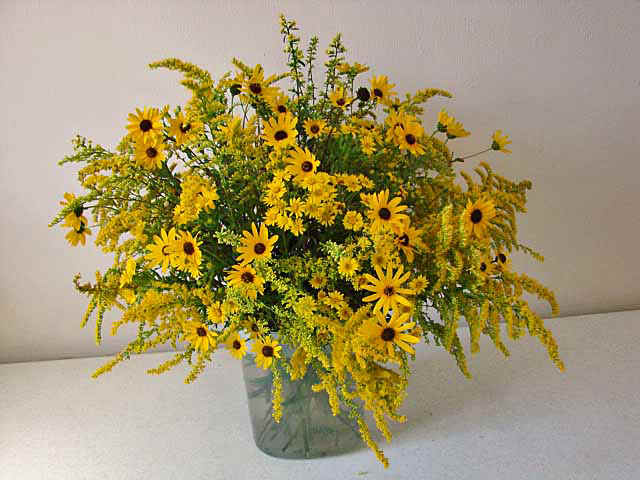
Goldenrod (Solidago sp, probably canadensis)

Dear Readers, I’d been noticing this member of the daisy family growing in swathes alongside the railway line from Dorset to Waterloo, and was interested to come across it again in Trent Park in North London. Then, I saw some in the US during my recent visit to Monterey Bay. Goldenrods are largely native to North America, and are a family of some 120 species which look remarkably similar to one another, and may sometimes hybridise. In the UK, Canadian goldenrod (Solidago canadensis) is a popular garden plant and I would guess makes up a large part of the wild population here, though there is a native goldenrod too (Solidago virgaurea).

Goldenrod in the UK is largely a plant of wasteland and railway embankments, thriving on the bright sunlight and shallow soil. It is extremely popular with pollinators, who seem to love the racemes of tiny yellow flowers. The nectar produces a clear and spicy honey when not mixed with nectar from other plants.

Photo One by By Ivar Leidus - Own work, CC BY-SA 4.0, https://commons.wikimedia.org/w/index.php?curid=43154662

Cryptic Bumblebee (Bombus cryptarum) on European goldenrod (Solidago virgaurea) (Photo One)

Goldenrod is sometimes blamed for causing hayfever, but this is more likely to be the result of ingesting the pollen of ragweed (Ambrosia sp.) which blooms at the same time in late summer. Goldenrod pollen is heavy and sticky, and the plant is largely pollinated by insects: ragweed is wind-pollinated, so the pollen is light. However, handling the plant can cause skin irritation, and a 1998 report  suggested that goldenrod (along with chrysanthemums and other members of the daisy family) caused such severe dermatological reactions that florists handling the plants on a daily basis were forced to change careers.

Photo Two from http://www.backyardnature.net/simple/bouquets/020.jpg

Goldenrod and asters (Photo Two)

The leaves of goldenrod were once seen as a possible source of rubber by none other than scientist and inventor Thomas Edison. The idea was taken up by Henry Ford, and the tyres on the the Model T Ford that were given to Edison were made from goldenrod. Ford was concerned about the need to continue with rubber production during the Second World War, when many sources of the substance were cut off, and it seemed that goldenrod might produce a viable substitute, as the leaves contain approximately 7% rubber. However, the material produced was tacky, with low tensile strength, and so the experiment was abandoned.

Goldenrod does, however, have a distinguished history as a medicinal plant, particularly with regard to the treatment of kidney and urinary problems.

American goldenrod at Zmudowski State Beach

The young leaves and seeds of goldenrod have been used by Native American peoples as food, and a tea can also be made from the leaves or flowers (after the Boston Tea Party the plant was used to make ‘Liberty Tea’ to replace the tea that could no longer be obtained).

I was led slightly up the garden path by a US recipe for ‘eggs a la goldenrod’. It was described as ‘eggs on toast with gravy’. Turns out the ‘gravy’ would be called a ‘white sauce’ here in the UK, with the word ‘gravy’ reserved for the brown meaty stuff that’s poured over your roast dinner. Also, the recipe contains not a jot of the plant goldenrod. Two nations divided by a common language, indeed.

Photo Three from https://www.sixsistersstuff.com/recipe/eggs-ala-goldenrod-recipe/

Eggs a la goldenrod (Photo Three)

Goldenrod can also produce a dye, and the site here shows the amazing range of colours that can be created just by adding different chemicals. Dyeing is such an interesting subject, and such an outlet for creativity. I shall have to give it a go one of these days…

Photo Four from http://fibre2fabric.blogspot.com/2007/09/dyeing-with-goldenrod.html

Different dye colours produced from goldenrod (Photo Four)

Goldenrod does not just produce food for pollinators, but is also much liked by flies and parasitic wasps, whose larvae create galls just below the buds to protect themselves while they grow. Alas, some fishermen in North America have caught on to this and extract the larvae from their fortifications to use them as bait. Some woodpeckers and other birds have also learned this trick, and can be seen tappity-tapping until they’ve made a hole and can claim their prize, a valuable source of protein during the winter months.

Black-capped chickadee getting to work on a goldenrod gall (Public Domain)

Goldenrod is the state flower of Kentucky, Nebraska and South Carolina, and used to be the state flower of Alabama until it was replaced with the camellia. For many North American schoolchildren, its flowering indicates the end of the holidays, and time to get back to school. In the UK I can remember how the ‘Back to School’ signs in the windows of our local Co-op department store used to make my stomach shrink into my shoes. I hope that children these days have a happier experience of their educational establishments.

More US goldenrod

A patch of goldenrod growing outside your door is supposed to be a sign of sudden good fortune. On the other hand, goldenrod is yet another of those plants that superstitious folk in the UK will not allow inside the house. It is a wonder that anything floral gets past the front door in some abodes. Maybe just a few leaves would be safer if you are going to a dinner party. Or forget the flowers altogether and bring copious quantities of wine.

And as winter approaches, I am much taken by this poem by Bliss William Carman (1861 – 1929), a poet from New Brunswick in Canada that I hadn’t come across before. See what you think.

The Ghost-Yard of the Goldenrod by Bliss William Carman

WHEN the first silent frost has trod
The ghost-yard of the goldenrod,
And laid the blight of his cold hand
Upon the warm autumnal land,
And all things wait the subtle change
That men call death, is it not strange
That I— without a care or need,
Who only am an idle weed —
Should wait unmoved, so frail, so bold,
The coming of the final cold!

Photo Five by By Jason Hollinger (Snowy GoldenrodUploaded by Amada44) [CC BY 2.0  (https://creativecommons.org/licenses/by/2.0)], via Wikimedia Commons

1850’s cabin in North Carolina with goldenrod (Photo Five)

Photo CreditsPhoto One by By Ivar Leidus – Own work, CC BY-SA 4.0, https://commons.wikimedia.org/w/index.php?curid=43154662

Photo Two from http://www.backyardnature.net/simple/bouquets/020.jpg

Photo Three from https://www.sixsistersstuff.com/recipe/eggs-ala-goldenrod-recipe/

Photo Four from http://fibre2fabric.blogspot.com/2007/09/dyeing-with-goldenrod.html

Photo Five by By Jason Hollinger (Snowy GoldenrodUploaded by Amada44) [CC BY 2.0 (https://creativecommons.org/licenses/by/2.0)], via Wikimedia Commons


Bugwoman on Location – Monterey Bay

Dear Readers, I was due to travel on the 3rd of September, and on the 2nd September I was still not sure if I was going. Mum was in hospital, and Dad had had the paramedics out again for a chest infection. But suddenly everything seemed to settle down. Did I dare take a whole week out from the drama at home? I certainly needed it. I wasn’t sleeping. I was crying at the slightest little thing. I had broken out in a hideous rash. In short, I was on the verge of not being able to cope at all.

‘Go!’ said my brother. ‘I’ll handle things here’.

And so I went to the other side of the planet, to Monterey Bay in California, for a Naturetrek tour. I arrived in a flurry, my head still full of carer timetables and hospital visiting times and contingency plans. And then, I was out on the water, looking towards a grey horizon on a sea that was so calm that it felt as if the boat was bobbing about on liquid metal. The sea fret clouded my glasses and frizzed my hair, and the fog numbed the sound of the engine.

It can look so lifeless, the sea. But Monterey Bay is a cetacean hotspot, where cold upwellings from deep undersea trenches provide a feast of krill for the largest animals on earth, and all the smaller ones too. From that cold water comes the hottest blood in the ocean.

At first the sightings were fleeting. A long grey back broke the water, accompanied by a fountain of steam some thirty feet high. A blue whale, accompanied by her calf, was crossing the Monterey Bay superhighway. From our view in the boat she looked big, but the photograph below shows her true scale – blue whales grow to some 90 feet long here, though the longest ever recorded was 108 feet long.

Blue Whale swimming away from the boat (photo courtesy of Discovery Whale Watch and Slater Moore Photography)

Blue whales are remarkable animals, but because of their immense size they don’t go in for the acrobatics of their smaller relatives, the humpbacks, who measure a mere 50 feet long. There is a population of some 3000 humpbacks in the Monterey Bay area, and watching them made me wonder at their strength, their complexity and their sheer otherworldliness. Even after spending some twenty hours in their company in the course of a week I am still not quite sure if they were a dream, or if I actually saw them. Fortunately, there are photos.

It’s not uncommon to see a humpback ‘breaching’, or throwing itself out of the water. Scientists still don’t know why they expend the amount of energy required to heave that 30 ton body out of the water, but presumably it’s important. There has been speculation that it’s for communication (the noise of the splash carries for miles, and it’s been noted that when one whale breaches, another many miles away may do the same thing when the sound wave hits). Is it for exercise? Young whales seem to do more breaching, but maybe that’s just because they can. Or is it for sheer exuberance?

Incidentally, the angle of the photo below makes the whale look much closer to the boat than s/he actually was. The company that we used for the trips, Discovery Whale Watch  was very respectful of the rules around whalewatching in the area: whales were always given plenty of room, approached from the side rather than from behind, and the engine was cut when we were around the animals. In all the cases that I observed the whales carried on doing exactly what they were doing before we arrived.

Humpback breaching (Photo by Peter Dunn)

We also saw the extraordinary sight of a mother and calf breaching at the same time – was the mother teaching the youngster how to do it?

Mother and calf humpback breaching (Photo by Peter Dunn)

Generally, when humpbacks breach they land on the back of their heads, which are bony, rather than doing a belly flop. Look at the length of those pectoral fins! When people first found the bones of humpback whales in the Americas, they took one look at those huge ‘hands’ and thought they must be looking at the skeletons of giant angels.

Another humpback breaching (Photo by Peter Dunn)

Humpbacks often feed communally on the huge shoals of anchovy that gather in the Bay to feed on the krill. We watched them blowing a circle of bubbles to make sure that the fish were pushed into a tight ball, before opening their mouths en masse and swallowing swimming pool-sized gulps of fishy water. I’ve watched scenes like this on Blue Planet, but never dreamed that I’d have a chance to see it in real life.

It’s hard to capture the excitement of seeing so many whales together. It felt such a privilege, as animal encounters always do to me. It is so easy to for me to become embroiled in my particular challenges and dramas, but seeing something like this wipes the mind clean until all that is left is a sense of wonder.

Humpbacks lunge feeding (Photo by Peter Dunn)

As the whales fed they were joined by sealions and pelicans, shearwaters and terns, until the whole sea was boiling. The biologist onboard pointed out that if the sealions started jumping, the whales were often going to surface right beneath them, and so it proved. Sometimes the whales seemed to get irritated with all the other creatures and made a trumpeting sound that reminded me of a baby elephant. It must be crowded under the surface with  all those other animals trying to muscle in.

And how quickly the whales gobbled up the anchovies! Sometimes, all that remained were a few sad silvery scales bobbing  beneath the boat. The feeding frenzy also gave us humans the dubious pleasure of smelling ‘whale breath’, which resembles a combination of flatulence and halitosis. I guess that if you live on a diet of krill you must need powerful stomach bacteria to deal with it all.

Sealions feeding above Humpback whales (Photo by Peter Dunn)

And as if this wasn’t enough, on several occasions we were joined by a superpod of several hundred Common Dolphin. They love to ride the bows of the boat, and the hashtag bites on their backs are a token of how determined each one is to claim the front spot.

Common dolphins riding the bow of the boat (Photo by Peter Dunn)

There are lots of explanations for why dolphins jump, too. Is it a dominance display, or a way of communicating? Probably both, but to me it also looks like a whole lot of fun.

Common dolphin jumping (Photo by Peter Dunn)

And when I got back to the land (which seemed to heave slightly under my feet) and gazed out to sea, I was left with a sense of profound mystery. In some ways whales are so similar to us (they are mammals after all), but when I think about their lives underwater, their songs, their epic migrations and their bonds with one another that might be maintained over many years and over hundreds of miles, I am astounded. To think that we share the planet with such creatures fills me with awe, and gratitude, and humility.

Humpback pectoral (Photo by Peter Dunn)

The majority of the photographs this week were taken by one of our guides on the trip, Peter Dunn. It was wonderful to be able to just watch and appreciate these remarkable animals without having to worry about whether I was getting the perfect shot. Sometimes, the camera comes between me and what I’m looking at, but this time I could relax into the experience. Thanks, Peter!

The photo of the blue whale with our boat was taken by Slater Moore, using a drone. In case you are worried about this causing disturbance to the wildlife, I should point out that it was used for less than ten minutes during a four hour cruise, and at no point was it flown close to birds or smaller sea mammals who might have been disturbed by the noise. Have a look at Slater’s website for some other remarkable photographs.