The Liminal Frog

IMG_1588

Common Frogs (Rana temporaria) in amplexus

Frogs are mysterious creatures, neither land-living nor water-dwelling, but a bit of each. For a long time we didn’t know exactly what they were. In 1694, in France, it was described as ‘an insect that commonly lives in marshes’. Until the late nineteenth century, they were classified as reptiles, and it was only fairly recently that they were grouped as amphibians – animals which need water in which to breed, but which may live on dry land for the rest of the time. Frogs are certainly associated with damp conditions, which they need to prevent their skins from drying out, but they can be found quite a distance from water once the breeding season is over.

All through the winter, the male frogs have been hibernating, either in piles of deadwood, or under my wooden raised path, or in the sediment at the bottom of the pond. Then, one morning, I’ll look out of my bedroom window to see a cat sitting next to the water, taut with attention, and I’ll know that spring is coming, and the first frogs have woken up.

IMG_1210The male frogs emerge first, and wait around for the females to show. These are more likely to hibernate outside the pond – very sensibly because, as we’ll see, once they’re in the water they’ll be extremely popular.

The male frogs develop special bulges on their thumbs called ‘nuptial pads’. These help to hang onto the female during mating, and seem to have some kind of modified mucous gland inside, although there is no evidence that I’m aware of that they actually ‘stick’ to the females. No, grabbing and hanging on to a female (called ‘amplexus’) seems to be down to brute force and perseverance.


A splendid illustration of a nuptial pad, courtesy of Christian Fischer [CC BY-SA 3.0 (http://creativecommons.org/licenses/by-sa/3.0)], via Wikimedia Commons

A splendid illustration of a nuptial pad on an Edible Frog (Pelophylax esculentus), courtesy of Christian Fischer [CC BY-SA 3.0 (http://creativecommons.org/licenses/by-sa/3.0)], via Wikimedia Commons

The male frogs sing to attract a female, and on a warmish spring night I can hear the little calls while I’m washing up. Once a female has arrived, it’s every frog for himself. Usually, a relaxed relationship seems to develop. The female carries the male everywhere, and gets on with her day to day business. She is often full of spawn, but it might take her weeks to decide where, and when, to lay her eggs. As soon as she does so, the male frog releases his sperm, and the spawn is fertilised.

Two relaxed frogs waiting for a happy event.

Two relaxed frogs waiting for a happy event.Note how plump the female is! Hopefully it will be any day now.

Sometimes, however, things go wrong.

Oh dear.

Oh dear.

This froggy sandwich has been going on for several days, and none of the participants seem very happy. Look at that tangle of limbs! My heart goes out to the frog in the middle.  I have rarely seen so much pushing and shoving outside of a Northern Line tube train at rush hour. Frog hands are shoved under frog chins, legs kick and the whole group goes round and round in circles. I managed to capture one such attempt at resolving the situation. If you turn your sound up, you will even hear them singing.

There is much about frogs which is decidedly human in appearance. Their long, muscular legs and elegant fingers have something of the supermodel about them, whilst their big eyes and down-turned mouths always look a little disappointed to me, as if life has not turned out at all as they expected. And for many frogs, dissected in school labs, used in experiments or thrown, legless into a bucket after their limbs have been harvested for cuisses de grenouille, this would be a reasonable conclusion to come to. But for millions of other frogs, living out their lives in the relative peace of back gardens, lakes and ponds across the country, spring is a glad season, full of sex and excitement. It’s followed by a chance to retreat back into the undergrowth and do nothing more strenuous than munch on slugs and flies for the rest of the year. Happy is the garden with resident frogs, chilly-skinned, golden-eyed, and unchanged for 200 million years.

By Bernie (Own work) [CC BY-SA 3.0 (http://creativecommons.org/licenses/by-sa/3.0) or GFDL (http://www.gnu.org/copyleft/fdl.html)], via Wikimedia Commons

By Bernie (Own work) [CC BY-SA 3.0 (http://creativecommons.org/licenses/by-sa/3.0) or GFDL (http://www.gnu.org/copyleft/fdl.html)], via Wikimedia Commons

Much of today’s information came from ‘Frog’ by Charlotte Sleigh, one of the wonderful Reaktion series on the cultural history of different species. Highly recommended!

Wednesday Weed – Teasel

Every Wednesday, I hope to find a new ‘weed’ to investigate. My only criterion will be that I will not have deliberately planted the subject of our inquiry. Who knows what we will find…..

Teasel (Dipsacus fullonum)

Teasel (Dipsacus fullonum)

On a grey, damp day at the end of February, I went with my friend Ann to see what weeds I could find in St Pancras and Islington Cemetery. A stream runs along the far north-eastern edge of the area and there, silhouetted against the sky, we found the unmistakable seedheads of the Teasel.

IMG_1369Teasel, for all its grass-like appearance, is in fact a member of the Scabious family, and like scabious, it has a lot of wildlife value – I have seen whole families of goldfinches dangling from the stems and pulling out the seeds, and in summer, the flowers are loved by bees and other pollinators.

Blue Tits on Teasel by Archibald Thorburn

Blue Tits on Teasel by Archibald Thorburn

Hoverfly on Teasel flower by Rawdonfox via Flickr (https://www.flickr.com/photos/34739556@N04/14773481592/)

Hoverfly on Teasel flower by Rawdonfox via Flickr (https://www.flickr.com/photos/34739556@N04/14773481592/)

The Teasel flower itself is remarkable. In July, a band of flowers opens around the middle of the head, as below:

Teasel flower at beginning of flowering period (By D. Gordon E. Robertson (Own work) [CC BY-SA 3.0 (http://creativecommons.org/licenses/by-sa/3.0) or GFDL (http://www.gnu.org/copyleft/fdl.html)], via Wikimedia Commons)

Teasel flower at beginning of flowering period (By D. Gordon E. Robertson (Own work) [CC BY-SA 3.0 (http://creativecommons.org/licenses/by-sa/3.0) or GFDL (http://www.gnu.org/copyleft/fdl.html)], via Wikimedia Commons)

Then, gradually, the band separates into two ‘stripes’, one moving up the seed head, the other moving down.

The band of flowers has now separated into two bands ( © Copyright Gerald England and licensed for reuse under this Creative Commons Licence )

The band of flowers has now separated into two bands ( © Copyright Gerald England and licensed for reuse under this Creative Commons Licence)

For some truly beautiful close-ups of the Teasel, have a look at the photos by Brian Johnston here.

A close relative of ‘our’ teasel, Fuller’s Teasel (Dipsacus sativum) was extensively used in the  textile industry. The plant was used to ‘raise the nap’ on woollen fabric, particularly for such delicate jobs as treating the green baize covering on billiard tables (and indeed they are still used for this purpose, having proved to be the most efficacious way of performing this task). For anyone who would like to know more about the process, and about the history of baize, I can heartily recommend the Pegs and Tails website, which is full of arcane and interesting facts and photos.  The seed heads were attached to a machine such as the Teasel Gig below, from the Somerset Levels.

Teasel Gig from the Somerset Levels ( © Copyright Noel Jenkins and licensed for reuse under this Creative Commons Licence)

Teasel Gig from the Somerset Levels ( © Copyright Noel Jenkins and licensed for reuse under this Creative Commons Licence)

Dried teasel head ("Teasel" by Loggie-log (aka Loggie) - Own work. )

A single dried teasel head (“Teasel” by Loggie-log (aka Loggie) – Own work. )

By the twentieth century, the Teasel gigs had been largely replaced by metal combs. However, many weavers still swear by the Teasel heads – they don’t tear the cloth as metal items sometimes do, and are, of course, cheaper to grow or to harvest. And the Wild Teasel that I saw in the cemetery has also had its part to play – though the spines are weaker than those of Fuller’s teasel, they have still been used for gently carding wool, a process that ‘teases’ out the separate threads for spinning.

Fuller’s teasel was taken to Virginia in the USA by the early settlers for their woollen industry, although there it has proved to be something of a thug. It can grow surprisingly tall given half a chance.

Deer up to her ears in teasel (Hagerty Ryan, U.S. Fish and Wildlife Service)

Deer up to her ears in teasel (Hagerty Ryan, U.S. Fish and Wildlife Service)

In a winter garden, or in floristry, Teasels also have a kind of sculptural majesty, especially in autumn, where the low sunlight shows them to their best advantage.

Photo by William Radke, U.S. Fish and Wildlife Service (Public domain)

Photo by William Radke, U.S. Fish and Wildlife Service (Public domain)

One very interesting feature of the teasel is that when young, the leaves of the plant form a kind of continuous cup, which holds water when it rains. This prevents insects from climbing up the stem, and drowns a good number of those who try. There is some evidence that the insects that are thus left rotting are absorbed by the plant, in a form of partial carnivory – plants that have such ‘food’ seem to have a larger seedset than those who don’t.

Water storage at the base of the teasel plant ("Dipsacus-fullonum-water-storage". Licensed under CC BY-SA 3.0 via Wikimedia Commons

Water storage at the base of the teasel plant (“Dipsacus-fullonum-water-storage”. Licensed under CC BY-SA 3.0 via Wikimedia Commons

It’s also interesting that this is the very water that is said to have rejuvenating powers: it has also been used to remove freckles, and as an eye bath for those suffering from hay fever.

IMG_1370The structure of the Teasel seed head fascinates me. It looks a little like a small hedgehog, or some kind of many-spiked sea creature. It doesn’t surprise me at all that there is an Irish belief that a teasel head left on a grave will distract the Banshees, who will use it as a hairbrush. It is one of those plants which look almost otherworldly, a spiky character full of strange secrets and a most particular beauty.

By Radio Tonreg from Vienna, Austria (Dipsacus fullonum  Uploaded by Jacopo Werther) [CC BY 2.0 (http://creativecommons.org/licenses/by/2.0)], via Wikimedia Commons

By Radio Tonreg from Vienna, Austria (Dipsacus fullonum Uploaded by Jacopo Werther) [CC BY 2.0 (http://creativecommons.org/licenses/by/2.0)], via Wikimedia Commons


A Web of Sound

IMG_1537Dear readers, when I walk into Coldfall Wood my head is often full of ‘stuff’. What to cook for dinner? How I should deal with an awkward work situation? How to project manage my parents’ accessible bathroom, where work starts next week? Some days, I think I could walk past a dragon without noticing.

Coldfall Wood Dragon Tree

Coldfall Wood Dragon Tree

But on Thursday, when I got to the coppiced area of the wood, I finally woke up and noticed that there was something new. The whole area was bursting with song.

IMG_1548

The wood was a-thrum with bird-music. If I listened carefully, I could pick out not only the robins and the wrens, singing enthusiastically from the hedges,  but the churring call of blue tits, and the ‘teecher, teecher’ call of the great tit. Parakeets flew through at speed, cackling. A magpie was racketing like a machine gun, and a green woodpecker flew past, laughing. The longer I listened, the more I could hear. It was like gently relaxing into a warm, deep bath of sound.

Having enjoyed the ebb and flow of birdsong for half an hour, I wanted to capture something of this experience for you.In the little video below, you can see one robin, but also hear another and a wren in the background.

The wrens, however, were impossible for me to film. They would pop up onto a dead tree stump for twenty seconds and then disappear, only to pop up somewhere else. The photograph below is the best that I could manage, and that after almost an hour of listening, watching and, occasionally, swearing.

IMG_1540

Yes, there is a wren here somewhere

But for your delectation, here are some much nicer pictures by my photographer friend John Humble.

Wren (copyright John Humble)

Wren (copyright John Humble)

Wren (copyright John Humble)

Wren (copyright John Humble)

I love the way that song seems to explode out of the throat of the wren. If he were an opera-singer, he would be hoarse in no time. There are over eight million pairs of wrens in the UK, making them our commonest breeding bird by far and yet, apart from these brief weeks of boldness they seem to exist on the periphery of our vision, disappearing as soon we become aware of a movement.  When not singing, the male makes several ‘cock’s nests’, ‘starter homes’ which are built to impress the females. If a female likes his work, she will mate with him and finish off the nest to her own exacting standards. In this way, the male may be able to have several females within his territory, all looking after his offspring. With so much to gain, it’s no wonder that he’s such an energetic singer.

As I walked on through the wood, I could feel that the pulse of life here had quickened. Two parakeets were mating on a tree branch. The woodpeckers were at it as well. Everything seemed to be in a hurry. There is evidence that more experienced birds of many species mate and breed early in the year – they often already have a partner and a nest site. If the season is bad and their first brood fails, they have time for another. In a very good year, they’ll maybe breed twice. Certainly, considering that it’s only just the beginning of March no-one is hanging around here. Every little feathery body seems to be trembling with lust.

Robin (copyright John Humble)

Robin (copyright John Humble)

I got to the stream at the middle of the wood, sat down on a damp log, and decided to just record the scene. There are robins and a wren singing in the background, plus the constant roar of the North Circular road and a squirrel nearly falling out of the tree at about ten seconds in. Never let it be said that you don’t get drama on Bugwoman’s Adventures in London.

I so enjoyed my time in the woods that, just before sunset, I popped back to see what else I could find. I walked up by the stream again, to find this robin still staking his territorial claim. I cannot imagine how many calories he must have to eat to keep up this performance from dawn till dusk, and sometimes even beyond it – a bird singing at night in the city is almost certainly a robin.

But what surprised me most, on this return visit, was the behaviour of the crows. Normally they are the most chatty of birds, cawing at one another constantly, as if commenting on everything that happens. But this evening, they were wheeling over the allotments without a sound, as if in stealth mode. I have had a sense of ritual with them before, and here it was again.

I do a lot of research for my pieces here on Bugwoman – it’s very important to me not to misinform my readers. I adore books and appreciate the vast amount of work that goes into them. And yet, sometimes what I read in books doesn’t tally with what I see. Crows, for example, are not meant to be social creatures, and yet in Coldfall they gather in huge groups, and communicate with one another all the time, either by call or by body language or by some other signal. In the end, there is much to be said for not relying solely on received wisdom. The world is endlessly new and full of surprises. All we have to do is put down our ‘stuff’ and notice.


Wednesday Weed – Reflexed Stonecrop

Every Wednesday, I hope to find a new ‘weed’ to investigate. My only criterion will be that I will not have deliberately planted the subject of our inquiry. Who knows what we will find…..

Reflexed Stonecrop (Sedum rupestre)

Reflexed Stonecrop (Sedum rupestre/reflexum). There was some discussion over whether this plant was a subspecies of another one, hence the two names.

Dear Readers, I found this plant carpeting the graves in some of the more open, sunlit areas of  St Pancras and Islington Cemetery when I visited with my friend Ann a few weeks ago. It is always a surprise to find a succulent growing in the wild: with their water-storing leaves, I associate them more with climates where moisture is hard to come by, something that can hardly be said of the UK. However, the soil is very scanty on some of these burial places, and the addition of gravel or small slates has made the area even more free-draining.

IMG_1338In fact, this plant, also known as Large Rock Stonecrop, is an ‘alien’, although it has been here for almost four hundred years. It was originally introduced as a salad plant, but was recorded in the wild for the first time in 1666, and has been making itself at home ever since. There is something very toothsome about the leaves of Sedum plants – they remind me of tiny asparagus stalks. Maybe one day I will summon up the courage to try them as food.

IMG_1340The vigorous growth of this plant, coupled with its hardiness and resistance to drought, is one reason why it is a key component of many green roofs. These have become really popular during the past few years, and they have a lot of advantages – they help to insulate the rooms below, provide an additional habitat for invertebrates and other creatures, can help to absorb rainwater and reduce storm run-off, and can help to cool the air in urban areas through taking up water and releasing it by transpiration.

There are several different kinds of Green Roofs. Extensive roofs can support 10-25 pounds of vegetation per square foot, whilst intensive roofs can support up to 150 pounds. Sedum is the usual planting on extensive green roofs. These are often the roofs of choice – the substrate for planting is not so thick (typically just a few centimetres, and some roofs even have the Sedum planted directly into Rockwool), and therefore the requirement to  reinforce the roof to carry the extra weight is not so onerous. Furthermore, these roofs are practically maintenance free – someone just needs to climb up once a year to replace any ailing plants, and to pull out any perennial ‘weeds’ which are in danger of penetrating the waterproof layer beneath the soil with their roots.

The Sedum roof on the Atrium cafe in Clitheroe - note the dandelions making themselves at home!© Copyright John S Turner and licensed for reuse under this Creative Commons Licence.

The Sedum roof on the Atrium cafe in Clitheroe – note the dandelions making themselves at home!© Copyright John S Turner and licensed for reuse under this Creative Commons Licence.

By thingermejig (flickr.com) [CC BY-SA 2.0 (http://creativecommons.org/licenses/by-sa/2.0)], via Wikimedia Commons

A Sedum roof on top of a shop in Bisley Green, Gloucestershire, complete with Solar Panels. By thingermejig (flickr.com) [CC BY-SA 2.0 (http://creativecommons.org/licenses/by-sa/2.0)], via Wikimedia Commons

Now, I am all in favour of Green Roofs, and when I’m feeling particularly bossy (which is most of the time) I think that any new flat roofs in cities should be Green Roofs as a matter of course. In fact, the city of Toronto already mandates this for residential buildings over six storeys tall. Think of the difference all those Green Roofs could make on the 200 new skyscrapers that are planned for London! Fat chance of that, I suspect. But although I think that Sedum rupestre is a wonderful plant, I do think we could be more adventurous. Take a look at some of these:

The Green Roof on top of the War Museum in Ottawa, Canada. "Wheatfield in Ottawa" by cjuneau from Ottawa, CANADA - WheatfieldUploaded by Skeezix1000. Licensed under CC BY 2.0 via Wikimedia Commons

The Green Roof on top of the War Museum in Ottawa, Canada is made from native grasses. “Wheatfield in Ottawa” by cjuneau from Ottawa, CANADA – WheatfieldUploaded by Skeezix1000. Licensed under CC BY 2.0 via Wikimedia Commons

Green roof planted with native species at L'Historial de la Vendée, a new museum in western France

Green roof planted with native species at L’Historial de la Vendée, a new museum in western France

My absolute favourite - the Treasury Building in Athens, Greece. A magnet for pollinators and birds. "The Treasury - Syntagma" by Andrew Michael Clements - Oikosteges Archive. Licensed under CC BY 3.0 via Wikimedia Commons

My absolute favourite – the Treasury Building in Athens, Greece. A magnet for pollinators and birds. “The Treasury – Syntagma” by Andrew Michael Clements – Oikosteges Archive. Licensed under CC BY 3.0 via Wikimedia Commons

Of course, nothing is new under the sun. Sod roofs have been used in cold climates for hundreds, if not thousands of years, and very fine they are too.

Sod roof in Ljungris, Sweden. "Ljungris July 2013" by Arild Vågen - Own work. Licensed under CC BY-SA 3.0 via Wikimedia Commons

Sod roof in Ljungris, Sweden. “Ljungris July 2013” by Arild Vågen – Own work. Licensed under CC BY-SA 3.0 via Wikimedia Commons

On their own, Sedum roofs tend to be much less biodiverse than roofs that include a greater mixture of substrates and plants (a study was done by G.Kadas in 2006 on just this question). But even these relatively cheap and easy-to-install roofs can have their attractiveness to wildlife increased by seeding them with appropriate (i.e. local) grasses and herbs. There is a wonderful free publication by BugLIfe here . One day, when I’ve saved up my pennies, I’m going to put a green roof onto my garden shed. Here in the city, we need to maximise every corner’s potential as useful habitat for the creatures around us. After all, we’ve stolen most of the space they need. It wouldn’t hurt us to give something back.

Well, after that digression, let’s get back to our patient little Sedum.

By Teun Spaans (Own work) [GFDL (http://www.gnu.org/copyleft/fdl.html), CC-BY-SA-3.0 (http://creativecommons.org/licenses/by-sa/3.0/) or CC BY 2.5 (http://creativecommons.org/licenses/by/2.5)], via Wikimedia Commons

Sedum rupestre in flower. By Teun Spaans (Own work) [GFDL (http://www.gnu.org/copyleft/fdl.html), CC-BY-SA-3.0 (http://creativecommons.org/licenses/by-sa/3.0/) or CC BY 2.5 (http://creativecommons.org/licenses/by/2.5)], via Wikimedia Commons

How do you know if you’re looking at Reflexed Stonecrop? Well, the leaves have a habit of turning backwards, hence one of the plant’s Latin names, Sedum reflexum.

Reflexed Stonecrop from the Flora Batava

Reflexed Stonecrop from the Flora Batava

Here, the flowers are shown with six petals, but according to my Wild Flower key, they sometimes have seven. It seems that the Sedum hasn’t read the book, and this is often the way with plants – just when you think you’ve worked out what species they are, and are ready to whack a label on them, they throw you a curve ball. And don’t get me started on hybrids.

On the Seedaholic website, the author mentions that another name for Sedum reflexum is ‘Love Links’. The author speculates that, because the plant contains phytoestrogens which reduce testosterone, it could have been used to reduce male aggressiveness, and to encourage marital harmony. Maybe a stonecrop could be sent to some of the more bellicose of our world leaders to see if it did the trick with them too?

Finally, there is a long-standing belief that if a Stonecrop which is being kept as a houseplant dies, this is a sign of impending domestic trouble. And I can well believe it. If things have got to so bad that this hardy, tolerant, undemanding little plant has been killed off, the household must indeed be in a sorry state.

Resources this week include ‘Nature in Towns and Cities’ by David Goode in the New Naturalist series. I cannot recommend this book highly enough. It’s certainly worth getting a copy from your local library (if you are lucky enough to still have such a thing).


Foxycology

All of the fox photos this week are copyrighted by John Humble – many thanks to John for being my guest photographer. What great photographs they are!

_DSC1466_DxO_1280x800

Yesterday, at 7 a.m., my husband called me downstairs.

“There’s a fox under the bird table!”, he whispered. And there she was, delicately picking through the suet pellets for something edible. Something in my heart softened. A healthy fox is such a glorious animal, copper and frost, taut as a spring and yet confident. In an urban environment, a fox feels like a magical gift, one that can lift my spirits for a whole day. However often I see them, they are always a small glimpse of the wild world, and a reminder that not so long ago this area was not a suburb, but one of the most unruly areas of common ground in all of London: Finchley Common, home of Highwaymen and criss-crossed with fox tracks.

Later in the morning, as I went out to the shed to get some more bird food, there was a scuffle and the fox bolted out from her hiding place and away over the fence. As I peered into her refuge, I could see where she’d curled up under the ivy, snug and hidden amongst the foliage.

Last week I went to Foxycology, a London event organised by the League Against Cruel Sports. They are aiming to contest some of the many untruths that have grown up around foxes, especially at a time when there is a real threat that the Hunting Ban will be repealed. For those of you who aren’t familiar with the arcane ways of country sports, it is currently illegal in the UK to hunt foxes with dogs – instead, hunts have to follow a trail of scent that is laid in advance (drag-hunting). However, if the hounds pick up the scent of a fox and kill it, well, it’s difficult to prevent (apparently). The Hunting Act also permits up to two dogs to flush a fox towards someone who will shoot it.  And even this small measure of protection is now under threat. If the Conservatives are elected in May, they have promised to reinstate the old situation, where, as Oscar Wilde put it, the Unspeakable are in pursuit of the Uneatable.

In towns, there have been a number of horror stories in the press, in which foxes have have been demonised. There was the case in Hackney where a fox apparently entered a basement flat on a warm evening and bit two sleeping babies. There was a case in The Sun where a woman apparently had her finger bitten off by a fox. This was rather contradicted by a two-page spread with a photo of the ‘maimed’ woman holding up her hands which appeared to have a full complement of fingers. Furthermore, she had grabbed the fox, who had wandered into her house, and that was when she was bitten. To be honest, I would expect the same outcome (and worse) if I picked up a frightened feral cat.

So, what is the truth about foxes, as revealed at Foxycology?

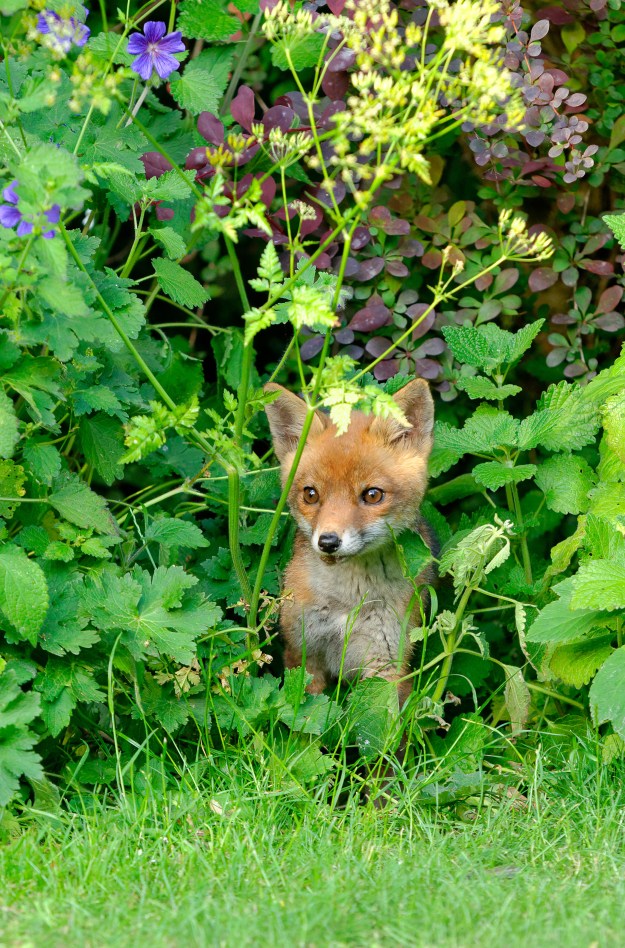
First of all, the papers will tell us that fox numbers are increasing, both in the town and in the country. In fact, there are approximately 225,000 rural foxes, and about 33,000 urban ones. These numbers have held steady since 2001, although urban foxes have increased their range and are now seen in more cities. Furthermore, in urban areas some foxes are becoming bolder, which gives an impression of an increased population.
Fox cub HR

The second untruth is that foxes are responsible for a high proportion of lamb and chicken losses in rural areas. Defra’s own figures show that 95% of lamb losses are due to husbandry issues, and that less than 1% of lamb deaths are due to fox predation. Often, foxes are seen scavenging lamb carcasses and are then blamed for the deaths. In the case of chickens, the estimate is that foxes are responsible for less than 2% of deaths where the poultry are kept indoors at night. Furthermore, whilst foxes, like most predators, will kill more than they can immediately eat if they manage to get into a hen house, given a chance they will cache the food to eat later. The predation of farm animals by foxes is also offset by the number of rabbits that they kill, which benefits arable farmers to the tune of about £200 a year (£900 over the fox’s lifetime).

Fox and flowers hr_DxO

The third untruth is that culling foxes is effective. In both rural and urban areas, a fox territory which is left vacant will be occupied in less than four days. This is so often the case – it applies equally to the culling of magpies, crows and many other predators. Furthermore, the animals that move into the vacant territories are likely to be young, inexperienced animals which will look for the easiest possible food source because they don’t have the skills to catch wild prey. This means that they are more likely to look to domestic animals as a source of food.

Of course, I was particularly interested in city foxes. The speaker was Dr Dawn Scott, who has been studying the behaviour of urban foxes. In Brighton, a number of animals were radio-collared, so that they could be tracked during their nightly excursions. The maps were like  abstract paintings, with lines showing where the animals had been. On an average night, an urban fox will travel about 3.5 km, but in the Brighton study, they seemed to spend a lot of time in two particular gardens. This was where the foxes were fed.

Fox knocking_1280x800

Feeding foxes is an area fraught with controversy. The message from Foxycology was, in general, not to feed, and certainly not to feed too much – some houses were leaving out two whole shopping bags full of scraps every night, and the foxes were becoming obese. But there are always exceptions. The fox that is injured, the fox that has mange (there are medications that can be administered through food), the fox that is already tame, these may all require a different approach. It is so hard, sometimes, knowing what is best for a wild animal, especially one which appears vulnerable. But there are various organisations, such as The Fox Project (details at the bottom of the article) who are able to help and advise. The Fox Project takes a humane approach to fox deterrence too, and has proven to be more effective in helping with ‘problem foxes’ than the use of terriers and poison.

Foxes 2_edited-1_1280x800

I am intrigued by my visiting fox. Is she a pregnant female, I wonder? Most of us are familiar with the shrieks and general carry-on in the winter as foxes mate and pair up, and I knew that male foxes keep company with vixens for a few weeks during the breeding season. What I didn’t know was that the males will often help to provide food for the cubs, and also that the cubs from the previous year may stay with their mother and also help to raise the next generation.

The talk that intrigued me the most at Foxycology, though, wasn’t by a scientist, interesting as they were. It was by Patrick Barkham, author of The Butterfly Isles and, more recently, Badgerlands. He showed us some slides of foxes in myth and legend – the cunning fox of Aesop and La Fontaine, the ‘Foxy Lady’ of Jimi Hendrix, and asked this question: how much do we really know about the fox, as an animal, and how much of what we know is all about the projection of our own needs and desires? For me, this is a constant battle. I can admire the idea of the fox or the coyote as a trickster, and acknowledge that both animals are adaptable, intelligent and opportunistic. But when does the stereotyping of an animal reflect more about us than about the animal itself? Can an animal really be ‘cunning’ for example (the word that I suspect is most often used in conjunction with the word ‘fox’)?. In Barkham’s talk he was, I think, asking us to take a step back and think about having a relationship with the real animal, rather than turning it mentally into a little person in a rust-coloured furry suit. And that is the real challenge. How can we empathise with an animal and still recognise that it has different needs from our own?

Fox cub 2_1280x800 The Fox Project website can be found here: it has lots of helpful information about what to do if you are worried about a fox, or if you want to discourage one humanely.

For more information about Dr Dawn Scott’s Fox Project in Brighton, there is a BBC article here.

And to find out more about the work of the League Against Cruel Sports, have a look here.


Wednesday Weed – Winter Heliotrope

Every Wednesday, I hope to find a new ‘weed’ to investigate. My only criterion will be that I will not have deliberately planted the subject of our inquiry. Who knows what we will find…..

Leaves of Winter Heliotrope (Petasites fragrans)

Leaves of Winter Heliotrope (Petasites fragrans)

When I was in Islington and St Pancras cemetery last week, I was very excited to see an enormous patch of these leaves, poking out from under a Cherry Laurel. I had never seen leaves shaped like this before, so it was completely new to me. But a little research (and some help from my friends) convinced me that this plant is Winter Heliotrope (Petasites fragrans), a locally abundant perennial of the Daisy family, closely related to Butterbur. Those pretty leaves, which remind me of a deer’s footprint, are, according to Richard Mabey,  used in Truro market to wrap bunches of violets.

Winter Heliotrope in flower (By Ian Kirk from Broadstone, Dorset, UK [CC BY 2.0 (http://creativecommons.org/licenses/by/2.0)], via Wikimedia Commons)

Winter Heliotrope in flower (By Ian Kirk from Broadstone, Dorset, UK [CC BY 2.0 (http://creativecommons.org/licenses/by/2.0)], via Wikimedia Commons)

Winter Heliotrope flowers so early that I may have already missed the almond and vanilla scented- blooms. It was brought to the UK in 1806 from North Africa, and had already ‘escaped’ by 1835. It is described as ‘very invasive’, and my patch was looking very vigorous and hearty. However, it seems to me that context is all: here in the churchyard I can only imagine that when the plant flowers, its fragrance will provide a kind of solace to those lingering here before making their way down to the crematorium.

IMG_1348

Under its alternative Latin name, Tussilago fragrans, Winter Heliotrope has been used as a homeopathic remedy. The following is what is said to have happened when the tincture was ‘proved’:

“Demesnes proved *Tus. fg. taking three drops of the O tincture on the tongue. After first causing a disagreeable, spiteful mood, it set up, in a few days, an opposite condition, which lasted some time. A journey taken on the ninth day of the proving, which usually caused loss of weight, did not do so. Stoutness increased, and plethora was added, later the abdominal protuberance permanently disappeared. A *Peculiar Sensation induced was as if a morsel of food lay at the bottom of the cardia and would not pass.” (from the Dictionary of Practical Materia Medica by by John Henry Clarke).

As I am sadly ignorant about homeopathy, I can only hazard a guess that Winter Heliotrope would be useful for someone who needed to be calmed down, or who needed to put on weight. However, I would be extremely happy if any of my readers who are homeopaths could put me right.

Winter Heliotrope (thanks to www. KlassimGarten.at)

Winter Heliotrope (thanks to www. KlassimGarten.at)

The name ‘Heliotrope’ literally means ‘to follow the sun’, and so you would expect this plant to be turning its face towards the sun, as many flowers do. However, our plant often barely sees the sun, being shade-loving and often tucked away almost out of sight. Furthermore, the colour heliotrope is a bright purple-pink, as seen in the true Heliotrope.

Heliotropium peruvianum. A heliotrope-coloured heliotrope.

Heliotropium peruvianum. A heliotrope-coloured heliotrope.

I can only imagine that maybe the scent of the Winter Heliotrope is reminiscent of that of the true Heliotrope, which goes under the alternate name of Cherry Pie Plant. Winter plants are often highly scented, because the cold air is less able to transport scent than the warmer breezes of summer, as anyone who has ever walked down a country lane in August, when the hedgerow is threaded with wild honeysuckle, can testify.

IMG_1347Winter Heliotrope is dioecious, which means that it has male and female plants (as do some of the other plants I’ve been investigating lately, such as Annual Mercury). Until very recently, only the male plant occurred in the UK, so it spread by rhizomes (modified underground stems) rather than by seed. This means that those pretty, scented flowers give up their pollen to grateful early bumblebees without any hope of benefiting from the transaction. As Winter Heliotrope often grows at roadsides, we can speculate that the activity of diggers and tractors and other machinery has served to distribute the plant along roadways.

However, according to a recent article by Ken Thompson in The Telegraph, the female Winter Heliotrope has now been spotted in West Sussex. As he puts it:

“The inability to produce seeds has hardly held back the male plant in the wild in Britain, where it is already in more than 2,000 hectads*. However, now free for the first time in 200 years to enjoy the delights of some female company, this Mediterranean native may manage to do even better in future.”

As it is a rare source of food for pollinators who emerge early in the year, this may well be something to be celebrated.

* A hectad is an area 10 km x 10 km square, and is often used to record the existence of plant and animal species.

Winter_heliotrope_(petasites_fragrans)_-_geograph.org.uk_-_657074

pam fray [CC BY-SA 2.0 (http://creativecommons.org/licenses/by-sa/2.0)], via Wikimedia Commons


The Lone Gull


Lone Herring Gull (Larus argentatus)

Lone Herring Gull (Larus argentatus) – this bird is in his or her third winter. By next year, s/he will have full adult plumage

When I went to Cherry Tree Wood on a cold, blustery day last week, I didn’t expect to see anything unusual.  The tits were quiet, the blackbirds scuttled in the undergrowth, and even the squirrels growled less than usual. But there, next to a muddy pond in the middle of the playing field was a single gull. This was a Herring Gull, the quintessential ‘seagull’ of seaside towns. He was a young ‘un, with a few pale grey feathers on the head and a general air of melancholy. Where were the other Herring Gulls? Had he popped in and got left behind, or did he want to be alone?

IMG_1397Herring Gulls are not unusual in Greater London, and indeed they seem to be making themselves at home all over the place, with breeding taking place in Billingsgate Market, Beckton and even at Paddington Station. But I have only to hear their call to be transported to the seaside, and indeed, at one point when we were living in our previous house we heard them so often that we nicknamed our borough ‘Islington-on-Sea’. For anyone who is unfamiliar with their half melancholy, half manic outpourings, I suggest a little listen to this courtesy of the Garden-birds.co.uk website.

Herring Gull in flight (By JalilArfaoui (Own work) [CC BY-SA 3.0 (http://creativecommons.org/licenses/by-sa/3.0) or GFDL (http://www.gnu.org/copyleft/fdl.html)], via Wikimedia Commons)

Herring Gull in flight (By JalilArfaoui (Own work) [CC BY-SA 3.0 (http://creativecommons.org/licenses/by-sa/3.0) or GFDL (http://www.gnu.org/copyleft/fdl.html)], via Wikimedia Commons)

I have had several encounters with gulls, and have come to the conclusion that they are much more complicated, intelligent birds than we normally assume. The first time that I really noticed one was when I was on holiday in Paignton in Devon. We were staying in a splendid Bed and Breakfast establishment, but I had a terrible cold,  and was laying in bed feeling sorry for myself. As I gazed out of the window I noticed that a Herring Gull on the roof of the house opposite was sliding down the tiles as if skiing down a slope. This was so unexpected that it distracted me for a moment. I levered myself up so that I could have a better look. The gull had arrived at the gutter, and had a little look around. Then, he fluttered back up to the top and slid down again. I was astonished. By the time the bird did it for the fifth time, I had come to the conclusion that he or she was playing. Furthermore, I felt much better, and was able to get up and go downstairs for breakfast.

We think nothing of it when baby mammals play, but it isn’t often observed in birds. Crows and parrots, those geniuses of the bird world, are known to find things to amuse themselves with, not just when young but throughout their adult lives too. However, Herring Gulls have been observed dropping objects and trying to catch them in mid-air, especially when it was windy and the task was therefore more challenging. I wonder how many other birds enjoy playtime without us noticing?

Adult Herring Gull (By Scottmliddell (Own work) [CC BY 3.0 (http://creativecommons.org/licenses/by/3.0)], via Wikimedia Commons)

Adult Herring Gull (By Scottmliddell (Own work) [CC BY 3.0 (http://creativecommons.org/licenses/by/3.0)], via Wikimedia Commons)

We once stayed in a chalet in Lochinver in Scotland. When we arrived, we noticed a huge gull standing on the handrail of the front porch. Up close these are intimidating birds, with the pale eyes and intense stare of the monomaniac. He watched us unlock the front door, and unload the car. Eventually he flew off,  so we settled in and eventually went to bed, even though the sky was barely dark, what with it being midsummer.

And then, at 4 a.m., we were awoken by a tapping sound.

The gull was pecking at the glass door. At first it was a relatively gentle sound, but, as we continued to ignore our supplicant, it got louder and louder until we were  afraid that the panel would shatter. I got up and went to the kitchen. We had only arrived on the previous day, so the only food in the house was some welcome packets of shortbread biscuit. At the sight of me unwrapping them, the bird flapped energetically. I eased the door open and threw out a biscuit. The bird caught it deftly, broke it in two, ate one half and then the other, and then, sizing me up to see if there was any more, shuffled forward in that strangely mincing way that gulls have, wings half open, until I gave him the other biscuit and he flew off, granting us a few more hours sleep.

Naturally, he visited every morning for the rest of our trip, though he normally waited until about 7 a.m. Maybe he realised that he’d broken our will early on.

Seaside Herring Gull eating a starfish ( © Copyright Mike Pennington and licensed for reuse under this Creative Commons Licence.)

Seaside Herring Gull eating a starfish (© Copyright Mike Pennington and licensed for reuse under this Creative Commons Licence.)

Food is a great motivator for gulls, as ice-cream sellers at many a seaside town will attest. When we went to Greve de Lecq in northern Jersey, we were puzzled to see the vendors walking about with water pistols. And then we realised why. Half a dozen gulls were sitting on top of the spherical streetlights, surveying the scene. A family with a toddler bought an ice cream cone for their child. The little one was shuffling along, raising the cornet to his mouth when, seemingly out of nowhere, a gull flew down, arced over the child’s shoulder and snatched the ball of ice cream right out of the cone. It was a manoeuvre so beautifully timed and executed that I could only marvel at the bird’s skill, though I didn’t find it quite so funny when exactly the same thing happened to me the next day. The bird came so close that I felt its wingtip brush my hair. It seemed it would take more than a squirt from a water pistol to put these guys off.

Ambushed by Herring Gull in Ostende....("Birdsniper" by loki11 - own work -place Oostende ( Belgium). Licensed under Public Domain via Wikimedia Commons - http://commons.wikimedia.org/wiki/File:Birdsniper.jpg#mediaviewer/File:Birdsniper.jpg

Ambushed by Herring Gull in Ostende….(“Birdsniper” by loki11 – own work -place Oostende ( Belgium). )

Gulls always seem rather solemn birds, for all their penchant for mischief. Even when they are sliding down roofs or stealing icecream they seem to do it seriously, without the joie de vivre of crows or magpies.  And this is part of their charm. On a very, very wet day in St James’s Park, I stood with a dear friend of mine and watched a Herring Gull dancing on the wet grass. The bird’s legs were jigging and shimmying back and forth, sending up little splashes of water, but all the time his body and head were completely still. He looked like nothing so much as an ornithological version of Michael Flatley from Riverdance. Every so often, the gull would stop his merry contortions and reach down to pick up a worm. The bird looked so deep in thought, so philosophical, even as his legs were executing tricky figures of eight in the mud, that it was impossible not to laugh with delight. At this, the gull looked at me with what I could have sworn was contempt, and turned his back on me.

These spikes are meant to deter birds from perching. Someone should have told the Herring Gull....("Silbermöwe". Licensed under Public Domain via Wikimedia Commons - http://commons.wikimedia.org/wiki/File:Silberm%C3%B6we.jpg#mediaviewer/File:Silberm%C3%B6we.jpg)

These spikes are meant to deter birds from perching. Someone should have told the Herring Gull….(“Silbermöwe”. Licensed under Public Domain via Wikimedia Commons – http://commons.wikimedia.org/wiki/File:Silberm%C3%B6we.jpg#mediaviewer/File:Silberm%C3%B6we.jpg)

So, I am intrigued to see the lone Herring Gull in Cherry Tree Wood. Will he be there for long? Will he soon be heading off to find a mate? Is he, indeed, even a ‘he’? I will probably never know. One day, he will just be gone. But I have a great respect for these clever, bold, adaptable creatures, who seem to think that they’re every bit our equals. And who knows if they aren’t right?

IMG_1400

Wednesday Weed – Snowdrop

Every Wednesday, I hope to find a new ‘weed’ to investigate. My only criterion will be that I will not have deliberately planted the subject of our inquiry. Who knows what we will find…..

Snowdrops in St Pancras and Islington Cemetery (Galanthus nivalis)

Snowdrops in St Pancras and Islington Cemetery (Galanthus nivalis)

For me, the sight of the first snowdrops of spring is like a long drink of cold water after a hot, dusty walk. The dazzling white flowers and the fresh green-grey foliage seem fresh and toothsome, as delicious as the first asparagus.

IMG_1353This is especially true in a woodland setting, and in St Pancras and Islington Cemetery there are a number of unkempt, wild areas, where the graves have become overgrown with moss and lichen. Here, the Snowdrops have naturalised, creating a wash of white that glows in the dim spaces.

IMG_1359Some vernacular names for the Snowdrop include February Fairmaids, Candlemas Bells and, my own particular favourite, Snow Piercer. This last has a fine Saxon edge to it, as if the plant were a well-loved sword. And yet, there is much debate over whether it is a native plant or naturalised. The answer is probably that it is both. As Richard Mabey points out in Flora Britannica, it is native to Continental Europe, and grows wild in northern Brittany, so it may be that the colonies in the south-west of England are native, arriving while the UK was still part of the European mainland, while those elsewhere are the result of garden escapes, albeit from hundreds of years ago. The Snowdrop has long been associated with purity, and may have been deliberately planted in monastery gardens and churchyards.

St George's Churchyard, Near Damerham, Hampshire, UK ( © Copyright Miss Steel and licensed for reuse under this Creative Commons Licence.)

St George’s Churchyard, Near Damerham, Hampshire, UK ( © Copyright Miss Steel and licensed for reuse under this Creative Commons Licence.)

IMG_1354I have found Snowdrops extremely difficult to grow in my garden, and I have the feeling that they are not a hundred percent at home in our climate. They emerge too early for most pollinating insects, which makes sense if you consider that they probably come from an area with warmer winters and earlier springs. Because of this, they spread by division of the bulbs, rather than by seed. Many cultivated varieties are also sterile. Chelsea Physic Garden runs Snowdrop Days during February, to show off the sheer variety of cultivars: to read the Gentle Author’s account of a visit, and to see photos of some of them, have a look here.

IMG_1363The Latin name for the Snowdrop genus, Galanthus, means ‘milk-flower’, and the nivalis species name means ‘of the snow’. So, even if you had never seen a snowdrop you would have the definite impression that it was white. And such a white! But each flower also has exquisite green markings on the petals, and also inside the flower itself.

IMG_1355In Homer’s ‘The Odyssey’, a priestess, Circe, turns Odysseus’s crew into pigs. To protect against her enchantments, Odysseus is given the plant Moly by Hermes, and there is some agreement that Moly was, in fact, the Snowdrop. One theory is that the transformation of the crew was a metaphor for the euphoria and hallucinations induced by plants such as Deadly Nightshade and Datura. It just so happens that the Snowdrop contains a chemical called Galantamine, which can counteract the effects of these plants. I love the way that story and science mix here, as they so often do. In the painting below, Circe is offering Odysseus a nice refreshing drink, though the pig on her left-hand side is something of a warning. Just as well Odysseus has his Snowdrop to protect him.

Circe Offering the Cup to Odysseus, by John William Waterhouse. Note the tell-tale pig on the right hand side. Just as well Odysseus has his Snowdrops!

Circe Offering the Cup to Odysseus, by John William Waterhouse.

Snowdrops at Welford Park, Berkshire ("Welford Park Snowdrops 1" by Chris Wood (User:chris_j_wood). - Photograph by myself with original filename DCP_3674.JPG. Unmodified.. Licensed under CC BY-SA 3.0 via Wikimedia Commons - http://commons.wikimedia.org/wiki/File:Welford_Park_Snowdrops_1.jpg#mediaviewer/File:Welford_Park_Snowdrops_1.jpg)

Snowdrops at Welford Park, Berkshire (“Welford Park Snowdrops 1” by Chris Wood (User:chris_j_wood). – Photograph by myself with original filename DCP_3674.JPG. Unmodified.. Licensed under CC BY-SA 3.0 via Wikimedia Commons )

Because of their association with purity, the flowers were sometimes used in Victorian times to warn off over-passionate lovers – a few Snowdrops in an envelope might be enough to dampen a young man’s ardour. But Snowdrops have also been considered unlucky, and in some parts of the UK a single flower is still seen as a death-token, perhaps because, as Mabey explains, Victorians felt that the flower looks ‘for all the world like a corpse in its shroud’. But to me, the bloom looks more like a beautiful white and green moth, and, coming from Bugwoman, there is no higher praise.

"Snowdrop 'Viridi-Apice'" by Schnobby - Own work. Licensed under CC BY-SA 3.0 via Wikimedia Commons - http://commons.wikimedia.org/wiki/File:Snowdrop_%27Viridi-Apice%27.jpg#mediaviewer/File:Snowdrop_%27Viridi-Apice%27.jpg

“Snowdrop ‘Viridi-Apice'” by Schnobby – Own work. Licensed under CC BY-SA 3.0 via Wikimedia Commons – http://commons.wikimedia.org/wiki/File:Snowdrop_%27Viridi-Apice%27.jpg#mediaviewer/File:Snowdrop_%27Viridi-Apice%27.jpg


Bugwoman’s First Annual Report

IMG_1194Dear Readers,

A year ago today, I created my first ever blog post for Bugwoman’s Adventures in London. At that time, I had no idea what I was doing, except that I had a passion for my local wildlife, and wanted to write about it, so I set myself the task of investigating the creatures that lived within a half-mile of my North London house. I wondered if anyone else was interested in the overlooked, under-reported animals that inhabit our gardens, our streets and sometimes even our houses.

Indoor Woodlouse 002

Woodlouse galloping over the duvet

In a world where the creatures and plants that live with us have so often been pushed to the margins, it was a relief to see that they are not going quietly. Once I started to pay attention (and of course I had to, because I needed something to write about), I found animals everywhere. There were foxes, frogs and snails in the back garden.

The Gardener's Friend

The Gardener’s Friend

Cropped Fox

A very confident fox hoovering up the suet pellets from the bird table

There were mistle thrushes on the local playing fields, and crows, parrots and woodpeckers in the tiny remnant of local wood around the corner.

IMG_1085

Ring-necked parakeet setting up house

Crows 16

Crow bathing in Coldfall Wood

Jays stole the peanuts that I’d intended for the tits, and finches ate a 25kg bag of sunflower seeds every month.

IMG_0777

Goldfinches

There were damselflies and butterflies, Spanish slugs and froghoppers, early bees and leafcutter bees.

Red Admiral Cropped 2

Red Admiral on Ivy

Elecampane blog 6

Leaf Cutter bee on Elecampane in the garden

To begin with, I concentrated on writing, but soon I discovered that I wanted to photograph the creatures that I saw, to put together word and image. I grew to love sharing the sounds of nature with the people who read the blog, and even experimented with video. It fulfilled a deep need in me, but also seemed strangely familiar. And then I remembered why.

When I ten years old, I was in charge of the nature table at school. Do schools even have nature tables these days, I wonder? It was always full of bits and pieces that the children had found, acorns and feathers, seashells and stones, even, in pride of place, a shrew’s skull. But this wasn’t enough. I created a weekly nature magazine, eight pages every week, full of competitions and animal stories and accounts of creatures spotted. The other children read it mainly, I think, for the bars of chocolate that I bought with my pocket money to offer as prizes, but for me it was a chance to share what I had discovered with anyone who would listen.

“Look”, I wanted to say. “Isn’t that extraordinary?”

IMG_0924

The trunk of the Totteridge Yew, over 2000 years old and still going strong

It isn’t enough for me to know something, or to have seen something. I need to share it, to help other people to see it, to hear about what’s going on in their gardens or parks. I want to be told stories too, and so often that’s what I get. A fox or a robin or a magpie shared, sometimes across continents, knits a community that does see, does care. Mine is not the only heart to leap at the sight of a heron, or at the sound of the first frog-song from the pond.

Heron Blog 22

But the real revelation for me this year has been the Wednesday Weed.

Yarrow

Yarrow

I started off knowing very little about the plants that grow in my neighbourhood – there were maybe a dozen that I could identify by sight. So, when I started writing about them, I thought that it would be a short-lived phenomenon. But instead, I realised that I was falling in love with the diverse, often scruffy, always overlooked plants that were everywhere around me. Like Londoners, they came from every corner of the world. Like Londoners, many of them were scratching out a living in the poorest of habitats, but surviving nonetheless. And like people everywhere, each species had its legends, its history and its place in the fabric of things. I loved unearthing the strange and wonderful stories of Herb Robert and White Deadnettle, of Groundsel and Yarrow, of Feverfew and Cuckoopint. It made me humble to realise how little I knew that would have been second nature to my recent ancestors. It reinforced my sense that so many people are alienated from the world around them, including myself. But it filled me with a kind of joy that it was so very easy to find out about the plants, to start to know them.

White Dead-nettle (Lamium album)

White Dead-nettle (Lamium album)

Trailing Bellflower

Trailing Bellflower

Pineapple Weed

Pineapple Weed

There is still something of the Ancient Mariner about me as I grab passers-by to encourage them to look at some bird or plant that I’ve found. An unfortunate young man got out of a council van outside a derelict house last week, only to have me inform him that the patch of Annual Mercury in the front garden had both male and female flowers, and, look, this is how you told them apart.

“Cool”, he said, in a way that made me think that perhaps he was either very slightly interested in what I’d told him, or very polite.

Annual Mercury (Male)

Annual Mercury (Male)

The mood of the media is unrelentingly negative. I don’t have to watch it for long before I feel my anger and grief turning to helplessness and depression. What, after all, can ‘ordinary’ people do? Fortunately,  ‘ordinary’ people are not ordinary at all. ‘Ordinary’ people get off their backsides and save the local woods that they love. ‘Ordinary’ people put up bird feeders, grow plants for pollinators, protest, sign petitions, fight for their communities. Only today, a report showed that urban gardens provide a haven for bees and other pollinators, and have more species than farmland. An indictment of farmland, to be sure, but how heartening for anyone with a garden or a window box or space for a container, no matter how small! Writing the blog has shown me how many people, all over the world, are noticing, caring and acting. Let’s not be downhearted, dark as things often seem. A lot of people, doing small things, can change everything.

Wednesday Weed – Firethorn

Every Wednesday, I hope to find a new ‘weed’ to investigate. My only criterion will be that I will not have deliberately planted the subject of our inquiry. Who knows what we will find…..

Pyracantha growing in Coldfall Wood

Firethorn (Pyracantha sp) growing in Coldfall Wood

Dear Readers, this week we have something of a mystery on our hands. Growing at the edge of Coldfall Wood is what appears to be a Firethorn (Pyracantha) bush. This native plant of southern Europe through to south-east Asia is a common garden plant, but the clue to its normal form is in the name. Firethorn normally has the most impressive array of thorns of any common shrub, but this  individual appears to be thornless. What is going on?

I used to live in Chadwell Heath, which is in the hinterland between Essex and Greater London. I had two Pyracantha bushes, one with yellow berries, and one with orange ones, much like the one in the picture below.

A fine orange Pyracantha („Pyracantha-coccinea-berries“. Lizenziert unter CC BY-SA 3.0 über Wikimedia Commons - http://commons.wikimedia.org/wiki/File:Pyracantha-coccinea-berries.JPG)

A fine orange Pyracantha („Pyracantha-coccinea-berries“. Lizenziert unter CC BY-SA 3.0 über Wikimedia Commons – http://commons.wikimedia.org/wiki/File:Pyracantha-coccinea-berries.JPG)

As you might expect, my garden was wild and overgrown by suburban standards, but it was a home to sparrows and bumblebees, toads and foxes. The sparrows in particular would chirp from the depths of the Firethorn, safe from predators, for none would dare the Firethorn’s spiky tracery. When I sold the house, there was a mix up with the moving vans, and we were marooned after the transaction was completed. The new owners took possession, but we had nowhere to go while we waited for transport to move all our stuff. We had to watch as the new owners of the house started to hack the garden about. For reasons which puzzle me even now, the new man of the house took his shirt off before he started in on my beloved Firethorn. As anyone who has ever encountered one knows, pyracantha fights back with a vengeance. Within half an hour, the plant was half its previous size, but its attacker had so many cuts on his torso that he looked as if he’d been whipped. The Firethorn might have been going down, but it left its opponent bloodied and resentful.

Pyracantha flowers and fruit ("Starr 021126-0030 Pyracantha angustifolia" by Forest & Kim Starr. Licensed under CC BY 3.0 via Wikimedia Commons - http://commons.wikimedia.org/wiki/File:Starr_021126-0030_Pyracantha_angustifolia.jpg#mediaviewer/File:Starr_021126-0030_Pyracantha_angustifolia.jpg)

Pyracantha flowers and fruit (“Starr 021126-0030 Pyracantha angustifolia” by Forest & Kim Starr. Licensed under CC BY 3.0 via Wikimedia Commons )

Pyracantha has many advantages as a wildlife garden plant, and has been cultivated in the UK since the Fifteenth century. We have already mentioned its thorns, so useful as a deterrent to would-be burglars. Its flowers attract bees, and its berries attract birds. In fact, the fruits can be such a draw that the municipal planting of Pyracantha and its close relative, Cotoneaster in supermarket car parks sometimes summons that most colourful and iconic of winter birds, the Waxwing.

Waxwing (Bombycilla garrulus) ("Bohemian Wax Wing" by Randen Pederson - originally posted to Flickr as Cedar Wax Wing. Licensed under CC BY-SA 2.0 via Wikimedia Commons - http://commons.wikimedia.org

Waxwing (Bombycilla garrulus) (“Bohemian Wax Wing” by Randen Pederson – originally posted to Flickr as Cedar Wax Wing. Licensed under CC BY-SA 2.0 via Wikimedia Commons – http://commons.wikimedia.org

Of course, none of this explains exactly why this thornless, berryless, flowerless specimen has popped up in the wood.

IMG_1161IMG_1160IMG_1159We have seen numerous examples of plants who have escaped from gardens and established themselves (no doubt with great glee) in the ‘wild’. And as Coldfall Wood backs onto many gardens, it would be a simple thing for a passing blackbird to gobble down a berry, perch in a hornbeam tree and deposit the seed amongst the fallen leaves. But living in the deep shade of the uncoppiced part of the wood is not ideal for a plant that needs at least some direct sunlight. I have a hypothesis that, because thorns are expensive for a plant to produce, maybe this individual is putting all its energy into producing leaves at the moment. Maybe it is too young and innocent to have thorns. Or maybe, in my infinite wisdom, I have misidentified it and it is, in fact, some errant Cotoneaster (though my botanist friends agree that it is a Pyracantha).

Not everybody is fond of Pyracantha.  Like Hawthorn, its flowers are said to smell a little like sex, and so it has come to have something of a wicked reputation. Indeed, it is said that some churches will not have Firethorn berries included as part of the Harvest Festival flower arrangements because it is associated with the Devil. Terrible woman that I am, this makes me admire it even more. Who could not love this fierce, beautiful, generous plant? It is as much a force of nature as a tiger or a kestrel. And in the uncertain, tumultuous days ahead, maybe this is exactly what our struggling pollinators and birds will need.

Pyracantha hedge.   © Copyright Christine Johnstone and licensed for reuse under this Creative Commons Licence

Pyracantha hedge from Sandhill (north of Leeds).  © Copyright Christine Johnstone and licensed for reuse under this Creative Commons Licence.

Sources this week include the Plantlore website, the Plant Lives website and Richard Mabey’s Flora Britannica.