The Lone Gull


Lone Herring Gull (Larus argentatus)

Lone Herring Gull (Larus argentatus) – this bird is in his or her third winter. By next year, s/he will have full adult plumage

When I went to Cherry Tree Wood on a cold, blustery day last week, I didn’t expect to see anything unusual.  The tits were quiet, the blackbirds scuttled in the undergrowth, and even the squirrels growled less than usual. But there, next to a muddy pond in the middle of the playing field was a single gull. This was a Herring Gull, the quintessential ‘seagull’ of seaside towns. He was a young ‘un, with a few pale grey feathers on the head and a general air of melancholy. Where were the other Herring Gulls? Had he popped in and got left behind, or did he want to be alone?

IMG_1397Herring Gulls are not unusual in Greater London, and indeed they seem to be making themselves at home all over the place, with breeding taking place in Billingsgate Market, Beckton and even at Paddington Station. But I have only to hear their call to be transported to the seaside, and indeed, at one point when we were living in our previous house we heard them so often that we nicknamed our borough ‘Islington-on-Sea’. For anyone who is unfamiliar with their half melancholy, half manic outpourings, I suggest a little listen to this courtesy of the Garden-birds.co.uk website.

Herring Gull in flight (By JalilArfaoui (Own work) [CC BY-SA 3.0 (http://creativecommons.org/licenses/by-sa/3.0) or GFDL (http://www.gnu.org/copyleft/fdl.html)], via Wikimedia Commons)

Herring Gull in flight (By JalilArfaoui (Own work) [CC BY-SA 3.0 (http://creativecommons.org/licenses/by-sa/3.0) or GFDL (http://www.gnu.org/copyleft/fdl.html)], via Wikimedia Commons)

I have had several encounters with gulls, and have come to the conclusion that they are much more complicated, intelligent birds than we normally assume. The first time that I really noticed one was when I was on holiday in Paignton in Devon. We were staying in a splendid Bed and Breakfast establishment, but I had a terrible cold,  and was laying in bed feeling sorry for myself. As I gazed out of the window I noticed that a Herring Gull on the roof of the house opposite was sliding down the tiles as if skiing down a slope. This was so unexpected that it distracted me for a moment. I levered myself up so that I could have a better look. The gull had arrived at the gutter, and had a little look around. Then, he fluttered back up to the top and slid down again. I was astonished. By the time the bird did it for the fifth time, I had come to the conclusion that he or she was playing. Furthermore, I felt much better, and was able to get up and go downstairs for breakfast.

We think nothing of it when baby mammals play, but it isn’t often observed in birds. Crows and parrots, those geniuses of the bird world, are known to find things to amuse themselves with, not just when young but throughout their adult lives too. However, Herring Gulls have been observed dropping objects and trying to catch them in mid-air, especially when it was windy and the task was therefore more challenging. I wonder how many other birds enjoy playtime without us noticing?

Adult Herring Gull (By Scottmliddell (Own work) [CC BY 3.0 (http://creativecommons.org/licenses/by/3.0)], via Wikimedia Commons)

Adult Herring Gull (By Scottmliddell (Own work) [CC BY 3.0 (http://creativecommons.org/licenses/by/3.0)], via Wikimedia Commons)

We once stayed in a chalet in Lochinver in Scotland. When we arrived, we noticed a huge gull standing on the handrail of the front porch. Up close these are intimidating birds, with the pale eyes and intense stare of the monomaniac. He watched us unlock the front door, and unload the car. Eventually he flew off,  so we settled in and eventually went to bed, even though the sky was barely dark, what with it being midsummer.

And then, at 4 a.m., we were awoken by a tapping sound.

The gull was pecking at the glass door. At first it was a relatively gentle sound, but, as we continued to ignore our supplicant, it got louder and louder until we were  afraid that the panel would shatter. I got up and went to the kitchen. We had only arrived on the previous day, so the only food in the house was some welcome packets of shortbread biscuit. At the sight of me unwrapping them, the bird flapped energetically. I eased the door open and threw out a biscuit. The bird caught it deftly, broke it in two, ate one half and then the other, and then, sizing me up to see if there was any more, shuffled forward in that strangely mincing way that gulls have, wings half open, until I gave him the other biscuit and he flew off, granting us a few more hours sleep.

Naturally, he visited every morning for the rest of our trip, though he normally waited until about 7 a.m. Maybe he realised that he’d broken our will early on.

Seaside Herring Gull eating a starfish ( © Copyright Mike Pennington and licensed for reuse under this Creative Commons Licence.)

Seaside Herring Gull eating a starfish (© Copyright Mike Pennington and licensed for reuse under this Creative Commons Licence.)

Food is a great motivator for gulls, as ice-cream sellers at many a seaside town will attest. When we went to Greve de Lecq in northern Jersey, we were puzzled to see the vendors walking about with water pistols. And then we realised why. Half a dozen gulls were sitting on top of the spherical streetlights, surveying the scene. A family with a toddler bought an ice cream cone for their child. The little one was shuffling along, raising the cornet to his mouth when, seemingly out of nowhere, a gull flew down, arced over the child’s shoulder and snatched the ball of ice cream right out of the cone. It was a manoeuvre so beautifully timed and executed that I could only marvel at the bird’s skill, though I didn’t find it quite so funny when exactly the same thing happened to me the next day. The bird came so close that I felt its wingtip brush my hair. It seemed it would take more than a squirt from a water pistol to put these guys off.

Ambushed by Herring Gull in Ostende....("Birdsniper" by loki11 - own work -place Oostende ( Belgium). Licensed under Public Domain via Wikimedia Commons - http://commons.wikimedia.org/wiki/File:Birdsniper.jpg#mediaviewer/File:Birdsniper.jpg

Ambushed by Herring Gull in Ostende….(“Birdsniper” by loki11 – own work -place Oostende ( Belgium). )

Gulls always seem rather solemn birds, for all their penchant for mischief. Even when they are sliding down roofs or stealing icecream they seem to do it seriously, without the joie de vivre of crows or magpies.  And this is part of their charm. On a very, very wet day in St James’s Park, I stood with a dear friend of mine and watched a Herring Gull dancing on the wet grass. The bird’s legs were jigging and shimmying back and forth, sending up little splashes of water, but all the time his body and head were completely still. He looked like nothing so much as an ornithological version of Michael Flatley from Riverdance. Every so often, the gull would stop his merry contortions and reach down to pick up a worm. The bird looked so deep in thought, so philosophical, even as his legs were executing tricky figures of eight in the mud, that it was impossible not to laugh with delight. At this, the gull looked at me with what I could have sworn was contempt, and turned his back on me.

These spikes are meant to deter birds from perching. Someone should have told the Herring Gull....("Silbermöwe". Licensed under Public Domain via Wikimedia Commons - http://commons.wikimedia.org/wiki/File:Silberm%C3%B6we.jpg#mediaviewer/File:Silberm%C3%B6we.jpg)

These spikes are meant to deter birds from perching. Someone should have told the Herring Gull….(“Silbermöwe”. Licensed under Public Domain via Wikimedia Commons – http://commons.wikimedia.org/wiki/File:Silberm%C3%B6we.jpg#mediaviewer/File:Silberm%C3%B6we.jpg)

So, I am intrigued to see the lone Herring Gull in Cherry Tree Wood. Will he be there for long? Will he soon be heading off to find a mate? Is he, indeed, even a ‘he’? I will probably never know. One day, he will just be gone. But I have a great respect for these clever, bold, adaptable creatures, who seem to think that they’re every bit our equals. And who knows if they aren’t right?

IMG_1400

Wednesday Weed – Snowdrop

Every Wednesday, I hope to find a new ‘weed’ to investigate. My only criterion will be that I will not have deliberately planted the subject of our inquiry. Who knows what we will find…..

Snowdrops in St Pancras and Islington Cemetery (Galanthus nivalis)

Snowdrops in St Pancras and Islington Cemetery (Galanthus nivalis)

For me, the sight of the first snowdrops of spring is like a long drink of cold water after a hot, dusty walk. The dazzling white flowers and the fresh green-grey foliage seem fresh and toothsome, as delicious as the first asparagus.

IMG_1353This is especially true in a woodland setting, and in St Pancras and Islington Cemetery there are a number of unkempt, wild areas, where the graves have become overgrown with moss and lichen. Here, the Snowdrops have naturalised, creating a wash of white that glows in the dim spaces.

IMG_1359Some vernacular names for the Snowdrop include February Fairmaids, Candlemas Bells and, my own particular favourite, Snow Piercer. This last has a fine Saxon edge to it, as if the plant were a well-loved sword. And yet, there is much debate over whether it is a native plant or naturalised. The answer is probably that it is both. As Richard Mabey points out in Flora Britannica, it is native to Continental Europe, and grows wild in northern Brittany, so it may be that the colonies in the south-west of England are native, arriving while the UK was still part of the European mainland, while those elsewhere are the result of garden escapes, albeit from hundreds of years ago. The Snowdrop has long been associated with purity, and may have been deliberately planted in monastery gardens and churchyards.

St George's Churchyard, Near Damerham, Hampshire, UK ( © Copyright Miss Steel and licensed for reuse under this Creative Commons Licence.)

St George’s Churchyard, Near Damerham, Hampshire, UK ( © Copyright Miss Steel and licensed for reuse under this Creative Commons Licence.)

IMG_1354I have found Snowdrops extremely difficult to grow in my garden, and I have the feeling that they are not a hundred percent at home in our climate. They emerge too early for most pollinating insects, which makes sense if you consider that they probably come from an area with warmer winters and earlier springs. Because of this, they spread by division of the bulbs, rather than by seed. Many cultivated varieties are also sterile. Chelsea Physic Garden runs Snowdrop Days during February, to show off the sheer variety of cultivars: to read the Gentle Author’s account of a visit, and to see photos of some of them, have a look here.

IMG_1363The Latin name for the Snowdrop genus, Galanthus, means ‘milk-flower’, and the nivalis species name means ‘of the snow’. So, even if you had never seen a snowdrop you would have the definite impression that it was white. And such a white! But each flower also has exquisite green markings on the petals, and also inside the flower itself.

IMG_1355In Homer’s ‘The Odyssey’, a priestess, Circe, turns Odysseus’s crew into pigs. To protect against her enchantments, Odysseus is given the plant Moly by Hermes, and there is some agreement that Moly was, in fact, the Snowdrop. One theory is that the transformation of the crew was a metaphor for the euphoria and hallucinations induced by plants such as Deadly Nightshade and Datura. It just so happens that the Snowdrop contains a chemical called Galantamine, which can counteract the effects of these plants. I love the way that story and science mix here, as they so often do. In the painting below, Circe is offering Odysseus a nice refreshing drink, though the pig on her left-hand side is something of a warning. Just as well Odysseus has his Snowdrop to protect him.

Circe Offering the Cup to Odysseus, by John William Waterhouse. Note the tell-tale pig on the right hand side. Just as well Odysseus has his Snowdrops!

Circe Offering the Cup to Odysseus, by John William Waterhouse.

Snowdrops at Welford Park, Berkshire ("Welford Park Snowdrops 1" by Chris Wood (User:chris_j_wood). - Photograph by myself with original filename DCP_3674.JPG. Unmodified.. Licensed under CC BY-SA 3.0 via Wikimedia Commons - http://commons.wikimedia.org/wiki/File:Welford_Park_Snowdrops_1.jpg#mediaviewer/File:Welford_Park_Snowdrops_1.jpg)

Snowdrops at Welford Park, Berkshire (“Welford Park Snowdrops 1” by Chris Wood (User:chris_j_wood). – Photograph by myself with original filename DCP_3674.JPG. Unmodified.. Licensed under CC BY-SA 3.0 via Wikimedia Commons )

Because of their association with purity, the flowers were sometimes used in Victorian times to warn off over-passionate lovers – a few Snowdrops in an envelope might be enough to dampen a young man’s ardour. But Snowdrops have also been considered unlucky, and in some parts of the UK a single flower is still seen as a death-token, perhaps because, as Mabey explains, Victorians felt that the flower looks ‘for all the world like a corpse in its shroud’. But to me, the bloom looks more like a beautiful white and green moth, and, coming from Bugwoman, there is no higher praise.

"Snowdrop 'Viridi-Apice'" by Schnobby - Own work. Licensed under CC BY-SA 3.0 via Wikimedia Commons - http://commons.wikimedia.org/wiki/File:Snowdrop_%27Viridi-Apice%27.jpg#mediaviewer/File:Snowdrop_%27Viridi-Apice%27.jpg

“Snowdrop ‘Viridi-Apice'” by Schnobby – Own work. Licensed under CC BY-SA 3.0 via Wikimedia Commons – http://commons.wikimedia.org/wiki/File:Snowdrop_%27Viridi-Apice%27.jpg#mediaviewer/File:Snowdrop_%27Viridi-Apice%27.jpg


Bugwoman’s First Annual Report

IMG_1194Dear Readers,

A year ago today, I created my first ever blog post for Bugwoman’s Adventures in London. At that time, I had no idea what I was doing, except that I had a passion for my local wildlife, and wanted to write about it, so I set myself the task of investigating the creatures that lived within a half-mile of my North London house. I wondered if anyone else was interested in the overlooked, under-reported animals that inhabit our gardens, our streets and sometimes even our houses.

Indoor Woodlouse 002

Woodlouse galloping over the duvet

In a world where the creatures and plants that live with us have so often been pushed to the margins, it was a relief to see that they are not going quietly. Once I started to pay attention (and of course I had to, because I needed something to write about), I found animals everywhere. There were foxes, frogs and snails in the back garden.

The Gardener's Friend

The Gardener’s Friend

Cropped Fox

A very confident fox hoovering up the suet pellets from the bird table

There were mistle thrushes on the local playing fields, and crows, parrots and woodpeckers in the tiny remnant of local wood around the corner.

IMG_1085

Ring-necked parakeet setting up house

Crows 16

Crow bathing in Coldfall Wood

Jays stole the peanuts that I’d intended for the tits, and finches ate a 25kg bag of sunflower seeds every month.

IMG_0777

Goldfinches

There were damselflies and butterflies, Spanish slugs and froghoppers, early bees and leafcutter bees.

Red Admiral Cropped 2

Red Admiral on Ivy

Elecampane blog 6

Leaf Cutter bee on Elecampane in the garden

To begin with, I concentrated on writing, but soon I discovered that I wanted to photograph the creatures that I saw, to put together word and image. I grew to love sharing the sounds of nature with the people who read the blog, and even experimented with video. It fulfilled a deep need in me, but also seemed strangely familiar. And then I remembered why.

When I ten years old, I was in charge of the nature table at school. Do schools even have nature tables these days, I wonder? It was always full of bits and pieces that the children had found, acorns and feathers, seashells and stones, even, in pride of place, a shrew’s skull. But this wasn’t enough. I created a weekly nature magazine, eight pages every week, full of competitions and animal stories and accounts of creatures spotted. The other children read it mainly, I think, for the bars of chocolate that I bought with my pocket money to offer as prizes, but for me it was a chance to share what I had discovered with anyone who would listen.

“Look”, I wanted to say. “Isn’t that extraordinary?”

IMG_0924

The trunk of the Totteridge Yew, over 2000 years old and still going strong

It isn’t enough for me to know something, or to have seen something. I need to share it, to help other people to see it, to hear about what’s going on in their gardens or parks. I want to be told stories too, and so often that’s what I get. A fox or a robin or a magpie shared, sometimes across continents, knits a community that does see, does care. Mine is not the only heart to leap at the sight of a heron, or at the sound of the first frog-song from the pond.

Heron Blog 22

But the real revelation for me this year has been the Wednesday Weed.

Yarrow

Yarrow

I started off knowing very little about the plants that grow in my neighbourhood – there were maybe a dozen that I could identify by sight. So, when I started writing about them, I thought that it would be a short-lived phenomenon. But instead, I realised that I was falling in love with the diverse, often scruffy, always overlooked plants that were everywhere around me. Like Londoners, they came from every corner of the world. Like Londoners, many of them were scratching out a living in the poorest of habitats, but surviving nonetheless. And like people everywhere, each species had its legends, its history and its place in the fabric of things. I loved unearthing the strange and wonderful stories of Herb Robert and White Deadnettle, of Groundsel and Yarrow, of Feverfew and Cuckoopint. It made me humble to realise how little I knew that would have been second nature to my recent ancestors. It reinforced my sense that so many people are alienated from the world around them, including myself. But it filled me with a kind of joy that it was so very easy to find out about the plants, to start to know them.

White Dead-nettle (Lamium album)

White Dead-nettle (Lamium album)

Trailing Bellflower

Trailing Bellflower

Pineapple Weed

Pineapple Weed

There is still something of the Ancient Mariner about me as I grab passers-by to encourage them to look at some bird or plant that I’ve found. An unfortunate young man got out of a council van outside a derelict house last week, only to have me inform him that the patch of Annual Mercury in the front garden had both male and female flowers, and, look, this is how you told them apart.

“Cool”, he said, in a way that made me think that perhaps he was either very slightly interested in what I’d told him, or very polite.

Annual Mercury (Male)

Annual Mercury (Male)

The mood of the media is unrelentingly negative. I don’t have to watch it for long before I feel my anger and grief turning to helplessness and depression. What, after all, can ‘ordinary’ people do? Fortunately,  ‘ordinary’ people are not ordinary at all. ‘Ordinary’ people get off their backsides and save the local woods that they love. ‘Ordinary’ people put up bird feeders, grow plants for pollinators, protest, sign petitions, fight for their communities. Only today, a report showed that urban gardens provide a haven for bees and other pollinators, and have more species than farmland. An indictment of farmland, to be sure, but how heartening for anyone with a garden or a window box or space for a container, no matter how small! Writing the blog has shown me how many people, all over the world, are noticing, caring and acting. Let’s not be downhearted, dark as things often seem. A lot of people, doing small things, can change everything.

Wednesday Weed – Firethorn

Every Wednesday, I hope to find a new ‘weed’ to investigate. My only criterion will be that I will not have deliberately planted the subject of our inquiry. Who knows what we will find…..

Pyracantha growing in Coldfall Wood

Firethorn (Pyracantha sp) growing in Coldfall Wood

Dear Readers, this week we have something of a mystery on our hands. Growing at the edge of Coldfall Wood is what appears to be a Firethorn (Pyracantha) bush. This native plant of southern Europe through to south-east Asia is a common garden plant, but the clue to its normal form is in the name. Firethorn normally has the most impressive array of thorns of any common shrub, but this  individual appears to be thornless. What is going on?

I used to live in Chadwell Heath, which is in the hinterland between Essex and Greater London. I had two Pyracantha bushes, one with yellow berries, and one with orange ones, much like the one in the picture below.

A fine orange Pyracantha („Pyracantha-coccinea-berries“. Lizenziert unter CC BY-SA 3.0 über Wikimedia Commons - http://commons.wikimedia.org/wiki/File:Pyracantha-coccinea-berries.JPG)

A fine orange Pyracantha („Pyracantha-coccinea-berries“. Lizenziert unter CC BY-SA 3.0 über Wikimedia Commons – http://commons.wikimedia.org/wiki/File:Pyracantha-coccinea-berries.JPG)

As you might expect, my garden was wild and overgrown by suburban standards, but it was a home to sparrows and bumblebees, toads and foxes. The sparrows in particular would chirp from the depths of the Firethorn, safe from predators, for none would dare the Firethorn’s spiky tracery. When I sold the house, there was a mix up with the moving vans, and we were marooned after the transaction was completed. The new owners took possession, but we had nowhere to go while we waited for transport to move all our stuff. We had to watch as the new owners of the house started to hack the garden about. For reasons which puzzle me even now, the new man of the house took his shirt off before he started in on my beloved Firethorn. As anyone who has ever encountered one knows, pyracantha fights back with a vengeance. Within half an hour, the plant was half its previous size, but its attacker had so many cuts on his torso that he looked as if he’d been whipped. The Firethorn might have been going down, but it left its opponent bloodied and resentful.

Pyracantha flowers and fruit ("Starr 021126-0030 Pyracantha angustifolia" by Forest & Kim Starr. Licensed under CC BY 3.0 via Wikimedia Commons - http://commons.wikimedia.org/wiki/File:Starr_021126-0030_Pyracantha_angustifolia.jpg#mediaviewer/File:Starr_021126-0030_Pyracantha_angustifolia.jpg)

Pyracantha flowers and fruit (“Starr 021126-0030 Pyracantha angustifolia” by Forest & Kim Starr. Licensed under CC BY 3.0 via Wikimedia Commons )

Pyracantha has many advantages as a wildlife garden plant, and has been cultivated in the UK since the Fifteenth century. We have already mentioned its thorns, so useful as a deterrent to would-be burglars. Its flowers attract bees, and its berries attract birds. In fact, the fruits can be such a draw that the municipal planting of Pyracantha and its close relative, Cotoneaster in supermarket car parks sometimes summons that most colourful and iconic of winter birds, the Waxwing.

Waxwing (Bombycilla garrulus) ("Bohemian Wax Wing" by Randen Pederson - originally posted to Flickr as Cedar Wax Wing. Licensed under CC BY-SA 2.0 via Wikimedia Commons - http://commons.wikimedia.org

Waxwing (Bombycilla garrulus) (“Bohemian Wax Wing” by Randen Pederson – originally posted to Flickr as Cedar Wax Wing. Licensed under CC BY-SA 2.0 via Wikimedia Commons – http://commons.wikimedia.org

Of course, none of this explains exactly why this thornless, berryless, flowerless specimen has popped up in the wood.

IMG_1161IMG_1160IMG_1159We have seen numerous examples of plants who have escaped from gardens and established themselves (no doubt with great glee) in the ‘wild’. And as Coldfall Wood backs onto many gardens, it would be a simple thing for a passing blackbird to gobble down a berry, perch in a hornbeam tree and deposit the seed amongst the fallen leaves. But living in the deep shade of the uncoppiced part of the wood is not ideal for a plant that needs at least some direct sunlight. I have a hypothesis that, because thorns are expensive for a plant to produce, maybe this individual is putting all its energy into producing leaves at the moment. Maybe it is too young and innocent to have thorns. Or maybe, in my infinite wisdom, I have misidentified it and it is, in fact, some errant Cotoneaster (though my botanist friends agree that it is a Pyracantha).

Not everybody is fond of Pyracantha.  Like Hawthorn, its flowers are said to smell a little like sex, and so it has come to have something of a wicked reputation. Indeed, it is said that some churches will not have Firethorn berries included as part of the Harvest Festival flower arrangements because it is associated with the Devil. Terrible woman that I am, this makes me admire it even more. Who could not love this fierce, beautiful, generous plant? It is as much a force of nature as a tiger or a kestrel. And in the uncertain, tumultuous days ahead, maybe this is exactly what our struggling pollinators and birds will need.

Pyracantha hedge.   © Copyright Christine Johnstone and licensed for reuse under this Creative Commons Licence

Pyracantha hedge from Sandhill (north of Leeds).  © Copyright Christine Johnstone and licensed for reuse under this Creative Commons Licence.

Sources this week include the Plantlore website, the Plant Lives website and Richard Mabey’s Flora Britannica.

Bugwoman on Location – Regent’s Park, London

Young Grey Heron (Ardea cinerea)

Young Grey Heron (Ardea cinerea)

Dear readers, you will know from previous posts that when I go to visit a zoo I am usually more interested in the wild creatures than the tame ones. So it is not surprising that for some years I have been fascinated by the Grey Herons that visit the penguin and flamingo pools at London Zoo. They stand amongst the Rockhoppers and the Humboldts, confusing the tourists and no doubt costing the zoo a small fortune in herring.

Heron and Humboldt Penguin

Heron and Humboldt Penguin

These are truly wild birds – there is a heronry in the middle of the boating lake in Regent’s Park, with a dozen enormous nests. There are no signs of breeding activity just yet, but I intend to visit later in the spring to provide an update.

Regent's Park Heronry. No signs of activity just yet.

Regent’s Park Heronry. No signs of activity just yet.

Herons are something of a success story, for once. There are an estimated 13,000 breeding pairs in the UK, approximately 65,000 individuals, and they are the commonest large predatory bird in the UK. Their success is largely due to the vast improvement in water quality, the same change which has benefited all manner of creatures, from trout and salmon to otters. Looking after an ecosystem like a river or a lake has positive effects for everything that uses it.

When in flight Grey Herons look to me like pterodactyls who have somehow become misplaced in time. Their presence is often announced by the angry cries of other birds, especially crows, who seem to bear herons a particular animosity.

Grey Heron in flight (By Charlesjsharp (Own work) [CC BY-SA 3.0 (http://creativecommons.org/licenses/by-sa/3.0)], via Wikimedia Commons)

Grey Heron in flight (By Charlesjsharp (Own work) [CC BY-SA 3.0 (http://creativecommons.org/licenses/by-sa/3.0)], via Wikimedia Commons)

Grey Herons are tremendous fishermen, patient, fast and efficient.  Such is their success that it was once believed that the feet of herons secreted a fish attractant, and so human fishermen would sometimes carry a heron’s foot for good luck. Not such good luck for the heron, obviously.

Herons will also eat amphibians and small mammals.For a while, I was Treasurer of the wonderful Culpeper Community Garden in Islington. I was told that a heron would pay an occasional visit to the garden’s pond during the time when the frogs were breeding. The bird would throw the frogs into the air one at a time, catch them in his beak and swallow them, sometimes eating twenty in a sitting. Then he would relax for a while, looking around with perfect equanimity before taking off with a few powerful wing strokes and disappearing. He only appeared when the frogs were around, and the person that I spoke to was convinced that the heron had a mental calendar of what food was available when. And who knows? Herons can live for up to twenty-five years, and strike me as quite capable of performing such a calculation.

Heron Blog 17There is something very fine about the appearance of an adult Grey Heron, with his long thin crest of dark feathers and his piercing barley-sugar eyes.

Heron Blog 19Heron Blog 22Of course, those fine feathers don’t look after themselves, and herons spend a lot of time contorting themselves into yoga positions in order to reach those awkward feathers on their backs or under their wings. Herons have special feathers on their breasts called ‘Powder Down’ – these feathers, when crushed, produce a kind of chalk which absorbs all the fish oil, scales and other secretions that are inevitable when you eat a lot of eels and other slimy creatures. The bird spreads the powder through its feathers, and then scrapes it off with a serrated claw.

Heron Blog 10Heron Blog 7Heron Blog 16There is something very thrilling about seeing such a large bird close up.The Grey Herons at the Zoo were completely unconcerned by the human visitors, even those slightly-scruffy female ones who almost dropped their cameras in an attempt to capture their distinctive beauty. The herons only raised their heads in interest when a member of the zoo staff, wearing a distinctive green jumper, stepped into the exhibit.Surely this meant that feeding time was at hand? But alas, it was a false alarm, and the zoo keeper was just there to clean up. Normality returned, and the herons settled back into placid watchfulness.

Heron Blog 13A few years ago, I was drinking a cup of tea in the kitchen of my house in East Finchley and was gazing idly out of the kitchen window when a pair of long, dangly legs began to descend slowly towards my pond. I almost spat out my breakfast in shock. A heron!  But the descent was short-lived, because no sooner had the tip of the bird’s toe broken the surface when a pair of crows appeared from nowhere, cawing and cackling and flapping and harassing the heron so much that it broke off and flew back up again, pursued across the rooftops and gaining height all the time. It must have been the shortest heron visitation in living memory, which was just as well for my frogs.

Heron Blog 15It is said that captured herons are dangerous birds, and that even the young ones will not hesitate to peck directly at the eyes of their captor if given a chance. One rash fellow who, for some reason known only to himself, grabbed a heron found that the heron took hold of his nose in a piercing grip and refused to let go. A mad dance ensued, which would probably have been quite amusing to watch were it not for the danger to all involved. The man only managed to get the heron to release its grip by strangling it. Let us hope that it taught him never to mess with a Grey Heron again.

Heron Blog 18 In some parts of the country, there is a tradition that, on meeting a heron, one should tip one’s hat and wish it good morrow. How refreshing it would be to greet a wild animal in just the way that you would greet a neighbour! Because, after all, we are neighbours, and whilst the heron might be indifferent to my appearance in his territory, I am certainly very glad to have made his acquaintance.


Wednesday Weed – Annual Mercury

Every Wednesday, I hope to find a new ‘weed’ to investigate. My only criterion will be that I will not have deliberately planted the subject of our inquiry. Who knows what we will find…..

Annual Mercury (Annua mercurialis )

Annual Mercury (Mercurialis annua )

What a diffident plant Annual Mercury is, growing away on disturbed land without any flamboyant flowers or bright foliage to catch the eye. And yet, in the south of England at least, it pops up everywhere. It is a member of the spurge family  (and so related to Sun Spurge), and has a similar milky-white sap if the stems are broken. I found this patch growing just opposite the tube station, and it seems to be doing very well. The plant is dioecious, which means that it has male and female flowers on different plants. Most of the ones on my patch were male, with the flowers held within tall spikes.

Male flowers

Male flowers

And here are the female flowers, along with the burr-like fruits.

Female flower (to the left) with fruits (By Olivier Pichard (Own work) [CC BY-SA 3.0 (http://creativecommons.org/licenses/by-sa/3.0)], via Wikimedia Commons)

Female flower (to the left) with fruits (By Olivier Pichard (Own work) [CC BY-SA 3.0 (http://creativecommons.org/licenses/by-sa/3.0)], via Wikimedia Commons)

I remember first meeting this plant when I was about nine years old. We had recently acquired an allotment in Manor Park, East London, with a great view of the Victorian gas holders at the nearby gas works. When we first got our plot, it was waist-deep in brambles and stinging nettles, and it was a good while before it was cleared and we could get down to planting. Annual Mercury was such a doddle to keep under control compared with some of the other weeds – it pulled up easily, and didn’t draw blood, or raise blisters. But it was a stealthy little devil, popping up as soon as we turned our backs. What I didn’t realise is that the seeds are often carried away by ants as a food store for when times get hard. Some of the seeds will then germinate in the ants’ nest, in perfect conditions. No wonder it can become so prolific.

IMG_1177Annual Mercury has been used as an emollient ointment, and historically has been used as a purgative, diuretic and anti-syphilitic. There is some debate about how it got its name – for Pliny, it was because the plant was discovered by Mercury, the messenger of the gods. On the Poison Garden website, the author suggests that

“Perhaps, as an attractive, athletic man travelling widely to deliver the gods’ messages, Mercury had need of its properties.”

The plant is also eaten, boiled, in Germany – it is said to taste a little like spinach, but as it is poisonous (though not as poisonous as its lookalike, Dog’s Mercury (Mercurialis perennis)), I would be inclined to give it a miss. I would hate to think of my readers dropping like flies. Also, in France the plant is known as Mercuriale ou la Foirolle, with la Foire meaning diarrhoea. You have been warned.

IMG_1173In spite of its toxicity, the plant has been fed to pigs in France (though maybe it’s cooked first), and the seeds are eaten by Bullfinches. I would be very happy to have a garden full of Annual Mercury if I was visited by Bullfinches.

Male Bullfinch (By Mark S Jobling (Mjobling at English Wikipedia) (Transferred from en.wikipedia to Commons.) [Public domain], via Wikimedia Commons)

Male Bullfinch (By Mark S Jobling (Mjobling at English Wikipedia) (Transferred from en.wikipedia to Commons.) [Public domain], via Wikimedia Commons)

Annual Mercury is also known as ‘Girl’s Mercury’ and ‘Boy’s Mercury’, which intrigues me. According to Pliny, the plant could be used by a pregnant mother to select the sex of her child. The author of the Poison Garden website wonders if Pliny is referring to the two different species of Mercury (Annual and Dog’s), and I wonder if there was an understanding that Annual Mercury could be either male or female, and if the mother-to-be would choose her ‘poison’ accordingly. At any rate, this undemonstrative ‘weed’ has a long history of interactions with us, and with the animals in its habitat. I will never look at it in the same way again.


The Early Bird – Update

Dutch Christmas card featuring a Robin

Dutch Christmas card featuring a Robin

Dear Readers, it has been pointed out to me that I was rather hasty in asserting that only people in Britain love the Robin, and that in Europe it is not held in such affection. One of my readers,  London Details (who has a wonderful blog here ) pointed out that the Robin can be found on Christmas cards from the Netherlands (as in the image above), Germany and Austria, and that people cherish the bird just as much in these countries as we do here. Indeed, just a little research found Robins on cards from a variety of places.

German Christmas Robin

German Christmas Robins

French Christmas card

French Christmas card

What do these cards tell us? Well, they tell me that the British are not alone in their love of the Robin, and that when I blithely use the phrase ‘on the Continent’ I should stop first to consider that Europe is a very big, diverse place, containing many people who care for their wildlife as much as I do. Whilst there are people who shoot songbirds, I would hazard that there are many, many more who are welcoming them into their gardens and providing food for them. We need to be working together to preserve what’s left of our plants and animals, and sweeping generalisations are not helpful. Many thanks to my readers for their thought-provoking contributions, and for sharing their knowledge and experience.

cd5257110df94913d1df3ed9b6d0d476


The Early Bird

IMG_1146-1

Robin ( Erithacus rubecula)

Last night, as I was having a final look around the garden before the sun set, I heard a bird singing. From the cherry tree next door, a Robin was sending a rather lonely, thin little song out into world. It was a hesitant sound, with something of a wheel in need of greasing about it, but nonetheless, it cheered me to think that someone was confident enough to be staking an early claim to my back garden. If you would like to have a listen for yourself, there is a link to a Robin’s song in the RSPB webpage.

And once I’d noticed the bird in my back garden, it seemed that Robins were everywhere.

Robin (Erithacus rubecula)

Robin in a feisty mood

As I walked up the road towards Coldfall Wood, two Robins were having what my Nan would have described as ‘a bit of a barney’ in the crab apple tree. Both birds were fluffed up and flying sorties at one another, making an agitated chinking sound. Cute and cuddly they may be, but these two rivals were deadly serious in their animosity. They were oblivious to everything else that was going on and so was I – I almost fell over a pram in my haste to get a few photos. Robins are notoriously territorial, and, in the breeding season, are said to attack anything that vaguely resembles a rival, including bunches of red feathers  and small birds belonging to other species.

IMG_1156Though in the UK Robins are often called ‘Robin Redbreast’, it is quite clear that their chests are more orange than scarlet. But regardless of the accuracy of their name, they are symbols of charity and compassion. One story has it that their breast colouration came about when they tried to remove the crown of thorns from Christ’s brow, and were injured themselves. Another story tells that the feathers were burnt when the Robins brought water to souls in the fiery pit of Hell, and indeed one Welsh name for the bird is brou-rhuddyn – ‘Breast-burnt’. However, the stories surrounding Robins date back further than Christianity – they were sacred to Thor, for example. No bird is held in greater affection in Britain: the Robin features on Christmas cards as a symbol of hope and energy in the snowy midwinter, and it is an unusual person who isn’t delighted to have one in their garden. This is not the case on the Continent, however, where Robins are fair game and can end up on a skewer like so many other songbirds.

IMG_1152The European Robin is a member of the Old World Flycatcher family, which means that it is related to such rarer birds as the Stonechat and the Whinchat. None of the other members of the family have that distinctive rotund shape, however, and none of them are as tame and confiding as the Robin.

Whinchat (Saxicola rubetra) ("Saxicola rubetra -Belgium -male-8" by Frank Vassen from Brussels, Belgium - Braunkehlchen (Saxicola rubetra), Warchetal bei Hünningen, OstbelgienUploaded by snowmanradio. Licensed under CC BY 2.0 via Wikimedia Commons - http://commons.wikimedia.org/wiki/File:Saxicola_rubetra_-Belgium_-male-8.jpg#mediaviewer/File:Saxicola_rubetra_-Belgium_-male-8.jpg)

Whinchat (Saxicola rubetra) (“Saxicola rubetra -Belgium -male-8” by Frank Vassen from Brussels, Belgium

European Stonechat (Saxicola rubicola) (By Amurfalcon (Own work) [CC BY-SA 3.0 (http://creativecommons.org/licenses/by-sa/3.0) )

European Stonechat (Saxicola rubicola) (By Amurfalcon (Own work) [CC BY-SA 3.0 (http://creativecommons.org/licenses/by-sa/3.0) )

As the name would suggest, all Old World Flycatchers are insectivorous, which explains why the Robin is often portrayed as the gardener’s companion, waiting on a branch for a human to turn over the soil and reveal a tasty worm or grub. However, there is evidence that Robins were following wild boar about prior to our arrival in Britain, for exactly the same reason. In truth, humans are just substitutes for hairy porcines as far as the Robin is concerned.

The European Robin is also very different from the American Robin, which is a thrush rather than a flycatcher, and is several times larger than our bird.

Turdus-migratorius-002

American Robin (Turdus migratorius) (“Turdus-migratorius-002”. Licensed under CC BY-SA 3.0 via Wikimedia Commons)

I find some of the folklore about Robins particularly evocative. There is a belief, for example, that if you kill a Robin, the hand that did the deed will always shake, as if some of the febrile energy of the bird has passed into your very bones to punish you for your iniquity. William Blake wrote that ‘A Robin Redbreast in a cage/puts all Heaven in a rage’. This little bird that has lived alongside us for so long that it is surrounded with a protective web of folklore, forbidding humans to harm it. How unfortunate that the rest of the animal world does not have  similar prohibitions against cruelty and wanton slaughter.

Back garden Robin ( Erithacus rubecula)

Wednesday Weed – Germander Speedwell

Every Wednesday, I hope to find a new ‘weed’ to investigate. My only criterion will be that I will not have deliberately planted the subject of our inquiry. Who knows what we will find…..

Germander Speedwell (Veronica chamaedrys)

Germander Speedwell (Veronica chamaedrys)

Dear Readers, the challenge of identifying plants which are not in flower continues this week with this wonderful plant. I found it growing on a long-neglected grave in St Pancras and Islington Cemetery, and with the help of the good people at the British Wildflowers Facebook group, I discovered that it is Germander Speedwell, not Ground Ivy or any of a number of other possibilities. How do I know? Well, the stems of plants in the Speedwell family are round, unlike the square stems of the Deadnettle family, and also, a close look at the stem of the plant shows that there are two rows of long white hairs on either side of the stem. Of course, if it had been in flower there would have been no problem.

Note the diagnostic white hairs on the stem of the speedwell

Note the diagnostic white hairs on the stem of the speedwell

Germander Speedwell in flower (Tony Atkin [CC BY-SA 2.0 (http://creativecommons.org/licenses/by-sa/2.0)], via Wikimedia Commons)

Germander Speedwell in flower (Tony Atkin [CC BY-SA 2.0 (http://creativecommons.org/licenses/by-sa/2.0)], via Wikimedia Commons)

There is so much to love about this little plant. I love the deeply-veined, softly-triangular leaves. I love the intense blue of the flowers, with their two stamen that look for all the world like the antennae of bees ( all speedwells have only two stamen). Perhaps most of all, I love that because the flowers wilt very quickly after picking, it is named ‘Men’s Faithfulness’ in German. The flowers also drop from the stems very easy, giving the plant the alternative names of ‘Farewell’ and ‘Goodbye’.  I imagine the robust heroines of Wagnerian opera looking at a drooping, flowerless posy of speedwell in much the same way as I do when presented with a bunch of yellowing chrysanthemums from the garage on Valentine’s Day. This is one plant that is definitely best appreciated where it is found.

IMG_1118Normally, the Germander Speedwell is fertilized by flies, but the flowers will close during the rain, which means that the pollinators can’t get in. If the downpour lasts for long enough, the plant will self-pollinate, which is a handy tactic when times are hard, though not good for the species long-term. Still, the weather in every summer is something of a lottery, and it’s always good to have something to fall back on when times are hard.

The white centre of the plant gives rise to several of its alternative names (© Nevit Dilmen [CC BY-SA 3.0 (http://creativecommons.org/licenses/by-sa/3.0) or GFDL (http://www.gnu.org/copyleft/fdl.html)], via Wikimedia Commons)

The white centre of the plant gives rise to several of its alternative names (© Nevit Dilmen [CC BY-SA 3.0 (http://creativecommons.org/licenses/by-sa/3.0) or GFDL (http://www.gnu.org/copyleft/fdl.html)], via Wikimedia Commons)

Germander Speedwell is also known as Cats-eye, or Birds-eye, probably as a result of its white centre spot. But the name Speedwell relates to the belief that it was a blessing for those about to go on a journey, and in Ireland they were sometimes sewn onto the jackets of travellers for good luck. They also have a reputation as a gout cure, and as a vulnerary ( a healer of wounds). There is certainly something very uplifting about those pure blue flowers, but even without them I found it a most endearing plant. Although the person whose grave it covers has long since been forgotten, it felt as if the Speedwell was wishing them good luck on their journey, wherever the destination might be.

IMG_1114


The Mondrian Bird

Great Spotted Woodpecker (Dendrocopos major)

Great Spotted Woodpecker (Dendrocopos major)

Dear readers, there is something about the stark black and white patterning of the Great Spotted Woodpecker, combined with the red patch of the vent, that reminds me of the paintings of Mondrian.

Piet Mondrian, 1926 - Composition in Red,Blue, Gold and Black

Piet Mondrian, 1926 – Composition in Red,Blue, Gold and Black

This bird is a female – the males have a small patch of red on the back of their heads, and the juveniles have a complete red cap.

Male Great Spotted Woodpecker (By Ken Billington (Own work) [CC BY-SA 3.0 (http://creativecommons.org/licenses/by-sa/3.0)], via Wikimedia Commons)

Male Great Spotted Woodpecker (By Ken Billington (Own work) [CC BY-SA 3.0 (http://creativecommons.org/licenses/by-sa/3.0)], via Wikimedia Commons)

Juvenile Great spotted Woodpecker (By Jason Thompson (Flickr: Great Spotted woodpecker (juvenile)) [CC BY 2.0 (http://creativecommons.org/licenses/by/2.0)], via Wikimedia Commons)

Juvenile Great spotted Woodpecker (By Jason Thompson (Flickr: Great Spotted woodpecker (juvenile)) [CC BY 2.0 (http://creativecommons.org/licenses/by/2.0)], via Wikimedia Commons)

But, regardless of sex, these birds are in charge of the suet feeder from the moment that they arrive on their stiff wings. They stab the suet pellets with their stiletto beaks, propping themselves up with their stiff tail feathers. They live their lives at forty-five degrees to the vertical, hopping up the trunks of trees and hammering away with such vigor that they would no doubt give themselves concussion if they didn’t have shock absorbers in their skulls.

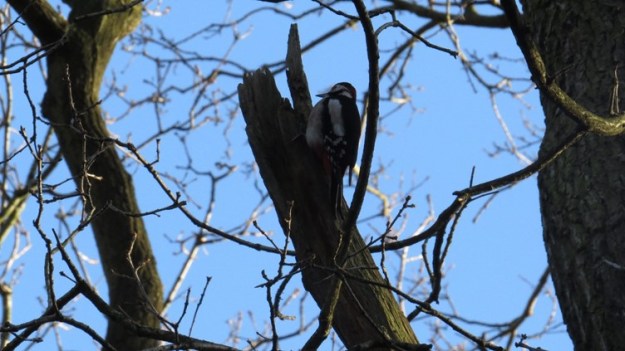
I tend to see the woodpecker in the garden during the winter. In spring and summer, they spend much more time in Coldfall Wood. Last week, as I walked through the hornbeams, I heard an extraordinary sound, midway between a creak and a drumroll. I followed the noise, eager to see if it was what I thought it was. After some time standing at the bottom of a tree, almost falling backwards as I leaned further and further back, I saw this:

A woodpecker was drumming away on a dead branch, the sound echoing through the trees. The bird’s head was just a blur as he knocked his beak repeatedly against the wood – he is able to make between five and twenty strikes per half second. This wasn’t an attempt to make a nest hole – he was declaring his territory. After every session of drumming he looked around, as if listening, and sure enough, another bird was answering his challenge from the other side of the wood. Both male and female Great Spotted Woodpeckers drum, which makes me think that they share a territory during the breeding season, and that both sexes are involved in defending it.

I wondered if the Woodpecker was choosing his branch with care, in order to make the maximum amount of noise. If so, he joins an elite company of animals who use the world around them to create displays. I am thinking particularly of a male chimpanzee that I knew in Cameroon, who would choose a hollow tree to kick when he was displaying over all others, presumably because of its deep, bass-drum quality.

And then there was a cackle and another Great Spotted Woodpecker appeared. The two birds flew up and clashed wings, like dragonflies, before heading out over the houses. A third bird also joined in, possibly the original bird’s mate, so for a few seconds the blue sky was patterned with black and white and red shapes. And then, all was silent again. But there was no doubt in my mind that spring had already begun, and the great battle to reproduce had started all over again. As broken as the world sometimes seems, the great engine of the seasons is still working.

To see a short video of one of the woodpeckers drumming, please see below. Quality isn’t great, but you can hear the bird (though you might want to take a seasickness pill before viewing 🙂 )