R.I.P Fleur Adcock

Fleur Adcock – Photo by Jemimah Kuhfeld

Dear Readers, Fleur Adcock, internationally-renowned poet, has died, aged 90. She lived just a few streets away from my house here in East Finchley, and I must have passed her unknowingly many times; she did poetry readings locally, but she was also a reserved person as so many writers are. Born in New Zealand, she settled for good in the UK in 1980, and worked as a poet and as a poetry commentator and translator for the BBC. In 2006 she won the Queen’s Gold Medal for Poetry, only the sixth woman to do so in the 73-year history of the award.

You can get a fine idea of her character from this interview, I see a thoughtful, curious woman and her poetry reflects this – so many themes and interests! But the best way to get to know a poet is through her poems, and so I offer a few of my favourites here.

First up, I think we’ve all been here…..

Things

There are worse things than having behaved foolishly in public.
There are worse things than these miniature betrayals,
committed or endured or suspected; there are worse things
than not being able to sleep for thinking about them.
It is 5 a.m. All the worse things come stalking in
and stand icily about the bed looking worse and worse and worse.

And as Bug Woman we have to have this one….

Blow Flies

If you liked them, how your heart might have lifted
to see their neat trapezium shapes studding
the wall like a newly landed flight of jet
ornaments, the intensity of their black
gloss, with secret blues and greens half-glinting through,
and the glass wings, not so unlike those of bees –

if you could bring yourself; if they occupied
a niche in creation nudged fractionally
sideways –
because it’s not their present forms, it’s
their larval incarnations that you can’t stop
heaving into view, white nests moistly seething
in a dead pigeon or a newspaper-wrapped
package leaking beside a path (but enough –
the others will kindly absent themselves, please!)

And wondering what, where – under the floorboards
or behind the freezer – suddenly hatched these.

And this one. I can imagine the scene, and the last line is a corker…

Leaving the Tate

Coming out with your clutch of postcards
in a Tate gallery bag and another clutch
of images packed into your head you pause
on the steps to look across the river

and there’s a new one: light bright buildings,
a streak of brown water, and such a sky
you wonder who painted it – Constable? No:
too brilliant. Crome? No: too ecstatic –

a madly pure Pre-Raphaelite sky,
perhaps, sheer blue apart from the white plumes
rushing up it (today, that is,
April. Another day would be different

but it wouldn’t matter. All skies work.)
Cut to the lower right for a detail:
seagulls pecking on mud, below
two office blocks and a Georgian terrace.

Now swing to the left, and take in plane-trees
bobbled with seeds, and that brick building,
and a red bus…Cut it off just there,
by the lamp-post. Leave the scaffolding in.

That’s your next one. Curious how
these outdoor pictures didn’t exist
before you’d looked at the indoor pictures,
the ones on the walls. But here they are now,

marching out of their panorama
and queuing up for the viewfinder
your eye’s become. You can isolate them
by holding your optic muscles still.

You can zoom in on figure studies
(that boy with the rucksack), or still lives,
abstracts, townscapes. No one made them.
The light painted them. You’re in charge

of the hanging committee. Put what space
you like around the ones you fix on,
and gloat. Art multiplies itself.
Art’s whatever you choose to frame.

And this one reminds me of what a relief it is to stop worrying about how you look. Not that I ever worried that much, having much more interesting things to think about, but no one is immune to societal pressure I suspect.

Weathering

Literally thin-skinned, I suppose, my face
catches the wind off the snow-line and flushes
with a flush that will never wholly settle. Well:
that was a metropolitan vanity,
wanting to look young for ever, to pass.

I was never a pre-Raphaelite beauty,
nor anything but pretty enough to satisfy
men who need to be seen with passable women.
But now that I am in love with a place
which doesn’t care how I look, or if I’m happy,

happy is how I look, and that’s all.
My hair will turn grey in any case,
my nails chip and flake, my waist thicken,
and the years work all their usual changes.
If my face is to be weather-beaten as well

that’s little enough lost, a fair bargain
for a year among lakes and fells, when simply
to look out of my window at the high pass
makes me indifferent to mirrors and to what
my soul may wear over its new complexion.

And here’s a very local poem. I know that feeling.

Londoner

Scarcely two hours back in the country
and I’m shopping in East Finchley High Road
in a cotton skirt, a cardigan, jandals —
or flipflops as people call them here,
where February’s winter. Aren’t I cold?
The neighbours in their overcoats are smiling
at my smiles and not at my bare toes:
they know me here.
I hardly know myself,
yet. It takes me until Monday evening,
walking from the office after dark
to Westminster Bridge. It’s cold, it’s foggy,
the traffic’s as abominable as ever,
and there across the Thames is County Hall,
that uninspired stone body, floodlit.
It makes me laugh. In fact, it makes me sing.

And this one. This one is stunning.

The Soho Hospital for Women (IV)

I am out in the supermarket choosing –
this very afternoon, this day –
picking up tomatoes, cheese, bread,

things I want and shall be using
to make myself a meal, while they
eat their stodgy suppers in bed:

Janet with her big freckled breasts,
her prim Scots voice, her one friend,
and never in hospital before,

who came in to have a few tests
and now can’t see where they’ll end;
and Coral by the bed by the door

who whimpered and gasped behind a screen
with nurses to and fro all night
and far too much of the day;

pallid, bewildered, nineteen.
And Mary, who will be all right
but gradually. And Alice, who may.

Whereas I stand almost intact,
giddy with freedom, not with pain.
I lift my light basket, observing

how little I needed in fact;
and move to the checkout, to the rain,
to the lights and the long street curving.

And finally (though there is so, so much more of Fleur Adcock’s poetry to love), this one, possibly her most famous poem.

For a Five-Year-Old

A snail is climbing up the window-sill
into your room, after a night of rain.
You call me in to see, and I explain
that it would be unkind to leave it there:
it might crawl to the floor; we must take care
that no one squashes it. You understand,
and carry it outside, with careful hand,
to eat a daffodil.

I see, then, that a kind of faith prevails:
your gentleness is moulded still by words
from me, who have trapped mice and shot wild birds,
from me, who drowned your kittens, who betrayed
your closest relatives, and who purveyed
the harshest kind of truth to many another.
But that is how things are: I am your mother,
and we are kind to snails.

R.I.P Fleur Adcock. Thank you for your poetry.

Missing the Spider Walk

Green Crab Spider (Diaea dorsata) Photo By André Karwath aka Aka – Own work, CC BY-SA 2.5, https://commons.wikimedia.org/w/index.php?curid=289458

Dear Readers, after my second fall last week I wasn’t able to go on Sunday’s Invertebrate walk in Coldfall Wood, led by spider expert Edward Milner. It’s so frustrating, but it is what it is, and so I have to enjoy such events vicariously. I was delighted to get an email from Edward this morning, saying that one of the spiders that they’d found was the little beauty above – a Green Woodland Crab Spider (Diaea dorsata). We don’t think of British spiders as being particularly colourful, but this is a splendid spider, a specialist of woodlands – it particularly favours yew, box and oak.

Photo by By André Karwath aka Aka – Own work, CC BY-SA 2.5, https://commons.wikimedia.org/w/index.php?curid=289462

As is often  the case with spiders, the male looks completely different – you can see one in a short film here. They compete for females by standing opposite one another, stretching their (very long) front legs  and dancing around one another. Well, it beats fighting. In some species of crab spider, the female can be sixty times larger than the male. One theory is that the bigger the female, the more eggs she can produce, while the smaller males are much more agile and can dash about to find females.

As with all crab spiders, these are ambush predators, hanging about on a flower or leaf or the trunk of a tree with their ‘arms’ wide open and ready to fold a passing fly into their deadly embrace. In the film you can see the spider extruding a line of silk – crab spiders often use this as an ‘anchor’ to prevent themselves from falling off if they grab an over-vigorous prey, and the threads can even act as tripwires, to slow up approaching (or more likely retreating) prey.

Although they can look pretty terrifying, these spiders only grow to about 6mm long, so they are on the small side for crab spiders, though even the  giant of the family only manages just over 11mm. In their habitat they are little tigers, though, waiting for passing prey with infinite patience. Our woodlands and gardens are full of drama on a miniature scale. It’s always good to be introduced to one of the actors.


It’s National Squirrel Awareness Month!

Dear Readers, if you’ve been following me for a while you will probably know that I love squirrels, but also find them, well, a bit much sometimes. I put out feeders for the little birds and the squirrels will go to any lengths to eat every last seed, as you can see. I put out a supposed squirrel-proof feeder, which worked for a while, until the little devils not only took the lid off but ‘disappeared’ the lid somewhere in the garden. So I was intrigued to see that October is actually ‘squirrel-awareness month’ – the Squirrel Lovers Club was founded in 1995 by Gregg Bassett, who encountered a squirrel at the Grand Canyon who somehow melted his heart. It’s good to know that I’m not the only person distracted by the wildlife whilst at this wonder of the natural world – I remember being entranced by my first-ever mule deer, and amazed at the sight of a couple of chipmunks. It’s strange how much we take our ‘regular’ wildlife for granted – personally, I’m always seeing pigeons or squirrels doing something that I wouldn’t have expected.

There is actually a wealth of information on the Squirrel Lovers’ website. There’s information on care of infant or injured squirrels, along with a proviso that usually professional attention is best, if the mother is really absent. In many places, including the UK, it’s actually against the law to release a grey rehabilitated squirrel, which presents something of a challenge – I remember a programme about a Scottish wildlife charity who received some baby squirrels when their drey blew out of a tree and the mother couldn’t be found. It’s impossible to determine the species of very young squirrels, and the rehabber explained that if they turned out to be grey, rather than red, squirrels, they would have to be euthanised. What a dilemma! Fortunately they were all red squirrels, so they were eventually released back into the wild.

There’s also a very interesting article on keeping squirrels out of your attic. We don’t have an attic, so at least that’s one problem we don’t have, though I have friends who have heard the patter of tiny feet above their heads (which can sound rather like the squirrels are wearing hob-nail boots). I note that Mr Bassett thought that there was no such thing as a squirrel-proof feeder, and I have come to the conclusion that he’s right.

It sounds as if Mr Bassett was one of those people who fell in love with a creature that many people regard as vermin, and made it his life’s mission to help others to understand and appreciate them. And there are plenty worse things that one can do with one’s life. Personally, I think that the moment you see an animal as an individual (and heaven forfend you give it a name – I am still keeping an eye open for Harriet, the shower spider) you feel compassion for it – it’s no longer a category, it’s a living, breathing being. And then we start to care, and then we’re really sunk. Hey ho.

I also realised that I have never included a poem about a squirrel here on the blog, but I rather liked this one, which came second in the People Need Nature  competition set on the Young Poets’ Network. There’s a lot of keen observation here, and much admiration. See what you think.

Squirrel
by Finn Farnsworth

Swift and agile
Sleek and prehensile –
Skittering across bark
And as dexterously over brick –
Squirrel.
The arch survivor –
A thief in woodland
A bandit of suburbia,
Beautiful peanut pirate.
You skim the rigging of
Rotary washing lines
And old telephone wires:
Your sail-tail
A Spinnaker of balance –
A back garden acrobat.
Grey down of fur covers
The machine of sinew
Tendons tight
Like bowstrings
Wired to shoot across
Fence top,
Gate post, sign post,
Post box – post haste.
The highwayman of the high street,
Terror of the terraces
Ply your profession –
Livelihood in the manmade Landscape.
A narrow escape
With a clutch of grapes
Hijacked from garden vine
Jam-packed with sweet juice.
You make a getaway
Into ornamental spruce
Where you have your hideaway.

Watch The Skies (Again)…

Comet C/2023 A3 Tsuchinshan-Atlas, photographed from Mount Burnett Observatory, close to Melbourne, Australia (Photo By cafuego – https://www.flickr.com/photos/cafuego/54036127092/, CC BY-SA 2.0, https://commons.wikimedia.org/w/index.php?curid=153475979)

Dear Readers, as if the Northern Lights weren’t enough excuse to watch the skies (and yes, I did miss them yet again), for the rest of the month of October there’s a good chance of seeing a comet with the naked eye; the best views, according to NASA, will be from 14th to 24th October. The Tsuchinshan-Atlas comet was first spotted by the Purple Mountain Observatory in China in 2023, and was subsequently confirmed by the Asteroid Terrestrial Impact Last Alert System (ATLAS for short). Goodness, who knew that there was a system keeping a robotic eye open for possible impacts? Not me, for sure, though I did once go on a date with a man who was completely obsessed with such things, and who had ‘forgotten his wallet’ when the time came to pay for dinner. But I digress. Fortunately, this comet (which I will be abbreviating to TA for conciseness) will definitely not be crashing into the earth and wiping us all out like so many dinosaurs, but it may be thrillingly visible until about the end of October if the weather cooperates (tonight (Sunday 13th October) looks pretty good for the southern UK at least).

Time lapse of the comet by By Cpayoub – Own work, CC0, https://commons.wikimedia.org/w/index.php?curid=148265841

Where to look for it, though? I can only speak for folks in the UK, but it seems to have already been visible in many places worldwide. The advice here is to look westwards shortly after sunset, preferably where you have a view to the horizon (not so easy in a built up area, but there we go). Where there have been clear views of the comet, it seems to have a spectacular tail. It’s always worth digging out the binoculars to scan the skies too.

Comet as seen from Gran Canaria (Photo by By Victor R. Ruiz – https://www.flickr.com/photos/rvr/54030812988/, CC BY 2.0, https://commons.wikimedia.org/w/index.php?curid=153379677)

The comet was ‘born’ in the Oort Cloud, a vast spherical dome-shaped cloud of icy objects that surrounds the whole of the solar system. This is thought to be the home of ‘long-period’ comets – TA will not return to the skies above the Earth for 80,000 years, and this is the first time in human history that it’s been documented. I rather like this image of the comet from the International Space Station. There’s something about that wandering spark above the blue arc of the Earth that I find very moving.

Photo by astronaut Matthew Dominick on the International Space Station in September (NASA)

Incidentally, did you ever wonder what a comet is made of? Apparently they’re more like ‘dirty snowballs’ than anything – they are remnants of our solar system when it was first forming, and this is why scientists are so fascinated with their composition. In 2014 Rosetta was the first spacecraft to orbit a comet, Churyumov–Gerasimenko, although the lander, Philae, got stuck in a crevice and was unable to communicate with Rosetta. Nonetheless Rosetta produced some extraordinary images, and collected extraordinary quantities of data during its mission, which included flypasts of other asteroids and comets. Have a look at these!

Image of Churyumov-Gerasimenko taken by Rosetta (Photo By Justin Cowart – 67P/Churyumov-Gerasimenko – Rosetta, CC BY 2.0, https://commons.wikimedia.org/w/index.php?curid=71790842)

Comet as seen from Rosetta’s NAVCAM (Photo By ESA/Rosetta/NAVCAM – https://www.flickr.com/photos/europeanspaceagency/16456721122/, CC BY-SA 2.0, https://commons.wikimedia.org/w/index.php?curid=40847079)

Space sometimes feels like unimaginable reaches of black, empty space, peopled by wandering rocks obeying their own physical rules, appearing and disappearing over the span of human history and causing wonder and speculation whenever they appear. Let’s hope that at least some of us will get a chance to view Comet C/2023 A3 Tsuchinshan-Atlas before it heads off into the depths of the solar system again.

Northern Lights in East Finchley!

Photo by Sheila Holloway (thanks Sheila!)

Dear Readers, the Northern Lights appeared over East Finchley last night, and yet again I have managed to miss them (being sat on the sofa with icepacks on both legs, quite a performance). But how lovely to see all the photographs today – the one above is from Bounds Green/Muswell Hill, just up the road from me, and my Facebook feed today is full of photos from all over the southern UK. They’ll have to rename the Northern Lights to the North London Lights at this rate. I was planning on a trip to Iceland to see them at some point, but it sounds as if I could see them from the upstairs window.

But why are they appearing so far south? Normally, Auroras (Borealis in the north, Australis in the south) are seen at the poles, and in fact occur at the poles of other planets too – look at this amazing  photograph of the Aurora on Jupiter, published by Nasa and taken  by the Hubble Telescope.

Auroras are caused by the ‘solar wind’, usually defined as an emission of charged particles by the sun. When these bounce off of the gases in the Earth’s atmosphere, they release light at various wavelengths which form the colourful display. Normally these displays are limited to the poles, but the sun goes through cycles of activity which last for about eleven years. During the height of the cycle, gigantic geomagnetic storms occur on the surface of the sun, forming sunspots and causing a massive increase in the ‘solar wind’. Instead of just bouncing off the poles, the ‘wind’ forms a much broader band, bouncing off the atmosphere above a much wider range of countries. Here’s an image from the last ‘big’ aurora, in May this year, from Stirling in Scotland.

The aurora in May seen over Stirling in Scotland (Photo by Richard Sutcliffe at Aurora borealis © Richard Sutcliffe :: Geograph Britain and Ireland

And so, will this continue? The sun is currently at its peak, but there might be a few more opportunities before things return to ‘normal’. In the UK you can subscribe to Aurora Watch, which will give you a warning if an aurora is expected. I’d love to know if you’ve been able to see it! Has there been similar activity in the southern hemisphere, I wonder? Let me know in the comments!

Sharing is Caring….

Winner of the Wildlife Photographer of the Year 2024 – The Swarm of Life by Canadian photographer Shane Gross

Dear Readers, yesterday I gave my talk to Finchley Women’s Institute, on the subject of ‘ A Community is More Than Just People’. I was a bit worried about it – I hadn’t done a presentation for years, plus as you might remember I managed to throw myself to the floor again on Tuesday, so was back to hobbling about with a crutch. But what a lovely evening it was! I had forgotten how much fun it was to talk about something that other people also care about, and are interested in. I got some great questions, and at the end one of the ladies showed me the photo above, and asked me what I thought it was.

At first glance, it looks like a flight of birds heading through a bamboo forest, but it is actually a shoal of Western Toad tadpoles, taken in Canada by photographer Shane Gross. It’s just won the annual Wildlife Photographer of the Year award, and I am so pleased that such a humble creature has been given its moment in the spotlight. So often photography prizes are won by photos of  big charismatic animals such as elephants or tigers, but this particular prize often highlights interesting images of creatures that are often overlooked.

I wondered how Gross took the photo, and the answer was ‘with some difficulty’. He snorkelled in a lake on Vancouver Island, using the paths made by beavers so that he didn’t stir up silt and make the water cloudy. But what are the tadpoles doing? Every night they hide away from predators in the depth of the lake, but in the morning they travel en masse to shallower water to feed. Only about 1 percent of the tadpoles will survive to adulthood, which is probably the same percentage of the froglets in my pond that will survive. No wonder frogs and toads often lay so many eggs, and have so many offspring, when the odds against them are stacked so high.

The image itself is stunning. We can see the sunlight in the top left of the photo, and little bubbles of air are clinging to the sides of some of the tadpoles, making them look silver. Am I the only one that looks at them and wills them on, hoping for the best for every single little scrap of life. It’s amazing how a single image can make you stop and think, not only about the little toads but about the whole underwater world, hidden from our eyes for most of the time but so vital to the health of the planet.

And I suppose that’s why it’s so important to share an image, a story, an idea about the natural world – it helps us to find ‘our people’, the great and expanding community of those who care about the plants and animals around us, and want to share their knowledge and their observations. There is something very special about knowing that you’re not alone, however eccentric you might sometimes feel. The world is full of Bug Women (and Men) and Tree People, and Plant Persons. You just need to find them.

You can see some of the other winning photos in Wildlife Photographer of the Year here.

Yikes!

Dear Readers, what a day yesterday was! You might remember that I was having the whitebeam and the hawthorn pruned (the last time it was done was about seven years ago, and they were both getting very overgrown for the size of the garden). Well, the tree surgeons arrived at about 8.30 and worked literally through thunderstorms and torrential rain. The chipper outside was going almost continually, and M, the guy that I’ve been working with for the past fifteen years, took on the hedge while someone younger went up the trees. Poor old M had a heart attack last year, so I suspect his days of shinning up trees like a squirrel are done, but he still wields a chain saw like an expert.

This morning all the collared doves and woodpigeons were sitting on the whitebeam as if nothing had happened. I had no idea of how many of them there were. The pollarding looks brutal, but past experience tells me that within a year the tree will have even more leaves than it had last time.

The squirrels are very fed up about the hawthorn, but fortunately there is still plenty of undergrowth and bushy stuff for them to rummage through.

And in the middle of all this, I managed to fall over on the landing. At least it was indoors! My fractured leg is a bit sore, and the ankle on the other side is complaining a bit, but it could have been much worse. I’m beginning to wonder if I have a condition called Chronic Ankle Instability – it happens when there have been a number of ‘sprained ankle’ incidents which stretch the ligaments and cause the ankle to just ‘give way’, which has certainly been my experience. Has anyone ever heard of it? I could really do with finding out what’s going on, it’s so traumatic, not least for my poor husband. I think his life flashes in front of his eyes every time he hears a thump.

Anyhow, this is the first time that I’ve been able to see the Virginia Creeper at the back of the garden from the kitchen. The whole space feels much lighter and more open, and when I talk to my prospective new garden help on Friday, I’ll see what we can do to really maximise the space for wildlife and for humans. I wince when I look at the trees (and at the squirrels and pigeons,) but it’s all for the best in the long run.

What’s the Story With the Plane Lace Bug?

Plane Lace Bug (Corythucha ciliata) Photo from https://animalia.bio/corythucha-ciliata

Dear Readers, there have been a number of stories in the press this week about ‘Dangerous Biting Insects Spotted in UK for First Time in 18 Years’, and the culprit is pictured above – the Plane Lace Bug (or Sycamore Lace Bug if you live in North America). The big worry is actually not about the insects ‘biting’ (they are only 4 mm long, and there have been very occasional reports of them biting and causing a ‘mild rash’). The real problem is that London has many, many plane trees (the London Plane is probably ‘the’ London tree – there are estimated to be over 100,000 in the capital). The Plane Lace Bug comes originally from North America, but it is now widespread in mainland Europe, where it causes extensive damage to plane trees (you can read about what’s happening in Brussels here).

Like all true bugs, Plane Lace Bug has sharp, piercing mouth parts, and feeds on sap. Both adults and nymphs cluster on the underside of leaves and feed from there, nicely hidden from birds and other predators.

Plane Leaf Bug adults and nymphs feeding (Photo from https://www.monaconatureencyclopedia.com/corythucha-ciliata/?lang=en)

The leaves that are infested turn yellow, particularly along the veins, and may fall early. Repeated infestations may weaken the tree and eventually cause it to die. Infestations are also much more likely to occur on trees that are already stressed by heat, drought, shallow soil and the other problems that street trees face. Occasionally the infestation weakens the trees enough to allow damaging fungi to take hold, which then kill the tree. You can see why a Plane Lace Bug infestation could be a serious problem.

In 2006, Plane Lace Bugs were spotted at a nursery in Bedfordshire, imported with plane trees from France and Italy. Fortunately this particular infestation was treated, but it was found that there were already Plane Lace Bugs on the mature London Plane trees close to the nursery site, and the decision was made that the insect was in effect already here, but wasn’t causing serious damage. For this reason, it was decided that no statutory action was required.

The Forestry Commission has now confirmed (September 2024) that Plane Lace Bugs have been found on plane trees in central London. The Woodland Trust sent out volunteers from the  Observatree programme to look for signs of Plane Lace Bug damage – this is a specially-trained group which will look for specific pests and diseases if there is an alert. If you see someone looking up at a plane tree with a pair of binoculars, it’s probably someone from Observatree! If you see something suspicious you can report a suspected sighting on the Tree Alert site here.

An example of the leaf damage is below:

So, I imagine that until we have better surveillance we won’t really know how extensive the Lace Plane Bug problem is, and how much of a danger the insects present. In mainland Europe they can gather in large swarms, entering homes and generally making a nuisance of themselves, but there’s no sign of that in the UK (yet). In the meantime, if  you live in London, keep an eye on your trees.

But what to do if there is an infestation? The use of insecticide on mature plane trees would be costly, inefficient  and extremely damaging to the rest of the ecosystem. DEFRA (the Department for Environmental, Rural and Agricultural Affairs) suggest other remedies such as ‘hosing down’, ‘soapy water’ and the use of biocontrols such assassin bugs, spiders and mites where the infestation is spotted early. And that is probably the key. Maybe we should all be assigned a plane tree to keep an eye on. I will certainly be taking the time to check out the beautiful trees along East Finchley High Street.

Trepidation!

t

Dear Readers, Tuesday is a big day here in Bug Woman Towers – the tree surgeons that I’d booked for the spring, and who had to cancel because they were so far behind with their work, are now coming tomorrow, to do a fine pruning job on the whitebeam/hawthorn/mixed hedge. It has to be done, but I always find it really stressful – the trees will look as if they’ve been butchered, the squirrels will be thoroughly fed up, and the  birds will be confused. Plus there’s the perennial problem of finding two parking spaces outside the house for the van and the chipper – at the moment I have one, but I’ll be watching with great agitation to see if either of the cars on either side move. Thank heavens for the street Whatsapp group, that’s all I can say. Update – I now have two spaces, let’s hope some irate driver doesn’t move the bins.

There are several dreys in the Hawthorn, but they don’t look as if they’re used at present. And interestingly, most of the berries have been eaten already. At least we’re coming towards the end of the season.

So many leaves just waiting to drop!

I’ve also bitten the bullet, and am talking to someone to help me with the gardening – between the back, the leg and the heart it’s all been feeling a bit much, so I’ve found someone who seems sympathetic to the idea of a wildlife garden, and who will give me a hand. It’s hard sometimes to admit that you need help, but if the past few months have taught me anything, it’s that ‘independence’ is something of an illusion, and that we all need help sometimes. Let’s see how we get on!

“Hard Graft” at the Wellcome Collection

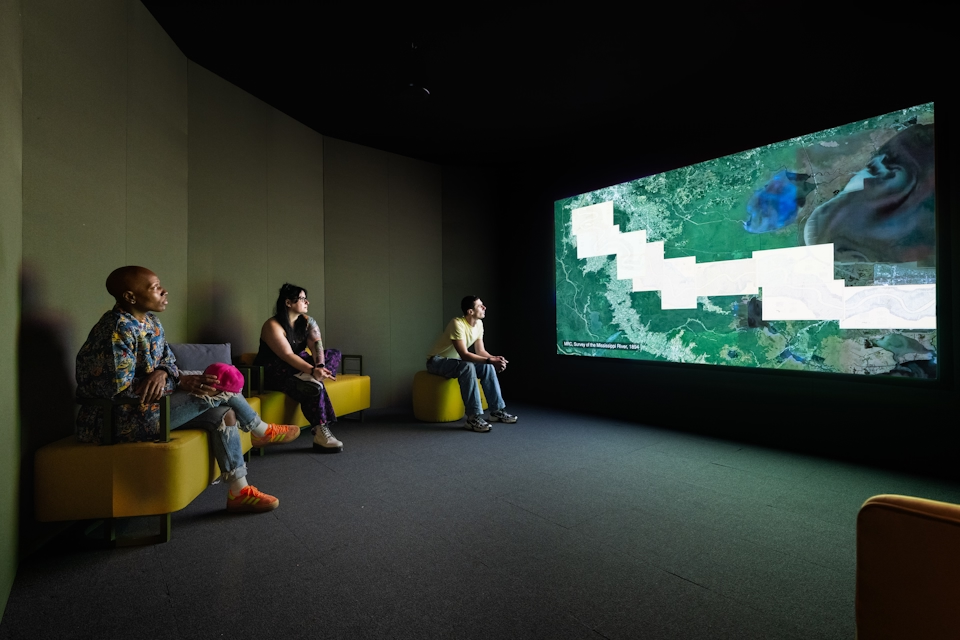
An Image from an exploration of ‘Death Alley’ along the Mississippi in Louisiana

Dear Readers, yesterday I made another foray into central London to see the current (free) exhibition at the Wellcome Collection, “Hard Graft“. It was a fascinating exploration of the ways in which work impacts the human body, and there was much to think about.

I didn’t have the stamina to spend as much time there as I would have liked, but I did sit for twenty minutes to watch the film in the photograph above. It explores an area along the Mississippi river in Louisiana which used to be known as ‘Cancer Alley’ (now ‘Death Alley’) and it describes how the land once used as sugar plantations is now a network of industrial sites, interspersed with small towns populated largely by black people, many of them the descendants of the slaves that used to live and die there. It shows how the plumes of toxic chemicals and particulates impact these small towns, and the images of the poisoned air that people are breathing in every day is horrifying. But people are fighting back on a number of fronts, and one of them is to identify the burial grounds of the slaves who died on the various plantations. When companies want to develop the land for industrial purposes, it’s surprising how often the archaeological companies that they employ ‘miss’ these graveyards, only for them to turn up when a less biased organisation is involved – even in Louisiana, it’s illegal to build over a graveyard. So a lot of work is going into identifying these burial sites, which were usually very close to the slave quarters, and where trees such as magnolias were often planted by those who were related to the deceased. If the sites can be found, at least any further industrial development can be halted, while efforts are being made to hold the existing facilities to account for their emissions.

The exhibition is split into three sections – ‘Plantation’, ‘Street’ (which features everything from sex workers to garbage disposal teams) and ‘Home’, about cleaners, piece work and other work done from the home. It has a strong emphasis on people coming together to fight injustice, and the importance of collective action. I highly recommend it, not least because it made me think about the impact of work on the body.

My mother was a ‘touch-typist’ who used to type up reports, manuscripts and other documents dictated by some boss-type chap (and it was always a chap) into a recording machine called a Dictaphone. Who remembers those? Back in the day, people didn’t do their own typing on their own laptop. No, they got someone else (usually a woman) to do it for them. One day Mum was musing about her life, and said something that’s stayed with me to this day.

“I just feel like part of a machine. I’ve got the ear phones in my ears (to listen to the recorded tape), my hands on the keyboard (Mum was once timed at 130 words per minute, and that was on a manual typewriter) and my feet on the pedals (that controlled how fast the tape went).

In fact, towards the end of her working life Mum developed carpal tunnel syndrome (CTS), but interestingly this only happened after the electric typewriter was introduced. On a manual typewriter, you used to have to stop to return the carriage at the end of every line, and so there were a variety of hand and arm movements. With an electric machine you could just keep going, and once the PC came in you didn’t even have to change the paper, so you were performing a small number of micromovements, just the sort of thing to irritate the median nerve, that runs through the tight corridors of the wrist joint.

Other people who suffer from carpal tunnel syndrome include people who work with machinery such as jack hammers or drills. It is extremely painful and debilitating, but when one of Mum’s colleagues asked for time off for her CTS she was accused of being neurotic, and was managed out of the organisation. This was back in the early 1990s. Would it still happen now? I’d like to think not, but I’m not so sure.

The exhibition also made me think  about the implications of increasing the retirement age. If even sitting in an office can cause something as damaging as CTS (not to mention back pain and all the other joint problems that all that sitting can generate), how about people who are builders, or garbage collectors, gardeners or scaffolders? What happens if  you work outside in all weathers or have to do a lot of heavy lifting or other physically demanding labour as you grow older? Some people will stay as fit as a fiddle, but how about if you have arthritis or one of the other ailments that happen as approach retirement age? Clearly we have a demographic problem in the UK, as in the rest of the Western World, but it does seem particularly harsh that those who are often paid the least, and have the least chance to retire early, are the ones who end up suffering the most.

Rant over! If you’re in London, the exhibition is well worth a look, and there’s a fine café and bookshop too.