Paulus Potter – Painter of Animals

Paulus Potter – The Young Bull (1647) Public Domain

Dear Readers, I’m always intrigued by artists who choose to make animals their subject – partly because of what it says about the attitude to animals at the time, and partly because the best painters seem to be able to incorporate the personality of the animal in such a way that it becomes a portrait. Back in the 17th Century, Dutch artist Paulus Potter(1625 – 1654) took to painting monumental pictures of farm animals, but no illustration can give you an idea of the scale of the work. ‘The Young Bull’ shows a life-size bull, and its realism is striking – there is an enormous cowpat more or less at eye level. This looks like a living animal, although in his book ‘The Upside Down World – Meetings with the Dutch Masters’, Benjamin Moser points out that the bull is actually a composite of several animals, drawn from memory. This doesn’t take away from the impression it made when it was first shown in the Louvre in 1795, after Napoleon had added the masterpieces of the Netherlands to his burgeoning collection of European art. The Dutch traveller Adriaan van der Willigen described its impact:

I saw two French peasants taking a good long look at Potter’s large bull. Their natural and correct judgment pleased me particularly, and came down to their opinion that they thought this was the best painted and loveliest picture in the whole gallery. After they had spent a while this way, as if in bliss, they left the object not without regret”.(B.Moser, ‘The Upside Down World’ pg 247.

Clearly, Potter had a ‘thing’ about animals. He started off by painting images from mythology, as most artists did, but his humans paled into insignificance beside the animals. As a genre, there was no such thing as ‘animal painting’ in the Netherlands, so Potter invented it almost single-handedly. As he moved onto painting farmyard creatures, humans disappeared even more – I love the image of the milkmaid concealed behind the more important cow in the picture below.

Cattle with Milkmaid (1643) Paulus Potter

Although there are probably more paintings of cattle than any other animal, Potter could turn his hand to most mammals. I love the painting below, of two pigs below. You can see their individual characters, and also a kind of sadness, as if they knew what their ultimate end would be.

Two Pigs in a Sty (Paulus Potter, 1649)

And how about this splendid wolfhound? What has he seen in the mid-distance?

Wolfhound (Paulus Potter c. 1650-52)

And then there’s this piebald horse, looking somewhat anxiously off to the left. Does she sense a storm coming?

The Piebald Horse (Paulus Potter, c. 1650 -54)

Potter’s most interesting, and certainly most gruesome picture is ‘The Punishment of the Hunter’. What a complex painting it is! The outer twelve photos show various hunting scenes of varying degrees of cruelty. However, in the centre two paintings the animals take their revenge, killing the hunter by roasting him on a spit and hanging his dogs from a tree. Well, there is a certain amount of wish-fulfilment here I’m sure (except for the dogs) but it has the feeling of a virtuoso, wanting to cram as many different species as possible into one painting. 

Punishment of a Hunter by Paulus Potter (c. 1650 – 52)

Paulus Potter was one of a kind, an artist who didn’t shy away from the facts of life, and death. One of his paintings, known colloquially as ‘The Pissing Cow’ (brown standing cow on the left hand side if you want to see why) proved too much for its intended owner, who bundled it off to the vaults of the Hermitage instead.

The Farmyard aka The Pissing Cow by Paulus Potter, 1649

Potter died of tuberculosis in 1654. His life was short, but full of art – he created over a hundred paintings in his twenty-eight years, and his wife said that she never saw him without a notebook in his pocket, so that if he saw something unusual he could do a sketch on the spot. Some of these drawings have survived, and they’re full of energy and curiosity. They are all, without exception, of animals, and yet what shines through reminds us that we’re not the only species with emotions and personality. I am very glad to have discovered him, and will keep an eye open for his paintings when I visit European galleries – there is one at the National Gallery in the UK, for example. He is definitely in the same league as George Stubbs as far as I’m concerned, and he didn’t have a half-dissected horse in his garage.

Sketch of Pig and Piglet by Paulus Potter (c.1652)

A Small Survivor

Dear Readers, when I was taking a shower yesterday I looked down and, without my glasses on, noticed a little blob in the corner that I took to be a bobble from a jumper or  some such thing. I decided to ignore it for the time being, and went on with the two shampoo, one conditioner routine that I usually have. It was only when I finished that I realised that the aforesaid ‘blob’ must have been sentient, because it had completely disappeared!

I thought no more of it until today, when I was cleaning my teeth (with my glasses on) and noticed that not only was the ‘blob’ back, but that it was actually an extremely resilient spider, though clearly one with a low sense of self-preservation. I noted earlier in the week that spiders often suffer from desiccation in our centrally-heated houses, but this one was obviously taking things to extremes.

How she (for I can currently see no pedipalps so am hedging my bets) survived the pounding from a hot ten-minute shower (I’m a bit slower after the broken leg) plus gallons of purple shampoo (to keep my ‘naturally silvery locks’ silver) not to mention my amber and oud shower gel I have no idea, but I am regarding the little arachnid with a new respect. Later today I shall encourage her to relocate to somewhere else in the bathroom, and I shall make doubly sure to check all corners of the shower stall before entering. After all, having survived this ordeal (and quite possibly a number of previous ones) I think she deserves another chance. I’m going to call her ‘Harriet’ because she is surprisingly hairy.

And incidentally….I am rather liking the deodorant and shower gel that I’m getting from Wild. You buy one case and then you can buy refills – the cases are made from recycled plastic, and the shower gel or deodorant comes in a completely recyclable cardboard container that you just slot into your case. The deodorant lasts for at least a month with daily usage and they have a wide variety of scents, plus some for people with sensitive skins. There’s no palm oil, no parabens or other nasties. And no, I’m not on commission. I find the deodorant very effective, and the shower gel is lovely and seems to last forever. So if you’re thinking to reduce your plastic usage, or cut back on the chemicals in your toiletries, I’d recommend Wild. Every little helps, I’m sure.

Has anyone else made a switch to a new company for environmental/ethical reasons lately? Any recommendations? Let me know in the comments, and I might knock a blogpost together if I hear about some good suppliers. Often, little companies don’t get the credit for innovation that they deserve.

The Post Box Topper Phenomenon

A crocheted Christmas Post Box topper from Inverkip in Scotland (Photo by By dave souza – Own work, CC BY-SA 4.0, https://commons.wikimedia.org/w/index.php?curid=97993838)

Dear Readers, after yesterday’s rather heavy blogpost, I wanted to share a phenomenon that seems to be gathering momentum here in the UK – the post box topper. These are knitted or crocheted ‘scenes’ that local knitters pop on top of a postbox to cheer people up, to highlight an issue or to celebrate something. Sometimes they get vandalised (usually by drunken adults), I imagine that they get grubby, and that birds occasionally poo on them, but the Post Box Topper gang are undeterred. Anything that we put out into the world is vulnerable, but from the response to these woolly wonders, the positive responses far outweigh those who like to destroy things. Here’s just a selection from the interwebs…

First up is a Postbox Topper from Walthamstow, full of poppies for Remembrance Day.

 (Photo by By GrimsbyT – Own work, CC BY-SA 4.0, https://commons.wikimedia.org/w/index.php?curid=96009048)

The next one is to celebrate the Coronation of King Charles III – it’s from Godalming in Surrey.

(Photo By Doyle of London – Own work, CC BY-SA 4.0, https://commons.wikimedia.org/w/index.php?curid=131071989)

Royal occasions are something of a favourite – the topper below was for Queen Elizabeth II’s Platinum Jubilee. Not content with the Queen, we have corgis, a beefeater and a Queen’s Guard.


It’s not all about royalty, though…this one is in honour of the Hospice at Home service run in Sidmouth, Devon.

This one celebrates autumn in Liscard Village in The Wirral.

This one is celebrating the new school year, in Orpington, Kent.

This one celebrates a donkey sanctuary in Devon..

Bug Woman obviously approves of this topper…it’s by@ToppersBySteph on Queen Square near Great Ormond Street Hospital in London.

And finally, this one is very special. It was made to commemorate the life of Sophie Lancaster, a young woman who was murdered because she looked ‘different’ (she was a goth). The photos are from the Bailgate in Lincoln, and were taken by Glen Red Imp Hughes (Photos from here).

So, are postbox toppers just a British thing, or does anyone else have something similar? I think what I love about them most is that people spend many hours on them, then release them into the world to take their chance. I’m leaving the last word to Sue Cockcroft, a topper-maker…

Although it can be a bit gutting if the thing you’ve made is taken, I think we all do it with the idea of spreading some happiness into our communities… That’s something you have to do knowing that not *everyone* will feel the same way.
But we keep on going, and sharing happiness, because it gives us happiness too. 💚”

Thoughts About an Eco Friendly End

Woodland Burial Area in the City of London Cemetery (Photo by By Acabashi – Own work, CC BY-SA 4.0, https://commons.wikimedia.org/w/index.php?curid=91073911)

Dear Readers, my dear friend’s mother died last week, and she had very definite thoughts on what she wanted for her funeral. There was to be no church service, but she wanted music and poetry. Most of all, she wanted a woodland burial, in a wicker coffin. She yearned for simplicity, and for a ceremony that celebrated her as a human being. And so, I’m sure that’s what she’s going to have, and I’m just keeping my fingers crossed that the weather is kind, and that the peace of the beautiful trees will help to calm the grieving souls who stand beneath them.

And so, my thoughts turned to what I would want when I die. I believe that it’s never too early to start thinking about these things (though of course I hope that any planning won’t come to fruition for quite a while yet). I’ve been to rather more funerals/memorial services/internments than I’d have liked over the past few years, but they have given me a bit of an idea of what I’d like.

Mum wanted to be cremated because she didn’t like the idea of the ‘creepy crawlies’, and so that’s what she got. As Bug Woman, however, I am very happy to feed the creepy crawlies, though an important thing to note is that one shouldn’t be embalmed – the chemicals are terrible for the soil and for the very creatures that do the work of decomposition. Plus, I have heard of too many people terrorised by the sight of a embalmed loved one in an open coffin, completely changed from how they looked in life. I do respect that in other traditions this is an important part of the ceremony (in fact, take everything written here as purely personal, and not a judgement on what anybody else wants), but I wouldn’t want a long lying-in in state. I’m not Lenin, after all.

Cremation is also very energy-intensive, as you can imagine – some forward-looking crematoria are aiming to power their cremators by renewable energy, but even so I can’t help thinking that there must be at least some air pollution from the whole process. Plus I can’t get past that James Bond film where he wakes up in a coffin being fed into a cremator and has to kick his way out with flames all around him. No thank you!

If one is being buried, however, it’s important to think of what you’re being buried in. In some woodland burial sites, you can be buried in a simple cotton shroud, or a wicker or cardboard coffin. I always fancied one of those Ghanaian coffins, which are designed to represent the interests of the person who has died, though I’m not sure that they’re that eco-friendly. Maybe we could get a cardboard one, and someone could paint it with a few burial beetles so they’ll get the idea of what’s expected of them.

Ghanaian Coffin in the shape of a lobster…(Photo by Yanajin33, CC BY-SA 3.0 <https://creativecommons.org/licenses/by-sa/3.0&gt;, via Wikimedia Commons)

A Selection of Ghanaian Coffins (Photo by Walt Jabsco at https://www.flickr.com/photos/waltjabsco/263248255)

Cocoa pod coffin (cocoa was one of Ghana’s main exports) Photo Christina B Castro at https://www.flickr.com/photos/cbcastro/1393532104

In a lot of woodland burial sites, there are no headstones and no memorials, though you can often plant an appropriate tree. Personally I don’t mind this – I don’t believe that I’ll be there, except as a recycled earthworm or lesser celandine or, if I’m lucky, a robin. I believe that you live on in the minds and hearts of those who knew you, or came across your writing or art or whatever you left behind, and that feels like enough. I think it might have been different if I’d had children – I certainly get a lot of comfort from visiting Mum and Dad’s grave, but I think that’s more because of the whole village and my memories of it, rather than any thoughts that Mum and Dad are actually there. They’re with me in my heart, always, in my DNA and in the way I cook a roast dinner (Mum) or plant out my seedlings (Dad),

There are some new burial methods coming up as well. One is known as water cremation, and it seems to basically involve the same technique that murderers have used to get rid of  bodies after their dastardly crimes. Technically known as alkaline hydrolysis, the body is basically dissolved in boiling potassium hydroxide and water, before the remains are reduced to a small amount of ash. Apparently it’s becoming more popular in the UK, and it certainly has a much lower carbon footprint than cremation, though for totally illogical reasons it makes me feel a bit sick in a way that cremation doesn’t.

And then there’s composting – the body is placed in a stainless steel container with wood  chips, alfalfa and straw, and after about two months everything has literally been turned to compost. Alas, this isn’t available in the UK yet, but it’s becoming popular in the US, so I imagine it will become an option here soon. You can use the compost for trees and plants (though I have no idea if you can be ‘spread’ on your own vegetable garden).

All in all, I think I fancy the idea of a woodland burial, but with this caveat: I think that the ceremonies that we have after death are really for those left behind. So while there is comfort in doing things according to a loved-one’s wishes, I think there’s a lot to be said for also reassuring those that you love that, in the end, it was what happened while you were alive that mattered, and if your wishes can’t be followed it doesn’t matter. I think of the torture that people went through during lockdown when they couldn’t have the ceremonies that they would have liked to remember their loved ones, and what an additional burden of grief and guilt this put on people who were already suffering. And  so, preferences are just that – preferences. If they can’t be fulfilled, it’s not important. And no one should punish themselves for things that turned out not to be possible.

Over to you, Readers! Preferences for burial, cremation, something else? I am not forgetting that Hunter S. Thompson asked for his ashes to be fired out of a cannon, and I have heard several people express a preference for a Tibetan-style Sky Burial, where your bones are carried off by vultures (though you’d wait a long time for a vulture in East Finchley). Is it something you think about, or something you’d rather not dwell upon? Have you been to a funeral or ceremony that seemed to hit all the right/wrong notes?

And we haven’t even gotten started on funeral music yet. The man being buried just before my Dad had chosen ‘The Ride of the Valkyries’, which was nothing if not dramatic. But that’s maybe something for another post.

The Springtail – The Springiest Animal Known to Science

Dear Readers, if you have ever turned over some leaf litter in the garden and noticed some tiny creatures pinging away in all directions, you might have encountered some springtails. Once upon a time, they were regarded as primitive insects, but these days they are considered to be such an ancient lineage that they’re described as ‘non-insect hexapods (hexapod meaning ‘six-legged’). The scientific name for springtails is ‘Collembola’,  which means ‘glue-peg’ – this relates to a strange organ called the collophore, which, as we shall see, is a vital part of the way the springtail gets around.

The springtail Deutonura monticola (Photo by By Philippe Garcelon – Deutonura monticola, CC BY 2.0, https://commons.wikimedia.org/w/index.php?curid=93328444)

Because they are so small, springtails go largely unnoticed, which is surprising as there may be 30 to 40 species per square metre in deciduous woodland, and up to 100 species in the same area in the tropics. Some estimates suggest that a square metre of soil can contain up to 100,000 individual springtails. Although we will notice them most when digging in the garden, they can be found right up into the forest canopy, and hopping about on the snow in North America – this particular species is known as a snow flea (Hypogastrura nivicola) and it contains a protein which enables it to be active when most other small invertebrates are torpid.

Snow Flea (Photo by By Daniel Tompkins, en:User:Plantman2 – en:Image:Snow Flea close up.JPG, CC BY-SA 3.0, https://commons.wikimedia.org/w/index.php?curid=3380961)

So, what are springtails doing in the soil, in such numbers? Some are detritivores, breaking down organic material and releasing its nutrients into the soil. Some are predatory, and eat a wide variety of other invertebrates and even microbes. They are clearly important in maintaining soil health, and  yet we know so little about them. One thing that is clear is that they are very prone to desiccation, and that they emit a pheromone that attracts them to one another – this helps them to find a safe, damp space where they can live together and share the same safe environment. While some species are very adaptable, others are not, and changes to land practices can cause the total elimination of some of the slower-moving, more specialised species. One species has been used as a model  to test soil toxicity, herbicides and pesticides.

Folsomia candida – a model species used in laboratories to test everything from pesticide resistance to circadian rhythms (Photo By Andy Murray – Folsomia candida, CC BY-SA 2.0, https://commons.wikimedia.org/w/index.php?curid=44266481)

Springtails are also food for a wide variety of other organisms, including mites, spiders and harvestmen. And so, they have developed a very particular way of escaping when threatened. Springtails have an organ called a furca, which extends like a stick at the end of the body, and is used as a kind of lever to flick the animal into the air.

Springtail Isotoma habitus – you can see the furca protruding at the end of the body (Photo by By U. Burkhardt – Taken and uploaded on de:WP the 01/06/2006 by de:Benutzer:Onychiurus, CC BY-SA 3.0, https://commons.wikimedia.org/w/index.php?curid=793827)

And what a flick! Scientists Adrian Smith and Jacob Harrison filmed some springtails after they’d given them a prod with a paintbrush, and discovered that they can leap up to 80 body lengths away from where they started in a single jump, rotating 368 times per second as they did so.

There seemed to be two types of landing – Smith described one as an ‘uncontrolled bounce and tumble’, and the other as an ‘anchored stop’ – the latter involved that organ for which this group is named, the collophore, which is a sticky tube (you can see it in the middle of the body of the springtail in the photo above). The tube is normally used for things like controlling fluid balance in the springtail’s body, but can also be used to anchor the body of the springtail after a jump.

You can watch the springtails ‘doing their stuff’ on the New Scientist Youtube page here. Highly recommended!

I’ll leave the last word to Adrian Smith:

People might think that everything in nature is described and known, says Smith, but this isn’t so. “There’s so many things that are right there in and amongst us that are incredible.”

The New Scientist article is here.

The research paper is here.

A Little Mystery

Dear Readers, I’ve been idly watching this web appear in the corner of our French doors for the past few weeks, but only today did I summon up the energy to hobble over and have a proper look. And what a structure it is! You can see that it’s a sheet, but in the middle there’s a hole that looks a little like some vortex in the middle of a nebula (plus a pretty impressive tear).

From inside the house, you can just about see the long tube leading down to the bottom left corner of the window.  What I can’t see at the moment is a spider, but I might hobble outside with a torch at some point, provided I can convince my long-suffering husband to come with me so that I don’t topple over.

But who has made such a structure? Interestingly, it might well be one of our autumn visitors, the Common House Spider – I don’t think of these spiders as making webs, but apparently they do. Furthermore, several generations of Common House Spiders can use a web, enlarging it and repairing it as they go, rather like the aged retainers of a country house. The spider will live at the bottom of the tunnel, waiting for prey to land on the sheet part of the web. The vibrations that the unfortunate insect creates in its attempts to escape alert the spider, which rushes out and grabs it.

One reason that I might not have seen the spider on his/her web is that at this time of year, as we know, male Common House Spiders go in search of love, and enter our houses to look for the (much larger) females. When he finds one, he might spend several days or weeks with her, before dying, whereupon he is sometimes consumed by the female. No point in letting all those nutrients go to waste! Spiders are nothing if not pragmatic.

Incidentally, you can tell adult male spiders from adult females because the males have these little ‘boxing glove’ appendages at their front ends – these are pedipalps, and are used to transfer sperm from the male during mating.

A very impressive male Common House Spider (Photo By sanja565658 – «собственная работа», CC BY-SA 3.0, https://commons.wikimedia.org/w/index.php?curid=6228310)

Female Common House Spiders can live for several years if they find a house with suitable conditions. They lay their eggs in cream-coloured egg sacs, usually suspended by a strand of silk somewhere within the funnel web. I shall have to keep an eye open and see if I can see one! Each egg sac holds about 50 eggs, which will hatch in April when the spiderlings will disperse.

I always find it interesting how our homes and sheds and outbuildings form their own unique habitat. As far as a spider is concerned, our centrally-heated homes are just a rather pleasant substitute for the caves that they used to live in millenia ago. If only, I’m sure they’d say if they could talk, our homes weren’t so dry! One of the big risks for a spider in our homes is desiccation, and some of the ‘spider people’ that I talk to online regularly put out little bottle tops full of water for their spider friends to drink from. And considering the number of clothes moths that the average Common House Spider can eat, it might be a good investment.

An Ivy Bee Update

Ivy Bees (Colletes hederae) Photo by Phil Buckley

Dear Readers, you might remember that last year I mentioned that reader Phil Buckley had a garden absolutely full of nesting ivy bees, and this year they’re back! Phil describes how the lawn is positively criss-crossed with bees flying less than a centimetre above the grass, and how his poor wife hesitates before hanging out the washing because she’s afraid of stepping on them. Interestingly, they don’t seem interested in the ivy growing nearby – maybe they’re mostly males waiting for the females to emerge, and this seems more important than food? It will be interesting to see how things turn out.

The honeybees are enjoying the ivy, even so.

Honeybee and ivy flowers – Photo by Phil Buckley

And below are three short films taken by Phil of the ivy bees ‘doing their thing’. The males emerge first and hang around waiting for the females to emerge (all the bees result from eggs laid in little tunnels last year – the eggs hatch and the larvae are provisioned by ivy pollen balls that their mothers collected during last autumn). When the females do emerge, the males pile on in a most ungallant fashion. The females then go about collecting pollen to feed the next generation, while the males drift about for a few days and then die. And so the cycle begins again.

From being a real rarity in the UK, ivy bees have become one of our most notable autumn phenomena, at least in the south – they’re up there with the red deer rut and the appearance of migratory birds, at least as far as I’m concerned. Considering that it was first spotted in Dorset in 2001, and is now outnumbering honeybees in some locations, I think we can regard this species as a success story.

An interesting paper on ivy bees in Sussex suggests that this species has established itself so well because it is using an abundant and underutilised source of nectar and pollen – even though social wasps and honeybees use ivy, it’s been estimated that over half of the nectar and pollen remains uncollected by the end of the year, because so many insect species are no longer around by mid/late autumn. Plus, unlike many other solitary bees, the ivy bee is remarkably undemanding about its nest sites – the bees like short grass and patches of bare soil, don’t mind if the site is sloping or level, and, as we can see from Phil’s garden, are very at home in a domestic setting. Other bees may require a particular soil type or a particular orientation, but the ivy bee is happy in many easily available places. Keep your eyes peeled for the next few weeks – these little guys will be gone by the end of October (or earlier if the weather is too bad) and then we’ll have to wait until next September to see them again.

At Pilates

Dear Readers, today I was back at Pilates Central in Islington for the first time in over three months, and what a relief it was! I’ve been going to this studio for nearly twenty years now, having first attended after a bout of sciatica which left me incapable of standing up for more than a few minutes at a time. As anyone who has experienced sciatica will tell you, the pain is excruciating – I couldn’t believe that something so painful wasn’t caused by something serious, and so off I went to the doctor.

His advice? “You can take ibuprofen and paracetamol at the same time, you know”.

Hah! I was determined to try to ‘fix’ myself (although painkillers did play a role for a few weeks). I had acupuncture. I visited a chiropractor. But most importantly of all, I started going to pilates. What I liked about the studio in Islington was that it wasn’t a ‘class’ as such – the instructors would do an assessment and then give each person a programme of different exercises to help with their particular problems and goals. It meant that if I had a flare-up of my back, or a tight shoulder from too much time on the computer (not that anyone ever does that), the instructor would suggest how to ‘tweak’ my usual routine, and make sure that I was doing the exercises properly. And what excellent exercises they are! After today’s session I can feel my body ‘remembering’ how it’s supposed to work, especially my core muscles which have had a bit of a holiday just lately. And I’ve noticed how I can flex my uninjured foot much further than the one attached to the injured leg – if you’d asked me, I’d have said that they were both the same. Clearly, this is one reason that I still have a limp, and it’s something that we can gently work on.

Plus I got to show everybody my fracture X-ray photos, which is always fun (for me, anyway).

But I thought that the father of pilates should get a shout out here, because he was a most unusual man. Joseph Hubertus Pilates (1883 – 1967) was a very sickly child, suffering from rickets, rheumatic fever and asthma. His father introduced him to physical fitness and gymnastics, and by the time Pilates moved from his home in Germany to the UK in 1912, he earned a living as a circus performer and self-defence trainer for Scotland Yard. Alas, this was bad timing as he, along with many other Germans, was interred during World War I. Pilates spent his time teaching physical fitness to the other internees, boasting that they’d be in better physical condition when they left than when they went in.

At this point, Pilates’s methods were beginning to form the basis of what we now know as pilates, though it was called ‘Contrology’ at the time. There was an emphasis on the core muscles, on breathing correctly, and on alignment of the spine. One feature of pilates is the importance of correctly lining everything up, and paying close attention to what various muscles are actually doing – a subtle change of posture can have an extraordinary effect. Pilates also discovered that his methods could help some of the severely-injured veterans who were starting to return home.

After the war, Pilates returned briefly to Germany, before emigrating to the United States – he met his wife Clara on the boat, and the two of them set up a studio when they arrived. The pair of them were teaching well into the 1960s. Pilates as a technique was recognised by some of the foremost dancers and choreographers of the time, including Martha Graham and George Balanchine. Both luminaries sent their students to Pilates for help with conditioning and recovery from injury, and soon pilates became the flavour of the month.

Pilates died of emphysema in 1967, but the techniques that he developed are still helping people today, including me. Ironically, a few days before my accident I remember waking up and thinking “I don’t remember the last time that I had back pain”. Sadly, at the moment the back pain is back, mainly due to the weakening of my muscles during my enforced rest, and my limp, but I have little doubt that with persistence and patience (and by being realistic about what I can do) I can sort myself out. Thank you, Joseph Pilates!

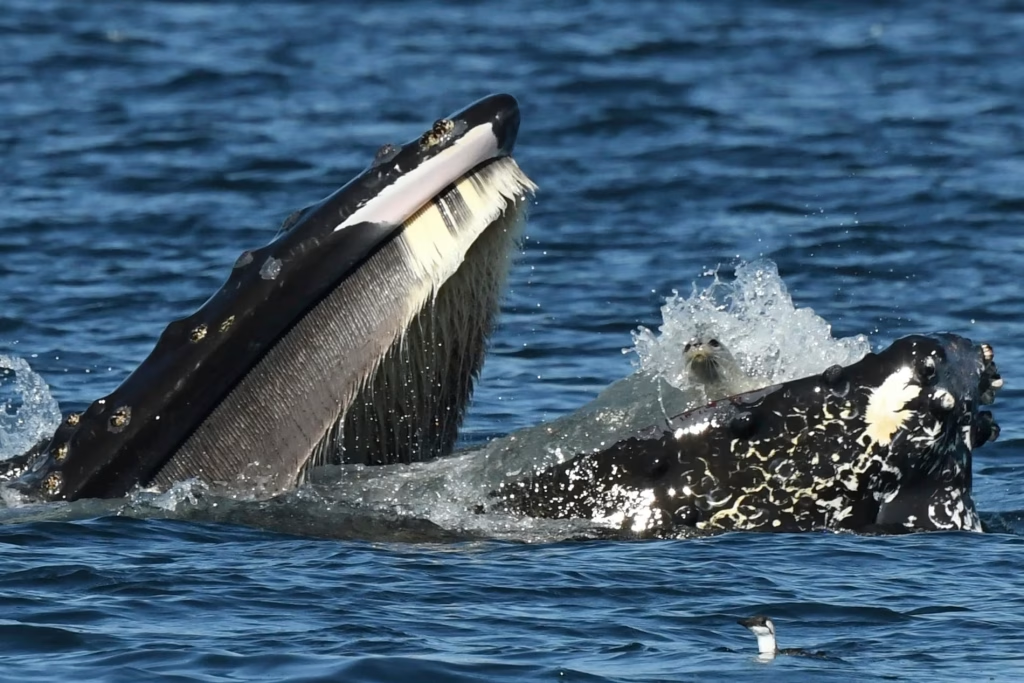
Gulp!

Humpback Whale and Surprised Seal (Photo by Brooke Casanova, taken off Anacortes, Washington USA)

Dear Readers, I’m sure many people were alarmed when they saw this photo today. Is that whale about to eat that poor seal? Well, no, and for a variety of reasons, though because of the way that they feed, humpbacks often end up with larger items on their menu than they anticipated.

When I was whalewatching in Monterey Bay back in 2018, I was lucky enough to witness the feeding tactics of humpbacks close up. You could often tell what was going on from miles away simply by watching the seabirds.

Photo by Peter Dunn

Humpbacks are baleen whales – they feed on tiny fish that they corral into a ball by blowing a ring of bubbles around them. As the fish start to mass together, they jump out of the water in their panic, and this attracts various kinds of gulls, shearwaters, and even pelicans.

The birds, in turn, attract sea lions.

Sealions massing above humpback whales (Photo by Peter Dunn)

And then this happens…

Humpbacks lunge-feeding (Photo by Peter Dunn)

As I mentioned in my blogpost about this trip, I’d seen scenes like this on ‘Blue Planet’ but never imagined that I’d see it for myself in a million years. Normally all the birds and the sealions manage to get out of the way of the whales in time, but I have seen a whale spit out a bedraggled pelican, and the whales sometimes ‘trumpet’ in irritation at the sealions. Something to bear in mind, though, is that the throat of a humpback whale is very, very small in diameter, and so the chance of anything as large as a bird, let alone a sealion, ending up in the stomach of a humpback is very unlikely.

A few words here about the photographer, Peter Dunn. He was our guide on this trip, and a more knowledgeable, well-organised and kinder human being you couldn’t hope to meet. Sadly, Peter was diagnosed with terminal cancer in March 2020, and contracted Covid-19 while he was in hospital. He died in May 2020, and what a loss that was, to his family and to the UK nature community. He was also a great photographer, and I think the photo below, of a mother whale breaching with her baby by her side, is one of his best photographs. What a wonderful man he was. You can read his full obituary here.

Double-breach – Photo by Peter Dunn

Peter Dunn in Antarctica


Normality!

Dear Readers, life is gradually ‘getting back to normal’ for Bug Woman here in East Finchley. Today, I met my dear friend P for lunch in Table du Marché, easily my favourite restaurant on the High Street. Admittedly I was leaning on a crutch and she had a walking stick so we made a pretty four-legged pair as we sidled crab-wise into the restaurant, but after three courses and a good old catch-up we both felt much better about the world. Plus, the wait for the 263 bus to take my friend home was only about five minutes, and the bus driver even stopped to make sure that she’d sat down before he took off towards Archway. Result! All too often the driver pulls away from the bus stop as if they’re driving a Formula One racing car, with the result that all the standing passengers head towards the back of the bus like pinballs.

Anyhow, my Open University course is open for those keen people who want to start early (official start date is 4th October), tomorrow I’m venturing into Islington on my own to get my hair cut, and on Friday I’m back to pilates for the first time in three months, which will necessitate a very slow and careful re-introduction to core strength and flexibility.

And in other news, I am giving a talk for  Finchley Women’s Institute on 9th October, which is coming up extremely fast. How to pack everything into 45 minutes is the question! I want to talk about making a garden wildlife friendly and what there is to see around North London in the way of urban creatures, plus I would really like to sing the praises of my beloved Coldfall Wood. Some judicious editing will be required for sure. And this is the first time that I’ve spoken in public since before lockdown, so I am sure to be a little anxious. Never mind! The past few months have shown me how easy it is for the world to get smaller, so now that I’m able to get out and about a bit I’m determined to push back the walls a bit and let the outside world back in. Let’s see how we get on.

The link to my talk in October is here. Wish me luck!